Key Points
- Division facts within 100 divide by 1 to 10 with no leftovers, so each one is a times-table fact read backward.
- To solve , ask which number times 7 makes 63, then check that .
- Zero shared among 8 plates gives 0 each, but 8 shared among 0 plates has no answer, since no number times 0 makes 8.
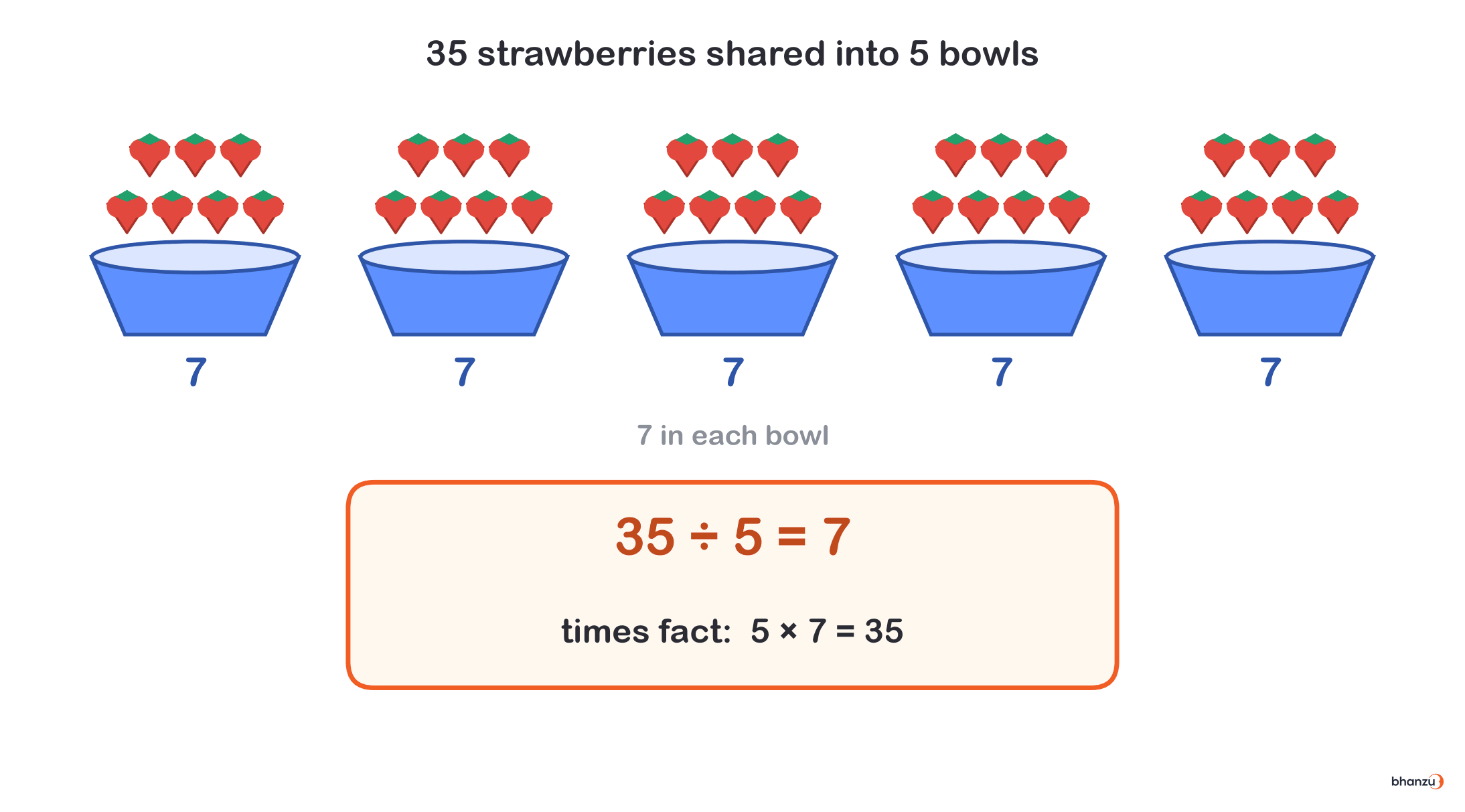
Thirty-five strawberries and five bowls
Thirty-five strawberries have to go into 5 bowls, the same number in each. Instead of dropping them in one at a time, find the number that times 5 makes 35. That number is 7.
Now flip the job (same berries, new question). Put 5 strawberries in each bowl, and you fill exactly 7 bowls. Both questions land on the same 7, because 5 times 7 and 7 times 5 are both 35.
What are division facts within 100?
Division facts within 100 are the divisions that undo the times table up to , with nothing left over. You divide by 1 to 10, and the answer is 0 to 10. Next year, the same facts help split 350 into 5 groups of 70, and leftovers called remainders join in.
Sharing 35 strawberries into 5 bowls is one of these facts, written and read as 35 divided by 5 equals 7. Its three numbers are the dividend, divisor and quotient.
- The dividend, 35, is the number being shared or grouped.
- The divisor, 5, is the number you divide by.
- The quotient, 7, is the answer.
This skill is Common Core standard 3.OA.C.7, which asks 3rd graders to "fluently multiply and divide within 100" with strategies. It also expects children to "know from memory all products of two one-digit numbers" by the end of 3rd grade. For your child, that means a fact like 24 divided by 4 comes quickly and surely, usually by reaching for the times fact that matches it.
Two ways to see one division fact
A division fact can ask for the size of each group or for the number of groups. The 35 strawberries showed both.
| Way to see it | What you know | What the 7 means |
|---|---|---|
| Sharing | 5 bowls | 7 in each bowl |
| Grouping | 5 in each bowl | 7 bowls |
Both give 7, because and are both 35. Changing the order of two numbers you multiply doesn't change the answer, and that rule is the commutative property of multiplication.
The two pictures are easy to mix up, because the divisor changes jobs. In sharing, 5 counts the bowls, but in grouping, 5 is the size of each bowl. Story problems give the job away with a few phrases:
| Words in the problem | Math it means |
|---|---|
| shared equally into 3 cups | divide by 3, the number of groups |
| how many in each cup | the answer is the group size |
| in packs of 8 | divide by 8, the group size |
| how many packs | the answer is the number of groups |
More bowls leave fewer in each, so 35 strawberries in 7 bowls give 5 per bowl. On a number line, grouping is jumps backward, and takes three jumps of 4.
A child who deals counters one at a time (one for you, one for you) does fine with small piles, then loses count. For bigger numbers, a times fact is faster than dealing.
Try It Yourself
Drag counters onto the plates, or tap a plate to drop one in, until every plate holds the same number. When the pile is empty and the plates match, the readout shows the division fact and the times fact that checks it. Then use the plate buttons to try 1 plate and 0 plates, and see which one has no answer.
How can a times fact give you the answer?
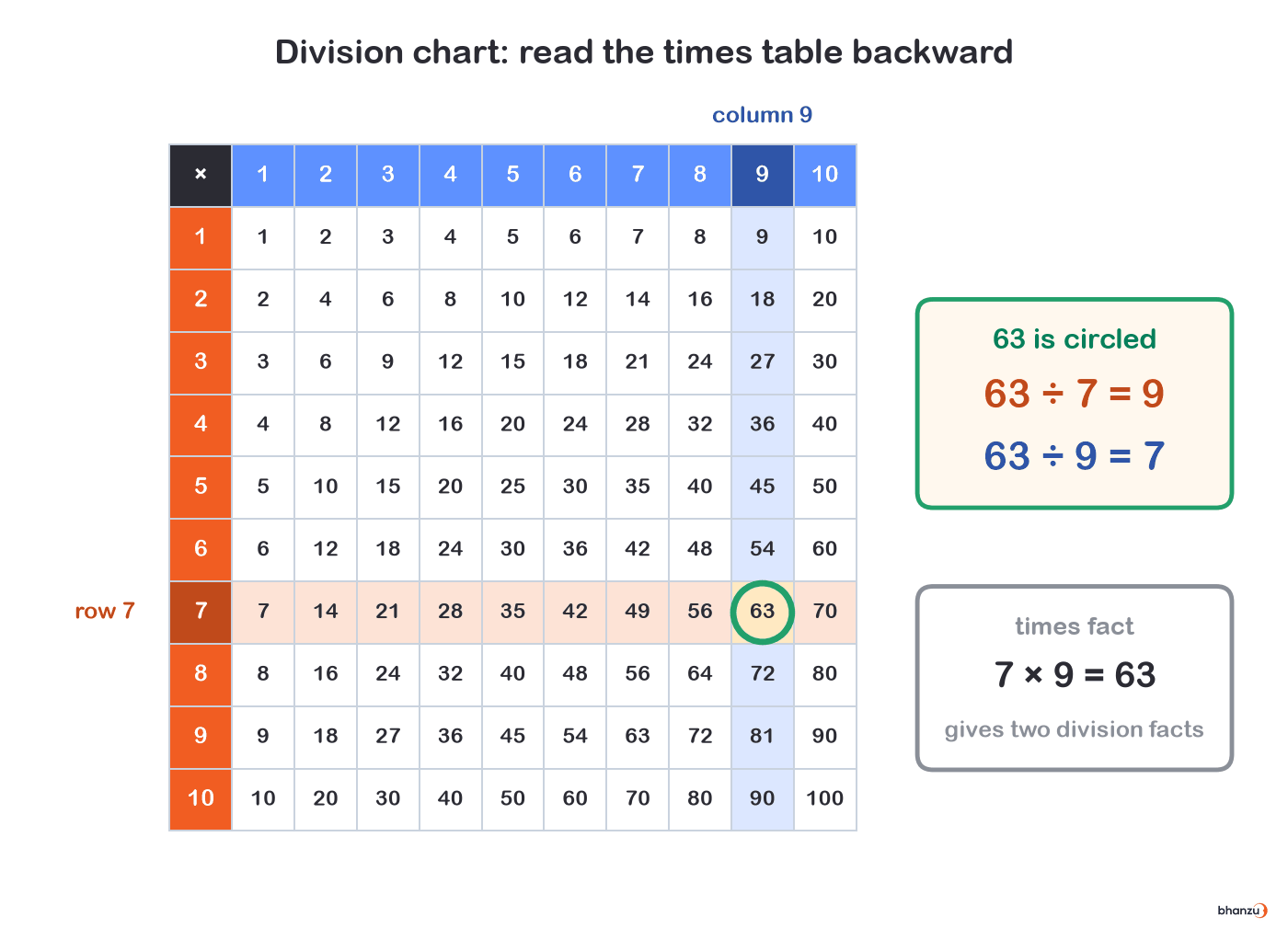
A times fact gives the answer because every division fact hides a missing factor, one of the two numbers you multiply. So asks the same thing as , where the box stands for the missing factor.
- Find the divisor, 7 in .
- Ask which number times 7 makes 63.
- Name the times fact, , so the answer is 9.
- Multiply the quotient by the divisor to check that 63 comes back.
Counting by 7s reaches 63 on the ninth count if the 7 times table is still new. And comes free, because both facts belong to one fact family, the facts built from 7, 9 and 63.
The box can also sit where the divisor goes, as in . Since , the box is 8, and puzzles with unknown numbers in multiplication and division use the same thinking. Some divisors have faster routes.
| Divide by | Route | Why it works | Example |
|---|---|---|---|
| 2 | Halve the number | 2 equal groups are halves | |
| 4 | Halve, then halve again | ||
| 8 | Halve three times | ||
| 5 | Double, then remove the 0 | Two 5s make one 10 | |
| 10 | Remove the 0 at the end | 70 is 7 tens | |
| 9 (from 9 to 90) | Add 1 to the tens digit | Each 9 is 1 less than 10 |
The 9s route holds because 7 nines are 7 tens minus 7, so the tens digit sits one below the answer. Halving on its own finishes the job for 2, 4 and 8. For 3, 6 and 7, go straight to the times fact, and the chart below holds every one.
What happens when you divide by 0 or 1?
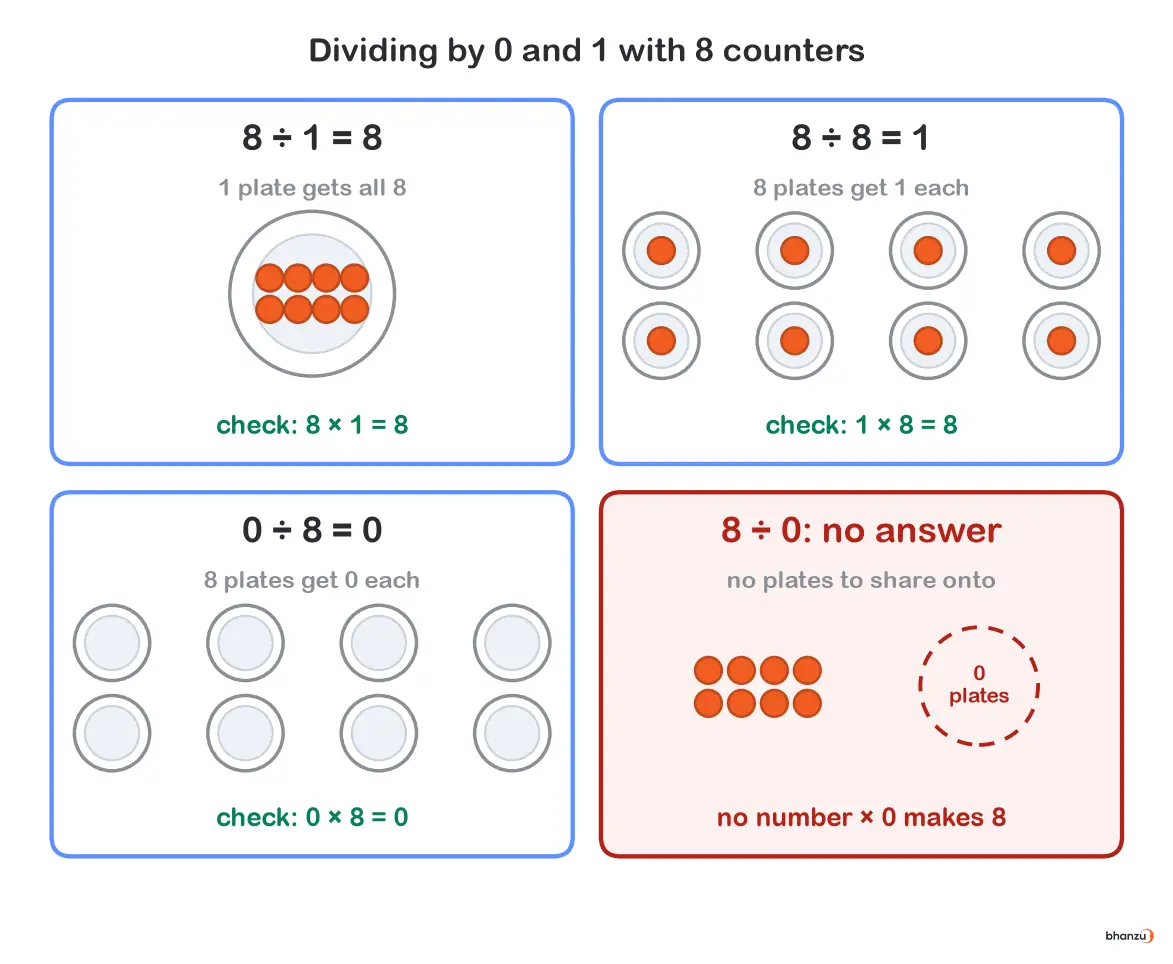
Dividing by 1 leaves a number as it is, and a number divided by itself is 1, unless that number is 0. Zero divided by 1 to 10 is 0, but no number can be divided by 0.
| Division | Answer | Check by multiplying |
|---|---|---|
| 8 | ||
| 1 | ||
| 0 | ||
| no answer | no number times 0 makes 8 |
Plates make the 0 rules easy to see. Zero cookies on 8 plates means every plate gets 0. Eight cookies and 0 plates (no plates at all) means the sharing can't start. That is why is called undefined, meaning it has no answer.
Children sometimes say , mixing up dividing with taking away. Sharing 8 cookies among 8 plates puts 1 on each plate, so the answer is 1.
Examples of division facts within 100
Example 1
Leo shares 18 pencils equally into 3 cups. How many pencils go in each cup?
Ask which number times 3 makes 18.
Each cup gets 6 pencils.
Example 2
Find 42 divided by 6.
Counting by 6s on fingers feels safe, until one extra tap goes past 42 to 48. Eight taps make the answer look like 8. Multiply back to check it.
The check gives 48, not 42, so 8 is one group of 6 too many.
Ask which number times 6 makes 42 instead.
Example 3
72 divided by a missing number equals 8. What is the missing number?
The box stands for the divisor, the number you divide 72 by.
Ask which number times 8 makes 72.
The missing number is 9, since .
Example 4
Solve 9 divided by 9 and 0 divided by 9. Why does 9 divided by 0 have no answer?
- , because .
- , because .
A quotient for would need to make 9 when multiplied by 0, but every number times 0 is 0.
Example 5
Which is bigger, 36 divided by 4 or 36 divided by 6? Explain.
So 36 divided by 4 is bigger. More groups leave fewer in each group.
Example 6
Ms. Rivera shares 64 markers, in packs of 8, equally among 4 tables. How many packs and markers does each table get?
Find the number of packs.
Share the 8 packs among 4 tables.
So each table gets 2 packs, and 2 packs of 8 make 16 markers.
Why does dividing with times facts work?
Dividing with times facts works because division undoes multiplication. If 7 groups of 9 make 63, then 63 split into 7 equal groups must give 9.
- It turns new facts into old ones. A 10 by 10 times table holds 100 times facts, and each one is also a division fact.
- It makes fair shares exact. Splitting 24 stickers among 4 friends gives 6 each, and 3rd-grade multiplication and division word problems stay within 100.
- It sets up 4th grade. Next year, starts from .
- It makes mental math quicker. Facts reached without counting are ready for bigger problems.
In the 2024 NAEP mathematics results, 39% of fourth graders nationally scored at or above Proficient, 3 points higher than in 2022, and 76% scored at or above Basic. Those scores cover all of 4th-grade math, and 4th-grade division grows out of these facts.
What do teachers watch for in division facts?
Teachers watch for whether a child counts up from 0 for every fact, more than for speed. A child who counts by 6s on fingers for 48 divided by 6 understands division but is still building fluency.
The fix is a 10s fact just above the one that's stuck. Ten 6s make 60, and 48 is two 6s less than 60.
So 48 is 8 sixes, and . The same move rebuilds the big facts in the 6s, 7s, 8s and 9s from a 10s fact your child already trusts.
Speed comes last. The National Council of Teachers of Mathematics, in its 2023 position statement on procedural fluency, describes fluency as using a method accurately, efficiently and flexibly. It also says timed quizzes do not measure fluency and should be avoided.
The mistakes kids make most often with division facts
Mistake 1: Starting with the smaller number
Where it slips in: Writing a division fact from a times fact. The 7 comes first in , so children start the division with 7 too.
Don't do this: Writing from .
The correct way: The dividend is the total from the times fact, and it goes first, as in . Read it back as 63 shared into 7 groups.
Mistake 2: Mixing up 8 divided by 0 with 0 divided by 8
Where it slips in: The 0 rules, as in Example 4. Children learn that any number times 0 is 0 and stretch that rule to division.
Don't do this: Writing .
The correct way: Zero divided by 8 is 0, because . Turn it around and has no answer, because no number times 0 makes 8.
Mistake 3: Landing on the fact next door
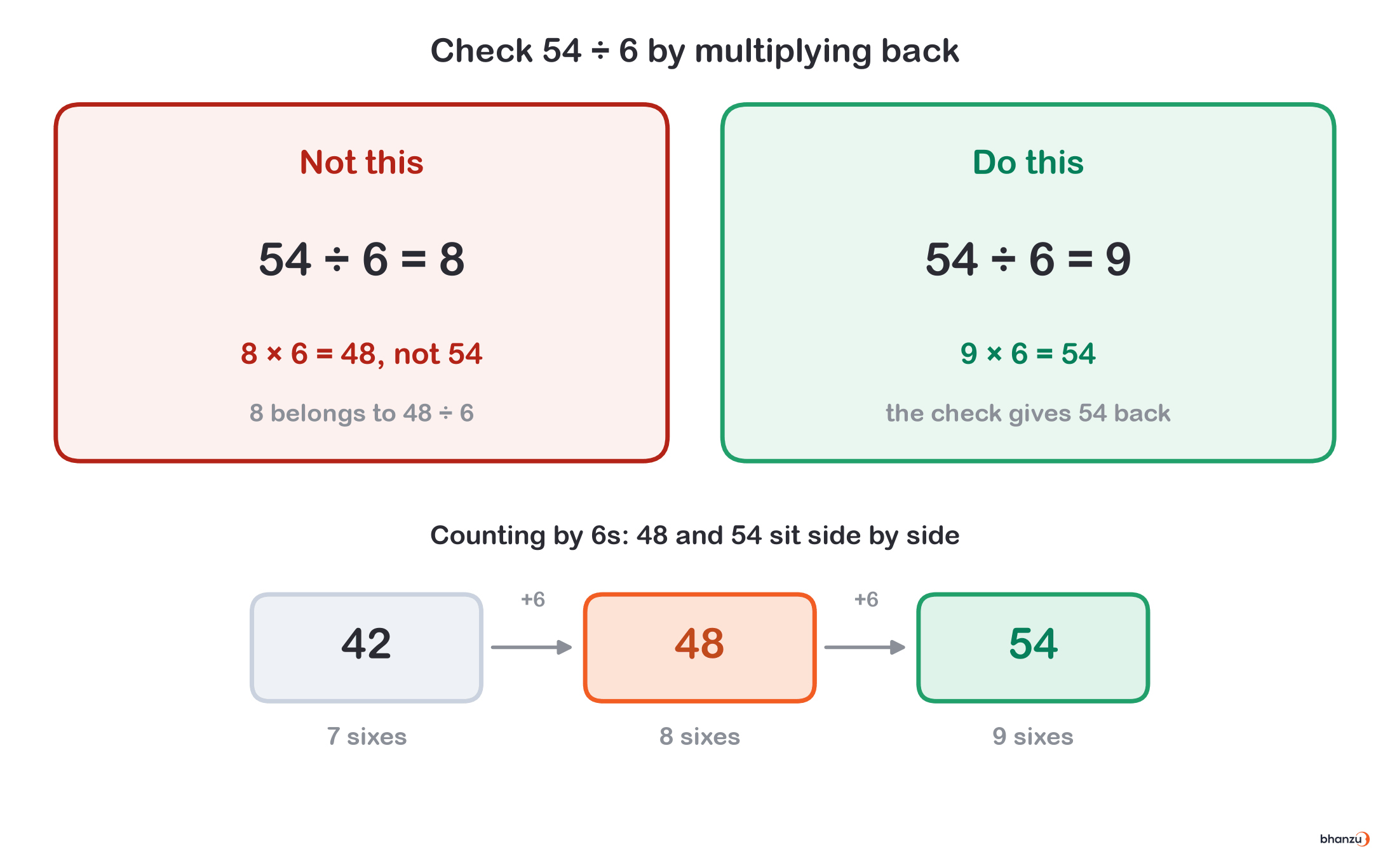
Where it slips in: The 6s to 9s. When you count by 6s, 48 and 54 sit side by side (only one 6 apart). A child who rushes grabs the neighbor of the right fact.
Don't do this: Writing .
The correct way: Multiply back before moving on. Since , not 54, the 8 belongs to , and gives .
Key Takeaways
- Read every one of the division facts within 100 as a times fact with one number missing.
- The same dividend split into more groups leaves fewer in each, so is bigger than .
- A division like has no answer, because any number times 0 stays 0 and never makes 8.
- For more practice turning a stuck fact like 54 divided by 6 into a times fact, explore Bhanzu's 3rd grade math curriculum or elementary math programs.
Read More
- Fractions on a Number Line
- Dividing Multiples of 10, 100 and 1000
- Divisibility Rules
- How to Do Long Division
- 9 Times Table
Research Behind This Article
- Common Core State Standards Initiative, Grade 3 Operations and Algebraic Thinking (2010). thecorestandards.org
- OpenStax, Prealgebra 2e, 1.4 Multiply Whole Numbers (2020). openstax.org
- OpenStax, Prealgebra 2e, 1.5 Divide Whole Numbers (2020). openstax.org
- National Center for Education Statistics, NAEP Mathematics 2024: National Trends, Grade 4 (2025). nationsreportcard.gov
- National Council of Teachers of Mathematics, Procedural Fluency in Mathematics (2023). nctm.org
Quick Quiz: Check Yourself
Three levels with new numbers each time. Easy divides by 2, 3, 4, 5 or 10. Medium adds dividing by 6 to 9, missing divisors and the 0 and 1 rules. Hard is a two-step packing story.
Was this article helpful?
Your feedback helps us write better content
Frequently Asked Questions
Why is division so hard for some kids?
How do you teach division facts for 3rd grade?
Does my 3rd grader need division facts 1 to 12?
How many division facts are on a division chart to 100?
How can my child practice division facts at home?