Key Points
- A missing number is the one value that makes both sides of an equal sign hold the same amount, like 9 in .
- Finding the missing number works by counting up, using a related fact or using a double, then putting the number back to check.
- A common 1st grade mistake is adding the two numbers in view, so gets 19 instead of 5.
- In 1st grade, the box can sit anywhere in an equation within 20, even before the equal sign.
A mystery bag on the balance
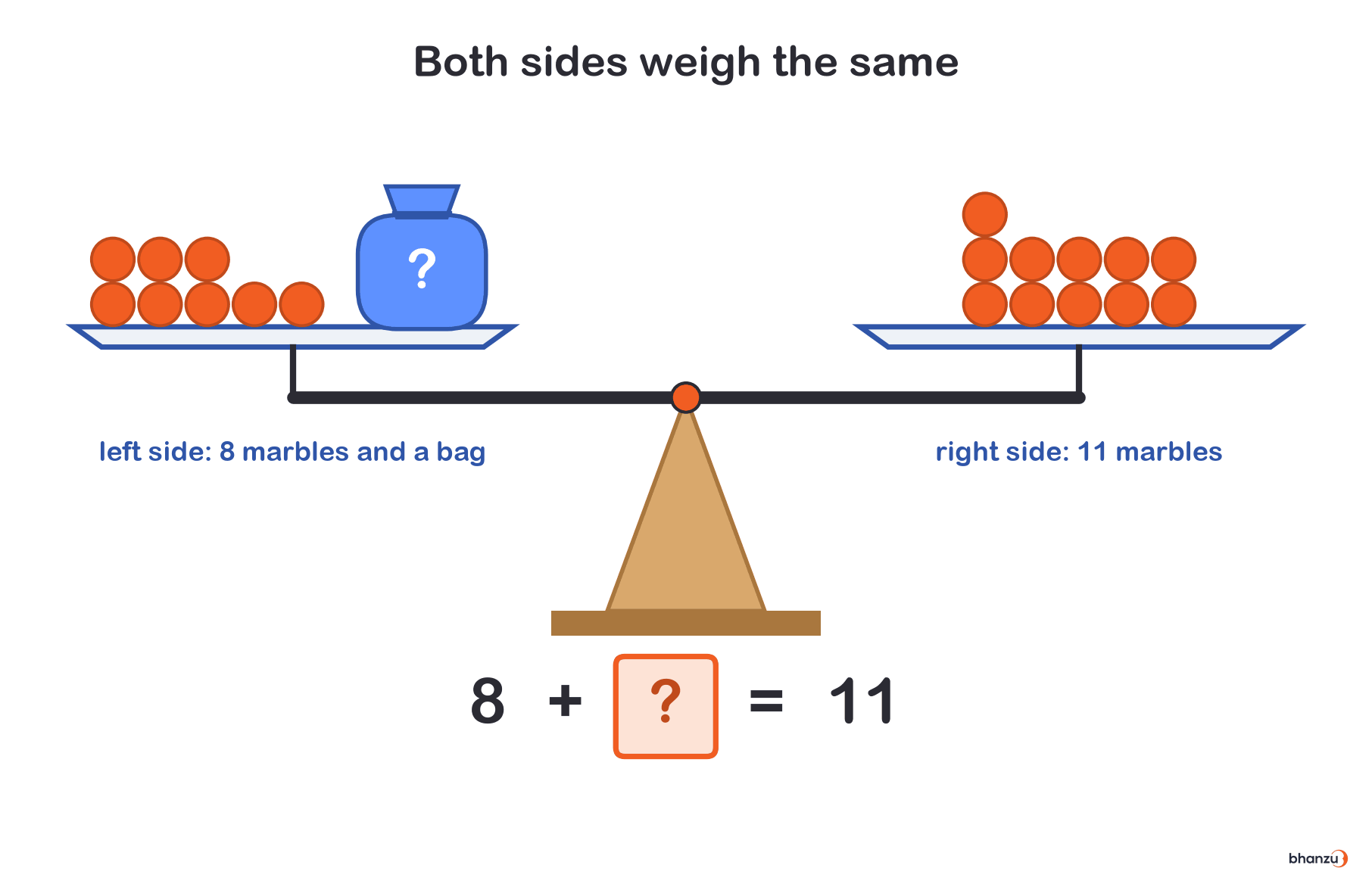
Put 8 marbles and one closed bag on a balance, with 11 marbles on the other side. The balance sits level. So the bag must hold exactly enough marbles to turn 8 into 11.
That hidden amount is a missing number. Your child is expected to find missing numbers like this in 1st grade, in addition and subtraction up to 20, wherever the box sits, even in front of the equal sign. In 2nd grade, the same balancing idea works when finding the missing number within 100.
How do you find the missing number?
Finding the missing number works like the balance: the equal sign, , is the middle, and both sides must hold the same amount. You pick the number that makes them match.
An equation is a math sentence with an equal sign, such as . The question mark stands for the one number not found yet, and the equal sign means "is the same as" when read aloud.
- Read the equation aloud, saying "is the same as" for the equal sign.
- Find the whole (the total) and the two parts. The whole might be the box.
- Count up, use a fact you know, or act it out with counters.
- Put your number in the box and check that both sides match.
An addend is a number you add, so a missing addend is a missing part, like the 3 in . The skill is Common Core standard 1.OA.D.8, which covers finding the unknown number in an addition or subtraction equation relating three whole numbers.
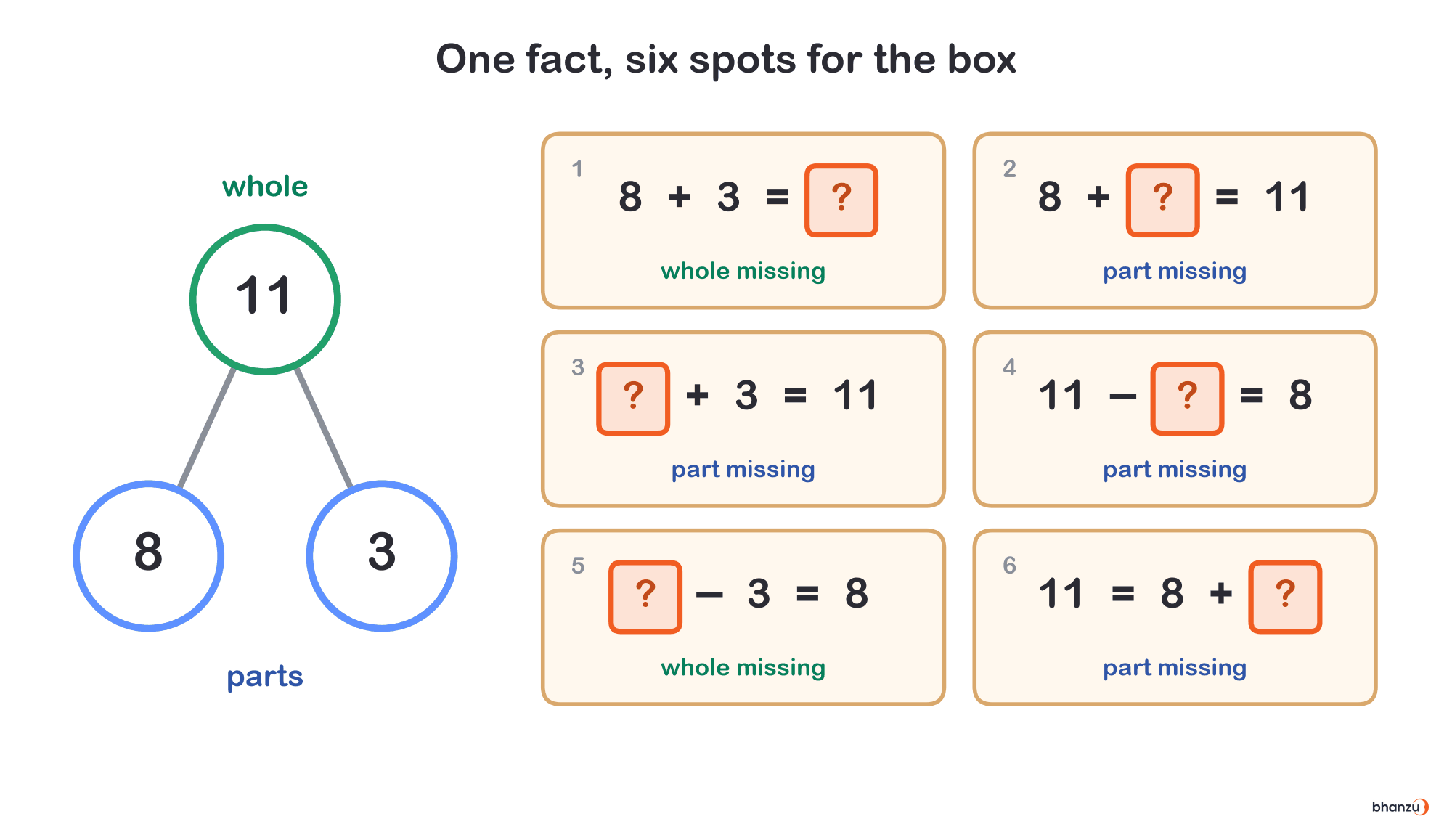
A number bond, a picture of a whole joined to its two parts, shows this fact with the box in six spots.
Which way finds the missing number fastest?
Which of the three ways is fastest depends on the numbers.
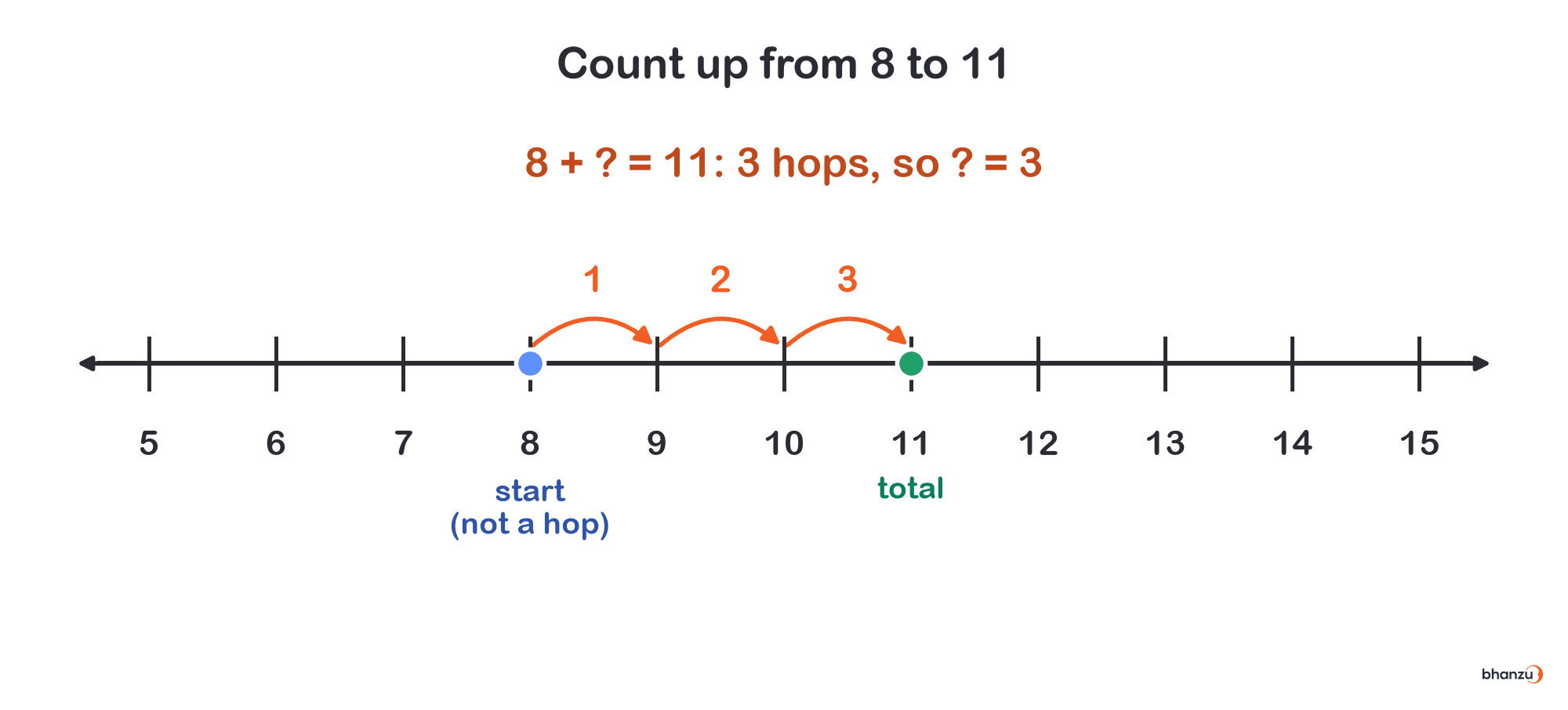
- Count up. Start at the part you know and count on to the whole. For , say 9, 10, 11 (that's 3 hops), so the missing number is 3.
- Think addition or subtraction. OpenStax calls the two inverse operations because each undoes the other, so and share one fact, as fact families show.
- Use a fact you know. Doubles like and near doubles like fill the box in one step. A child who knows by heart may still count on fingers for , because the box hides the fact.
Counting up gets slow when the hops pile up. For , counting back 3 from 12 (11, 10, 9) beats counting up from 3, so the missing number is 9.
In the 2024 NAEP math assessment, 87% of 4th graders got full credit on a question asking which number joins 18 to make 23. In 2022 it was 85%, about the same. NAEP's notes name three ways to solve it, which are reaching 20 first, subtracting and counting up.
How do you find a missing number in subtraction?
Subtraction hides the box in two tricky spots.
- The start is missing, as in . Add back the 4 that was taken away, so .
- The amount taken away is missing, as in . Count up from 7 to 12 and get 5 hops.
A child who meets often takes 4 from 6 and writes 2, because those are the numbers in view. The start-unknown form feels the most backward at first, since its minus sign is asking you to add.
Counting up from what is left is also a handy way to do mental subtraction. Story problems hide the box in words.
| Words in the problem | Math it means |
|---|---|
| had some, at first | the start is missing |
| spent, gave away | take away (minus) |
| has some left | what remains, after the equal sign |
| found more, in all | add, or the whole |
Try It Yourself
Tap the plus and minus buttons to put marbles in the bag until the balance sits level. When both sides match, the box fills in. Press Hint for one clue at a time, or New problem to move the box, even in front of the equal sign.
Examples of finding the missing number
Example 1
What number makes true?
Both parts are 6, so this is a double.
The missing number is 12.
Example 2
Find the missing number in .
The tempting move is to subtract the two numbers you can see.
Then the equation says 5 is the same as 2 take away 3, but 2 marbles can't lose 3, so 2 is wrong.
Read it as 5 is the same as some number take away 3. Three were taken and 5 are left, so put the 3 back by adding 3.
Check: . The missing number is 8.
Example 3
Find the missing number in .
Counting up from 4 to 13 is a long trip, so count back 4 from 13, saying 12, 11, 10, 9.
Check: . The missing number is 9.
Example 4
Which of 7, 8 or 22 makes true?
Read it as 15 is the same as 7 plus some number. The double is one short, so the missing number is one more than 7.
Adding the two numbers you see gives 22, and 7 only makes 14. The missing number is 8.
Example 5
Diego had some cents. He spent 6 cents and has 9 cents left. How many cents did he start with?
"Had some" means the start is missing, "spent" means take away, and 9 cents is what is left.
Put the 6 cents back by adding 6.
Check: . Diego had 15 cents at the start.
Why does finding the missing number matter?
A missing number is how math writes down something you don't know yet, so you can work backward from what you do know.
- It answers "how many were there before?" Diego's 15 cents came from two facts, the 6 he spent and the 9 left.
- It tells you how far you have to go. With 9 points in a game that ends at 15, says you need 6 more.
- It gives the equal sign its real meaning. Middle schoolers who read it as "the same as" solved equations better, even allowing for math skill, in a 2006 study by Knuth and colleagues.
In 3rd grade the same box turns up in , and later a letter such as takes its place.
Common errors when finding the missing number
Mistake 1: Adding the two numbers you can see
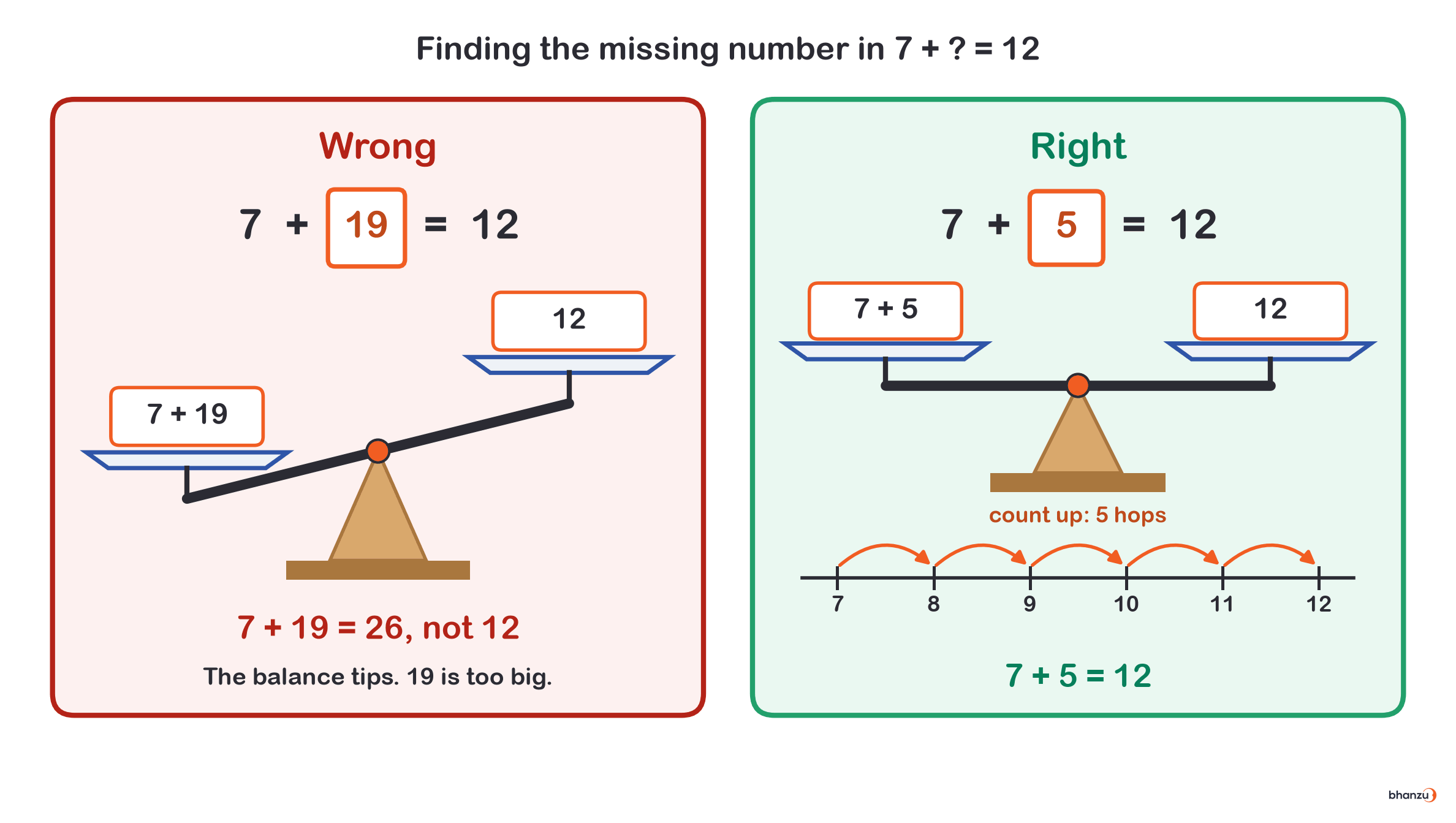
Where it slips in: A box right after a plus sign, as in , looks like every "add these" problem before it. A child who rushes writes the sum, often while knowing well.
Don't do this: Add 7 and 12 and put 19 in the box. Then , not 12.
The correct way: Count up from 7 to 12, saying 8, 9, 10, 11, 12. That is 5 hops, so the missing number is 5.
A missing part can never be bigger than the whole, so any answer above 12 means read again.
Mistake 2: Thinking the answer must come after the equal sign
Where it slips in: Equations with the total on the left, as in . A 2018 study by Blanton, Otalora and Brizuela found kindergartners reading the equal sign as a cue to write the answer, before formal teaching. That habit makes this one look backwards.
Don't do this: Add 12 and 5 and put 17 in the box.
The correct way: Read it as 12 is the same as some number plus 5. The whole is 12, so take 5 away to get 7.
Mistake 3: Counting the start number as a hop
Where it slips in: Counting up for . The child says 6, 7, 8, 9, 10 and counts five numbers, because counting objects starts at one on the first object.
Don't do this: Put 5 in the box. But , not 10.
The correct way: Count only the hops after 6, saying 7, 8, 9, 10. That is 4 hops, so the missing number is 4.
What do most guides miss about finding the missing number?
Many guides teach a separate move for each place the box can sit. One rule covers every spot: find the whole first.
- If the whole is missing, add the two parts.
- If a part is missing, take the known part from the whole, or count up from it.
The rule shows why subtracting the two numbers you see works for but fails for . In the second one, the whole is hiding in the box. Common Core's glossary calls these result unknown, change unknown and start unknown problems, and the one rule handles all three.
Key Takeaways
- Finding the missing number gets easier once you know whether the whole or a part is hiding.
- When counting up is a long trip, count back or use a double.
- One line checks any answer, because both sides must match when the number goes back in.
- For more practice catching the add-what-you-see mistake in boxes like , explore Bhanzu's 1st grade math tutor or Common Core math curriculum.
Read More
- Adding Three Numbers
- Adding Tens and Ones Without Regrouping
- Unknown Numbers in Multiplication and Division
- Equations With Tape and Hanger Diagrams
- Solving an Equation
Research Behind This Article
- Common Core State Standards Initiative, Grade 1: Operations and Algebraic Thinking (2010). thecorestandards.org
- OpenStax, Prealgebra 2e: Subtract Whole Numbers (2020). openstax.org
- National Center for Education Statistics, NAEP Mathematics 2024: National Trends and Student Skills (2025). nationsreportcard.gov
- Knuth, Stephens, McNeil and Alibali, Does Understanding the Equal Sign Matter? Evidence from Solving Equations (2006). eric.ed.gov
- Blanton, Otalora and Brizuela, Exploring Kindergarten Students' Early Understandings of the Equal Sign (2018). eric.ed.gov
- Common Core State Standards Initiative, Common Core State Standards for Mathematics (2010). thecorestandards.org
Quick Quiz: Check Yourself
Three levels, new numbers every time: fill the box in a short addition, find the box anywhere in an equation within 20, then solve a story problem.
Was this article helpful?
Your feedback helps us write better content
Frequently Asked Questions
How do you teach a missing addend in 1st grade?
Why does my child think the equal sign means the answer comes next?
What is an unknown number in an equation?
How do you solve missing addend word problems?
Is there a missing number game to play at home?