Key Points
- Area and the distributive property meet when a rectangle is cut along one side, since both parts keep the same rows and their areas add up to the whole.
- Cutting 8 into 5 + 3 turns into plus , or 35 + 21 = 56 square units.
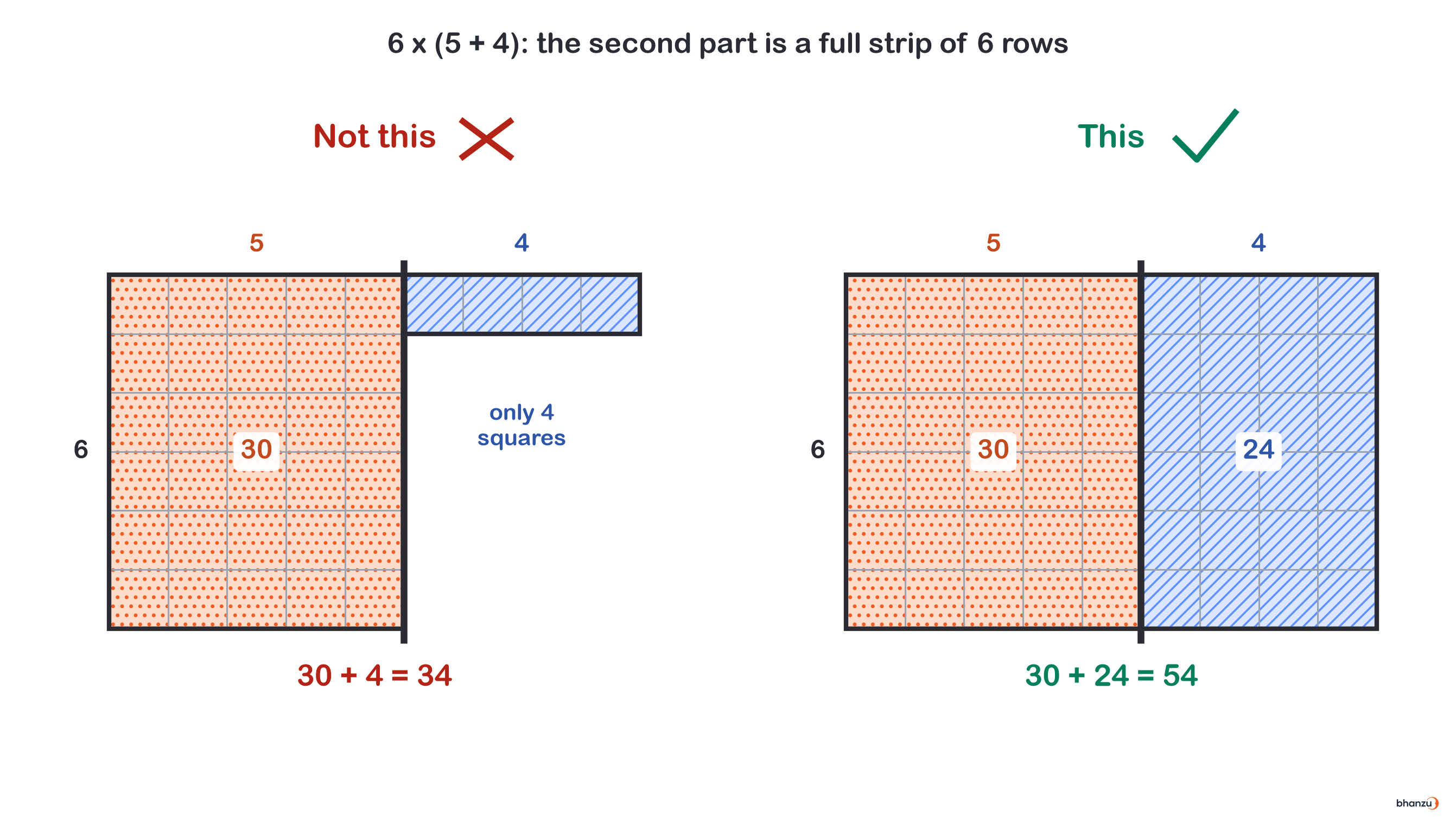
- The mistake to watch for is multiplying only the first part, so becomes 30 + 4 = 34 instead of 54 square units.
- Common Core places area models for the distributive property in 3rd grade, starting with tiling rectangles in unit squares.
The quilt that does multiplication
A quilt with 7 rows of 8 squares hides a multiplication fact. Sew the first 5 columns in orange and the last 3 in blue. Orange now holds 7 rows of 5, or 35 squares, and blue holds 7 rows of 3, or 21.
Together they still make all 56. Nothing was added or lost. Later, the same cut lets you multiply much bigger numbers, like 4 rows of 23, without counting a single square.
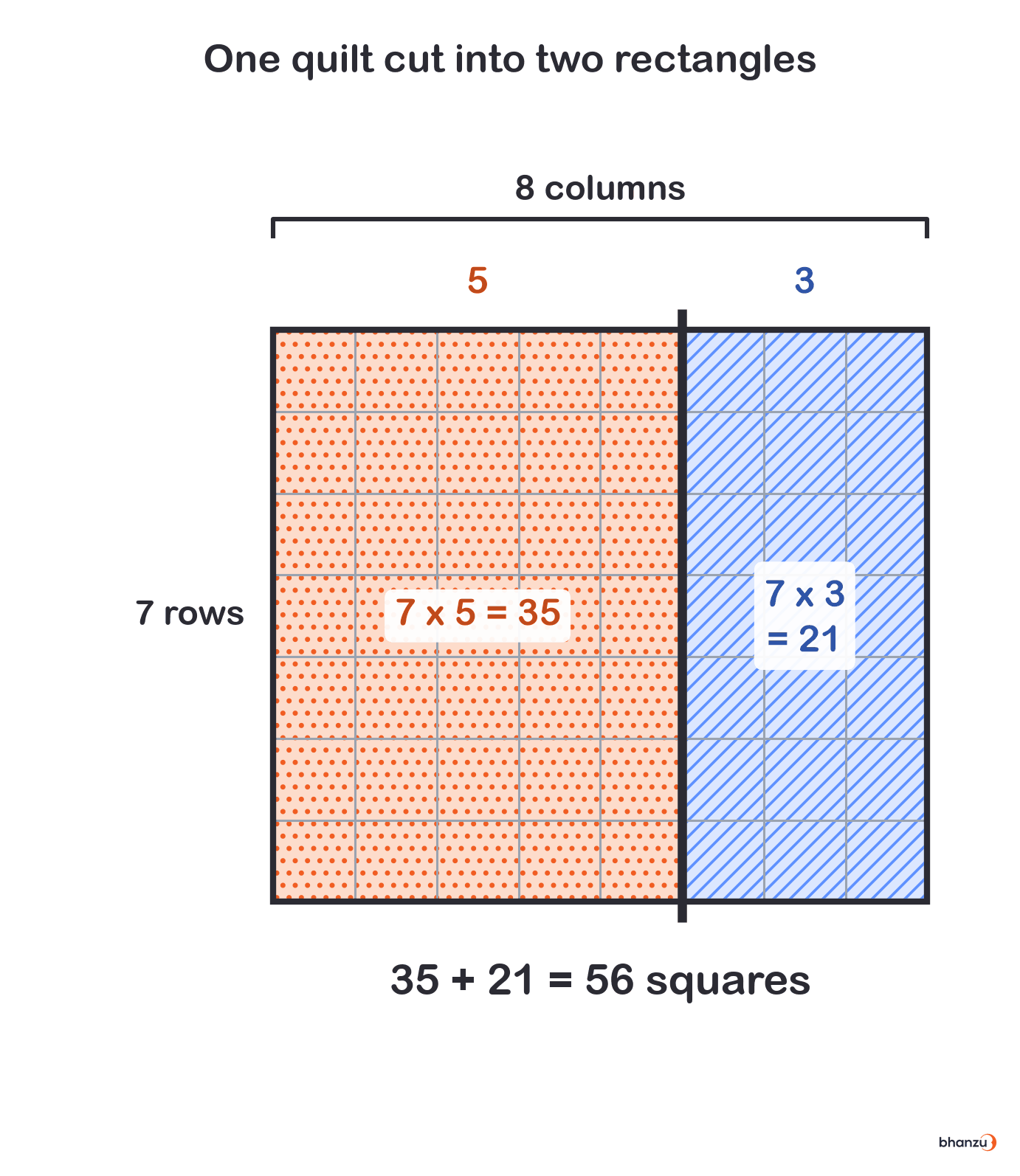
How do you use the distributive property to find area?
To use area and the distributive property, cut one side of a rectangle into two parts and add the areas of the two smaller rectangles. Area is the number of unit squares that cover a flat shape with no gaps or overlaps. A unit square is 1 unit long on each side, so area is a 2D measure counted in square units, such as square feet.
The distributive property says that multiplying a number by a sum gives the same answer as multiplying it by each part and adding. A grid rectangle 9 squares tall and 7 squares long splits into a 9 by 5 part and a 9 by 2 part.
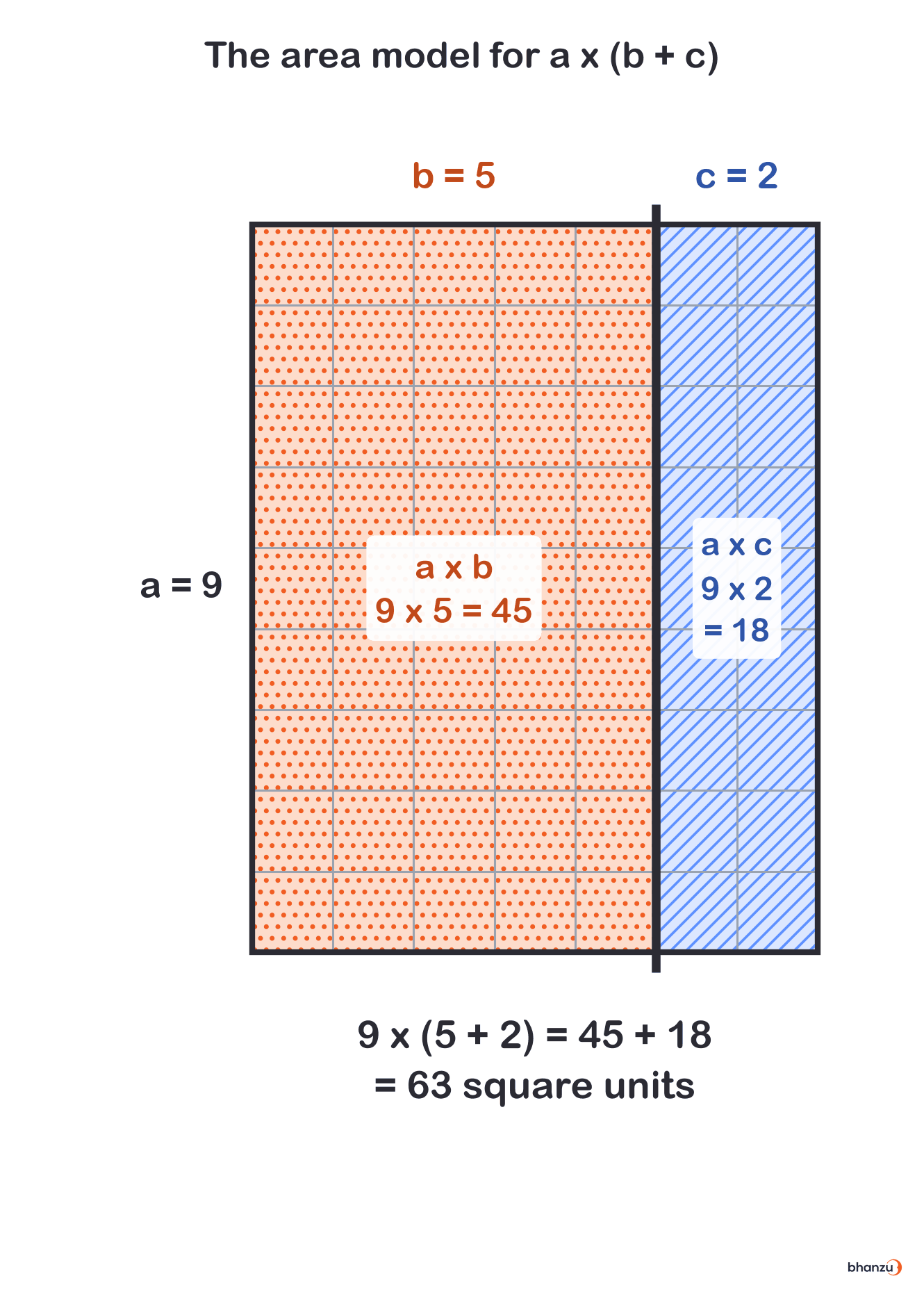
| Symbol | Meaning | Units |
|---|---|---|
| The uncut side, 9 here | units | |
| and | The two parts of the cut side, 5 and 2 | units |
| and | The areas of the two parts | square units |
The rule works because both parts keep the same rows, so together they hold rows of squares.
The name is the odd part. To distribute means to hand out, and the 9 gets handed to both the 5 and the 2.
Area and the distributive property sit in Common Core standard 3.MD.C.7.c, which starts with tiling, or covering a rectangle with unit squares. Then the standard asks students to "use area models to represent the distributive property in mathematical reasoning" (the standard's words). By the end of 3rd grade, your child should be able to cut a grid rectangle, multiply both parts, add them and explain why the total matches rows times columns.
How do you split a rectangle into two smaller ones?
Cut one side into two numbers you know how to multiply, and keep the other side whole. The cut grid is called an area model, a rectangle cut into parts that each show one multiplication fact. Take a rectangle 8 squares tall and 9 squares long.
- Count the sides, 8 rows and 9 columns, so it is an 8 by 9 rectangle.
- Cut the 9 into parts you know, such as 5 and 4. The second part is the whole side minus the first, .
- Multiply each part by the uncut side, and .
- Add the areas, square units.
- Check that 8 rows of 9 also make 72.
Counting squares one by one is fine on a 3 by 4 grid. On an 8 by 9 grid it means 72 taps, and a child who taps every square can lose count halfway. Two short facts do the same job.
Word problems describe the same cut in words. Each phrase points to one piece of math.
| Words in the problem | Math it means |
|---|---|
| "3 squares tall and 7 squares long" | |
| "cut into a 3 by 5 part and a 3 by 2 part" | |
| "the garden's area" or "in all" | add the two areas |
| "how many more square feet" | subtract the smaller area |
Try It Yourself
Drag the orange corner to build a rectangle up to 9 rows by 15 columns. Then slide the blue cut line to split it in two. Watch the two areas change while their total always matches rows times columns.
Which split makes the multiplying easier?
Any cut gives the same area, so choose parts whose facts you already know. Cuts that make 5s, 2s, 10s or doubles usually feel easiest. A 7 by 8 rectangle shows the choice.
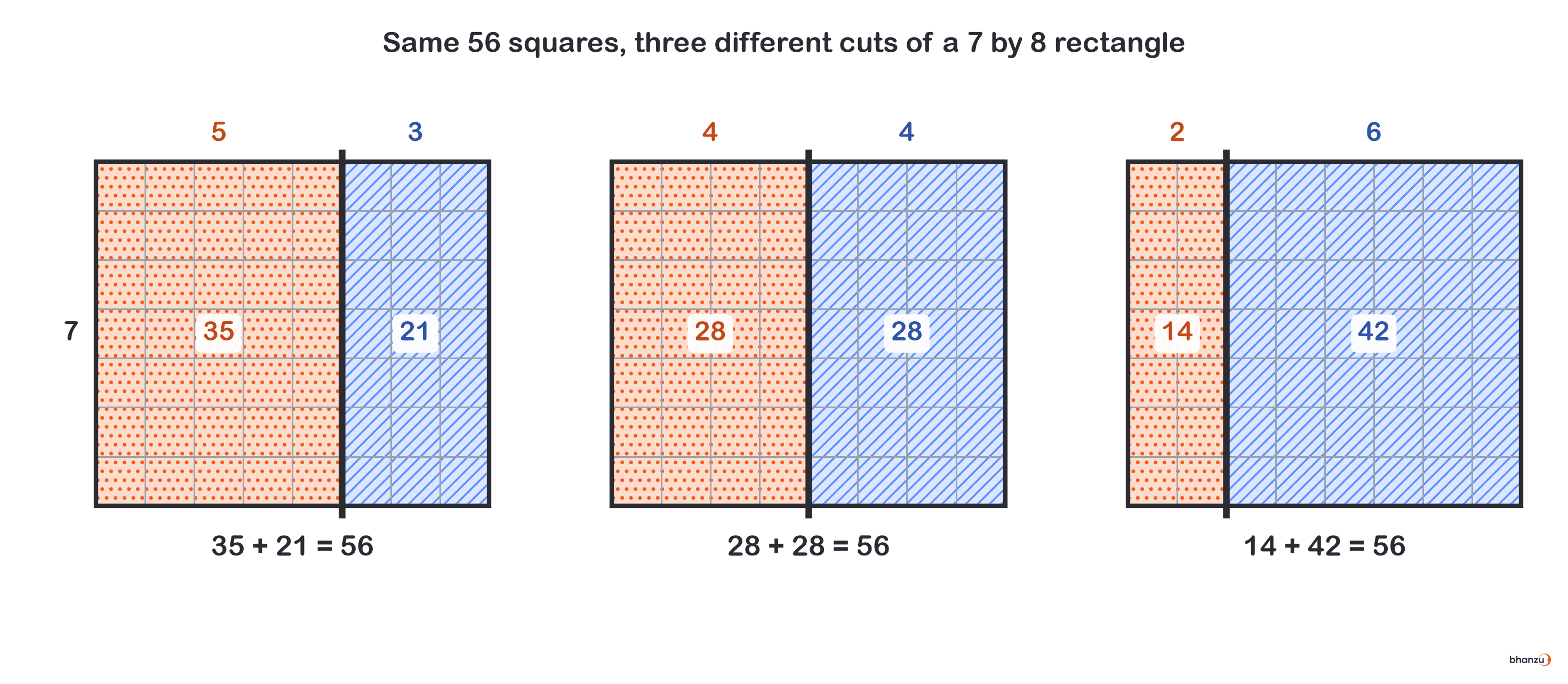
All three cuts cover the same 56 squares. The 5 and 3 cut leans on the 5s, and the 4 and 4 cut is a double (28 + 28).
Sides from 11 to 19 split best into 10 and the rest. For a 4 by 17 rectangle, the tens part is just multiplying by multiples of 10.
A released question from the 2024 NAEP math assessment asked 4th graders about covering a bulletin board that takes 6 rows of 25 unit squares. In 2024, 27 percent earned full credit, about the same as the 25 percent in 2022. Cutting 25 into 20 and 5 turns the board into squares, which makes this cut worth practicing now.
Sometimes taking a strip away is faster. A 9 by 7 rectangle is one row short of 10 rows of 7, so its area is square units.
Examples of area and the distributive property
Example 1
A rectangle 3 squares tall and 7 squares long is cut into a 3 by 5 part and a 3 by 2 part. What is its area?
Find each part's area.
Add them.
The area is 21 square units. To check, .
Example 2
Use the distributive property to find the area of a 6 by 8 rectangle.
Cut the 8 into 5 and 3.
The area is 48 square units.
Example 3
Find the area of a rectangle 4 squares tall and 13 squares long.
The tempting move is to split 13 by its digits, 1 and 3.
That cannot be right. The 4 by 10 part alone holds 40 squares, and 1 and 3 add to 4, not 13.
Cut 13 into 10 and 3 instead.
The area is 52 square units.
Example 4
What number goes in the box in ?
The box stands for the other part of the cut side. The parts must add back to 7, so subtract the known part from the whole side, .
The box is 3. To check, , which matches .
Example 5
Leo cuts a 4 by 9 rectangle into 4 by 5 and 4 by 4. Mei cuts it into 4 by 7 and 4 by 2. Who is right?
Leo adds his two parts.
Mei adds hers.
Both are right. Each cut covers the same 36 square units.
Example 6
Aisha's garden is 8 feet by 12 feet. Tomatoes fill an 8 by 10 part and beans fill the 8 by 2 part. What is the garden's area, and how many more square feet of tomatoes are there than beans?
Add the parts for the whole garden.
The garden covers 96 square feet. Subtract to compare the parts.
There are 64 more square feet of tomatoes than beans.
Why does the break apart strategy work?
The break apart strategy works because area is a count of unit squares, and cutting a rectangle never adds or loses a square. Only the way you count changes.
- It turns one hard fact into two friendly ones. In place of , you use and .
- It counts every square once. Both parts share the same 7 rows, so there are no gaps and no overlaps.
- It reaches sides too long to count. A patio 6 feet by 14 feet is square feet.
- It keeps the unit squares in view. The TIMSS 2023 Advanced benchmark for 4th grade includes finding "the area of a triangle or square using unit squares," a level 13 percent of US 4th graders reached.
So the cut is a counting choice. The quilt's 56 squares stay 56 whichever way you slice them.
The pattern hiding inside area and the distributive property
In and , the uncut 7 shows up twice. That repeat means both parts share one whole side. When two rectangles don't line up along a full side, the shape becomes an L. Finding the area of composite shapes like that L comes next in 3rd grade.
You can also cut the other side. The quilt's 7 rows can become 4 rows of 8 and 3 rows of 8.
Cutting rows works too. Turning the quilt on its side swaps rows and columns, and the commutative property says and match. Common Core standard 3.OA.B.5 gives three properties as multiplying strategies, the commutative property, the associative property of multiplication and the distributive property.
The standard's footnote adds that "students need not use formal terms for these properties," so your child's picture and reason count for more than the name. A child who gets 56 with the column cut may doubt it after seeing the row cut. Laying the two drawings side by side settles it.
Area and the distributive property: spot the trap before you fall in
Mistake 1: Multiplying only the first part
Where it slips in: After the cut, when the second part looks like a few extra squares.
Don't do this: Writing as .
The correct way: Multiply both parts by 6, so and . The area is 54 square units.
Children who know often add the 4 as single squares. The 4 on the side looks like 4 more things instead of 4 more columns of 6.
Mistake 2: Adding the side lengths instead of multiplying
Where it slips in: On a labeled picture like the quilt, where the plus sign in 5 + 3 makes adding feel right.
Don't do this: Adding and , then .
The correct way: Multiply, and . The area is 56 square units.
A child who rushes to add every number on the picture is borrowing a perimeter habit. Adding side lengths finds the distance around a shape, so area vs perimeter comes down to squares inside or steps around the edge.
Mistake 3: Thinking only one cut is right
Where it slips in: When a classmate (or a worksheet) cuts the same rectangle another way.
Don't do this: Erasing because the worksheet showed .
The correct way: Keep it. The worksheet's cut gives too, and any parts that add back to 8 cover the same 24 squares.
Children often treat the first method they see as the only rule. A new cut then looks like a new answer.
Key Takeaways
- Check that the two parts of the cut side add back to the whole side, as does.
- Multiply the uncut side by both parts, never by just one.
- Any cut covers the same squares, so pick parts with facts you know.
- Area and the distributive property turn a teen side like 13 into 10 + 3, so you need a tens fact plus a small one.
- For more practice cutting rectangles like the 7 by 8 quilt, with a teacher who spots a skipped second strip, explore Bhanzu's 3rd grade math tutor or math programs for elementary students.
Read More
- Order of Operations in 2-Step Expressions
- Multiplying Up to 4-Digit Numbers by 1-Digit Numbers
- Area of Rectangles With Fractional Side Lengths
- How to Teach Multiplication
- Properties of a Rectangle
Research Behind This Article
- Common Core State Standards Initiative, Grade 3 Measurement & Data (2010). thecorestandards.org
- OpenStax, Rice University, Prealgebra 2e, 7.3 Distributive Property (2020). openstax.org
- National Center for Education Statistics, NAEP Mathematics: National Trends and Student Skills, 2024 (2025). nationsreportcard.gov
- National Center for Education Statistics, TIMSS 2023 U.S. Results (2024). nces.ed.gov
- Common Core State Standards Initiative, Grade 3 Operations & Algebraic Thinking (2010). thecorestandards.org
- Common Core State Standards Initiative, Grade 4 Number & Operations in Base Ten (2010). thecorestandards.org
Quick Quiz: Check Yourself
Three levels, new numbers every time: add two areas, find a missing part, then solve word problems with a side of 11 to 19 feet.
Was this article helpful?
Your feedback helps us write better content
Frequently Asked Questions
How can I help my 3rd grader with the distributive property at home?
Is the break apart strategy the same as the distributive property?
Can you show the distributive property with arrays instead of area?
Do kids use the distributive property in 4th grade?
What are fun ways to teach the distributive property for kids?