Key Points
- Tape and hanger diagrams both model a one-variable equation, with a tape splitting a total into labeled parts and a hanger staying level only when both sides weigh the same.
- Hanger equations take one of two moves, removing the same amount from both sides for or splitting both sides into equal groups for .
- A frequent error on is subtracting 4 to get 16, and substituting exposes it, because .
- Common Core standard 6.EE.B.7 places these equations in 6th grade with whole-number, fraction or decimal values, and negative values join them in 7th grade.
A book title that means balancing
The word algebra comes from a book title, and one word in it means balancing.
About 1,200 years ago, a Baghdad scholar named al-Khwarizmi wrote Hisab al-jabr w'al-muqabala, the book whose title gave us the word algebra. Its second part, al-muqabala, means balancing, the move of taking the same amount off both sides of an equation. A hanger diagram is that move drawn as a picture.
Balancing never left. Chemists balance reaction equations atom by atom, bridge engineers balance the pull on each side of a support, and accountants balance two columns to the cent.
In the simplest hanger, one side holds a mystery shape and 5 small weights, the other holds 12 small weights, and the beam hangs level.
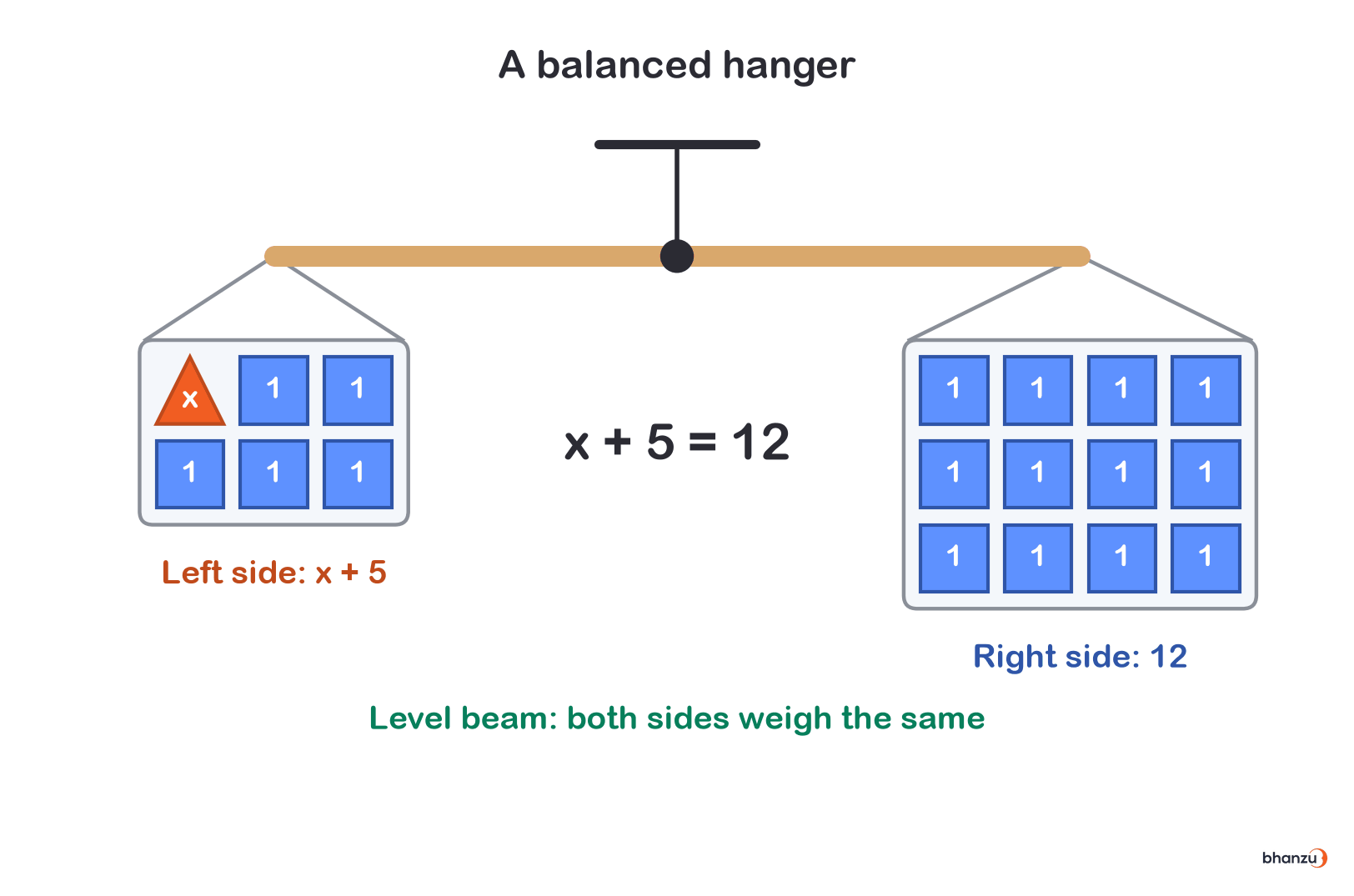
What are tape and hanger diagrams?
Tape and hanger diagrams are two ways to draw an equation, a math sentence saying two amounts are equal, so the unknown becomes a length you can see or a weight you can balance. The letter that stands for the unknown amount is called a variable, and x is the usual choice (any letter works).
- A tape diagram is a bar cut into parts that add up to the whole. Common Core's glossary also calls it a strip diagram or bar model.
- A balanced hanger is a beam on a hook that stays level only when both sides weigh the same.
In the tape, a bar of 12 is cut into 3 equal boxes labeled x. In the hanger, 3 identical triangles (each weighing x) balance 12 unit squares, which weigh 1 each. Both pictures say the same thing: , so .
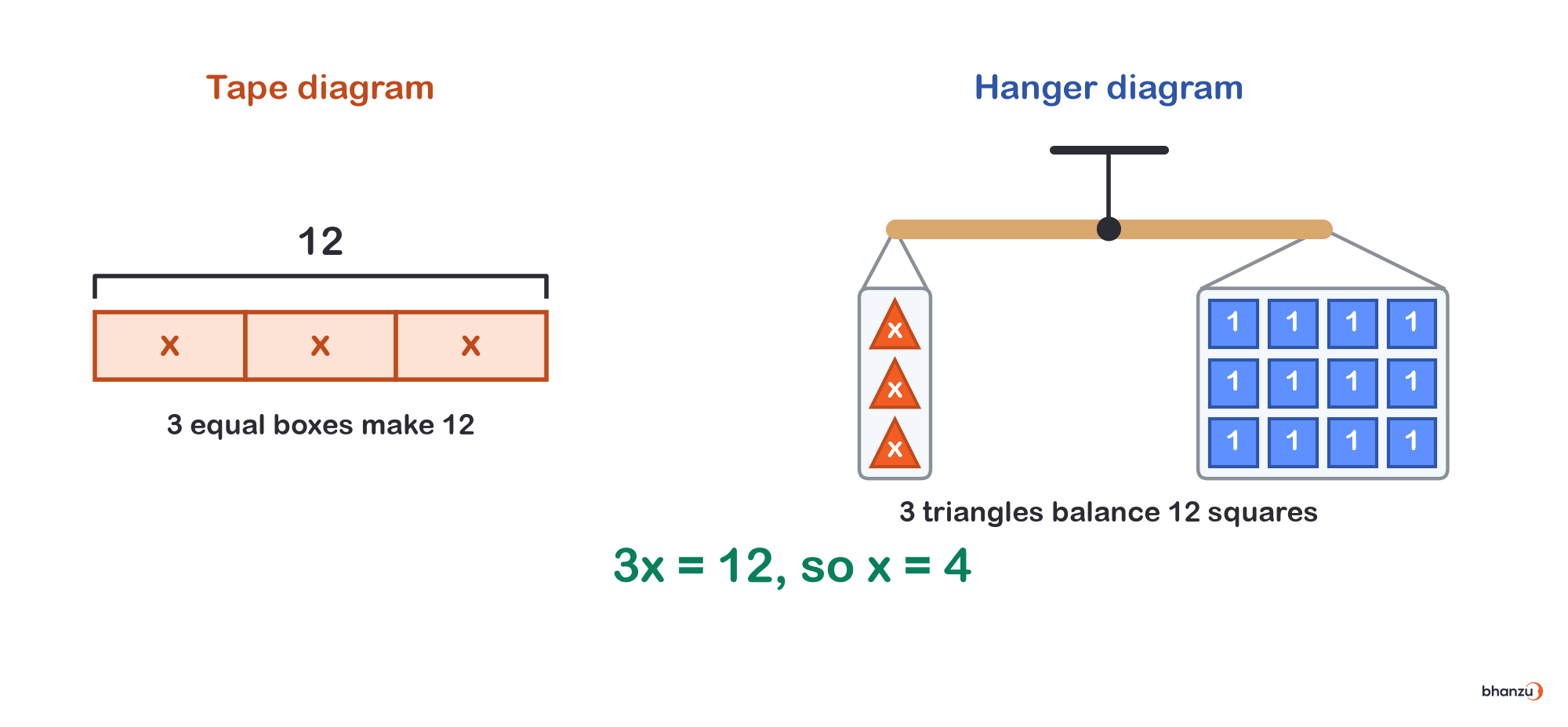
This is Common Core standard 6.EE.B.7, which covers equations shaped like and , with known numbers and and no negative values. For your child, answers like or are normal now. Drawing first also has research behind it. A 2012 Institute of Education Sciences practice guide for grades 4 to 8 rated teaching students to use visual representations, such as strip diagrams, as backed by strong evidence.
How do you solve a balanced hanger diagram?
Whatever you do to one side of a hanger, you do to the other, so the beam stays level while you get x alone. This is often called the hanger method.
- Write the equation the hanger shows (x can hang on either side).
- If loose unit weights sit beside x, as in , subtract from both sides by removing squares from each.
- If only identical x shapes remain, as in , divide both sides by by splitting each side into equal groups. Written in symbols, the same division works even when is a decimal such as , which no hanger can show.
- Put the value back on the original hanger. If both sides still match, the answer is right.
For the hanger, subtract 5 from both sides, which leaves . For , no loose squares sit beside the triangles, so split instead. Divide both sides by 3, and one triangle balances 4 squares, so .
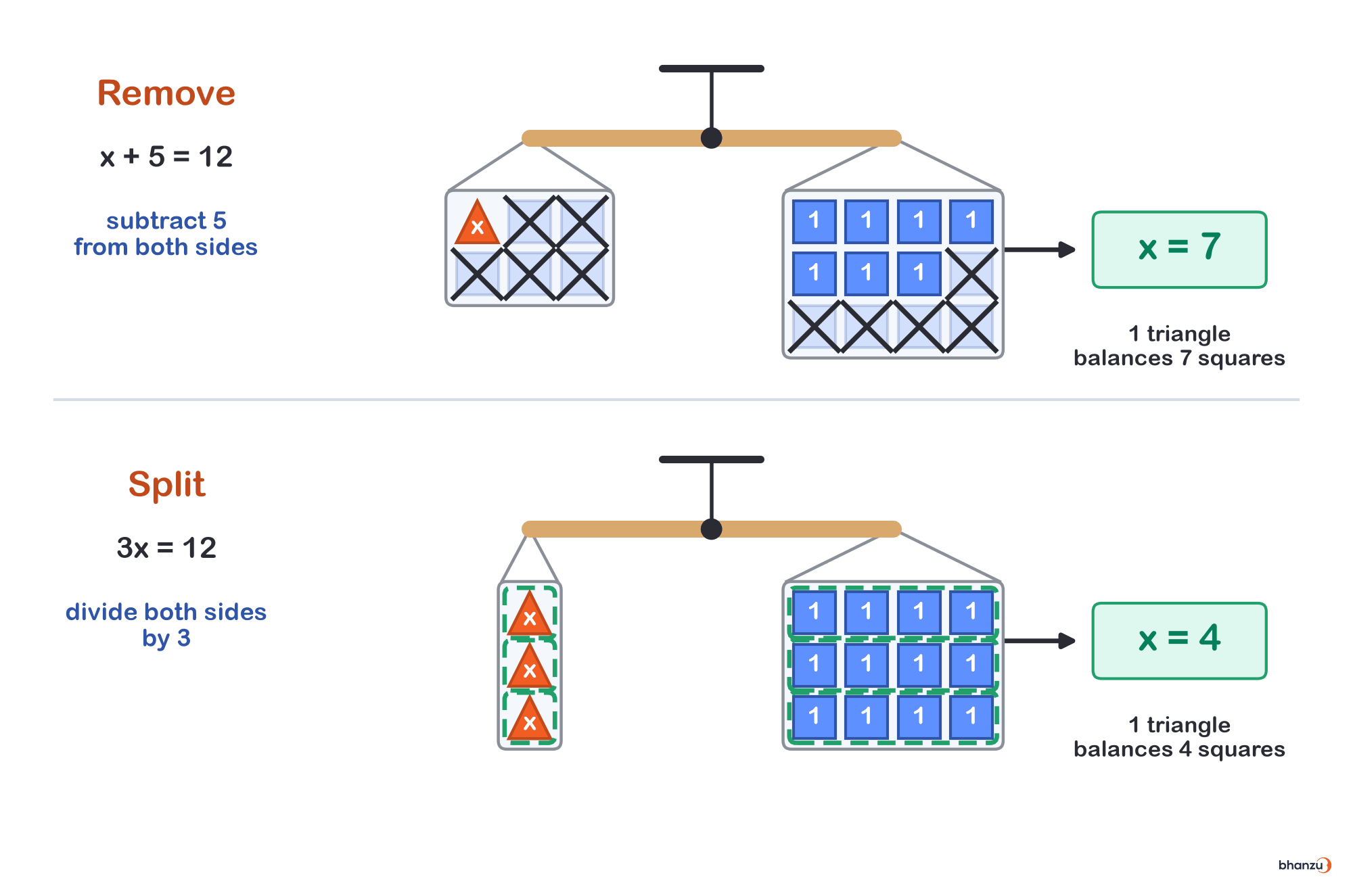
Children who have just solved by subtracting often subtract again on , because subtraction worked a minute ago. Asking "is the 4 a weight or a count of shapes?" catches that habit early. Later methods for solving an equation reuse these two moves, for two-step equations in 7th grade and for x on both sides in 8th grade.
Try It Yourself
Tap a button to take one unit weight off the left side or the right side, and watch the beam tip whenever the two sides stop matching. Get x alone with the beam level, and if several x shapes are left, split both sides into that many equal groups. The hint line under the hanger tells you what each move did and checks your answer.
How do you turn a tape diagram into an equation?
Put the whole tape on one side of the equal sign and its parts on the other.
- Label the total, the length of the whole bar.
- Label each part, giving an unknown part a letter.
- Give equal boxes the same letter, since they stand for the same amount.
- Count the letter boxes. That count multiplies the letter, so three x boxes make .
One tape gives more than one true equation. Three x boxes making 21 give and , so . A part x and a part 3 making 21 give and , so .
One distinction confuses plenty of people at first: the 3 in counts boxes, while the 3 in is a box of its own.
| Words in the problem | Math it means |
|---|---|
| "in all" or "total" | the whole tape, alone on one side of |
| "more" or "added" | beside the unknown |
| "each," with a count of identical items | , the count times the unknown |
| "is" or "costs" | |
| "shared equally" | divide both sides by the number of groups |
Pick the tape when a story gives a total. It is the same bar used for part-part-whole ratio problems, where the parts are shares of a ratio. Pick the hanger to see why a move must happen on both sides. Both drawings get slow with big numbers (nobody wants to draw 150 unit squares), so then write the equation and use the same moves in symbols.
Examples of tape and hanger diagrams
Example 1
A tape diagram has a total of 12, split into an unknown part and a part of 5. Find the unknown part.
Let x stand for the unknown part. The parts make the whole, so
Subtract 5 from both sides, so , and fills the tape.
Example 2
A balanced hanger has 4 identical triangles on the left and 20 unit squares on the right. Find the weight of one triangle.
Let x stand for the weight of one triangle.
The tempting move is to take 4 off both sides. That leaves .
Put 16 back on the hanger. Four triangles of 16 weigh , far heavier than 20, so the beam would tip hard to the left. The 4 was never a weight. It counts the triangles.
Split instead. Divide both sides by 4, making 4 equal groups of one triangle and 5 squares, so , and keeps the beam level.
Example 3
A bag of rice and a 2.5-pound weight hang on one side of a balanced hanger. The other side holds 8 pounds. How much does the bag weigh?
Let y stand for the bag's weight in pounds.
Subtract 2.5 from both sides, so . The bag weighs 5.5 pounds, since .
Example 4
A tape diagram shows a total of 12 split into 5 equal boxes, each labeled x. Write two equations for the tape and find x.
Here x stands for the length of one box. Five boxes make 12, and one box is 12 shared into 5 parts.
Dividing both sides of by 5 gives the same thing, so . Check that .
Example 5
A balanced hanger has 15 unit squares on the left and a bag weighing n with 6 unit squares on the right. Which of 4, 6, 9 or 12 makes the hanger balance?
Let n stand for the weight of the bag.
| Value of | Right side, | Level with 15? |
|---|---|---|
| 4 | 10 | No |
| 6 | 12 | No |
| 9 | 15 | Yes |
| 12 | 18 | No |
Only balances. Subtracting 6 from both sides agrees, since .
Example 6
A pack of 6 juice boxes costs $4.50. At the same price per box, how many juice boxes can Maya buy with $3.00?
Let p stand for the price of one box in dollars. A tape of 4.50 split into 6 equal boxes gives
Divide both sides by 6, so one box costs $0.75. Now let b stand for the number of boxes Maya can buy with $3.00.
Divide both sides by 0.75, so . Maya can buy 4 juice boxes, because .
Why does keeping the hanger level work?
An equation is a promise that two amounts are equal, and a level beam is that promise in a form you can see. Every allowed move keeps the promise.
- The equal sign means same value. The equal sign says both sides are worth the same, not that the answer comes next.
- Equal changes keep the balance. Taking 5 off two equal sides leaves two sides that still match, which mathematicians call a property of equality.
- Equal splits keep it too. If 3 triangles weigh the same as 12 squares, one third of each side must also match.
- Substitution is a built-in check. Common Core standard 6.EE.B.5 asks 6th graders to decide which values from a set make an equation true, exactly what putting a value back on the hanger does.
- Later algebra runs on the same moves. The 2024 Nation's Report Card put the national average eighth-grade algebra score at 281.7, about 7 points below 2019's 288.9, so the both-sides habit is worth building now.
A child who knows why the beam stays level can handle an equation they've never seen, because a reason carries over to new numbers and a copied step doesn't.
The part of tape and hanger diagrams nobody explains
A hanger is a bridge to symbols, and it gives way in two places most pages never mention.
- Negative answers. The equation has the answer , and nothing weighs less than nothing, so it can't be hung. Equations like it arrive in 7th grade with one-step equations with negative numbers.
- Answers that aren't whole. Splitting 12 squares into 5 groups puts 2.4 squares in each, and a drawing can only hint at four tenths of a square.
Researchers are cautious about the model too. A 2019 review of 34 journal articles on the balance model could not identify a clear pattern linking how the model is used to what students learn. So use the hanger to see why a move is allowed, then write the move in symbols every time.
A child who solves in their head but stalls on usually understands more than it looks. Guessing worked on the first one, and 2.4 is hard to guess, so draw the split.
Where students trip up on tape and hanger diagrams
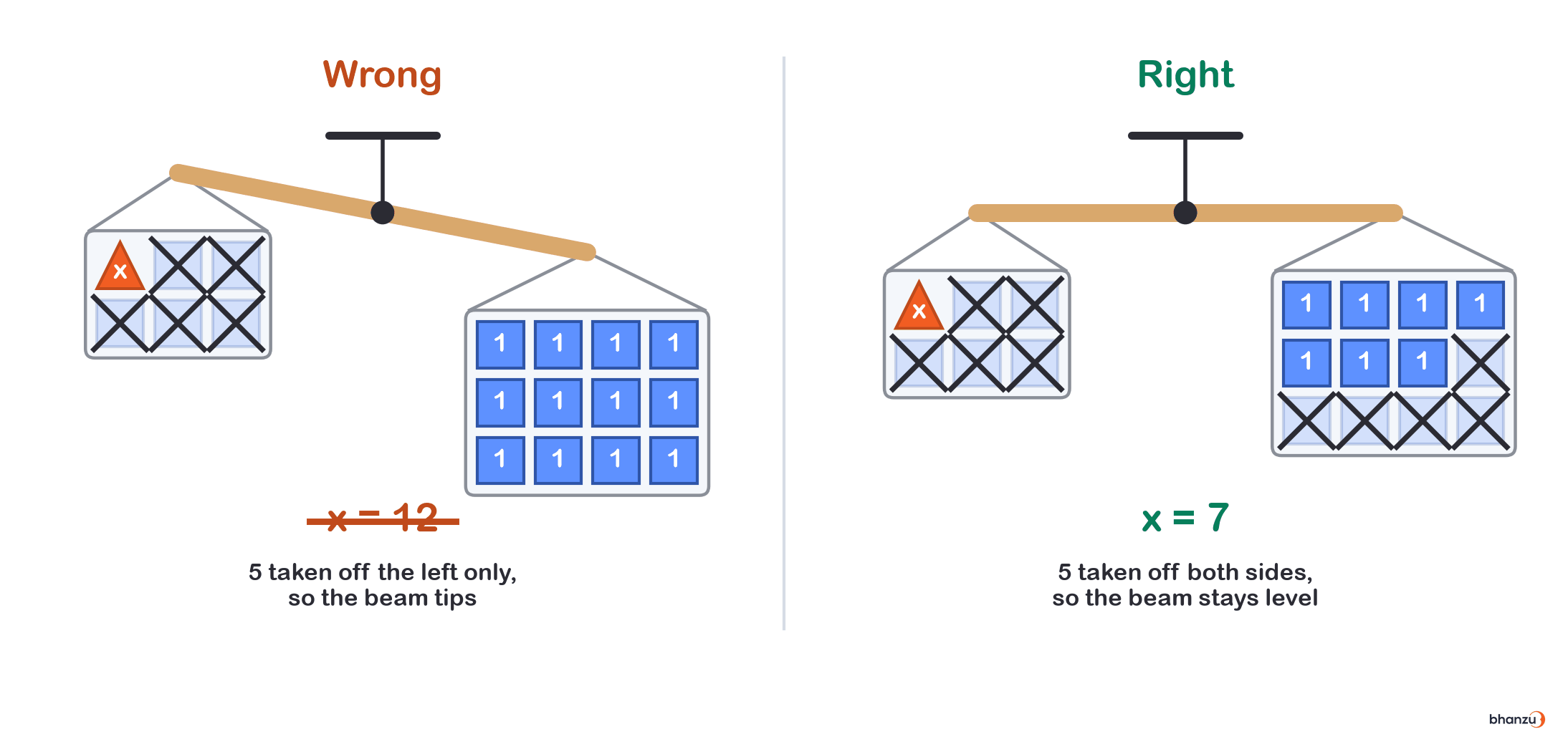
Mistake 1: Changing only one side
Where it slips in: Removing the 5 unit weights from . Children watch the side with x, because that is where the answer will appear.
Don't do this: Take 5 off the left side only and read the hanger as .
The correct way: Take 5 off both sides, so . Put 7 back in, , and the beam stays level.
Mistake 2: Adding every number in the picture
Where it slips in: A tape with a total of 12, one part of 5 and one part of x, as in Example 1.
Don't do this: Write .
The correct way: The 12 is the whole tape, so . A part of 17 would make the tape long, longer than the whole.
Children often add the two numbers on a tape because 12 and 5 are the only numbers in the picture. A child who rushes to the answer does this most, so ask them to point at the whole tape before writing anything.
Mistake 3: Reading three x boxes as x + 3
Where it slips in: Matching a tape to its equation, as in Example 4. The 3 counts boxes, but it looks like one more number to add.
Don't do this: Write three x boxes with a total of 12 as , which gives .
The correct way: Three equal boxes mean 3 times x, so . Divide both sides by 3 to get , and confirms it.
Key Takeaways
- Whatever you take off or split on one side of a hanger has to happen on the other side too, or the beam tips.
- In tape and hanger diagrams, a number written in front of x counts shapes or boxes, so you divide by it rather than subtract it.
- Find the whole tape first, because the missing part is the whole minus the parts you know.
- Putting your answer back into the original equation tells you right away whether it balances.
- For more practice with the split move, especially on equations like where subtracting the 4 looks tempting, explore Bhanzu's 6th grade math tutor or algebra tutor sessions.
Read More
- Properties of Operations
- Inequalities on a Number Line
- Unknown Numbers in Multiplication and Division
- Two Step Equations
- Algebraic Expression
Research Behind This Article
- MacTutor History of Mathematics, University of St Andrews, Abu Ja'far Muhammad ibn Musa Al-Khwarizmi (1999). mathshistory.st-andrews.ac.uk
- Common Core State Standards Initiative, Mathematics Glossary: Tape Diagram (2010). thecorestandards.org
- Common Core State Standards Initiative, Expressions and Equations, Grade 6 (2010). thecorestandards.org
- Institute of Education Sciences, What Works Clearinghouse, Improving Mathematical Problem Solving in Grades 4 Through 8 (2012). ies.ed.gov
- National Center for Education Statistics, The Nation's Report Card: 2024 Mathematics, Grades 4 and 8 (2025). nationsreportcard.gov
- Otten, Van den Heuvel-Panhuizen and Veldhuis, The Balance Model for Teaching Linear Equations: A Systematic Literature Review (2019). eric.ed.gov
Quick Quiz: Check Yourself
Three levels, new numbers every time: find x on a tape diagram, find x on a balanced hanger, then solve equations with decimal or fraction answers and a two-step price problem.
Was this article helpful?
Your feedback helps us write better content
Frequently Asked Questions
How do I teach hanger diagrams at home?
Are tape diagrams 6th grade math?
How do you draw a tape diagram from a word problem?
What is the equation for a hanger diagram?
Where can my child find hanger diagram practice problems?
Is doing the inverse operation the same as doing the same thing to both sides?