Key Points
- Adding within 1000 joins hundreds with hundreds, tens with tens and ones with ones, and 3rd graders are expected to do it fluently.
- Breaking apart, jumping on an open number line and making a hundred are three strategies beside the column method, chosen by the shape of the numbers.
- Leaving out the regrouped hundred turns into 724, and subtracting 248 back exposes it by giving 476, not 576.
Three waterfalls pretending to be one
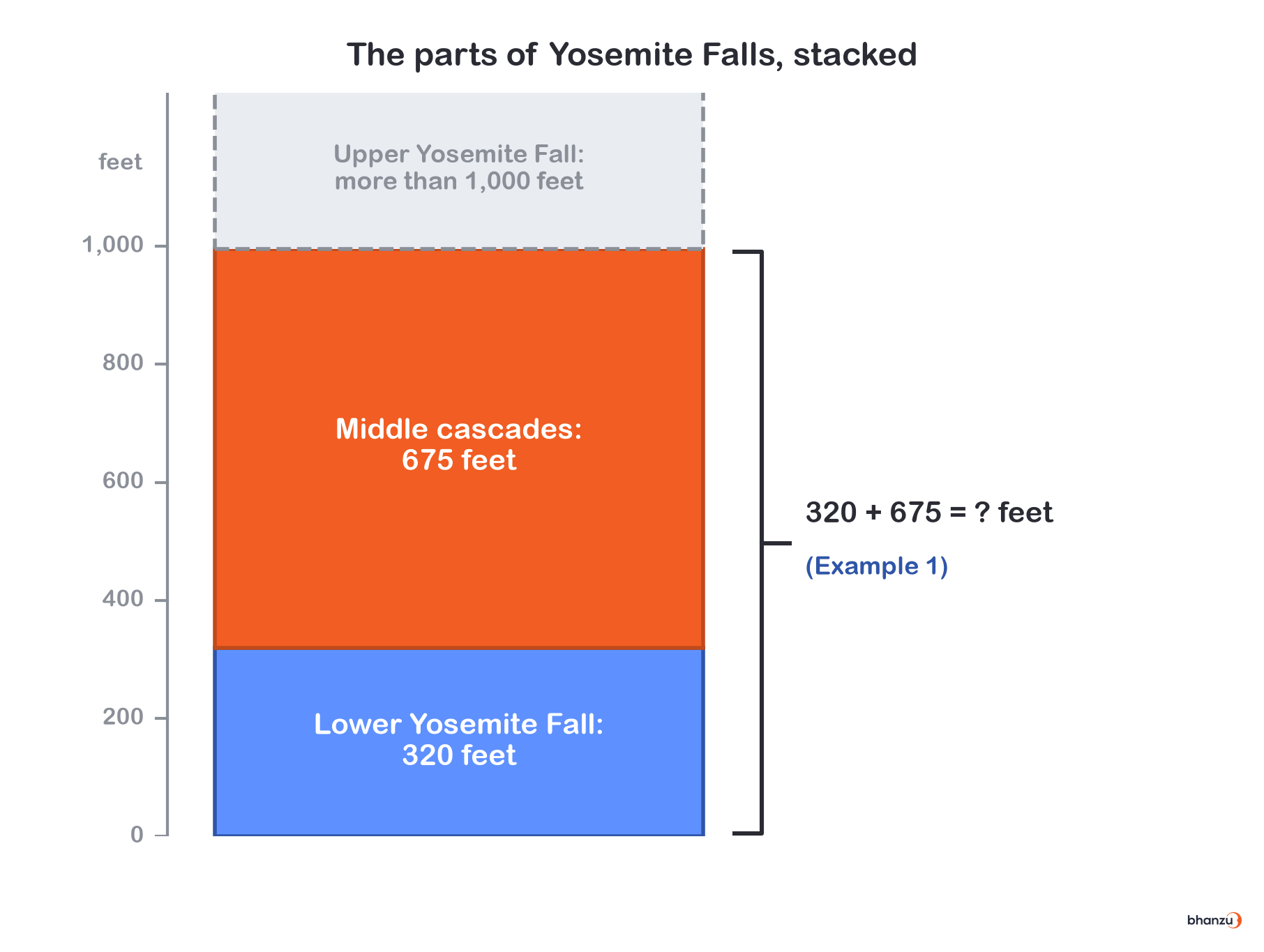
Yosemite Falls looks like one tall waterfall, but it is really three. Lower Yosemite Fall drops 320 feet, and the middle cascades above it drop 675 feet, with the upper fall stacked on top.
The National Park Service lists those heights on a waterfall page updated in May 2026. Stacked, the two lower drops make a real three-digit addition, and Example 1 finds the total. In 4th grade, the same place-value moves add numbers in the thousands.
What does adding within 1000 mean?
Adding within 1000 means finding the sum (the answer to an addition) when the total is 1,000 or less. You put hundreds together, then tens, then ones. Each number being added is an addend.
Place-value disks show this, since each disk is a counter marked 100, 10 or 1. Build 368 and 475, then push matching disks together.
| Place | 368 | 475 | Together |
|---|---|---|---|
| Hundreds | 3 | 4 | 7 |
| Tens | 6 | 7 | 13 |
| Ones | 8 | 5 | 13 |
Once the extra tens and ones are traded, that pile is 843. This is Common Core standard 3.NBT.A.2. It asks for fluent adding and subtracting with strategies and algorithms based on place value, properties of operations and how addition and subtraction relate.
By the end of 3rd grade, your child is expected to add within 1000 accurately, with a strategy that suits the numbers, building on 2nd grade's blocks and drawings for adding three-digit numbers.
How does breaking apart by place value work?
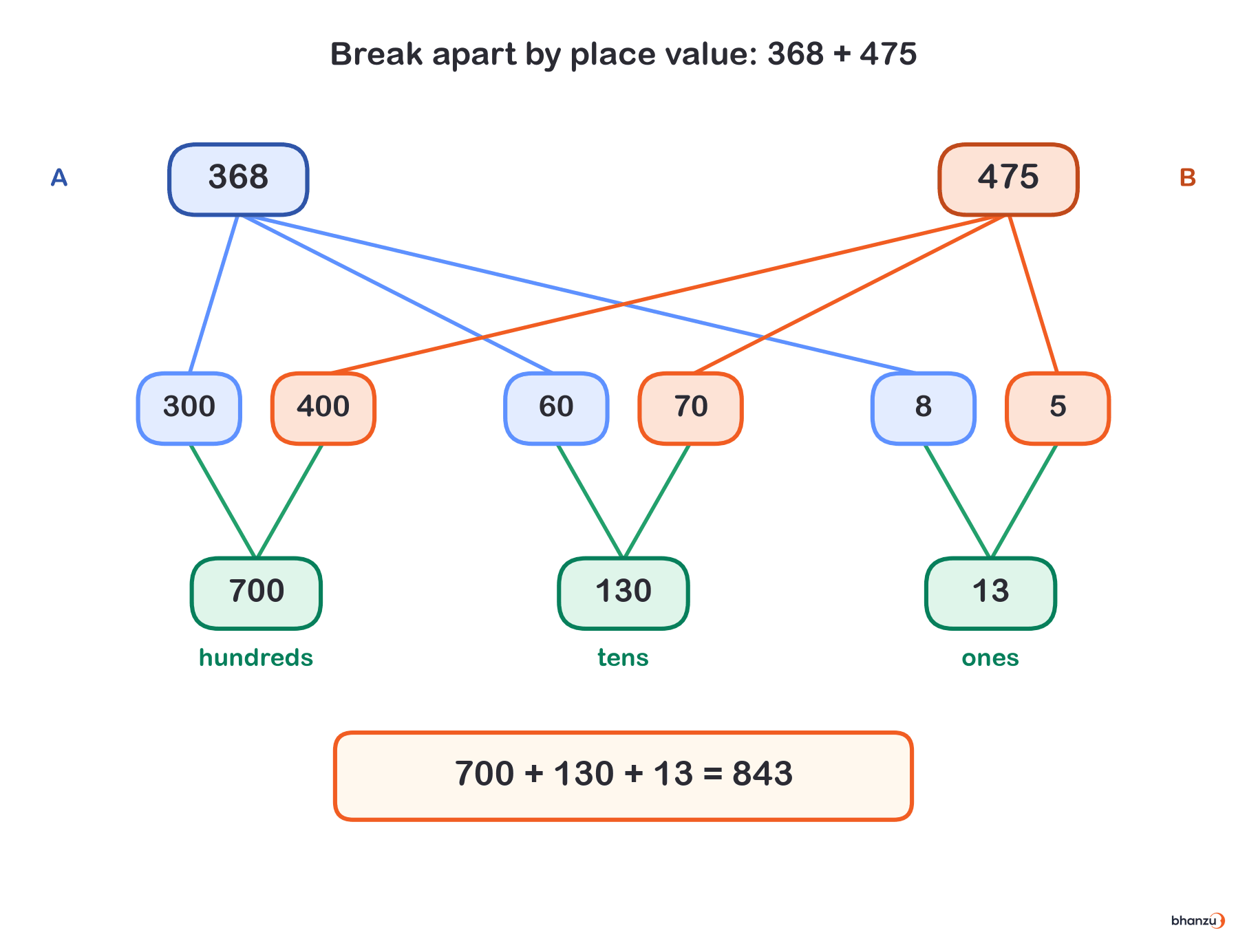
Take and split each addend into hundreds, tens and ones. That move is called breaking apart by place value, and it turns one big sum into three small ones. In expanded form, the parts are easy to read.
Add each place on its own. Each answer is a partial sum, one piece of the total.
Breaking apart gets heavy when both the tens and the ones make 10 or more. Then a hundred or a ten can slip away while joining 700, 130 and 13.
A number bond, a diagram where one number branches into its parts, shows the same split.
How do you add 3-digit numbers in your head?
Keep a running total, hundreds first, and say 700, then 830, then 843. Starting big is a handy habit for adding mentally, because the first number you say is already close to the answer.
Which strategy fits which numbers?
Look at the numbers before you add, because their shape shows the easiest path. The sum can go four ways, and every one lands on 843.
Adding on a number line within 1000
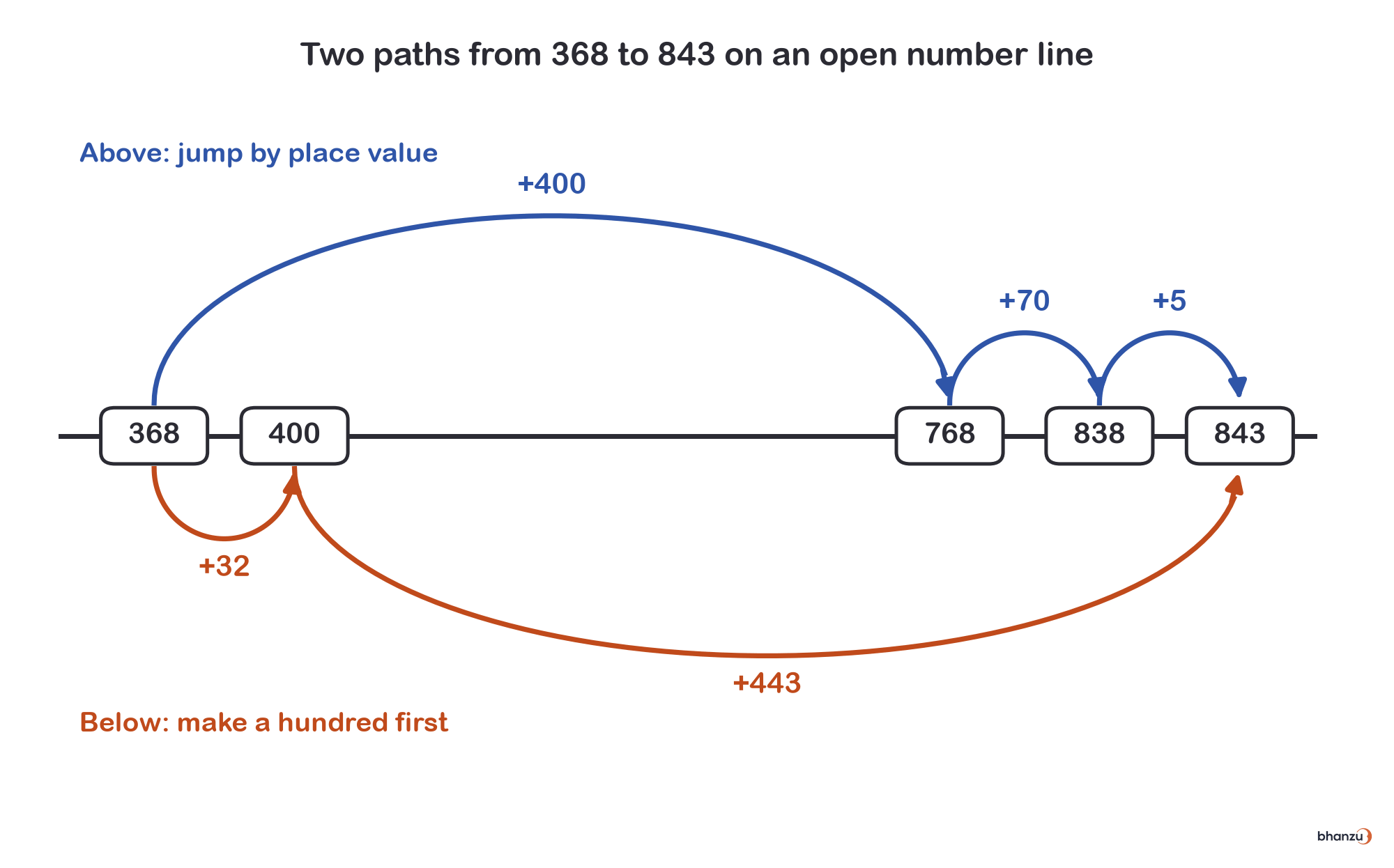
Start at one addend and jump the other addend's hundreds, then its tens, then its ones. An open number line has no printed ticks, so you mark only where you land. It's adding and subtracting on a number line with bigger jumps.
Making a hundred first
Making a hundred moves part of one addend to the other. Here 368 needs 32 to reach 400, so 32 moves over from 475 and leaves 443.
For , add 300 instead and take the extra 1 back off.
That version is called compensation, because the last step makes up for the change.
Reordering and counting up
Order and grouping never change a sum (the commutative and associative properties of addition), so can start with .
For a missing part, say what the box stands for first. In , the box is the amount still needed to reach 900.
- From 368 up to 400 is 32.
- From 400 up to 900 is 500.
- The jumps add to .
Counting up gives the same answer as subtracting 368 from 900, the inverse operation. Story words point to each move.
| Words in the problem | Math it means |
|---|---|
| "How many cans in all?" | Add the two amounts |
| "What is her total score?" | Add all three scores |
| "Is the sum more than 800?" | Find the sum, then compare |
| "How many more feet would make 1,000?" | Count up to the missing part |
What is regrouping in addition?
Regrouping means trading 10 of one place for 1 of the next, such as 10 ones for 1 ten or 10 tens for 1 hundred. The OpenStax Prealgebra textbook says carrying is the same as regrouping, so both words name one trade. The column method is an algorithm, a set of steps that works the same way for any numbers.
- Line up 368 over 475 by place value.
- Add the ones, on the right. , so write 3 and regroup 1 ten.
- Add the tens with the regrouped ten. , so write 4 and regroup 1 hundred.
- Add the hundreds with the regrouped hundred. , so the sum is 843.
Regrouping never changes the amount, the way 10 pennies and 1 dime are both worth 10 cents. Within 1000, if every place trades, the sum lands on exactly 1,000.
How do you check an addition problem?
Check before and after. Before adding, estimate by rounding to the nearest 10 or 100. Under the usual rule a 5 rounds up, so 475 becomes 480 (other rules exist).
Both say 843 is sensible, and the nearest-ten estimate lands closer. After adding, undo it by subtracting, .
A child who sees 843 beside the estimate 900 sometimes erases a correct answer. An estimate only tells you about where the sum lands.
Try It Yourself
Set two numbers with the up and down buttons, then tap a Trade button whenever a column holds 10 or more disks. Once every column has 9 or fewer, the sum appears with an estimate and a subtraction check. Tap Story to turn your two numbers into a word problem.
What makes adding within 1000 worth learning?
Place value lets you add three small pieces instead of counting to 843 one by one. Lots of totals a child cares about land between 100 and 1,000.
- It keeps a score fair. Game rounds of 175, 238 and 25 points add to 438 in any order, so two players can each add and compare.
- It answers "how many more" with no new skill. Counting up from 368 to 900 gives 532, just as subtracting does.
- It catches a total that can't be right. In , the 87 is less than 100, so the sum must stay under 759.
All three rest on one fact. A digit's place sets its size, so a 3 can mean 3, 30 or 300.
Examples of adding within 1000
Example 1
Yosemite's middle cascades drop 675 feet, and Lower Yosemite Fall drops 320 feet. How far do the two fall in all?
Break apart by place value.
The two lower parts drop 995 feet.
Example 2
Add 498 and 237.
The number 498 is close to 500, so a fast first move is . Then it feels natural to add the 2 back on.
That can't be right. Using 500 instead of 498 already added 2 too many, so 737 is too big, and adding 2 more moves even further away. Take the extra 2 off instead.
The sum is 735, and columns give the same answer.
Example 3
Leo's class collected 264 cans for a food drive, and Aisha's class collected 387. How many cans is that in all?
Jump from 264 on an open number line.
The two classes collected 651 cans.
Example 4
Mei scored 175, 238 and 25 points in three rounds of a game. What is her total score?
The 175 and 25 make a round 200, so add them first.
Mei scored 438 points.
Example 5
Is the sum of 382 and 459 more than 800?
Estimate first by rounding to the nearest ten.
The estimate says probably yes. In columns, the ones and the tens each regroup 1.
The sum is 841, and checks it. Yes, it is 41 more than 800.
Example 6
Vernal Fall in Yosemite is 317 feet tall, and Nevada Fall is 594 feet tall. How tall are they together, and how many more feet would make 1,000?
Step 1. Move 6 from 317 to 594 to make a hundred.
Step 2. The box stands for the feet still missing.
Count up 9 to reach 920, then 80 more to reach 1,000. So the box is 89.
Together the falls are 911 feet tall, and 89 more feet would make 1,000.
The part of adding within 1000 nobody explains
The word "fluently" in the standard means adding accurately and efficiently. Common Core's glossary separates an algorithm, "a set of predefined steps" that always works, from a strategy, a purposeful change chosen for particular numbers.
Columns are an algorithm, and turning into is a strategy. The line can blur, which is genuinely confusing, since a number line done the same way every time acts like an algorithm. Before adding, look for three things.
- A number just under a hundred. Make a hundred and fix the extra.
- Two parts that make a hundred. Change the order.
- Two or three places to trade. Use columns, and with fewer trades, break apart or jump.
How a child adds keeps changing after 3rd grade. A 2025 study of 1,947 students found about half changed how they usually added and subtracted multi-digit numbers between 3rd and 4th grade. In a 2009 study of 195 second, third and fourth graders, children free to pick hardly used compensation, the round-and-fix shortcut.
Estimating sums and differences builds the same look-first habit, and subtracting within 1000 uses it in reverse.
Tripping points to avoid with adding within 1000
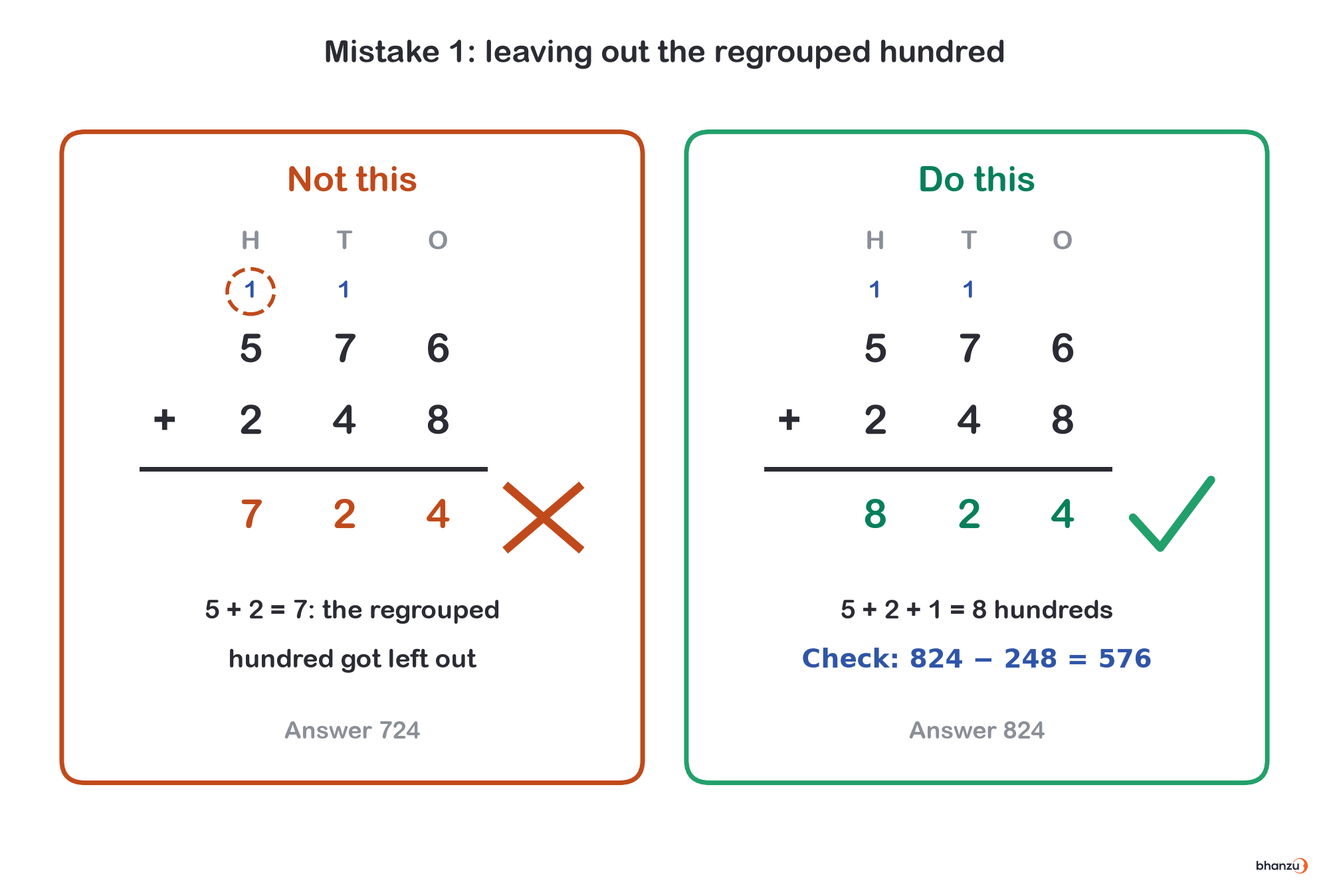
Mistake 1: Leaving out the regrouped hundred
Where it slips in: The second trade, when the tens make 10 or more, as in .
Don't do this: After and , add only hundreds and write 724.
The correct way: Add the small 1 too, , so the sum is 824.
The small 1 sits above the column, apart from the digits, so a child who writes it often moves straight on. Both checks catch this, since and the estimate is far from 724.
Mistake 2: Starting a two-digit number under the hundreds
Where it slips in: Columns with a two-digit addend, such as .
Don't do this: Write 87 under the 65, which turns the problem into and gives 1,529.
The correct way: Write 87 under the 59, so the ones and tens both regroup and .
Children start at the left edge, the way a line of words starts. A size check catches it, since 87 is less than 100 and the sum must stay under .
Mistake 3: Leaving out a place when breaking apart
Where it slips in: Breaking apart when the tens make 100 or more, as in .
Don't do this: Add and , then write 707, with the tens never added.
The correct way: Add the tens as well, , so .
Children breaking numbers apart often do the hundreds and ones first because they look quick, then forget the tens. The estimate shows 707 is far too small.
Key Takeaways
- Before adding within 1000, let the numbers' shape pick the strategy.
- After rounding an addend up to a friendly hundred, take the extra back off.
- Ten of any place trade for 1 of the next, and the amount stays the same.
- An estimate before and a subtraction after will catch a lost hundred.
- For guided practice choosing between a number line, a friendly hundred and columns, explore Bhanzu's 3rd grade math tutor or math programs for kids.
Read More
- Subtracting Within 1,000
- Multi-Digit Addition
- Adding Two-Digit Numbers with Regrouping
- Common Core Math vs Traditional Math
- Mental Math for Kids
Research Behind This Article
- National Park Service, Waterfalls, Yosemite National Park (2026). nps.gov
- Common Core State Standards Initiative, Grade 3 Number and Operations in Base Ten (3.NBT) (2010). thecorestandards.org
- OpenStax, Rice University, Prealgebra 2e, 1.2 Add Whole Numbers (2020). openstax.org
- Common Core State Standards Initiative, Mathematics Glossary (2010). thecorestandards.org
- Sievert, Hickendorff, van den Ham and Heinze, Children's Arithmetic Strategy Use and Strategy Change from Grade 3 to Grade 4 (2025). eric.ed.gov
- Torbeyns, De Smedt, Ghesquiere and Verschaffel, Acquisition and Use of Shortcut Strategies by Traditionally Schooled Children (2009). eric.ed.gov
Quick Quiz: Check Yourself
Three levels, new numbers every time: add with no trading, then use friendly hundreds or two trades, then find missing parts and solve story problems.
Was this article helpful?
Your feedback helps us write better content
Frequently Asked Questions
What does it mean to fluently add and subtract within 1000?
Is regrouping allowed in addition?
What's the word for addition without carrying?
How do you explain regrouping to a child?
How do I teach 3-digit addition with regrouping at home?