What Division Property of Equality Means
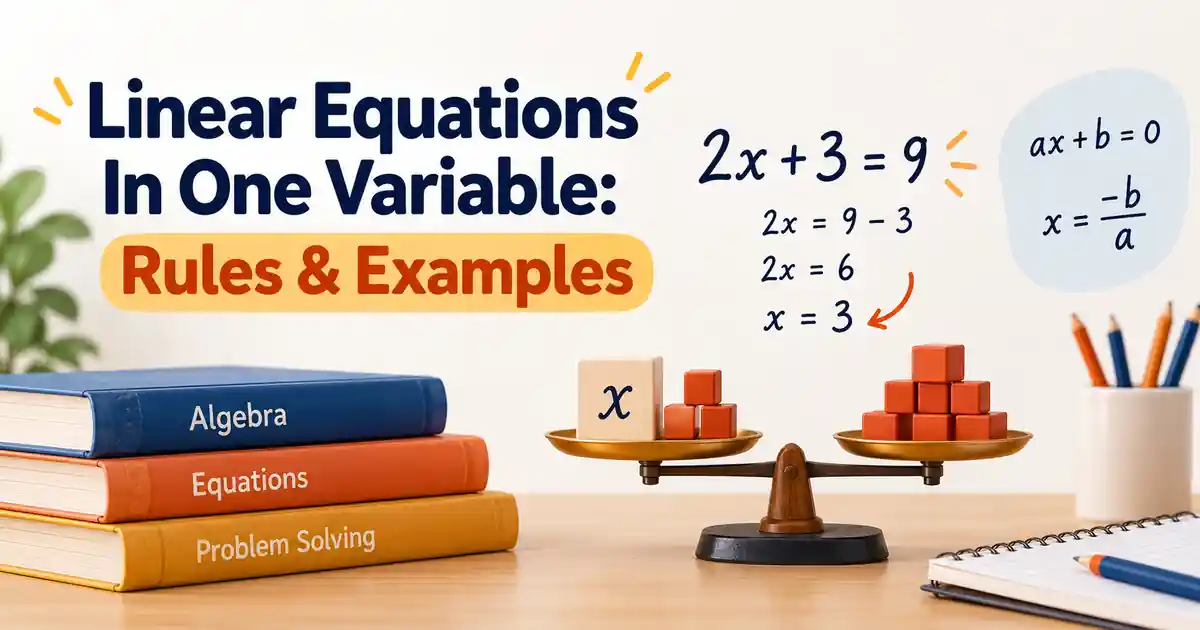
The division property of equality states that if two quantities are equal, then dividing both sides of the equation by the same non-zero number keeps the two sides equal. In symbols, if and , then . It is the rule that lets you undo a multiplication and isolate a variable.
If you deleted everything below this paragraph, that sentence would still answer the search. The rest of the article shows the formula in action, explains why zero is forbidden, and names where the property quietly breaks.
The Formula
The property is written compactly as a conditional statement.
Read it in plain English: whatever you divide the left side by, you must divide the right side by the same thing — and that thing cannot be zero. Here and are the two equal quantities, and is the divisor.
The property is one of the eight properties of equality. Its partner, the multiplication property of equality, does the reverse: it lets you multiply both sides by the same number. Because division and multiplication are inverse operations, the two properties are used to unwind each other.
The Properties of Equality
The division property is one of eight properties of equality — the rules that describe what you are allowed to do to an equation without breaking it. Seeing them together shows where division fits.
Property | What it says (given ) |
|---|---|
Reflexive | ; any quantity equals itself. |
Symmetric | If , then . |
Transitive | If and , then . |
Substitution | If , then may replace in any expression. |
Addition | If , then . |
Subtraction | If , then . |
Multiplication | If , then . |
Division | If and , then . |
The addition, subtraction, multiplication, and division properties are the four that actually operate on both sides; the reflexive, symmetric, transitive, and substitution properties describe how equality behaves. Division is the only one that carries a condition — the divisor can never be zero.
Examples of the Division Property of Equality
Each example below states the problem in bold, then works one step per line.
Example 1
Solve .
Dividing both sides by 5 cancels the 5 on the left and leaves alone.
Example 2
Solve . (Watch the tempting shortcut first.)
The first instinct is to divide only the side with the variable, or to drop the negative sign because "it looks messy":
Check it: , not 21. The answer is clearly wrong. The rescue is to divide both sides by and keep the sign.
Check: . Correct.
Example 3
Solve .
The answer does not have to be a whole number. A fraction is a complete answer.
Example 4
Solve .
Dividing by a fraction means multiplying by its reciprocal, so divide both sides by :
Check: . Correct.
Example 5
A geometry use: is bisected into two equal angles that together measure . Find each half.
Let each half be . Then .
Each half of measures . The property is what justifies "an angle bisector splits an angle into two equal parts."
Example 6
A word problem: four identical notebooks cost $52 in total. Find the price of one.
Let one notebook cost . Then .
One notebook costs $13. The property turns "the total splits evenly" into a single division step.
Why Does the Non-Zero Rule Matter?
The single most important part of the property is the phrase , and it is not a technicality. Division by zero is undefined — there is no number that answers "what times zero gives a non-zero result?" So the property simply cannot apply when the divisor is zero.
Here is where the rule earns its keep:
It keeps the balance real. An equation is a claim that two things weigh the same. Dividing both pans of a scale by the same weight keeps it level. Dividing by "nothing" is not an operation you can perform on a scale at all.
It protects against a hidden trap. Suppose you have and you divide both sides by to conclude . That is only valid if . If could be zero, is true for any and , and the cancellation would smuggle in a false conclusion. This is exactly the flaw in classic "fake proofs that ."
Where Students Trip Up on the Division Property of Equality
Mistake 1: Dividing only one side
Where it slips in: early one-step equations, when the reader focuses on the side with the variable and forgets the other.
Don't do this: from , write by "moving the 6 away" from the left only.
The correct way: divide both sides by 6 — , giving . The habit that fixes this is writing the division bar under both sides before simplifying either.
Mistake 2: Dividing by zero
Where it slips in: equations where the coefficient of the variable is itself an expression that could be zero, like .
Don't do this: cancel to get and call the work done, without asking whether can be zero.
The correct way: state the condition before dividing. The reader who quietly assumes the divisor is safe — the same reader who trusts a shortcut without checking — is the one who gets caught by a hidden zero.
Mistake 3: Confusing which operation undoes the multiplication
Where it slips in: when the reader sees and reaches for division out of habit.
Don't do this: divide by 4 again, giving — this makes the equation worse.
The correct way: the variable is already divided by 4, so you multiply both sides by 4 (the multiplication property) to get . Division undoes multiplication; multiplication undoes division. Match the inverse to the operation you actually see.
Key Takeaways
The division property of equality says: if and , then .
You must divide both sides by the same number, and that number can never be zero.
It is the inverse of the multiplication property, and the two undo each other.
It works with fractions and negatives as long as the divisor is non-zero.
The property justifies isolating a variable and many equal-splitting steps in geometry.
A Practical Next Step
Try these three on your own, one step per line: (1) solve ; (2) solve ; (3) solve . If you get stuck on the fraction one, come back to Example 4 and divide by multiplying by the reciprocal. To take equation-solving further with a teacher, explore Bhanzu's algebra tutor, get targeted help with algebra, or browse math classes online.
Want a live Bhanzu trainer to walk through more equation problems? Book a free demo class — available online globally.
Read More
Was this article helpful?
Your feedback helps us write better content