Key Points
- 467 sits 3 steps from 470 and 33 steps from 500, so rounding to the nearest 10 or 100 moves 467 up both times.
- Reading 467 as 46 tens and 7 ones puts it between 460 and 470, and 7 ones is past halfway, so 467 rounds to 470.
- Rounding twice gives the wrong hundred, since 749 rounds to 700, but rounding 749 to 750 first leads to 800.
- Common Core places rounding to the nearest 10 or 100 in 3rd grade, and 4th graders round thousands the same way.
A banner that says about 500 cans
The food drive banner says about 500 cans, but the real count is 467.
Nobody is fibbing. The banner swapped 467 for the closest hundred, a number that is quicker to say, picture and compare. That swap has a name: rounding.
Later in 3rd grade, rounded numbers like 500 let you add big numbers in your head and check whether an answer makes sense.
What is rounding to the nearest 10 or 100?
Rounding to the nearest 10 or 100 means swapping a number for the closest ten or hundred on a number line (a line marked with numbers at equal steps). Those tens and hundreds are multiples of 10 and 100, the numbers you say when skip counting by 10s or 100s. In 3rd grade you round whole numbers, the counting numbers and 0, up to 1,000.
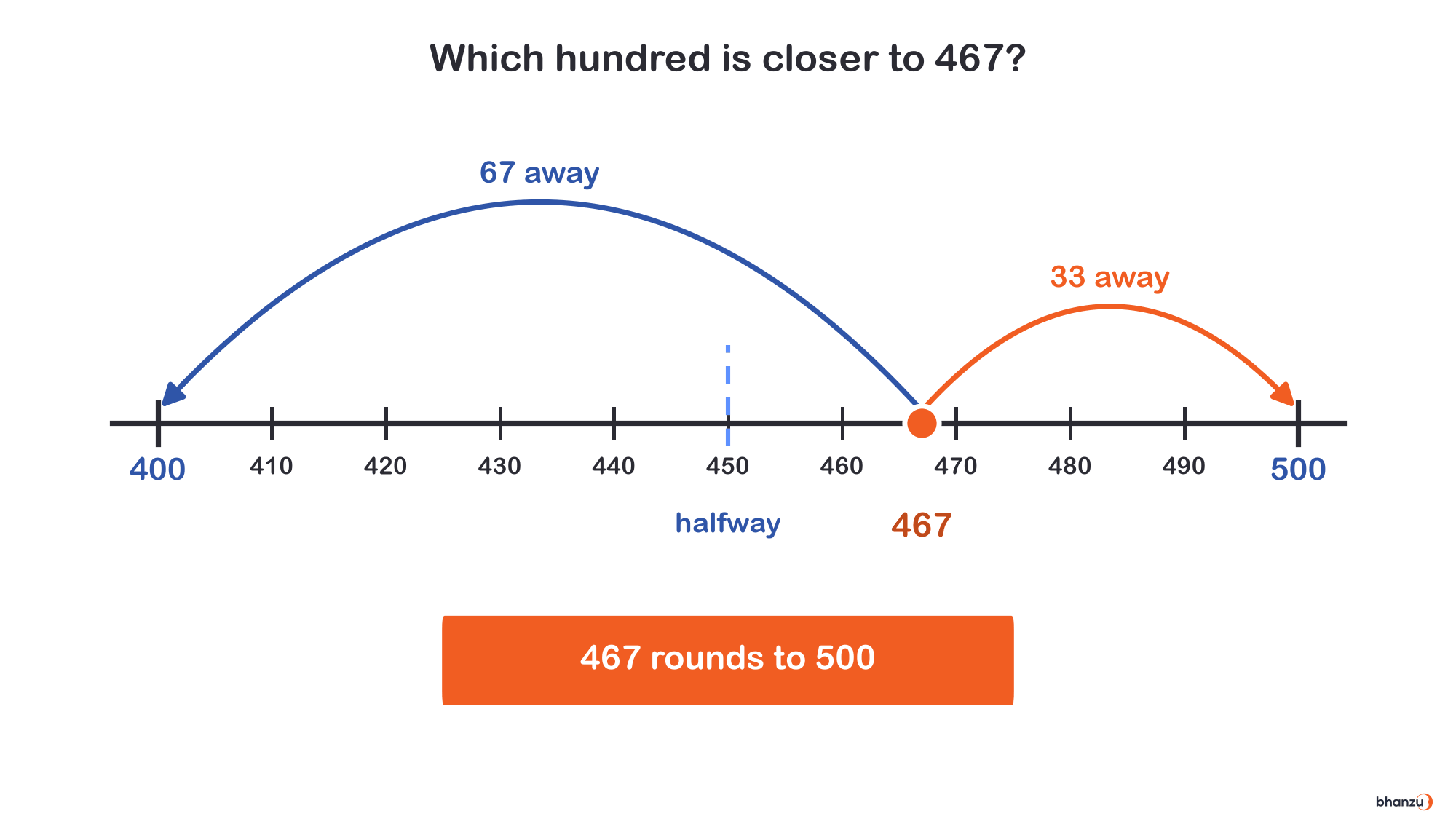
The model is a number line with the two neighboring tens or hundreds and the halfway point between them. For 467, the hundreds are 400 and 500, with 450 halfway.
467 is much closer to 500, so it rounds to 500.
Common Core standard 3.NBT.A.1 asks your child to "use place value understanding to round whole numbers to the nearest 10 or 100" during 3rd grade. In the framework for the 2026 Nation's Report Card, 45 percent of the 4th grade math items cover number properties and operations, so number work stays big after 3rd grade. The same framework names the number line as a tool for rounding.
How does place value find the nearest ten?
To round to the nearest ten, count the tens first. 467 is 46 tens and 7 ones, so it sits between 46 tens (460) and 47 tens (470).
Place value reads 467 in more than one way, and expanded form is only one of them.
| Way to read it | 467 |
|---|---|
| Tens and ones | 46 tens, 7 ones |
| Hundreds and ones | 4 hundreds, 67 ones |
| Expanded form |
A number line shows which ten is closer.
- Write 460 at the bottom of a line and 470 at the top.
- Mark the halfway point, 465, in the middle.
- Put a dot for 467 two steps above 465.
- Count 3 steps up to 470 and 7 steps down to 460, so 467 rounds to 470.
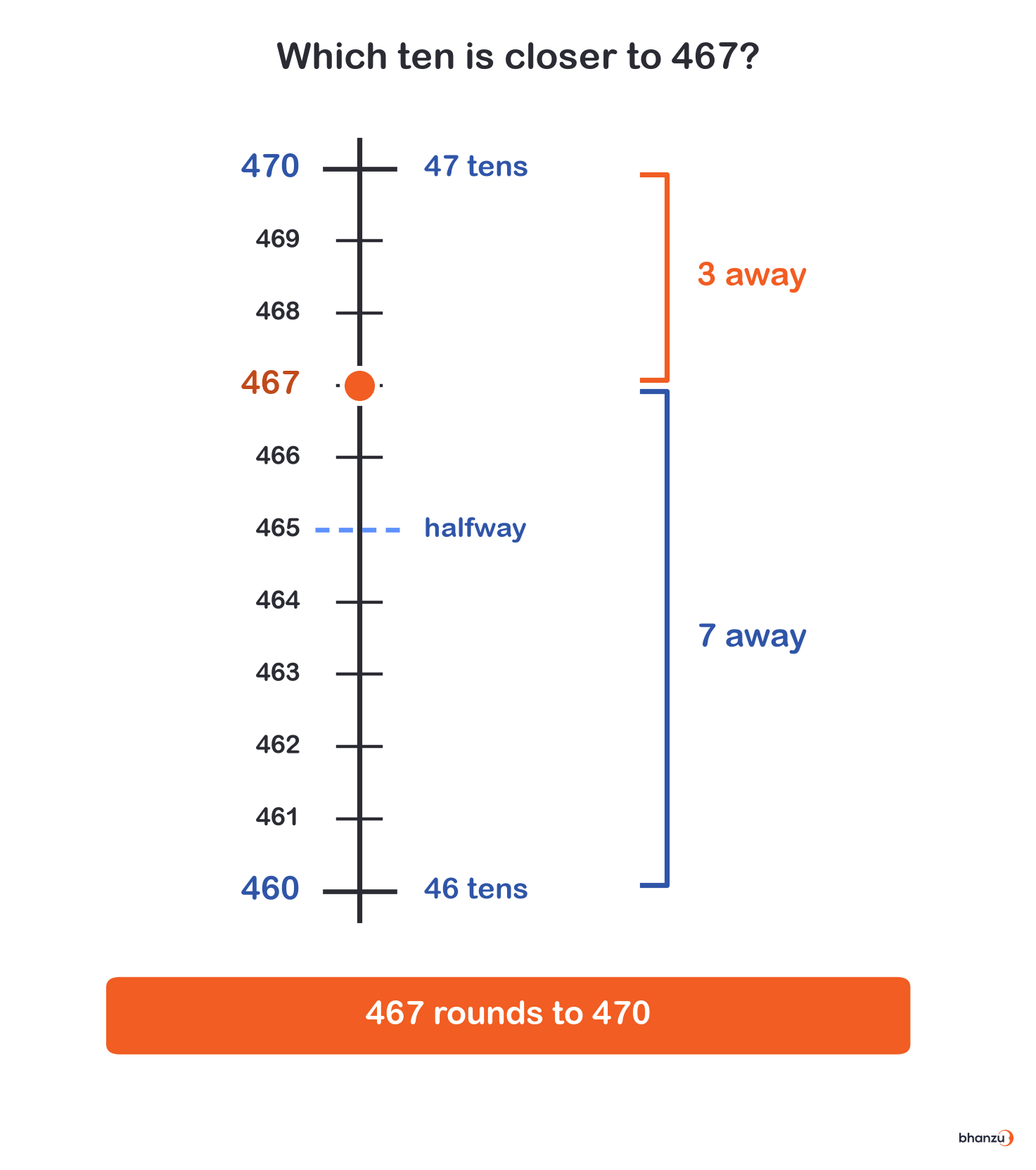
A number line can stand up like a thermometer, as long as the steps stay even. A 2003 study by Robert Siegler and John Opfer linked one cause of children's estimating trouble to picturing bigger numbers squeezed together.
Rounding up moves to the higher ten. Rounding down keeps the same tens and turns the ones into 0.
| Ones digit | Move | Example |
|---|---|---|
| 0 | None, already a ten | 120 is 12 tens, so it stays 120 |
| 1 to 4 | Round down | 462 rounds to 460 |
| 5 | Halfway, round up | 465 rounds to 470 |
| 6 to 9 | Round up | 467 rounds to 470 |
465 is 5 steps from each ten, so the line cannot choose. The OpenStax Prealgebra textbook explains that mathematicians agreed to round halfway numbers up to the higher number.
The digit rule is faster, but it hides the reason it works, and it trips children up when a 9 has to go up. A child who reads only the last digit can get 470 without knowing which two tens 467 sits between.
How do you round 3-digit numbers to the nearest 100?
Count the hundreds, and let the tens digit decide. 238 is 2 hundreds and 38 ones, so it sits between 200 and 300, with 250 halfway.
The tens digit of 238 is 3, less than the 5 at halfway, so 238 rounds down to 200. The 8 ones make no difference.
| Number | Nearest 10 | Nearest 100 |
|---|---|---|
| 467 | 470 | 500 |
| 238 | 240 | 200 |
| 615 | 620 | 600 |
| 350 | 350 | 400 |
A number can round up to a ten and down to a hundred, as 615 does, because the two questions use different neighbors.
Every whole number from 450 to 549 rounds to 500, a team of 100 numbers. Each hundred from 100 to 900 has a team that size. In 4th grade, the same move works for thousands.
What happens when rounding climbs into a new hundred?
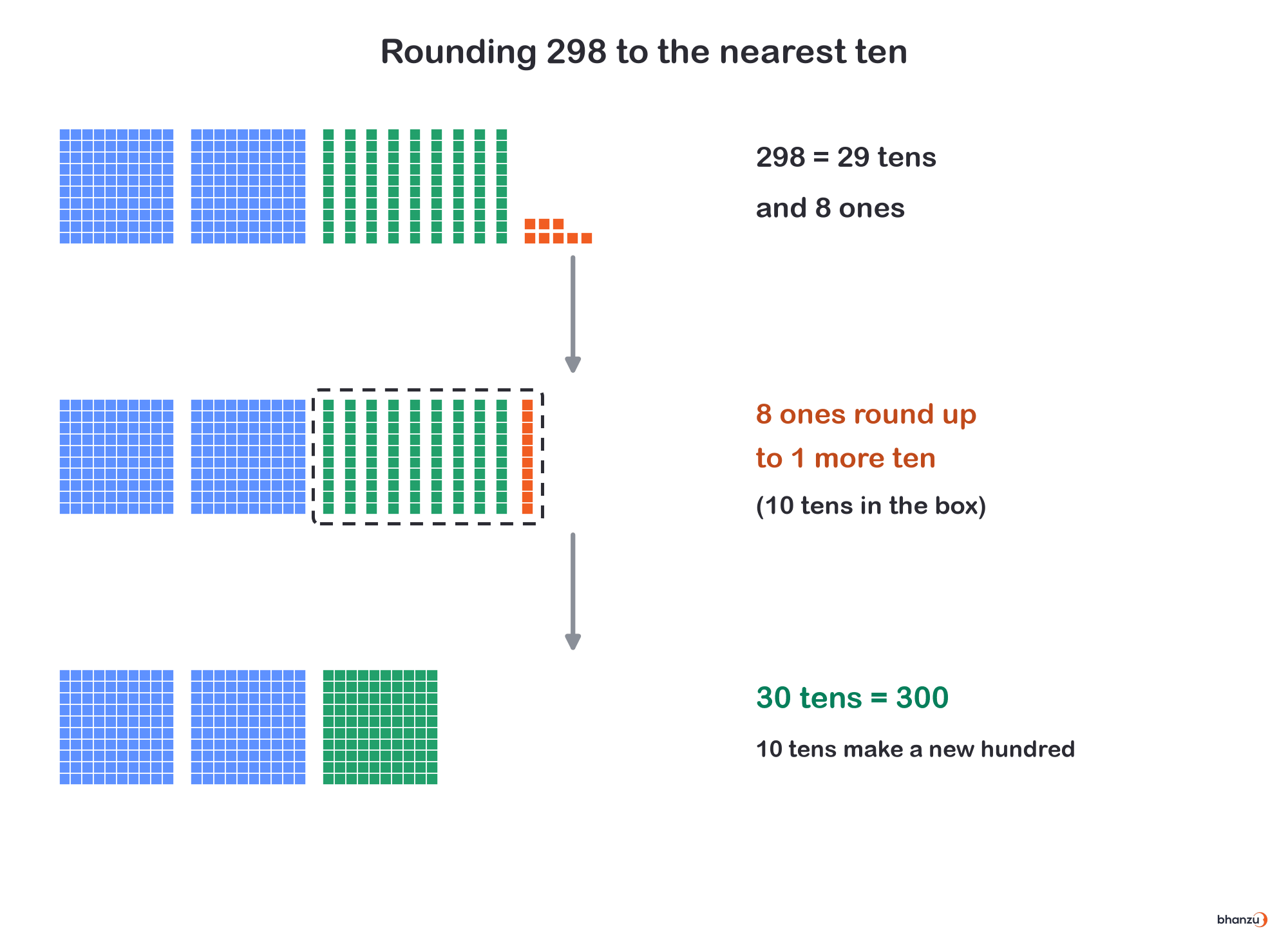
When the tens digit is 9 and a number rounds up to the next ten, 10 tens make a new hundred. That is how 298 rounds to 300.
- 298 is 29 tens and 8 ones.
- Eight ones is past halfway, so add one more ten.
- 29 tens and 1 ten make 30 tens, which is 300.
Trading 10 tens for 1 hundred is called regrouping, the same move you use when adding within 1,000. In digit terms, the 9 becomes 0 and the digit to its left goes up by 1.
What is 999 rounded to the nearest ten?
999 is 99 tens and 9 ones, so one more ten makes 100 tens.
So 999 rounds to 1,000. 976 also reaches 1,000 to the nearest hundred, since it is past 950. In 5th grade, decimals such as 4.97 roll over the same way.
Children who use the 5-or-more rule smoothly often stall at 298, because the 9 has no next digit to become. Another child writes 300, then crosses it out because the hundreds digit changed (that change is allowed).
Try It Yourself
Tap the plus and minus buttons to build a three-digit number, or drag the orange dot along the line. The readout counts the tens or hundreds and shows how far each neighbor is. Switch between Nearest 10 and Nearest 100, then build 398 and watch it climb into a new hundred.
Examples of rounding to the nearest 10 or 100
Example 1
Diego's class collected 172 cans. Round 172 to the nearest ten.
172 is 17 tens and 2 ones, between 170 and 180.
It is 2 away from 170 and 8 away from 180, so 172 rounds to 170.
Example 2
Aisha's class collected 681 cans. Round 681 to the nearest hundred.
681 is 6 hundreds and 81 ones, between 600 and 700, with 650 halfway.
681 is past 650, so it rounds to 700.
Example 3
Round 396 to the nearest ten.
The ones digit is 6, so 396 rounds up. The tempting move turns the 9 tens into 10 in place and writes 3,100.
That cannot be right. The answer must be 390 or 400, the two tens next to 396, and 3,100 is more than 2,700 away.
Use place value instead. 396 is 39 tens and 6 ones, and 6 ones is past halfway, so add 1 ten.
40 tens is 400, so 396 rounds to 400, just 4 away.
Example 4
Leo's class has about 300 cans, to the nearest hundred. What are the least and greatest possible counts?
Halfway between 200 and 300 is 250, which rounds up, so 250 is the least.
350 rounds up to 400, so the greatest is 349.
Example 5
The mystery box's can count uses the digits 2, 5 and 8 once each. It rounds to 300 to the nearest hundred and 290 to the nearest ten. How many cans are there?
The six possible numbers are 258, 285, 528, 582, 825 and 852.
Only 258 and 285 round to 300. The others round to 500, 600, 800 and 900.
258 rounds to 260. 285 is halfway between 280 and 290, so it rounds up to 290.
The box holds 285 cans.
Where rounding shows up in real life
Rounding exists because an exact number often carries more detail than a job needs. A rounded number is one you can hold in your head and compare at a glance.
- It makes big sums friendly. is hard to add in your head, but is quick mental math, only 5 from the exact 705. That swap starts estimating sums and differences.
- It shows size at a glance. Counts of 467 and 212 cans are about 500 and about 200, so the gap is clear.
- Grown-ups use the same halfway rule. The IRS instructions for the 2025 Form 1040 let people round cents to whole dollars, with 50 cents or more going up, so $2.50 becomes $3. They also say to add the exact amounts first and round only the total.
Each trade gives up a little exactness to make thinking easier.
Where do kids trip up on rounding?
Mistake 1: Chopping off the last digit
Where it slips in: Nearest-ten problems with a ones digit of 5 or more, such as 267.
Don't do this: Writing 267 as 260 by covering the 7 with a finger.
The correct way: 267 is 26 tens and 7 ones. Seven ones is past halfway, so 267 rounds up to 270.
A child who rushes often covers the last digit and keeps what is left. Chopping works whenever the ones digit is 0 to 4 (so the habit feels like the rule).
Mistake 2: Losing the zero
Where it slips in: The last step of a nearest-ten problem, when tens turn back into a number.
Don't do this: Writing 537 to the nearest ten as 54.
The correct way: 537 is 53 tens and 7 ones, which rounds to 54 tens. 54 tens is 540.
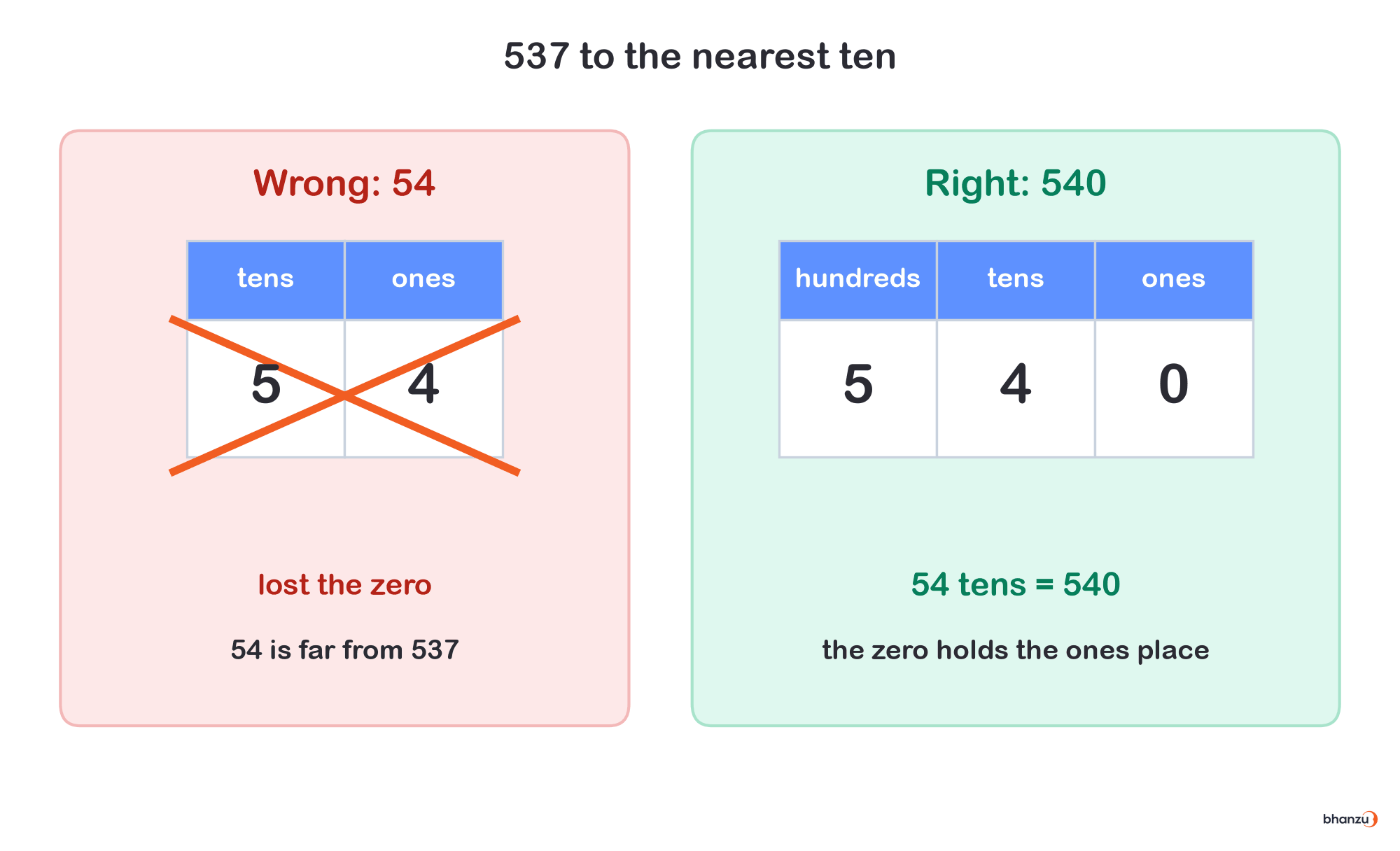
Children who think in tens often write 54 when they mean 54 tens, because 54 is the number they just said out loud. A size check catches it, since 54 is nowhere near 537.
Mistake 3: Rounding twice
Where it slips in: Nearest-hundred problems after a page of nearest-ten practice, especially numbers ending in 45 to 49.
Don't do this: Rounding 749 to 750, then rounding 750 up to 800.
The correct way: Round once, from the original number. The tens digit of 749 is 4, so 749 rounds to 700.
The nearest-ten habit runs first and moves 749 onto the halfway mark, 750, which then rounds up.
The part of rounding nobody explains
The 5-or-more rule has reasons you can check.
- Why 5 goes up. From 460 to 469 there are ten numbers, and endings 0 to 4 stay with 460 while endings 5 to 9 move to 470. The halfway agreement makes the two teams the same size.
- Why one digit is enough. Nothing after the deciding digit can carry a number past halfway, so 449 still rounds to 400.
- When not to round. 467 cans rounds to 500, yet a class with a 500-can goal is still 33 cans short.
School math rounds halfway numbers up, but the NIST guide to SI units (2008) keeps an even digit at an exact tie. By that rule, 250 would round to 200, not 300.
It is a little strange that 467 is about 500 and also less than 500. Both are true, because they answer different questions.
Key Takeaways
- Count the tens or hundreds first, since only that count or the next one up can be the answer.
- A number exactly halfway, like 465 or 350, is a tie, and school math breaks it by going up.
- When a 9 rolls over, trade 10 tens for a new hundred.
- Use rounding to the nearest 10 or 100 for about-how-many questions, and keep exact counts for goals.
- For more practice with numbers like 298 that climb into a new hundred, explore Bhanzu's elementary math tutor sessions or the 3rd grade math curriculum.
Read More
- Estimating to the Nearest Ten and Hundred
- Subtracting Within 1,000
- Multiplying by Multiples of 10
- Rounding Multi-Digit Numbers
- Rounding Decimals
Research Behind This Article
- Common Core State Standards Initiative, Grade 3: Number and Operations in Base Ten (2010). thecorestandards.org
- National Assessment Governing Board, Mathematics Framework for the 2026 National Assessment of Educational Progress (2019). nagb.gov
- Siegler and Opfer, The Development of Numerical Estimation: Evidence for Multiple Representations of Numerical Quantity (2003). pubmed.ncbi.nlm.nih.gov
- OpenStax, Prealgebra 2e: 1.1 Introduction to Whole Numbers (2020). openstax.org
- Internal Revenue Service, 1040 (2025) Instructions: Rounding Off to Whole Dollars (2026). irs.gov
- National Institute of Standards and Technology, NIST Guide to the SI, Appendix B: Conversion Factors (2008). nist.gov
Quick Quiz: Check Yourself
Three levels, new numbers every time. Easy rounds to the nearest ten. Medium rounds to the nearest hundred, climbs past a 9, or finds the least or greatest number that rounds to a hundred. Hard brings mystery-digit puzzles and the round-twice trap.
Was this article helpful?
Your feedback helps us write better content
Frequently Asked Questions
Are rounding and estimating the same thing?
What is the largest whole number that rounds to 100?
What grade do kids start rounding numbers?
How do you teach rounding to 3rd graders?
Can anything be rounded?