Key Points
- Estimating to the nearest ten and hundred replaces a number with its closest multiple of 10 or 100, so 271 is about 300.
- A digit of 5 or more just right of the rounding place means round up, and 4 or less means round down.
- Rounding 245 twice, to 250 and then 300, lands on the wrong hundred, since 245 is closer to 200.
The book that is about 300 pages
Ask how long a chapter book is, and someone will say about 300 pages. The real book might have 271, and nobody is fibbing. They swapped 271 for the closest hundred, which is easier to hold in your head.
That swap is called estimating. Later in 2nd grade, a quick about-answer like this tells you whether a big sum or difference makes sense.
What is estimating to the nearest ten and hundred?
Estimating to the nearest ten and hundred means finding the ten or hundred closest to a number on a number line, then using it instead. A ten here means a multiple of ten, a number you say when counting by 10s, like 30 or 40. An estimate is a close, easy number chosen on purpose.
Rounding to the nearest 10 or 100 is a 3rd grade skill, Common Core standard 3.NBT.A.1, so your child's work now is a head start. In a 2023 study that followed 332 children from first into second grade, the children already knew that a good estimate lands close to the exact answer without matching it.
How do you round to the nearest ten?
To round to the nearest ten, find the two tens around your number and move to the closer one. Try it with 38.
- Find the tens on each side by skip counting by 10s. 38 sits between 30 and 40.
- Mark the halfway point, 35, the number exactly in the middle.
- Count the distance. 38 is 2 steps from 40 and 8 steps from 30.
- Move to the closer ten. 38 rounds to 40.
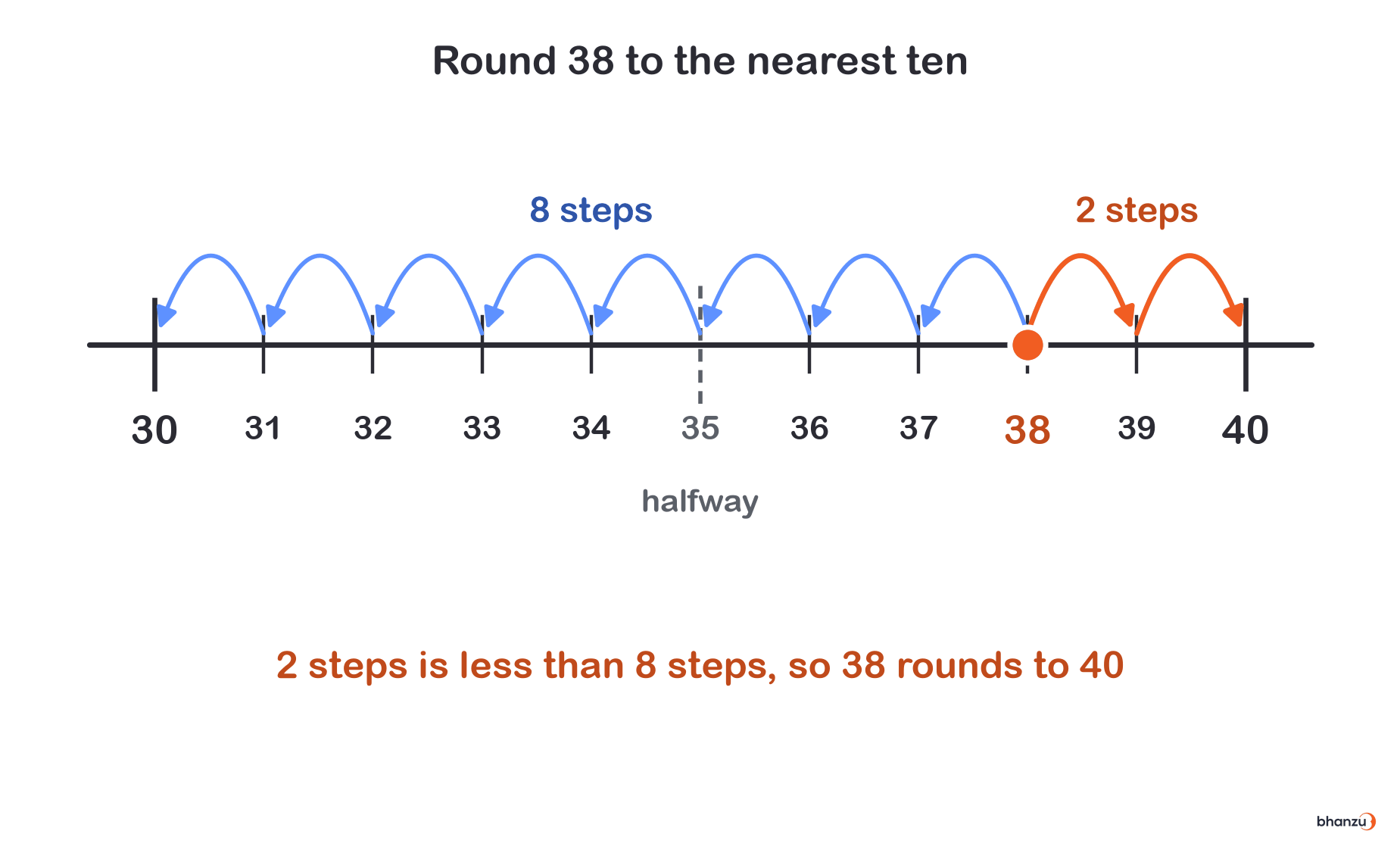
Moving to the higher ten, like 38 to 40, is rounding up. Moving to the lower ten, like 73 to 70, is rounding down. A faster way looks only at the ones digit (the digit on the far right).
| Ones digit | What to do |
|---|---|
| 0, 1, 2, 3 or 4 | Round down to the lower ten |
| 5, 6, 7, 8 or 9 | Round up to the higher ten |
The shortcut is quicker, but drawing the line, as you do when adding and subtracting on a number line, shows why it works. Children rounding 38 often count all eight ticks up from 30 before noticing 40 is two ticks away.
A number ending in 5 sits exactly halfway, like 35, which is 5 from both 30 and 40. School math settles the tie by rounding up, so 35 rounds to 40 and 95 rounds to 100. The numbers 35 to 44 are the team that rounds to 40.
How do you round to the nearest hundred?
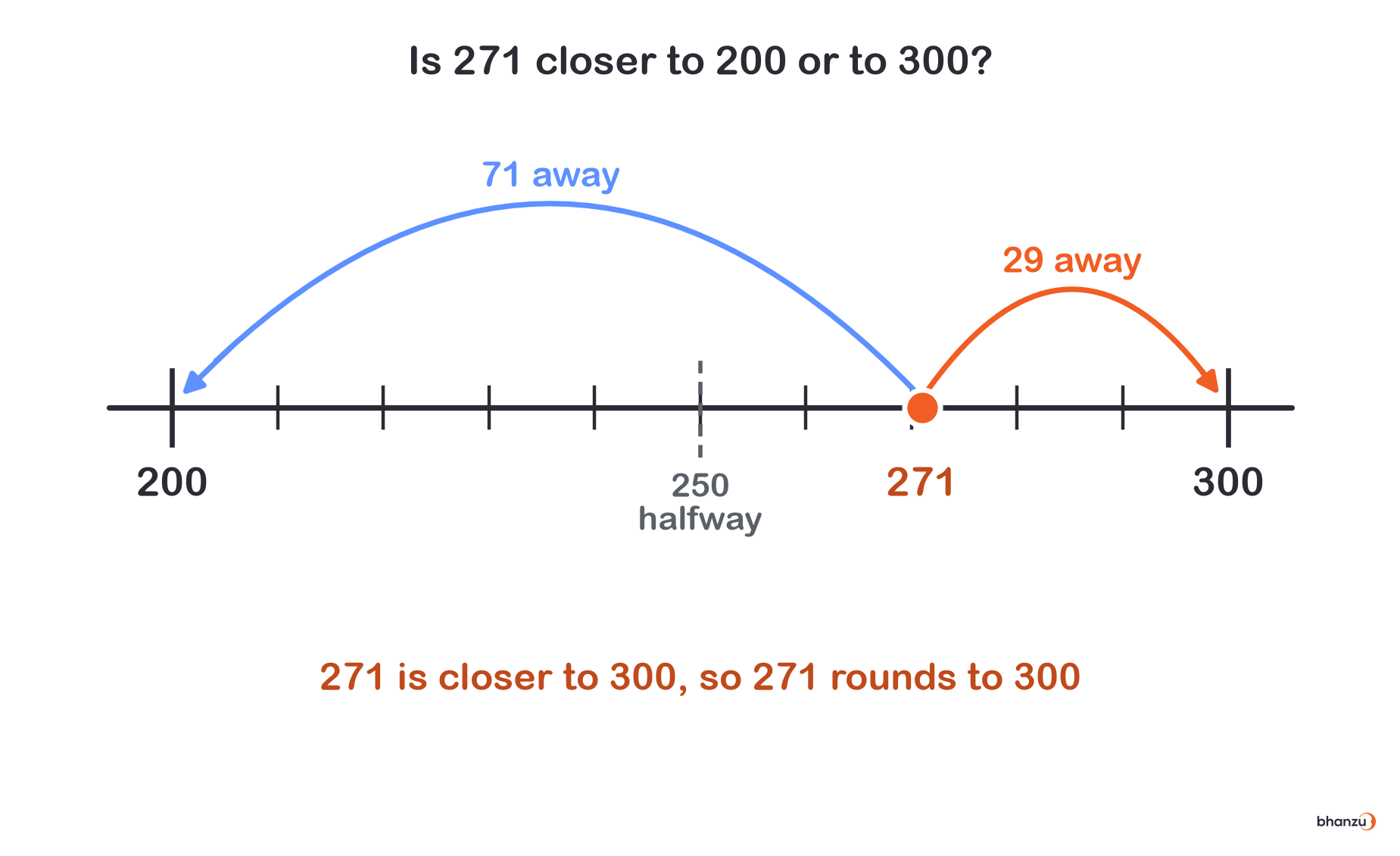
Rounding to the nearest hundred is the same move with hundreds, the numbers you say counting by 100s. The halfway point ends in 50.
- Find the hundreds on each side. 271 sits between 200 and 300.
- Mark the halfway point, 250.
- Count the distance. 271 is 29 away from 300 and 71 away from 200.
- Move to the closer hundred. 271 rounds to 300.
For hundreds, the tens digit (just left of the ones) decides, and 5 or more rounds up, so 249 rounds to 200, while 250 rounds to 300.
| Number | Nearest ten | Nearest hundred |
|---|---|---|
| 528 | 530 | 500 |
| 683 | 680 | 700 |
| 715 | 720 | 700 |
In 4th grade, the same move works for thousands.
Try It Yourself
Drag the orange marker or press the arrow keys to see how far your number is from each neighboring ten. Switch to Nearest 100 and stop on a halfway number such as 250. Then tap New number and pick the ten or hundred it rounds to.
How do you use an estimate to check an answer?
Round each number to its own nearest ten or hundred, then add or subtract the rounded numbers. An exact answer far from that estimate has gone wrong somewhere. In a 2022 study, most of 88 fourth graders in Germany rounded this way, even when one number went up and the other down.
Check with the nearest hundred.
The exact answer, 323, is close to 300, so the work for subtracting three-digit numbers looks reasonable.
In math word problems, these words tell you which answer to give.
| Words in the problem | What it asks you to do |
|---|---|
| about, around, roughly | Round, then add or subtract |
| estimate | Round each number first |
| exactly, in all | Find the exact answer |
| Does the answer make sense? | Estimate, then compare |
A child who works out the exact sum when a question asks "about how many" has done extra work.
Examples of estimating to the nearest ten and hundred
Example 1
Leo read 73 pages this week. Round 73 to the nearest ten.
73 sits between 70 and 80, and the halfway point is 75.
73 is 3 away from 70 but 7 away from 80, so it rounds to 70.
Example 2
The whole school read 462 pages. Round 462 to the nearest hundred.
The tempting move is to keep the 4 hundreds and drop the rest, which gives 400.
That cannot be right. 462 is 62 away from 400 but only 38 away from 500, because it has passed the halfway point, 450.
Use the tens digit instead. It is 6, so 462 rounds up to 500.
Example 3
Which whole numbers round to 60 when you round to the nearest ten?
55 is halfway between 50 and 60, and halfway numbers round up, so 55 is the smallest.
65 is halfway between 60 and 70 and rounds up to 70, so 64 is the largest.
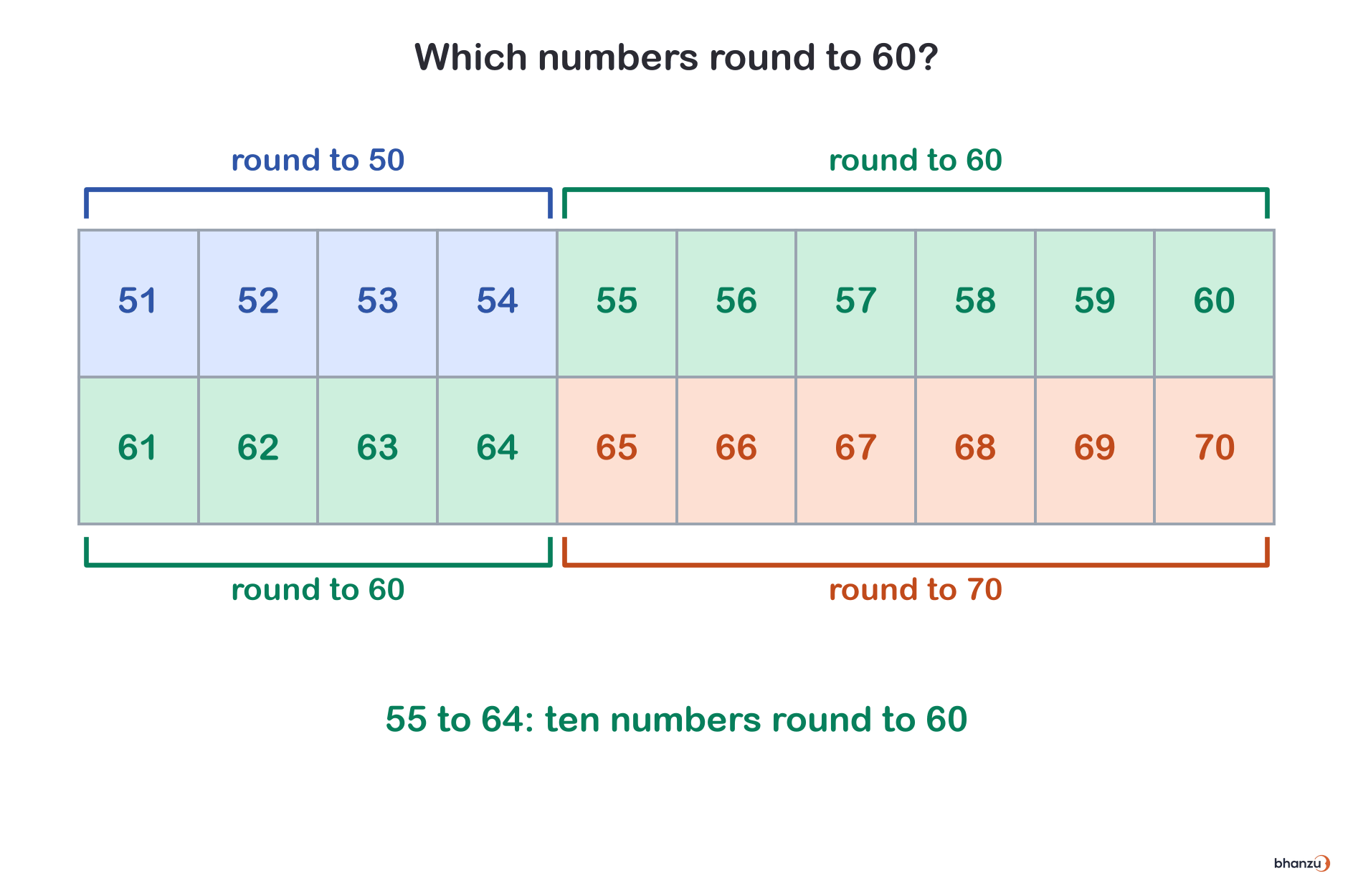
The team is 55 to 64, ten numbers in all.
Example 4
Sam adds 57 + 26 and gets 713. Use an estimate to check it.
57 rounds to 60, and 26 rounds to 30.
713 is nowhere near 90, so it cannot be right. The exact sum is 83, which is close to the estimate.
Example 5
Noah pays for a 58-cent juice and a 29-cent apple with 1 dollar. Estimate to the nearest ten. Is 1 dollar enough, and about how much change will he get?
58 rounds to 60, and 29 rounds to 30, so the estimate is 90 cents.
90 cents is less than 100 cents, so 1 dollar is enough, with about 10 cents of change.
The exact total is 87 cents, so the real change is 13 cents.
Why do people round numbers?
People round because an exact number often carries more detail than a job needs. A rounded number fits in your head.
- It makes mental math possible. is quick mental math, while takes more steps.
- It catches mistakes. An answer in the 700s cannot come from adding two numbers under 100.
- It answers "about how many" questions. Some counts keep changing, like the crowd at a ball game.
Checking that 1 dollar covers a juice and an apple before you reach the counter is rounding at work. In 3rd and 4th grade, you may meet another estimating tool called compatible numbers.
What most guides get wrong about rounding
Few guides say what "round down" really does. It keeps the tens digit and turns the ones into 0, so 73 becomes 70, not 60. The name is confusing, because the tens digit does not move at all.
Guides also skip why halfway numbers go up. 85 is 5 from both 80 and 90, and the OpenStax Prealgebra textbook explains that mathematicians agreed to round such ties up. A measurement guide from NIST keeps an even digit instead, so by its rule 85 would become 80, not 90.
Where students trip up on rounding and estimating numbers
Mistake 1: Rounding a halfway number down
Where it slips in: Numbers ending in 5 for tens, or in 50 for hundreds.
Don't do this: Rounding 65 to 60, or 750 to 700.
The correct way: Halfway numbers round up, so 65 rounds to 70 and 750 rounds to 800.
65 really is 5 away from both 60 and 70. Children often point at the halfway tick, call it a tie, and pick the smaller ten because down feels safer.
Mistake 2: Rounding twice to reach the hundred
Where it slips in: Rounding to the nearest hundred right after nearest-ten practice.
Don't do this: Rounding 245 to 250, then 250 to 300.
The correct way: Round once, from the starting number. 245 is 45 away from 200 and 55 away from 300, so it rounds to 200.
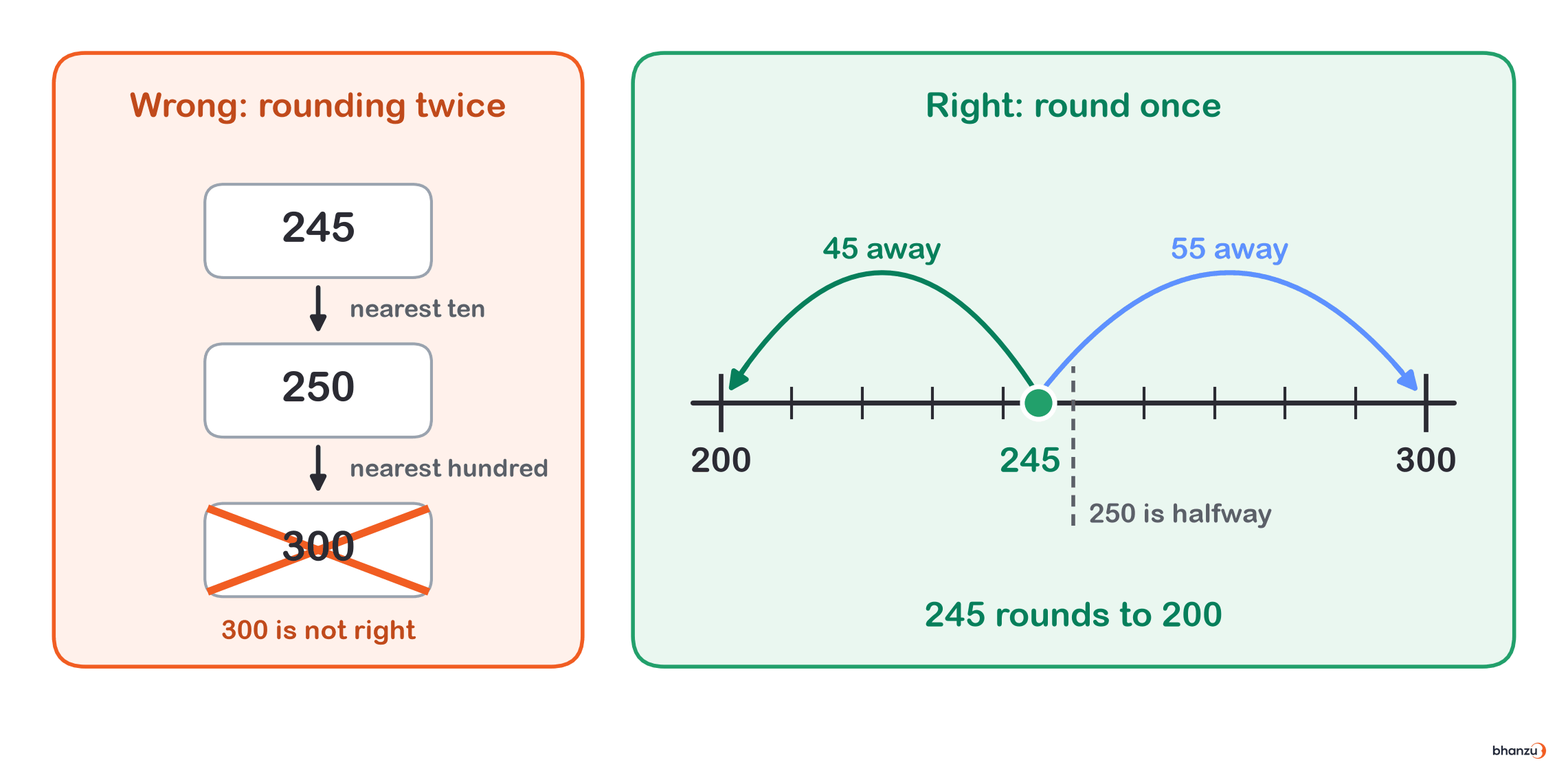
A child who rushes to the ones digit out of habit gets 250 first, and that halfway number then rounds up to 300.
Mistake 3: Calling a guess an estimate
Where it slips in: "About how many" questions, like Examples 4 and 5.
Don't do this: Saying is "about 100" because it feels like a lot.
The correct way: Round first. , and the exact sum, 54, is close to it.
In everyday talk, "estimate" and "guess" sound alike, so the rounding step gets skipped. A guess has no reason behind it, while an estimate comes from the real numbers.
Key Takeaways
- Find the two neighbors first, since the digit shortcut only speeds up that choice.
- A halfway number, like 65 for tens or 750 for hundreds, is a tie that school math settles by going up.
- Estimating to the nearest ten and hundred before you add or subtract makes a wrong exact answer stand out.
- For more practice choosing the closer hundred instead of rounding twice, explore Bhanzu's 2nd grade math curriculum or math programs for elementary.
Read More
- Rounding to the Nearest 10 or 100
- Estimating Sums and Differences
- Counting Money and Money Word Problems
- Adding Three-Digit Numbers
- Estimating Length
- Mental Math for Kids
Research Behind This Article
- Common Core State Standards Initiative, Grade 3: Number and Operations in Base Ten (2010). thecorestandards.org
- Elke Sekeris and colleagues, The Development of Computational Estimation Strategies: A Longitudinal Study with 6- to 7-Year-Olds (2023). eric.ed.gov
- Sebastian Poloczek and colleagues, Children's Mixed-Rounding Strategy Use in Computational Estimation (2022). eric.ed.gov
- OpenStax, Prealgebra 2e: 1.1 Introduction to Whole Numbers (2020). openstax.org
- NIST, Guide for the Use of the International System of Units (SI), Special Publication 811 (2008). nist.gov
- Julie L. Booth and Robert S. Siegler, Developmental and Individual Differences in Pure Numerical Estimation (2006). eric.ed.gov
Quick Quiz: Check Yourself
Three levels, new numbers every time: round to the nearest ten, round to the nearest hundred or find the smallest or largest number that rounds to a ten. The top level estimates sums, differences and change.
Was this article helpful?
Your feedback helps us write better content
Frequently Asked Questions
Is estimating the same as rounding?
What is 100 rounded to the nearest ten?
What grade do kids learn rounding numbers?
How can I teach rounding to the nearest 10 at home?
Why is estimating important in elementary school?