Key Points
- Estimating sums and differences turns into , an estimate of 700 that sits 8 from the exact 692.
- Rounding to hundreds moves each number 50 or less, so a two-number estimate stays within 100 of the exact answer, or 10 for tens.
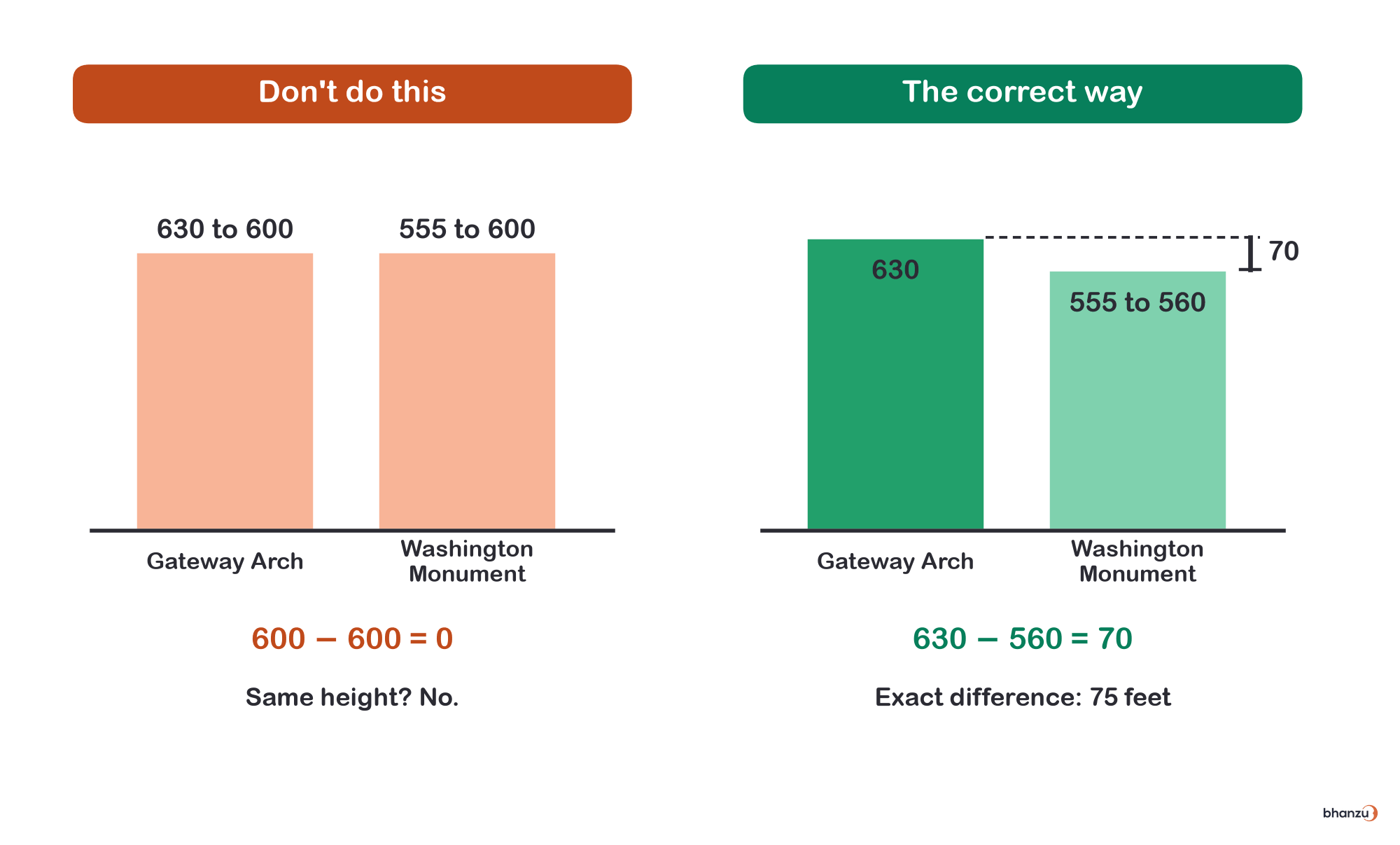
- Close heights such as 630 and 555 feet both round to 600, so nearest hundred calls the gap 0 feet, while tens give 70 feet.
- Common Core standard 3.OA.D.8 asks 3rd graders to judge whether answers are reasonable using estimation strategies, including rounding.
A tower made of two landmarks
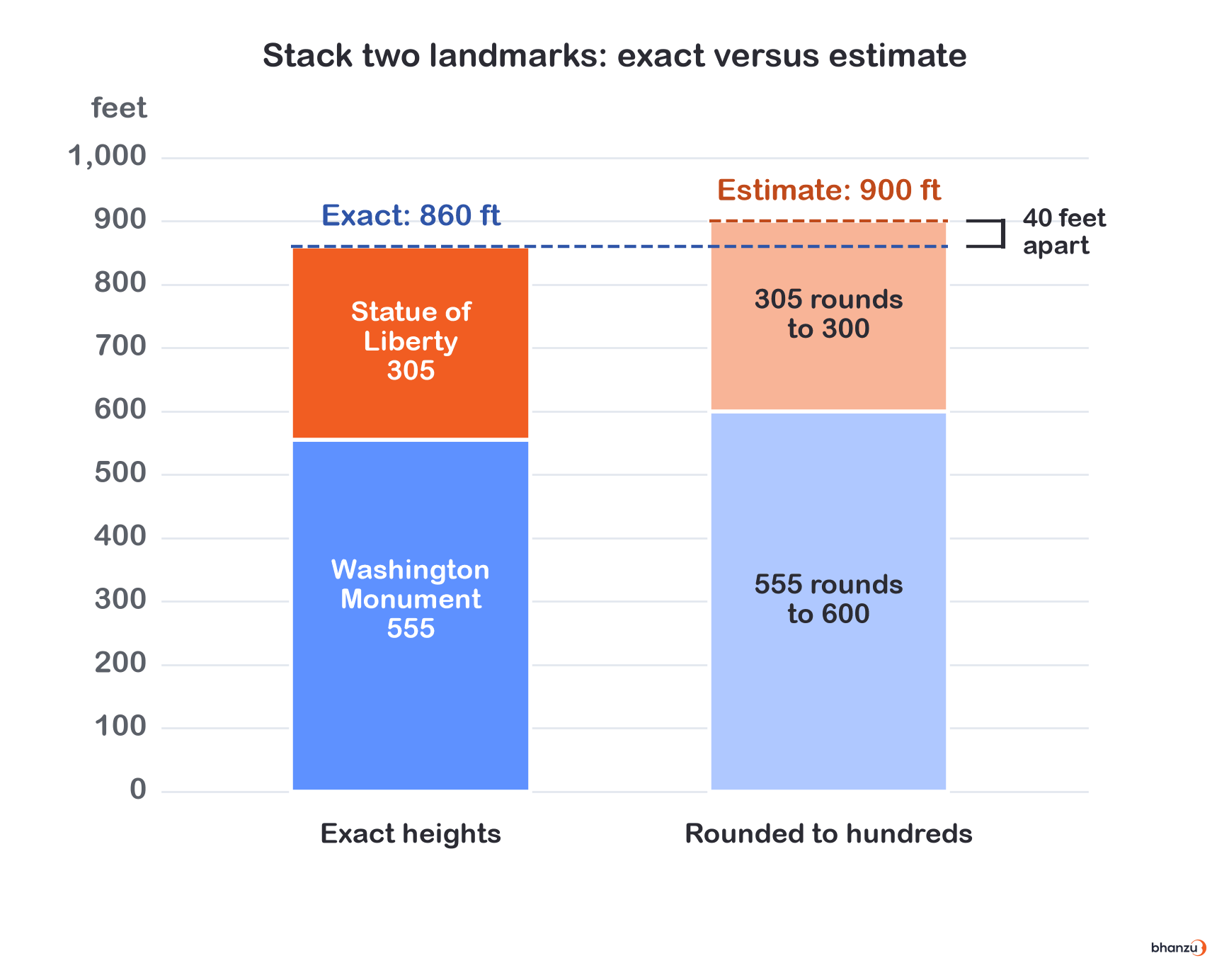
The Statue of Liberty stands 305 feet from the ground to its torch. The Washington Monument stands 555 feet. Both are whole-foot heights from the National Park Service: its 2024 statue statistics and a 2022 history page.
Stack one on the other, and you can size up that tower in your head. 305 is close to 300 and 555 is close to 600, so it would be about 900 feet.
Added exactly, the whole-foot heights make 860 feet, only 40 feet below the estimate. In 4th grade, you'll use this same move on longer story problems.
How do you estimate sums and differences?
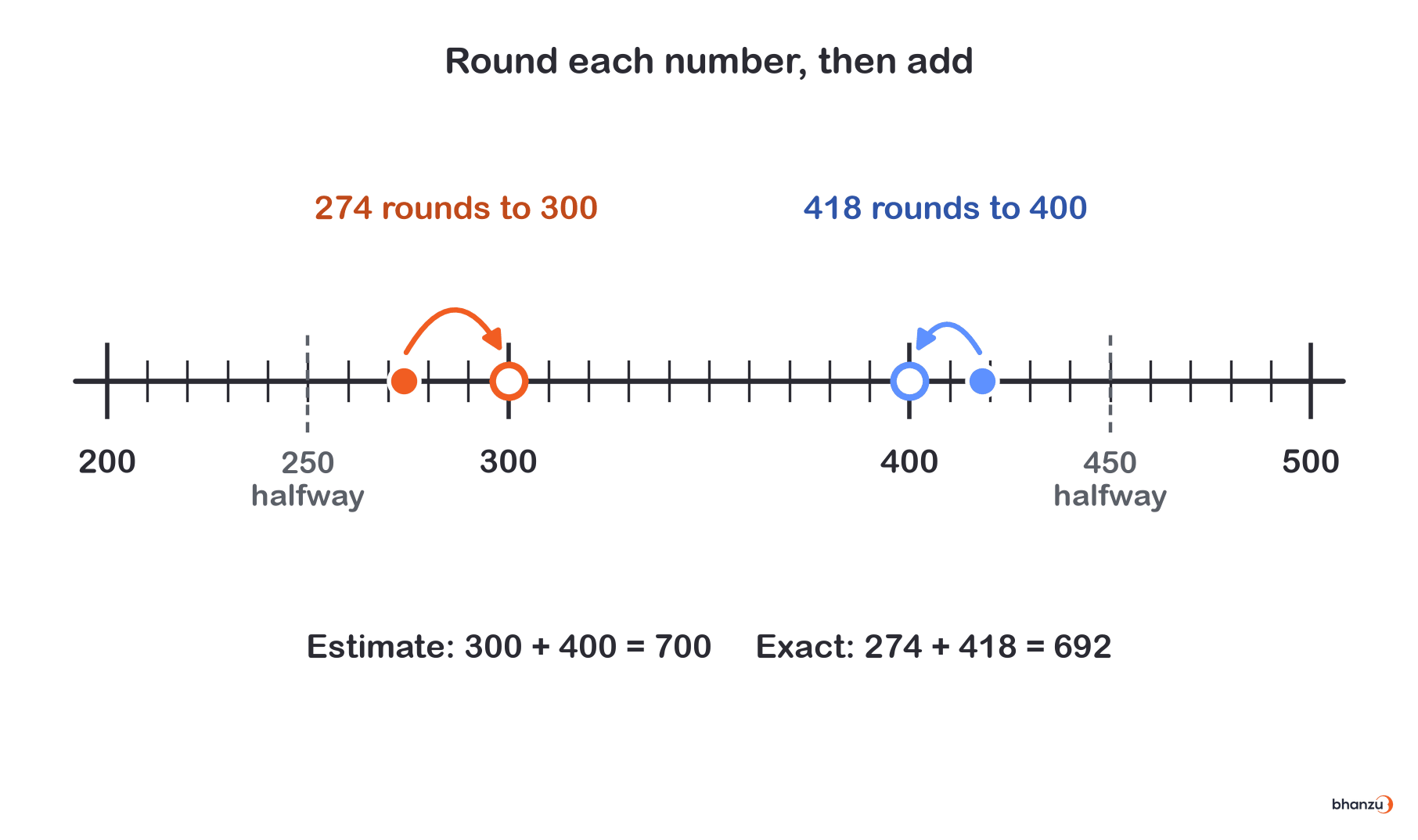
Estimating sums and differences takes two moves: change each number to a friendly number (an easy one, such as 300), then add or subtract. Rounding is the usual way to get one. An estimate is a close answer that is quick to find.
A number line, a straight line with numbers spaced evenly, shows which friendly number is nearer. A sum is the answer to an addition. A difference is the answer to a subtraction, and rounding to the nearest 10 or 100 moves a number to the closest ten or hundred.
- Pick the nearest ten or the nearest hundred.
- Round each number to that place.
- Add or subtract the rounded numbers.
For , 274 is nearer 300 and 418 is nearer 400.
The exact sum is 692. Some books write , where the wavy sign means about.
This skill sits in Common Core standard 3.OA.D.8, which asks children to judge whether answers are reasonable. It leans on 3.NBT.A.1 for rounding and 3.NBT.A.2 for adding and subtracting.
By the end of 3rd grade, your child should add and subtract within 1,000 and use a rounded estimate to judge whether an answer makes sense. Some classes start estimating to the nearest ten and hundred in 2nd grade, but Common Core first lists rounding in 3rd grade.
When estimating, what do you round to?
Round to the nearest hundred for a fast check. Round to the nearest ten for a closer estimate, or when the numbers sit close together.
| Problem | Nearest hundred | Nearest ten | Exact |
|---|---|---|---|
In the second row, 451 moved up 49 and 349 moved down 49, which stretched the estimate to 200. The real gap is only 102. Children who have just learned the nearest hundred often use it everywhere, even when the two numbers sit close together.
Front-end estimation keeps only the first digit of each number, so becomes this.
For a sum, front-end can only come out too low (or exact, if the dropped parts are zeros). The leftovers, 86 and 47, make about 130, so a better estimate is about 630.
School math rounds halfway numbers such as 450 up, though some science work breaks ties differently.
What are compatible numbers?
Compatible numbers are nearby numbers that are easy to add or subtract in your head, such as 475 and 125. Look for endings that make a hundred together, like 25 and 75, or 40 and 60.
For , nudge the numbers to 475 and 125.
The exact sum is 601. For , nudge to 750 and 250.
The exact difference is 504, while nearest hundred would say , which is 96 away.
Compatible numbers turn the estimate into mental math, math done in your head. They are a choice, so two children can pick different pairs and both be right (one might use 470 and 130). Rounding to the same place gives everyone the same estimate.
How do you know an answer is reasonable?
An exact answer is reasonable when it lands close to your estimate, and "close" has a size. Rounding to hundreds moves each number 50 or less, so with two numbers the answer stays within 100 of the estimate. That window is the reasonable zone.
With tens, the zone shrinks to 10, and each extra number you round adds 50 more room, or 5 for tens. An answer inside the zone could still be wrong, so check one near the edge, like 605 for an estimate of 700, with tens.
- Make the estimate first.
- Solve exactly, by adding within 1,000 or subtracting.
- Find the gap between the answer and the estimate.
- If the gap is bigger than the zone, check again.
Say a page shows , with a hundred lost while regrouping. The estimate is 148 away from 652, more than the zone allows, so look again. The real sum, 752, is 48 away.
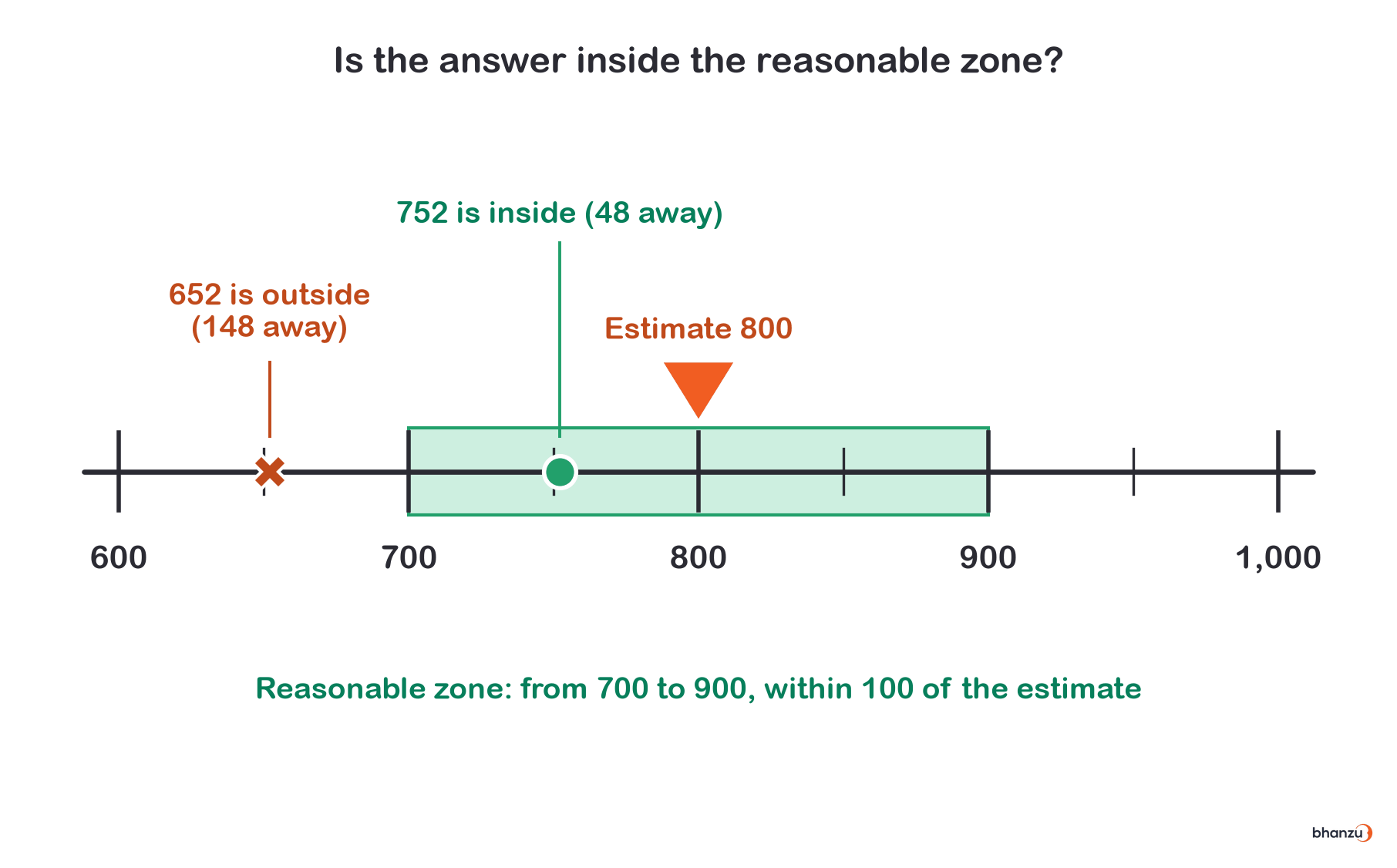
Some children erase a correct 752 because it does not equal 800. An estimate is meant to land near the answer, not on it.
Story words tell you which operation to use, and they matter most in two-step word problems.
| Words in the problem | Math it means |
|---|---|
| "about how many" | round first, then add or subtract |
| "how much taller" or "how many more" | subtract |
| "gave away" | subtract |
| "got" or "new ones" | add |
| "is there enough" | compare the total with the limit |
Try It Yourself
Drag the blue and orange dots (or use the arrow keys), then pick Add or Subtract and a rounding place. Each number hops to its rounded value. Press Show a slip to see whether an answer off by 100 lands outside the reasonable zone around the estimate.
Examples of estimating sums and differences
Example 1
Estimate by rounding each number to the nearest ten.
48 rounds to 50, and 37 rounds to 40.
The estimate is about 90. The exact sum, 85, is 5 away.
Example 2
Estimate to the nearest hundred and to the nearest ten. Which estimate is closer to the exact difference, 444?
To the nearest hundred, 712 rounds to 700 and 268 rounds to 300.
To the nearest ten, 712 rounds to 710 and 268 rounds to 270.
The nearest-ten estimate wins. It sits 4 from 444, while 400 sits 44 away.
Example 3
Leo says . Is his answer reasonable?
The tempting move is to call 605 right because it lands inside the nearest-hundred zone.
Leo's 605 is 95 from 700, inside the zone of 100, so it looks fine.
Now look at the parts. The hundreds make , and the leftovers 38 and 67 add to more than 100. So the sum must top 700, and 605 cannot be right.
Round to the nearest ten instead.
Leo's 605 is 105 from 710, far outside the zone of 10, so the nearest-ten check shows it cannot be right. Adding again gives 705.
Example 4
Use compatible numbers to estimate .
524 and 276 sit close to 525 and 275, which make an even hundred, and 148 is close to 150.
The estimate is about 950, and the exact sum is 948.
Example 5
The Gateway Arch is 630 feet tall, and the Statue of Liberty is 305 feet tall to its torch. About how much taller is the arch?
The park's 2026 FAQ page lists the Gateway Arch at 630 feet. "How much taller" means subtract.
With tens, 305 rounds up to 310.
The arch is about 300 feet taller, or 320 with tens. The exact difference is 325 feet.
Example 6
A school library had 836 books. It gave away 278, then got 154 new ones. About how many books does it have now, and is Sam's count of 712 reasonable?
"Gave away" means subtract, and "got" means add. To the nearest hundred, the numbers are 800, 300 and 200.
The library has about 700 books. Three rounded numbers allow 150 of room, and 712 is only 12 away, so Sam's count is reasonable. The exact steps, and , agree.
Why is estimation important in math?
Estimation tells you about how much without every digit, and it catches big mistakes early.
- It tells you when to count exactly. Classes of 268 and 345 head to a 600-seat auditorium, and lands right at the limit, so the estimate cannot decide. Counting exactly gives 613, so 13 students need other seats.
- It checks a calculator. One missed key turns into , nowhere near 900.
- It works without paper. Numbers like 300 and 600 add in your head, even in a store line.
In 4th grade the same moves check products and quotients. In 5th grade they check decimal sums.
The easy-to-make errors (and how to catch them)
Mistake 1: Rounding your answer instead of the numbers
Where it slips in: Checking an answer you already worked out, as in Example 3. A child who rushes to the exact answer often rounds it and calls that the estimate, so a wrong answer checks itself.
Don't do this: Work out as 734 (a lost hundred), round 734 to 700 and call it checked.
The correct way: Round the numbers first. The estimate is 166 away from 734, so add again and get 834.
Mistake 2: Rounding close numbers to the nearest hundred
Where it slips in: Differences of two close numbers. Rounding to the biggest place becomes a habit, and some lessons teach it as the rule.
Don't do this: Round the Gateway Arch's 630 feet and the Washington Monument's 555 feet to 600 each, so and they seem equal.
The correct way: Round to the nearest ten. The estimate sits close to the exact 75 feet.
Mistake 3: Adding when the story asks how many more
Where it slips in: "About how many more" or "how much taller" stories, as in Example 5. The word "more" sounds like adding.
Don't do this: Diego read 412 pages and Aisha read 289. Asked how many more Diego read, add .
The correct way: "How many more" compares two amounts, so subtract. The estimate is , or with tens, and the exact answer is 123.
The pattern hiding inside estimating sums and differences
With two numbers, the exact answer always has the same number of hundreds as the nearest-hundred estimate, or one fewer. An estimate of 800 means an answer in the 700s or 800s, so 652 for fails at a glance. That follows from the zone, which reaches 100 below the estimate but less than 100 above.
The pattern has a blind spot. A mistake in the tens, such as 742 for 752, keeps the 7 hundreds, so switch to tens.
That estimate sits 18 from 742, more than 10, and the mistake shows.
A 2006 study of 315 third graders gives parents a clue. Skill with basic number facts was one of several abilities that predicted how well children estimated. If estimates come slowly, it can help to check facts such as inside first.
Key Takeaways
- Make the estimate before you solve, so the check cannot copy a wrong answer.
- Allow 50 of room for each number rounded to a hundred, and 5 for each one rounded to a ten.
- When two numbers sit close together, like 630 and 555, switch to tens before you subtract.
- Estimating sums and differences fits any "about how many" story, and an estimate right at a limit means count exactly.
- For more practice making estimates that catch a lost hundred, explore Bhanzu's 3rd grade math curriculum or math classes for kids.
Read More
- Subtracting Within 1,000
- Relating Multiplication and Division
- Estimating Products and Quotients
- Estimating Decimal Sums and Differences
- Mental Subtraction
Research Behind This Article
- National Park Service, Statue Statistics (2024). nps.gov
- National Park Service, History and Culture: Washington Monument (2022). nps.gov
- Common Core State Standards Initiative, Grade 3 Operations and Algebraic Thinking (2010). thecorestandards.org
- Common Core State Standards Initiative, Grade 3 Number and Operations in Base Ten (2010). thecorestandards.org
- National Council of Teachers of Mathematics, Principles and Standards for School Mathematics: Number and Operations (2000). nctm.org
- Seethaler and Fuchs, The Cognitive Correlates of Computational Estimation Skill among Third-Grade Students (2006). eric.ed.gov
Quick Quiz: Check Yourself
Three levels, new numbers every time: estimate with two-digit numbers, then three-digit numbers, then story problems and is-it-reasonable checks.
Was this article helpful?
Your feedback helps us write better content
Frequently Asked Questions
Is estimating the same as rounding?
When should you estimate?
How can I help with estimating sums and differences in 3rd grade?
What are good estimating games for kids?
Where can I find estimating sums and differences worksheets?