Key Points
- Subtraction within 1000 is Common Core skill 3.NBT.A.2, where 3rd graders subtract fluently using strategies and algorithms based on place value.
- Regrouping trades 1 hundred for 10 tens or 1 ten for 10 ones, so 652 can become 5 hundreds, 14 tens and 12 ones.
- Moving both numbers by the same amount keeps their difference, so 700 minus 258 can become 699 minus 257, which needs no regrouping.
- Adding the answer back to the number taken away checks the work, as 265 plus 387 rebuilds 652.
The reading goal with three zeros
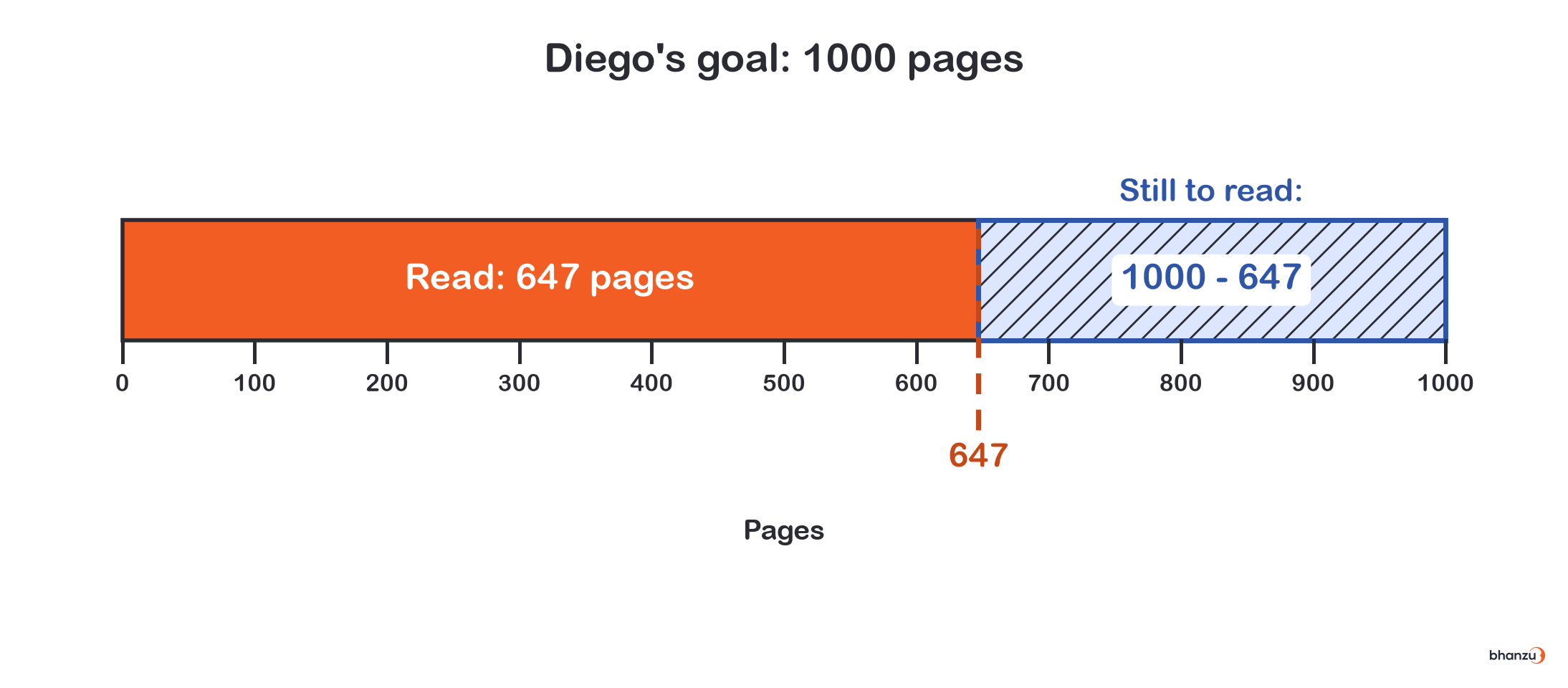
Diego's reading goal is 1000 pages, and he has read 647 so far. One way to find the pages left writes 1000 above 647 and crosses out three zeros, one after another.
Another way never regroups at all. Take 1 page off both numbers, and the problem turns into 999 minus 646, where every top digit is big enough. In 4th grade, you'll use these same moves on numbers in the thousands.
How do you subtract within 1000?
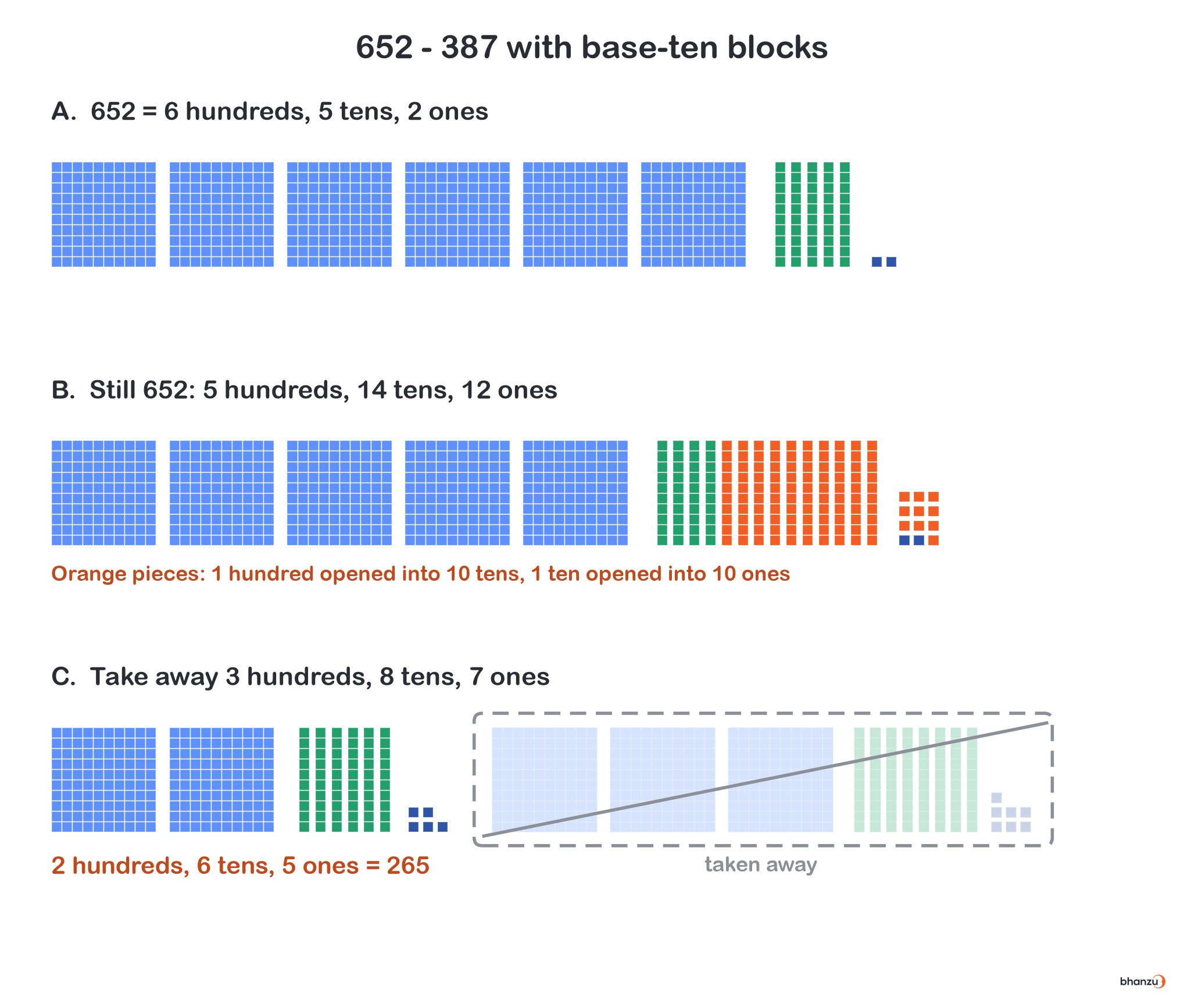
Subtraction within 1000 works one place value at a time, taking each bottom digit from the top digit above it. When a top digit is too small, you use regrouping, which means trading 1 of a bigger place for 10 of the next smaller place. Base-ten blocks show each trade (a flat is 10 rods, and a rod is 10 cubes).
Here is with blocks.
- Build 652 with 6 flats, 5 rods and 2 cubes.
- There are only 2 cubes, so open a rod to get 12 cubes and 4 rods.
- There are only 4 rods, so open a flat to get 14 rods and 5 flats (still 652).
- Take away 3 flats, 8 rods and 7 cubes. What's left makes 265, the difference, or answer to a subtraction.
Your child did this in 2nd grade with blocks and drawings, when subtracting three-digit numbers. In 3rd grade, Common Core standard 3.NBT.A.2 asks children to "fluently add and subtract within 1000," using strategies and algorithms based on place value.
In the 2025 long-term trend results from NAEP, the Nation's Report Card, 84% of 9-year-olds reached Level 200, where children can add two-digit numbers but are still learning to regroup in subtraction. So if your child still pauses before a trade, that is common at this age.
What is the standard algorithm for subtraction?
The standard algorithm is a fixed set of column steps that works for any two numbers within 1000 when the bigger one is on top. The 3rd grade standard says a range of algorithms may be used, and this column method is one of them.
- Line up the hundreds, tens and ones, with 387 under 652.
- In the ones, 2 is less than 7, so open a ten to make 12 ones. Then .
- In the tens, only 4 are left after that trade, so open a hundred to make 14 tens. Then .
- In the hundreds, 5 are left, and . The answer is 265.
In a 1982 report, researcher Kurt VanLehn studied 1,138 subtraction papers from classrooms that were mostly 3rd and 4th grade. The most common steady error by far skipped every trade and took the smaller digit from the larger one in each column. On 106 papers, it was the only error.
How do you subtract across zeros?
Subtracting across zeros adds one step, because a 0 on top has nothing to give. In , the ones need a trade but the tens digit is 0, so the trade starts at the hundreds.
Now , and , so . The 0 ends as a 9 only because the ones needed a trade.
How do you check subtraction with addition?
Add the answer to the number you took away. If you land back on the top number, the answer is right.
Adding back uses the same columns as adding within 1000, with trades running the other way.
For a second check, round to the nearest ten, so sits close to 265. Common Core standard 3.OA.D.8 asks 3rd graders to judge answers this way, the same habit behind estimating sums and differences.
Which 3rd grade subtraction strategies fit the numbers?
Look at the numbers before you pick a method. The right strategy can turn a problem full of trades into one with none.
A 1998 study by Thomas Carpenter and colleagues followed 82 children from 1st through 3rd grade, and about 90% used strategies they invented. Those who invented strategies before learning standard algorithms showed a stronger grasp of place value than those who started with algorithms.
- Break apart by place value. is , and , or 533. It stops working once any top digit is smaller.
- Count up on an open number line. For , hops of 7, 30 and 200 reach 800, so the difference is 237. It's quickest for round or close numbers, as in .
- Use the same change. becomes with no trades, because sliding both numbers 1 step left on a number line keeps the gap the same.
- Use the standard algorithm. It handles any pair, but it has the most steps.
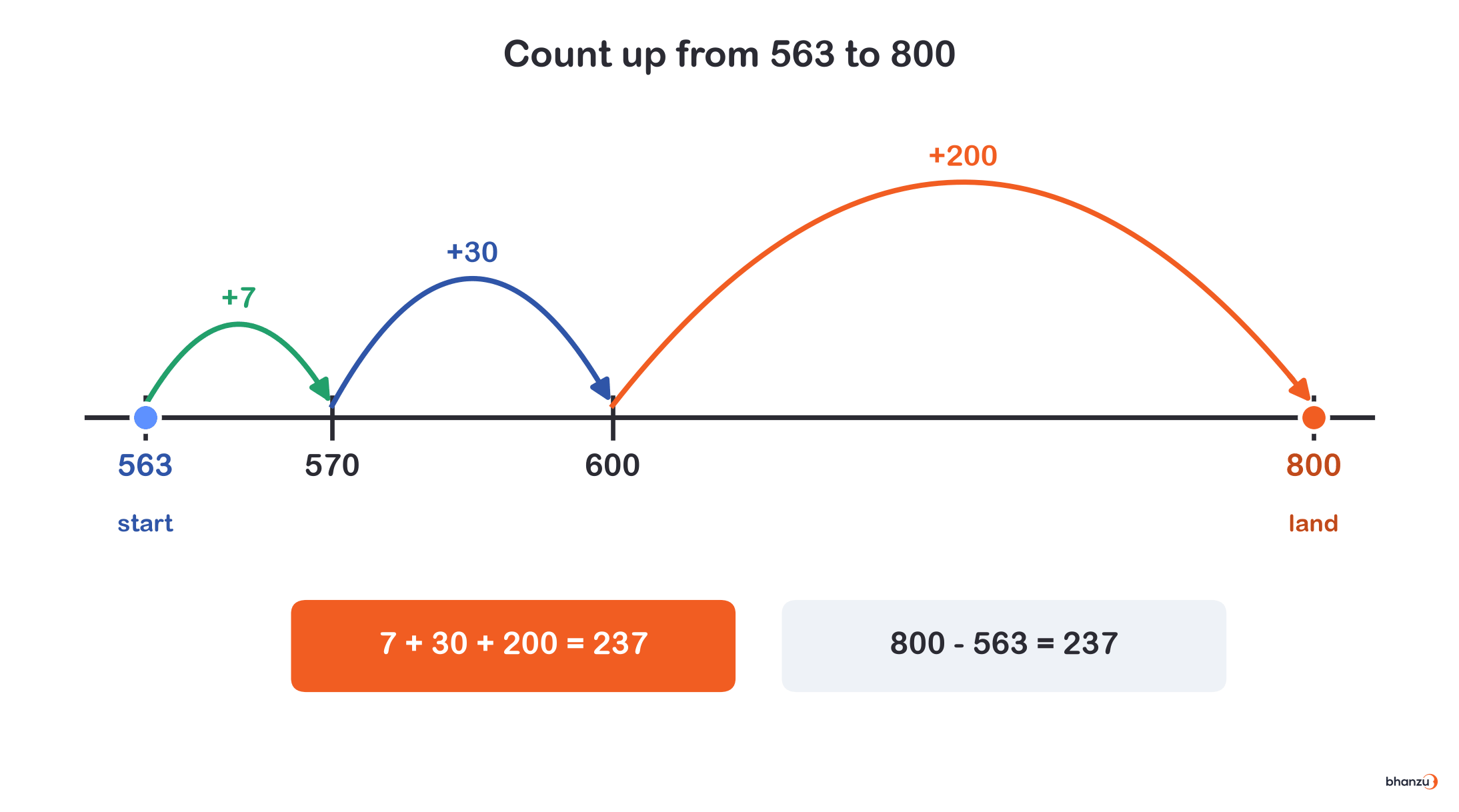
Counting up grows out of adding and subtracting on a number line from 2nd grade. The same change is a classic mental subtraction move (teachers call it compensation), and it works best when the top number ends in zeros. Children who learn the column method first often cross out all three zeros for , when a single hop of 1 finishes it.
A child who starts crossing out before reading the numbers misses shortcuts like that. In story problems, the numbers also hide inside words.
| Words in the problem | Math it means |
|---|---|
| How much more do they need? | The gap, $$600 - $347$ |
| In October and in November | Add first, |
| How many pages are left? | Goal minus pages read, |
| What number goes in the box in ? | The number taken away, |
Try It Yourself
Hop from the smaller number to the bigger one with the +100, +10 and +1 buttons, and your hops add up to the difference. When the top number ends in zeros, press Take 1 from both and watch the zeros disappear while the gap stays the same. Press New story for fresh numbers, and read the subtraction and its addition check when you land.
Examples of subtraction within 1000
Example 1
What is ?
No top digit is smaller, so break it apart by place value.
Together that makes 625. Check with addition, .
Example 2
What is ?
The tempting move takes the smaller digit from the bigger one in each column. That gives , and , or 444.
That can't be right, since , not 724. A nearest-ten estimate, , is far from 444 too.
Work from the ones instead, opening a ten and then a hundred to rename 724.
So , and .
Example 3
Use the same change to find .
Take 1 from both numbers, and no column needs a trade.
Check with addition, .
Example 4
What number goes in the box in ?
The box stands for the number taken away from 912 to leave 475, so find . Open a ten, then a hundred.
The box holds 437, and checks it.
Example 5
Priya's class needs $600 for a field trip and has raised $347. How much more do they need?
Find the gap, $$600 - $347$. The tens digit on top is 0, so open a hundred, then a ten.
They need $253 more, and $$253 + $347 = $600$ checks it.
Example 6
Diego read 288 pages in October and 359 pages in November. His goal is 1000 pages. How many pages are left?
Add the two months first.
Then subtract from the goal with the same change.
Diego has 353 pages left. Check with addition, .
Why does subtraction within 1000 matter?
Subtraction within 1000 answers one question, how far apart two amounts are. Every story in this lesson, from Diego's pages to Priya's field trip, asks that same thing.
- It measures the gap. Pages left to a reading goal and change from a $100 bill are the same question in two outfits.
- It checks itself. Addition undoes subtraction, so proves that .
- A trade never changes the amount. Trading one $100 bill for ten $10 bills keeps the same money, just as 1 hundred is still 10 tens.
Later grades reuse these same trades with 4-digit numbers and with dollars and cents, so the place-value thinking your child builds now keeps paying off for years.
Where do kids trip up on subtraction within 1000?
Mistake 1: Lining up a two-digit number on the left
Where it slips in: A three-digit number minus a two-digit number, such as . A child who copies numbers left edge first, the way words are written, puts the 6 under the 7.
Don't do this: Writing 6 under 7 and 8 under 0, which works out and gives 25.
The correct way: Line up the ones, so 8 sits under 5. Open a hundred, then a ten, to get 6 hundreds, 9 tens and 15 ones. Then , and , so .
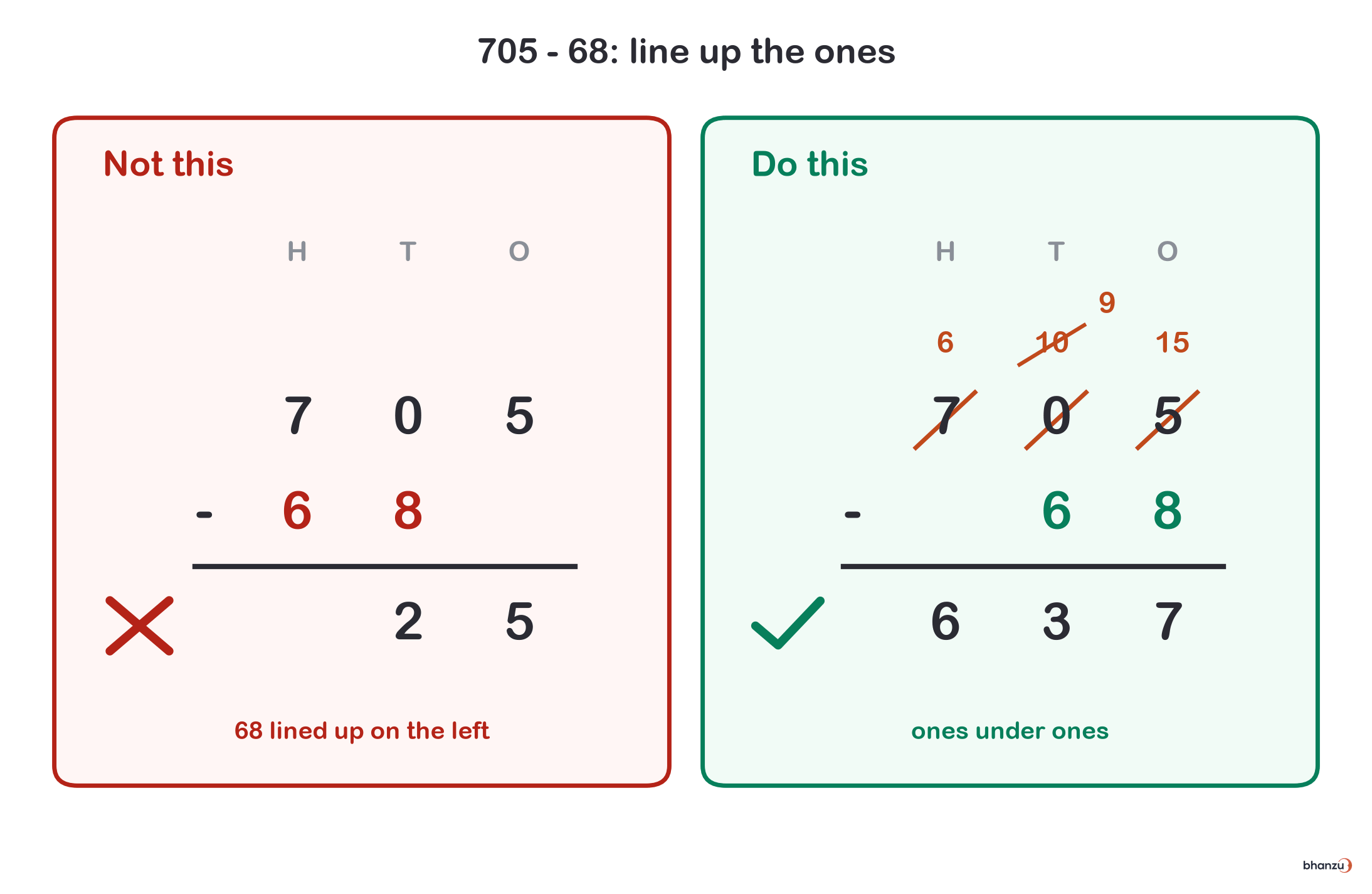
Adding back catches the wrong layout (25 plus 68 is only 93).
Mistake 2: Leaving the hundreds unchanged
Where it slips in: A two-digit bottom number that still needs a hundreds trade, such as . The empty spot under the hundreds looks finished, so children bring the top digit straight down and forget the hundred they opened.
Don't do this: Working and , then bringing the 8 straight down for 867.
The correct way: The tens trade opened a hundred, so the 8 became 7, and . Adding back proves it, since while is exactly 100 too many.
Mistake 3: Turning every zero of 1000 into 10
Where it slips in: 1000 minus a three-digit number, such as . Each zero gets fixed on its own, as if every column could borrow from nowhere.
Don't do this: Working , and for 724.
The correct way: One chain of trades turns 1000 into 9 hundreds, 9 tens and 10 ones. Then , and , so . The same change skips the chain, because needs no trades.
What most guides miss about subtraction within 1000
The word "fluently" in 3.NBT.A.2 asks for more than speed. A 2023 position statement from the National Council of Teachers of Mathematics defines procedural fluency as using procedures efficiently, flexibly and accurately. It also says timed quizzes do not measure fluency. Counting up for and using the algorithm for are both fluent choices, because each method fits its numbers.
The word compensation trips up adults too, because books use it for two different moves.
- Change one number, then fix the answer. , and adding the 1 back gives .
- Change both numbers the same way. becomes , with nothing to fix.
The same change in this lesson is the second move.
Key Takeaways
- Look at the numbers before choosing, since round or close numbers suit counting up and zeros suit the same change.
- In subtraction within 1000, a two-digit bottom number lines up under the ones, and the hundreds digit still drops by 1 when a hundred is opened.
- Sliding both numbers down by 1 never changes their difference, which turns any 1000-minus problem into a 999-minus problem with no trades.
- For more practice regrouping across zeros, with a teacher who spots a misplaced two-digit number, explore Bhanzu's 3rd grade math curriculum or elementary math tutor.
Read More
- Rounding to the Nearest 10 or 100
- Two-Step Word Problems
- Regrouping Hundreds, Tens and Ones
- Multi-Digit Subtraction
- Mental Math for Kids
Research Behind This Article
- Common Core State Standards Initiative, Grade 3 Number and Operations in Base Ten (3.NBT) (2010). thecorestandards.org
- National Center for Education Statistics, NAEP Long-Term Trend Mathematics: Performance-Level Results, Age 9 (2026). nationsreportcard.gov
- VanLehn, Kurt, Empirical Studies of Procedural Flaws, Impasses, and Repairs in Procedural Skills (1982). eric.ed.gov
- Common Core State Standards Initiative, Grade 3 Operations and Algebraic Thinking (3.OA) (2010). thecorestandards.org
- Carpenter, Thomas P., and colleagues, A Longitudinal Study of Invention and Understanding in Children's Multidigit Addition and Subtraction (1998). pubs.nctm.org
- National Council of Teachers of Mathematics, Procedural Fluency in Mathematics (2023). nctm.org
Quick Quiz: Check Yourself
Three levels, new numbers every time: one regroup or none, then two regroups, zeros and missing numbers, then money and two-step stories.
Was this article helpful?
Your feedback helps us write better content
Frequently Asked Questions
Does 3rd grade subtraction include regrouping?
How do you explain borrowing in subtraction?
How normal is it for a 3rd grader to struggle with subtraction?
How do you teach subtraction with regrouping at home?
How do you solve 3rd grade subtraction word problems?