Key Points
- Multiplying by multiples of 10 uses a times fact plus place value, so is 72 tens, or 720.
- The associative property regroups as , and multiplying 24 by 10 moves each digit one place left, giving 240.
- When the times fact already ends in 0, the product keeps both zeros, so is 400, never 40.
- Common Core standard 3.NBT.A.3 places one-digit numbers times 10 to 90 in 3rd grade, and 4th grade stretches the same steps to multiples of 100.
Seven fours and seven forties
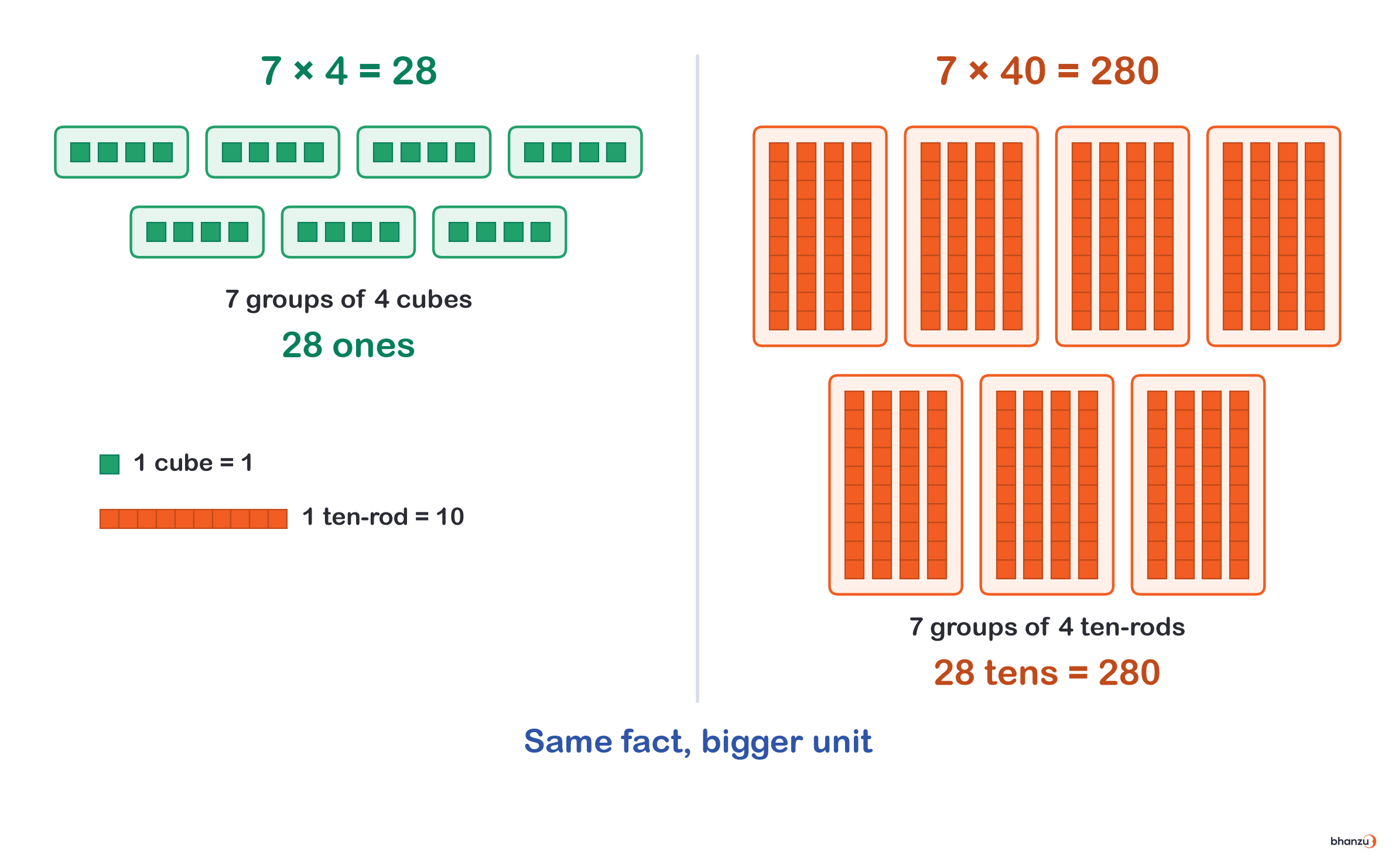
If you know that 7 times 4 is 28, you already know 7 times 40. Set out 7 groups of 4 cubes, and you have 28 cubes. Now swap every cube for a ten-rod (a stick of 10 cubes).
You still have 7 groups of 4, but every piece is worth ten, so you have 28 tens, or 280. Only the unit grew. Before long, you'll use the same idea to turn 4 hours into minutes in your head.
How do you multiply by multiples of 10?
Multiplying by multiples of 10 takes four short moves: read the multiple of 10 as tens, use the times fact, name the answer in tens, and write it as a number.
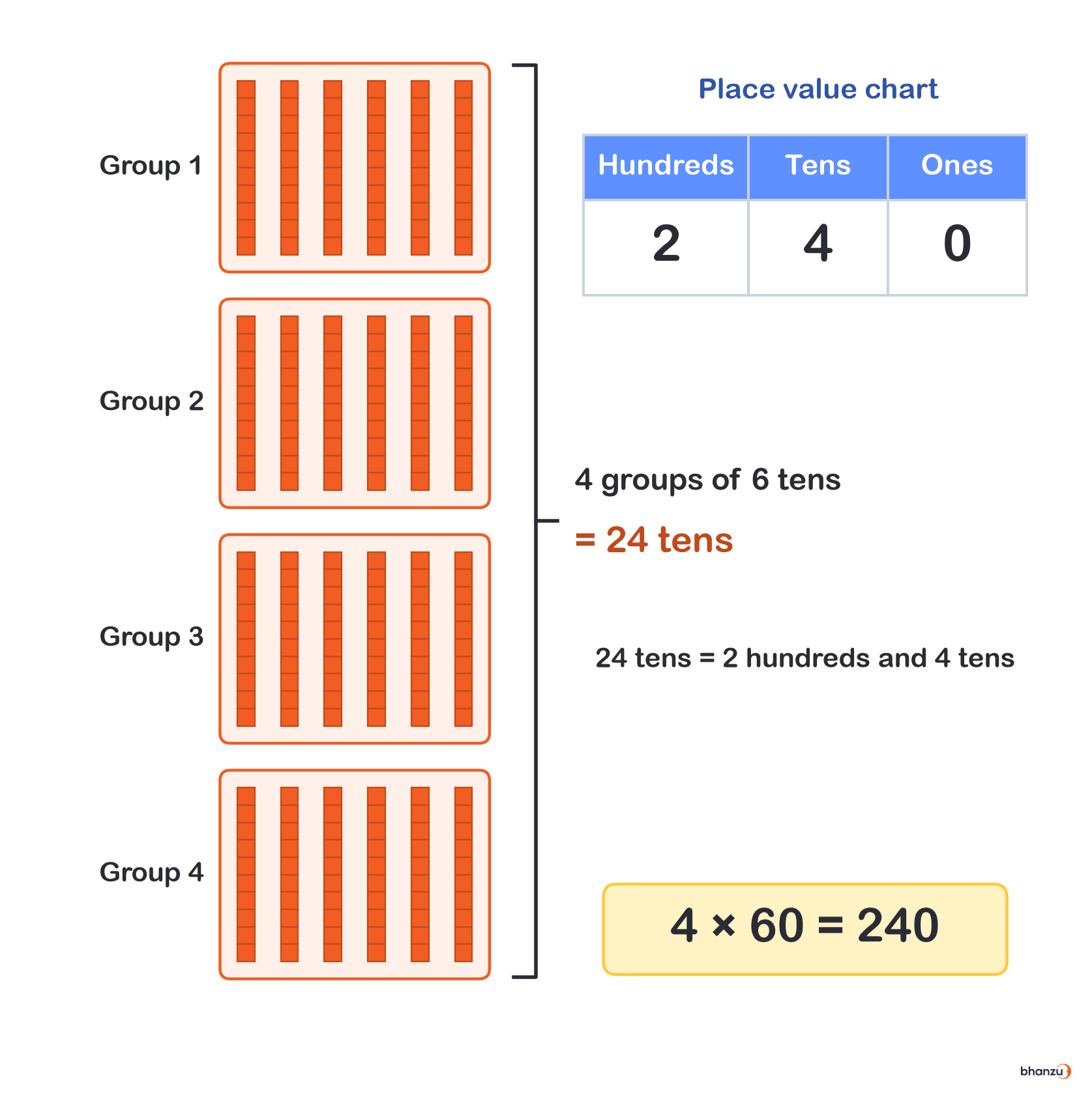
A ten-rod is a base-ten block that stands for one ten. Put 6 rods in each of 4 equal groups, and you have 24 rods, or 24 tens.
What is a multiple of 10? A multiple of a number is the answer when you multiply that number by a whole number. The multiples of 10 are the numbers you say when skip counting by 10s, and each has a 0 in the ones place.
Trading 20 rods for 2 hundred flats leaves 4 rods, so 24 tens is 2 hundreds and 4 tens, or 240. It's the same regrouping of hundreds, tens and ones from 2nd grade.
| Problem | Times fact | In tens | Product |
|---|---|---|---|
| 24 tens | 240 | ||
| 72 tens | 720 | ||
| 30 tens | 300 |
This is Common Core standard 3.NBT.A.3, which covers one-digit numbers times 10 to 90, using place value and properties of operations.
Your child will lean on this tens thinking again in 4th grade, and the framework for the 2026 Nation's Report Card asks 4th graders to see that 253 holds 25 tens.
Why does a zero appear when you multiply by 10?
Nothing really gets added. Multiplying by 10 moves every digit one place left, and a 0 holds the empty ones place. Writing 60 as shows it.
Moving the parentheses uses the associative property of multiplication. Changing which two factors (numbers being multiplied) you group first doesn't change the product, or answer.
On a place value chart, the 2 tens of 24 slide into the hundreds place and the 4 ones slide into the tens place. A 0 fills the empty ones place. The steps are the same every time.
- Read the multiple of 10 as tens (60 is 6 tens).
- Multiply the one-digit numbers ().
- Name the answer in tens (24 tens).
- Write the tens as a number (240).
The steps run backward when the multiple of 10 is missing. For 3 times what makes 210, read 210 as 21 tens. Since , the missing number is 7 tens, or 70.
Skip counting by 60s (60, 120, 180, 240) works too, but slowly. A child who reads 60 as "sixty" instead of "6 tens" often counts those jumps on fingers. A missing times fact can be split into two known facts instead.
Try It Yourself
Slide the groups and the tens in each group, and watch the ten-rods, the times fact and the product change. Press the bundle button to turn every 10 tens into a hundred. Then press New target, build that number, and read how many tens you are short or over.
Which patterns make multiplying by tens easier?
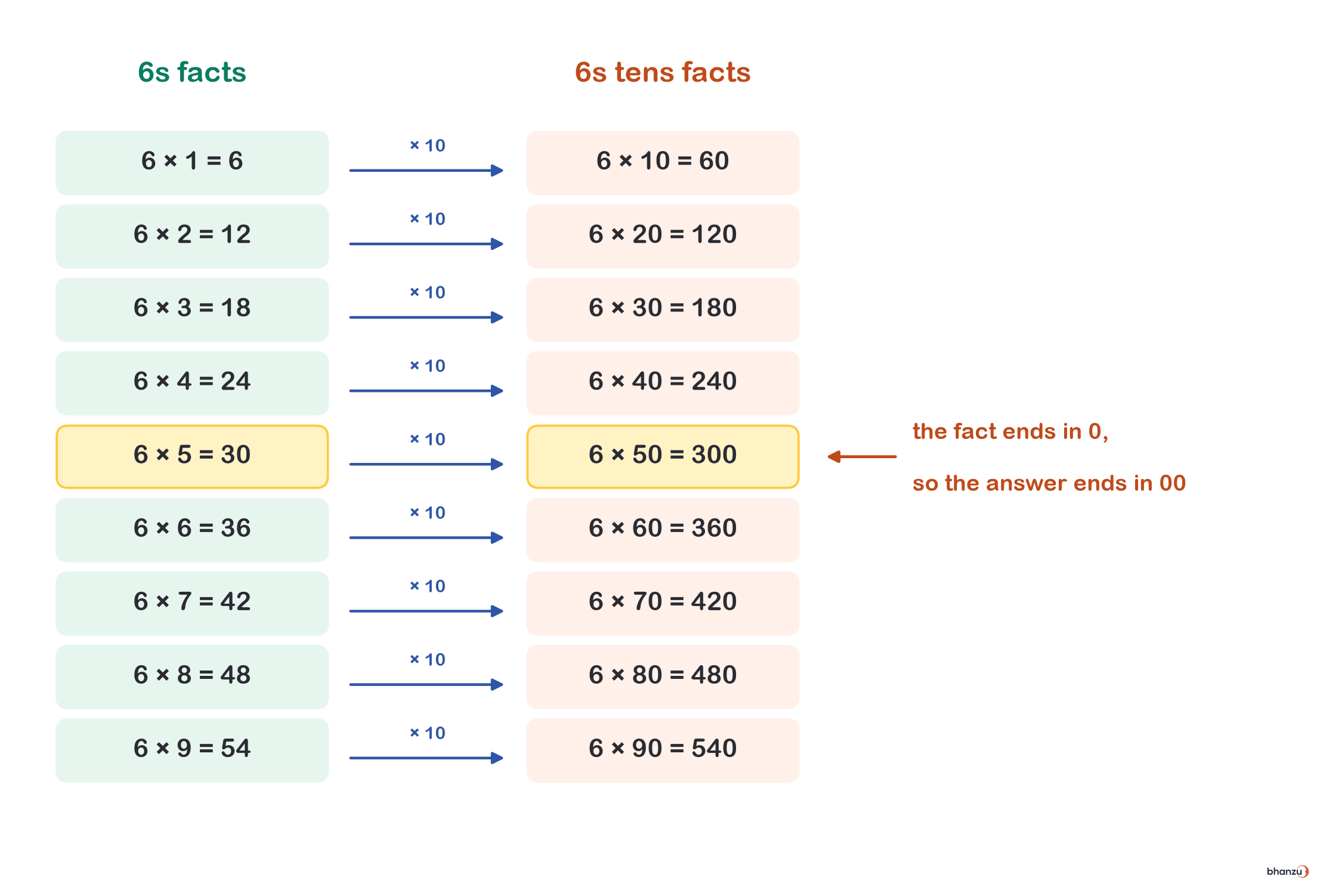
Eight times 7 is 56, so eight times 70 is 56 tens, or 560. That pattern and three others rebuild any tens fact.
- Same fact, bigger unit. In , each 7 became 7 tens, so the digits stay and only the unit grows. That's why the table of 30 reads 30, 60, 90, the 3s facts counted in tens.
- Swap the tens. and are both 24 tens, because the commutative property (order doesn't change a product) makes and the same fact.
- Five and an even number. Up to , the only facts that end in 0 pair a 5 with an even number, like . Their tens products end in 00, like , and that's where the zero trap waits.
- Split a missing fact. If isn't ready, split 80 into 50 and 30, so is , or 720. That's the distributive property (break one factor into parts, then add the products).
The two descriptions can feel confusing side by side. "Add a zero" and "every digit moves one place left" give the same answer, but only the second one explains it.
What do multiples of 10 look like in word problems?
Word problems with multiples of 10 hide equal groups, just like the multiplication and division word problems you solve with smaller numbers. The words tell you which number counts the groups and which is the tens.
Time and money turn into tens facts too. A dime is 10 cents, and an hour has 60 minutes.
So 3 hours is , or 18 tens, which is 180 minutes. When a story mixes 3 boxes of 20 and 2 boxes of 50, find each product in tens and add, so .
| Words in the problem | Math it means |
|---|---|
| 9 apples at 40 cents each | 9 groups of 40, or |
| hours changed to minutes | multiply the hours by 60 |
| how many more | subtract the smaller amount |
| in all, with two kinds of boxes | add the two products |
Examples of multiplying by multiples of 10
Example 1
What is ?
90 is 9 tens, and .
So is 18 tens, or 180.
Example 2
What is ?
The tempting move is . Since 40 already ends in 0, the answer looks like 40.
But 5 groups of 80 must be more than one 80, so 40 can't be right.
Work in tens instead. 80 is 8 tens, and , so the product is 40 tens.
40 tens is 400, and skip counting by 80s agrees (80, 160, 240, 320, 400).
Example 3
Find the missing multiple of 10 in .
The box stands for the missing multiple of 10, and 480 is 48 tens.
, so the box is 6 tens, or 60.
To check, is 48 tens, or 480.
Example 4
Which is greater, or ?
, so is 30 tens, or 300.
, so is 27 tens, or 270.
300 is 3 tens more than 270, so is greater.
Example 5
Noah buys 9 apples that cost 40 cents each. How much does he spend?
, so cents is 36 tens, or 360 cents.
100 cents make a dollar, so Noah spends $3.60.
Example 6
Mei reads for 40 minutes each night for 5 nights. Her goal for the week is 4 hours. How many more minutes does she need?
She has read minutes, which is 20 tens, or 200 minutes.
Her goal is 4 hours, or minutes, which is 24 tens, or 240 minutes.
Subtract to find what is left.
Mei needs 40 more minutes.
Multiplying by multiples of 10 beyond the textbook
Place value counts in tens, so every tens fact is a times fact with a bigger unit. That lets a small set of facts reach much bigger numbers.
- It reuses facts you know. The 81 facts from to also answer all 81 problems from to .
- It matches how money works. Six stickers at 30 cents cost 18 tens of cents, or $1.80, which is quick mental math once you see the tens.
- It starts bigger multiplication. In 4th grade, 6 times 52 begins with 6 times 50, which is 300.
Ten is the unit place value is built on, so no tens problem ever needs a brand-new fact.
The part of multiplying by multiples of 10 nobody explains
The 0 at the end of 240 marks an empty ones place. It shows that 240 is 24 tens and 0 ones.
A 2020 study by Hurst and Hurrell gave 16 times 10 to 530 children aged 10 and 11 in Australia, New Zealand and the UK. Of those children, 61.7% got it right, but only 4.0% could explain what happened to the digits. Most of the children who tried to explain gave a rule such as "a zero is added".
- The reason still works with decimals. In 5th grade, , but "add a zero" gives 0.30, which still equals 0.3.
- The reason names the right property. Regrouping as is associative, while splitting into plus is distributive.
The mistakes kids make most often with multiplying by multiples of 10
Mistake 1: Dropping the tens
Where it slips in: One-step problems like Example 1, when a child rushes and stops once the times fact is done, because the fact feels finished.
Don't do this: .
The correct way: , so is 21 tens, or 210.
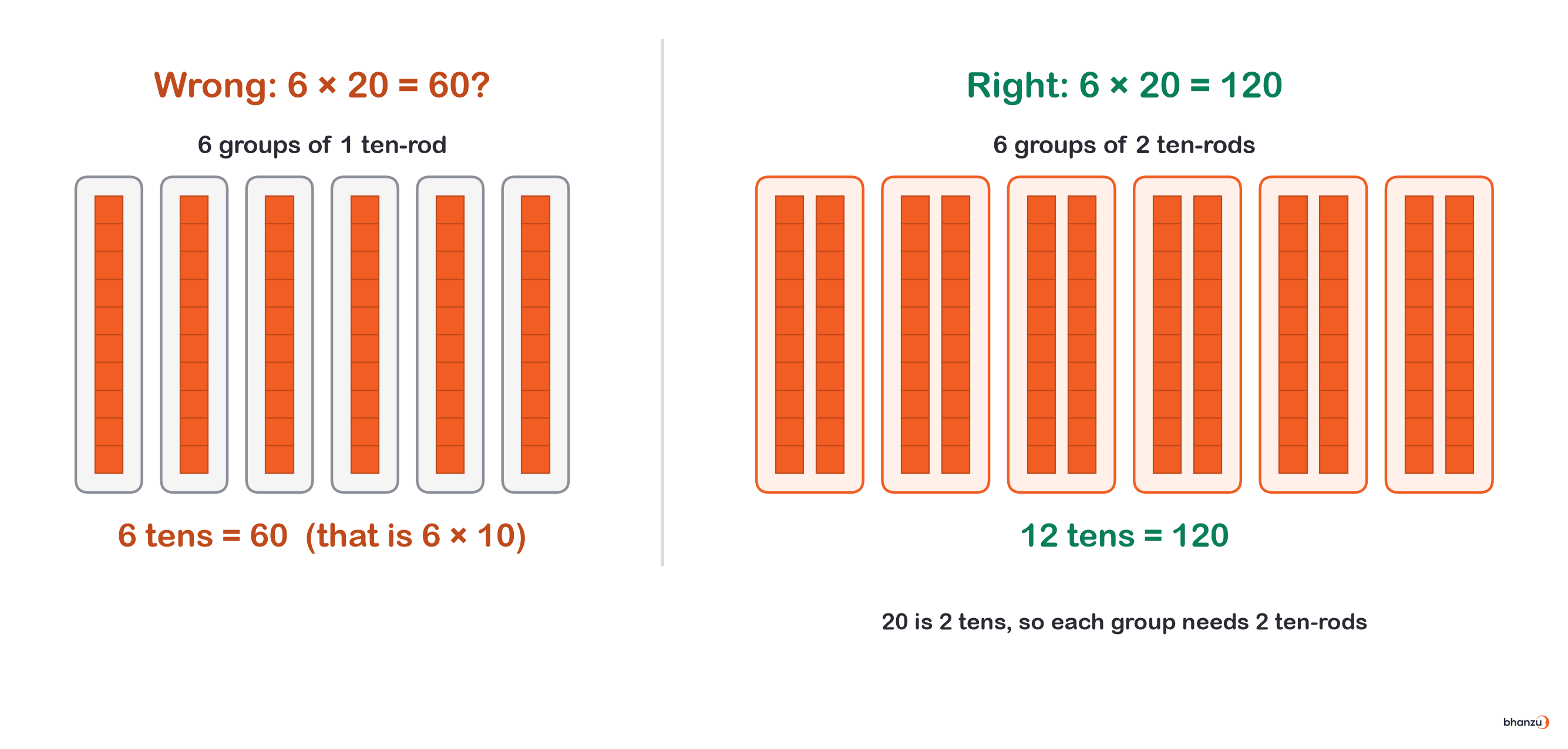
Mistake 2: Treating every multiple of 10 like 10
Where it slips in: Right after "times 10, add a zero" clicks, a child stretches it to 20 or 30 and loses the 2 or 3.
Don't do this: .
The correct way: 20 is 2 tens, so is 12 tens, or 120.
Mistake 3: Adding one zero too many
Where it slips in: Products like , when a child adds a zero for the 50 and a second zero for the ten, counting it twice.
Don't do this: .
The correct way: , so is 15 tens, or 150. Since 3 groups of 100 make only 300, 1,500 is far too big.
Children who learned "add a zero" without the reason often add zeros by feel instead of counting tens. Saying the answer in tens first, 15 tens, leaves no room for an extra zero.
Key Takeaways
- Say the multiple of 10 as tens first, and multiplying by multiples of 10 shrinks to a times fact you know.
- Check the size of every answer, since 5 groups of 80 can't be smaller than one 80.
- Swapping the digits, as in and , keeps the same number of tens.
- For more help with the zero trap in products like , explore Bhanzu's 3rd grade math tutor or math classes for kids.
Read More
- Two-Step Word Problems
- Division Facts Within 100
- Multiplying by 10, 100 and 1,000
- Multiplying and Dividing by Powers of 10
- Tables from 1 to 20
Research Behind This Article
- Common Core State Standards Initiative, Grade 3: Number and Operations in Base Ten (2010). thecorestandards.org
- National Assessment Governing Board, Mathematics Framework for the 2026 National Assessment of Educational Progress (2019). nagb.gov
- OpenStax, Prealgebra 2e: 1.4 Multiply Whole Numbers (2020). openstax.org
- OpenStax, Prealgebra 2e: 7.2 Commutative and Associative Properties (2020). openstax.org
- National Institute of Standards and Technology, Guide for the Use of the International System of Units (SI), Special Publication 811 (2008). nist.gov
- Chris Hurst and Derek Hurrell, Multiplicative Thinking: 'Pseudo-Procedures' Are Enemies of Conceptual Understanding (2020). eric.ed.gov
Quick Quiz: Check Yourself
Three levels, new numbers each time: tens facts, the zero trap or a missing factor, then two-step word problems about minutes or boxes.
Was this article helpful?
Your feedback helps us write better content
Frequently Asked Questions
What are the first 5 multiples of 10?
Can you use the same steps for multiplying by multiples of 10 and 100?
What grade does my child learn multiplication with multiples of 10?
How can I help my child practice multiplying by tens at home?
Are there games for multiplying multiples of 10?
Is there a multiplying by multiples of 10 worksheet on this page?