Key Points
- Rounding multi-digit numbers lets one digit decide, the one just right of the chosen place, so the 5 in 98,540 makes it round up to 99,000 at the nearest thousand.
- A number line shows why the rule works, since at the nearest ten thousand 196,680 is past the halfway mark, 195,000, and so is closer to 200,000.
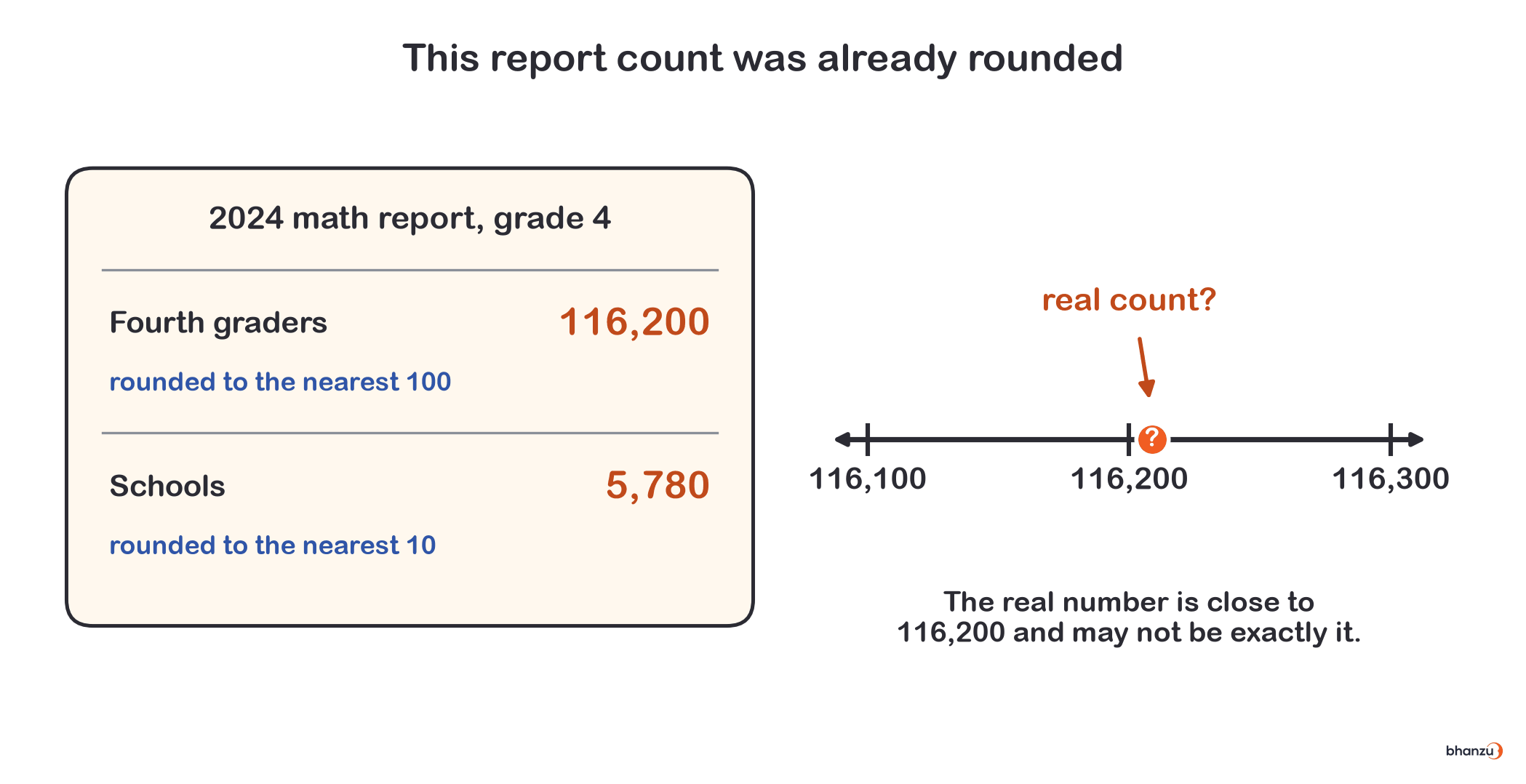
- The 2024 Nation's Report Card rounds its count of fourth graders to the nearest hundred, so its 116,200 is at most 50 from the real count.
The number that was already rounded
The 2024 Nation's Report Card lists 116,200 fourth graders in its math sample. That number was already rounded. The report's own technical tables say the student count is rounded to the nearest hundred, and its 5,780 schools to the nearest ten.
The real number of children may be a little different, and rounding tells you how different it could be. In 5th grade, you'll use the same move on decimals, like 3.86 to the nearest tenth.
What does rounding multi-digit numbers mean?
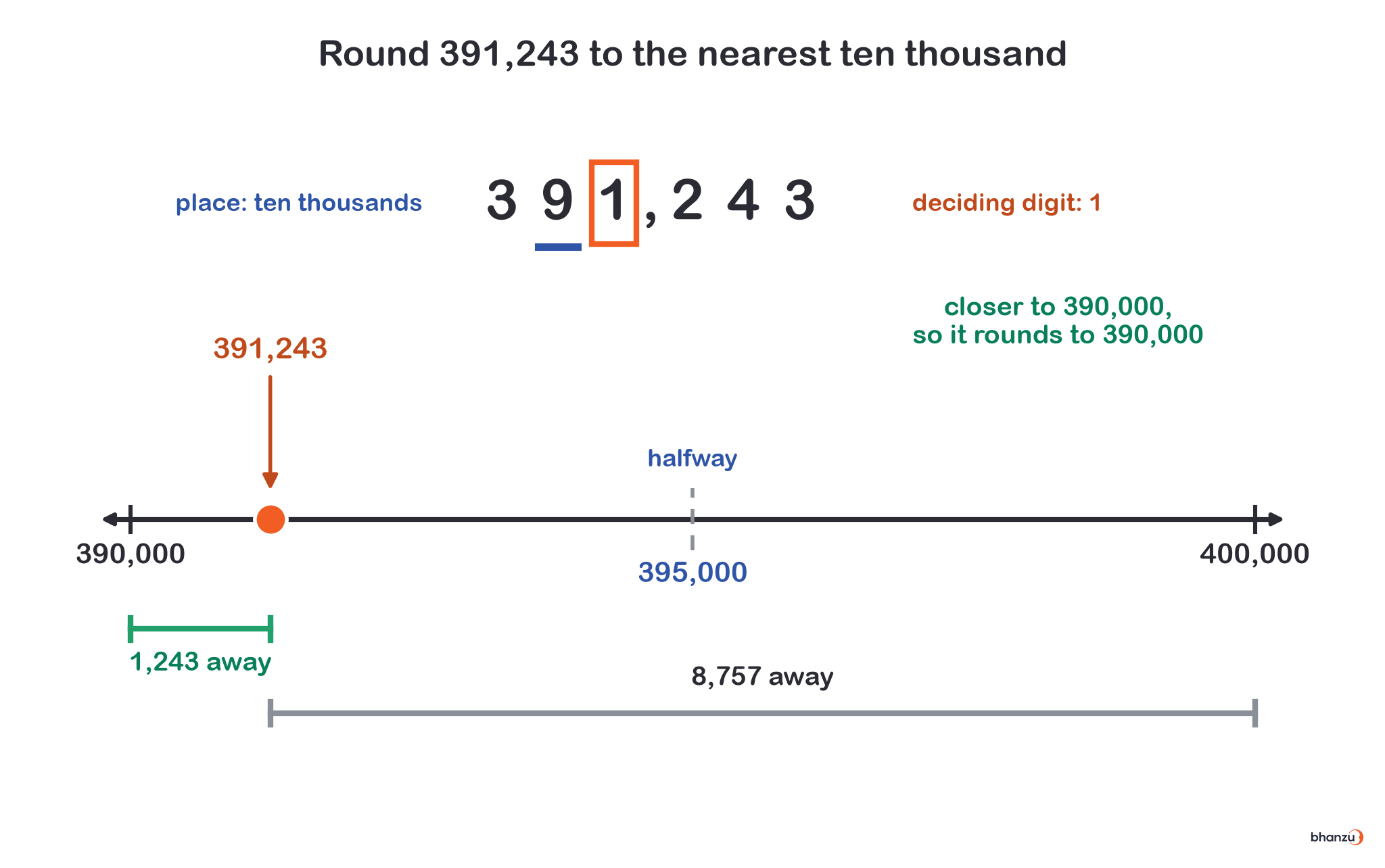
Rounding multi-digit numbers means finding a number's two neighbors at the place you choose, one below and one above, then picking the closer one on a number line. At the nearest ten thousand, the neighbors are multiples of 10,000, the numbers you land on counting by ten thousands. Moving to the higher neighbor is rounding up. Staying at the lower one is rounding down.
Mark the halfway point too (the number exactly between the two neighbors). The number 391,243 sits only 1,243 past 390,000, so it rounds down to 390,000.
Rounding here works on whole numbers, the numbers 0, 1, 2, 3 and so on. For parents, this is Common Core standard 4.NBT.A.3, and a footnote to the 4th grade standards caps its numbers at 1,000,000. It builds on rounding to the nearest 10 or 100 from 3rd grade, adding bigger places and numbers where several digits change at once.
How do you round to any place?
To round to any place, let one digit decide, the one just right of that place.
- Find the place you are rounding to and underline its digit.
- Look only at the digit just to its right.
- If that digit is 4 or less, leave the underlined digit alone. If it is 5 or more, add 1 to the underlined digit (a 9 becomes 0, and the digit on its left goes up by 1).
- Change every digit after the underlined place to 0.
Place value, a digit's value from its spot, names each place, as in standard, word, and expanded form. A child who reads from the left often starts at the first big digit instead of the named place, so underline first.
Texas grew by 391,243 people from July 2024 to July 2025, the most of any state in US Census Bureau estimates. Here it is rounded at every place, each time from 391,243.
| Nearest | Digit to the right | 391,243 rounds to |
|---|---|---|
| ten | 3 | 391,240 |
| hundred | 4 | 391,200 |
| thousand | 2 | 391,000 |
| ten thousand | 1 | 390,000 |
| hundred thousand | 9 | 400,000 |
Why does 5 round up?
The number 395,000 sits exactly halfway between 390,000 and 400,000.
Neither neighbor is closer, so the word "nearest" can't decide. School math settles ties with a convention, a rule people chose: halfway numbers round up, so a deciding 5 always means up (OpenStax's Prealgebra textbook states the rule).
Rounding word problems often ask for an estimate, a close answer you can find in your head. Washington grew by 73,062 that year. To estimate how many more Texas gained, use two steps.
- Round each number to the same place, so 391,243 becomes 390,000 and 73,062 becomes 70,000.
- Add or subtract the rounded numbers.
The exact difference is 318,181.
What happens when a 9 rounds up?
A 9 that rounds up makes 10 of its place, and one digit can't hold 10, so write 0 and add 1 to the digit on its left. Repeat while that digit is also a 9.
Round 299,512, which is 299 thousands and 512 ones, to the nearest thousand. The 5 next door says round up.
Trading 10 thousands for 1 ten thousand is regrouping whole numbers. Rounding 999,700 to the nearest thousand works the same way, with three 9s rolling over to reach 1,000,000.
What does 9 round up to?
A 9 that rounds up turns into 0, and the digit to its left goes up by 1. Children who round 299,512 correctly often erase their 300,000, because they expected only the thousands digit to change.
Which numbers round to the same answer?
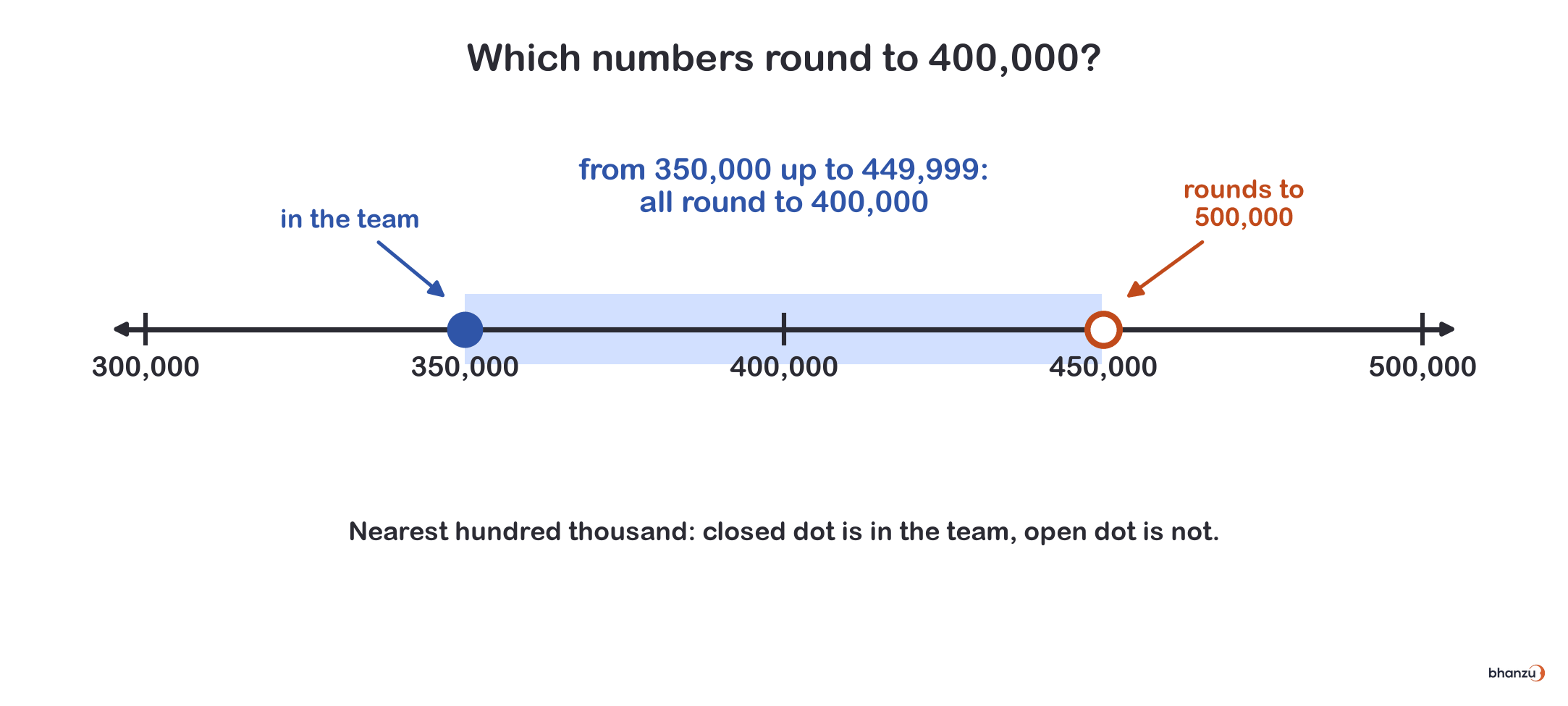
Every whole number from 350,000 up to 449,999 rounds to 400,000 at the nearest hundred thousand. Call all the numbers that round to the same answer its team. The team for 400,000 starts at the halfway mark below and stops just before the one above, so 350,000 is the smallest whole number that rounds to 400,000.
Missing-digit problems use the same team.
- The box is the deciding digit. In the box decides a hundred-thousands rounding, so the number rounds to 400,000 only with 5, 6, 7, 8 or 9 in the box.
- The box is the rounding digit. If rounds to 80,000 at the nearest ten thousand, the 6 rounds it up, so the box plus 1 is 8 and the box is 7.
Try It Yourself
Pick a place, then drag the orange dot or use the arrow keys to change the number. Watch the boxed digit and the dashed halfway mark, because the answer jumps to the higher neighbor once the dot reaches halfway.
Examples of rounding multi-digit numbers
Example 1
Round 5,780, the report's count of schools, to the nearest hundred.
The digit right of the hundreds place is 8, so the 7 goes up to 8.
5,780 rounds to 5,800.
Example 2
Georgia grew by 98,540 people from 2024 to 2025. Round that to the nearest thousand and to the nearest hundred.
The digit right of the thousands place is 5, so the nearest thousand is 99,000.
The digit right of the hundreds place is 4, so the nearest hundred is 98,500.
Example 3
Florida grew by 196,680 people from 2024 to 2025. Round that to the nearest ten thousand.
The tempting move sees the 6 next door. Then it leaves the 9 alone, since 9 plus 1 won't fit in one digit, and writes 190,000.
That can't be right. 190,000 is 6,680 below 196,680, while 200,000 is only 3,320 above.
Count in ten thousands instead. 196,680 is 19 ten thousands and 6,680 more, which is past halfway.
196,680 rounds to 200,000.
Example 4
rounds to 50,000 at the nearest ten thousand. Which digits can go in the box?
The box is the thousands digit, which decides a ten-thousands rounding, so it must be 5 or more.
The box can hold 5, 6, 7, 8 or 9. With a 4, 44,312 would round down to 40,000.
Example 5
The 2024 report lists 116,200 fourth graders, rounded to the nearest hundred. If halfway numbers round up, what are the least and greatest whole numbers the real count could be?
Halfway down is 116,150, which rounds up to 116,200, so 116,150 is the least.
Halfway up is 116,250, which rounds to 116,300, so the greatest is 116,249.
That makes 100 possible counts.
Example 6
From 2024 to 2025, North Carolina grew by 145,907 people and South Carolina by 79,958. Round each to the nearest ten thousand to estimate how many more North Carolina gained.
145,907 rounds up to 150,000, since its thousands digit is 5.
79,958 rounds up to 80,000, since its thousands digit is 9 and 7 ten thousands plus 1 is 8 ten thousands.
North Carolina gained about 70,000 more. The exact difference, 65,949, also rounds to 70,000.
Why does rounding large numbers matter?
Exact numbers carry more detail than most questions need. A rounded number is one you can compare and work with in your head.
- It is how scientists describe giant sizes. NASA gives the Sun's diameter as about 865,000 miles, and "about" is the clue that it was rounded.
- It catches mistakes in exact work. In mental math, Texas plus Florida is about , so an exact sum of 487,923 is about 100,000 too small, a sign of a missing regrouped 1.
- It gets you ready for multiplying. Later this year, estimating products and quotients turns into .
Rounding answers "about how many." When a question asks "exactly how many," the exact number wins.
Tripping points to avoid with rounding
Mistake 1: Deciding with the wrong digit
Where it slips in: Rounding 493,618 to the nearest hundred thousand.
Don't do this: Look at the 4 in the rounding place, say "4 or less stays", and write 400,000.
The correct way: Look next door at the 9. It is 5 or more, so 493,618 rounds to 500,000, only 6,382 away.
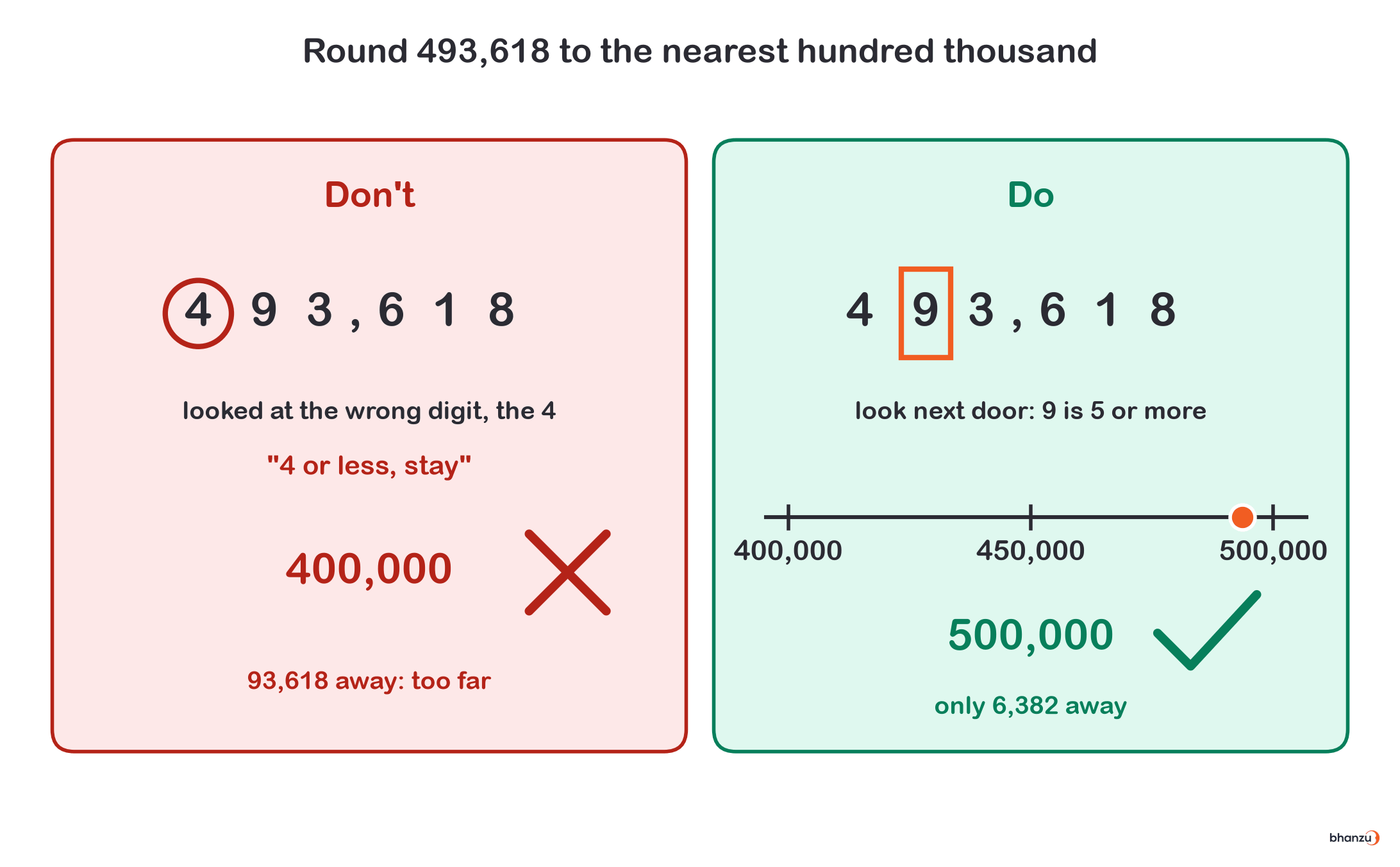
Children who know the 5-or-more rule well often aim it at the rounding digit itself, because step 1 told them to find that digit. A child who rushes sees the small 4 and decides before looking next door.
Mistake 2: Keeping the old digits after the place
Where it slips in: Step 4, right after rounding up.
Don't do this: Round 627,584 to the nearest thousand and write 628,584.
The correct way: Write 628,000. Every digit after the thousands place turns to 0, because 628,584 is not a neighbor.
One changed digit feels like the whole job.
Mistake 3: Rounding to the wrong place
Where it slips in: Five-digit numbers rounded to the nearest ten thousand, where that place is the first digit.
Don't do this: Round 64,382 to the nearest ten thousand and write 64,000, which is the nearest thousand.
The correct way: The 6 is the ten-thousands digit and the 4 next door says stay, so 64,382 rounds to 60,000.
Ten thousand and thousand share a word, and "ten thousandth", a tiny decimal place for later grades, sounds almost the same.
The pattern hiding inside rounding
A rounded number is never more than half the place away from the real one.
| Nearest | Farthest from the real number |
|---|---|
| hundred | 50 |
| thousand | 500 |
| ten thousand | 5,000 |
| hundred thousand | 50,000 |
Texas's 391,243 rounded to the nearest hundred thousand is 400,000, only 8,757 off. So choosing a place means choosing how close you need to be, an idea that returns in science as measurement error. At exactly half, where school math rounds up, a NIST guide for scientists keeps an even digit, so it rounds 385,000 to 380,000 at the nearest ten thousand, not 390,000.
A quick check catches some wrong answers, since a correct answer ends in at least as many zeros as the place has (three for thousands). 628,584 fails at once. But 190,000 for 196,680 passes and is still wrong, so the check never replaces step 2.
Key Takeaways
- When rounding multi-digit numbers, underline the place, let only the digit next door decide, and write zeros after it.
- A 9 that rounds up becomes 0 and pushes 1 left, so digits before the place can change too.
- A rounded answer's team runs from the halfway mark below it to just before the one above.
- For help catching the wrong-digit habit in rounding, explore Bhanzu's 4th grade math tutor or elementary math programs.
Read More
- Comparing and Ordering Multi-Digit Numbers
- Multi-Digit Addition
- Multi-Digit Subtraction
- Rounding Decimals
- Estimating Sums and Differences
Research Behind This Article
- National Center for Education Statistics, Technical appendix tables for 2024 mathematics report card (2025). nationsreportcard.gov
- Common Core State Standards Initiative, Grade 4 Number & Operations in Base Ten (2010). thecorestandards.org
- US Census Bureau, State Population Totals and Components of Change: 2020-2025 (2026). census.gov
- OpenStax, Rice University, Prealgebra 2e, 1.1 Introduction to Whole Numbers (2020). openstax.org
- National Institute of Standards and Technology, NIST Guide to the SI, Appendix B: Conversion Factors (2025). nist.gov
- NASA Science, Sun: Facts (2026). science.nasa.gov
Quick Quiz: Check Yourself
Three levels, new numbers every time: round to the nearest hundred or thousand, round six-digit numbers, then find missing digits, rounded ranges or an estimate.
Was this article helpful?
Your feedback helps us write better content
Frequently Asked Questions
What grade do kids learn rounding?
Is rounding the same thing as estimating?
How can I explain rounding to my child at home?
What is the proper way to round numbers?
Do kids still need rounding when they have calculators?