Key Points
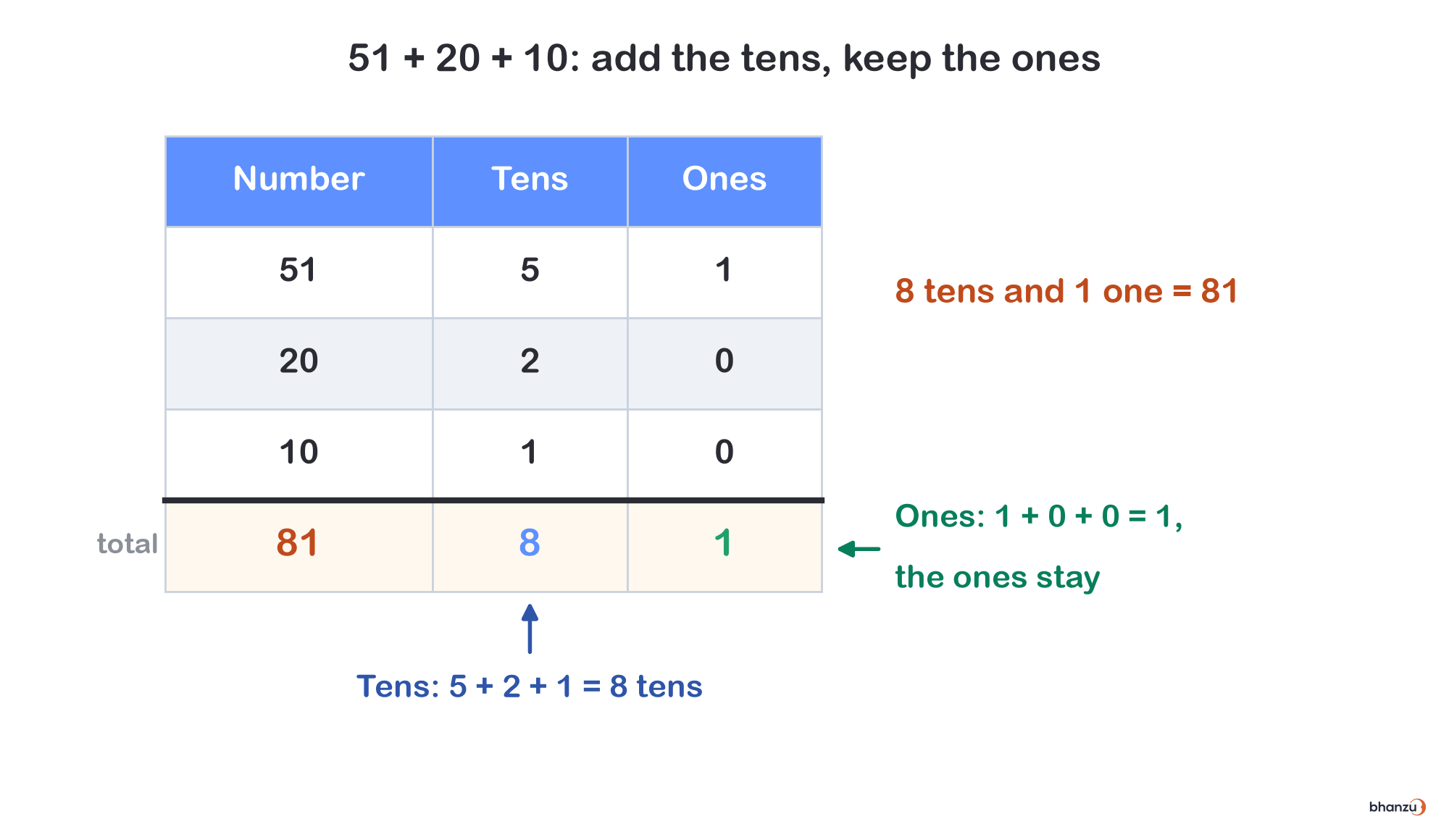
- Adding multiples of 10 to a 2-digit number adds only tens, so 51 + 20 + 10 = 81 and the 1 one stays put.
- Every multiple of 10 has 0 ones, so the tens can be added one hop at a time or all together first.
- In a 2016 study of 84 children aged 5 to 7, 69% counted to 100 by tens, yet 18% solved 42 + 30 with tens.
A ring toss score that jumps by tens
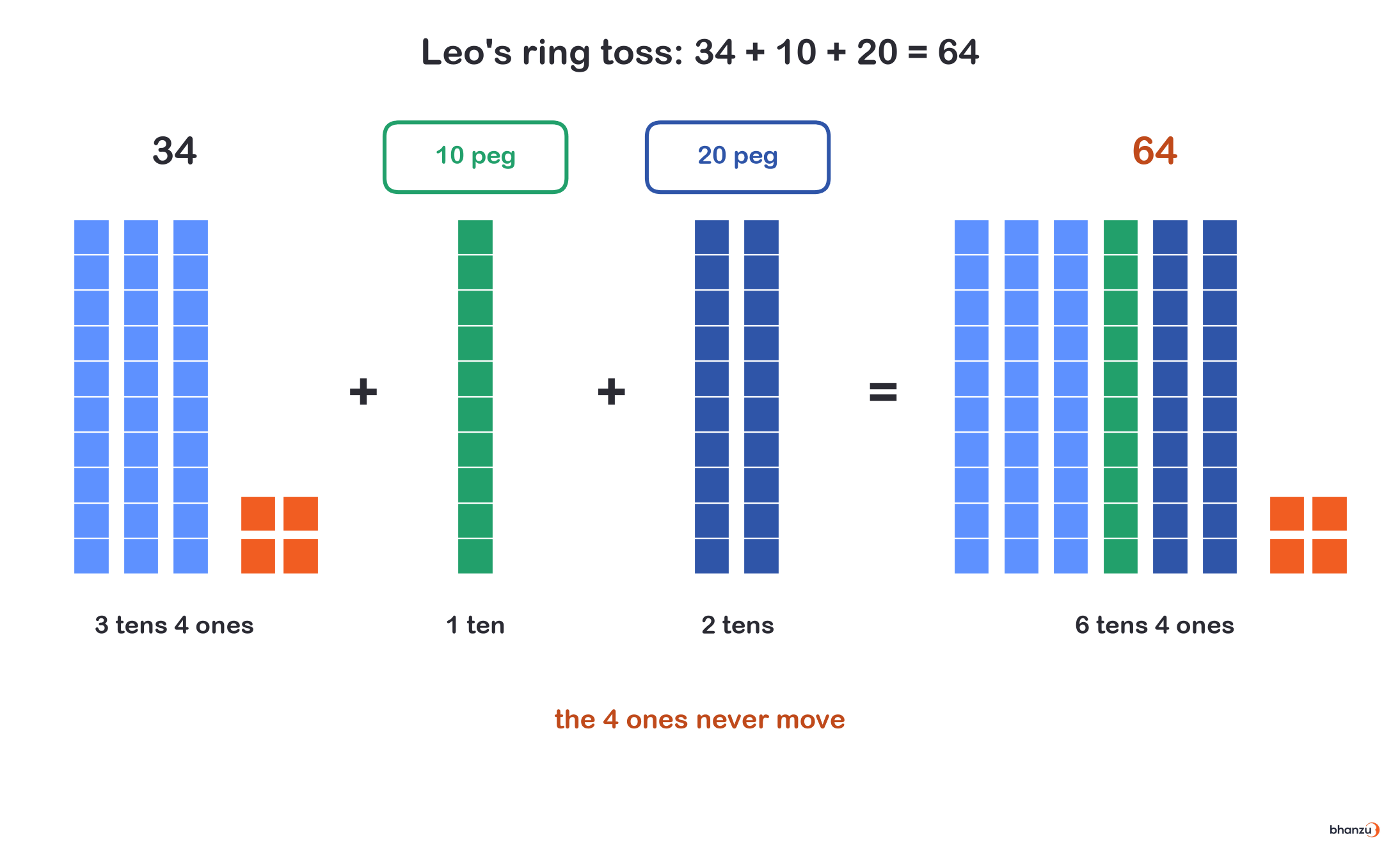
Leo has 34 points, and his next two rings land on the 10 and the 20. The 10 peg adds 1 ten. The 20 peg adds 2 more tens.
His 3 tens grow into 6 tens. His score jumps to 64, and the 4 from his first score never moves, because no peg is worth single points. By 2nd grade, the same move helps you add up to four 2-digit numbers.
How do you add multiples of 10 to a 2-digit number?
Adding multiples of 10 to a 2-digit number means joining new tens to your tens, while the ones stay exactly as they were. On base-ten blocks, where a cube is 1 and a rod is a row of 10 cubes, only new rods join the pile.
What is a multiple of 10? A multiple of 10 is what you get from whole groups of ten with nothing extra, like 20, 50 or 90.
- Split 34 into 3 tens and 4 ones.
- Add the tens from 34, 10 and 20, so tens.
- Bring back the 4 ones.
Common Core standard 1.NBT.C.4 covers "adding a two-digit number and a multiple of 10" within 100, with models or drawings. Your child is right on track if they can show 34 + 10 + 20 with blocks and say why the 4 stays.
Adding one tens number, like 26 + 40, is where adding tens and ones begins.
Why do the ones stay the same?
The ones stay the same because every multiple of 10 brings 0 ones, so the ones never make a new ten.
Adding joins things that share a place-value box, the spot that sets a digit's worth. So each tens fact is a ones fact with one 0 on the end.
| Ones fact | Tens fact |
|---|---|
The 0 in 20 can look like nothing, which is genuinely confusing. That 0 holds the ones place, so the 2 has to mean 2 tens, not 2 ones.
A child who gets 64 for Leo's score may erase it, since the 4 seemed to do nothing. Staying put is its job. That makes the ones digit a check, though it can't catch a miscounted ten.
A 2023 study that followed 279 kindergartners into 2nd grade compared many number tasks. Of those single tasks, counting objects in tens and ones best predicted later multi-digit calculation.
Which is faster: one ten at a time or tens first?
Both ways give the same total, but adding the tens first saves hops, and the saving grows with every extra tens number.
A hundred chart has 1 to 100 in 10 rows of 10. Each ten is one row straight down, the move for 10 more and 10 less. For 43 + 30 + 20, hop to 53, 63, 73, 83 and 93.
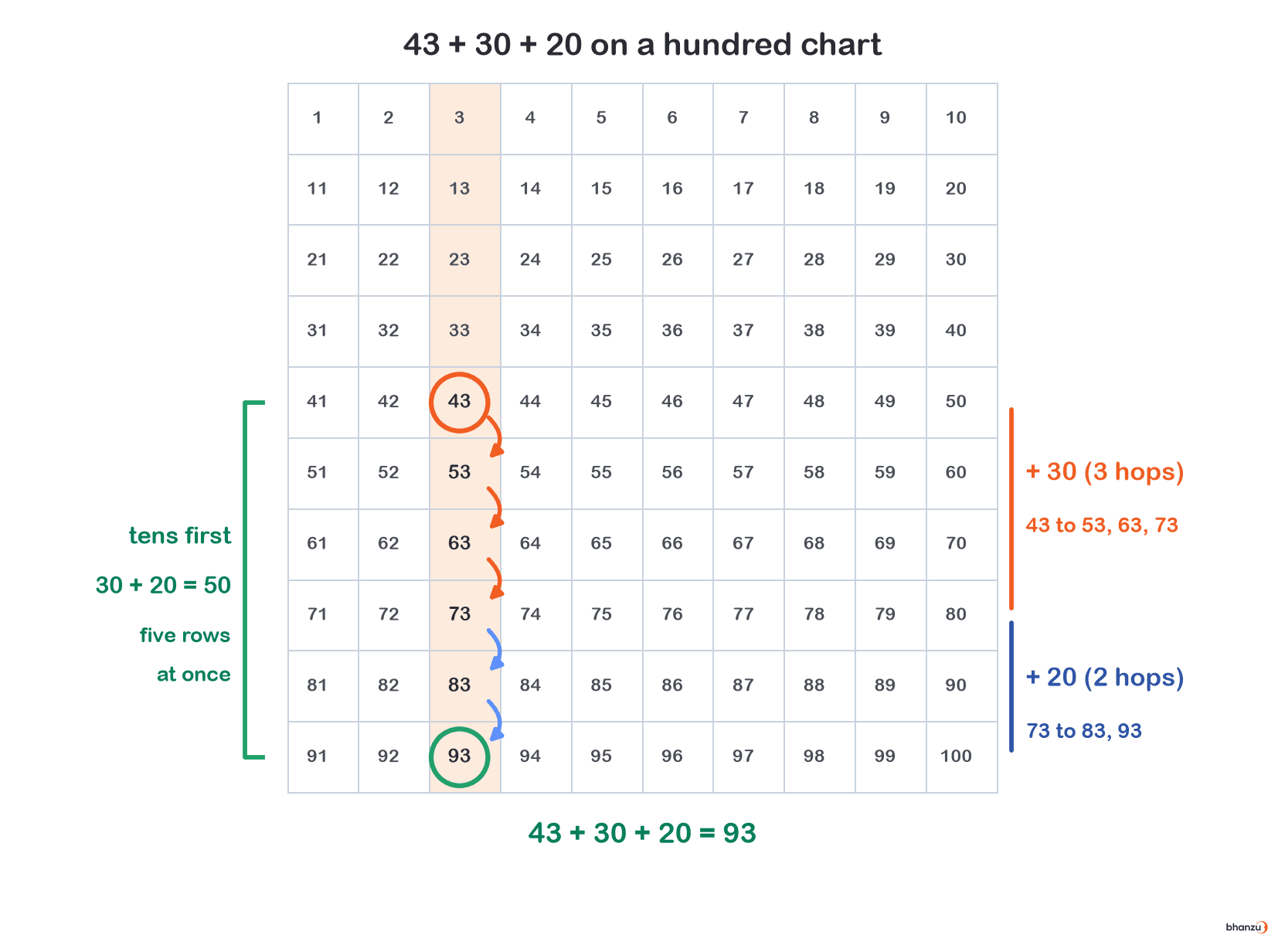
When hopping tens, children often say "one" on the square where they start, which leaves them a row short.
Tens first means adding the tens numbers together, then making one big jump.
Grouping the numbers differently never changes the total, the same rule as in adding three numbers (grown-ups call it the associative property).
Counting on by ones turns 43 + 50 into 50 counts. The hundred chart ends at 100, and so do 1st grade sums (adding past 100 waits for 2nd grade).
How do you find a missing ten?
To find a missing ten, count up from the tens you have to the tens you need, as long as the ones already match. In , the box stands for the missing tens.
- Check the ones. 46 and 96 both end in 6.
- Count the tens you have, .
- Count up to 9 tens, 6, 7, 8, 9. That's 4 more tens, so the box is 40.
Story words turn into numbers like these.
| Words in the problem | Math it means |
|---|---|
| gets 2 more dimes | add 20 |
| lands on the 30 peg | add 30 |
| how many points in all | add every number |
| how many more tens to reach 87 | the box |
Try It Yourself
Pick a start number, then tap tens cards to add 10, 20, 30 or 40. New rods join the blocks, and the hundred chart hops one row down per ten. Press Tens first to add the cards to each other before they join the start, and watch the ones digit stay put.
Why does adding multiples of 10 matter?
Numbers are written in tens and ones, so adding a whole ten takes one step instead of ten counts.
- It keeps game scores easy, because a total that grows by 10s is simple to keep in your head.
- It makes money quick. Dimes act like rods when counting coins, so 24 cents and 5 dimes make 74 cents.
- It is the first move in adding mentally. For 35 + 42, add 40 to reach 75, then 2 to reach 77.
- It grows into 2nd grade, where standard 2.NBT.B.6 moves on to adding up to four two-digit numbers.
Scores, coins and mental math all start with the same move, tens joining tens.
Examples of adding multiples of 10
Example 1
What is 12 + 10 + 10?
12 is 1 ten and 2 ones.
The tens make tens, and the 2 ones stay.
Example 2
What is 25 + 20 + 40?
The tempting move adds every tens digit, , and writes 80.
80 can't be right. The 20 and 40 bring 0 ones, so the 5 ones from 25 must still be there, yet 80 has none.
Keep the 8 tens and put the 5 ones back.
Example 3
Add 27 + 40 + 20 two ways. Do both give the same total?
One tens number at a time.
Tens first.
Yes, both give 87, since grouping the tens differently can't change how many there are.
Example 4
Which multiple of 10 makes true?
The box stands for the missing tens. The ones already match, 7 and 7.
37 and 20 make tens, and 87 has 8 tens. Counting up 6, 7, 8 makes 3 more tens.
Example 5
Aisha has 16 cents. Her grandma gives her 2 dimes and her brother gives her 3 dimes. How many cents does she have now?
16 cents is 1 ten and 6 ones, and each dime is 1 ten. The tens make tens, and the 6 ones stay.
Aisha has 66 cents.
Example 6
Leo starts a new round with 28 points. His rings land on the 20, 10 and 30 pegs. How many points does he have, and which peg gets him to 98?
Add the tens first, then add them to 28.
98 has 1 more ten than 88, so Leo has 88 points and needs the 10 peg.
The part of adding multiples of 10 nobody explains
Counting by tens and adding tens are two different skills. The chant starts at 10, while adding tens starts wherever your number is.
In a 2016 study of 84 children aged 5 to 7 in New Zealand, 69% could count to 100 by tens. Only 18% solved 42 + 30 by thinking in tens, and their adding still leaned on counting on by ones.
- Start the tens count at your number, 42, 52, 62, 72.
- Say the tens fact aloud, "4 tens and 3 tens make 7 tens."
A child may chant 10, 20, 30 perfectly, then restart at 10 for 42 + 30. At home, ask your child to count on by tens from 42.
Adding multiples of 10: common confusions cleared up
Mistake 1: Writing tens as hundreds
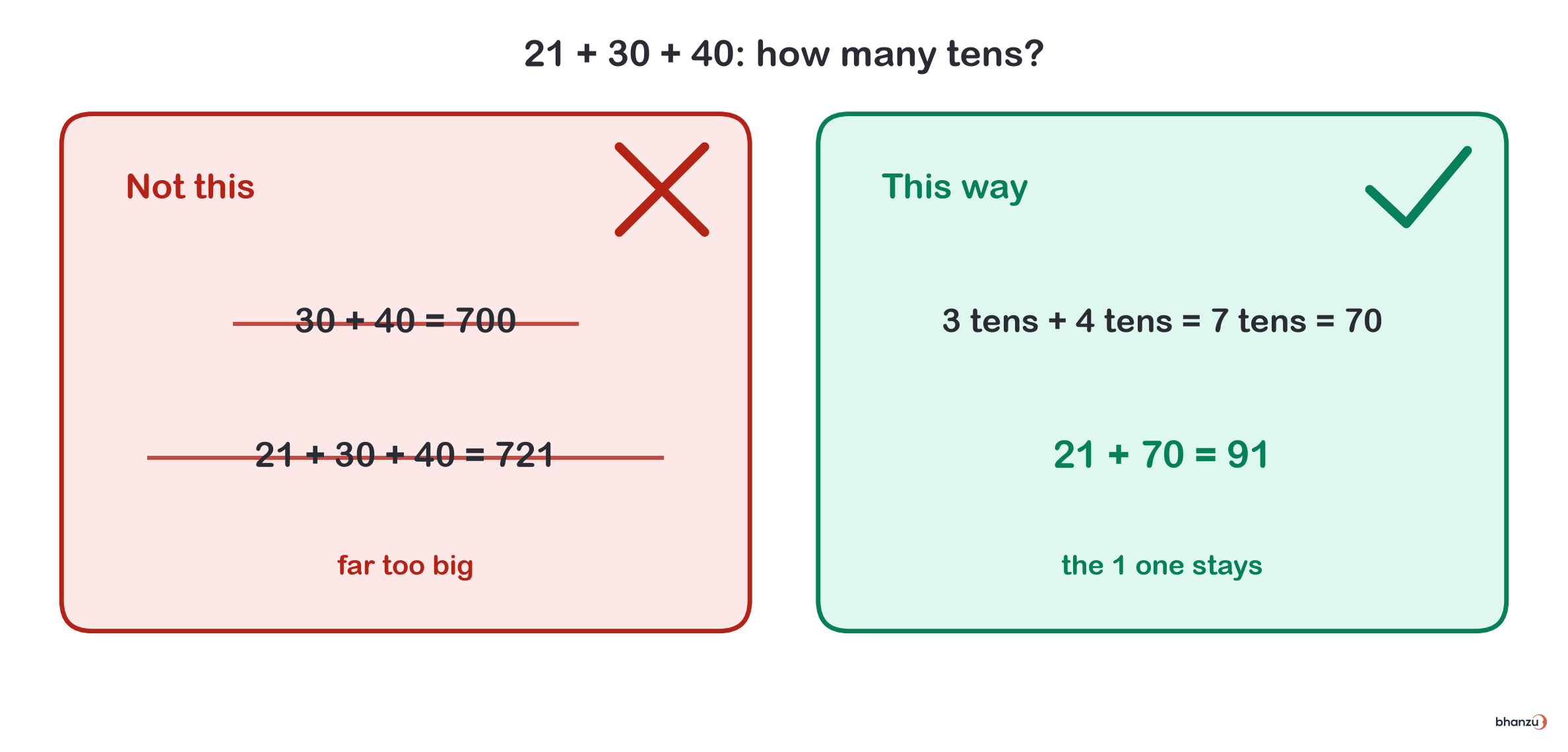
Where it slips in: Adding the tens first, as in 21 + 30 + 40. Children who hear "thirty and forty" often add 3 + 4 = 7, then keep both zeros, one from each number.
Don't do this: Writing 30 + 40 as 700, so the total reads 721.
The correct way: 3 tens and 4 tens make 7 tens, or 70, and 21 + 70 = 91.
A child who rushes the tens fact tends to tack on every zero. Saying 721 aloud shows it's far too big (hundreds come in 2nd grade).
Mistake 2: Counting every one through a long chain
Where it slips in: Long chains like 56 + 30 + 10, when counting on by ones still feels safest.
Don't do this: Counting 57, 58, 59 and on for 40 counts, then stopping at 95 or 97.
The correct way: 5 + 3 + 1 = 9 tens, and the 6 ones stay, so the total is 96.
Mistake 3: Moving sideways on the hundred chart
Where it slips in: Hopping tens on the chart, as in 62 + 10 + 20. Counting by ones moves along a row, so the next square feels like the next step.
Don't do this: Moving right to 63, 64 and 65.
The correct way: Move one row down per ten, to 72, 82 and 92.
Key Takeaways
- Your ones digit is a built-in check, because adding multiples of 10 leaves it as it was.
- When several tens numbers line up, add the tens together first, then make one jump.
- On a hundred chart, every ten is one row down, never a step sideways.
- To practice chains of tens with a teacher who catches 700 for 70, explore Bhanzu's 1st grade math tutor or math programs for elementary students.
Read More
- Subtracting Multiples of Ten
- Adding Within 100 by Making a New Ten
- Skip Counting by 2s, 5s and 10s
- Counting to 120
- Multiplying by Multiples of 10
Research Behind This Article
- Common Core State Standards Initiative, Grade 1 Number and Operations in Base Ten (2010). thecorestandards.org
- Mix, Kelly S. and others, Predictive Relations between Early Place Value Understanding and Multidigit Calculation: Approximate versus Syntactic Measures (2023). eric.ed.gov
- Common Core State Standards Initiative, Grade 1 Operations and Algebraic Thinking (2010). thecorestandards.org
- Common Core State Standards Initiative, Grade 2 Number and Operations in Base Ten (2010). thecorestandards.org
- Young-Loveridge, Jenny and Bicknell, Brenda, Developing Early Place-Value Understanding: A Framework for Tens Awareness (2016). eric.ed.gov
Quick Quiz: Check Yourself
Three levels, new numbers every time: add tens to a start number, find a missing ten or count dimes, then solve ring toss problems.
Was this article helpful?
Your feedback helps us write better content
Frequently Asked Questions
What is 45 + 30?
How many tens are in a hundred?
Is there a game for adding multiples of 10?
Can you add and subtract multiples of 10 the same way?
How can I help my child add tens at home?