Key Points
- Skip counting by 2s, 5s and 10s says only the numbers you land on after equal hops. Counting by 5s from 0 reaches 120 in 24 hops.
- The ones digit, a number's last digit, repeats in a pattern because five hops of 2, or two hops of 5, make exactly one ten.
- A common mistake is changing the jump partway, such as saying 20 and then 30 while counting by 5s.
Thirty crayons, only three numbers
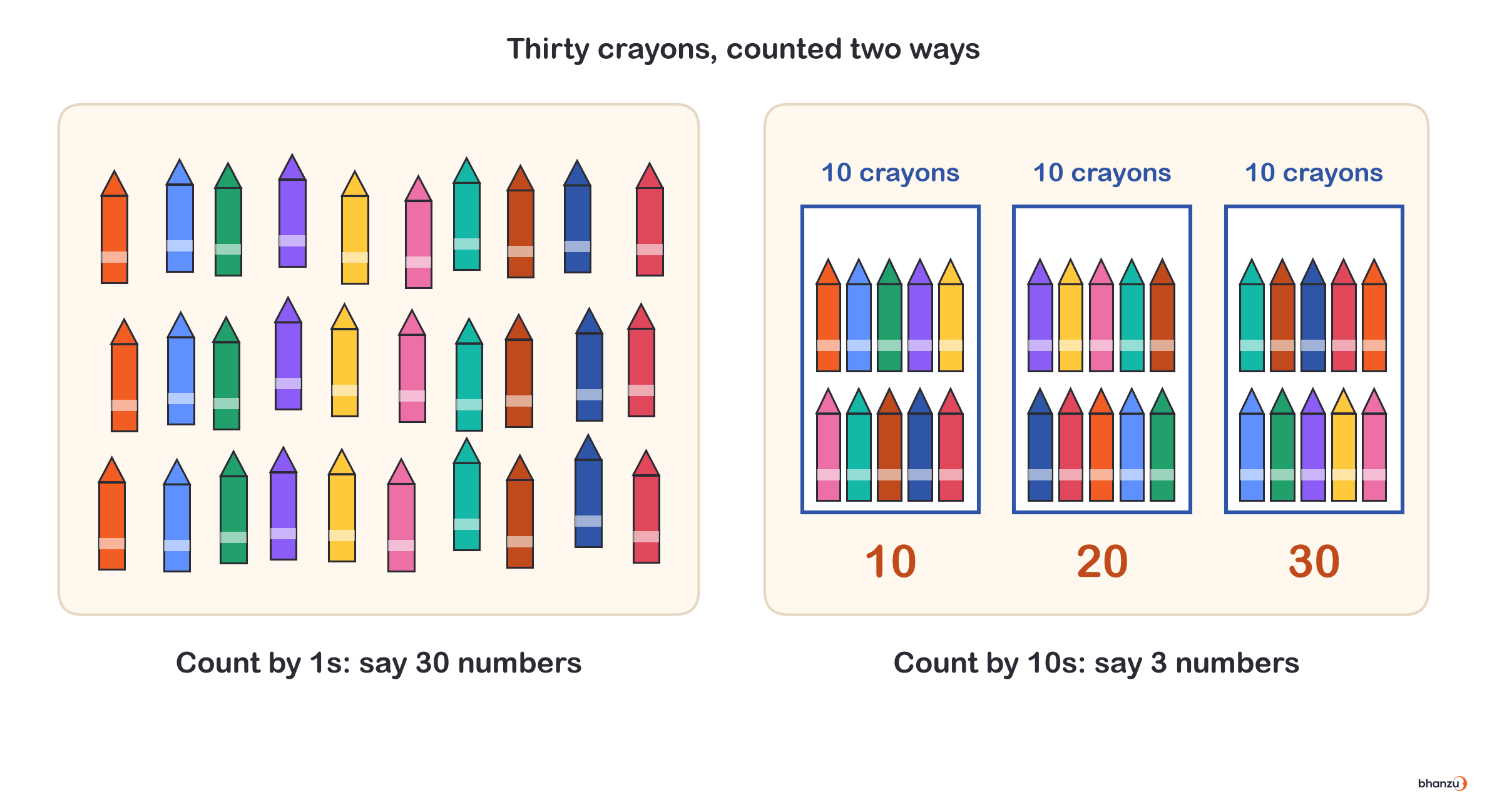
You can count 30 crayons by saying only three numbers. Maya keeps her crayons in boxes of 10, so she points at each box and says 10, 20, 30. That's skip counting.
Socks come in pairs, so count them by 2s. Count fingers by 5s, a hand at a time. Next year, the same jumps of 5 will help you read a clock to the nearest five minutes.
What is skip counting?
Skip counting by 2s, 5s and 10s is counting in equal hops, saying only the number you land on after each hop. On a number line (a straight line with the numbers in order), each hop is one jump.
Skip counting works like repeated addition (adding the same number again and again).
Common Core does not list skip counting as a 1st grade standard at all. Counting to 100 by tens is a kindergarten standard (K.CC.A.1), and 1st graders count to 120 from any number (1.NBT.A.1). "Skip-count by 5s, 10s, and 100s" is the 2nd grade standard 2.NBT.A.2.
A fair goal for your child this year is counting by 10s to 120 from any number, and by 2s and 5s with objects.
How do you skip count by 2s, 5s and 10s?
Pick a jump, then keep adding it.
- Choose a jump of 2, 5 or 10.
- Say the start number, often 0.
- Add the jump to get the next number, and say it.
- Keep the jump the same while the groups stay the same size.
- When the groups change size, change the jump too, as in 10, 20, 25 for 2 boxes of 10 crayons and a pack of 5.
Going from 0 to 30 shows what the jump changes: 15 hops by 2s, 6 by 5s and only 3 by 10s.
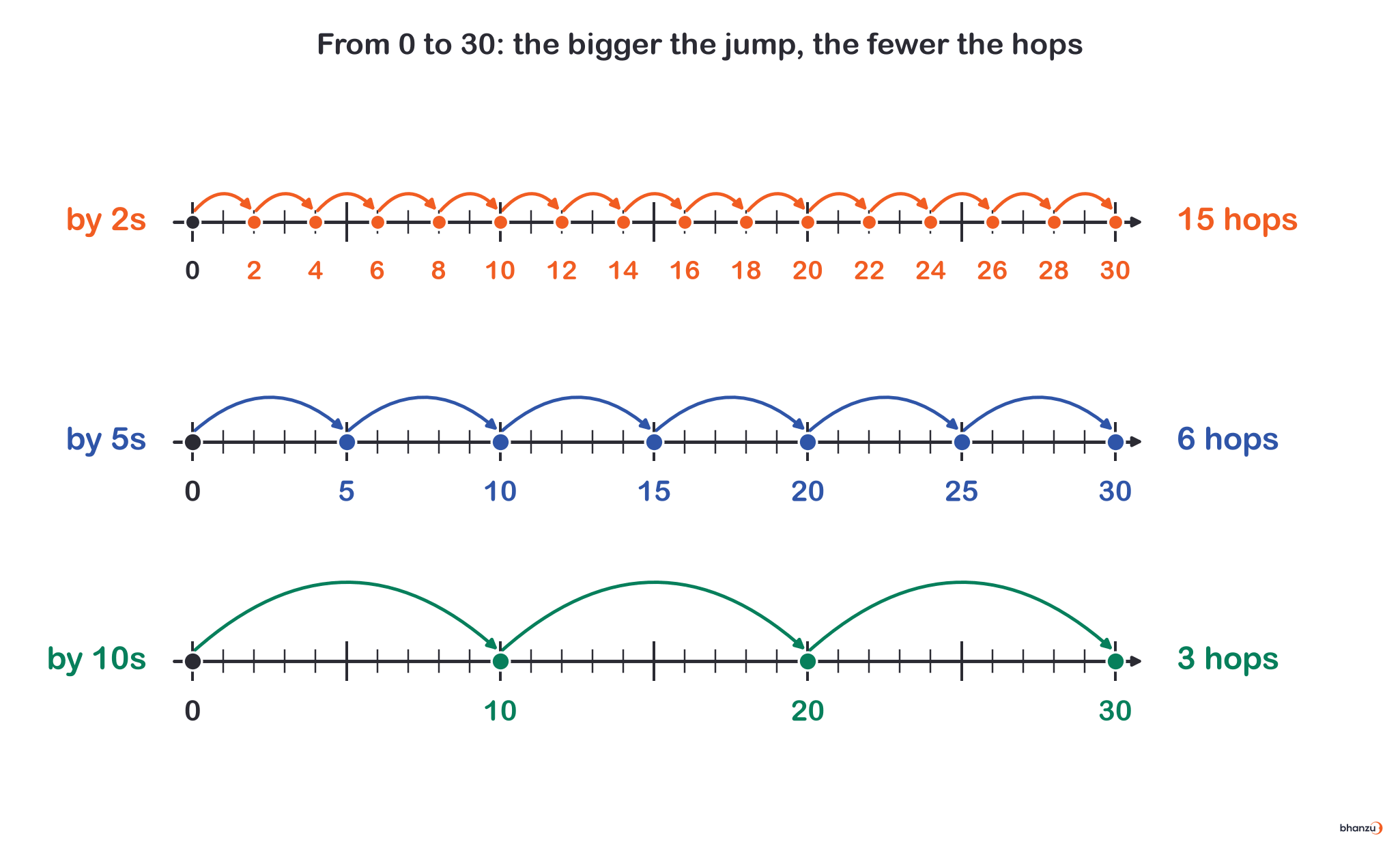
Counting by ones works too, but small jumps drag on big piles. Sixty socks take 30 hops by 2s. Make 6 piles of ten and count by 10s instead.
Which numbers do you land on?
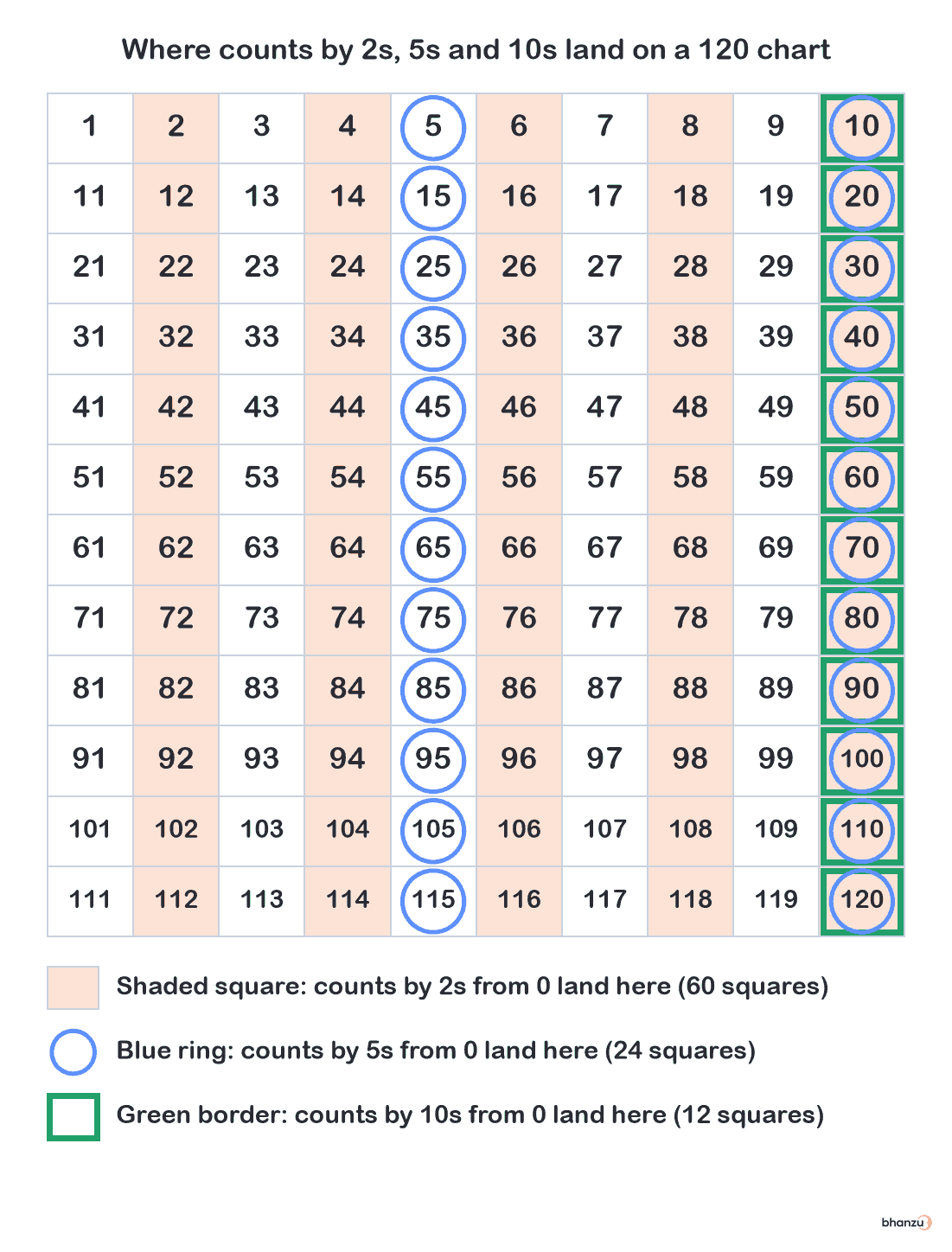
Count by 2s from 0, and every number you say ends in 0, 2, 4, 6 or 8. That last digit is the ones digit (it tells how many ones), and these are the even numbers, a word you'll use more in 2nd grade. From 0, counts by 5s end in 5 or 0, and counts by 10s end in 0.
| Count by | Past 100, up to 120 |
|---|---|
| 2s | 102, 104, 106 and on to 120 |
| 5s | 105, 110, 115, 120 |
| 10s | 110, 120 |
The patterns keep going past 100, and a count by 5s from 0 reaches 120 in 24 hops. A 120 chart shows 1 to 120 in rows of ten. On it, counts from 0 fill whole columns: 2s every second column, 5s the 5 and 10 columns, 10s the last one.
In a 2023 study, kindergarten and 1st grade children solved word problems with a hundreds chart. They counted by tens more often when its numbers grew from top to bottom than from bottom to top. So print your child a chart with 1 to 10 across the top row.
Starting at 7 and counting back
Any number can be the start if every hop is the same size. From 7 by 10s, the ones digit stays 7 and the tens go up by one each hop, as in 10 more and 10 less. To count back, take the jump away each time, as in counting on and counting back.
A child who second-guesses 17 often counts on by ones from 7 to check it. After two or three hops, the tens pattern takes over.
| Start | Jump | First five numbers |
|---|---|---|
| 7 | Add 10 | 7, 17, 27, 37, 47 |
| 1 | Add 2 | 1, 3, 5, 7, 9 |
| 3 | Add 5 | 3, 8, 13, 18, 23 |
| 120 | Take away 10 | 120, 110, 100, 90, 80 |
A count by 2s from 1 lands on the odd numbers. The count by 5s from 3 can look wrong at first, because 3 and 8 take turns instead of 5 and 0.
Try It Yourself
Pick a jump and a start, then press Hop forward or Hop back to light squares on the 120 chart. Before each hop, tap the number where you think it lands, and watch the ones digits below.
Examples of skip counting by 2s, 5s and 10s
Example 1
Count by 2s from 2 to 20.
Start at 2 and add 2 at each hop.
2, 4, 6, 8, 10, 12, 14, 16, 18, 20
Example 2
Leo starts at 7 and counts by 10s, writing 7, 17, 27, ?, ?, 57. What are the missing numbers?
The tempting move is to jump to the familiar tens, 30 and 40.
Check the hops. From 27 to 30 is only 3, and from 40 to 57 is 17, so those are not hops of 10.
Add 10 at each hop instead.
The missing numbers are 37 and 47, and checks it.
Example 3
Diego puts only nickels in an empty jar. Can the jar hold exactly 47 cents?
Each nickel adds 5 cents, so the totals are a count by 5s from 0.
Counts by 5s from 0 end in 5 or 0, but 47 ends in 7.
No, the jar can't hold exactly 47 cents. Nine nickels make 45 cents, and ten make 50.
Example 4
Three frogs hop back from 120 to 80, one by 2s, one by 5s and one by 10s. How many hops does each take?
By 2s, the frog lands on 118, 116, 114 and every even number down to 80, which is 20 hops.
By 5s, it lands on 115, 110, 105, 100, 95, 90, 85, 80, which is 8 hops.
By 10s, it lands on 110, 100, 90, 80, which is 4 hops.
The frogs take 20, 8 and 4 hops.
Example 5
At Maya's picnic, 4 friends each hold up both hands, and 3 more friends each hold up one hand. How many fingers are up in all?
Two hands make 10 fingers, so count the first 4 friends by 10s.
10, 20, 30, 40
One hand is 5 fingers, so the groups change size and the count goes on by 5s from 40.
45, 50, 55
There are 55 fingers up in all.
Why is skip counting important?
Lots of things come in equal groups, and counting groups is faster than counting every single thing.
- It counts groups, not single things. Eight pairs of shoes go 2, 4, 6, 8, 10, 12, 14, 16, so there are 16 shoes.
- It makes counting coins quicker, since each nickel adds 5 cents and each dime adds 10.
- It leads to multiplication. Counting by 5s to 50 says the answers in the 5 times table, a 3rd grade topic.
A 2026 article for math teachers describes children moving from counting by ones to skip counting, then to groups of groups. That means seeing 3 groups of 5 as one group of 15.
The pattern hiding inside skip counting
The ones digits repeat because a few hops always add up to exactly one ten.
- Five hops of 2 make one ten, so a count by 2s from 0 repeats its ones digits every 5 hops (2, 12, 22).
- Two hops of 5 make one ten, so a count by 5s from 0 flips its ones digit between 5 and 0.
- One hop of 10 is a whole ten, so the ones digit never moves. That's why 7, 17, 27 keeps its 7.
For parents, the order matters: tens first, then fives and twos, as in a University of Denver learning trajectory by Douglas Clements and Julie Sarama.
Where do kids trip up on skip counting?
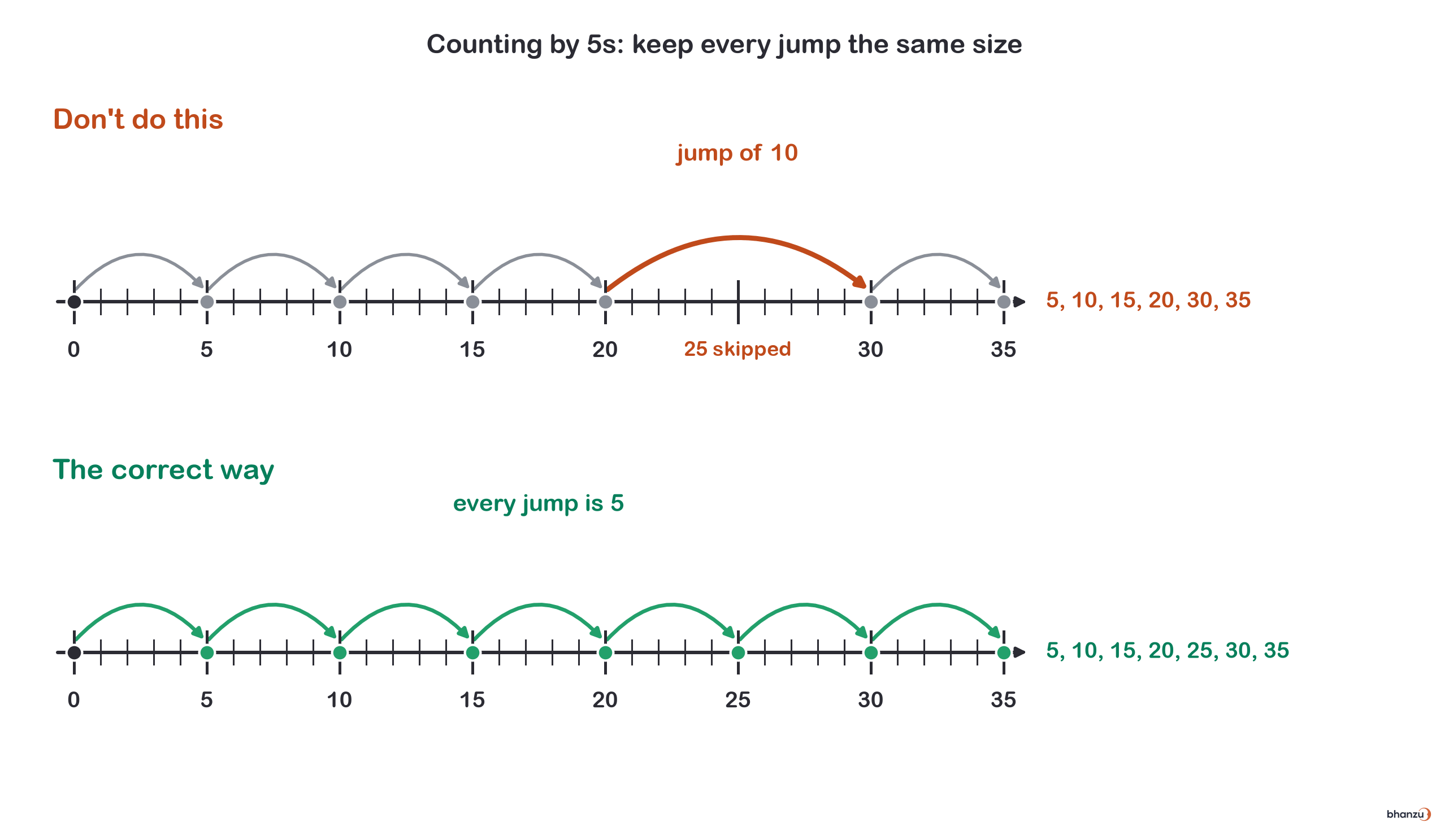
Mistake 1: Changing the jump partway
Where it slips in: Counting by 5s past 20, because 20 and 30 sit side by side in the count by 10s.
Don't do this: Saying 5, 10, 15, 20, 30, 35.
The correct way: Add 5 at every hop, so comes next.
Mistake 2: Starting at 0 when the count starts somewhere else
Where it slips in: Directions such as "Start at 1 and skip count by 2" on a practice page.
Don't do this: Writing 2, 4, 6, 8, 10.
The correct way: Start at 1 and add 2 each time, which gives 1, 3, 5, 7, 9.
Most counts by 2s children say begin at 0, so 2, 4, 6 slips out on its own.
Mistake 3: Giving every mitten its own number
Where it slips in: Counting pairs of real things, when a child rushes.
Don't do this: Touching each of 10 mittens while saying 2, 4, 6 up to 20, so 10 mittens become 20.
The correct way: Touch each pair once and say 2, 4, 6, 8, 10, so 5 pairs make 10 mittens.
A child who says the 2s fast often outruns the hand. Sliding each pair aside as you say its number keeps the two together.
Key Takeaways
- Keep every hop the same size while the groups stay the same, so 30 right after 20 in a count by 5s means a hop was too big.
- Skip counting by 2s, 5s and 10s works from any start, so 7, 17, 27 is a count by 10s.
- Touch each pair once, so 5 pairs of mittens make 10 mittens, not 20.
- To practice counts that start at 7 or pass 100 with a teacher, explore Bhanzu's 1st grade math curriculum or an elementary math tutor.
Read More
Research Behind This Article
- NGA Center and CCSSO, Common Core State Standards for Mathematics (2010). corestandards.org
- Osana and others, Spatial Configuration of Hundreds Charts Influences Children's Knowledge of Base-Ten Concepts (2023). eric.ed.gov
- Kling and others, Intuitive Multiplication Fact Strategies (2026). eric.ed.gov
- Clements and Sarama, University of Denver, Learning and Teaching with Learning Trajectories, Skip Counter by 10s to 100 (2019). learningtrajectories.org
- Bicknell and others, A Design Study to Develop Young Children's Understanding of Multiplication and Division (2016). eric.ed.gov
Quick Quiz: Check Yourself
Three levels, new numbers every time. Say the next number, fill a gap in a count forward or backward, then solve stories about pairs, hands, boxes and hops.
Was this article helpful?
Your feedback helps us write better content
Frequently Asked Questions
How does skip counting help in addition?
How do I teach skip counting by 2 at home?
What is the best way to teach skip counting?
Can kindergartners learn skip counting?
How does skip counting help with division?