Key Points
- The associative property of multiplication keeps the factors in order and moves only the parentheses, so both groupings of make 40.
- Grouping a 2 with a 5 first turns into , an easier step than .
- Moving a factor to a new place is the commutative property, and calling that move associative is a common mix-up between the two rules.
Two ways to count 48 juice boxes
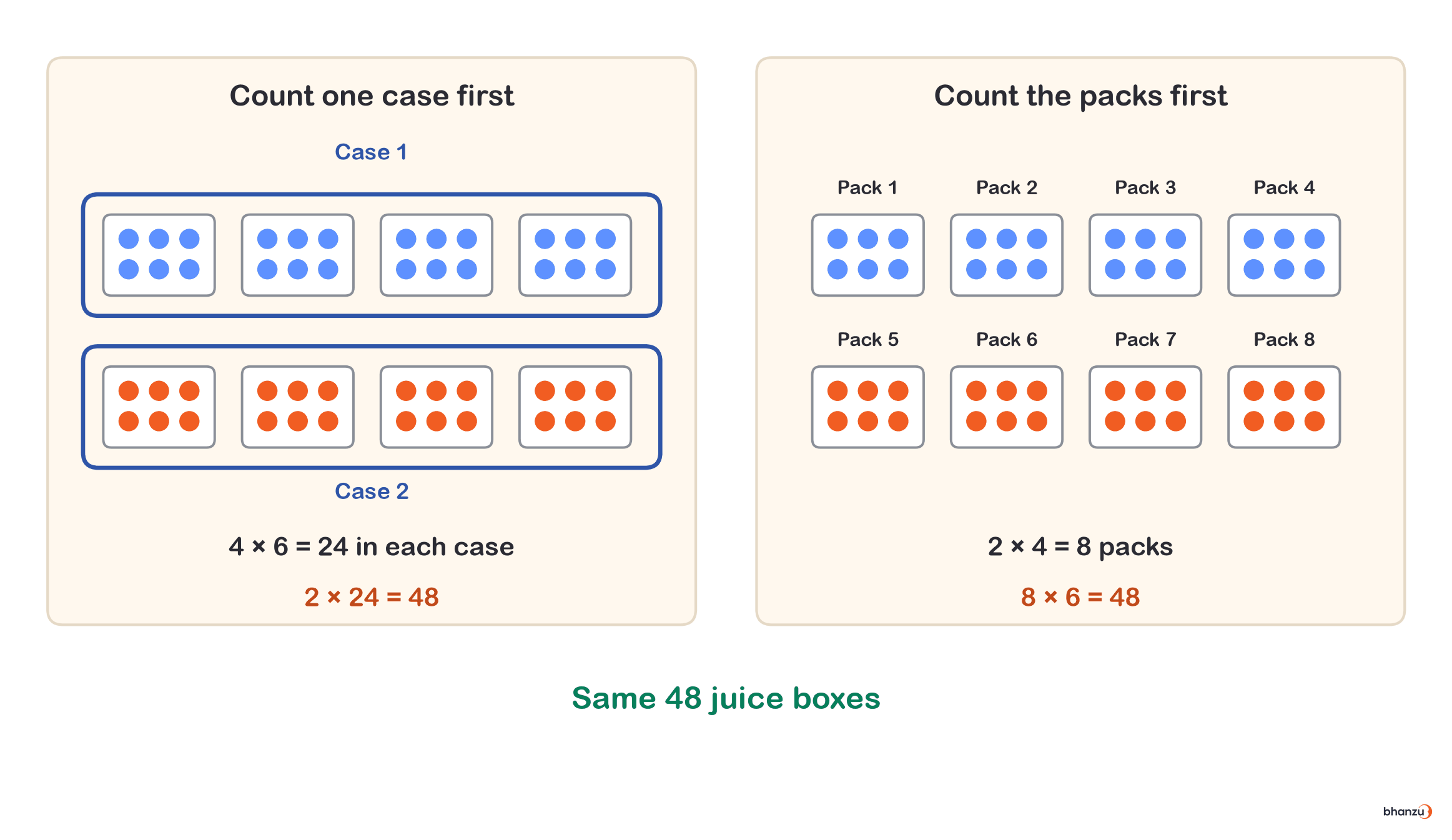
Two friends count the same cart of juice boxes and both get 48. The cart holds 2 cases, each case holds 4 packs, and each pack holds 6 juice boxes. Maya counts one case first (4 packs of 6 is 24) and then doubles it.
Leo lines up all 8 packs and counts 8 sixes. Neither of them got lucky, because the boxes never changed, only the bundles they counted first. Later this year, the same move will help you find 6 times 30 in your head.
What is the associative property of multiplication?
The associative property of multiplication says that when you multiply three whole numbers, the pair you multiply first does not change the answer, called the product. A factor is each number being multiplied. The order of the factors stays put.
The model is equal groups inside equal groups, like packs in cases. Parentheses show which pair to multiply first.
What is the formula for the associative property of multiplication? Letters stand in for any three whole-number factors.
| Symbol | Meaning | Units |
|---|---|---|
| the first factor, any whole number | none (a count) | |
| the second factor | none (a count) | |
| the third factor | none (a count) |
Both sides count the same objects in different bundles, so the totals must match. You met this move when adding three numbers in 1st grade, where becomes . Of the four operations, regrouping works only for adding and multiplying.
This skill is Common Core standard 3.OA.B.5, which asks 3rd graders to use properties of operations as strategies to multiply and divide. A footnote says students need not use the formal names, so your child can show the skill by turning into without ever saying the word associative.
How do parentheses change the grouping?
To use the associative property, keep the factors in their places and move only the parentheses. The pair inside the parentheses is multiplied first, the same signal parentheses send in the order of operations.
- Write the three factors in order, .
- Put parentheses around the first pair and multiply, .
- Move the parentheses to the last pair, .
Both groupings count the same 70 dots, set out in arrays of equal rows. Two layers of 5 rows of 7 make 10 rows of 7, or 2 groups of 35. In 5th grade, the same layers will count cubes in a box.
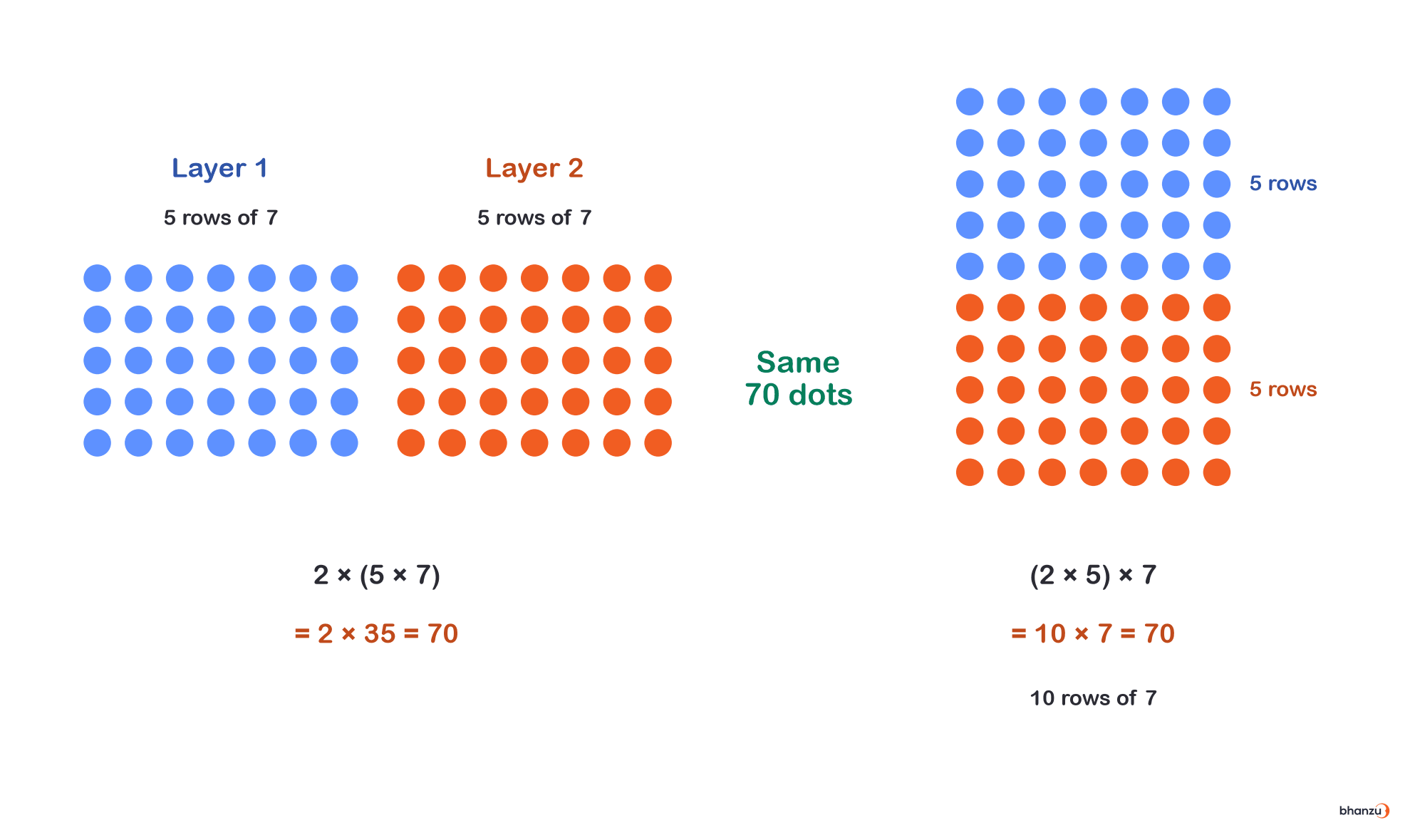
Children meeting parentheses for the first time often ask what the curved lines do to the numbers. They change nothing except which multiplication happens first.
Story problems hide the grouping in their words.
| Words in the problem | Math it means |
|---|---|
| 4 packs in each case | in one case |
| 2 cases | |
| how many in all | the product, 48 |
| how many are left | subtract |
Which two numbers should you group first?
Group the neighboring pair whose product is friendly, such as 10 or 20. A 2 beside a 5 makes 10, and a 4 beside a 5 makes 20, both from the 5 times table.
How do you multiply three numbers together? Multiply any neighboring pair, then multiply that product by the third number. Start with the pair that makes a ten when there is one.
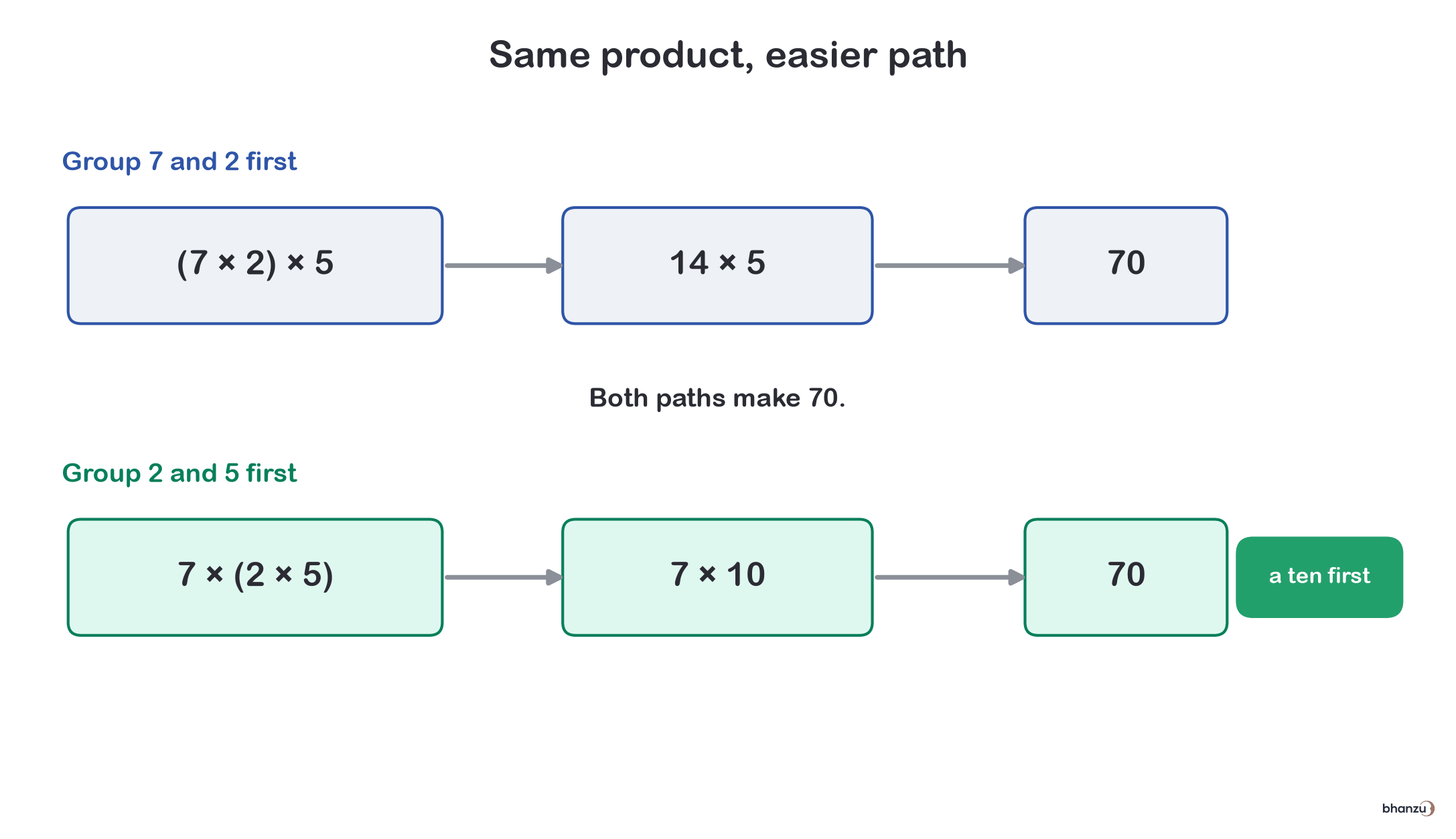
Some children always multiply left to right, even when the last two numbers are a 2 and a 5. They end up with instead of .
Grouping alone stops helping when no friendly pair sits side by side. In , you'd get or . Let the 4 and the 7 trade places first (that trade is the commutative property), then group the 4 with the 5.
A ten can also hide inside a factor, like the 20 in .
Writing 20 as is a split, and the regrouping after it is the associative step.
In a 2015 study of 101 fourth graders in China, an associative grouping strategy beat the distributive strategy and no strategy for accuracy and speed. The researchers add that a strategy which doesn't simplify a problem may not help.
Try It Yourself
Tap Group first two or Group last two to put parentheses around a pair, then tap Next step to finish. Try both groupings on the same numbers, and the readout shows the same product plus which grouping made a multiple of 10. Switch to Divide, and the groupings give different answers.
Is the associative property the same as the commutative property?
No. The commutative property changes the order of the factors, and the associative property changes only the grouping. This chart adds the distributive property, which splits one factor into a sum.
| Property | What changes | Example |
|---|---|---|
| Commutative | the order of two factors | |
| Associative | which pair is multiplied first | |
| Distributive | one factor is split into a sum |
Equal products can't tell you which property was used, so look at what moved. Places mean commutative, and parentheses mean associative.
The two names sound alike and are easy to swap. One way to hold them apart: commuters move to new places, and associates form groups.
Examples of associative property of multiplication
Example 1
Find by grouping it two ways.
Both groupings give 40.
Example 2
What number goes in the box?
The box stands for a missing factor. The factors keep the same order, so the right side must use 6, 3 and 2.
The box is 3.
Example 3
Find the easy way.
The tempting move is to grab both friendly-looking pairs, and , and multiply the results.
That can't be right. Since , the product is 9 tens, which is 90. The 5 got used twice, so 450 is five times too big.
Each factor belongs in exactly one group.
The other grouping agrees.
The product is 90.
Example 4
Which equation shows the associative property, A or B?
Each side makes 56, so the products can't decide it.
Equation A keeps 7, 2 and 4 in order and moves only the parentheses. Equation B moves the 4 to the front, which is the commutative property, so the answer is A.
Example 5
Find by writing 30 as .
So .
Example 6
Noah's school buys 3 cases of juice boxes for field day. Each case holds 4 packs, and each pack holds 5 juice boxes. If 52 children each drink one juice box, how many are left?
Group the 4 and the 5 first, since they make 20.
Then subtract the 52 juice boxes.
There are 8 juice boxes left.
The real reason the associative property exists
People pack things in equal groups inside equal groups. The associative property means you can count bundles inside bundles by whichever grouping is easiest and reach the same total.
- It lets you pick the easy pair. becomes , which is quick mental math.
- It lets two people check each other. One counts a delivery case by case, the other pack by pack, and the two totals should match.
- It lets you drop the parentheses, since every grouping of gives 30.
In a 2022 New Zealand study, only 35 of 308 students aged 10 to 13 linked to by regrouping. Most of those 35 worked out both products first and only then saw the link, so spotting a regrouping takes practice.
The pattern hiding inside the associative property
The "add a zero" shortcut is the associative property in disguise.
The zero at the end is the 10 you grouped last, and that regrouping is the reason behind multiplying by multiples of 10. A child who says "you just add a zero" but can't say where it came from has the shortcut (a fine start) without the reason.
A 2019 study of 25 Year 5 and 6 students in Australia, ages 10 to 12, asked them to explain how can equal . Fourteen described taking zeros off and putting them back, and only 3 explained it by grouping the tens. Two questions at home show whether the reason has landed.
- Ask "where did the zero come from?" and listen for "the 10 I grouped last."
- Ask your child to say the grouped version out loud, such as .
Common errors when working with the associative property
Mistake 1: Moving a factor and calling it grouping
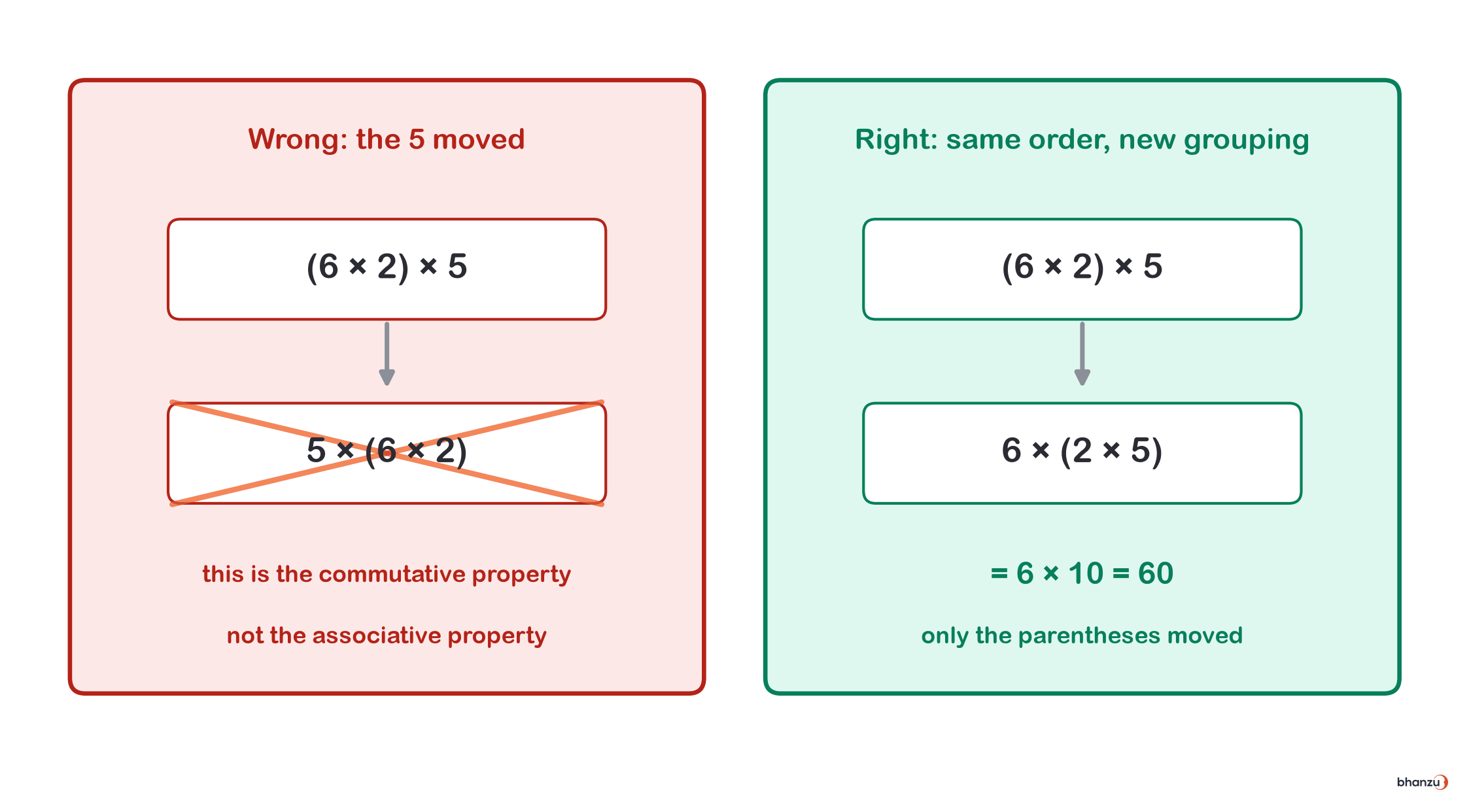
Where it slips in: Rewriting to show the associative property. Both properties keep the product the same, so one fuzzy rule feels like enough.
Don't do this: Write and call it associative. The 5 moved to the front.
The correct way: Keep 6, 2 and 5 in order and move only the parentheses, . Moving the 5 is the commutative property.
Mistake 2: Writing the product in the box
Where it slips in: Fill-in problems like , where the box is a missing factor.
Don't do this: Work out and write 60 in the box.
The correct way: The factors must match, so the box is 5, and checks it.
A child who works everything out first and writes the last number found is following an old habit: in many earlier problems, the box held the answer.
Mistake 3: Regrouping a division or a subtraction
Where it slips in: Three numbers joined by division or subtraction, such as . Children who have just learned that grouping is free often try it on division, which feels like multiplication's partner.
Don't do this: Regroup it as .
The correct way: Divide from left to right, as the order of operations does, so . Subtraction works the same way, since but .
Key Takeaways
- The associative property of multiplication moves the parentheses and never the factors.
- Before multiplying three numbers, look for a 2 beside a 5 so you can make a ten first.
- When two products match, check what moved, since places point to commutative and parentheses to associative.
- For more practice spotting the pair that makes a ten in three-factor problems, explore Bhanzu's 3rd grade math curriculum or work with an elementary math tutor.
Read More
- Multiplication and Division Word Problems
- Area and the Distributive Property
- Relating Multiplication and Division
- Multiplying by 1-Digit Numbers
- Properties of Operations
Research Behind This Article
- Common Core State Standards Initiative, Grade 3: Operations and Algebraic Thinking (2010). thecorestandards.org
- OpenStax, Prealgebra 2e: 7.2 Commutative and Associative Properties (2020). openstax.org
- Ru-De Liu et al., The Relations between Number Property Strategies, Working Memory, and Multiplication in Elementary Students (2015). eric.ed.gov
- Jodie Hunter et al., "It Has the Same Numbers, Just in a Different Order": Middle School Students Noticing Algebraic Structures within Equivalent Equations (2022). eric.ed.gov
- Ann Downton et al., The Case of Disappearing and Reappearing Zeros: A Disconnection between Procedural Knowledge and Conceptual Understanding (2019). eric.ed.gov
Quick Quiz: Check Yourself
Three levels, new numbers every time. Easy multiplies three numbers or finds a missing factor, and Medium fixes a doubled factor or picks the associative equation. Hard multiplies by a multiple of 10 or solves a juice box story.
Was this article helpful?
Your feedback helps us write better content
Frequently Asked Questions
What is the associative property of addition?
What is the associative law of multiplication?
Does the associative property work with zero?
Does the associative property of multiplication work with more than three numbers?
Is the associative property 3rd grade math?
How do I explain the associative property to my child?