Key Points
- Multiplying and dividing by powers of 10 such as 10, 100 and 1,000 moves all of a number's digits the same number of places on a place-value chart.
- Each place on a place-value chart is worth 10 times the place to its right, so multiplying by 10 moves digits one place left while the decimal point stays fixed.
- A frequent mistake is tacking zeros onto a decimal, writing 3.5 times 100 as 3.500, which still equals 3.5 rather than 350.
- Common Core standards 5.NBT.A.1 and 5.NBT.A.2 place this skill in 5th grade, along with exponents such as for 1,000.
The decimal point that never moves
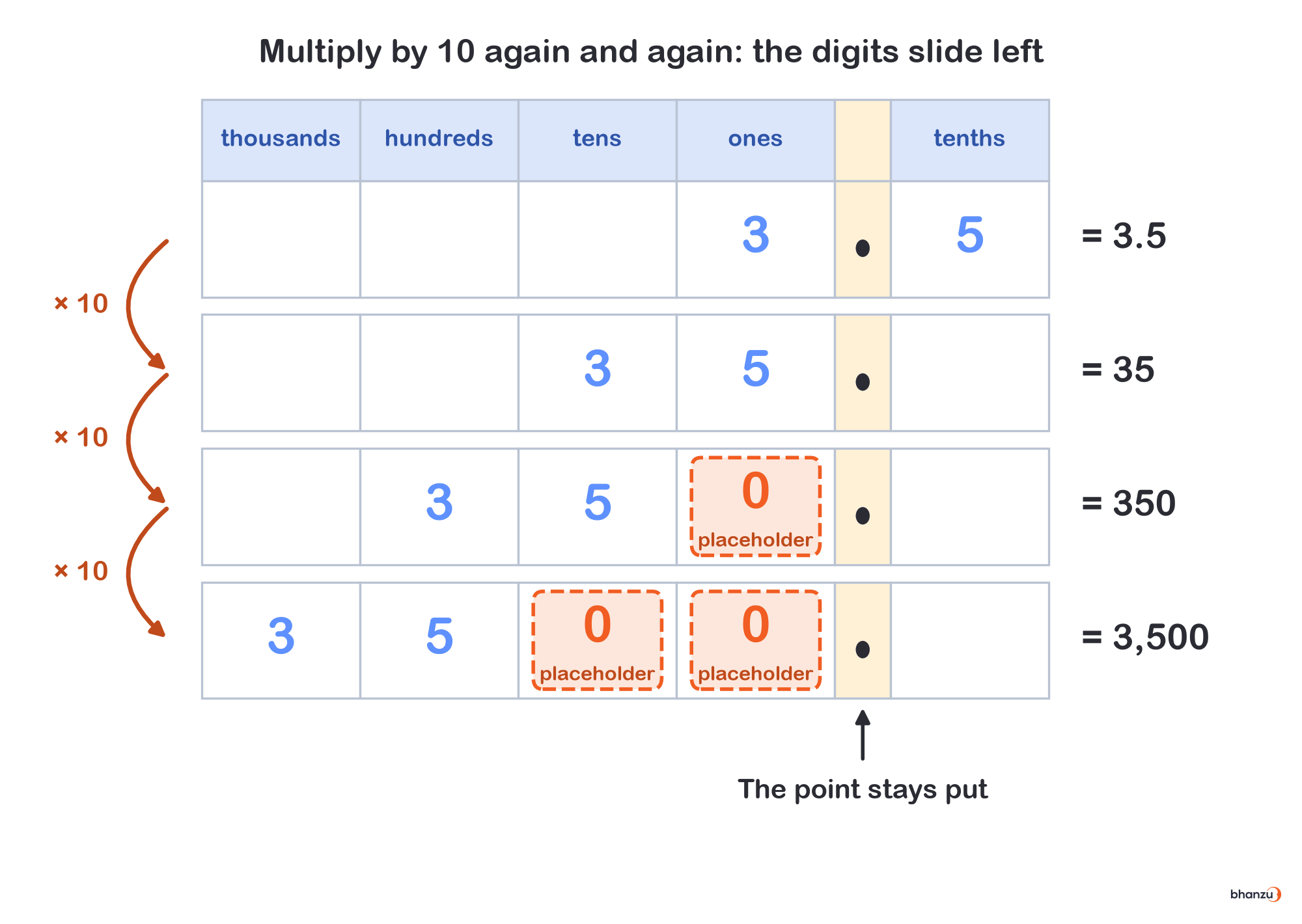
When you multiply 3.5 by 10, the decimal point stays right where it was.
The digits are what move. The 3 slides from the ones place into the tens place, the 5 slides from tenths into ones, and 3.5 becomes 35. Multiply by 10 again for 350, and once more for 3,500.
The point never budged, yet the number is now 1,000 times as large. The usual rule, "move the decimal point," gives the same answers but hides what each digit does. Soon you'll use this slide to turn 2.45 meters into 245 centimeters in your head.
What does multiplying and dividing by powers of 10 mean?
Multiplying and dividing by powers of 10 makes a number 10, 100 or 1,000 times bigger or smaller by sliding its digits across a place-value chart, a row of named columns. A power of 10 is 10 multiplied by itself some number of times, so 100 is and 1,000 is .
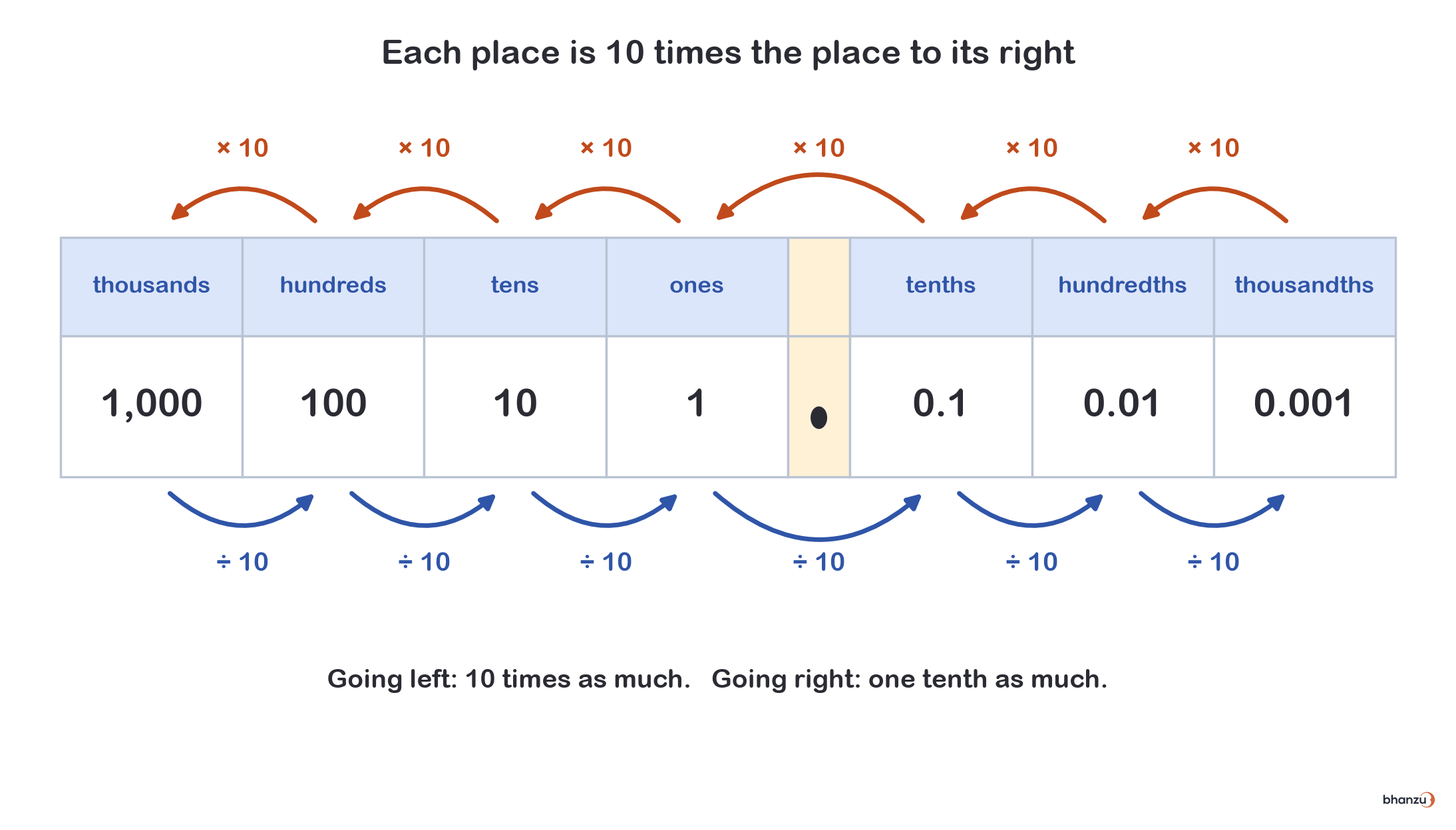
Left of the decimal point sit the ones, tens, hundreds and thousands. To its right sit tenths, hundredths and thousandths, the places you used for decimals in expanded form. Each column is worth 10 times the column to its right.
In 4th grade, multiplying by 10, 100 and 1,000 used whole numbers only. This skill comes from Common Core standards 5.NBT.A.1 and 5.NBT.A.2, where your child stretches that pattern to decimals as small as thousandths. The national NAEP assessment checks number properties and operations, the strand this skill belongs to, as one of its five content areas. Its 2024 NAEP mathematics results found 39% of fourth graders at or above Proficient and 24% below Basic.
How do you multiply by powers of 10?
To multiply by a power of 10, slide every digit one place left for each zero in the power, and keep the decimal point where it is.
- Count the zeros in the power of 10 (100 has two).
- Slide every digit that many places left.
- Write a placeholder zero, a 0 that holds an empty place, in any gap between the digits and the decimal point.
- Leave off the point if no digits sit after it.
Only the second answer needs a placeholder zero, because only there does the 7 land left of the ones place.
An exponent is the small raised number that counts how many 10s are multiplied. In standard form, the usual way of writing a number with digits, a power of 10 has exactly as many zeros as its whole-number exponent. That match makes exponents a quick way to write big powers of 10, and in 6th grade you'll see them on other numbers, such as .
| Exponent form | Repeated multiplication | Standard form |
|---|---|---|
| 10 | ||
| 100 | ||
| 1,000 |
The slide works only for powers of 10, so 3.5 times 300 needs a split first. Write 300 as , find , then slide two places to get 1,050.
How do you divide by powers of 10?
To divide by a power of 10, slide every digit one place right for each zero in the power, and keep the decimal point still.
| Problem | Places to slide | Answer |
|---|---|---|
| 1 right | 5.2 | |
| 2 right | 0.52 | |
| 3 right | 0.052 |
When there aren't enough digits, empty places appear. In the 5 lands in the hundredths place, so the empty tenths place gets a placeholder zero. The 0 before the point is a convention (.052 means the same, but the leading 0 keeps the point from getting lost).
Placeholder zeros also fill the gap in 0.4 divided by 100, which is 0.004. A child often stops after one slide and writes 0.04, because the first move already looks smaller. Counting the zeros in 100 out loud before sliding keeps both moves on paper.
Try It Yourself
Drag the slider or press the arrow keys to multiply or divide by 10, 100 or 1,000. Watch every digit slide across the place-value chart while the decimal point stays still, with orange placeholder zeros filling empty places. The line under the chart shows each step with an exponent, and New number gives you a fresh start.
How do the digits compare from place to place?
In 3.33, all three digits are 3s, but they're worth 3, 0.3 and 0.03. Each 3 is worth 10 times the 3 to its right and of the 3 to its left, where "of" means multiply.
"10 times as much" and "10 more than" sound alike, and adults mix them up too. Ten times 0.3 is 3, but 10 more than 0.3 is 10.3.
Two places apart means 100 times. In 7.77, the first 7 is worth 7 and the last is worth 0.07, and . Three places apart means 1,000 times.
The same place-by-place view settles comparing and ordering decimals, since a 4 in the tenths place, worth 0.4, beats any single digit in the hundredths place.
Examples of multiplying and dividing by powers of 10
Example 1
What is 46 times 100?
100 has two zeros, so the 4 slides from tens to thousands and the 6 from ones to hundreds. The empty tens and ones places get placeholder zeros.
Example 2
What is 3.5 times 100?
The tempting move is to copy Example 1 and tack on two zeros, giving 3.500.
That can't be right. The new zeros sit in the hundredths and thousandths places, so 3.500 is still 3.5. Multiplying by 100 has to land between 300 and 400.
Slide the digits instead. The 3 moves from ones to hundreds, the 5 from tenths to tens, and the empty ones place gets a placeholder zero.
Example 3
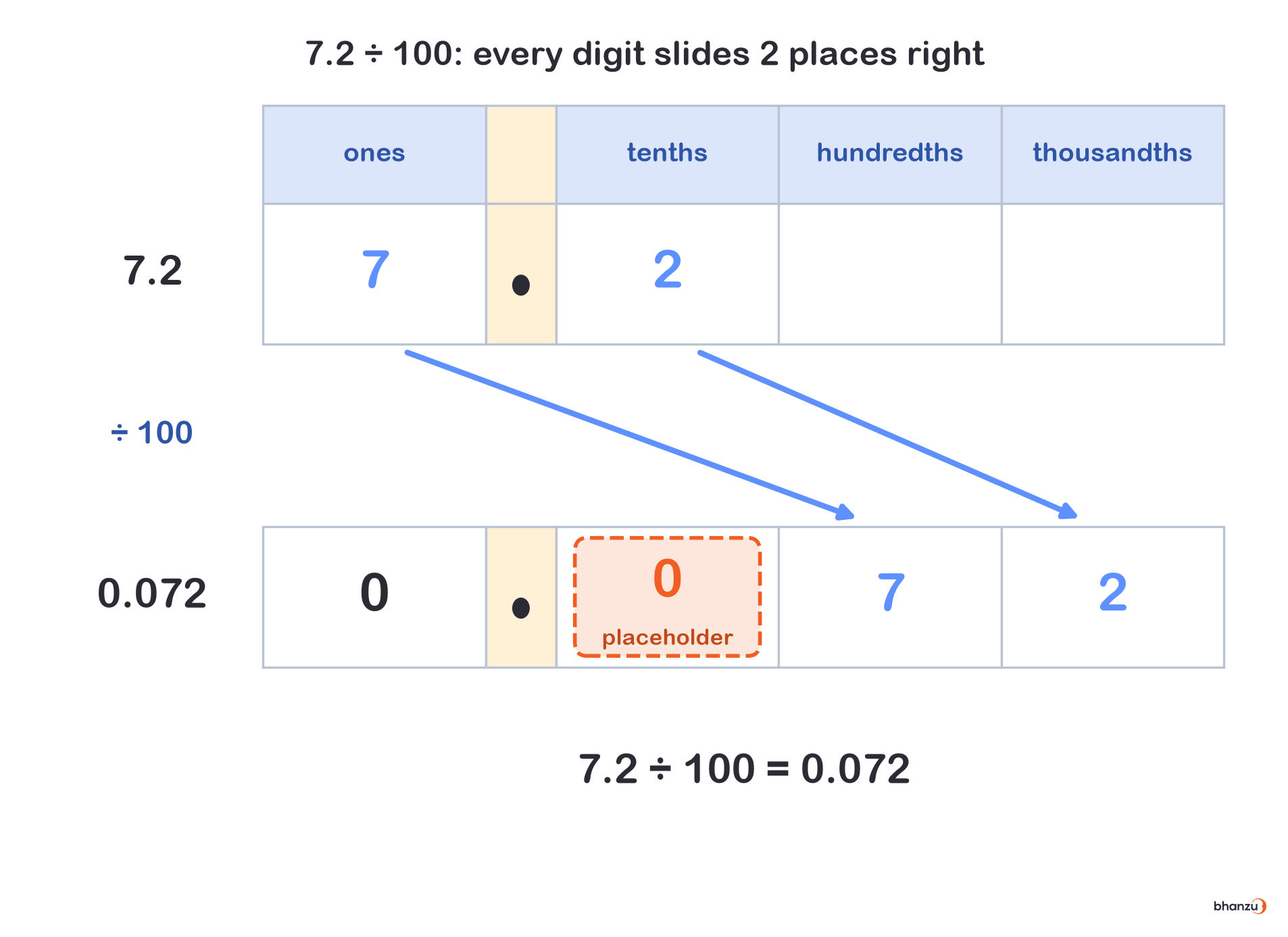
What is 7.2 divided by 100?
Dividing by 100 slides every digit two places right. The 7 moves from ones to hundredths and the 2 from tenths to thousandths.
The empty tenths place gets a placeholder zero, and a 0 sits in the ones place.
Multiplying back confirms it, since .
Example 4
What is 0.063 times 10 to the 3rd power?
Slide every digit three places left. The 6 moves from hundredths to tens and the 3 from thousandths to ones.
Example 5
528 divided by which power of 10 equals 0.528?
Let a box stand for the missing power of 10.
The 5 starts in the hundreds place and ends in the tenths place. Hundreds to tens, tens to ones and ones to tenths is three places right, so the box is , or 1,000.
The answer holds up, because .
Example 6
Diego's hiking trail is 1.35 kilometers long, and markers split it into 10 equal sections. How long is each section in meters?
Multiply by 1,000 to change kilometers to meters. The 1, 3 and 5 each slide three places left, and the empty ones place gets a placeholder zero.
Ten equal sections means dividing by 10.
Each section is 135 meters long.
Why do powers of 10 matter?
Powers of 10 matter because the way we write every number is built on them. Each place is worth 10 of the place to its right, so a slide is the exact way to scale a number by 10, 100 or 1,000.
- Metric units run on powers of 10. The National Institute of Standards and Technology page on metric prefixes, updated in 2025, defines kilo as 1,000, centi as one-hundredth and milli as one-thousandth, so 3 kilometers is 3,000 meters.
- Money uses the same places. A dollar is 100 cents, so $4.50 is 450 cents.
- Decimal multiplication leans on the slide. In multiplying decimals, can be worked as , then divided by 100 to get 0.06.
Take the slide away and each of those jobs turns back into long multiplication.
The part of powers of 10 nobody explains
Two habits make the slide reliable, and both come from watching the digits instead of the point. The point always sits between the ones and the tenths, so every check looks at where the digits land.
- Count the power, not the answer. In , the power has three zeros and the answer has none. A child who counts zeros will second-guess 63, yet it's right, because the zeros in 0.063 were only placeholders.
- Check the size first. must land between 300 and 400, and must be less than 0.01, since 0.4 is less than 1 and . That estimate catches a tacked-on zero and a missing placeholder.
In 8th grade this slide grows into scientific notation. Common Core standard 8.EE.A.3 has students use a single digit times a power of 10 to estimate very large and very small amounts. The 8th grade lesson on powers of 10 and estimation starts from exactly this skill.
Common errors when working with powers of 10
Mistake 1: Tacking a zero onto a decimal
Where it slips in: Multiplying a decimal, as in Example 2. "Add a zero" always worked with whole numbers in 4th grade, so a child who rushes reaches for it first.
Don't do this: Writing as 4.20, which is still 4.2.
The correct way: Slide both digits one place left to get .
Mistake 2: Leaving out the placeholder zero
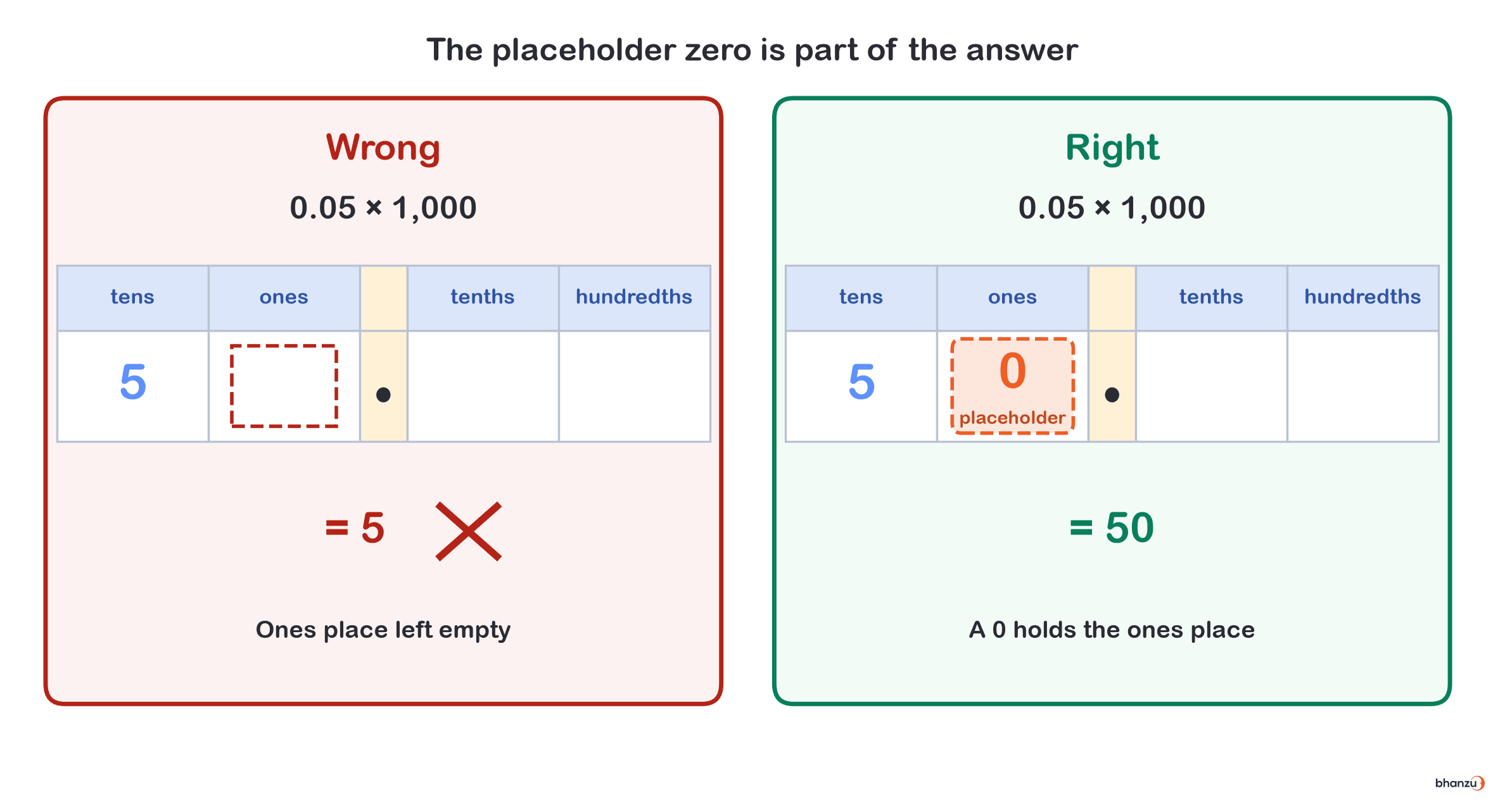
Where it slips in: Answers where a digit slides past an empty place, like .
Don't do this: Writing , or .
The correct way: The 5 slides three places left, from hundredths to tens, and the empty ones place needs a 0, so the answer is 50. In the same way, .
Children often move the 5 correctly in their heads, then skip writing the empty place. Saying each place name aloud as the digit passes it (tenths, ones, tens) keeps every stop on paper.
Mistake 3: Reading the exponent as a multiplier
Where it slips in: Problems like , where the raised 3 looks like "times 3."
Don't do this: Working out as .
The correct way: is three 10s multiplied together, or 1,000, so .
Key Takeaways
- Before multiplying and dividing by powers of 10, count the zeros in the power or read the exponent, since that count is how many places every digit slides.
- Slide left to multiply, right to divide, and leave the point alone.
- Every empty place between the digits and the point gets a placeholder zero, as in 50 and 0.006.
- Estimating first, such as 3.5 times 100 landing between 300 and 400, catches a tacked-on zero.
- For more practice sliding digits with a teacher who catches the 3.500 mistake right away, explore Bhanzu's 5th grade math tutor or math classes for kids.
Read More
- Dividing by Decimals
- Volume of Composite Figures
- Regrouping Decimals
- Dividing Multiples of 10, 100 and 1,000
- Scientific Notation
- Fractions, Decimals and Percentages
Research Behind This Article
- Common Core State Standards Initiative, Grade 5: Number and Operations in Base Ten (2010). thecorestandards.org
- National Center for Education Statistics, Explore Results for the 2024 NAEP Mathematics Assessment (2025). nationsreportcard.gov
- OpenStax, Prealgebra 2e, 5.2 Decimal Operations (2020). openstax.org
- National Institute of Standards and Technology, Metric (SI) Prefixes (2025). nist.gov
- Common Core State Standards Initiative, Grade 8: Expressions and Equations (2010). thecorestandards.org
Quick Quiz: Check Yourself
Three levels, new numbers every time: multiply or divide whole numbers by 10, 100 or 1,000, then decimals with placeholder zeros and missing powers, then exponents and a two-step metric word problem.
Was this article helpful?
Your feedback helps us write better content
Frequently Asked Questions
What is 10 to the 5th power?
Is dividing 1 by powers of 10 how you get 0.1, 0.01 and 0.001?
How do you know how many places to move when multiplying decimals by powers of 10?
What should a 5th grader know about powers of 10?
How can I help my child practice multiplying and dividing by powers of 10 at home?