Key Points
- Multiplying by 10, 100, and 1,000 moves the same digits, in the same order, into bigger places, so 38 becomes 380, 3,800 or 38,000.
- The digits move because each place is worth ten times the place to its right, so multiplying by 100 makes two ten-times jumps.
- A ten times a ten makes a hundred, so 40 times 60 is 24 hundreds, or 2,400, even though 40 and 60 each have only one zero.
- For a multiple such as 5,000, do the basic fact first and then name the place, so 6 times 5 thousands is 30 thousands, or 30,000.
One bill worth a hundred thousand dollars
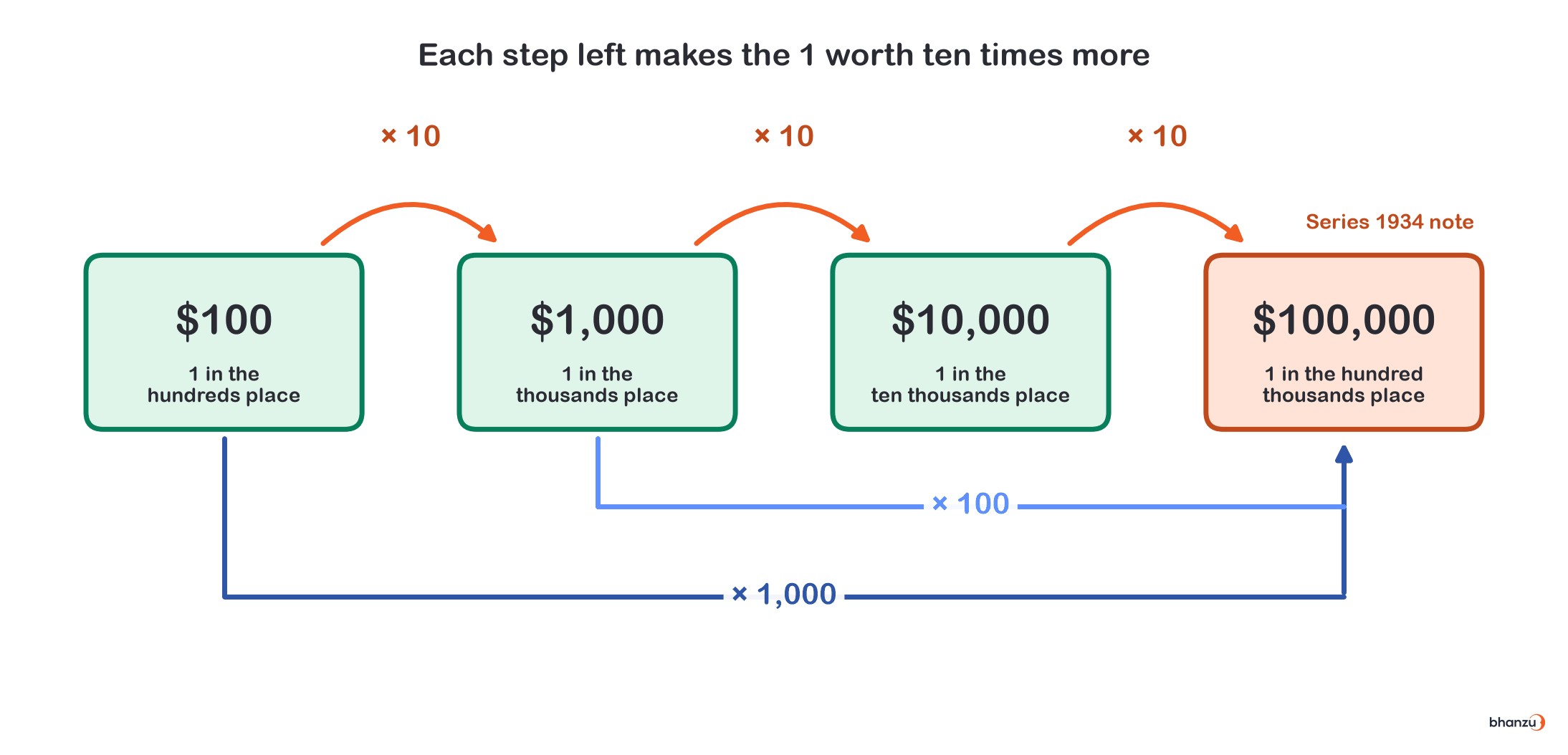
The biggest bill the Bureau of Engraving and Printing ever printed was worth $100,000. These gold certificates were printed for about three weeks, from December 18, 1934 to January 9, 1935, and only Federal Reserve Banks ever used them.
One of those notes equals 1,000 of today's $100 bills. In $100, $1,000, $10,000 and $100,000, the digit 1 never changes. Only its place does, and each step left makes it worth ten times more. Later in 4th grade, this same slide helps you multiply two-digit numbers such as 23 times 45.
How do you multiply by 10, 100, and 1,000?
Multiplying by 10, 100, and 1,000 means moving every digit 1, 2 or 3 columns left on a place value chart. That chart is a table with one column per place, ones on the right. A placeholder zero, a 0 that holds a place open, fills each empty column on the right. A digit is one of the symbols 0 to 9, and its place value is what it is worth because of its column, so the 3 in 306 is worth 3 hundreds.
- Count the zeros in 10, 100 or 1,000.
- Slide every digit that many places left.
- Write a 0 in each empty place, up to the ones.
- Check that the answer is 10, 100 or 1,000 times as big.
| Number | Times 10 | Times 100 | Times 1,000 |
|---|---|---|---|
| 7 | 70 | 700 | 7,000 |
| 38 | 380 | 3,800 | 38,000 |
| 306 | 3,060 | 30,600 | 306,000 |
The steps work for any whole number (0, 1, 2, 3 and so on), though 0 simply stays 0. The skill belongs to Common Core standards 4.NBT.A.1 and 4.NBT.B.5 in 4th grade. Your child is expected to see that each place is worth ten times the place to its right, for whole numbers up to 1,000,000, and to use place value to multiply.
Why do the digits move left?
Start with 306, which is 3 hundreds, 0 tens and 6 ones. Times 10, every part becomes ten times as big, so 3 hundreds become 3 thousands and 6 ones become 6 tens.
When you multiply by 10, each digit lands one place left, because each place is worth 10 of the place to its right (10 ones make a ten, 10 tens make a hundred). Multiplying by 100 is two jumps, since 100 is 10 times 10. Multiplying by 1,000 is three (in 5th grade, 1,000 gets the short form ).
The 0 inside 306 moves with its neighbors. The new 0 at the end holds the ones place. A child who learned "just add a zero" can write 3,060 and still not say why the 0 inside 306 stayed put.
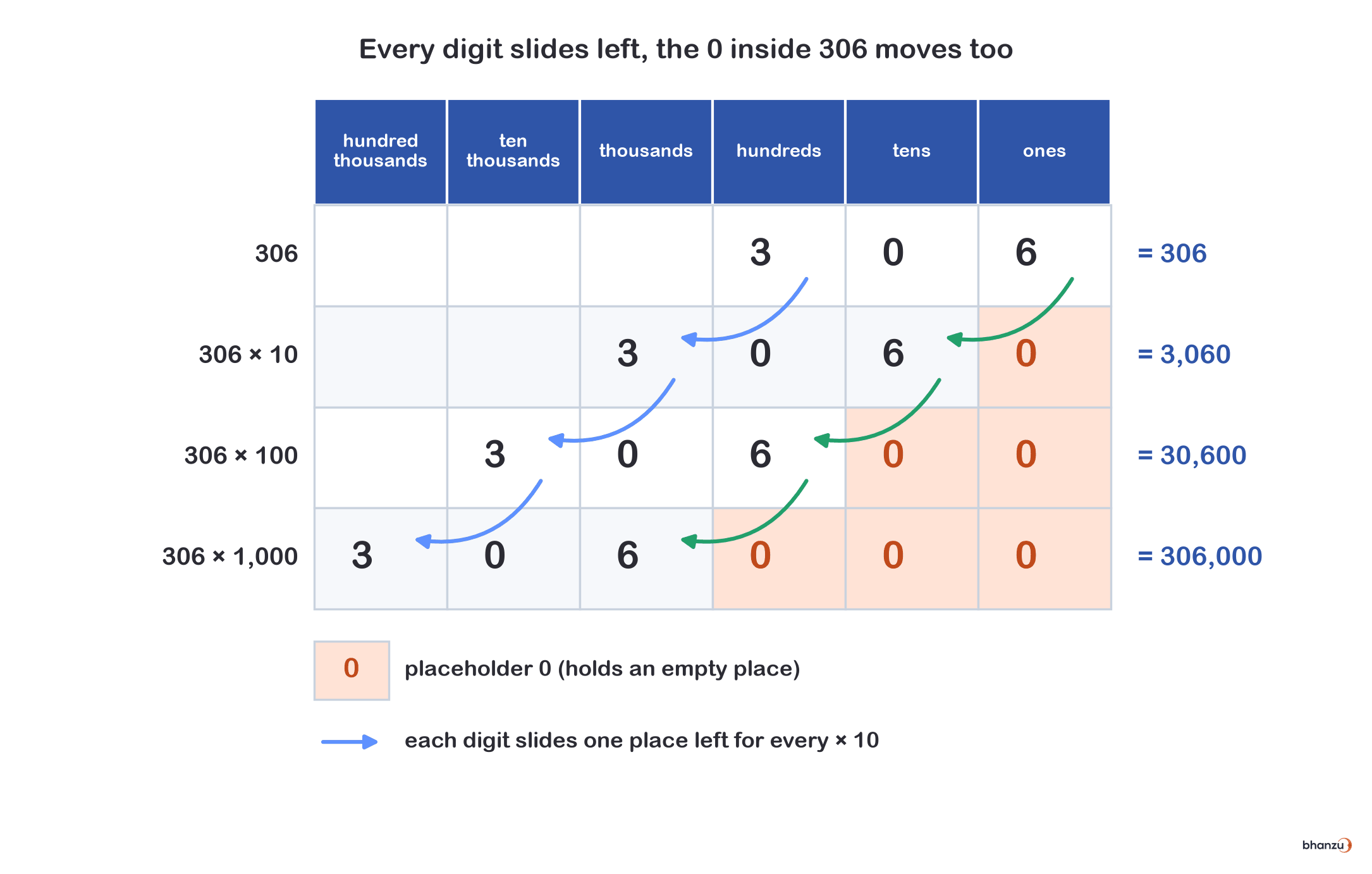
The slide also runs backward: if 29 became 2,900, the digits moved two places, so 29 was multiplied by 100.
Moving digits by hand makes the reason visible. In a 2016 study of 16 students in their fifth year of school, only 3 could at first explain that the digits move when a number is multiplied by ten. After sliding a strip of digits along place value columns, 14 of the 16 could.
How do you multiply by multiples like 30, 400, and 5,000?
To multiply by a multiple of 10, meaning a number made by multiplying 10 by a whole number, such as 30, 400 or 5,000, do the basic fact first and then name the place.
- Split the multiple into a digit and its place, so 700 is 7 hundreds.
- Use the basic fact, so .
- Name the place, so 21 hundreds is 2,100.
The steps work because you may multiply any pair first without changing the answer, a rule called the associative property.
Saying a number by its unit, such as 21 hundreds, is called unit form.
| Problem | Basic fact | Unit form | Product |
|---|---|---|---|
| 21 hundreds | 2,100 | ||
| 36 tens | 360 | ||
| 30 thousands | 30,000 |
The last row has four zeros even though 5,000 has three, because the basic fact already makes 30. In 3rd grade you practiced multiplying by multiples of 10 with one-digit numbers, such as 2 times 70. Now the place can be hundreds or thousands.
Units work the same way. Since , 3 kilograms is 3,000 grams.
Try It Yourself
Pick a starting number, then press times 10, times 100 or times 1,000 and watch each digit slide left as a 0 fills each empty place. For a multiple such as 400, start from a one-digit number like 7, press times 4 and then times 100, and read the equation under the chart.
Tens times tens make hundreds
A 30 by 50 rectangle cut into 10 by 10 squares holds 3 rows of 5 squares. Its area, the number of unit squares covering it, is length times width, because the unit squares sit in equal rows. Each 10 by 10 square holds 100 unit squares, so the 15 squares make 15 hundreds, or 1,500.
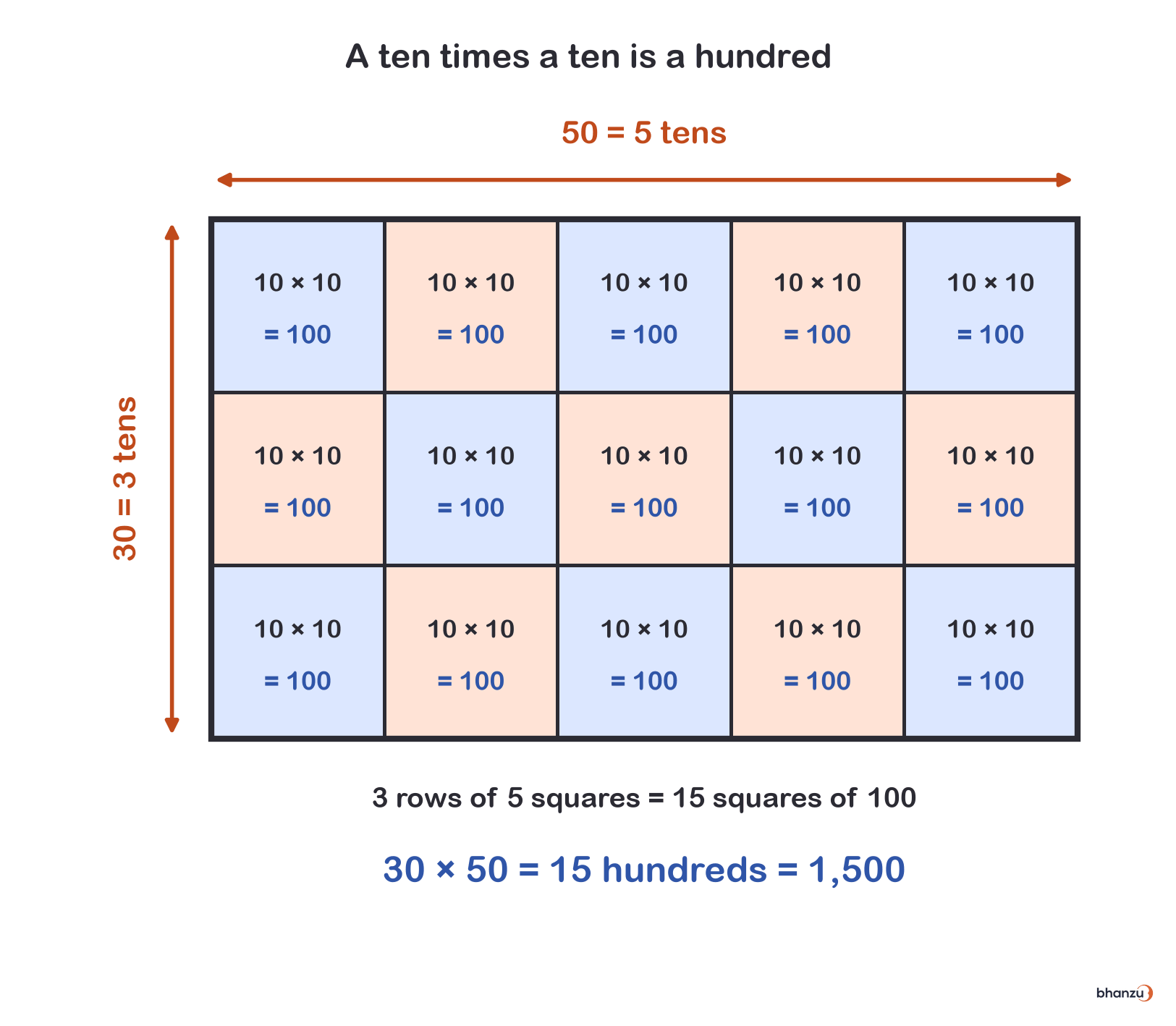
The numbers being multiplied are called factors. Write each factor as a digit times 10.
Swapping the factors is the commutative property, and regrouping them is the associative property. Together they put the two tens side by side, and a ten times a ten is a hundred. So every zero in both factors appears in the answer, plus any 0 the basic fact makes.
The method needs each factor to be one digit followed by zeros. For 23 times 40, first find with the steps for multiplying up to 4-digit numbers by 1-digit numbers, then slide one place to get 920.
Examples of multiplying by 10, 100, and 1,000
Example 1
What is 52 times 100?
100 has two zeros, so every digit slides two places left. The 5 tens become 5 thousands, the 2 ones become 2 hundreds, and zeros fill the tens and ones.
Example 2
What is 40 times 60?
The tempting move is plus one zero, which gives 240.
That cannot be right. is already 400, and 60 is more than 10, so the answer must be more than 400.
Count units instead. 40 is 4 tens and 60 is 6 tens, and a ten times a ten is a hundred, so the product is 24 hundreds.
Example 3
The $100,000 note was worth how many $1,000 notes?
Let ? stand for the number of $1,000 notes.
Undo the three-place slide by moving the 1 in 100,000 back three places, from the hundred thousands to the hundreds.
The note was worth 100 notes of $1,000.
Example 4
Mei buys 7 bags of flour that hold 600 grams each. Is that more or less than 4 kilograms, and by how much?
, so the flour is 42 hundreds of grams.
Change the kilograms to grams.
Mei has 200 grams more than 4 kilograms.
Example 5
A bank packs $20 bills in bundles of 100. How much money is in 6 bundles, and about how much do they weigh at about 1 gram per bill?
One bundle holds 100 bills of $20.
$$100 \times $20 = $2{,}000$$
Six bundles hold 6 times 2 thousand dollars.
$$6 \times $2{,}000 = $12{,}000$$
The bundles hold bills, so they weigh about 600 grams.
The real reason numbers grow by tens
Each place in the number system is worth ten times the place to its right. That is why multiplying by 10, 100 or 1,000 needs no new fact, only a slide.
- It builds the metric system. Deka, hecto and kilo mean 10, 100 and 1,000, and they were among the eight original metric prefixes adopted in 1795, so 4 kilometers is 4,000 meters.
- It sizes up a pile of money. The Bureau of Engraving and Printing says a note weighs about 1 gram whatever its value, so 1,000 notes weigh about 1 kilogram.
- It makes checking fast. When estimating products, 7 times 596 is close to 7 times 600, or 4,200.
A quick slide in your head tells you whether a class trip total is about right before anyone pays.
What do most guides miss about adding a zero?
The phrase "add a zero" only tells you what the answer looks like, never why. Adding zero leaves a number alone, since 36 + 0 is still 36. "Add zero" and "add a zero" sound almost alike, which is genuinely confusing.
Naming the unit shows where the zeros come from:
- 36 times 10 is 36 tens, or 360.
- 36 times 100 is 36 hundreds, or 3,600.
- 36 times 1,000 is 36 thousands, or 36,000.
Renaming 36 hundreds as 3,600 is the same move as regrouping whole numbers. In the wider project behind that 2016 study, with over 400 students, many could answer 74 times 10 quickly, and almost all of them explained it as "adding a zero". Asking your child "how many tens?" gets closer to the reason.
Common errors when multiplying by 10, 100, and 1,000
Mistake 1: Dropping the zero the fact already made
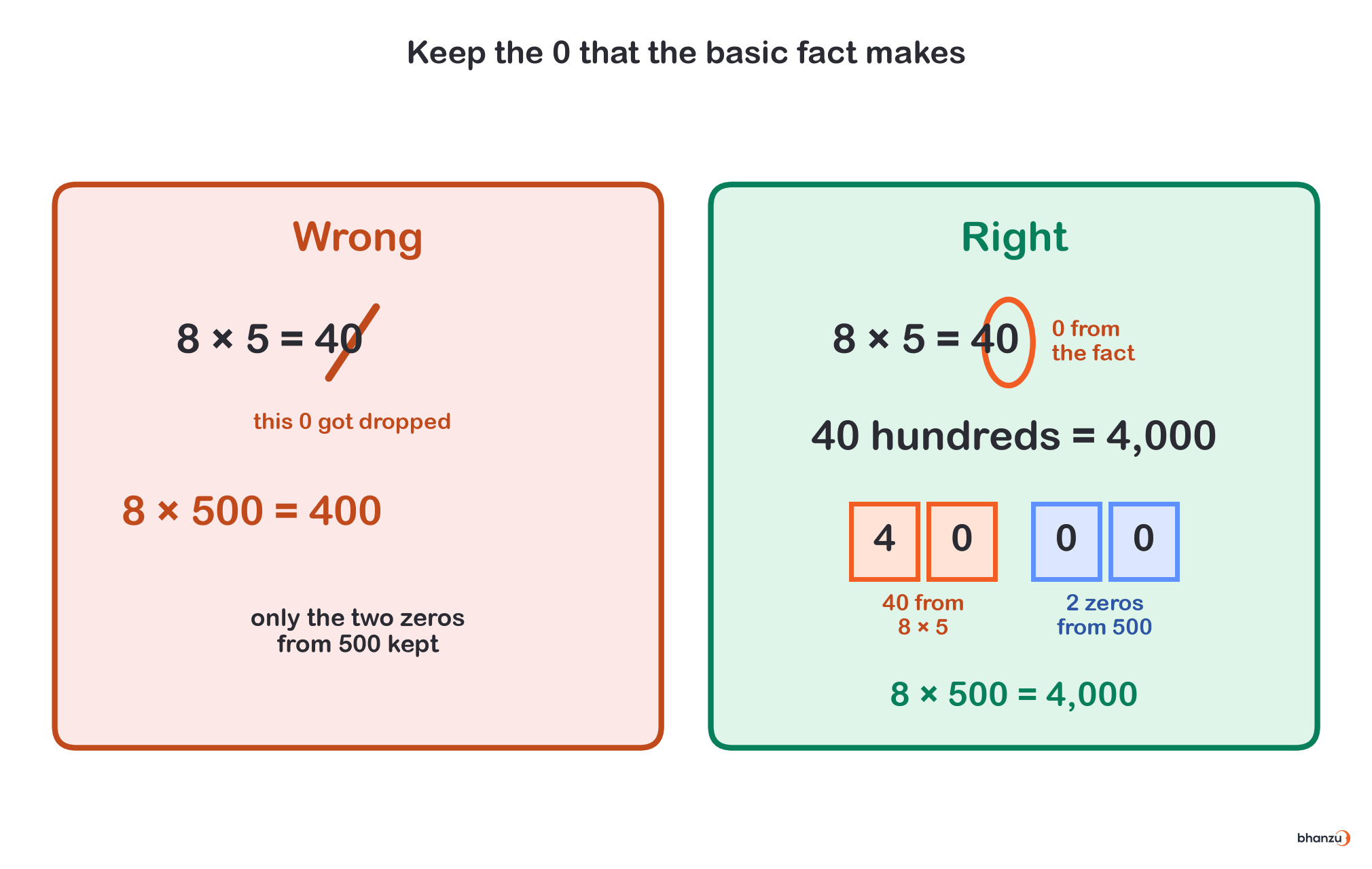
Where it slips in: Multiples whose basic fact ends in 0, such as 8 times 500 (8 times 5 is 40). A child who rushes counts the zeros in 500 and writes two, and a child who gets 4,000 may doubt it.
Don't do this: Writing 400 for .
The correct way: , so is 40 hundreds, or 4,000. The 0 in 40 comes from the fact.
Mistake 2: Sliding the digits the wrong number of places
Where it slips in: A times 1,000 problem right after several times 100 problems, such as 72 times 1,000, when the hand keeps writing two zeros out of habit.
Don't do this: Writing 7,200 for .
The correct way: 1,000 has three zeros, so the digits slide three places, and 72 thousands is 72,000.
Reading the answer aloud catches this one, because 7,200 is only 72 hundreds.
Mistake 3: Tacking a zero onto a price
Where it slips in: Prices with cents, such as 10 toys at $2.50 each, because writing a zero on the end always worked for whole numbers.
Don't do this: Writing $2.500 for 10 times $2.50, which is still only $2.50.
The correct way: Change to cents first. $2.50 is 250 cents, and cents, which is $25.00. In 5th grade, digits slide past the decimal point the same way.
Key Takeaways
- Count the zeros first when multiplying by 10, 100, and 1,000, because that count is how far each digit slides.
- Saying the unit, such as 36 hundreds, gives the right number of zeros.
- Keep any 0 the basic fact makes, so 6 times 5 thousands has four zeros in 30,000.
- Check that the answer grew, since a whole number greater than 0 gets bigger when multiplied by 10 or more.
- For help keeping the zero from 8 times 500 as numbers grow, work with Bhanzu's 4th grade math tutor or explore math programs for kids.
Read More
- Multiplicative Comparison
- Dividing Multiples of 10, 100, and 1,000
- Multiplying and Dividing by Powers of 10
- How to Teach Multiplication
- Mental Math for Kids
Research Behind This Article
- Bureau of Engraving and Printing, FAQs (2026). bep.gov
- OpenStax, Prealgebra 2e: 1.4 Multiply Whole Numbers (2020). openstax.org
- Common Core State Standards Initiative, Number and Operations in Base Ten (2010). thecorestandards.org
- Chris Hurst and Derek Hurrell, Sliding into Multiplicative Thinking: The Power of the "Marvellous Multiplier" (2016). eric.ed.gov
- National Institute of Standards and Technology, Metric (SI) Prefixes (2025). nist.gov
Quick Quiz: Check Yourself
Three levels, new numbers every time: multiply by 10, 100 or 1,000, then multiply by multiples like 700 and find missing factors, then multiply tens by tens and solve word problems.
Was this article helpful?
Your feedback helps us write better content
Frequently Asked Questions
What is 10 multiplied by 10?
How many zeros are in 1,000, and does that tell me how many places to move?
How can I teach my child to multiply by 10, 100, and 1,000 at home?
What grade do kids learn multiplying by 10, 100, and 1,000?
What if my child keeps getting multiplying by 10, 100, and 1,000 wrong?