Key Points
- Adding up to four two-digit numbers works place by place, and every 10 ones that pile up become 1 more ten.
- Addition allows any order and any grouping, so ones digits that make 10, like 7 and 3, can go first.
- Four ones digits total 36 at most, so the carry can be 2 or 3, and carrying 1 out of habit loses tens.
Two new tens hiding in the ones
Add four numbers, and the ones can hand you two new tens at once. Maya read for 27, 18, 33 and 12 minutes on four school nights. Her ones digits pair up neatly, 7 with 3 and 8 with 2.
Those 2 new tens join the 7 tens from the tens digits, so Maya read 90 minutes. Later in 2nd grade, adding three-digit numbers uses the same steps with a hundreds place on top.
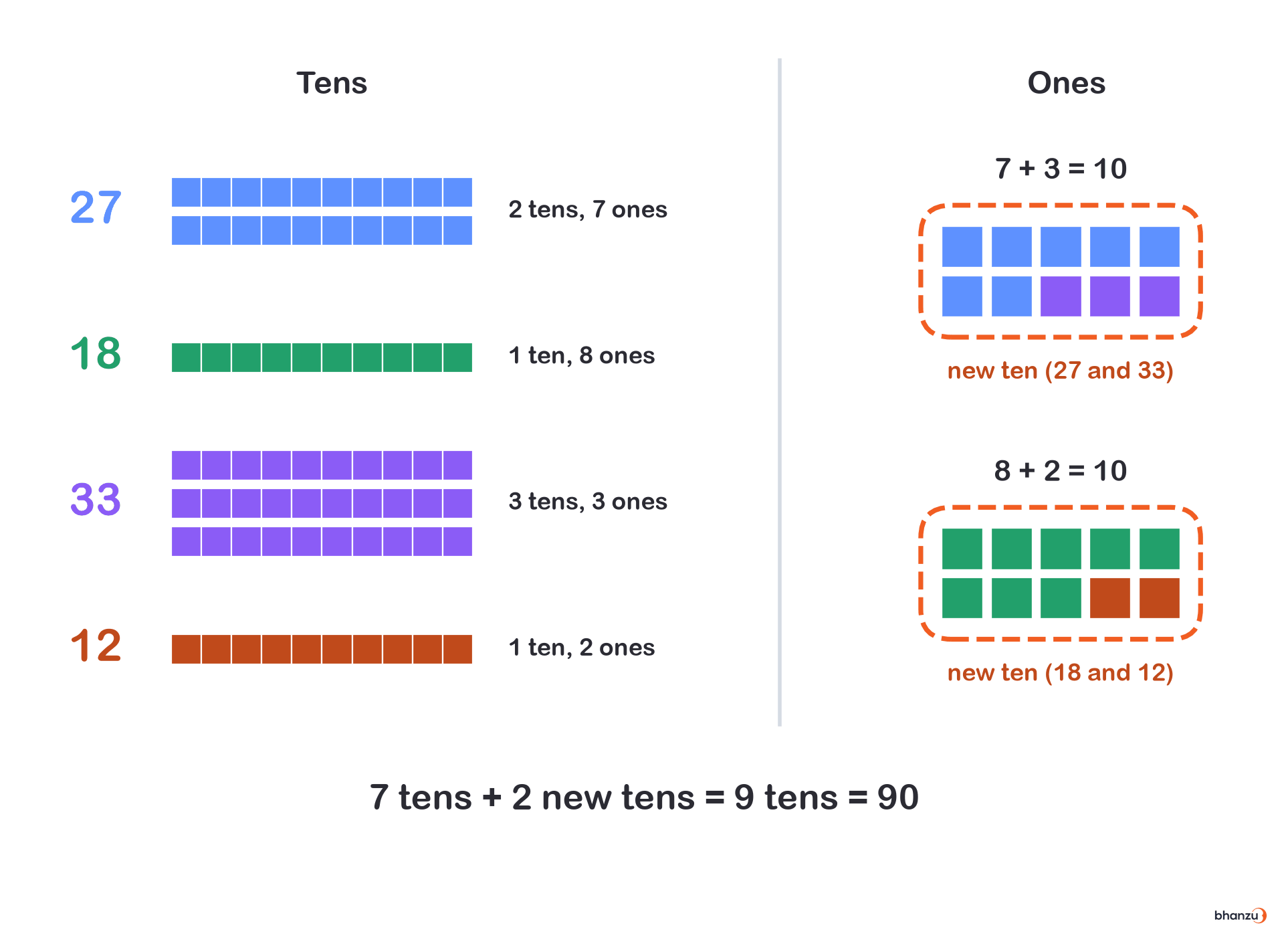
How do you add up to four two-digit numbers?
Adding up to four two-digit numbers works like piling base-ten blocks, rods of 10 and cubes of 1, then trading 10 cubes for a rod. Each number you add is an addend, and the total is the sum.
With two addends, as in adding two-digit numbers with regrouping, the ones reach 18 at most, so you make 1 new ten or none. Four addends can make up to 3 new tens.
- Partial sums. Add the tens, add the ones, then add both totals.
- Friendly pairs. Add ones that make 10 first.
- Column addition. Add one column at a time, ones first.
- Number line hops. Four numbers need many hops.
This is Common Core standard 2.NBT.B.6, which asks 2nd graders to add up to four two-digit numbers using place value and properties of operations. By the end of 2nd grade, your child is expected to add three or four two-digit numbers like these and explain why the method works, often with a drawing.
How do partial sums work?
Add all the tens, then all the ones, then add the two totals. Each total is a partial sum, one part of the answer.
- Split each number, so 34 is 30 and 4, 25 is 20 and 5, 16 is 10 and 6, and 23 is 20 and 3.
- Add the tens, as in adding several numbers with tens and ones.
- Add the ones.
- Add the partial sums.
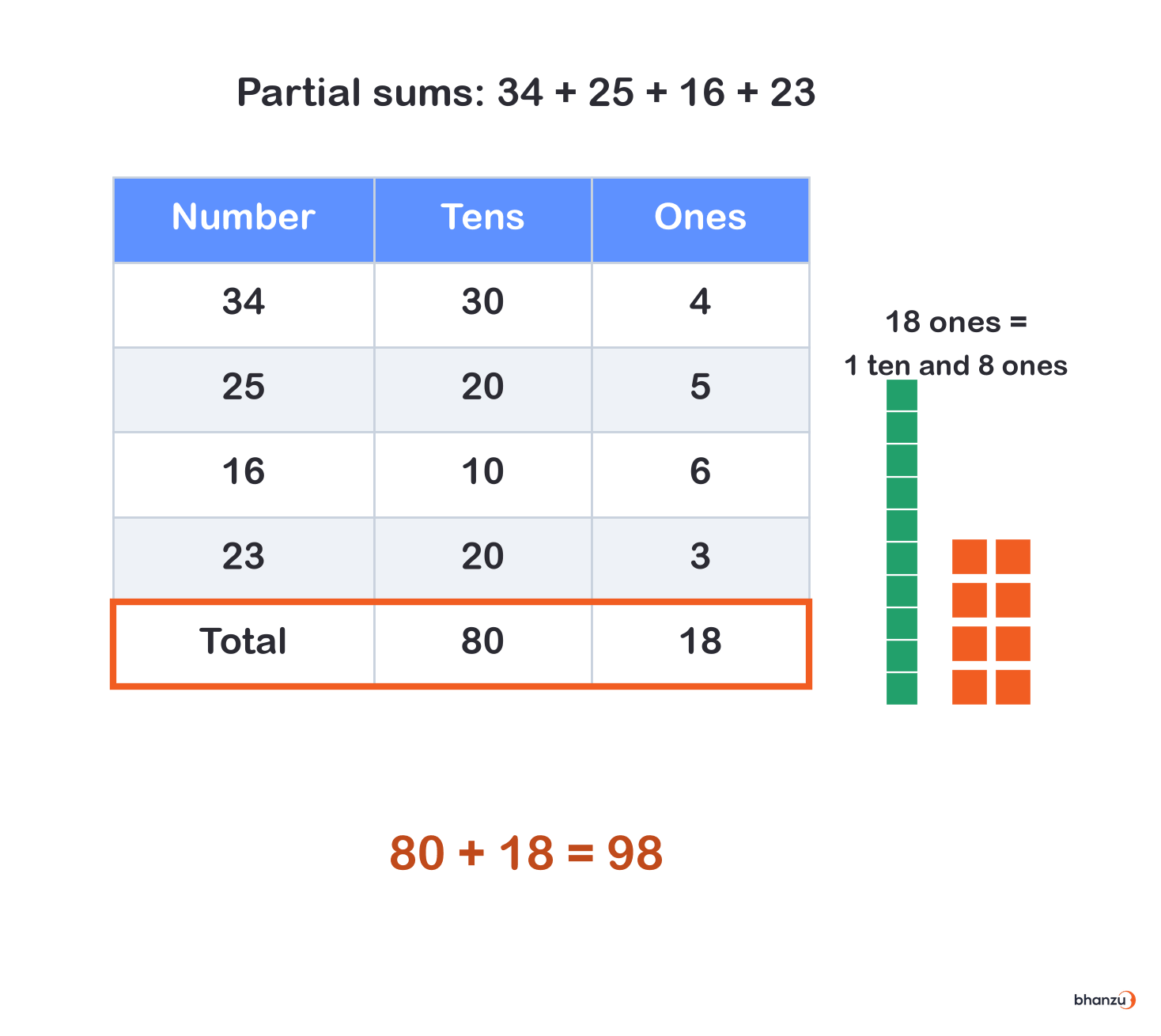
Partial sums keep every digit at its real value, so the 3 in 34 always means 30. The cost is extra writing.
Which numbers should you add first?
Add the ones that make 10 first. Addition lets you swap and group numbers any way you like, and the total stays the same.
A child who adds strictly left to right does first, then has to hold 15 while adding 3 and 2. Pairing turns the job into .
Hunting for a ten is the move from adding three numbers like in 1st grade. (For parents, these are the commutative and associative properties, names your child meets in later grades.) Other moves help too.
- Doubles. joins fast.
- Near tens. For 39, add 40 and take 1 back.
- No pair. If no ones make 10, use partial sums.
The make a ten strategy lasts. In a 2024 study in Sweden, children spent 1st grade in lessons built around making a ten. A year later, 73% of them solved correctly, against 51% of children from other schools taught the usual way.
How does column addition work with four numbers?
Column addition stacks the numbers by place value, ones under ones, then adds one column at a time, starting with the ones. Take .
- Add the ones.
- Write 4 under the ones and a small 2 above the tens, since 24 ones are 2 tens and 4 ones.
- Add the tens, starting with the small 2.
- Write 9 under the tens, so the sum is 94.
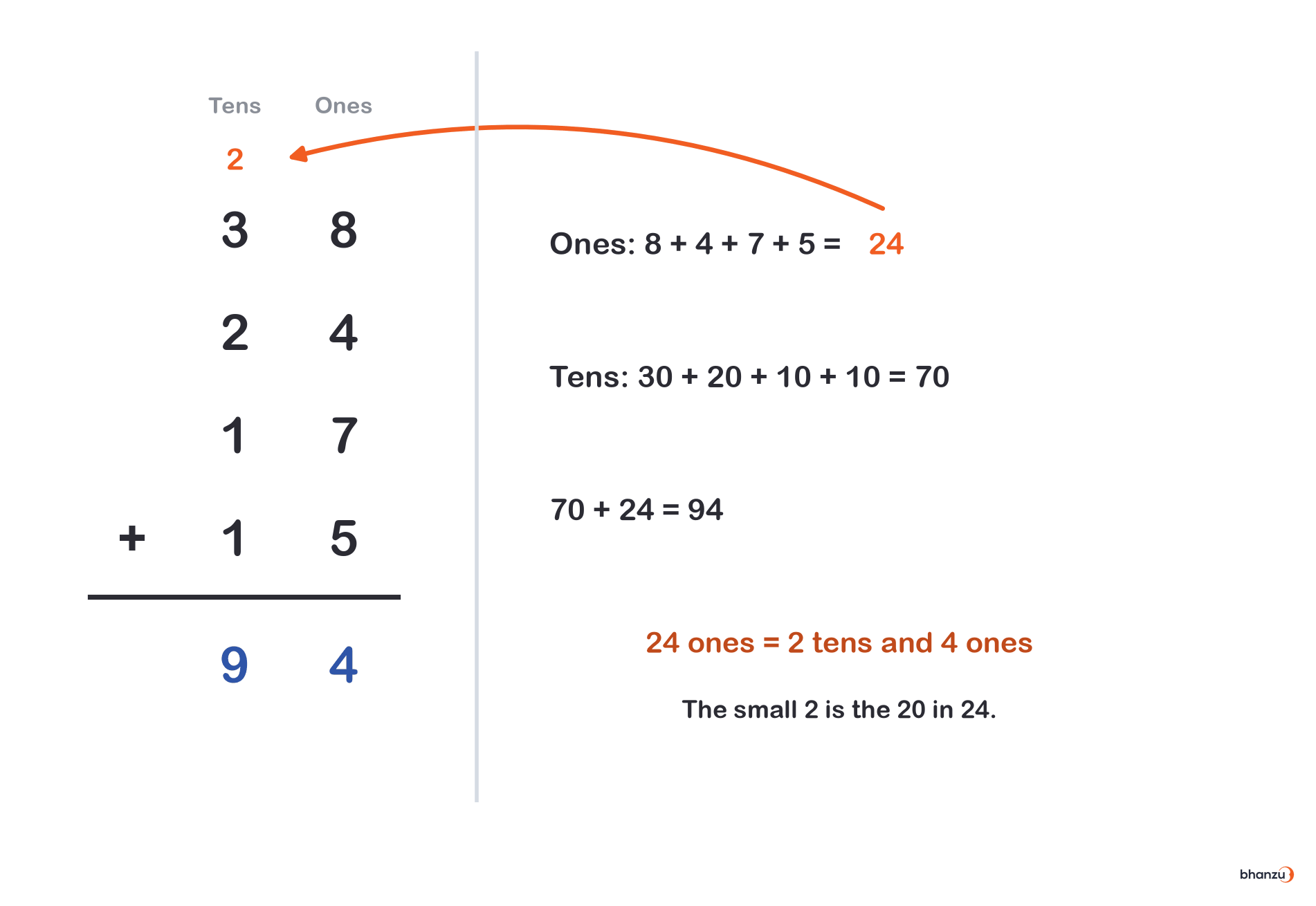
The small 2 is the 20 inside 24, and the words for it get muddled, even for grown-ups. "Carry" and "regroup" name one trade, 10 ones for 1 ten. A University of Hawaii textbook by Michelle Manes prefers "regroup" because it says what moved.
When the tens column reaches 10 or more, the same trade happens one place over, called regrouping hundreds, tens and ones. Thirteen tens make 1 hundred and 3 tens.
With four rows, the small 2 is easy to lose. In later grades, the same columns stretch into the thousands.
Try It Yourself
Tap two ones cards to join them, and hunt for pairs that make 10. Trade every 10 ones for a new ten rod and watch the carry above the tens column climb to 2 or 3. Press New numbers for another story.
Examples of adding up to four two-digit numbers
Example 1
Add 21 + 34 + 13.
Add the tens, then the ones.
The sum is 68.
Example 2
Add 46 + 25 + 17 + 38.
The ones make 26. The habit from two-number sums says write 6 and carry 1, which gives 11 tens and 116.
Partial sums show 116 cannot be right.
Add the 26 ones, and the total is 126. Carrying 1 kept only one of the two tens in 26, so carry 2.
Twelve tens and 6 ones make 126.
Example 3
Add 48 + 36 + 27 + 19 in columns.
The ones make , so write 0 and carry 3.
Thirteen tens make 130.
Example 4
Diego buys a ball for $24, a kite for $18, a puzzle for $36 and a book for $15. How much does he spend in all?
The ball and the puzzle pair up, because 4 and 6 make 10.
Then , so Diego spends $93 in all.
Example 5
Maya read 27, 18, 33 and 12 minutes. Sam read 23, 26, 15 and 32 minutes. Who read more, and how long did they read in all?
Maya read 90 minutes. Sam's tens make 80 and his ones make 16, so he read 96 minutes, which is more.
Together they read 186 minutes.
Why can you add in any order?
Adding only puts groups together, so the order you join them in cannot change how many there are in all. Four piles of blocks hold the same number of blocks, whichever pile you count first.
- It lets you pick the easy pair first, like 7 with 3.
- It lets tens and ones travel separately. is , which is why partial sums work.
- It gives a free check. Add a column top to bottom, then bottom to top, and the totals must match.
- It speeds up adding mentally, because your head grabs the friendly pair first.
Merchants needed long totals to come out right. The + sign first appeared in print in 1489, in a German arithmetic book for merchants by Johannes Widman.
Adding four two-digit numbers: where intuition breaks
Mistake 1: Forgetting the carried tens
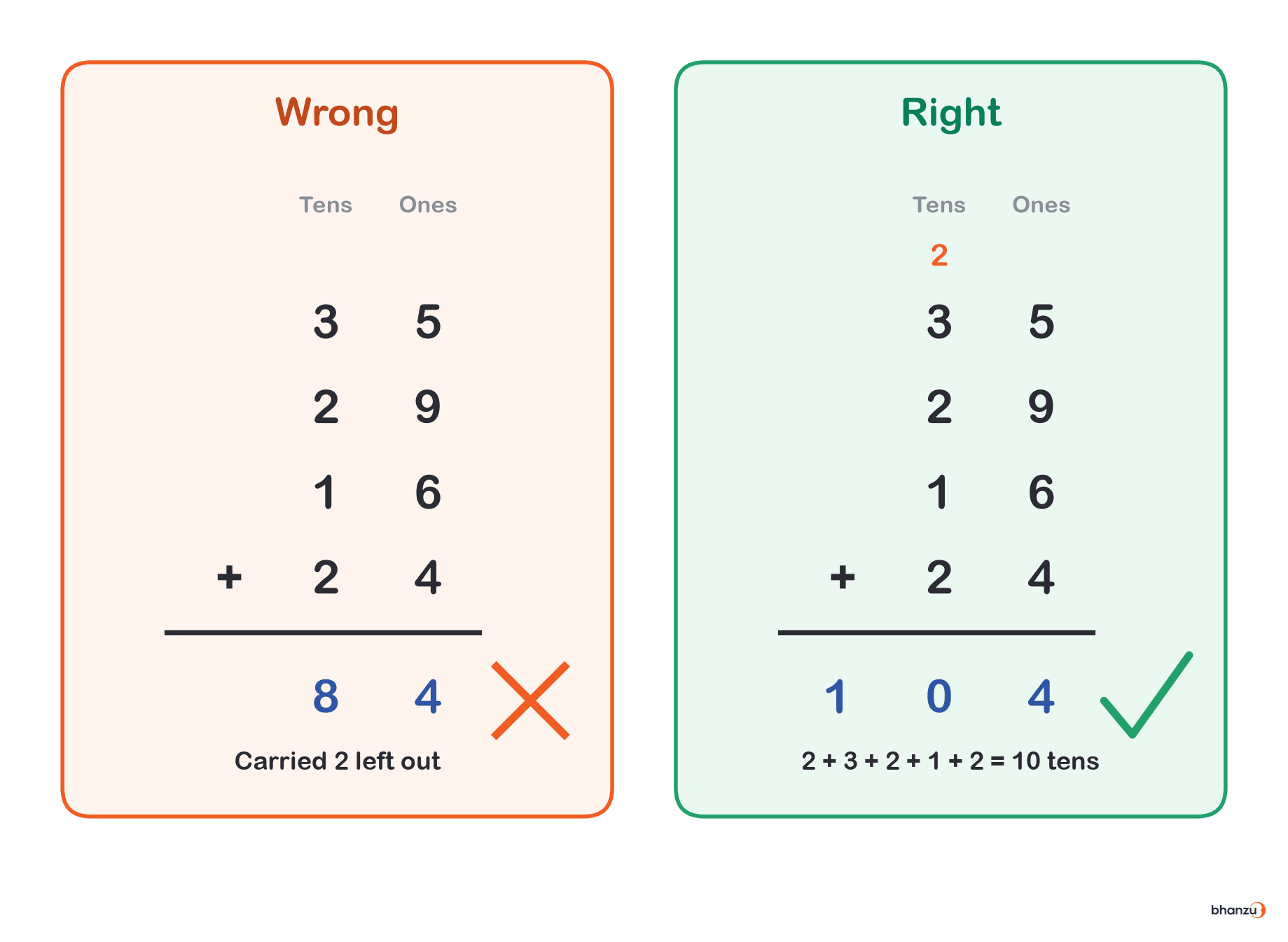
Where it slips in: The tens column, as in Example 3. A child who rushes down the big digits never looks up at the small number.
Don't do this: In 35 + 29 + 16 + 24, write 4 for the ones, then add the tens and get 84.
The correct way: Start the tens with the carried 2, so tens, and the sum is 104.
The small 2 often gets written so tiny or so high that it floats over the wrong column.
Mistake 2: Writing the ones total whole
Where it slips in: Any sum where the ones make 10 or more, like Maya's reading minutes. Each column was added correctly, so children write what each one gave.
Don't do this: Write 7 tens and 20 ones side by side as 720.
The correct way: Turn 20 ones into 2 tens, so 7 tens and 2 tens make 9 tens, or 90.
Four short reading times cannot add up to 720 minutes (12 whole hours).
Mistake 3: Lining a one-digit number up under the tens
Where it slips in: A story problem with a single-digit amount, such as 23 + 41 + 6 + 15. Words start at the left edge, so a lone digit often lands there too.
Don't do this: Write the 6 under the tens, so it counts as 60 and the total becomes 139.
The correct way: Line up from the right, as OpenStax's Prealgebra textbook advises. The ones make 15, so carry 1, and the tens make 8, for a sum of 85.
What teachers watch for in adding four two-digit numbers
The carry counts tens, and four ones digits reach 36 at most (four 9s), so the carry is never more than 3. That gives a range check, since three two-digit numbers total 30 to 297 and four total 40 to 396. Maya's 720 fails at once.
A child who has only ever carried 1 may change a correct 2 back to 1, and the 36 limit settles it. For a closer check, rounding to the nearest ten, a 3rd grade standard, turns into 140, close to the exact 130.
In a 2020 study of 270 2nd graders in Florida, 78% used the column method at least once, but only 34% invented their own strategy. Children who mixed both kinds had the highest standardized math scores. That is a link, not proof, but one problem solved both ways is easy to try.
Key Takeaways
- Scan the ones digits for pairs that make 10 before adding anything else.
- The small number above the tens counts tens, so it can be 2 or 3.
- Adding up to four two-digit numbers checks itself when you add the column again in another order.
- For more practice keeping a carried 2 or 3 in the tens column, explore Bhanzu's 2nd grade math tutor or math programs for kids.
Read More
- Two-Step Word Problems Within 100
- Adding and Subtracting 10 and 100 Mentally
- Adding and Subtracting on a Number Line
- Multi-Digit Addition
- Mental Math for Kids
Research Behind This Article
- Common Core State Standards Initiative, Grade 2: Number and Operations in Base Ten (2010). thecorestandards.org
- Kullberg and colleagues, Improvements in Learning Addition and Subtraction When Using a Structural Approach in First Grade (2024). doi.org
- Michelle Manes, University of Hawaii, Mathematics for Elementary Teachers: Addition: Dots and Boxes (2018). pressbooks.oer.hawaii.edu
- MacTutor History of Mathematics, Johannes Widman (2007). mathshistory.st-andrews.ac.uk
- OpenStax, Prealgebra 2e: Add Whole Numbers (2020). openstax.org
- Sahin, Dixon and Schoen, Investigating the Association between Students' Strategy Use and Mathematics Achievement (2020). eric.ed.gov
Quick Quiz: Check Yourself
Three levels, new numbers every time: three addends, then four that carry 2 or pair into tens, then carries of 3 and stories past 100.
Was this article helpful?
Your feedback helps us write better content
Frequently Asked Questions
Can you add 3 two-digit numbers without a calculator?
What should a 2nd grader know in math?
How can I help my 2nd grader with addition at home?
How do I help my child understand what the numbers in a sum mean?
How do you teach column addition?