Key Points
- Each number on a number line is a length from 0, so adding and subtracting on a number line means measuring jumps right or left.
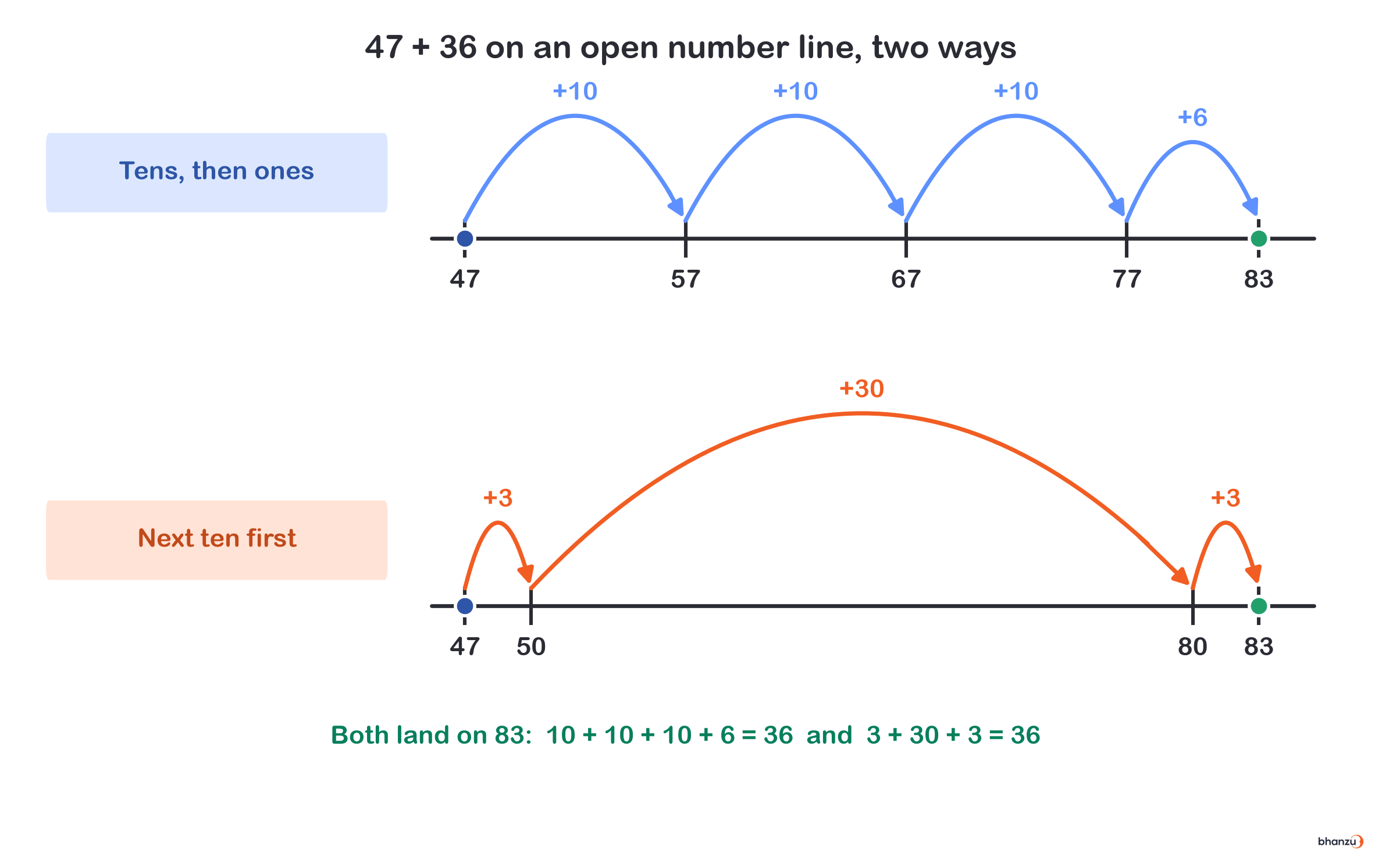
- Jumping to the next ten first turns 47 + 36 into jumps of 3, 30 and 3 that land on 83.
- Counting up from 57 to 82 takes jumps of 3, 20 and 2, so 82 minus 57 is 25.
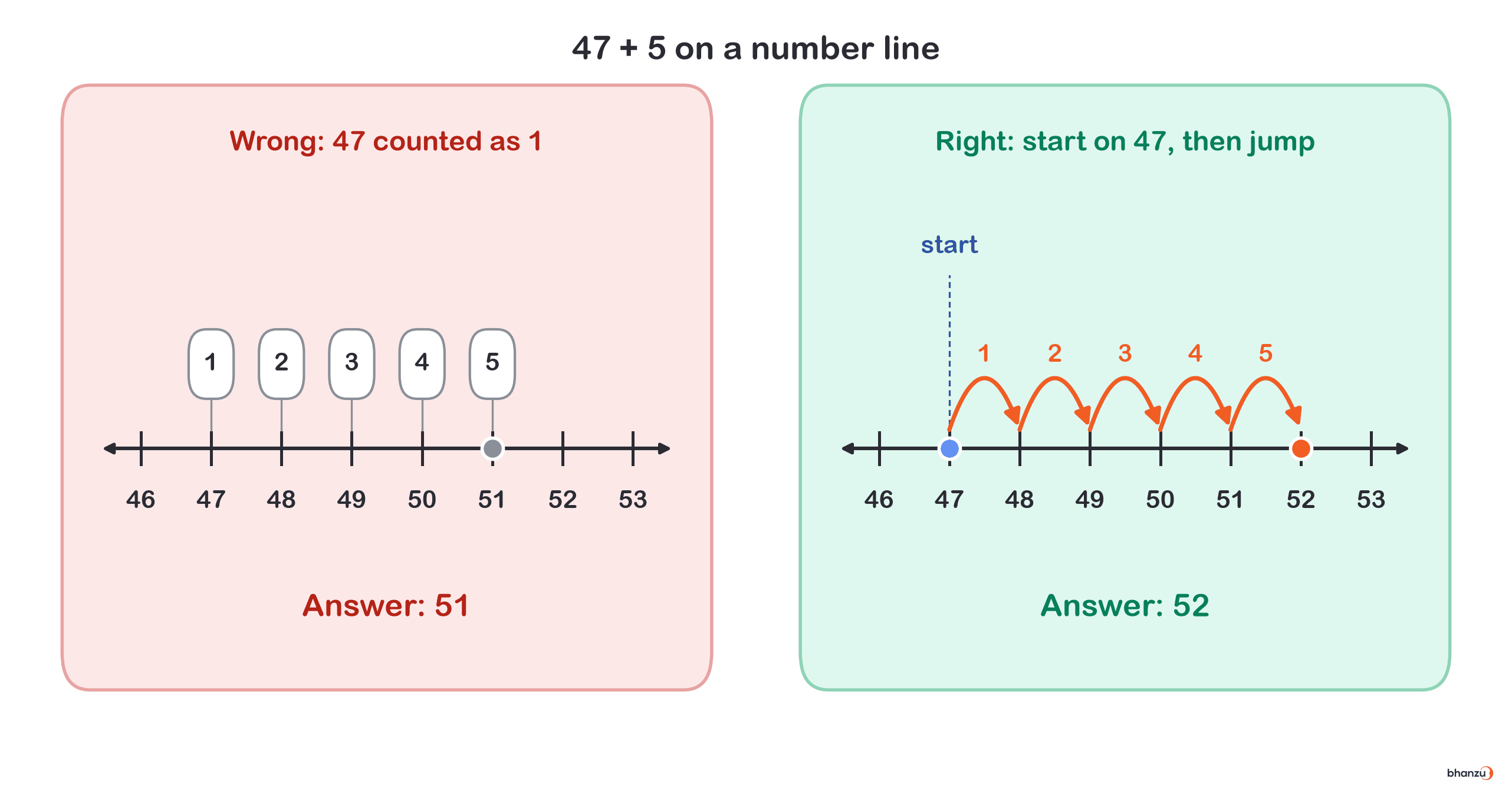
- Counting the starting number as a jump puts the answer one short, so 47 + 5 lands on 51 instead of 52.
A number line you can ride on
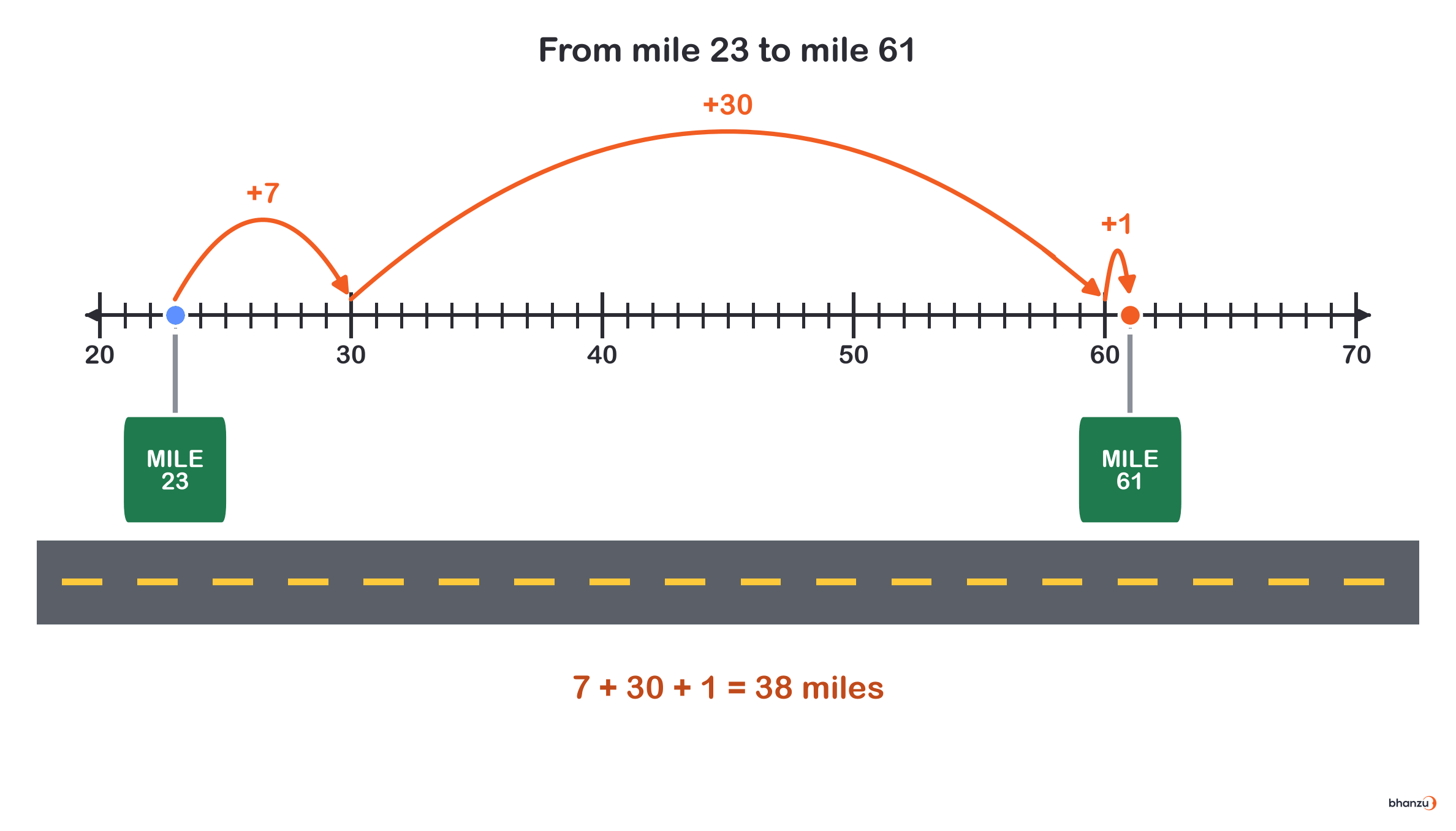
Those small green signs beside a freeway count the miles, one by one. The count on these mile markers starts at 0 at the road's south or west end in that state.
Say your car passes mile 23 and later mile 61. Hop 7 to reach 30, then 30 more to 60, then 1 more to 61. The trip was 38 miles, and you just solved a number line problem.
In 3rd grade, you'll put fractions such as one half on this same kind of line.
How do you add and subtract on a number line?
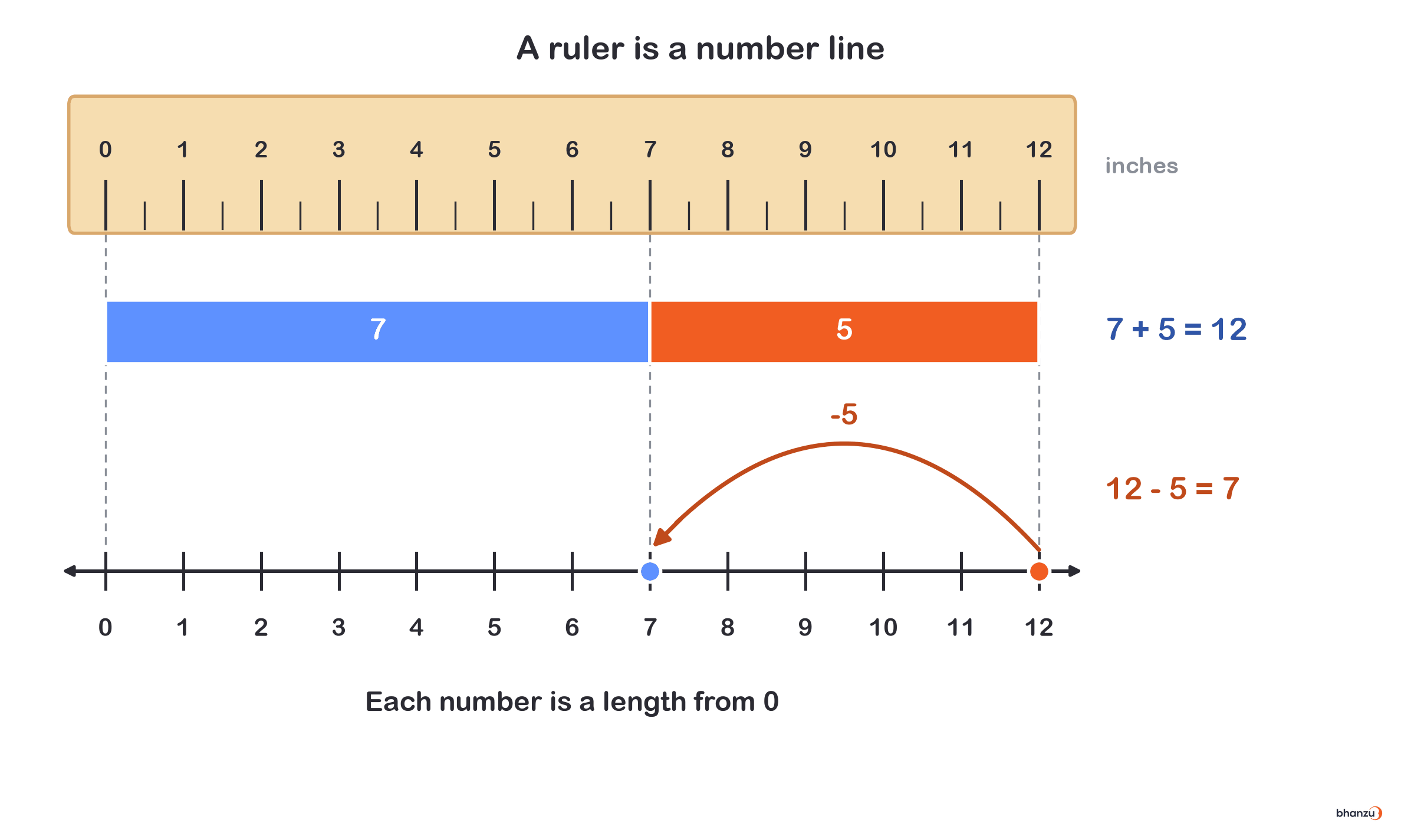
Adding and subtracting on a number line uses measured jumps from the first number, right to add or left to subtract. A number line is a straight line with numbers at equal spaces, starting at 0. Numbers grow to the right (a rule people agreed on).
A jump is one move along the line, and its label says how far it goes. Each number is a length from 0, so 7 sits seven spaces from 0. Adding 5 means five more spaces to reach 12, and jumping 5 back lands on 7 again.
This is Common Core standard 2.MD.B.6, which asks 2nd graders to show whole-number sums and differences within 100 on a number line.
In 1st grade, your child used counting on and counting back by ones within 20, and this year the jumps grow into tens on a line that stretches to 100. In the 2024 Nation's Report Card, 76 percent of US 4th graders scored at or above the NAEP Basic level in math. The Governing Board's description of that level includes locating whole numbers on a number line.
How do you add on an open number line?
An open number line, also called an empty number line, is a blank line where you mark only the numbers you need. To add, use the jump strategy, tens first and then ones. For 47 + 36, that takes four steps.
- Mark 47 at the left.
- Split 36 into 3 tens and 6 ones.
- Jump 10 three times, to 57, 67 and 77.
- Jump 6 more to land on 83, then check that the labels add to 36.
A second way jumps to the next ten first, so . Then 30 more reaches 80, and the last 3 lands on 83.
Counting 36 single hops works too, but a child who makes 36 tiny hops can lose count past 20. A child who counts 10, 20, 30 can still stall at 47, because 57, 67 and 77 don't sound like the tens they've practiced.
Past 100 the tens jumps still work ( lands on ), and for written work the next method is adding two-digit numbers with regrouping.
Which way should you jump to subtract?
Jump left to take away, starting at the first number, which is called counting back. To find how far apart two numbers are, start at the smaller one, jump right to the bigger one and add the jumps. That's counting up (some classes call it counting on to subtract).
Counting back finds 74 minus 8 in two jumps, back 4 to the ten at 70 and then back 4 more to 66. Counting up finds 82 minus 57 in three.
- Start at 57 and jump 3 to the next ten, 60.
- Jump 20 to reach 80.
- Jump 2 to land on 82.
- Add the jumps.
The total of the jumps, 25, is the difference between the two numbers, so . Count back when the number you take away is small, like 8. Count up when the numbers sit close together, because counting back 57 from 82 takes five jumps of 10 plus the ones.
The same jumps help with finding the missing number in , where ? stands for the jump total. Word problems tell you which way to jump.
| Words in the problem | What to do on the number line |
|---|---|
| in all, gets more, drives on | Jump right |
| left, take away, spent | Jump left |
| 8 fewer than 52 | Jump left 8 from 52 to 44 |
| how far, how many more | Count up and add the jumps |
Try It Yourself
Drag the blue dot to the start number, then tap jumps such as plus 10, plus 1 or next ten until you reach the answer. Switch to Count back or Count up to subtract, and watch the readout add up every jump. In Count up, start on the smaller number and add your jumps.
Why does jumping on a number line work?
Jumping works because a number line turns every number into a distance, so adding and subtracting become moving along a road.
- It's a ruler for numbers. A 7-inch strip plus a 5-inch strip reaches the 12 mark, which is why length word problems use the same skill.
- It matches tens and ones. Three jumps of 10 add 30 from any start, so place value does the counting.
- It puts mental math on paper. The open number line came out of the realistic mathematics movement in the Netherlands, as Carol Murphy's 2011 study describes. It records the steps of mental subtraction.
The miles left on a car trip are a number line question. Time works the same way in 3rd grade, on a line of minutes.
Examples of adding and subtracting on a number line
Example 1
Find 45 + 20 on a number line.
Start at 45. The 20 is 2 tens, so jump 10 twice, to 55 and 65.
Example 2
Use an open number line to find 29 + 46.
Jump 1 to the next ten, 30.
Jump 4 tens to 70.
Jump the last 5 to 75.
The jumps add to , so .
Example 3
Find 81 minus 26 on a number line.
The tempting move is to jump back 2 and then 6, because the digits are 2 and 6. That path lands on 73.
That can't be right. Taking away 20 alone lands on 61, so taking away 26 must land below 61.
The 2 in 26 means 2 tens. Jump back 10 twice, to 71 and 61. Then jump back 1 to 60 and 5 more to 55.
To check, .
Example 4
What number makes 37 + ? = 70 true?
The ? is the total length of the jumps from 37 to 70.
Jump 3 to 40, then 3 tens to 70.
The jumps add to , so the missing number is 33.
Example 5
Priya's family drives from mile marker 18 to a rest stop 45 miles away. Their exit is at mile marker 91. How many more miles is it to the exit?
Jump 2, 40 and 3 from 18, landing on 20, 60 and 63, the rest stop.
Count up from 63 to 91 with jumps of 7, 20 and 1.
It's 28 more miles.
What teachers watch for on an open number line
Teachers watch for children mixing up two kinds of number line with different rules.
| Scaled number line | Open number line | |
|---|---|---|
| Spaces | Equal, like a ruler | Rough, longer for bigger jumps |
| Marks | Every number | Only the numbers you need |
| The answer | Read it off the line | Add the jump labels |
This part is genuinely confusing, because one name covers both lines. A child might find 83 for 47 + 36, then erase it because the 30 jump looks too short. The 83 was right, since the labels 3, 30 and 3 still add to 36.
In 7th grade, you'll add and subtract negative numbers on this same kind of line, to the left of 0.
What are the most common mistakes on a number line?
Mistake 1: Counting the starting number as a jump
Where it slips in: Counting single hops of ones.
Don't do this: Counting 47 + 5 as 47, 48, 49, 50, 51 and answering 51.
The correct way: Put your finger on 47 and say nothing, then count each jump, 48, 49, 50, 51, 52. Five jumps land on 52.
Counting objects starts with one on the first object. On a number line, the first number is where you already stand, like the 0 on a ruler. A child who taps each tick mark while saying the numbers lands one short, every time.
Mistake 2: Giving the landing number as the answer
Where it slips in: Counting up to subtract, as in Example 4.
Don't do this: Counting up from 49 to 50, 60 and 64 for 64 minus 49, then answering 64.
The correct way: Add the jumps, , so .
In adding, the answer is where you land, so a child who rushes reads the last number written.
Key Takeaways
- Your finger starts on a number, not on a jump, so the first hop lands one step away.
- Adding your jump labels shows whether you jumped the right amount.
- When adding and subtracting on a number line, count back for a small take-away and count up when the numbers sit close.
- On an open number line, trust the labels over the drawing.
- For more practice counting up with a teacher who spots the start-number mistake, explore Bhanzu's 2nd grade math tutor or math classes for kids.
Read More
- Subtracting Two-Digit Numbers With Regrouping
- Two-Step Word Problems Within 100
- Comparing Lengths: How Much Longer?
- Fractions on a Number Line
- How to Add Mentally
Research Behind This Article
- Federal Highway Administration, Manual on Uniform Traffic Control Devices, 11th Edition with Revision 1, Chapter 2H: General Information Signs (2025). mutcd.fhwa.dot.gov
- Common Core State Standards Initiative, Grade 2: Measurement and Data (2010). thecorestandards.org
- National Center for Education Statistics, NAEP Mathematics 2024: National Trends and Student Skills, Grade 4 (2024). nationsreportcard.gov
- National Assessment Governing Board, Mathematics Assessment Framework for the 2022 and 2024 National Assessment of Educational Progress (2022). nagb.gov
- Murphy, Carol, Comparing the Use of the Empty Number Line in England and the Netherlands, British Educational Research Journal (2011). eric.ed.gov
Quick Quiz: Check Yourself
Three levels, new numbers every time: add with tens jumps or the next ten, count back and find missing numbers, then count up to subtract and solve mile marker trips.
Was this article helpful?
Your feedback helps us write better content
Frequently Asked Questions
How do you teach number line subtraction at home?
Is the number line a good way to teach subtraction?
Is number line addition taught in 1st grade?
What is an open circle on a number line?
Can you subtract money on a number line?