Key Points
- Two-step word problems within 100 hide a middle number, like the 21 kids left when 13 of 34 riders get off, before 8 more get on.
- A tape diagram, a long bar split into parts, shows parts and the whole, so the story's meaning picks plus or minus.
- The word fewer can still mean adding, because if Leo's 47 strawberries are 18 fewer than Maya's, Maya picked .
The number the story never tells you
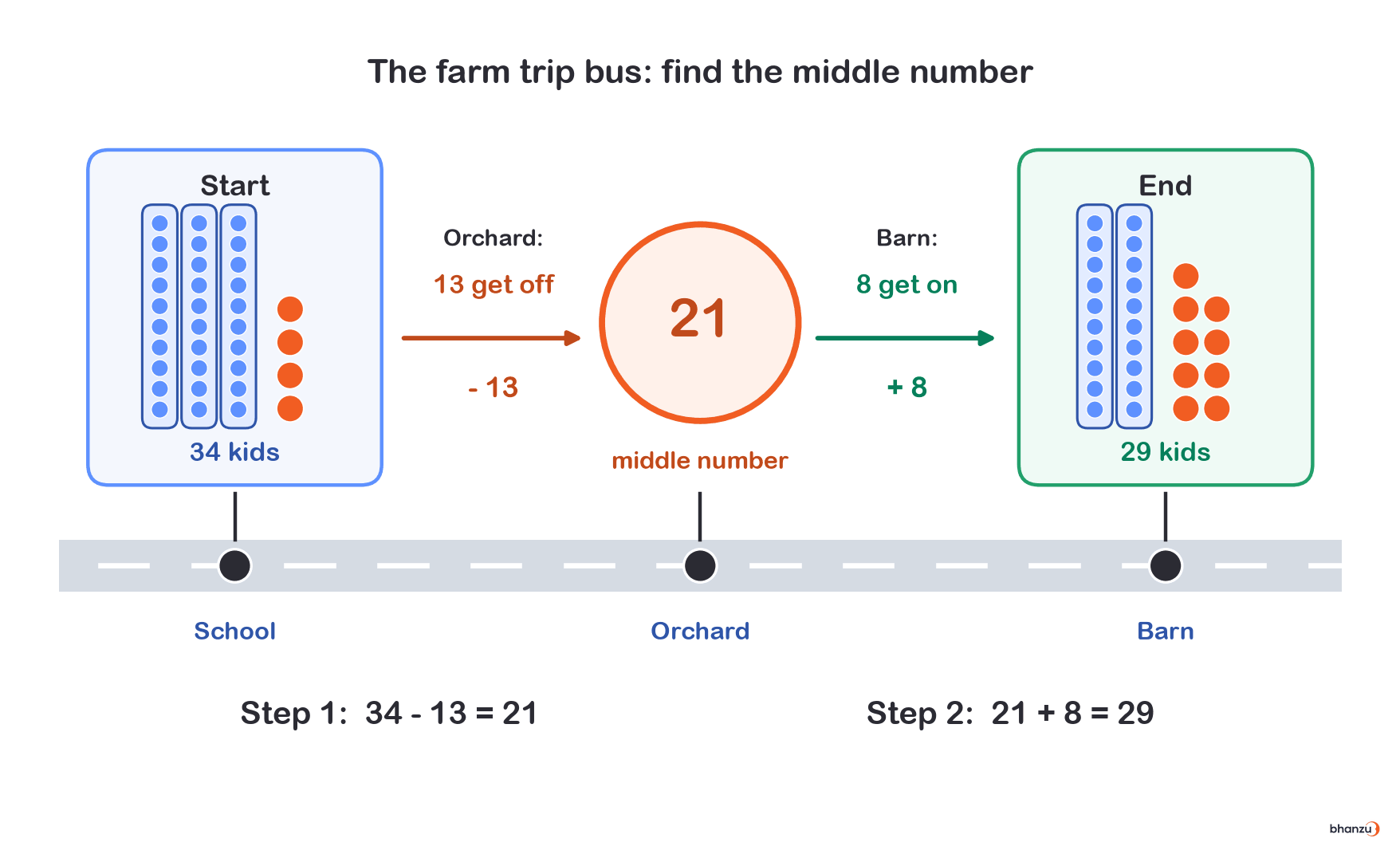
The farm trip bus leaves school with 34 kids and makes two stops. At the orchard, 13 kids get off. At the barn, 8 kids climb on.
The story asks about the end but never says how many kids sat on the bus between stops. That hidden number is 21, and 8 more kids turn it into 29.
Soon you'll use the same middle number to keep score in a game or count the cents left after two buys.
What is a two-step word problem?
Two-step word problems within 100 are stories that need two calculations, each one adding or subtracting, with every number at 100 or less. The answer to step 1 is the middle number, which the story never asks for but step 2 needs.
A one-step problem stops after one calculation. Mei has 25 shells and finds 10 more, so she has 35. Giving 12 to her brother adds a second step.
Act each story out with counters or a drawing first (fingers count too). Two-step stories are one family of math word problems, and in 3rd grade, two-step word problems add multiplying and dividing.
Two-step stories within 100 belong to Common Core standard 2.OA.A.1. By the end of 2nd grade, your child is expected to solve these stories with the missing number in any spot, and the standard suggests drawings and equations with a symbol for the unknown.
How do you solve two-step word problems?
Find the hidden first question, answer it, then use that middle number for the real question.
- Read the story and retell it.
- Find the question at the end and the hidden question before it.
- Draw a tape diagram, a long bar split into parts.
- Write an equation for each step, with a box for the missing number.
- Solve step 1, then start step 2 from the middle number.
- Check by estimating with tens and by working backward.
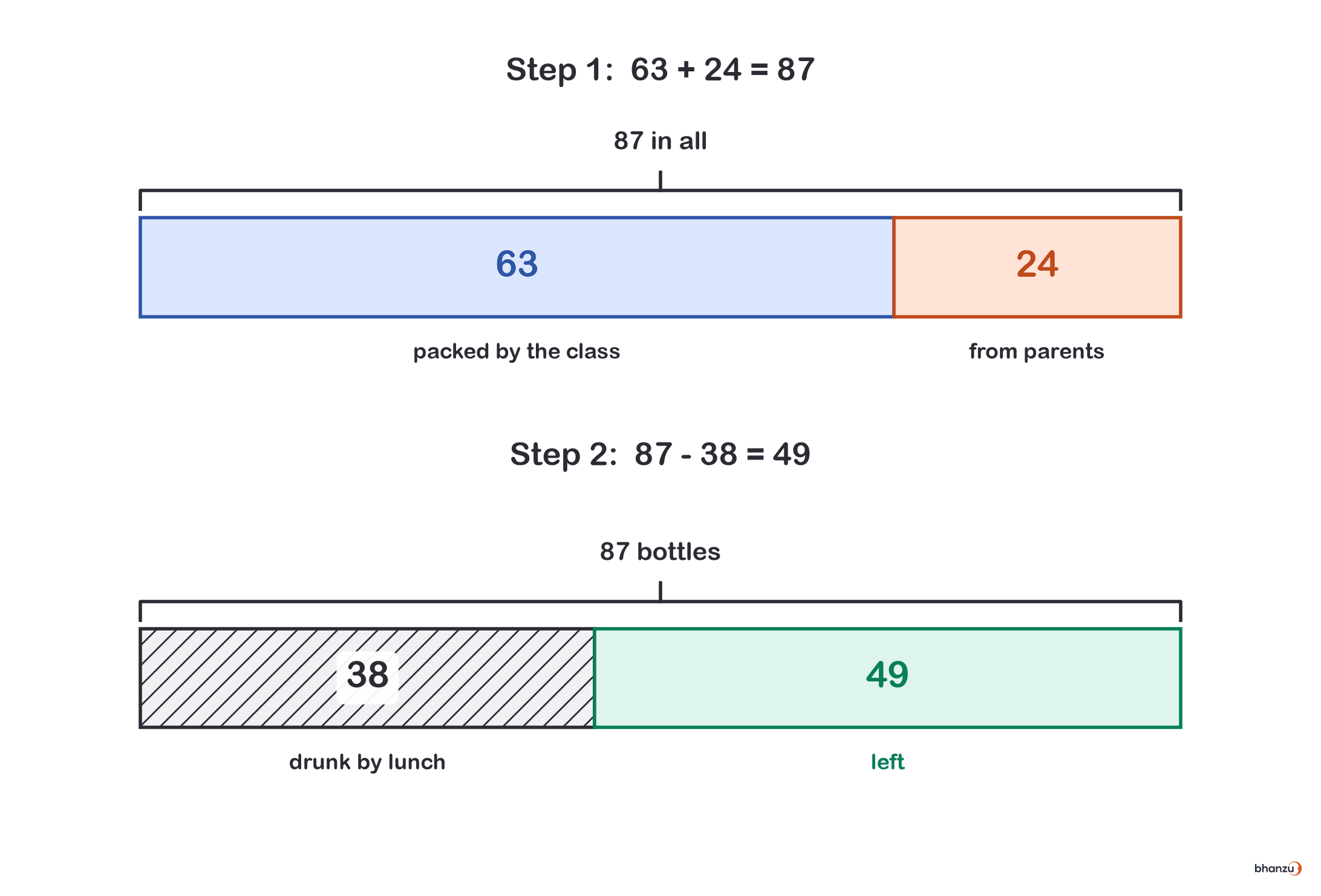
On the farm trip, the class packs 63 water bottles, parents bring 24 more, and the class drinks 38 by lunch. How many bottles are left? The hidden question is how many bottles there were in all.
Taking 8 ones from 7 ones means opening a ten, as in subtracting two-digit numbers with regrouping. Rounding 87 to 90 and 38 to 40 is estimating to the nearest ten, and sits close to 49.
When both steps add, or both subtract, join the changes first (mixed steps are easier one at a time). For a bus of 45 kids, 7 getting on and then 3 more make 10.
Adding 7 and then 3 adds 10 in all.
Drawing every counter gets slow past about 20, and a child counting riders one dot at a time often loses track. When the start is missing, working forward can't begin, so you work backward.
Which kind of story is it?
Every step in a two-step story is one of four Common Core story kinds: adding to, taking from, putting together or taking apart, and comparing. The Common Core adapted that list from a 2009 National Research Council report on early math.
| Words in the problem | Math it means |
|---|---|
| 8 kids get on at the barn | add 8 |
| 26 red, 19 green, the rest are yellow | the whole minus both parts |
| Leo picked 18 fewer than Maya | Maya has 18 more, so add |
| Some kids were on the bus | the start is missing, so work backward |
Compare stories can trip up adults too, because "Leo picked 18 fewer than Maya" names Leo first while Maya has the bigger number.
The missing number can sit at the start, the change or the end. To find a missing start, undo the last step first with the opposite operation. That move is finding the missing number within 100, done twice.
Undoing a step is a hop the other way, the move you know from adding and subtracting on a number line. In 3rd grade, the box becomes a letter.
Try It Yourself
Read the bus story, tap Add or Subtract for stop 1 and watch the counters change to the middle number. Pick the sign for stop 2, or switch to Backward and undo both stops to find the starting number. New story brings fresh numbers.
Examples of two-step word problems within 100
Example 1
On the farm trip, 23 kids ride the bus. At stop 1, 6 more get on, and at stop 2, 4 more get on. How many kids are on the bus now?
There are 33 kids on the bus.
Example 2
Leo picked 47 strawberries, 18 fewer than Maya. Then Maya gave 25 to her group. How many strawberries does Maya have now?
The word fewer tempts you to subtract twice.
That can't be right, because 29 is fewer than Leo's 47 and the story says Leo has fewer. Maya picked 18 more than Leo.
Maya has 40 strawberries now.
Example 3
The farm stand has 82 apples. 26 are red, 19 are green, and the rest are yellow. How many apples are yellow?
The farm stand has 37 yellow apples.
Example 4
At the gift shop, Priya has 90 cents, spends 35 cents on a bookmark, then gets 25 cents from her dad. How many cents does she have now?
Priya has 80 cents.
Example 5
Some kids rode the bus home. At stop 1, 12 got off, and at stop 2, 7 got on, so now 41 kids ride. How many were on the bus at the start?
The box stands for the kids at the start.
Undo the 7 who got on by subtracting 7.
Undo the 12 who got off by adding 12.
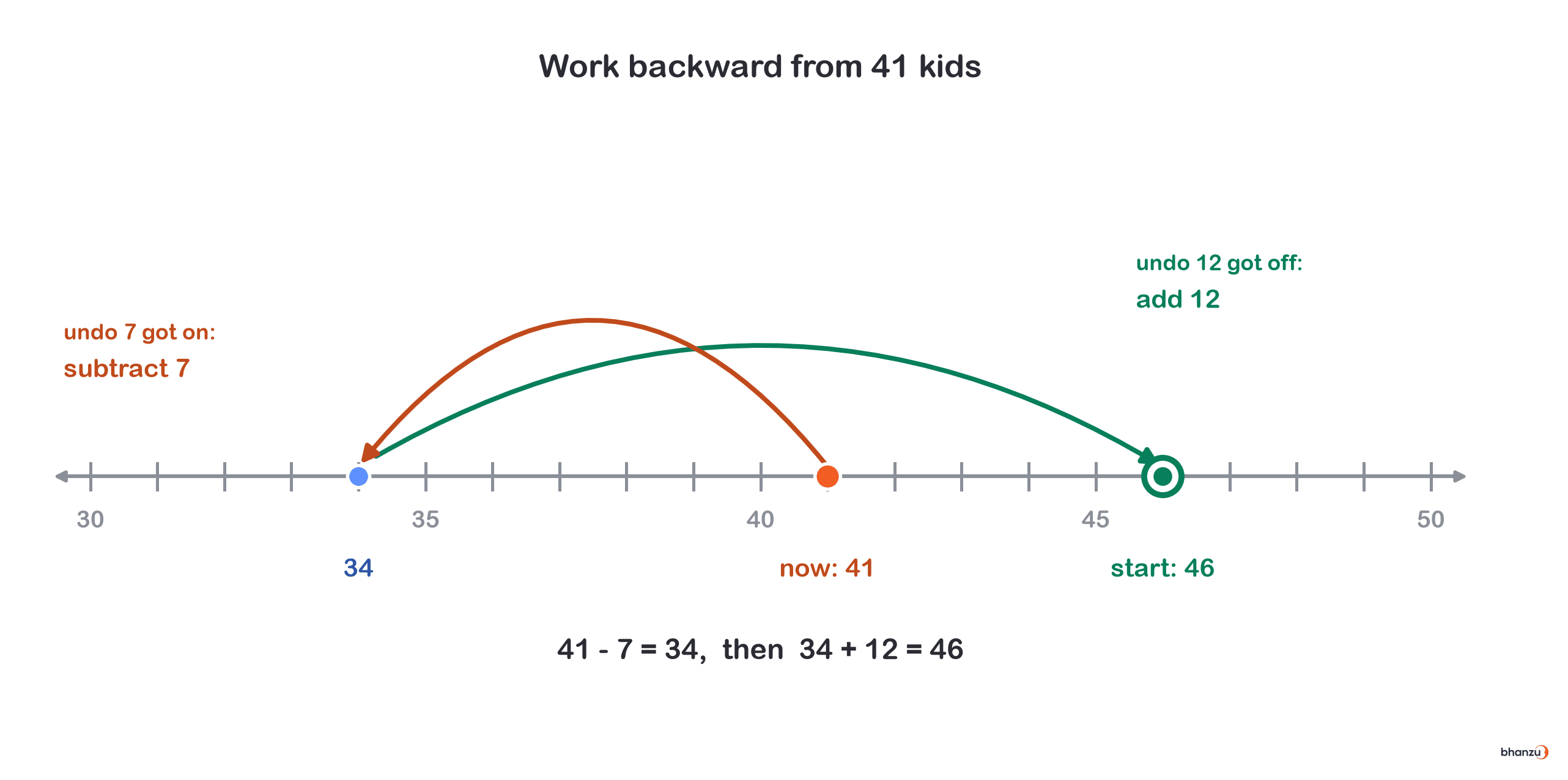
There were 46 kids at the start. As a check, and .
Example 6
On the nature trail, Diego finds a 34-inch stick, and Mei's stick is 17 inches longer. Laid end to end, how long are the two sticks?
Mei's stick is 51 inches, so the two sticks reach 85 inches.
Why do two-step word problems matter?
Two-step stories train you to hold a number nobody tells you and use it again.
- It keeps a running score. Start at 35 points, lose 12, then win 20, and the score is 23 before it is 43.
- It finds what nobody counted. Riders at the end reveal how many started.
- It plans spending. With 75 cents, a 40-cent pencil leaves 35 cents, and 20 cents from a friend makes 55.
- It grows into bigger plans. In 4th grade, the same plan handles stories with three or more steps.
In the 2024 Nation's Report Card, 87% of 4th graders got full credit for finding an unknown in a number sentence, but only 54% did on a released multi-step story problem.
Common errors when working with two-step word problems
Mistake 1: Stopping at the middle number
Where it slips in: Any story that asks about the end. A child who rushes often circles the first number worked out, because one finished calculation feels like a finished problem.
Don't do this: For "Noah has 64 stickers, gives 25 to his sister, then gets 18 from a friend," stopping at .
The correct way: 39 is only the middle number, so keep going. Noah has stickers.
Mistake 2: Letting more or fewer pick the sign
Where it slips in: Compare stories, because keyword charts teach that "more" means add.
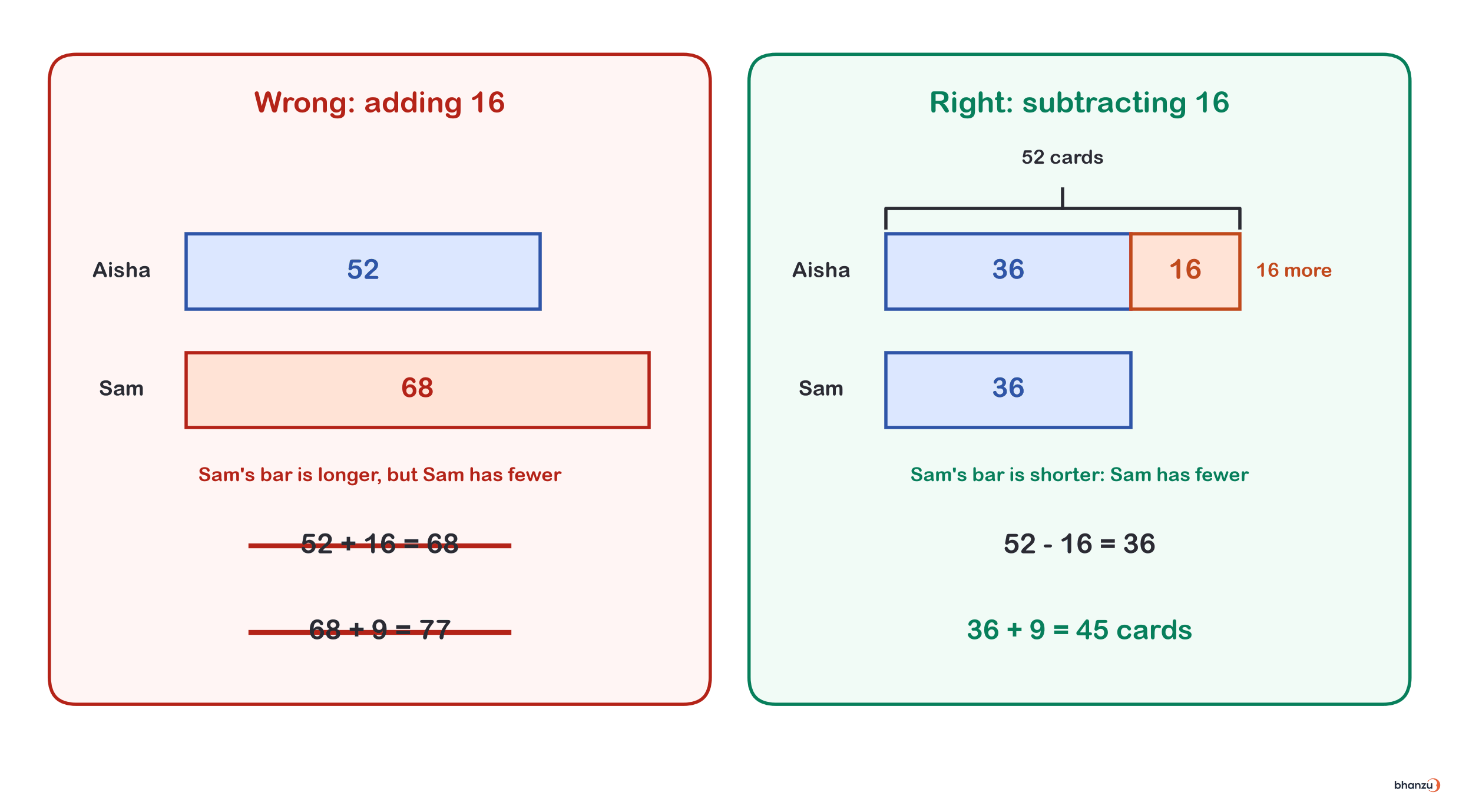
Don't do this: For "Aisha has 52 cards, 16 more than Sam. Then Sam gets 9 cards," adding , then .
The correct way: Aisha has more, so Sam has fewer (his bar is the shorter one). Find , then cards for Sam.
Mistake 3: Running a missing-start story forward
Where it slips in: Stories that open with the word Some. A child who uses every number in story order copies each move onto the end number.
Don't do this: For "Some kids were in the pool. 9 got out, then 14 jumped in. Now 30 are in the pool," working . Running 35 forward ends at 40, not 30.
The correct way: Undo the last step first, so and kids. Running 25 forward lands on 30.
What do most guides get wrong about two-step word problems?
Many guides hand children a keyword chart (more means add, fewer means subtract), and two-step stories break it. One story can hold two such words pointing different ways.
Even the Common Core's table notes that in some compare stories, only one wording points to the right operation. In 2021, the What Works Clearinghouse told teachers giving extra elementary math help to avoid keywords, partly because multi-step problems likely hold more than one. Its word-problem advice, which starts with teaching problem types, earned a strong evidence rating based on 18 studies.
Math educators Karp, Bush and Dougherty called the keyword strategy ineffective in 2019. Ask "who has more?" before choosing any sign.
Key Takeaways
- Say the hidden first question out loud before you add or subtract.
- In a compare story, decide who has more, then let that choose the sign.
- When two-step word problems within 100 hide the start, undo the last step first.
- To practice spotting the middle number and the more-or-fewer trap with a teacher, explore Bhanzu's 2nd grade math tutor or math programs for kids.
Read More
- Adding Two-Digit Numbers With Regrouping
- Adding Up to Four Two-Digit Numbers
- Length Word Problems
- Multi-Step Word Problems
- Two-Step Equations
Research Behind This Article
- Common Core State Standards Initiative, Grade 2: Operations and Algebraic Thinking (2010). thecorestandards.org
- Common Core State Standards Initiative, Mathematics Glossary: Table 1, Common Addition and Subtraction Situations (2010). thecorestandards.org
- National Research Council, Mathematics Learning in Early Childhood: Paths Toward Excellence and Equity (2009). nationalacademies.org
- National Center for Education Statistics, NAEP Mathematics 2024: National Trends and Student Skills, Grade 4 (2025). nationsreportcard.gov
- Karp, Bush and Dougherty, Avoiding the Ineffective Keyword Strategy (2019). eric.ed.gov
Quick Quiz: Check Yourself
Three levels, new numbers every time: same-direction changes, then a cents or find-the-rest story, then more-or-fewer, missing-start or end-to-end stick stories.
Was this article helpful?
Your feedback helps us write better content
Frequently Asked Questions
Do two-step word problems always mix adding and subtracting?
How can I help my child with math word problems at home?
My child can add and subtract but gets stuck on word problems. Why?
Should my child write the answer as a full sentence?
How are two step word problems in 2nd grade different from 3rd grade?