Key Points
- Multi-digit addition works one place-value column at a time, so 2,748 + 3,586 takes three regroups to reach 6,334.
- Each carried 1 is a real ten, hundred or thousand, so the partial sums 5,000, 1,200, 120 and 14 also make 6,334.
- An estimate to the nearest thousand catches big slips, but a lost carry worth 10 or 100 can hide inside it, so subtracting an addend checks the small places.
A trip to the Moon and back
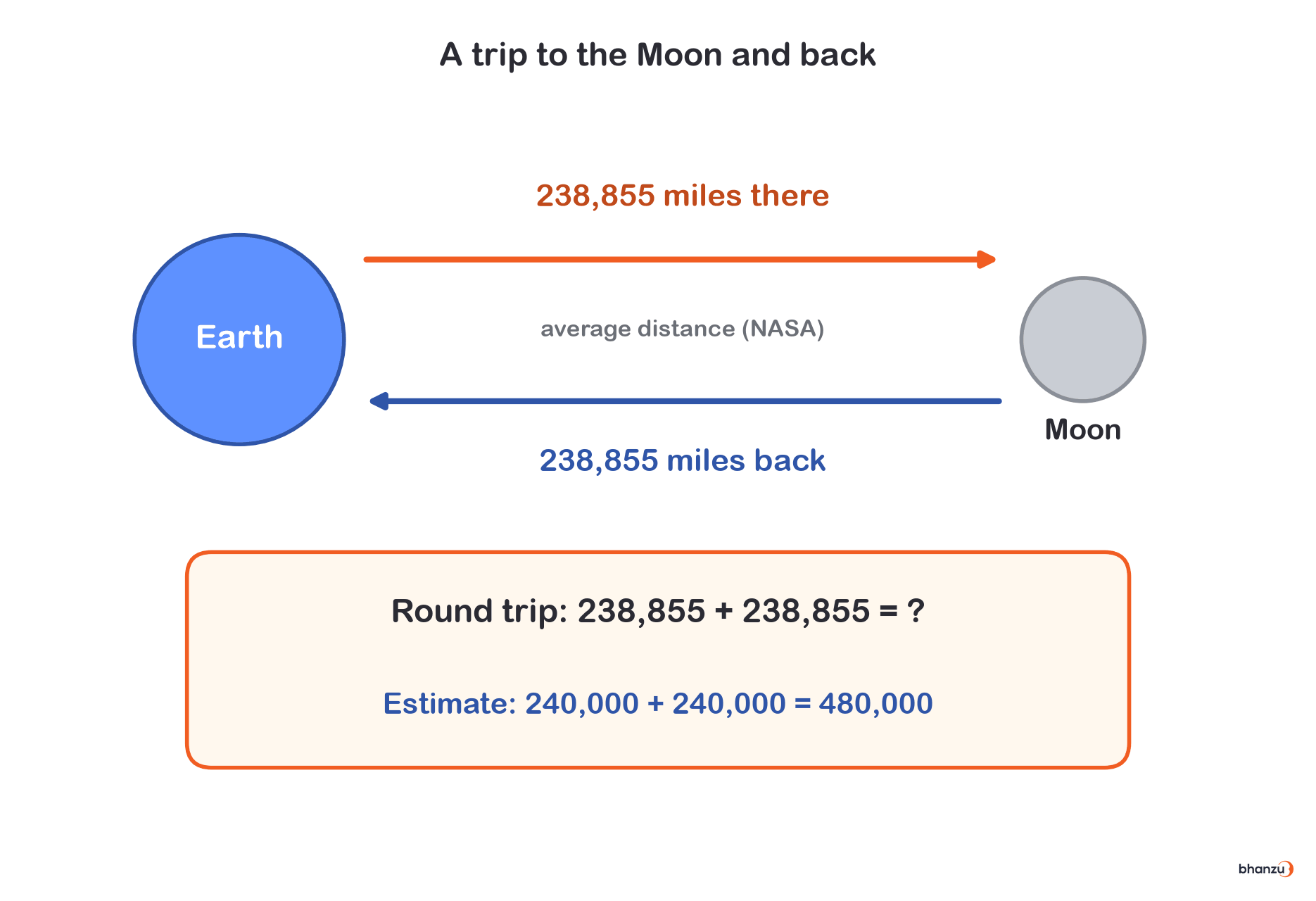
A trip to the Moon and back is really one big addition problem. NASA gives the Moon's average distance from Earth as 238,855 miles, so the round trip is 238,855 + 238,855 miles.
Counting that high would take days, but a pencil and one repeating move get there in minutes.
In 5th grade, the same columns carry you into multiplying big numbers and adding decimals.
How do you add multi-digit numbers?
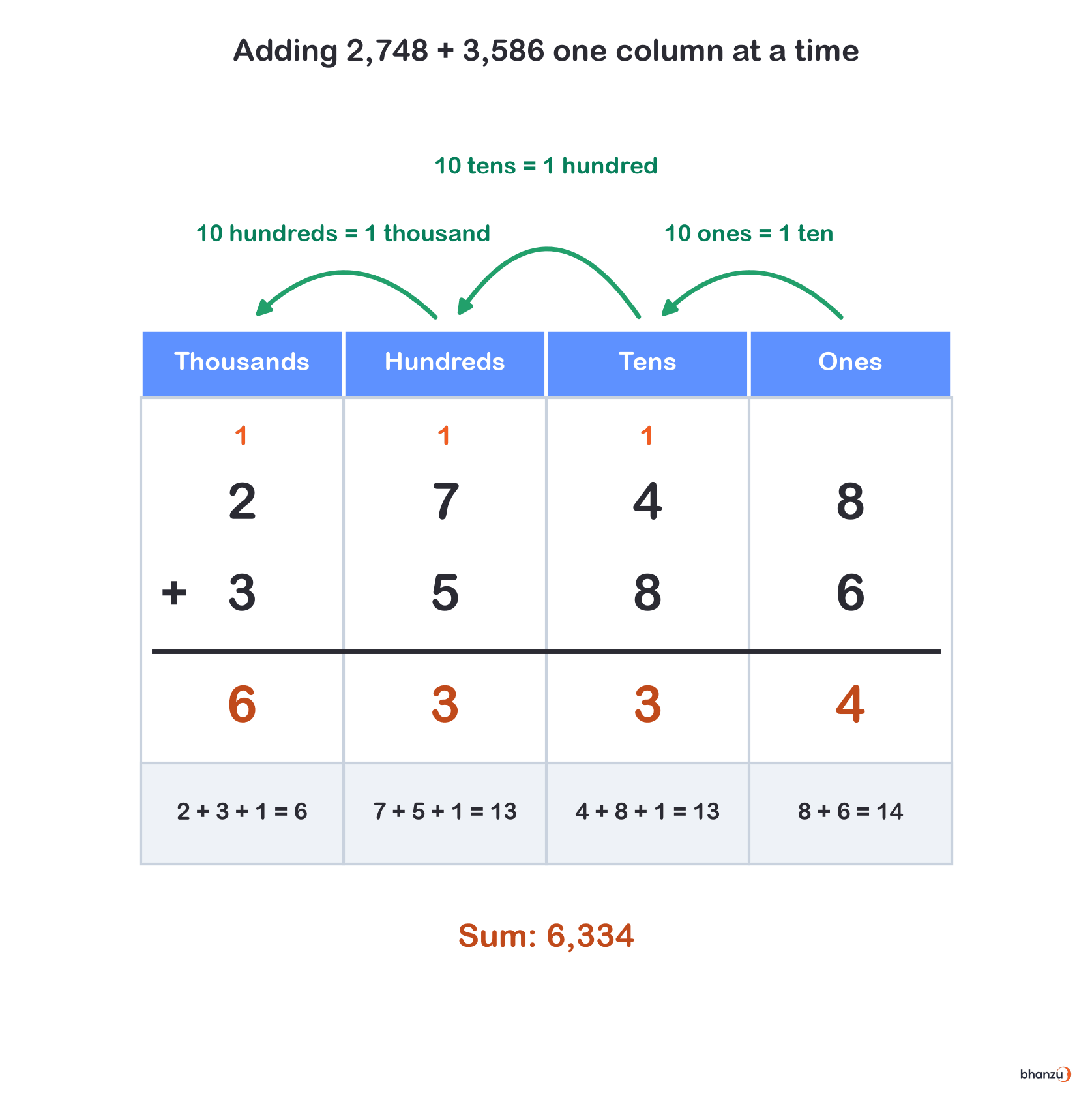
Multi-digit addition uses the standard algorithm, which stacks the numbers by place value and adds one column at a time, starting with the ones. Place value is what a digit is worth because of where it sits. An algorithm is a fixed list of steps that gives a correct answer every time you follow it.
On a place-value chart, 2,748 sits above 3,586, ones under ones. Regrouping means trading 10 of one place for 1 of the next place to the left, such as 10 ones for 1 ten.
- Line up the addends, the numbers being added.
- Add the ones. , so write 4 and regroup 1 ten.
- Add the tens. tens, so write 3 and regroup 1 hundred.
- Add the hundreds. hundreds, so write 3 and regroup 1 thousand.
- Add the thousands. , so the sum, or total, is 6,334.
This is Common Core standard 4.NBT.B.4: "Fluently add and subtract multi-digit whole numbers using the standard algorithm," up to 1,000,000. In 3rd grade your child practiced adding within 1,000 with place-value strategies, and this year those ideas become one written method for much larger numbers.
What does the carried 1 stand for?
Write 2,748 and 3,586 in expanded form, and each place can be added on its own.
Each line is a partial sum, the total for one place, and together they make the same 6,334. The 1 above the tens is the ten inside 14 ones. The 1 above the hundreds is the hundred inside 13 tens, and the 1 above the thousands is the thousand inside 13 hundreds.
The algorithm folds each new ten, hundred or thousand into the next column at once, the same renaming you practice when regrouping whole numbers. Starting at the ones means each new ten is ready before its column is added.
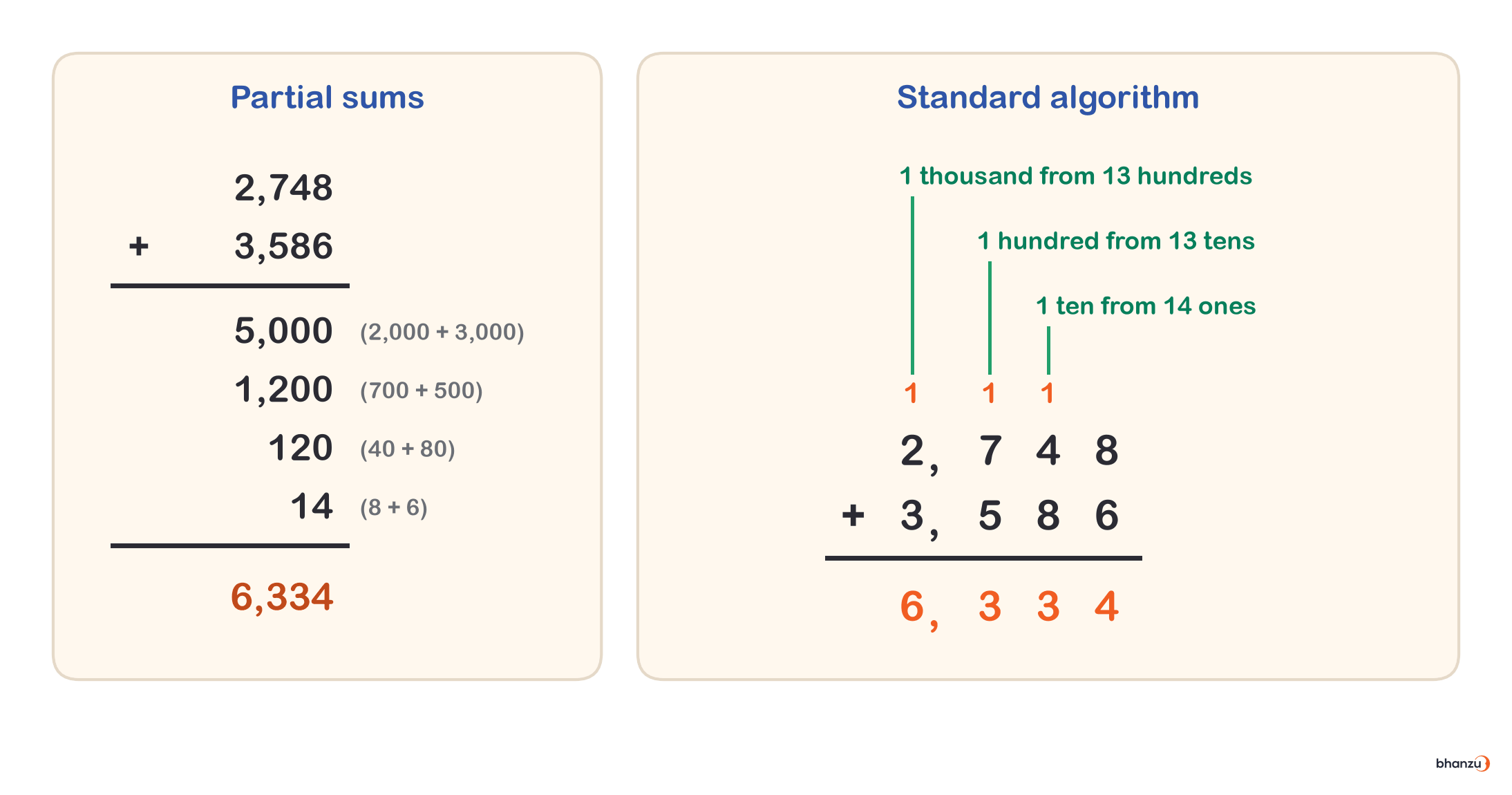
Classes record this in different ways. A 2019 review by Nicky Roberts reports that researchers Fuson and Li called two layouts "the most mathematically desirable and accessible" addition methods. They are these partial sums, called "write all totals," and "new groups below," which writes each new ten under its column.
Even the names get tangled. Carry, regroup, trade and exchange all describe one move, while the Common Core addition standards use none of them (they say "compose a ten").
Sums that need extra care
Some sums bend the usual pattern.
- Different lengths. Line up the ones, never the first digits, so 305,672 + 48,539 = 354,211.
- Three or more addends. A column can reach 20 or more, so in 4,527 + 1,386 + 2,949 the ones make and 2 tens move, for a sum of 8,862.
- Runs of 9s. In 4,999 + 2,003 the tens and hundreds each make , so each passes a 1 along (a relay, really) to reach 7,002.
- A carry out of the last column. In 68,475 + 54,836 the ten thousands make 12, so the 1 becomes a new digit on the left and the sum is 123,311.
A child who expects every regroup to be 1 will often carry only 1 when the ones make 22. Addition is commutative and associative, so any order of addends gives the same total.
The algorithm is the slow way near round numbers. For 3,999 + 1,001, adding mentally is faster, since 3,999 + 1 = 4,000 and 4,000 + 1,000 = 5,000.
How do you check multi-digit addition problems?
Check a sum twice, with an estimate before you add and a subtraction after.
- Estimate by rounding multi-digit numbers. To the nearest hundred, .
- Add to get 6,334, which is close to 6,300.
- Subtract one addend. returns the other addend, because subtraction undoes addition as its inverse operation.
A child who heads straight for the columns because they feel safe skips the estimate. In a 2019 study of 790 fourth graders in Taiwan, 25% could use number sense to judge whether a computed answer was reasonable. The estimate habit needs practice on purpose.
Try It Yourself
Press Add this column to pile up the counters, then Regroup 10 to move a bundle one place left, or Write digit when fewer than 10 are there. Watch the number bond split each total, such as 14 into 10 and 4, and see the sum checked by the estimate and by subtraction. New problem brings a fresh word problem, sometimes with three addends.
Examples of multi-digit addition
Example 1
Add 5,246 + 1,738.
| Place | Add | Write |
|---|---|---|
| Ones | 4, regroup 1 ten | |
| Tens | 8 | |
| Hundreds | 9 | |
| Thousands | 6 |
The sum is 6,984.
Example 2
Add 46,285 + 9,374.
The tempting move starts both numbers at the left, 9 under 4. That really adds 46,285 + 93,740 and gives 140,025.
That cannot be right. Adding less than 10,000 must keep the sum below 56,285, and the estimate 46,000 + 9,000 = 55,000 agrees.
Lined up by the ones, the columns work.
| Place | Add | Write |
|---|---|---|
| Ones | 9 | |
| Tens | 5, regroup 1 hundred | |
| Hundreds | 6 | |
| Thousands | 5, regroup 1 ten thousand | |
| Ten thousands | 5 |
The sum is 55,659, close to the estimate.
Example 3
Add 2,875 + 1,968 + 3,459.
| Place | Add | Write |
|---|---|---|
| Ones | 2, regroup 2 tens | |
| Tens | 0, regroup 2 hundreds | |
| Hundreds | 3, regroup 2 thousands | |
| Thousands | 8 |
The sum is 8,302.
Example 4
Two schools collected 18,746 and 23,589 cans for a food drive. Leo says the total is 32,335. Is he right?
The estimate already says 32,335 is too small.
| Place | Add | Write |
|---|---|---|
| Ones | 5, regroup 1 ten | |
| Tens | 3, regroup 1 hundred | |
| Hundreds | 3, regroup 1 thousand | |
| Thousands | 2, regroup 1 ten thousand | |
| Ten thousands | 4 |
The total is 42,335 cans. Leo dropped the regrouped 1 in the ten thousands, so he is exactly 10,000 short.
Example 5
The Moon is an average of 238,855 miles from Earth. How long is a trip there and back, and is it more or less than half a million miles?
The estimate is .
| Place | Add | Write |
|---|---|---|
| Ones | 0, regroup 1 ten | |
| Tens | 1, regroup 1 hundred | |
| Hundreds | 7, regroup 1 thousand | |
| Thousands | 7, regroup 1 ten thousand | |
| Ten thousands | 7 | |
| Hundred thousands | 4 |
The round trip is 477,710 miles, a little less than half a million.
Multi-digit addition beyond the textbook
Adding by hand still earns its place beside a calculator, for reasons a 4th grader can see.
- It scales. 48 + 36 and 238,855 + 238,855 use the same moves, and only the number of columns changes.
- It keeps a calculator honest. One missed key turns 18,746 + 23,589 into 1,874 + 23,589, the screen shows 25,463, and an estimate of 43,000 flags it.
- It leads into word problems. In the Nation's Report Card's 2025 long-term trend results, 84% of 9-year-olds reached the level for adding two-digit numbers, and 40% reached the level for one-step addition and subtraction word problems.
A calculator adds faster than anyone, but it takes a person who understands place value to notice when its answer makes no sense.
Where do kids trip up on multi-digit addition?
Mistake 1: Losing a carried 1
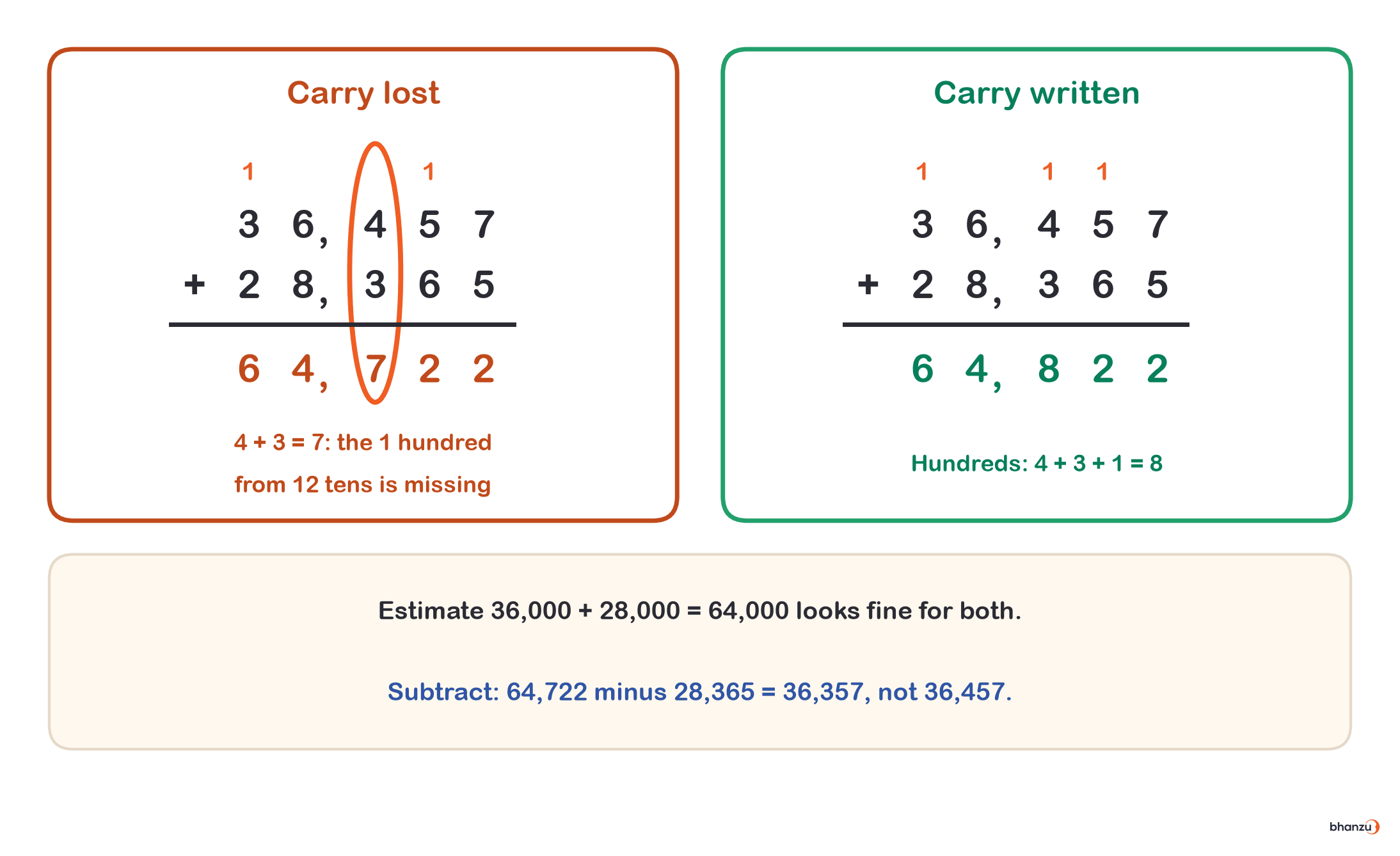
Where it slips in: Any column that gets a regrouped 1, most often when a child keeps the 1 in their head to save a pencil stroke. Roberts's 2019 review advises writing each step down instead.
Don't do this: , where the hundreds got only because the hundred from 12 tens never arrived.
The correct way: Write the 1 as soon as you make it, above the next column (or below it, if your class writes new groups below). The hundreds make , so the sum is .
Mistake 2: Writing a two-digit total in one column
Where it slips in: Any column that makes 10 or more, soon after a child starts using columns. A child may write a whole 13 under the ones and another under the tens, because the column feels finished once its total is down.
Don't do this: written as 7, 7, 13 and 13, which gives 771,313.
The correct way: Keep one digit per column. Write the 3 of 13 and regroup 1 ten, so the tens make , and the sum is 7,843. Two 4-digit numbers make at most , so a six-digit answer is a signal to look again.
What most guides miss about multi-digit addition
An estimate reliably catches only mistakes bigger than its own rounding. Rounding two addends to the nearest thousand moves each by up to 500. The estimate can then miss the true sum by up to 1,000, and a lost carry worth 10 or 100 hides inside that gap.
| Slip | Written sum | Estimate | Sum minus second addend |
|---|---|---|---|
| First digits lined up (Example 2) | 140,025 | 55,000, flags it | 130,651, not 46,285 |
| Lost ten-thousands carry (Example 4) | 32,335 | 43,000, flags it | 8,746, not 18,746 |
| Lost hundreds carry (Mistake 1) | 64,722 | 64,000, looks fine | 36,357, not 36,457 |
The subtraction also points at the column. 36,357 and 36,457 differ only in the hundreds digit, because a lost carry leaves the sum short by exactly its place value.
A 2023 study of 160 people, half fifth graders and half adults, found the students often "blindly trusted algorithms and rules," while only sense-making strategies went with more correct answers. Estimating first and subtracting after builds that sense-making into every sum.
Key Takeaways
- Put the ones under the ones before adding anything, even when one number is shorter.
- When the subtraction check returns the wrong addend, the digit that differs marks the column to fix.
- In multi-digit addition, estimate before adding and subtract after, so big and small slips both get caught.
- For more practice with a teacher who spots the carried 1 that goes missing, explore Bhanzu's 4th grade math curriculum or math classes for kids.
Read More
- Multi-Digit Subtraction
- Comparing and Ordering Multi-Digit Numbers
- Multi-Digit Multiplication
- Adding Decimals
- Math Word Problems
Research Behind This Article
- NASA Science, Moon Facts (2026). science.nasa.gov
- Common Core State Standards Initiative, Common Core State Standards for Mathematics (2010). thecorestandards.org
- Nicky Roberts, The Standard Written Algorithm for Addition: Whether, When and How to Teach It (2019). eric.ed.gov
- Der-Ching Yang, Performance of Fourth Graders When Judging the Reasonableness of a Computational Result (2019). eric.ed.gov
- National Center for Education Statistics, NAEP Long-Term Trends: Mathematics, Performance-Level Results, Age 9 (2026). nationsreportcard.gov
- Dimitrios Deslis and Despoina Desli, Does This Answer Make Sense? Primary School Students and Adults Judge the Reasonableness of Computational Results in Context-Based and Context-Free Mathematical Tasks (2023). eric.ed.gov
Quick Quiz: Check Yourself
Three levels with new numbers every time, from two 4-digit numbers to uneven lengths or three addends, then big-number word problems to finish or fix.
Was this article helpful?
Your feedback helps us write better content
Frequently Asked Questions
Is standard algorithm addition a 4th grade skill?
How do you go about adding 4-digit numbers without regrouping?
What does "one exchange" mean when adding 4-digit numbers?
How do you add 3-digit numbers in your head?
How can I help my child practice multi-digit addition at home?