Key Points
- Counting on and counting back add or subtract by hopping from a starting number, so means saying 8, 9, 10, 11.
- Counting on is fastest from the bigger number, and adding works in any order, so can start at 9 and take only 3 hops.
- Counting the start number as a hop is a frequent mistake that makes come out as 10, not 9.
The square you stand on doesn't count
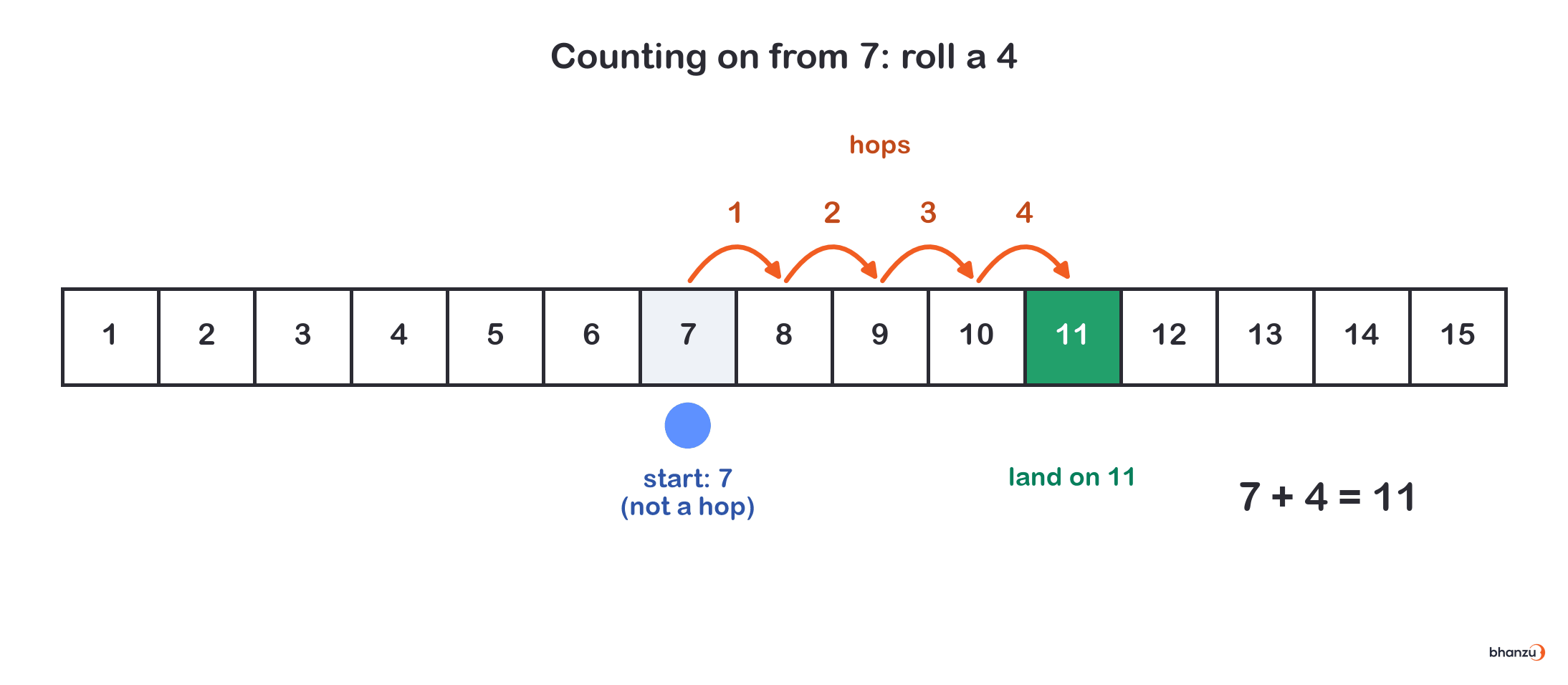
In a board game, your piece never lands on the square it's already on. It sits on 7. You roll a 4, so the first hop goes to 8, then 9, 10 and 11.
You just added 7 and 4 without counting from 1. Counting back runs the same hops the other way, to take away.
In 2nd grade, these hops grow into jumps along a number line up to 100.
What are counting on and counting back?
Counting on and counting back are ways to add and subtract by hopping from a starting number, forward to add and backward to take away. A hop is one move to the very next number. The skill is Common Core standard 1.OA.C.5, which asks 1st graders to relate counting to adding and subtracting.
You can track the hops on any of these.
- Fingers. Raise one finger for each hop.
- A number line. On this line of evenly spaced numbers, often starting at 0, you count the hops between marks.
- A number path. On this game-track strip of numbered boxes, you count the boxes you move to. A 2013 federal guide to early math calls it a number list, an easier tool than a number line for young children who are counting and learning numerals.
Counting on builds on starting a count at any number, a step in counting to 120. By the end of 1st grade, Common Core's next standard, 1.OA.C.6, expects your child to add and subtract within 20 using strategies such as counting on and making ten.
How do you count on to add?
To count on, start at the bigger number and count up by the smaller one.
- Find the bigger number.
- Say it, but don't count it.
- Raise one finger for each hop as you count up.
- Stop when your fingers show the smaller number. The last number you said is the answer.
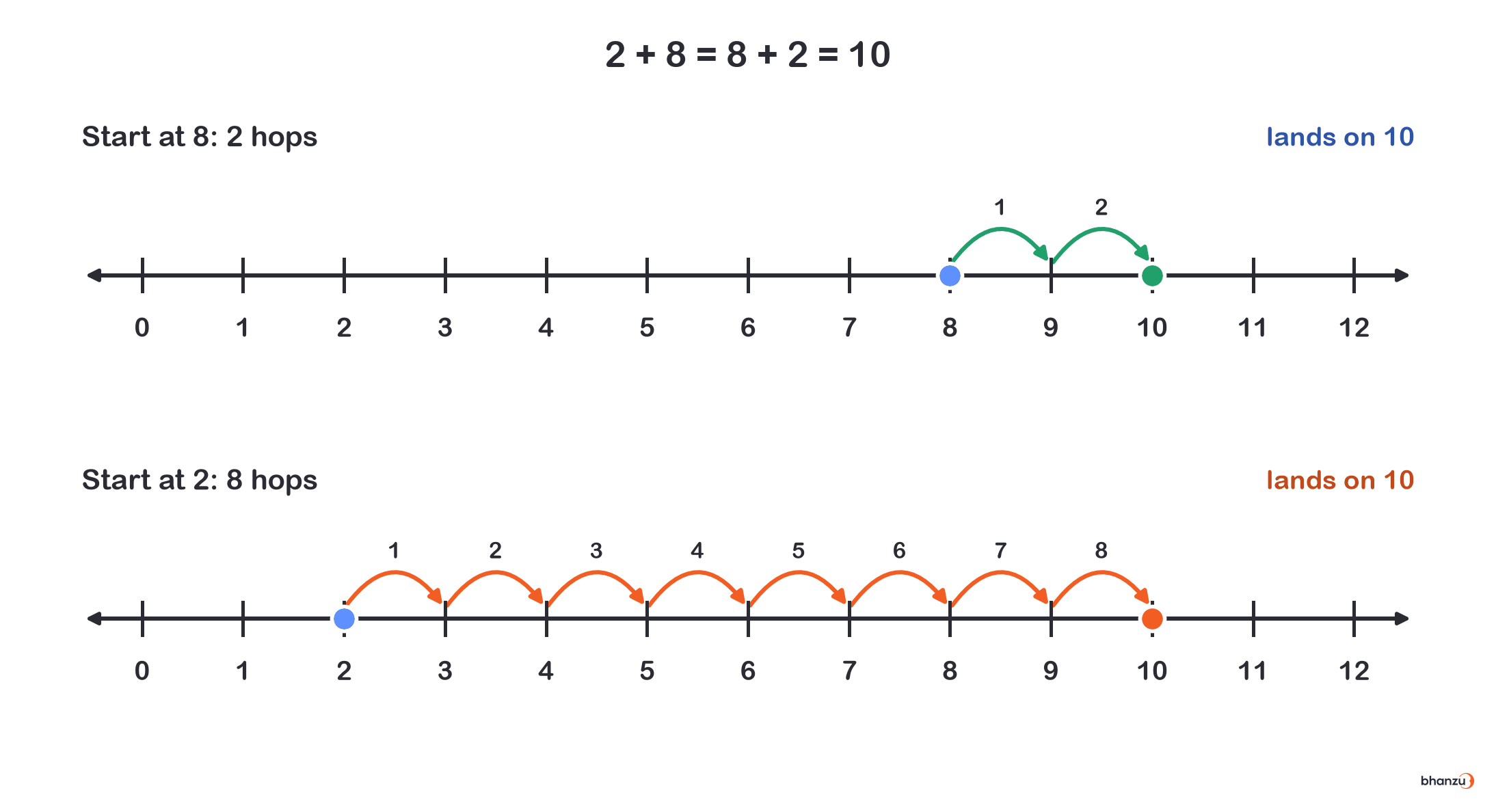
For , starting at 8 takes 2 hops, and starting at 2 takes 8 hops to the same 10. Adding works in any order (grown-ups call this the commutative property).
How is counting on different from counting all?
| For | What a child does |
|---|---|
| Counting all | Raises six fingers, then two more, and counts all eight from 1 |
| Counting on | Says "six" and raises two fingers for 7 and 8 |
Counting on is quickest for adding 1, 2 or 3, even across a ten (). Past about 4 hops it gets slow, so 1st grade adds a strategy called making ten. For , split the 6 into 2 and 4.
Which way should you count to subtract?
Count back when you take away a small number, and count up when the numbers are close. For , count back 3 hops from 12 to 11, 10 and 9, so .
For , counting back 9 hops is a long trip. Count up from 9 instead, saying 10, 11, 12. That's 3 hops, so .
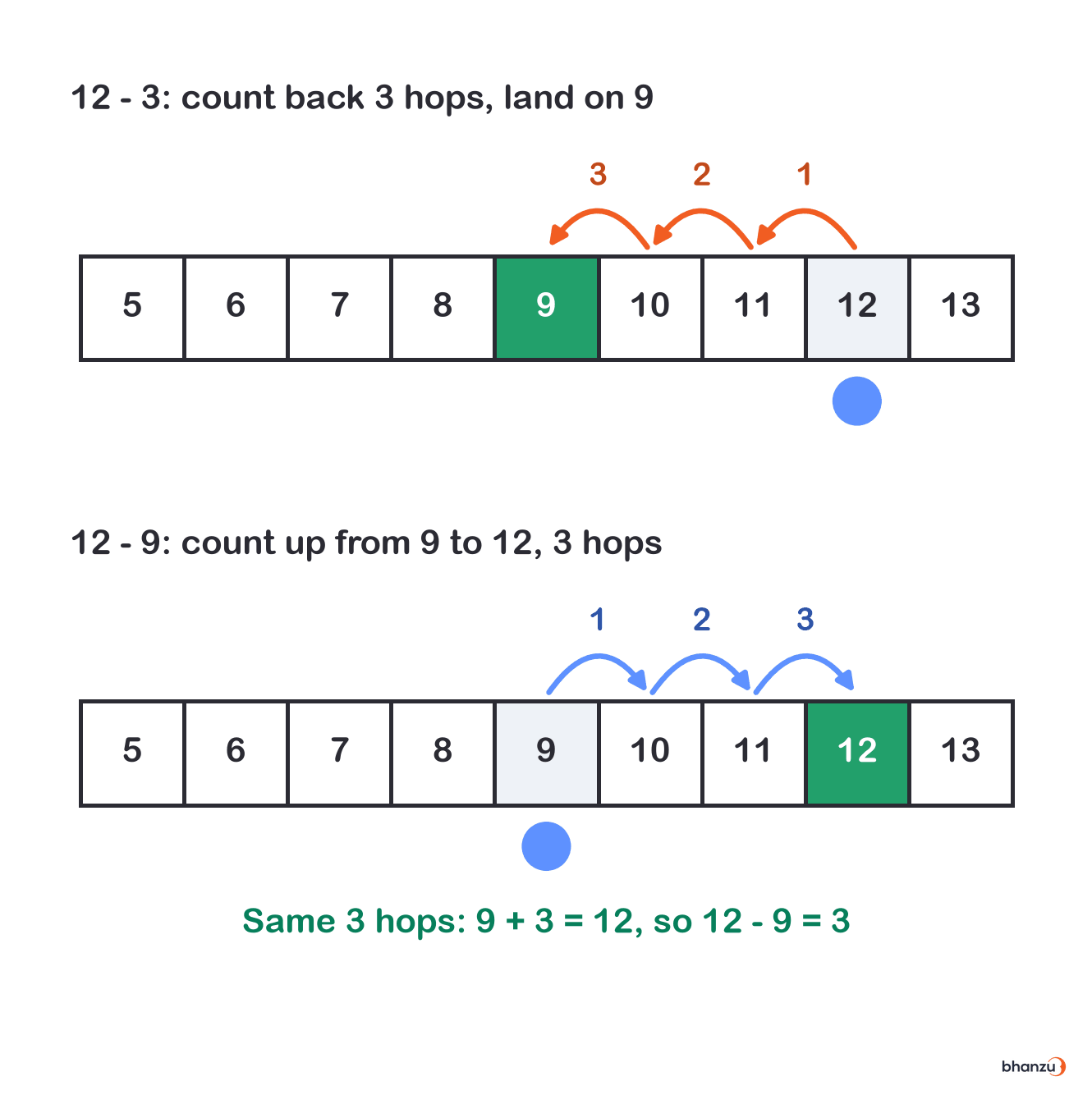
Counting up works because asks what you add to 9 to make 12.
The facts and belong to one fact family. Counting up is also how you find the missing number in an equation such as , where the question mark stands for the hops. The number of hops between two numbers is their difference, and in 2nd grade the same counting up handles bigger pairs such as .
Story problems tell you which way to count.
| Words in the problem | Math it means |
|---|---|
| rolls a 3 | count on 3 to add |
| spends 4 cents, how many are left | count back 4 to subtract |
| how many more to fill the box | count up, and the hops are the answer |
| go back 3 | count back 3 to subtract |
Try It Yourself
Pick Count on, Count back or Count up, set the start square, then tap Hop and say each number. The start square never gets a hop number, and in Count up mode the hops to the target square answer the subtraction.
The real reason counting on and counting back work
Every number in the counting list is exactly one more than the one before it. So a hop forward adds 1, and a hop back takes 1 away.
- It turns a count into a sum. Four hops from 7 add four 1s, making 11.
- It hides an addition inside every take-away. Counting up from 9 to 12 finds 3, because .
- It skips the long count from 1. Keeping one number in your head while you hop is a first step into mental math.
- It checks your change. If you pay 10 cents for a 7-cent eraser, counting up 8, 9, 10 shows 3 cents back.
A rocket countdown is counting back, with each number one less than the one before.
Examples of counting on and counting back
Example 1
Leo's game piece is on square 6. He rolls a 3. Which square does it land on?
Start at 6 without counting it, and hop to 7, 8 and 9.
It lands on square 9.
Example 2
Mei has 8 crayons, and her box holds 11. How many more crayons does she need to fill it?
The tempting move is to hear "more" and add, counting on 8 from 11 to reach 19. That can't be right, because the box holds only 11 crayons.
Count up from 8 instead, landing on 9, 10 and 11, which is 3 hops.
Mei needs 3 more crayons.
Example 3
Aisha has 15 cents. She spends 4 cents on a sticker. How many cents are left?
Spending takes away, and 4 is a small number, so count back 4 from 15 to 14, 13, 12 and 11.
Aisha has 11 cents left.
Example 4
What number makes true?
The question mark stands for the hops from 14 to 17. Count up to 15, 16 and 17, which is 3 hops.
The missing number is 3, and subtracting checks it, since .
Example 5
Maya's piece is on square 9. She rolls a 5, then lands on a square that says "go back 3." Where does she end up?
Count on 5 from 9 to 10, 11, 12, 13 and 14.
Then count back 3 to 13, 12 and 11.
Maya ends up on square 11.
What do most guides miss about counting on and counting back?
Finger counting grows in stages, and your child's finger moves show which stage your child has reached. In a 2026 study, Krenger, Bagnoud and Thevenot watched 207 children twice a year for three years, and the usual path had three finger stages.
- Both hands. Each number goes on its own hand, like 3 and 4 for .
- Concrete counting on. Both numbers go on fingers, counted in one run from 1, like 1 to 9 for . This stage is linked with weaker accuracy.
- Counting on. One number stays in your head and the fingers track the hops, like "six" and then 7, 8 and 9 on three fingers.
Is counting on fingers bad?
No. In another 2026 study of 192 children followed from age 4 and a half to 7 and a half, almost all used fingers. By 6 and a half, most children who no longer used fingers had used them before, and they added better than both children still using fingers and children who never had.
Where do kids trip up on counting on and counting back?
Mistake 1: Counting the start number as a hop
Where it slips in: The first hop of any count. A child who learned to count a pile from "one" taps the start square and counts it too.
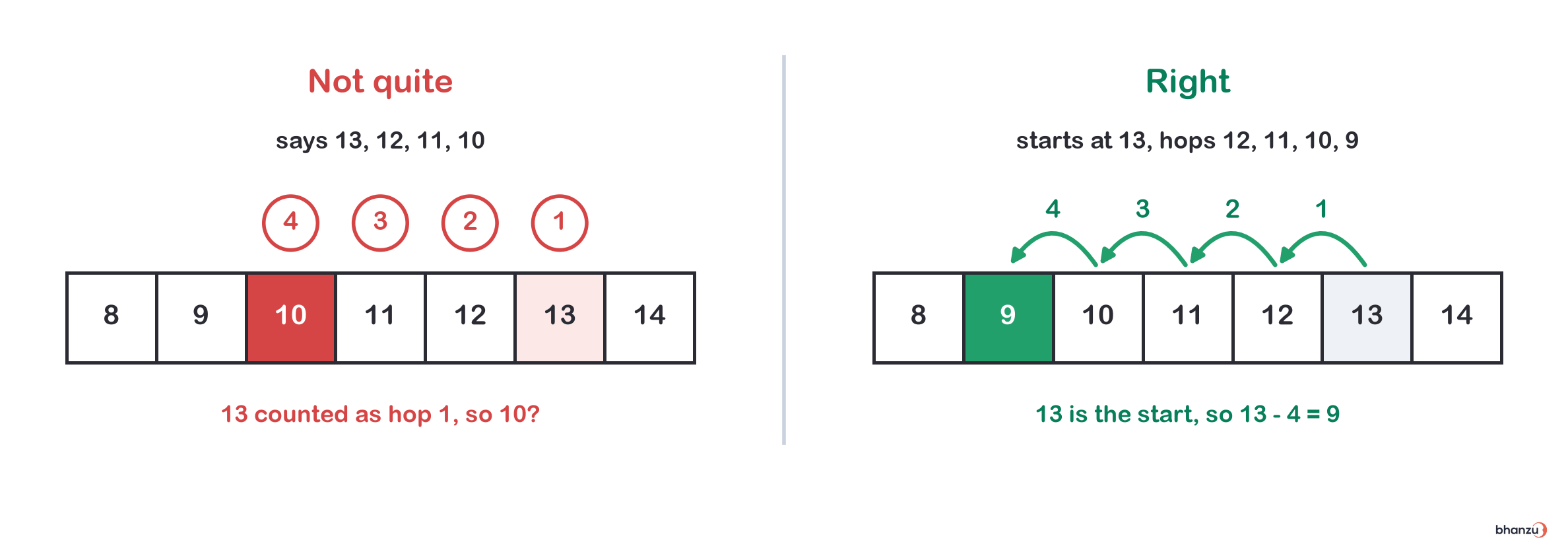
Don't do this: For , saying "13, 12, 11, 10" and answering 10.
The correct way: Say 13 without counting it, then hop to 12, 11, 10 and 9, so .
The same slip turns into 10. It makes every answer one too small when adding and one too big when taking away.
Mistake 2: Giving the landing number when counting up
Where it slips in: Counting up to subtract, as in . In counting on and counting back, the last number said is the answer, so a child carries that habit over.
Don't do this: Counting up from 11 to 12, 13, 14 and 15, then answering 15.
The correct way: Count the hops instead. Four hops means .
Key Takeaways
- For both counting on and counting back, say the start number, then count only the hops after it.
- Choose the direction from the gap, counting back for a small take-away and counting up when the numbers are close.
- Fingers work best when one number stays in your head and the fingers only track the hops.
- For more practice spotting the start-square trap when counting on, explore Bhanzu's 1st grade math curriculum or an elementary math tutor.
Read More
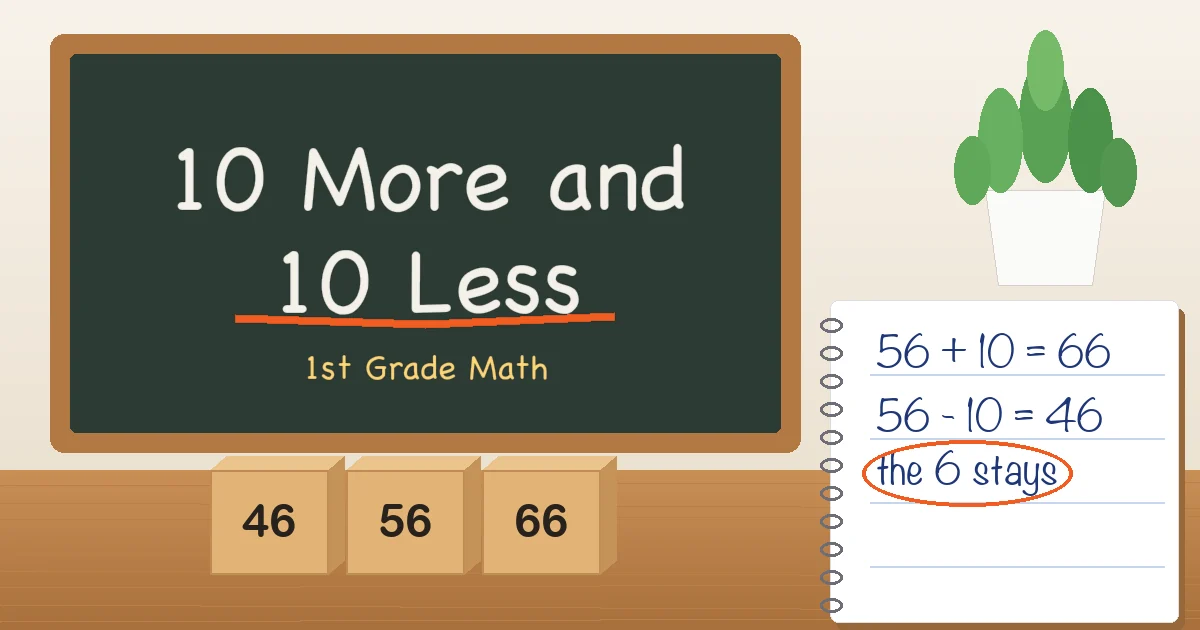
- 10 More and 10 Less
- Adding Three Numbers
- Skip Counting by 2s, 5s and 10s
- Adding and Subtracting on a Number Line
- Mental Subtraction
Research Behind This Article
- Common Core State Standards Initiative, Grade 1 Operations and Algebraic Thinking (1.OA) (2010). thecorestandards.org
- Institute of Education Sciences, What Works Clearinghouse, Teaching Math to Young Children (2013). ies.ed.gov
- Krenger, M., Bagnoud, J. and Thevenot, C., The Evolution of Finger Counting Strategies in Addition: A Three-Year Longitudinal Study in Young Children (2026). pmc.ncbi.nlm.nih.gov
- Krenger, M. and Thevenot, C., The role of children's finger counting history on their addition skills (2026). pubmed.ncbi.nlm.nih.gov
- Lê, M. L., Noël, M. P. and Thevenot, C., The efficacy of manipulatives versus fingers in supporting young children's addition skills (2024). pubmed.ncbi.nlm.nih.gov
Quick Quiz: Check Yourself
Three levels, new numbers every time: count on to add, count back or up to subtract or fill a missing number, then solve story problems.
Was this article helpful?
Your feedback helps us write better content
Frequently Asked Questions
How do you teach counting backwards from 20?
What can my child use besides counting on fingers?
How do you teach the counting on strategy in a fun way?
How do counting on and making ten work together to subtract?
Is counting back the same as counting backwards?