Key Points
- Fact families join adding and taking away, so 8, 4 and 12 give four facts, such as and .
- To subtract with a fact family, think addition, so asks what joins 9 to make 13, and counting up from 9 gives 4.
- A doubles family such as 6, 6 and 12 has only two different facts, because swapping two equal parts changes nothing.
Know one fact, get three more
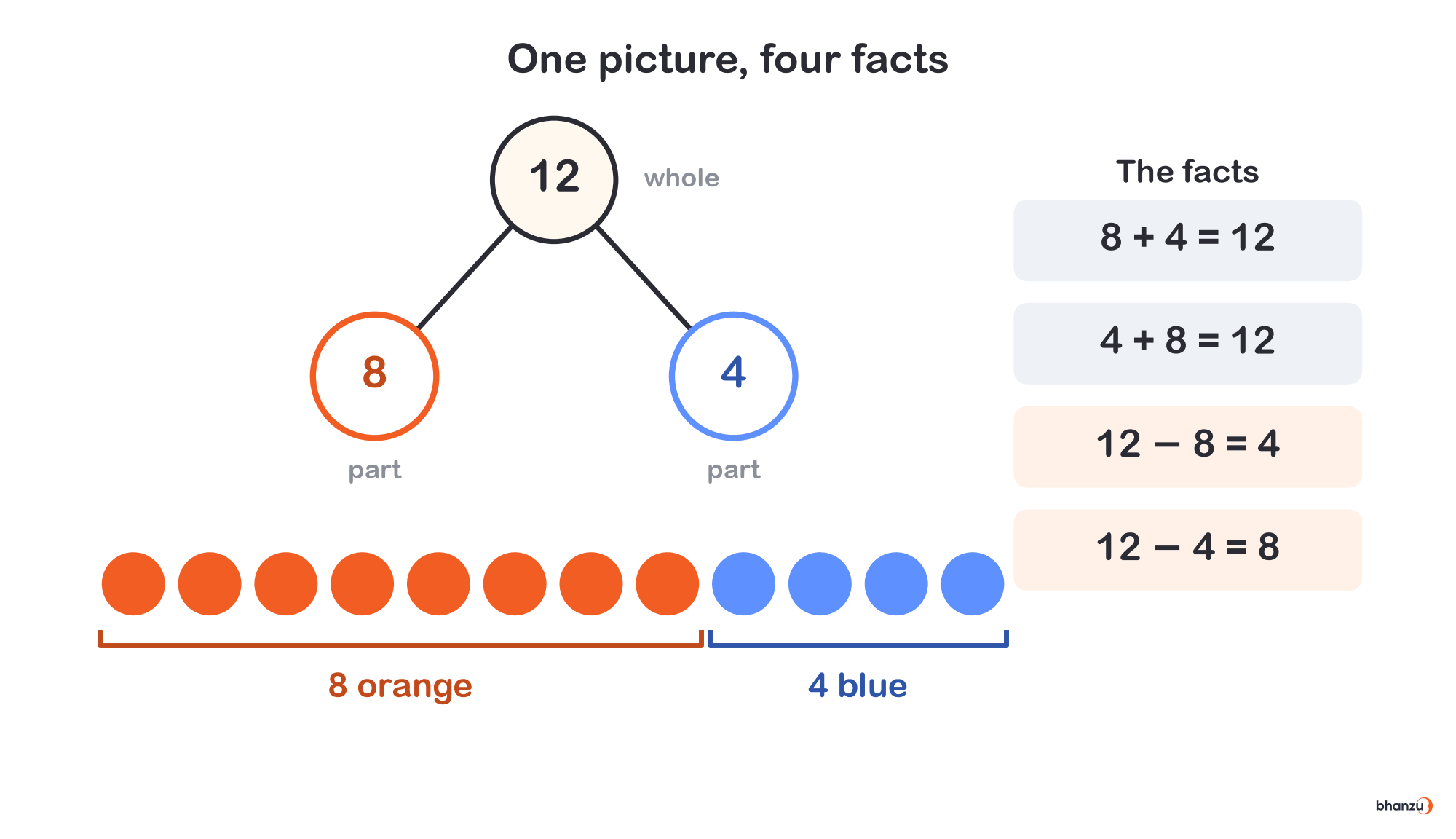
If you know that 8 plus 4 makes 12, you already know three more facts. Line up 12 counters, 8 orange and 4 blue, and count either color first to get 12.
Now cover the blue ones, and 8 are left. Cover the orange ones, and 4 are left. Next year, families like this one let you subtract in your head without counting.
What are fact families?
Fact families are small sets of related facts built from three numbers: two parts and the whole they make.
A number bond shows the whole in a top circle, with lines down to its two parts. For the counters, the whole is 12 and the parts are 8 and 4. Taking 8 away leaves 4, which is called the difference.
This is Common Core standard 1.OA.B.4, which treats subtraction as an unknown-addend problem (a missing number to add), along with 1.OA.C.6. By the end of 1st grade, your child should add and subtract within 20 and be fluent within 10, and fact families help build that.
The words "fact family" never appear in the standards, so homework may say related facts, number bonds or fact triangles instead.
How do you write fact families for addition and subtraction?
Start with the whole, the biggest number, and check its parts first.
- Find the whole, 12, so 8 and 4 are the parts.
- Check that . If the parts don't make the whole, stop.
- Write the parts in both orders, and (turn-around facts, which grown-ups call the commutative property).
- Write two subtraction facts that start with the whole, and .
A child who writes four facts by pattern and skips step 2 can turn any three numbers into a fake family. A fact family triangle holds the same three numbers, with the whole on top and the parts below.
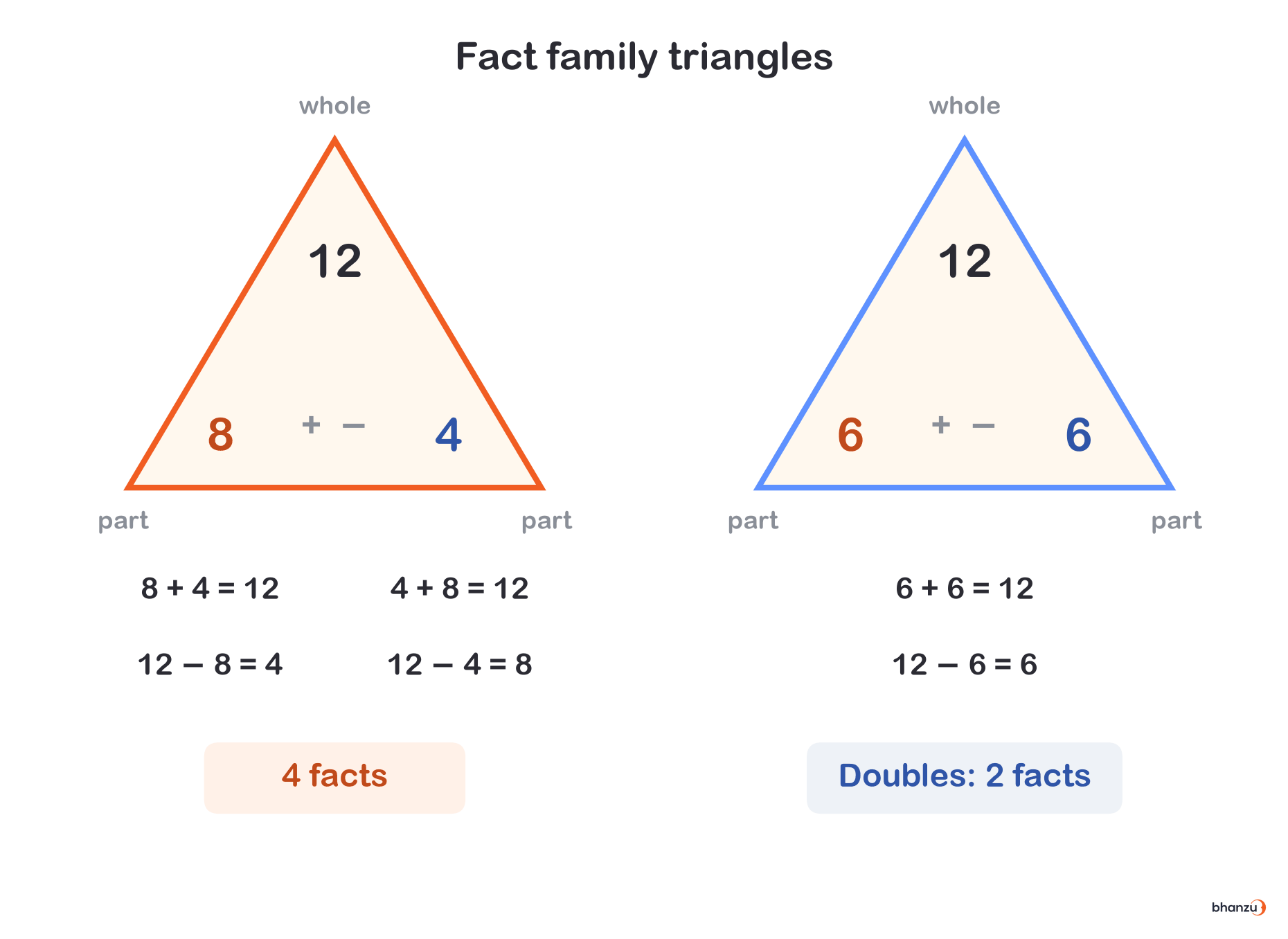
When both parts match, as in 6, 6 and 12, the family has only two different facts.
Swapping the two 6s gives the same facts again. Books disagree here, and some worksheets still draw four lines for a doubles family.
You can also write , because the equal sign means both sides are worth the same.
How does addition help you subtract?
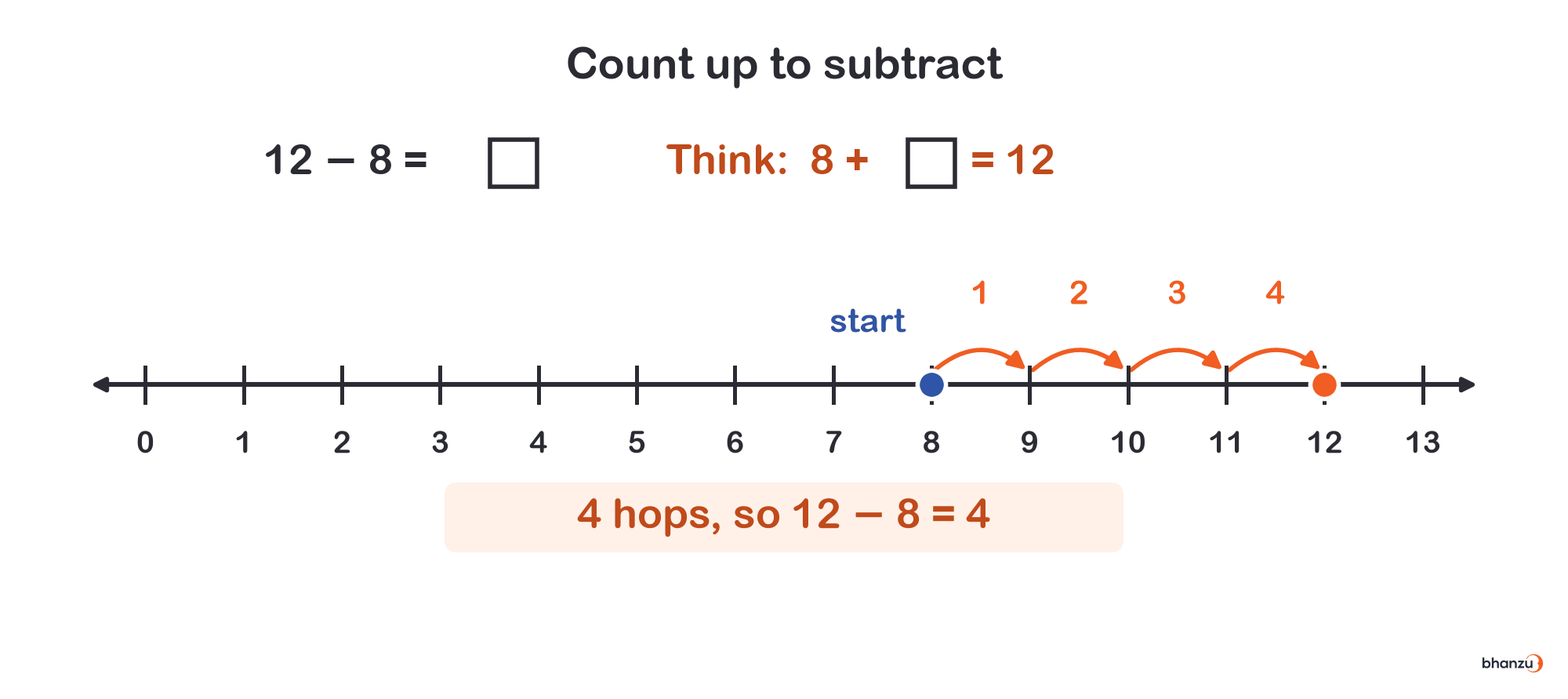
To subtract, ask what you add to the number taken away to reach the whole. An addend is a number being added, so becomes the unknown-addend problem , where the box stands for the missing part.
- Read as "8 plus what makes 12?"
- Start at 8.
- Count up to 9, 10, 11 and 12, one hop per number.
- Four hops means , so .
A child may say in a flash, then count back eight fingers for . The family is there but unused.
Counting on and counting back both work, but the trips differ in length.
- Count up when the number taken away is close to the whole, so is 4 hops up, not 9 steps back.
- Count back when it's small, so is 2 steps back, not 12 hops up.
Children rarely make this switch alone. In a 2012 study, 106 third to sixth graders kept taking away on problems like , while adults switch between the two. In a 2014 study of 75 first graders, practice with "If , then is 5" worked best on new subtraction facts.
Story problems use words that point to a part or the whole.
| Words in the problem | Math it means |
|---|---|
| in all, altogether | part + part = whole |
| left | whole - part = the other part |
| rolled away, eats | a part taken from the whole |
| how many more to make | part + = whole |
Maya had 12 crayons, and some rolled away, leaving 8. Think , so 4 rolled away, the same move used for finding the missing number in an equation.
Try It Yourself
Drag the line between the orange and blue counters, or press the arrow keys, and watch every fact change. Make the parts equal to see a doubles family. Then press Hide blue and tap Count up to find the hidden part, one hop at a time.
Why do fact families matter?
Fact families turn subtraction from a new job into finding the missing part of something you already know.
- It shrinks the job. The 45 adding facts with parts from 1 up and wholes up to 10, plus their 45 taking-away facts, fit into 25 families.
- It shortens take-aways. is 15 steps back but 2 hops up, a habit at the heart of mental subtraction.
- It checks answers. After , adding to get 15 proves it (a check you'll reuse on two-digit subtraction).
Making change works the same way. Pay $10 for a $7 snack, and counting up from 7 to 10 gives $3 back.
Examples of fact families
Example 1
Write the fact family for 3, 5 and 8.
The whole is 8, and checks the parts.
Example 2
Use addition to find .
Think and count up from 8 to 9, 10 and 11, which is 3 hops.
So .
Example 3
Do 2, 5 and 9 make a fact family?
The tempting move is to write four facts because there are three numbers, starting with .
That can't be right. Two counters and 5 counters make 7, not 9.
Check the parts first.
So 2, 5 and 9 are not a family, but 2, 5 and 7 are.
Example 4
How many different facts are in the fact family for 7, 7 and 14?
Swapping the two 7s repeats these, so the family has 2 different facts.
Example 5
A fact family triangle has 11 at the top and 4 in one bottom corner. What goes in the other corner?
The 4 is a small part, so count back 4 from 11 to 10, 9, 8 and 7.
Adding checks it, since . The other corner is 7.
Example 6
Mei has $18. She buys a kite and has $10 left. How much did the kite cost?
The $18 is the whole and the $10 is one part. Think and count up from 10 to 18, which is 8 hops.
The kite cost $8.
The pattern hiding inside fact families
The four facts in a family are one picture of parts and a whole, read four ways. Most guides teach them as shared numbers and skip why those numbers belong together.
A 2016 review of seven US 1st grade math programs found fact families in all six main programs. Only two of the seven built them on the idea that taking away undoes adding. In a study published in 2026, 195 UK children about 8 years old judged whether one fact helps with another.
| Pair the children judged | Judged correctly |
|---|---|
| and | 94.1% of the time |
| and | 64.6% of the time |
Turn-around facts came easily, but the jump to taking away did not, so give that jump most of your child's practice. Build 8 and 4, take the 4 away, and watch the 8 stay.
Fact families: common confusions cleared up
Mistake 1: Starting a subtraction fact with a part
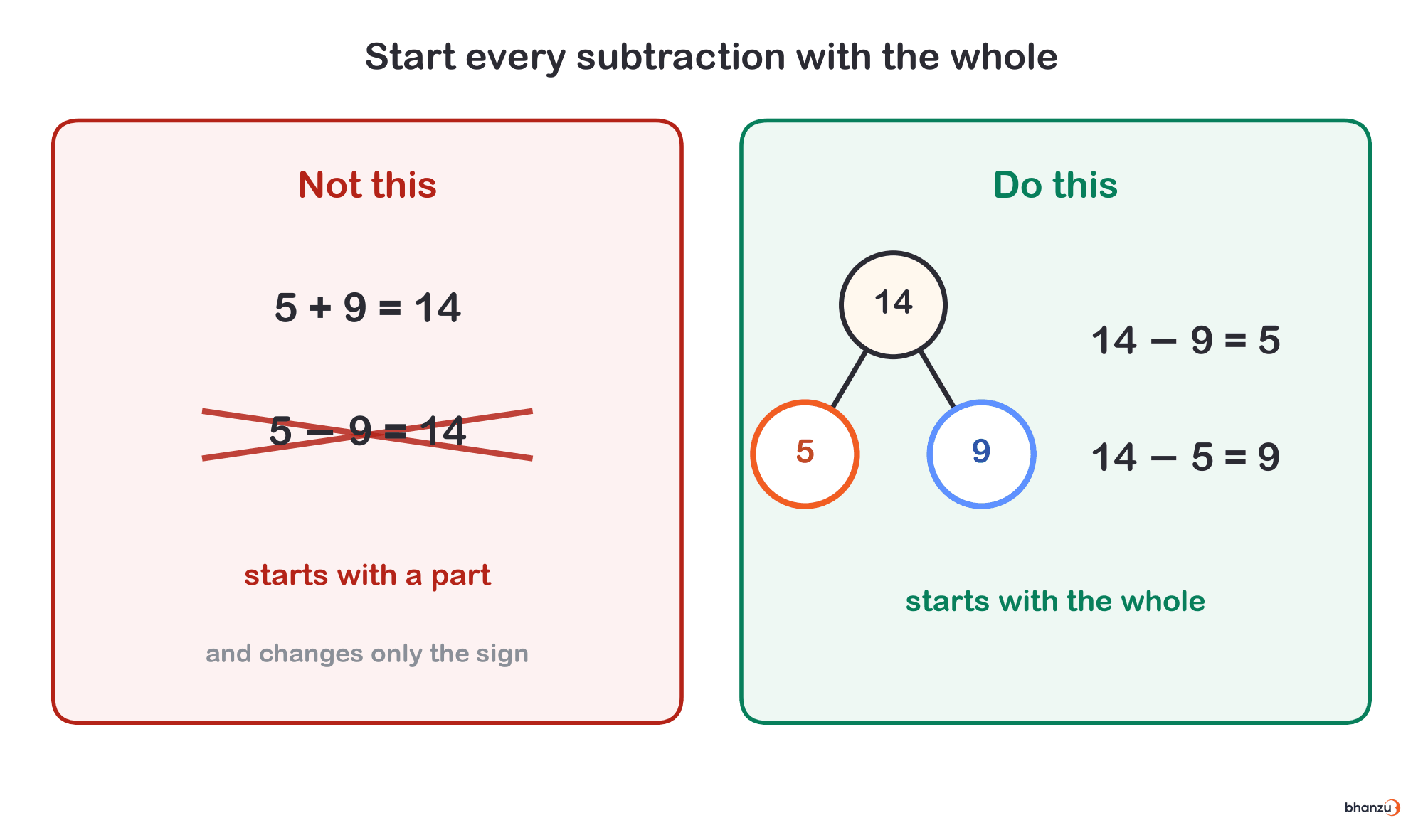
Where it slips in: Writing subtraction facts right after the addition facts, as for 5, 9 and 14.
Don't do this: Copying and changing only the sign to get .
The correct way: Start each subtraction with the whole, so and .
A child who rushes copies the line above and swaps just the sign. Taking 9 away from 5 can't leave 14, because taking away never makes a number bigger.
Mistake 2: Stopping after the addition facts
Where it slips in: Any "write the fact family" task, such as 3, 6 and 9.
Don't do this: Writing and , then stopping.
The correct way: Add and .
Adding feels like the real fact, and subtracting looks like a separate lesson.
Mistake 3: Counting back a long way
Where it slips in: Subtractions where the number taken away is close to the whole, such as .
Don't do this: Counting back 13 single steps from 16 (one skipped finger changes the answer).
The correct way: Think and count up 3 hops, so .
The minus sign says "take away", so counting back feels like the only honest move.
Key Takeaways
- Before writing any facts, check that the two smaller numbers add up to the biggest, a check 2, 5 and 9 fail.
- In every subtraction fact of a family, the whole comes first.
- When the number you take away sits close to the whole, count up instead of back.
- Doubles fact families stop at two different facts.
- To practice turning take-aways into count-ups with a teacher who catches the mix-up, explore Bhanzu's 1st grade math tutor or math programs for elementary students.
Read More
- Adding Three Numbers
- Finding the Missing Number Within 100
- Relating Multiplication and Division
- Mental Math for Kids
- Math Word Problems
Research Behind This Article
- Common Core State Standards Initiative, Grade 1: Operations and Algebraic Thinking (2010). thecorestandards.org
- Peters, Greet and colleagues, Children's Use of Subtraction by Addition on Large Single-Digit Subtractions (2012). eric.ed.gov
- Göbel, Silke M. and colleagues, Longitudinal Predictors of Conceptual Understanding of Arithmetic Principles (2026). doi.org
- Canobi, Katherine H., Children's Profiles of Addition and Subtraction Understanding (2005). eric.ed.gov
- Common Core State Standards Initiative, Grade 3: Operations and Algebraic Thinking (2010). thecorestandards.org
Quick Quiz: Check Yourself
Three levels, new numbers every time: finish a family, subtract by adding or count a family's facts, then fill a triangle or solve a story.
Was this article helpful?
Your feedback helps us write better content
Frequently Asked Questions
What is a fact in a fact family?
How are fact families and number bonds related?
How do you solve a fact family triangle with a missing number?
Are fact families taught in 1st grade?
How do you teach fact families to first graders?