What Does "Solving an Equation" Mean?
To solve an equation is to find the value(s) of the unknown variable that make the equation a true statement. The set of all such values is the solution set.
For example, the equation is true when (since ) and false for any other value. So the solution set is .
Some equations have:
Exactly one solution — most linear equations.
Multiple solutions — quadratics have up to two, cubics up to three.
No solution — like over the reals.
Infinitely many solutions — identities like .
The Universal Process
Regardless of equation type:
Simplify each side — distribute, combine like terms, clear fractions or decimals.
Collect variable terms on one side, constants on the other.
Undo operations in reverse order to isolate the variable.
Check by substituting into the original equation.
The four-step structure is the same; the specifics depend on the equation type.
How to Solve a Linear Equation
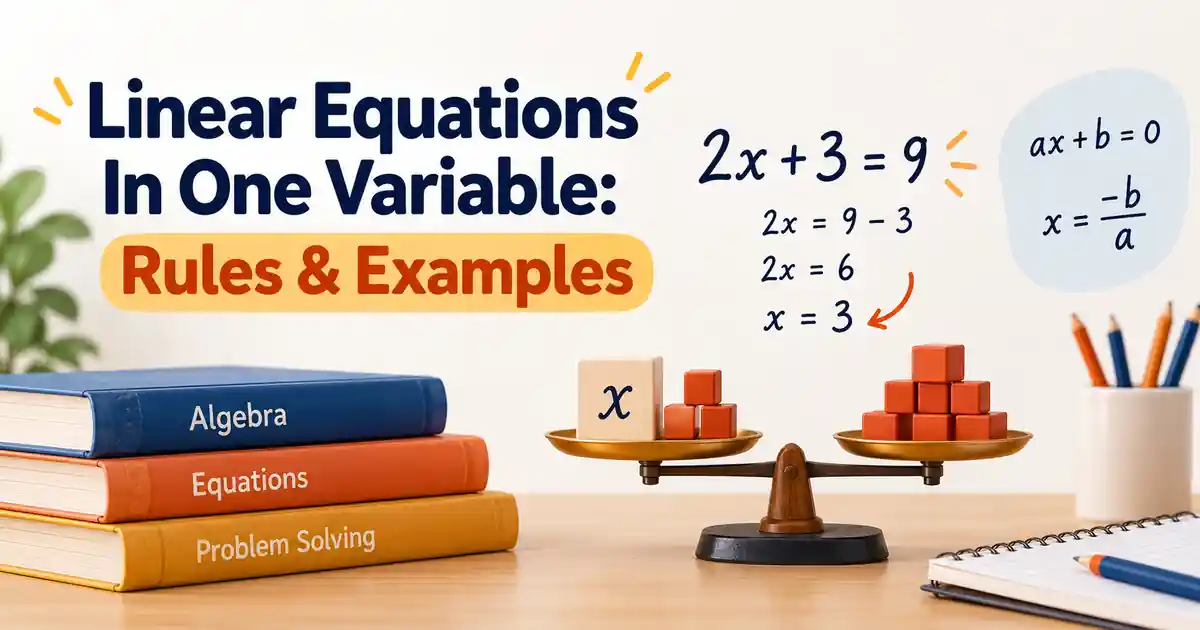
A linear equation has the variable to the first power: .
Step-by-step:
Distribute any parentheses.
Combine like terms on each side.
Move variables to one side, constants to the other.
Divide by the coefficient of the variable.
Check.
Worked example. Solve .
Step 1: Distribute → . Step 2: Combine → . Step 3: Subtract 7 → . Step 4: Divide by 5 → . Step 5: Check: ✓.
How to Solve a Quadratic Equation
A quadratic equation has the variable to the second power as its highest term: .
Three primary methods:
Method 1: Factoring
Rewrite the quadratic as a product of two linear factors. Use the zero-product property: if , then or .
Worked example. Solve .
Factor: . So or .
Method 2: Quadratic Formula
For :
Works for any quadratic — use when factoring isn't obvious.
Method 3: Completing the Square
Rewrite as a perfect square plus a constant. Mostly used for deriving the formula or in calculus.
How to Solve a Radical Equation
A radical equation has the variable inside a root: .
Process:
Isolate the radical.
Square both sides (or cube, for cube roots).
Solve the resulting equation.
Check for extraneous roots — squaring can introduce values that don't satisfy the original.
Worked example. Solve .
Step 1: Already isolated. Square both sides → . Step 2: Solve → . Step 3: Check: ✓.
Extraneous root example. Solve .
Squaring gives . But , not . So is an extraneous root — and the original equation has no solution.
How to Solve a Rational Equation
A rational equation has the variable in a denominator: .
Process:
Find the common denominator.
Multiply both sides by it to clear fractions.
Solve the resulting equation.
Check that no solution makes any original denominator zero.
Worked example. Solve .
Cross-multiply: → → → .
Check: at , neither nor is zero ✓; ✓.
How to Solve an Exponential Equation
An exponential equation has the variable in an exponent: .
Process. Take the logarithm of both sides, then use the power rule.
Worked example. Solve .
.
Or recognise directly.
Worked example with messier numbers. Solve .
.
Three Worked Examples — Quick, Standard, Stretch
Quick — Linear
Solve .
Subtract : . Add : . Divide: .
Standard — Quadratic
Solve using the formula.
:
Stretch — Radical with Extraneous Root
Solve .
Square both sides: , so , factoring as . Candidates: or .
Check both in the original:
: ✓
: . Extraneous.
Only solution: .
Why Does Solving Equations Matter? (The Real-World GROUND)
"To solve an equation is to find when one thing equals another." — applied mathematics.
Solving equations is the operational core of nearly every quantitative field:
Physics. Newton's laws of motion become equations to solve for velocity, position, or time.
Engineering. Stress, strain, current, voltage — every design constraint reduces to an equation to solve for an unknown.
Economics. Equilibrium prices, break-even quantities — all are equation-solving problems.
Computer science. Numerical methods (Newton-Raphson, gradient descent) automate equation-solving at scale.
The systematic method comes from Al-Khwarizmi's Al-Jabr (820 CE) — the book whose title gave us algebra. His central technique — al-jabr meaning "restoration" — is moving terms across an equals sign, the foundation of every solve method.
Learn more: How to Solve for x in Algebraic Equations
A Worked Example — Wrong Path First
Solve .
The intuitive (wrong) approach. A student cancels from both sides immediately:
Why it fails. The cancellation is valid if . But the cancellation step also discarded the case where the equation might have no solution. More importantly, the student needs to check that doesn't make the denominator zero.
The correct method. Note the domain restriction: (denominator can't be zero). Then cancel: . Check ✓.
Now suppose the problem had been instead. Cancelling would give — but is excluded by the domain restriction. So the equation would have no solution.
What Are the Most Common Mistakes With Solving Equations?
Mistake 1: Skipping the check
Where it slips in: Especially in radical and rational equations, where transformations can introduce extraneous roots.
The fix: Always substitute back into the original equation.
Mistake 2: Distributing a negative sign incorrectly
Where it slips in: , not .
The fix: The minus sign distributes to every term inside the parentheses.
Mistake 3: Dividing by an expression containing the variable
Where it slips in: . Dividing by gives → , contradiction — but the original does have as a solution.
The fix: Don't divide by an expression containing the variable. Move everything to one side and factor.
Key Takeaways
Solving an equation means finding the value(s) of the unknown that make both sides equal.
Four universal steps: simplify each side, collect like terms, isolate the variable, check.
Method depends on equation type: linear → legal moves; quadratic → factor/formula; radical → isolate and square; rational → clear denominators; exponential → take logs.
Always check by substituting into the original equation, especially after squaring or multiplying by expressions containing the variable.
Some equations have no solution (inconsistent), some have infinitely many (identities), some have multiple (polynomial equations).
A Practical Next Step
Try these three before moving on to systems of equations.
Solve .
Solve by factoring.
Solve and check for extraneous roots.
If problem 3 felt tricky, square both sides: , so . Candidates or ; both check ✓. Want a Bhanzu trainer to walk through more equation-solving? Book a free demo class — online globally/
Was this article helpful?
Your feedback helps us write better content