Key Points
- Common denominators are bottom numbers two fractions share after rewriting, so three-fourths and five-sixths become 9 twelfths and 10 twelfths.
- A common denominator must be a multiple of both denominators, and counting by the bigger denominator finds the smallest, such as 12 for 4 and 6.
- Adding two different denominators never gives a common denominator, because the sum always lands between the bigger denominator and its double.
- Common Core standard 4.NF.A.2 names creating common denominators as one way 4th graders compare fractions with denominators 2, 3, 4, 5, 6, 8, 10, 12 and 100.
Sixty little pieces in every hour
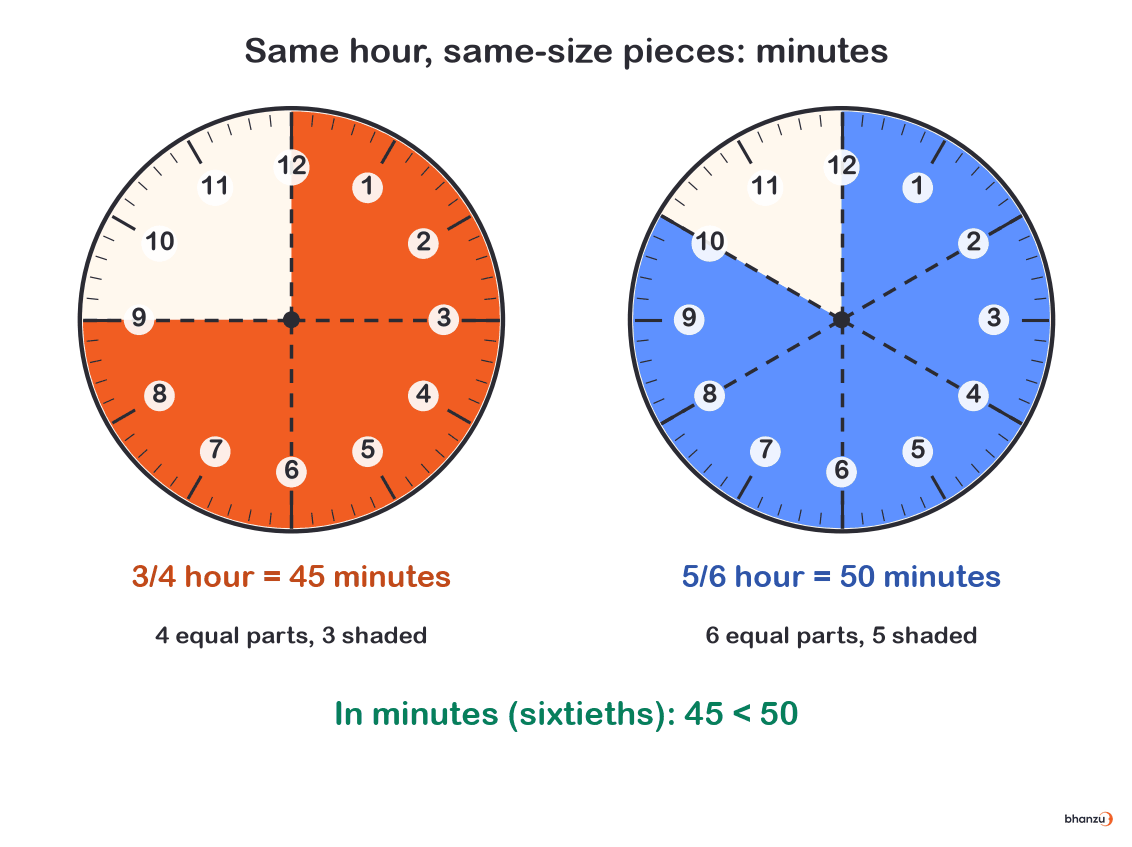
Every hour on a clock is already cut into 60 same-size pieces. Three-fourths of an hour is 45 minutes. Five-sixths of an hour is 50 minutes. As fourths and sixths, the chunks are different sizes and hard to line up.
In minutes, the longer one is plain to see. Minutes work because fourths and sixths both fit into 60 evenly (15 minutes per fourth, 10 per sixth). In 5th grade, the same renaming move lets you add fractions such as one-half and one-third.
What is a common denominator?
Common denominators are bottom numbers that two fractions share, so every piece in both fractions is the same size. The denominator is the bottom number, the count of equal pieces in the whole, and the numerator is the top number, the count of pieces you have.
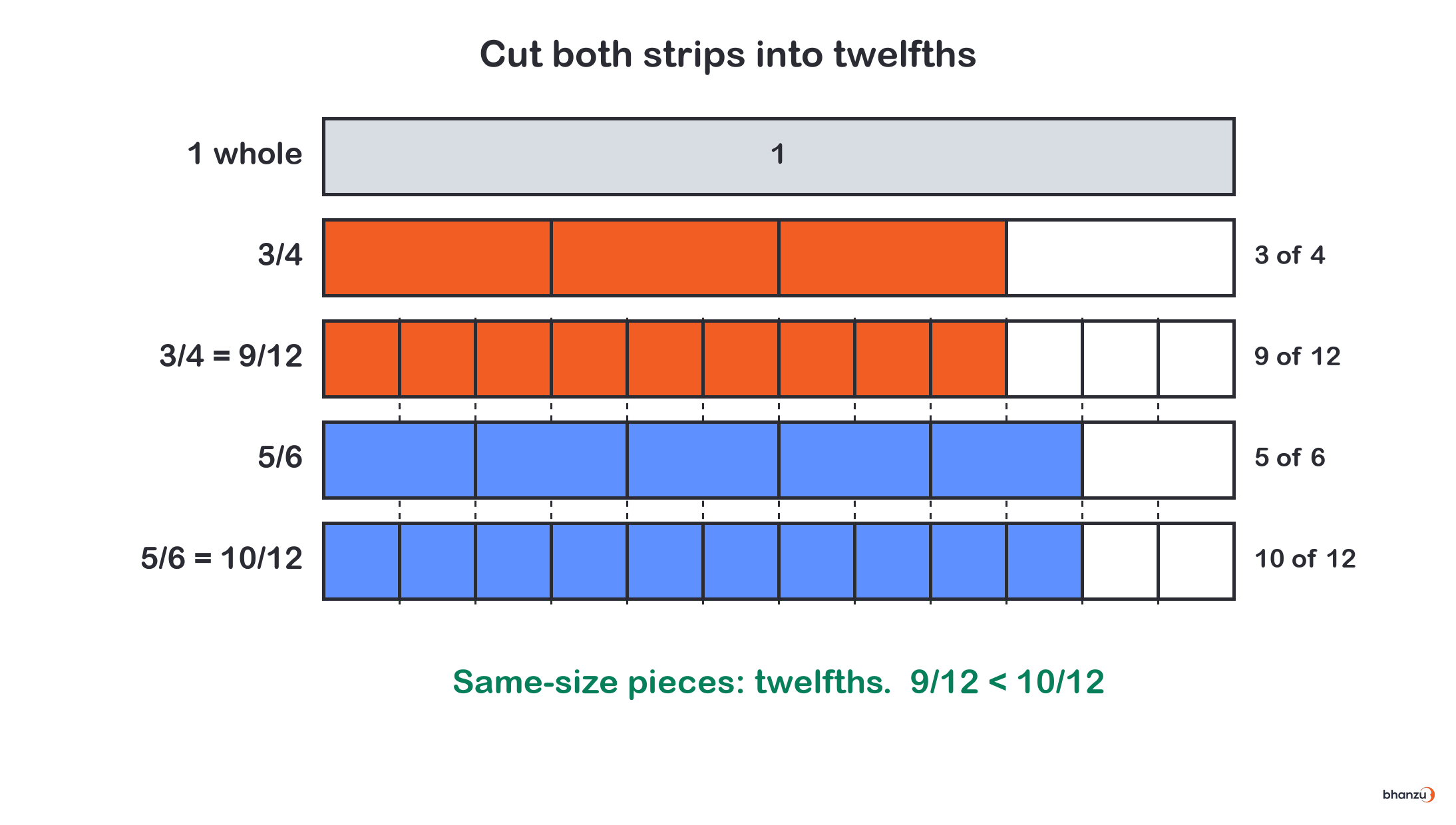
Take two same-length fraction strips showing and . Cut each fourth into 3 pieces and each sixth into 2, and both strips are in twelfths, the biggest pieces that fit both. Nine twelfths against 10 twelfths means is greater, just as the clock showed.
Fractions with different denominators are called unlike fractions. Comparing unlike fractions is Common Core standard 4.NF.A.2, which asks 4th graders to compare them by creating common denominators or numerators, or by using a benchmark such as . Common numerators and benchmarks are the other routes to comparing fractions with unlike denominators.
In 4th grade, your child works with the denominators 2, 3, 4, 5, 6, 8, 10, 12 and 100 and uses common denominators to compare, while adding unlike fractions waits for 5th grade. In the 2024 Nation's Report Card, NAEP's example of an Advanced 4th grade skill is to "compare and order whole numbers, fractions, and decimals to hundredths," and 9% of 4th graders reached Advanced.
How do you find a common denominator?
A common denominator is any number both denominators divide into evenly, so it is a common multiple, a number you land on when counting by each of the denominators. Three steps find one.
- Check whether the bigger denominator already works. For and , 12 divided by 3 is 4, so 12 works.
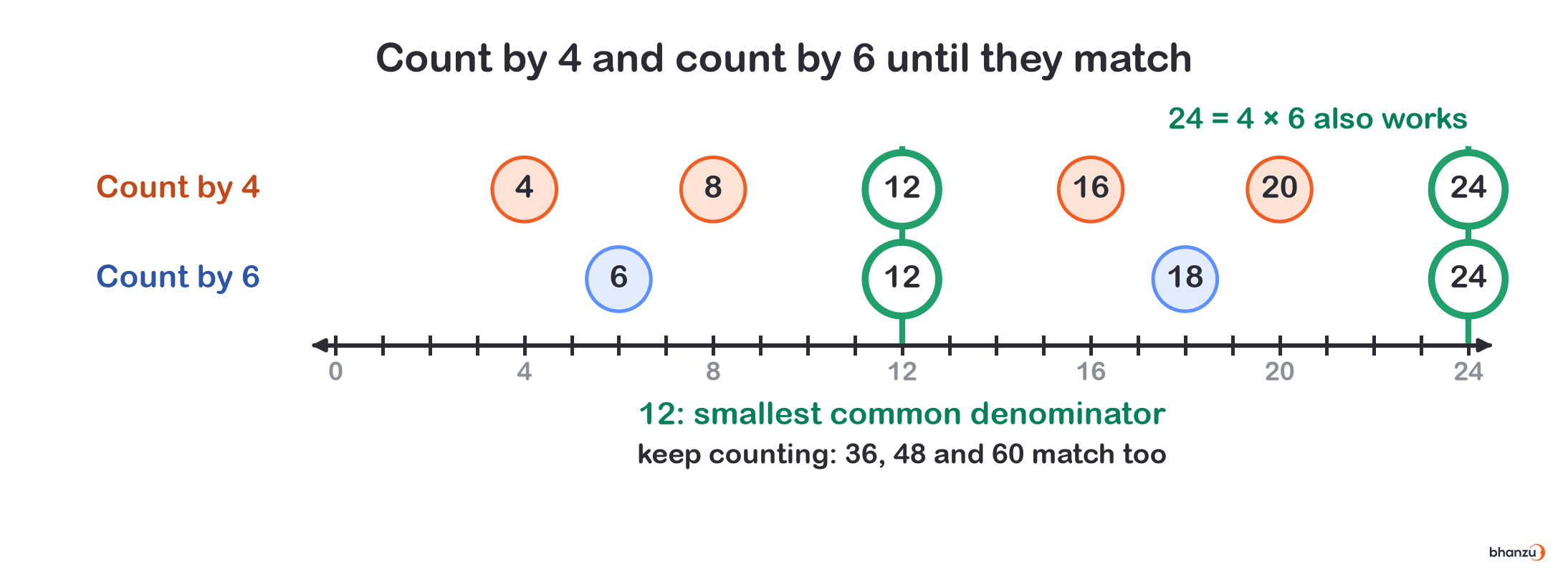
- If not, count by the bigger denominator and stop at the first number the smaller one divides into. For fourths and sixths, count 6, 12 and stop, because 12 divided by 4 is 3.
- Multiply the top and bottom of each fraction by the number that turns its old denominator into the new one.
Step 3 works because multiplying the top and bottom by the same number makes equivalent fractions, the same amount cut into more pieces. Here it is for the clock pair.
Multiplying the two denominators always works too (4 times 6 is 24), and the Institute of Education Sciences fractions guide asks teachers to explain why. That number grows fast, though. A child who multiplies every time cuts eighths and twelfths into 96 slivers when 24 already works, and later grades add a prime-factor method for when counting gets slow.
How do you find a common denominator for three fractions? Count by the biggest denominator until every other one divides in. For halves, thirds and eighths, count 8, 16, 24, and stop at 24.
Try It Yourself
Drag the slider under each fraction bar to cut every piece into smaller equal pieces, and watch the fraction's name change while its shaded length stays the same. When both bars use the same size pieces, the readout names the common denominator and the greater fraction. Press New pair for new fractions, or Reset to return to three-fourths and five-sixths.
Which common denominator should you pick?
Pick the smallest common denominator when you can find it fast, since smaller numbers are easier to multiply. Any common denominator still gives the right answer.
How can you tell if a number is a common denominator? Divide it by each denominator, and both answers must be whole. For 4 and 6, 18 divided by 6 is 3, but 18 divided by 4 leaves 2 over, so 18 fails.
| Denominators | Smallest common denominator | Multiply them |
|---|---|---|
| 2 and 3 | 6 | 6 |
| 3 and 4 | 12 | 12 |
| 3 and 6 | 6 | 18 |
| 4 and 6 | 12 | 24 |
| 5 and 6 | 30 | 30 |
| 6 and 8 | 24 | 48 |
| 8 and 12 | 24 | 96 |
When no number bigger than 1 divides both denominators, as with 3 and 4, multiplying gives the smallest. When one does, as 2 divides 4 and 6, the smallest is less than the product. The smallest one is called the least common denominator. The names get confusing, because it is also the least common multiple of the denominators, a name you will meet in 6th grade.
The list never ends, since 12, 24, 36, 48 and 60 all work for 4 and 6. A child who worked in 24ths may see a classmate's 12ths and erase a correct answer. Both are right.
Examples of common denominators
Example 1
Rewrite and with a common denominator.
8 divided by 4 is 2, so 8 works.
The pair becomes 2 eighths and 5 eighths.
Example 2
Find the smallest common denominator for and , then rewrite both fractions.
Count by 10. The count goes 10, 20, and 20 divided by 4 is 5.
So 20 is the smallest common denominator. The product 40 also works, with bigger numbers.
Example 3
Mei says and are equal, because each is one piece short of a whole. Is she right?
The tempting move is to agree. One missing piece each sounds like the same amount missing, so the two fractions would be equal.
That cannot be right. A fifth is bigger than a sixth (the same whole cut into fewer parts), so four-fifths is missing more.
Count by 6 up to 30, because 30 divided by 5 is 6.
Five-sixths is greater, and Mei is not right.
Example 4
Which of 16, 20, 30 and 60 could be a common denominator for and ? Rewrite both fractions with the smallest that works.
16 and 20 fail, because 6 does not divide either one evenly. 30 works, since 30 divided by 6 is 5 and 30 divided by 10 is 3, and 60 works too.
Example 5
On field day, Leo ran mile, Priya ran mile and Sam ran mile on the same track. Who ran the farthest? List the distances from least to greatest.
Count by 8 until 2 and 3 both divide in, which happens at 24.
Sam ran the farthest. The comparison is fair because the same track makes every fraction part of the same whole.
Why do fractions need a common denominator?
A common denominator turns two fractions into counts of the same size of piece. Counts of one thing are easy to compare.
- It turns different pieces into one unit. Three quarters and 8 dimes are easy to compare in cents, 75 against 80, because cents are hundredths and 8 tenths equals 80 hundredths, the tenths and hundredths idea.
- It is the step before adding. In 5th grade, one-half plus one-third becomes 3 sixths plus 2 sixths, the move behind adding and subtracting fractions in word problems.
- It pays off for years. In a 2012 study of 3,677 British and 599 American children, Robert Siegler's team found that fraction knowledge around age 10 predicted high school algebra and math achievement, even after accounting for general thinking ability and family income.
Minutes are a common denominator already printed around every clock face, which is why the clock pair works so well.
What do most guides miss about common denominators?
The size of the common denominator never changes which fraction is greater, and a clock already gives one for most 4th grade fractions. A bigger common denominator only means bigger numbers to handle.
| Fraction | In twelfths | In twenty-fourths | In sixtieths (minutes) |
|---|---|---|---|
The clock adds a second surprise: 60 is the smallest number that 2, 3, 4, 5, 6, 10 and 12 all divide into, so minutes cover every 4th grade denominator except 8 and 100. Theon of Alexandria, writing in the fourth century, suggested the Sumerians counted in sixties because 60 is the smallest number that 1, 2, 3, 4 and 5 all divide into. Historians have offered other reasons since, and none has settled the question.
For parents, rewriting before judging is a habit worth building early, since on the 2004 NAEP, half of 8th graders could not order three fractions from least to greatest.
The mistakes kids make most often with common denominators
Mistake 1: Adding the denominators
Where it slips in: The very first move with unlike fractions such as and , because adding is what many children reach for when they see two numbers.
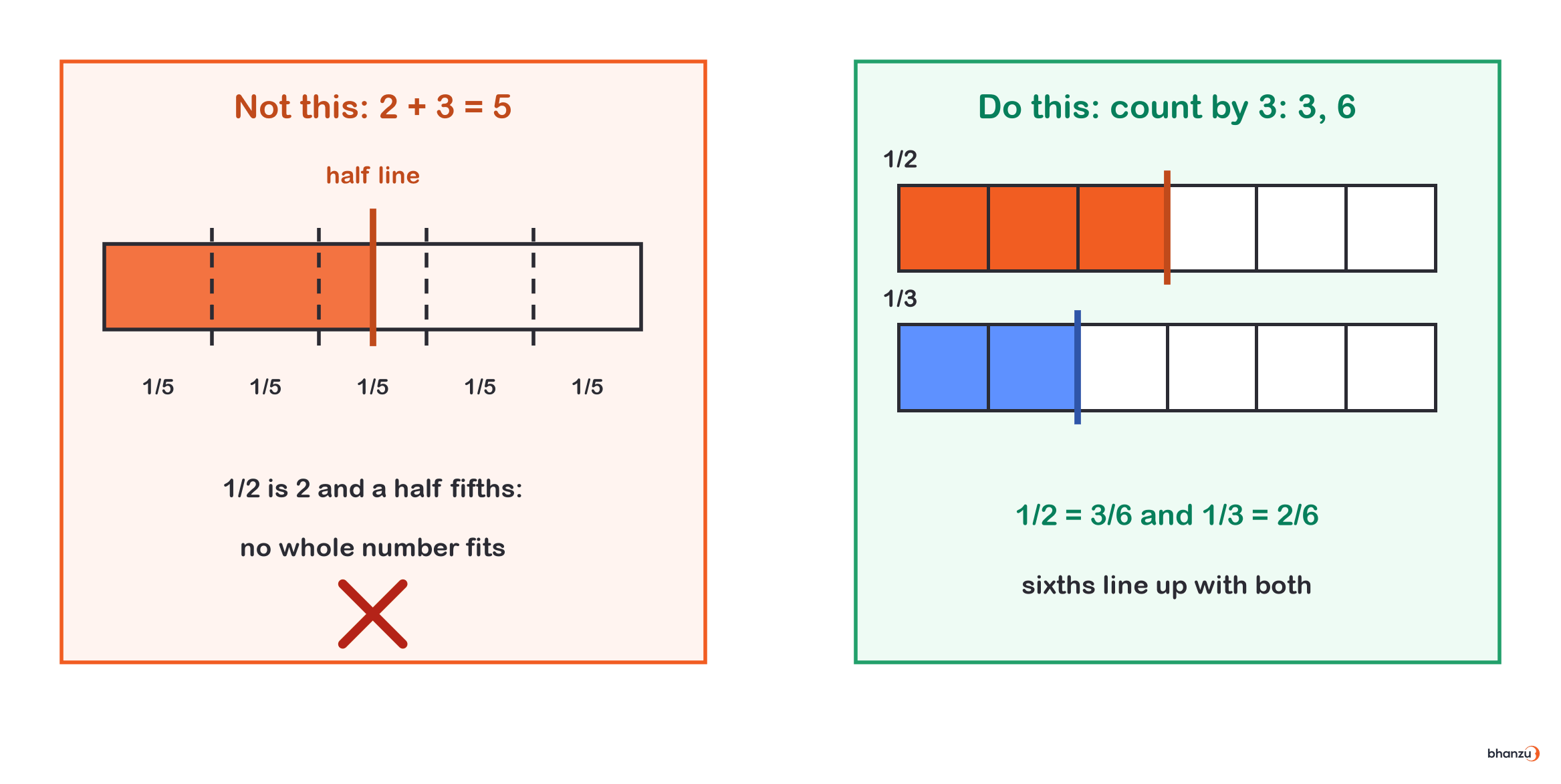
Don't do this: Add 2 and 3 to get 5, then try to write in fifths, where half of 5 is 2 and a half and no whole number fits.
The correct way: Count by 3 to 6. Then and . The sum of two different denominators always lands between the bigger one and its double, so the bigger denominator can never divide it.
Mistake 2: Using the bigger denominator when it does not fit both
Where it slips in: Pairs such as and , where 6 does not divide 8. Children who know their times facts well still grab 8, because the bigger denominator looks like it should be in charge.
Don't do this: Pick 8 and write as .
The correct way: 8 divided by 6 is not whole, so count on to 24, which 6 divides 4 times. Then and .
Mistake 3: Writing new bottoms but keeping old tops
Where it slips in: The rewriting step, such as using 15 for and . A child in a hurry writes the new bottom number on both fractions and rushes on to comparing.
Don't do this: Write and , then decide is greater.
The correct way: Multiply each top by the same number as its bottom, so and , and is greater.
Key Takeaways
- Before calling a number a common denominator, divide it by both denominators and check that both answers are whole.
- Count by the bigger denominator first, and keep multiplying the denominators as a backup that always works.
- Whatever you multiply a bottom number by, multiply its top number by the same amount.
- Twelfths, twenty-fourths and sixtieths pick the same winner, so a bigger common denominator only adds work.
- To keep building common denominators with a teacher who catches the add-the-denominators mistake early, explore Bhanzu's 4th grade math curriculum or math programs for kids.
Read More
- Equivalent Fractions with Models
- Comparing Fractions with the Same Numerator or Denominator
- Comparing Fractions of Different Wholes
- Decomposing Fractions
- Why Are Fractions So Hard
Research Behind This Article
- Common Core State Standards Initiative, Grade 4, Number and Operations: Fractions (2010). thecorestandards.org
- National Center for Education Statistics, NAEP Mathematics: National Trends and Student Skills, 2024 (2025). nationsreportcard.gov
- OpenStax, Rice University, Prealgebra 2e, 4.5 Add and Subtract Fractions with Different Denominators (2020). openstax.org
- Institute of Education Sciences, Developing Effective Fractions Instruction for Kindergarten Through 8th Grade (2010). ies.ed.gov
- Siegler, Robert S. and others, Early Predictors of High School Mathematics Achievement (2012). eric.ed.gov
- O'Connor and Robertson, MacTutor, Babylonian Numerals (2000). mathshistory.st-andrews.ac.uk
Quick Quiz: Check Yourself
Three levels, new numbers every time: fill in a missing numerator, find (and use) the smallest common denominator, then use a common denominator to pick the greater fraction or the longest run.
Was this article helpful?
Your feedback helps us write better content
Frequently Asked Questions
Is the least common denominator the same as the least common multiple?
Are there common denominators for decimals?
How do I teach finding common denominators at home?
What grade do kids learn common denominators?
What if one of the denominators is a 1?