Key Points
- Estimating products and quotients means changing hard numbers to nearby friendly ones, like to , so one basic fact gives a close answer.
- A product estimate rounds each factor with two or more digits and keeps a one-digit factor, while a quotient estimate keeps the divisor and swaps the dividend for a compatible number.
- Rounding both factors up makes a product estimate too high, and only 23% of fourth graders correctly chose when an estimate should land high or low on a 2024 national question.
The pizza order you can check in your head
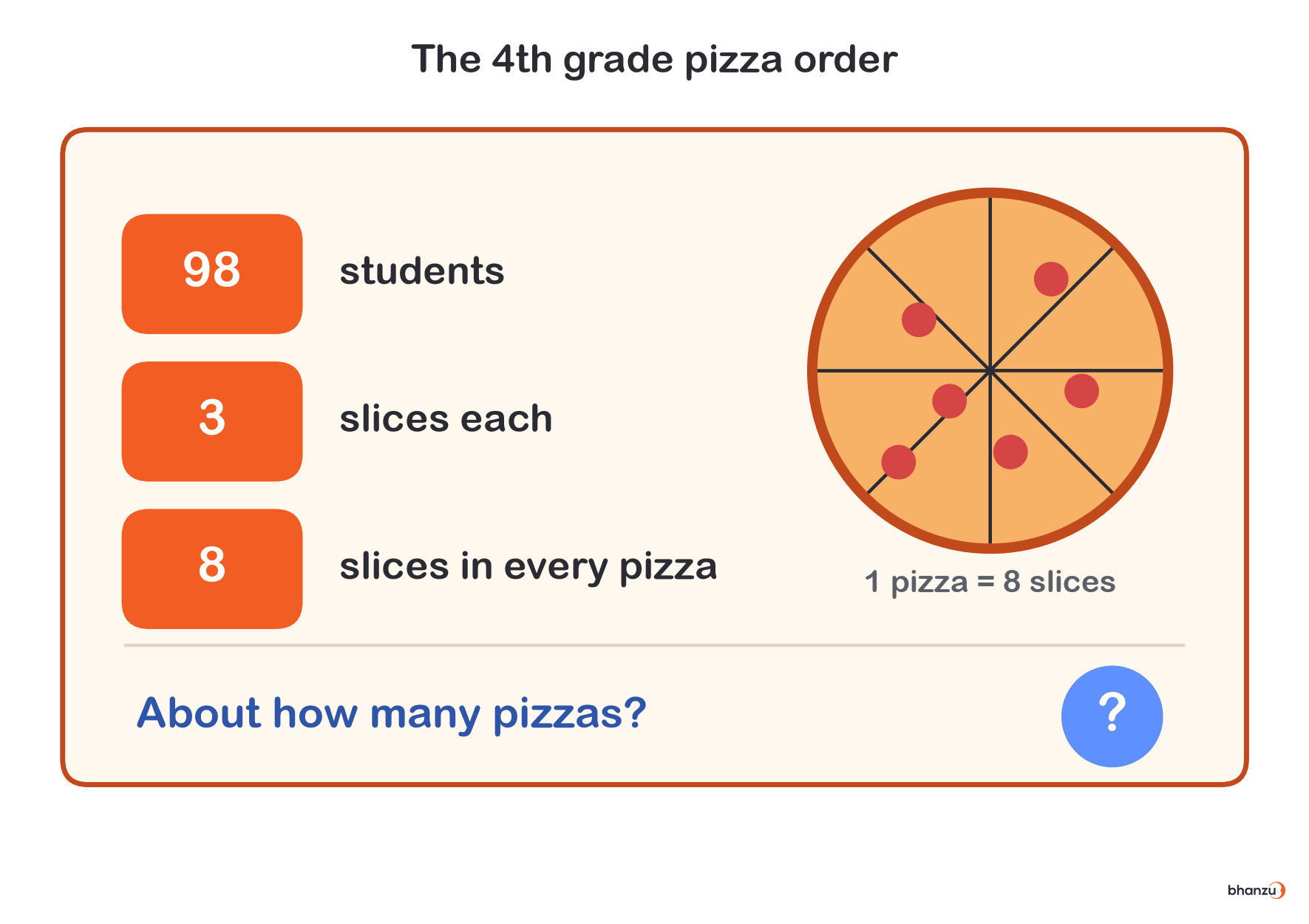
The 4th grade is having a pizza party for 98 students, with 3 slices each. Every pizza is cut into 8 slices, and the order goes in before lunch.
Nobody needs the exact count yet. A quick estimate already tells you whether the order is closer to 40 pizzas or 400, and the same friendly-number moves will help you estimate with decimals in 5th grade.
What is estimating products and quotients?
Estimating products and quotients means finding a close answer to a multiplication (its product) or a division (its quotient) by first swapping in nearby friendly numbers. On a number line, 38 sits 2 steps from 40 and 8 steps from 30. So 40 is the friendly choice for .
The wavy sign means "is about". The estimate uses a basic fact, a single-digit times fact like , plus one zero. An exact answer is reasonable when it lands near its estimate, as does here. Common Core standard 4.OA.A.3 asks 4th graders to "assess the reasonableness of answers" with estimation.
This year your child multiplies up to 4 digits by 1 digit or 2 digits by 2 digits, and divides up to 4 digits by 1 digit (standards 4.NBT.B.5 and 4.NBT.B.6). In 3rd grade your child estimated sums and differences, so the friendly-number idea is familiar. If your child reaches for the exact answer when asked to estimate, that habit is common. In a 2018 study of 26 fourth graders in Turkey, most leaned on exact calculation, and those children often took longer and got less realistic results.
How do you estimate a product?
To estimate a product, round each factor, or number being multiplied, that has two or more digits to its greatest place, the place of its first digit. A one-digit factor stays as it is.
- Round each big factor, the same move as rounding multi-digit numbers. becomes and becomes .
- Multiply the front digits as a basic fact. .
- Write the two zeros from the rounded factors after the , the pattern behind multiplying by 10, 100 and 1,000.
- Compare with the exact product, , once you have it.
Two other methods exist. Front-end estimation keeps the first digit and turns the rest into zeros, so it never lands high. Compatible numbers work for products too, like for .
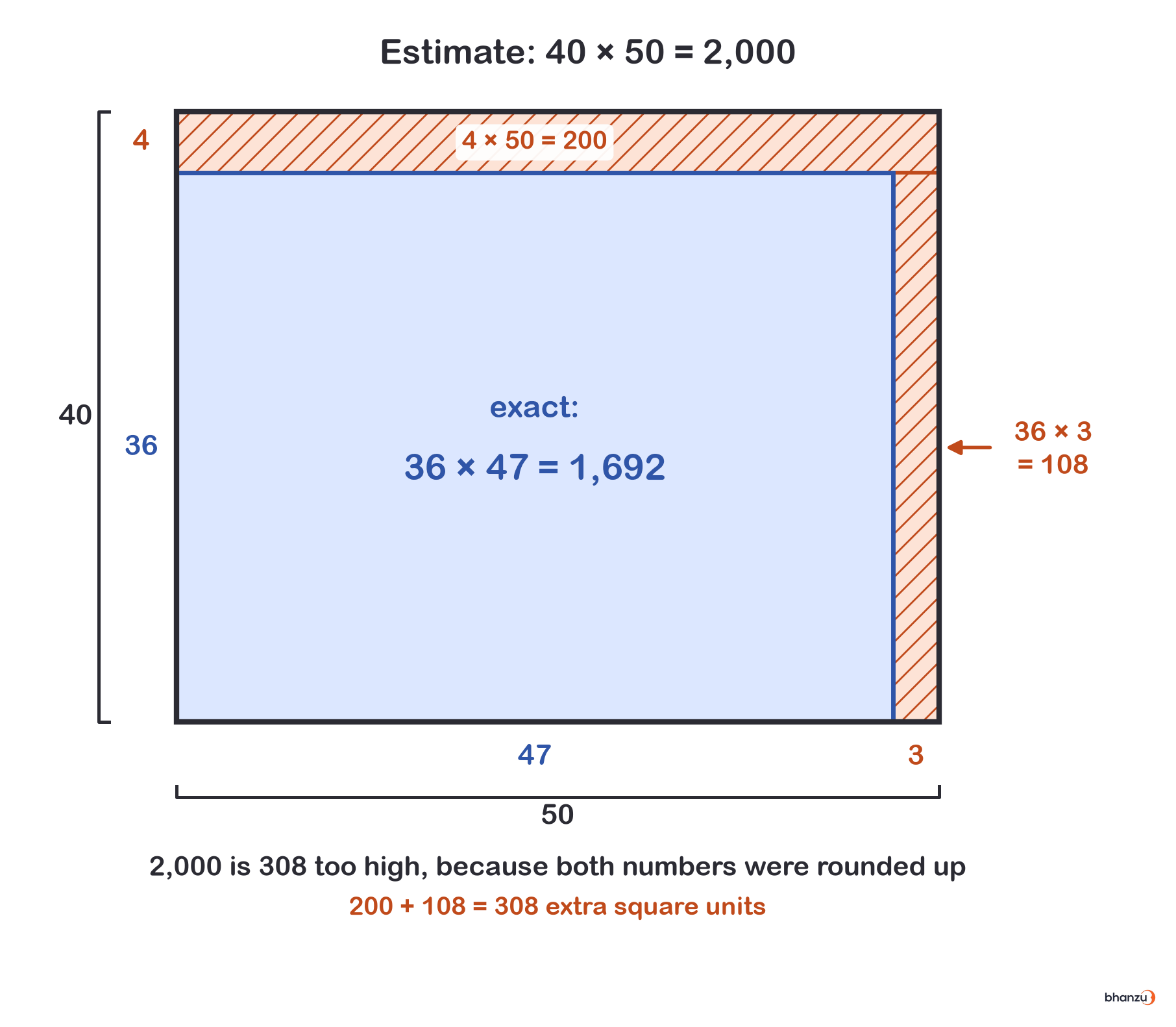
A 5 in the next place rounds up, so becomes (some books send halves to the even number). Rounding gets rough when both factors jump up a lot. For , the estimate overshoots the exact , so round just one factor when you need to land closer.
How do you estimate quotients using compatible numbers?
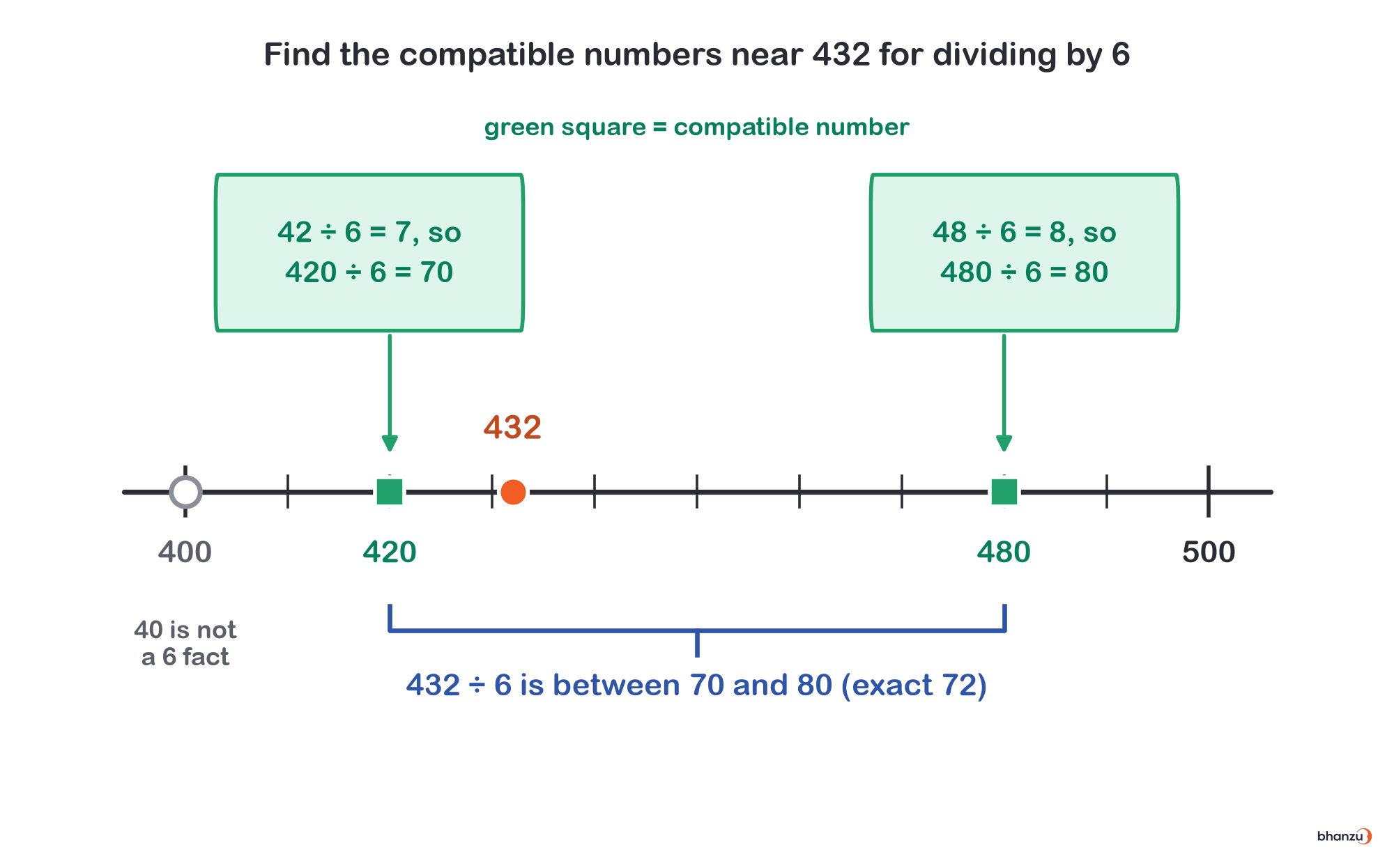
To estimate a quotient, keep the divisor, the number you divide by, and change the dividend, the number being divided, to a nearby number the divisor's facts know. Those are compatible numbers, numbers that work together in a basic fact, like and in . People also call them friendly numbers.
- Keep the divisor, .
- Find the 6 facts near , the front of . They are and .
- Use the closer one, , and put the zero back to get .
- Divide with the fact, the move behind dividing multiples of 10, 100 and 1,000.
Which works better for division, compatible numbers or rounding?
Compatible numbers usually do. Rounding to the nearest hundred gives , still hard because is not a 6 fact. Burzynski and Ellis make the same point in their open math textbook: when you estimate, convenience can beat the usual rounding rules.
The compatible numbers on either side fence the answer in, so sits between and , and it is exactly . Both are fair estimates, which feels odd after years of one right answer. A child who keeps erasing because it isn't is treating the estimate like the exact answer.
An estimate also skips any remainder, and it shows the size of the answer before long division begins.
Is your estimate too high or too low?
An estimate is too high, an overestimate, when you made the numbers bigger. It is too low, an underestimate, when you made them smaller.
| What you changed | The estimate lands | Example |
|---|---|---|
| Both factors up | Too high | for |
| Both factors down | Too low | for |
| Dividend up | Too high | for |
| Dividend down | Too low | for |
An area model shows the extra. Rounding up to adds strips of and , so the estimate is too high.
Division has one twist: a bigger divisor gives a smaller quotient, because the same amount is shared among more groups. You'll lean on that in 5th grade.
A story that needs enough seats, slices or juice boxes calls for an estimate that lands high. Picking the direction is harder than it looks. On the 2024 national math assessment, fourth graders decided whether three school situations called for an overestimate or an underestimate, and only 23% answered correctly.
| Words in the problem | Math it means |
|---|---|
| about how many | estimate first |
| 3 slices each, for 98 students | multiply, |
| so everyone gets a slice | land high |
| is the answer reasonable? | compare with an estimate |
Try It Yourself
Choose Multiply or Divide, then drag the marker along the number line, or press the arrow keys, to pick a friendly number. In Divide mode, compatible numbers turn green and show their basic fact. Press Show exact to see whether your estimate landed high or low, and by how much.
Examples of estimating products and quotients
Example 1
Estimate .
Round to and keep the .
The exact product, , is a little lower, because went up.
Example 2
Estimate .
The tempting move rounds both numbers, to and to .
That cannot be right. Since is less than , and , the real product is under . Keep the one-digit factor and round only .
The exact product is .
Example 3
Estimate .
Keep the . The front of is , a 7 fact, so use .
The exact answer is 501 R5.
Example 4
Estimate . Is the estimate too high or too low?
Both factors went down, so the estimate is too low. The exact product is .
Example 5
Diego worked out the cost of 8 tickets at $63 each and got $5,004. Is his answer reasonable?
Each ticket is about $60.
$$$60 \times 8 = $480$$
The claimed $5,004 is more than 10 times the estimate, so it is not reasonable. The exact cost is $504, so an extra zero slipped in.
Example 6
The 4th grade has 98 students, and each gets 3 pizza slices. Every pizza has 8 slices. About how many pizzas should the school order so everyone gets their slices?
Round to .
Next, is not a basic fact. The 8 facts near give and , and everyone needs their slices, so take the higher one.
Order about 40 pizzas. The exact need is 294 slices, and 40 pizzas hold 320, enough for everyone.
Why does estimating products and quotients matter?
Estimating gives you a check you can do in your head. A multiplication or division can slip by a whole place value, and friendly numbers catch that in seconds.
- It catches a slipped zero. An answer of for is more than 10 times the estimate , and the real product is .
- It answers "is there enough?" fast. A class of 27 needing 4 markers each uses about markers, so 12 boxes of 10 cover it.
- It tells you which way you are off, so you know whether the exact answer should be bigger or smaller.
An estimate tells you when to trust an exact answer, which is why 4th grade asks for both.
Estimating products and quotients: where intuition breaks
Mistake 1: Rounding the dividend to the nearest hundred
Where it slips in: Estimating a quotient such as . Rounding to the nearest hundred made sums easy in 3rd grade, so children often carry that habit into division.
Don't do this: Rounding to , then trying , which is still hard because is not a 4 fact.
The correct way: Use , because . Then , close to the exact 579 R1.
Mistake 2: Writing the wrong number of zeros
Where it slips in: Estimating as . When the basic fact ends in zero, children often write the three zeros they can see and lose the fact's own zero.
Don't do this: Turning into .
The correct way: Write the whole fact, , then the three zeros, to get . The exact product is .
Mistake 3: Rounding down when everyone needs a seat
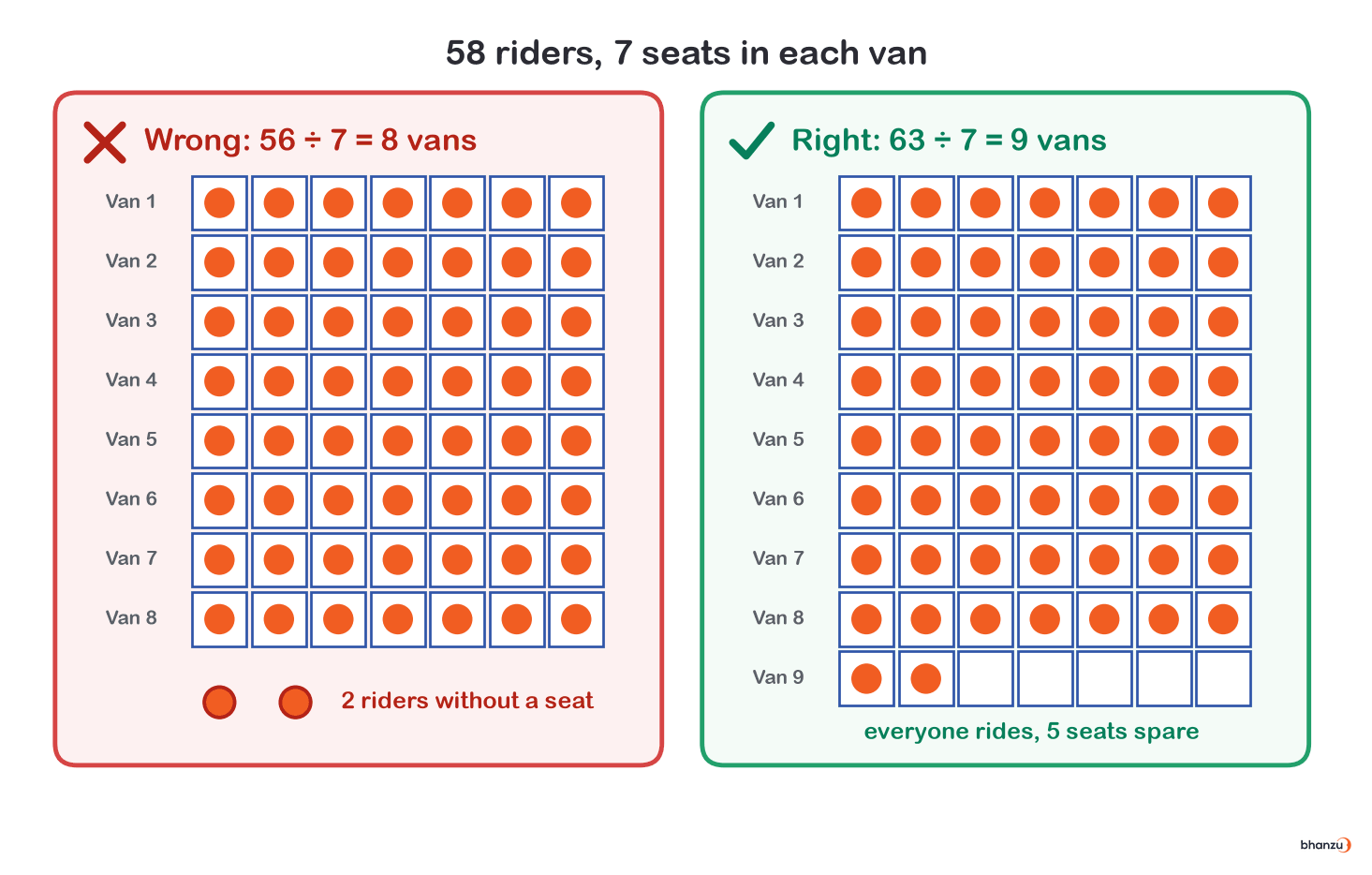
Where it slips in: A story that needs enough, like 58 people riding in vans that hold 7 each. A child who rushes grabs the closest compatible number, , without asking whether everyone fits.
Don't do this: Ordering vans, which leaves 2 people without a seat.
The correct way: Land high. vans seat all 58 people, since is 8 R2.
The pattern hiding inside estimating products and quotients
Many wrong answers in multiplication and division sit far from any estimate, because they come from a lost place value or the wrong operation. Spotting that gap takes seconds of mental math. Released questions from the Nation's Report Card show it.
| National question for 4th graders | Wrong answer many chose | Quick estimate | Verdict |
|---|---|---|---|
| (2011) | 518 (17%) and 90 (11%) | Far too small | |
| (2009) | 135 R1 (16%) | Too big |
Only 52% chose the right product, 1,184, and 59% chose the right quotient, 95 R1. The 15% who chose 1,164 sit near the estimate, so only exact work catches that slip.
Two compatible numbers also make a fence. In 2017, a national question shared $600 to $900 equally among 3 clubs, and only 12% picked exactly the two right choices, $225 and $295. Two quick divisions settle it.
Every possible share sits between $200 and $300.
Key Takeaways
- When you estimate a product, leave a one-digit factor alone and round the factors with two or more digits.
- For division, pick a dividend the divisor's facts already know, even when it isn't the nearest hundred.
- When a story needs enough for everyone, choose the estimate that lands high.
- For more practice estimating products and quotients with a teacher who catches an awkward , explore Bhanzu's 4th grade math tutor or Common Core math curriculum.
Read More
- Multiplying Up to 4-Digit Numbers by 1-Digit Numbers
- Multi-Step Word Problems With Whole Numbers
- Estimating Multi-Digit Products and Quotients
- Rounding to the Nearest 10 or 100
- Dividend, Divisor, Quotient and Remainder Formula
Research Behind This Article
- Common Core State Standards Initiative, Grade 4: Operations and Algebraic Thinking (2010). thecorestandards.org
- Common Core State Standards Initiative, Grade 4: Number and Operations in Base Ten (2010). thecorestandards.org
- Mustafa Ulu and Kemal Ozdemir, Determining the Mental Estimation Strategies Used by Fourth-Grade Elementary Students in Four Basic Mathematical Operations (2018). eric.ed.gov
- Denny Burzynski and Wade Ellis, Jr., LibreTexts, 10.4: Estimation by Rounding (2023). math.libretexts.org
- National Center for Education Statistics, NAEP Questions Tool: Grade 4 Mathematics, questions 2024-4M13 #7, 2017-4M1 #13, 2011-4M12 #6 and 2009-4M10 #12 (2024). nationsreportcard.gov
Quick Quiz: Check Yourself
Three levels, new numbers every time: estimate a product by rounding, estimate a quotient or a 2-digit by 2-digit product, then solve a word problem or judge whether an answer is reasonable.
Was this article helpful?
Your feedback helps us write better content
Frequently Asked Questions
Is rounding and estimating the same thing?
What should a 4th grader know about estimating products and quotients?
Can you estimate quotients with 2-digit divisors?
How do you solve 4th grade estimation word problems?
How can I help my child practice estimating at home?