Key Points
- Comparing multi-digit numbers works in a place value chart, read from the largest place on the left until one place holds different digits.
- One unit in a place outweighs everything the places to its right can hold, so 589,999 is still 1 less than 590,000.
- A number written in words needs a zero in every empty place before comparing, so four hundred six thousand, fifty becomes 406,050.
Three cities that all start with 9
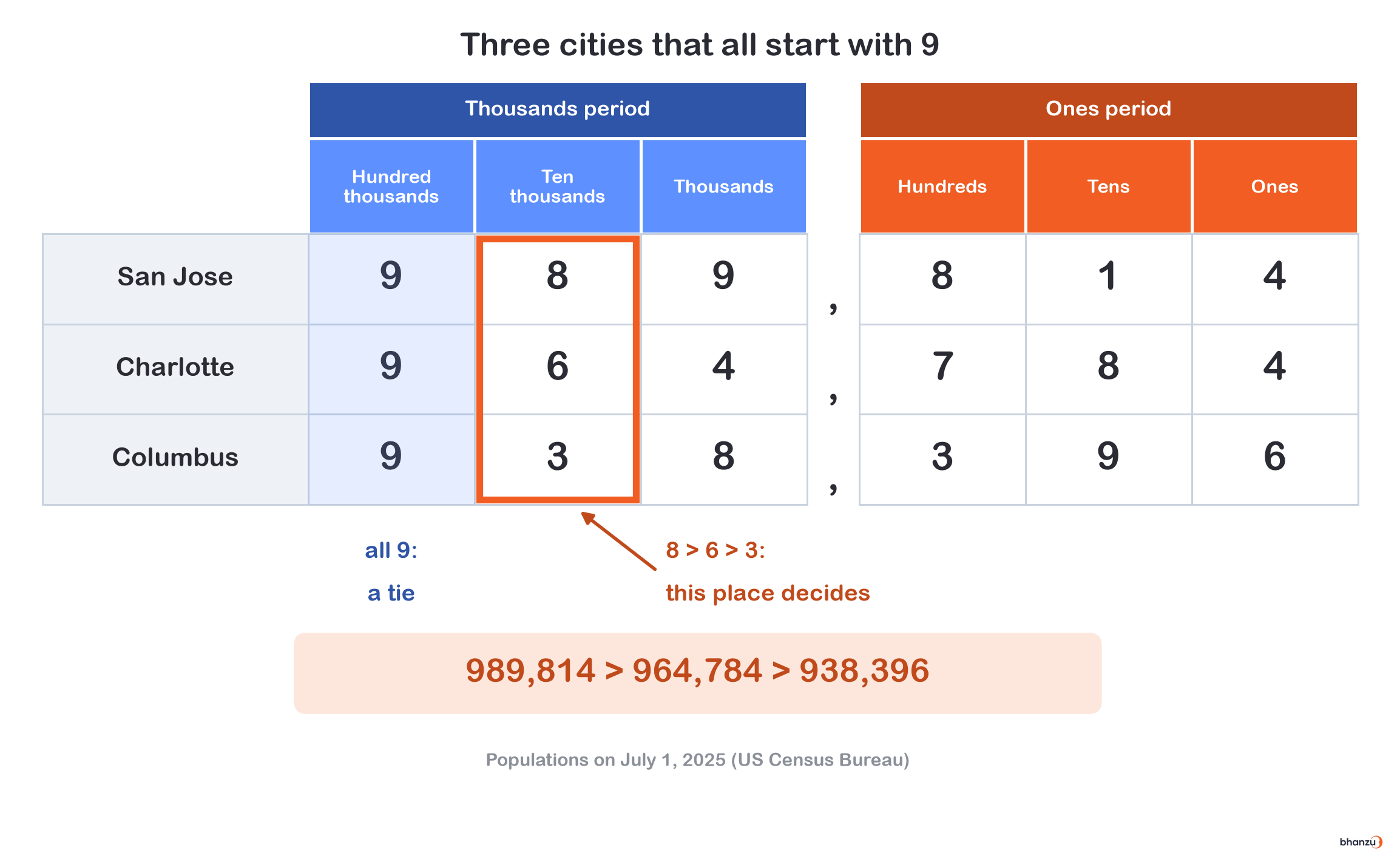
Three big US cities have populations that all start with the digit 9. On July 1, 2025, San Jose, California, had 989,814 people, Charlotte, North Carolina, had 964,784 and Columbus, Ohio, had 938,396, according to US Census Bureau estimates. The first digit can't pick the biggest city.
Ranking them looks hard, and you can settle it in a minute. Later this year, the same left-to-right look helps you round big numbers and check large sums.
How do you compare multi-digit numbers?
Comparing multi-digit numbers means lining them up in a place value chart, a table with one column for each place, and reading from the left to the first place where the digits do not match. The bigger digit at that place marks the greater number. Multi-digit numbers are whole numbers with two or more digits.
Place value is what a digit is worth because of where it sits, so in 938,396 the first 9 is worth 900,000 and the second is worth 90. Places come in groups of three called periods, split by commas. Base-ten blocks can't stretch to numbers this big (964,784 would need 964 thousand-cubes), so the chart does the work.
- Count the digits. With whole numbers, more digits means greater, because a shorter number has a 0 in every place left of its first digit. So 87,450 is less than 100,000.
- If the counts match, line the numbers up by place from the right.
- Compare the digits in the greatest place.
- If they match, move one place to the right.
- Stop at the first place that differs. If every place matches, the numbers are equal.
San Jose, Charlotte and Columbus tie at 9 hundred thousands and split at the ten thousands (8, 6 and 3), so the Census Bureau's Vintage 2025 estimates put San Jose first.
The sign means "is greater than" and means "is less than", and the open side faces the greater number, so one fact can be written both ways.
Common Core standard 4.NBT.A.2 expects your child, in 4th grade, to read and write numbers up to 1,000,000 in digits, words and expanded form and to compare two of them with these signs.
Why does the first different digit decide?
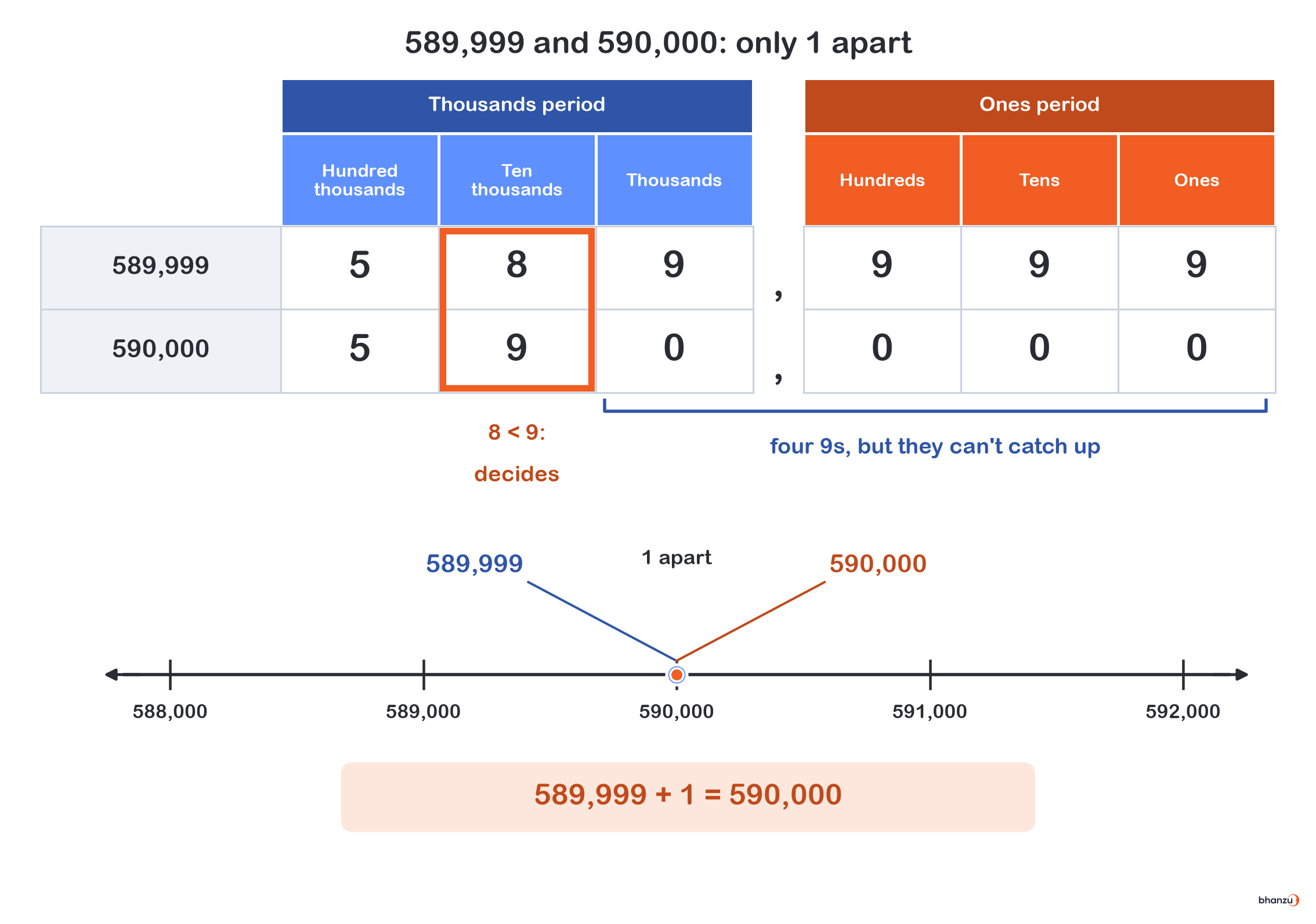
The numbers 589,999 and 590,000 are just 1 apart, yet the one full of 9s is smaller. The ten thousands settle it, 8 against 9.
Each place is worth 10 times the place to its right, so one extra ten thousand outweighs anything the four places to its right can hold, even four 9s.
Should you start from the ones place or the greatest place? Start at the greatest, because a big digit near the ones end can point the wrong way.
The move is the same one you used for comparing three-digit numbers, stretched across two periods. A child who has found the deciding place often goes back to check the ones "to be sure" (harmless, unless a bigger digit there talks them out of a right answer).
Try It Yourself
Tap the arrows on any digit to build two numbers, choose A is greater, B is greater or Same, and press Check. The chart lights up one place at a time from the left, stops at the first place that differs and shows the sign. Watch the A and B markers on the number line jump far apart when you change an early place.
How do you compare numbers written in different forms?
Rewrite both numbers in standard form, the usual digits, then compare place by place. Word form spells a number out (the standard calls it number names), and expanded form adds up each digit's value. Standard, word and expanded form name the same amount, so switching forms can't change the answer.
Word form hides its zeros. OpenStax's Prealgebra 2e textbook brings them back by giving every period after the first exactly three places.
- Find the word "thousand", which ends the thousands period.
- Draw three boxes for each period.
- Write the digits you hear in their boxes.
- Put a 0 in every empty box after the first digit.
Five hundred twenty thousand, nine becomes 520,009, and the expanded form becomes 502,900. They split at the ten thousands, 2 against 0.
| Standard form | Word form | Expanded form |
|---|---|---|
| 520,009 | five hundred twenty thousand, nine | |
| 502,900 | five hundred two thousand, nine hundred |
How do you order multi-digit numbers?
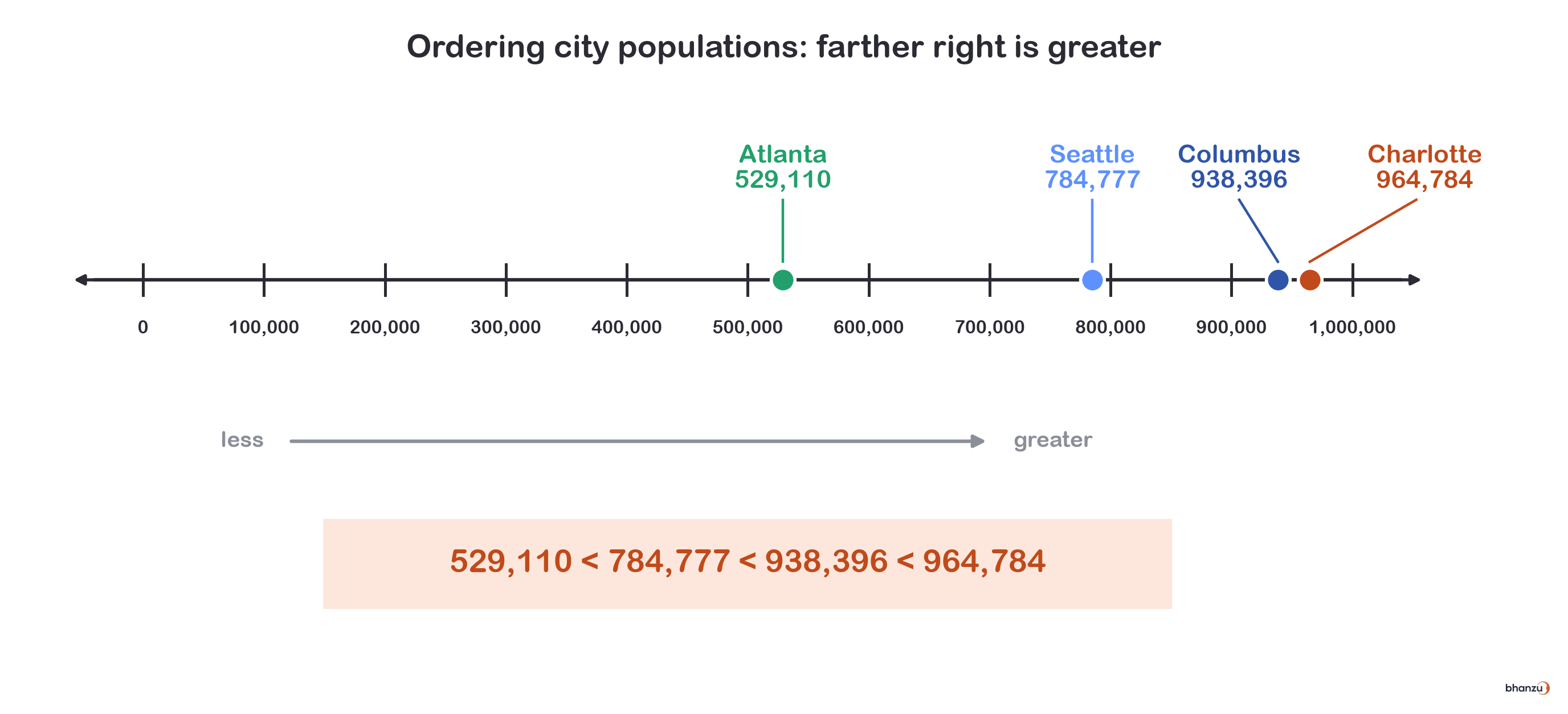
Ordering multi-digit numbers repeats the pair comparison until every number has a spot. Least to greatest puts the smallest first, greatest to least puts the largest first, and on a number line the greater numbers sit farther right.
- Group the numbers by how many digits they have, fewer digits first.
- Inside a group, sort by the greatest place.
- Break any tie by moving one place to the right.
- For greatest to least, read the list backward.
Census estimates list Seattle at 784,777, Columbus at 938,396, Atlanta at 529,110 and Charlotte at 964,784. The hundred thousands put Atlanta (5) first and Seattle (7) second. Columbus and Charlotte tie at 9, so the ten thousands, 3 against 6, decide.
Is there a quick way to put numbers in order? Pick out the least, cross it off and repeat, so four numbers take three rounds.
Examples of comparing multi-digit numbers
Example 1
Compare 52,318 and 47,906 using , or .
Both have 5 digits. At the ten thousands, 5 beats 4.
Example 2
On July 1, 2025, Celina, Texas, had 64,427 people and Fulshear, Texas, had 64,630. Which city had more people? Write the comparison two ways.
The ten thousands (6 and 6) and the thousands (4 and 4) match. At the hundreds, 6 beats 4.
Fulshear had more people.
Example 3
NASA lists Earth as 7,926 miles wide and the Moon as an average of 238,855 miles away. Which number is greater?
The tempting move compares first digits. The 7 beats the 2, so 7,926 looks greater. That can't be right, because NASA's Earth facts say 30 Earth-sized planets could fit between Earth and the Moon, so the distance must be far more than one Earth width.
The first digits were never in the same place, since 7,926 has 4 digits and 238,855 has 6. In a place value chart, 7,926 has 0 hundred thousands and 238,855 has 2.
Example 4
Which is greater, three hundred six thousand, forty, or ?
With three boxes in the ones period, the words give 306,040. The expanded form adds to 360,400.
Both have 3 hundred thousands, and then the ten thousands are 0 and 6.
The expanded form is greater.
Example 5
Put , , and in order from greatest to least.
The 5-digit number 45,920 goes last.
The other three share 4 hundred thousands and 0 ten thousands. At the thousands, the 9 in 409,250 makes it the greatest, and 405,920 and 405,290 split at the hundreds, 9 against 2.
Example 6
Maya's class walked seven hundred eighty-four thousand, seven hundred seventy steps this month. Leo's class walked 784,777 steps, and Aisha's class walked . Which class walked the most, and what is the order from least to greatest?
In standard form the totals are 784,770, 784,777 and 784,900.
All three match through the thousands. At the hundreds, Aisha's 9 beats the two 7s, so her class walked the most, and Maya's and Leo's totals split at the ones, 0 against 7.
The order is Maya's class, Leo's class, then Aisha's class.
Comparing multi-digit numbers beyond the textbook
Comparing by place tells you which amount is bigger in seconds. Counting to 964,784 at one number per second, with no breaks (not even for lunch), would take more than 11 days.
- It shows when a line is crossed. Austin, Texas, crossed into seven digits between 2024 and 2025 and had 1,002,632 people on July 1, 2025, Census estimates show.
- It catches slipped digits. Two 5-digit numbers add up to 199,998 at most, so a 7-digit sum means a mistake.
- It sets up rounding multi-digit numbers. Rounding 938,396 to the nearest hundred thousand starts with one comparison, against 950,000.
The next scoreboard or step counter that shows a big number can be sorted with the same left-to-right look.
The part of comparing multi-digit numbers nobody explains
The rule "more digits means greater" has a condition, and commas can count the digits for you.
The rule holds for whole numbers only. With decimals, later in 4th grade, 0.5 is greater than 0.45 even though 0.45 has more digits, and several popular guides still state the rule as "always".
A 2017 study by Abbey Loehr and Bethany Rittle-Johnson found that naming the places helps. Among 104 third and fourth graders, children taught to read 0.34 as "3 tenths and 4 hundredths", rather than "point three four", did better on problems that hinged on zero.
With whole numbers, each comma closes a period of three digits, so more commas means more digits and 1,002,632 beats 989,814 at a glance. The comma shortcut has one genuinely confusing gap. Some books print 4-digit numbers without a comma, so 7926 looks shorter than 1,200 even though 7926 is greater.
Comparing multi-digit numbers: where intuition breaks
Mistake 1: Letting a later place overrule an earlier one
Where it slips in: Pairs that tie at first and then point opposite ways, like 45,290 and 45,301.
Don't do this: Deciding that 9 tens beat 0 tens, so 45,290 is greater.
The correct way: The ten thousands and thousands match, and at the hundreds 3 beats 2, so and the tens never get a vote.
The 9 is the biggest digit in the pair, so it grabs attention from a small place.
Mistake 2: Dropping a zero when a number is written in words
Where it slips in: Comparing a number name with digits, such as four hundred six thousand, fifty and 46,500.
Don't do this: Writing the words as 40,650, then deciding 40,650 is less than 46,500.
The correct way: Give the ones period three boxes, 0, 5 and 0, to get 406,050, which has 6 digits, so .
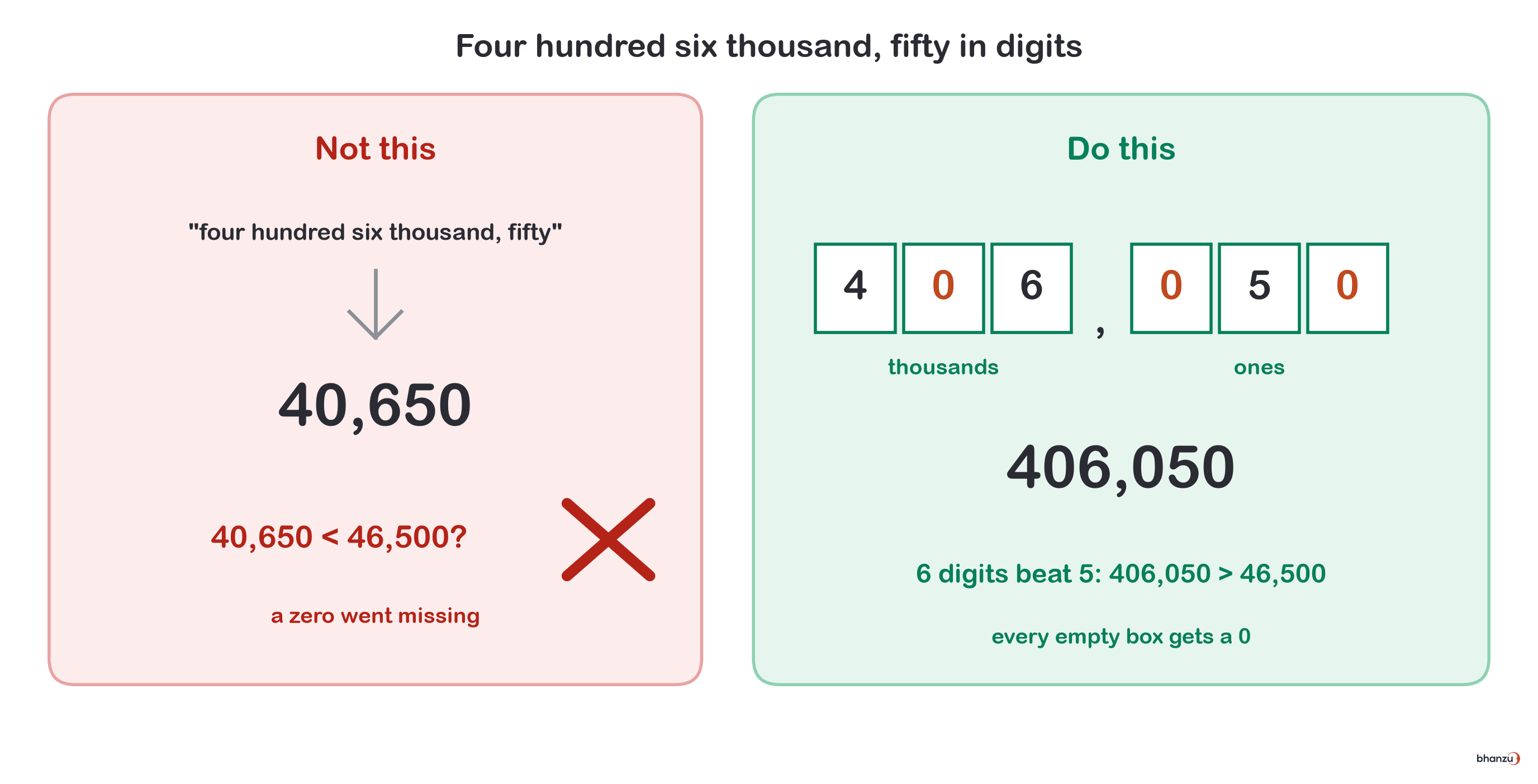
Children write the digits they hear, 406 and then 50, and no word says "zero hundreds" out loud. A child who writes as fast as the number is read never hears the missing zero.
Mistake 3: Writing the sign backward after a correct decision
Where it slips in: The last step, after a correct comparison of 964,784 and 938,396.
Don't do this: Deciding that 964,784 is greater, then writing .
The correct way: Say "964,784 is greater than 938,396" first, then write , with the point aiming at the smaller number.
The alligator-mouth picture doesn't settle it, because the mouth opens left in one problem and right in the next. A child who draws the sign before rereading the numbers leans on that picture alone.
Key Takeaways
- When comparing multi-digit numbers, stop at the first place that differs, since nothing to its right can change the answer.
- Count digits, or commas, first whenever both numbers are whole.
- Rewrite word and expanded form in digits first, with three places in every period after the first.
- Say "is greater than" or "is less than" out loud before drawing the sign.
- To keep comparing big numbers sharp with a teacher who catches a dropped zero in word form, explore Bhanzu's 4th grade math curriculum or math classes for kids.
Read More
- Regrouping Whole Numbers
- Multi-Digit Addition
- Comparing Decimals
- Comparing Two-Digit Numbers
- Comparing and Ordering Decimals
Research Behind This Article
- US Census Bureau, Largest Cities Faced Sharpest Declines in Population Growth (2026). census.gov
- Common Core State Standards Initiative, Grade 4 Number and Operations in Base Ten (2010). thecorestandards.org
- OpenStax, Prealgebra 2e, 1.1 Introduction to Whole Numbers (2020). openstax.org
- NASA Science, Earth: Facts (2025). science.nasa.gov
- Loehr and Rittle-Johnson, Putting the "th" in Tenths: Providing Place-Value Labels Helps Reveal the Structure of Our Base-10 Numeral System (2017). eric.ed.gov
Quick Quiz: Check Yourself
Three levels, new numbers every time: pick , or , then handle deep ties and numbers in words or expanded form, then find the greatest, least or second-smallest of four numbers.
Was this article helpful?
Your feedback helps us write better content
Frequently Asked Questions
What is the largest 6 digit number?
What is ascending and descending order for large numbers?
What is the greater than sign symbol called?
Is comparing multi-digit numbers taught in 4th grade?
How can I help my child with comparing large numbers at home?