Key Points
- Dividing multiples of 10, 100, and 1,000 by a one-digit number uses one basic fact plus place value, so 24 hundreds divided by 6 is 4 hundreds, or 400.
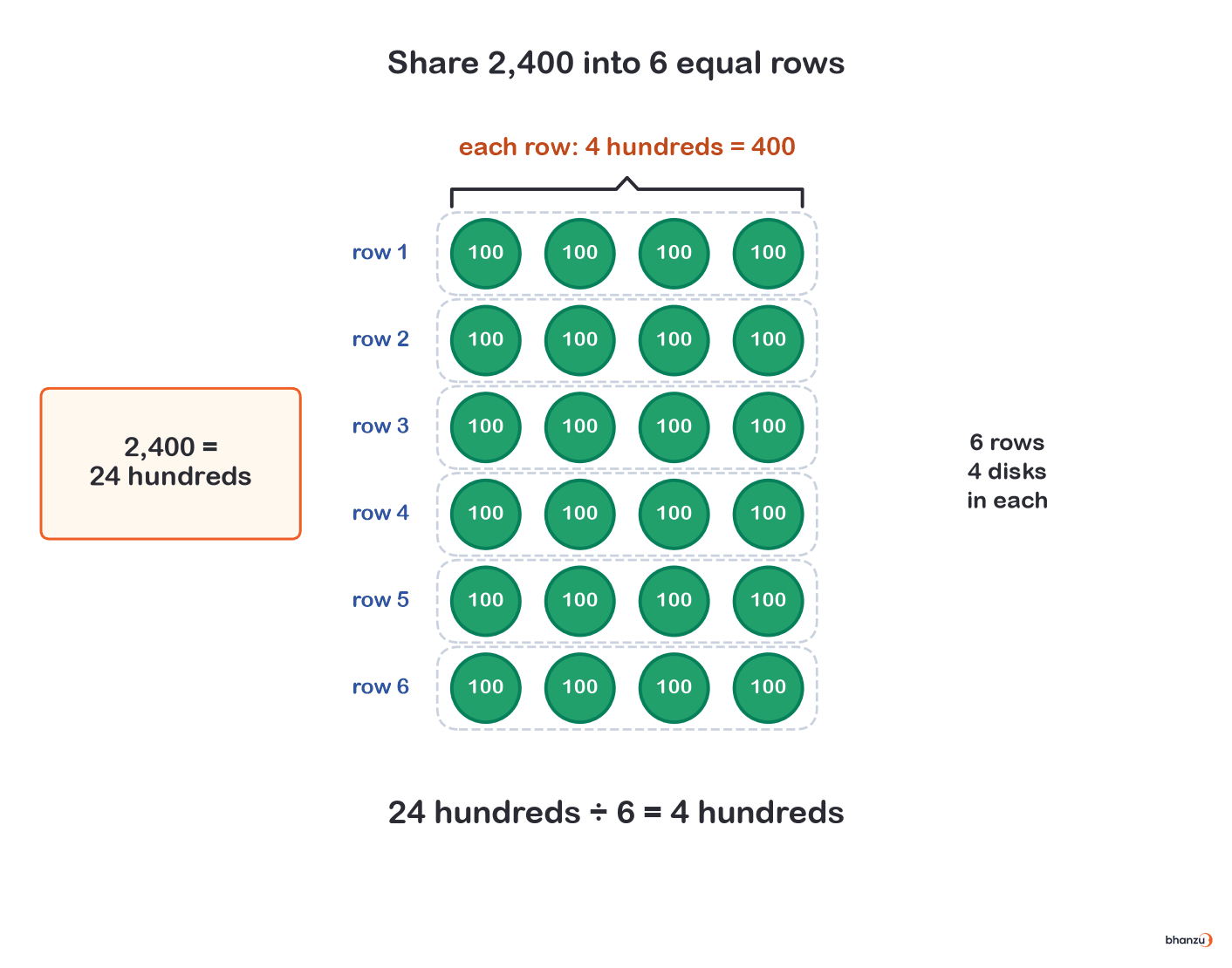
- Each place value disk keeps its value when shared, so 24 hundred-disks dealt into 6 equal rows leave 4 hundreds in every row.
- Counting zeros fails when the basic fact already ends in 0, as in 3,000 divided by 5, which is 30 hundreds divided by 5, or 600.
Two hundred nickels on one scale
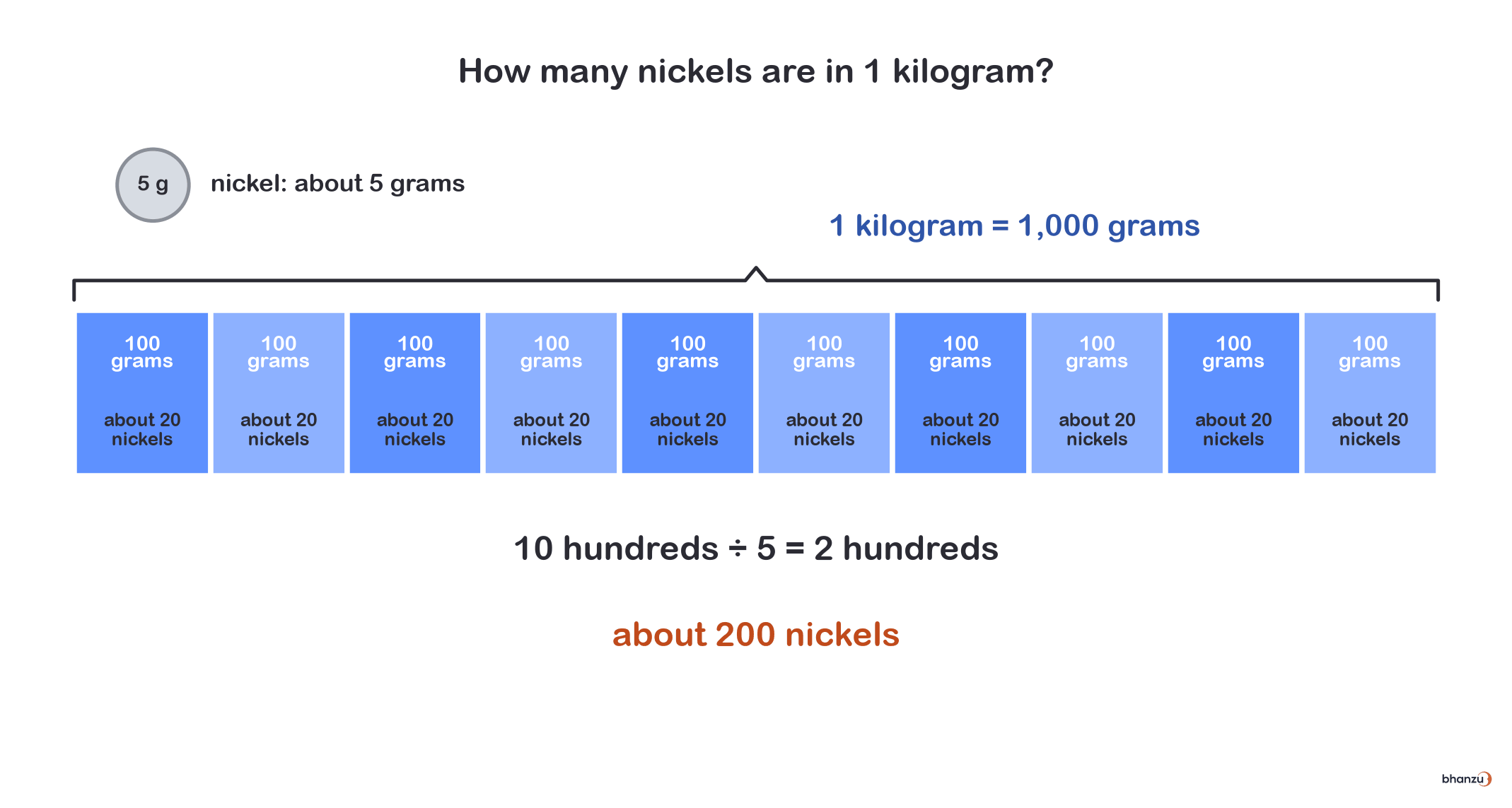
A pile of nickels that weighs one kilogram holds about 200 coins. Nobody has to count them one by one.
Each US nickel weighs about 5 grams, according to the National Institute of Standards and Technology (NIST), and one kilogram is 1,000 grams. So the count is 1,000 grams shared into groups of 5. The answer hides inside a fact you already know. Ten divided by 5 is 2, so 10 hundreds divided by 5 is 2 hundreds.
Later in 4th grade, the same move splits numbers like 2,436 into friendly parts, and in 5th grade it stretches to divisors like 30.
How do you divide multiples of 10, 100, and 1,000?
Dividing multiples of 10, 100, and 1,000 by a one-digit number takes two moves: divide a basic fact, then keep its place. The dividend, divisor and quotient are the number being divided, the number you divide by and the answer.
A multiple of 10 is any number you get by multiplying 10 by a whole number, such as 30 or 2,400. A basic division fact is one of the division facts within 100 from 3rd grade, like 24 divided by 6 is 4. Unit form writes a number as a count of one place, such as 24 hundreds for 2,400.
Place value disks show the idea. Make 2,400 from 24 disks marked 100 and deal them into 6 equal rows. Each row gets 4 disks, or 4 hundreds, and the rows form an array (equal rows with the same number in each).
- Read the dividend in a place that makes a basic fact (24 hundreds).
- Divide the fact ().
- Keep the place (4 hundreds, or 400).
- Check by multiplying the quotient by the divisor ().
| Dividend | Read it as | Divisor | Quotient |
|---|---|---|---|
| 80 | 8 tens | 4 | 2 tens, or 20 |
| 560 | 56 tens | 7 | 8 tens, or 80 |
| 9,000 | 9 thousands | 3 | 3 thousands, or 3,000 |
Common Core standard 4.NBT.B.6 covers quotients with up to four-digit dividends and one-digit divisors, using place value and its link to multiplication. By the end of 4th grade, your child is expected to choose a method and work out quotients like these mentally. The 2024 Nation's Report Card, which assessed 117,900 fourth graders, lists number properties and operations as one of its five math content areas.
Why does the place stay the same when you divide?
After 24 hundred-disks are shared into 6 rows, every disk is still worth 100 (a disk never turns into a 10 just because it moved). Dividing splits the count of units and leaves the size of each unit alone, so the quotient stays in hundreds.
Ten times the dividend gives ten times the quotient, because each place is worth ten times the place to its right. Solving all three with one fact is division using related facts.
How many hundreds are in 2,000? Twenty, because 10 hundreds make a thousand.
A child who reads 2,400 aloud as "two thousand four hundred" often stalls here, since 2 thousand-disks cannot be dealt into 6 equal rows. Saying "24 hundreds" makes the fact appear (same number, new name). Stacy Boote, writing in an NCTM journal in 2016, describes teaching this standard with base-ten pieces children bundle into tens themselves.
Choose the place that makes a basic fact
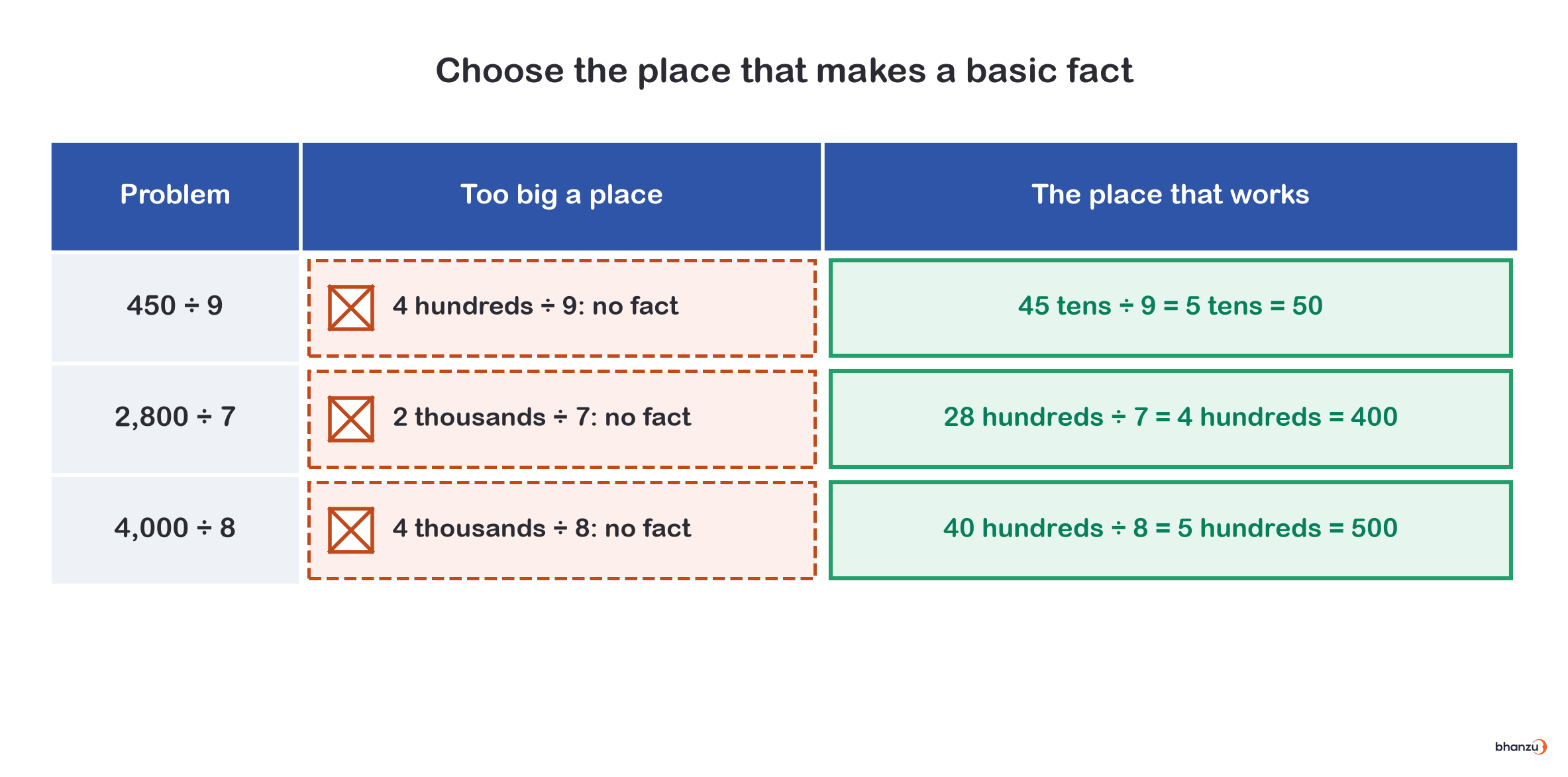
Read the dividend in the biggest place that leaves a basic fact with the divisor. If the first digit is smaller than the divisor, move one place right.
- 450 divided by 9. Four hundreds cannot fill 9 groups, so read 45 tens. The answer is 5 tens, or 50.
- 2,800 divided by 7. Two thousands are too few, so read 28 hundreds. The answer is 4 hundreds, or 400.
- 4,000 divided by 8. Four thousands are too few, so read 40 hundreds. The answer is 5 hundreds, or 500, with one zero fewer than 4,000.
How do you divide big numbers in your head? Say the place, the fact and the place again, as in "28 hundreds, 28 divided by 7 is 4, so 4 hundreds."
The shortcut stops when no basic fact fits. For 2,500 divided by 6, the 6s facts skip 25, so leaves 100 to share. Partial quotients handle that leftover, and later so does long division, whose standard method becomes the everyday tool by 6th grade.
Try It Yourself
Pick thousands, hundreds or tens, and the readout says whether that place makes a basic fact. If it does, press Share to deal the place value disks into equal rows and count one row for the answer. Press New problem for another, or Reset to start again.
Why does dividing multiples of 10, 100, and 1,000 matter?
Big round amounts get shared and spread over days all the time. This move turns each one into a fact you already know.
- It turns a week into days. The CDC says children ages 6 to 17 need at least 60 minutes of activity every day, and 300 minutes over a 5-day school week is 30 tens divided by 5, or 60 minutes a day.
- It counts coins by weight. A 1,500-gram bag of nickels holds about 300 coins, because 15 hundreds divided by 5 is 3 hundreds.
- It shares money fairly. $1,200 split among 4 class groups is 12 hundreds divided by 4, or $300 each.
- It sets up bigger division. 2,436 divided by 6 is 2,400 divided by 6 plus 36 divided by 6, or 406, and 400 alone is the close guess used when estimating products and quotients.
A fair share only feels fair when everyone can check it, and $4 \times $300 = $1{,}200$ shows the four shares rebuild the total.
Examples of dividing multiples of 10, 100, and 1,000
Example 1
What is ?
640 is 64 tens.
The answer is 8 tens, or 80.
Example 2
What is ?
The tempting move is to spot the fact and then tack on all three zeros from 3,000. That gives 6,000.
6,000 cannot be right. Dividing by 5 must make 3,000 smaller, and the multiplication check fails too.
The fact 30 divided by 5 already used one zero. Read 3,000 as 30 hundreds instead.
Check: .
Example 3
Find the missing number in .
The ? stands for the divisor. 4,200 is 42 hundreds and 700 is 7 hundreds, so 42 divided by the missing number is 7.
The missing number is 6. Check: .
Example 4
Which is greater, or ?
1,800 is 18 hundreds, and 4,500 is 45 hundreds.
The first quotient is greater, by 100.
Example 5
Mei and 3 friends share a 2-kilogram bag of nickels equally by weight. How many grams does each of the 4 children get, and about how many nickels is that?
2,000 is 20 hundreds, shared among 4 children.
Each child gets 5 hundreds, or 500 grams. A nickel weighs about 5 grams, and 5 hundreds divided by 5 is 1 hundred.
Each child gets 500 grams, which is about 100 nickels.
What do teachers watch for in division patterns with zeros?
Teachers watch for the moment "count the zeros" stops working. It stops when the basic fact has a zero of its own. With divisors and answers from 1 to 9, only 8 basic facts have a dividend ending in 0.
| 5 is the divisor | 5 is the answer |
|---|---|
Every one has a 5 as the divisor or the answer, so a 5 is your cue to check whether the fact ends in 0. When it does, the answer has one zero fewer than the dividend, so 1,000 divided by 5 is 200, with two zeros.
A 5 is a cue to look and never a rule by itself. 2,500 divided by 5 is 500 and keeps both zeros, because the fact 25 divided by 5 has no zero of its own.
The easy-to-make errors (and how to catch them)
Mistake 1: Stopping at the basic fact
Where it slips in: Word problems and mental work, such as 2,700 apples packed into 9 equal crates. A child who rushes sees 27 divided by 9 is 3 (the fact feels like the finish line) and writes 3.
Don't do this: , which puts only 27 apples in all 9 crates together.
The correct way: 27 hundreds divided by 9 is 3 hundreds, so each crate holds 300 apples.
Right after a page of plain facts, the first problem with hundreds often comes back as the bare fact. Saying "27 hundreds" aloud catches it.
Mistake 2: Crossing off a zero the divisor does not have
Where it slips in: After a glimpse of 5th grade work such as 2,400 divided by 60, where one zero comes off each number. A child who gets 800 for 3,200 divided by 4 may second-guess it as "too big" and cross off a zero.
Don't do this: Cross a zero off 3,200 only, so becomes .
The correct way: The divisor 4 has no zero to pair with, so 32 hundreds divided by 4 is 8 hundreds, or 800. Check: .
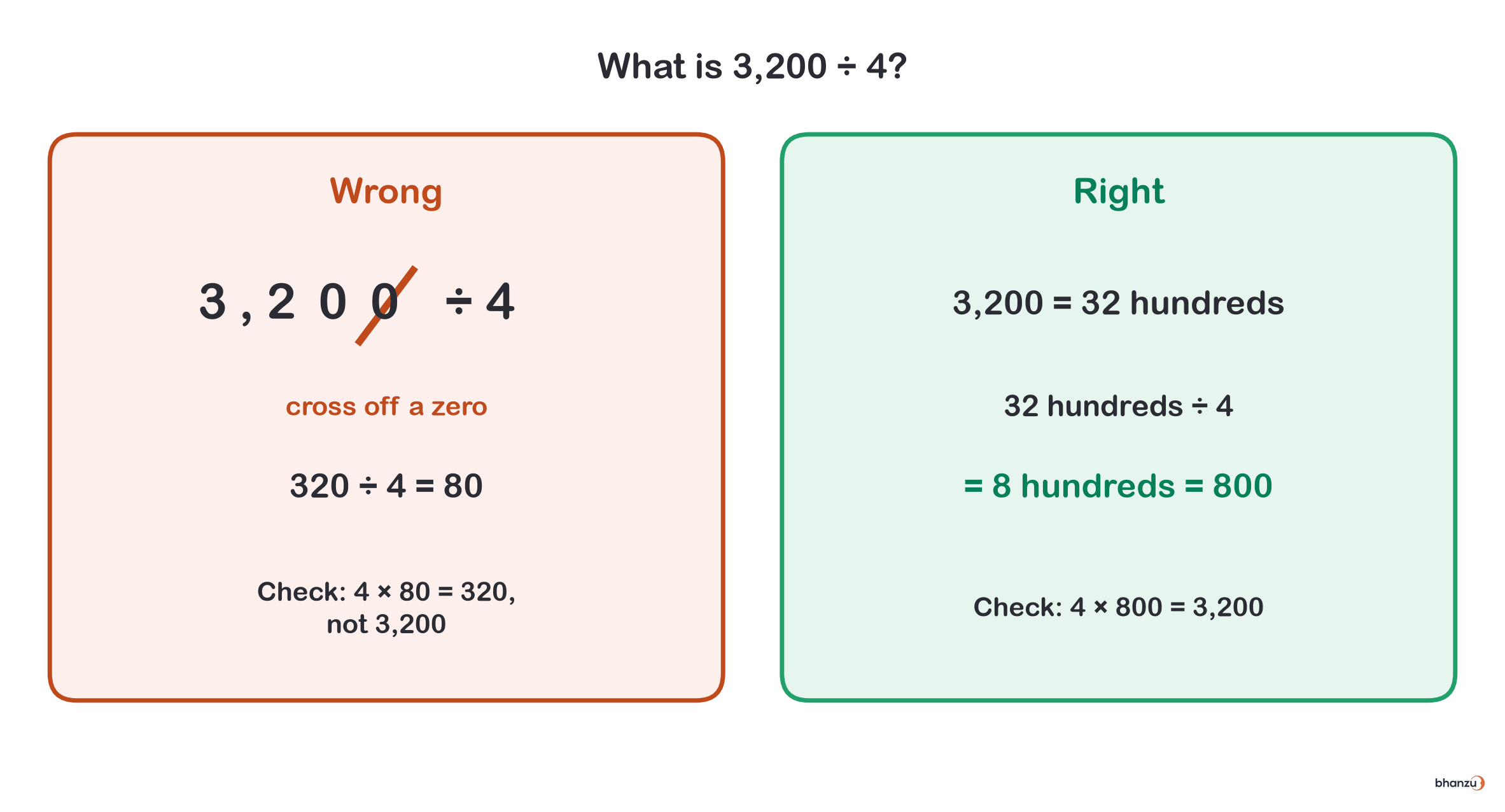
Crossing off keeps the answer the same only when both numbers lose a zero together.
Mistake 3: Sliding the digits as if dividing by 10
Where it slips in: A unit that teaches this skill beside dividing by 10, 100 and 1,000, which undoes multiplying by 10, 100, and 1,000. "Digits move right when you divide" is true for dividing by 10, so children borrow it for any division with zeros.
Don't do this: Slide 6,300 one place right and write .
The correct way: Dividing by 10, 100 or 1,000 slides the digits, so 6,300 divided by 10 is 630. Dividing by 9 shares the hundreds instead, so 63 hundreds divided by 9 is 7 hundreds, or 700.
"Dividing by 100" and "dividing hundreds by 9" sound almost the same, which is genuinely confusing, even for adults.
Key Takeaways
- Say the dividend in a place first, as in "28 hundreds," and the basic fact shows itself.
- When dividing multiples of 10, 100, and 1,000, read a 5 in the fact as a cue to look for a zero inside it.
- Cross off zeros only in pairs, and save that move for 5th grade divisors like 60.
- Finish by multiplying the divisor by the quotient to rebuild the dividend.
- To keep the zero inside facts like 30 divided by 5 from slipping out of your answers, explore Bhanzu's 4th grade math curriculum or its Common Core math curriculum.
Read More
- Multi-Step Word Problems
- Divisibility Rules
- Multiplying and Dividing by Powers of 10
- Mental Math for Kids
- How to Teach Math to Kids
Research Behind This Article
- National Institute of Standards and Technology, Everyday Estimation (2026). nist.gov
- Lynn Marecek and others, OpenStax, Prealgebra 2e, 1.5 Divide Whole Numbers (2020). openstax.org
- Common Core State Standards Initiative, Grade 4 Number and Operations in Base Ten (2010). thecorestandards.org
- National Center for Education Statistics, Explore Results for the 2024 NAEP Mathematics Assessment (2025). nationsreportcard.gov
- Stacy K. Boote, Teaching Children Mathematics, Choosing the Right Tool (2016). eric.ed.gov
- Centers for Disease Control and Prevention, Child Activity: An Overview (2025). cdc.gov
Quick Quiz: Check Yourself
Three levels, new numbers every time: tens and hundreds, then hundreds and thousands plus missing numbers, then word problems about minutes, nickels and money or comparing two quotients.
Was this article helpful?
Your feedback helps us write better content
Frequently Asked Questions
What is 2,400 divided by 8?
Is dividing by multiples of 10 the same as dividing multiples of 10?
How can I help my child practice dividing multiples of 10, 100, and 1,000 at home?
How can I help if my child keeps getting the zeros wrong?
What does division with zeros in the quotient mean?