Key Points
- Reading and writing large numbers uses three forms of one amount, standard form (588,753), word form and expanded form, which adds each digit's value.
- Commas split a large number into periods of three places, so 935,094 is read nine hundred thirty-five thousand, ninety-four, with "thousand" said at the comma.
- Zeros are silent in word form but keep their places in the digits, so six hundred eight thousand, forty-five is written 608,045.
Six digits hold a whole state
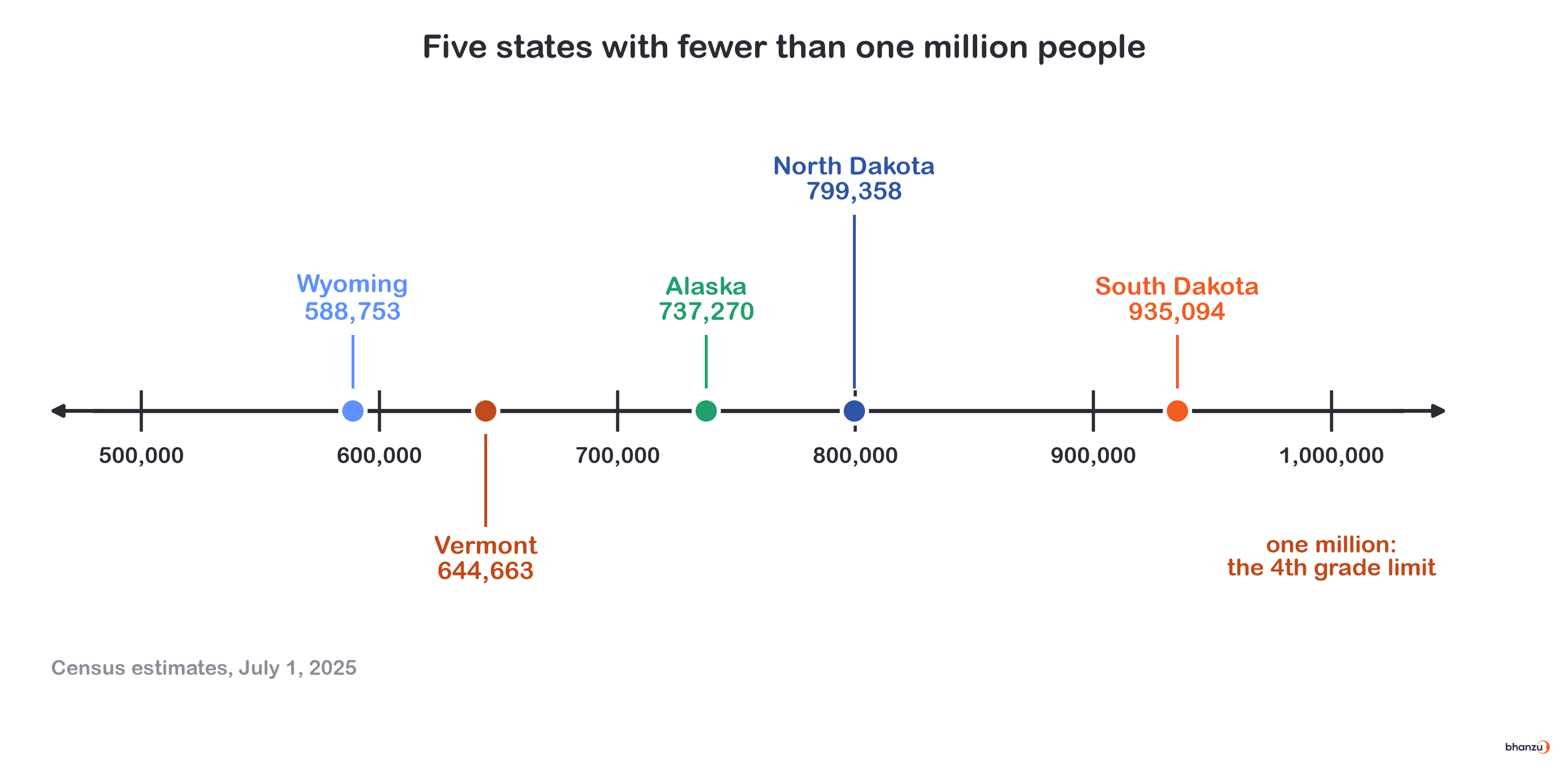
Every person living in Wyoming fits inside one six-digit number, 588,753. That is the US Census Bureau's estimate for July 1, 2025, and no state had fewer people.
Vermont, Alaska, North Dakota and South Dakota also stayed under one million, with South Dakota the closest at 935,094. You can say each number aloud, spell it in words and split it into parts.
Later in 4th grade, the same place-value chart grows to the right of the ones place to hold tenths and hundredths, the decimals on price tags.
How do you read and write large numbers?
Reading and writing large numbers means using each digit's place to switch one amount between three forms. Standard form writes a number in digits with commas, such as 588,753. Word form spells out the number names. Expanded form writes a number as the sum of each digit's value.
A place-value chart, a row of six labeled columns from hundred thousands down to ones, gives each digit its value. Unit form, the third row below, counts how many of each unit the chart holds.
| Form | Wyoming's 2025 population |
|---|---|
| Standard form | 588,753 |
| Word form | five hundred eighty-eight thousand, seven hundred fifty-three |
| Unit form | 5 hundred thousands, 8 ten thousands, 8 thousands, 7 hundreds, 5 tens, 3 ones |
| Expanded form | 500,000 + 80,000 + 8,000 + 700 + 50 + 3 |
This is Common Core standard 4.NBT.A.2, which asks 4th graders to read and write multi-digit whole numbers (0, 1, 2, 3 and so on). Its footnote sets the 4th grade limit at 1,000,000.
Your child wrote numbers to 1,000 in standard, word and expanded form back in 2nd grade, and 4th grade stretches the same forms to one million, adding a second period and a comma.
How do commas help you read big numbers?
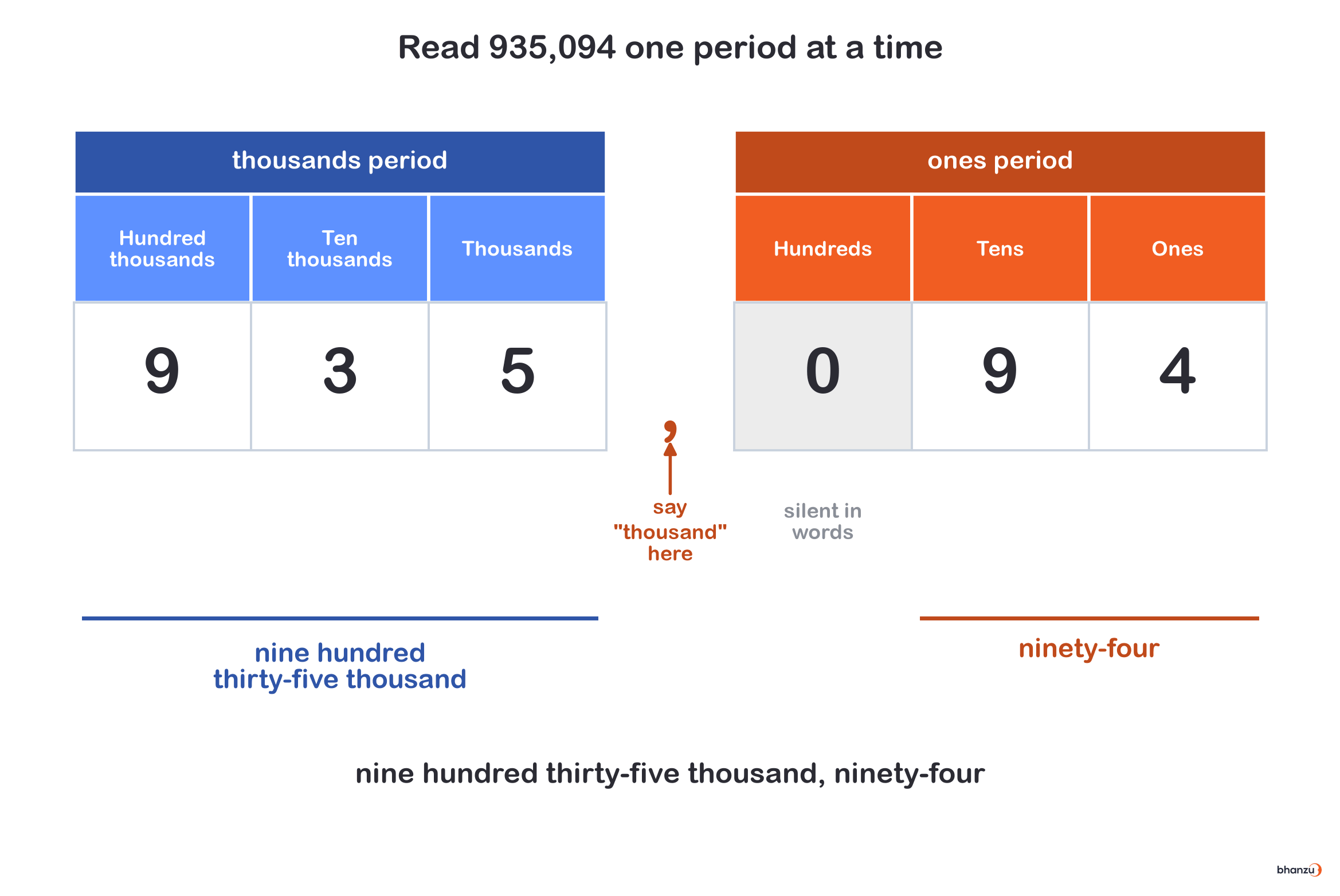
Commas split a number into periods, groups of three places counted from the right. Each period has its own hundreds, tens and ones, so you read it as a number up to 999, then say its name. South Dakota's 935,094 has a thousands period, 935, and a ones period, 094.
- Find the comma. With no comma printed, count three digits from the right and mark one.
- Read the left period, then say "thousand" at the comma.
- Read the ones period the same way, with no name after it.
- Skip every 0 out loud, since zeros hold places but are never spoken.
So 935,094 is nine hundred thirty-five thousand, ninety-four. The words follow a few US rules:
- Hyphens join tens and ones words from 21 to 99, as in ninety-four.
- A comma follows "thousand", matching the comma in the digits.
- In word form, "thousand" takes no "s", even though unit form says "5 thousands".
Adults lose track of places too. In a 2025 study of number reading, 172 adults reading aloud in Hebrew misread an average of 6.5% of 120 numbers of 3 to 6 digits printed without commas. Most of those mistakes, 69%, got a digit's place value wrong rather than the digit itself, which is why the comma step comes first.
A child who meets 935094 with no comma often starts "ninety-three thousand", then finds a digit left over. Counting three from the right before speaking fixes that habit.
How do you write a number in expanded form?
Write the value of each nonzero digit, biggest place first, and join the values with plus signs. Unit form makes those values easy to see, since 706,040 is 7 hundred thousands, 6 thousands and 4 tens.
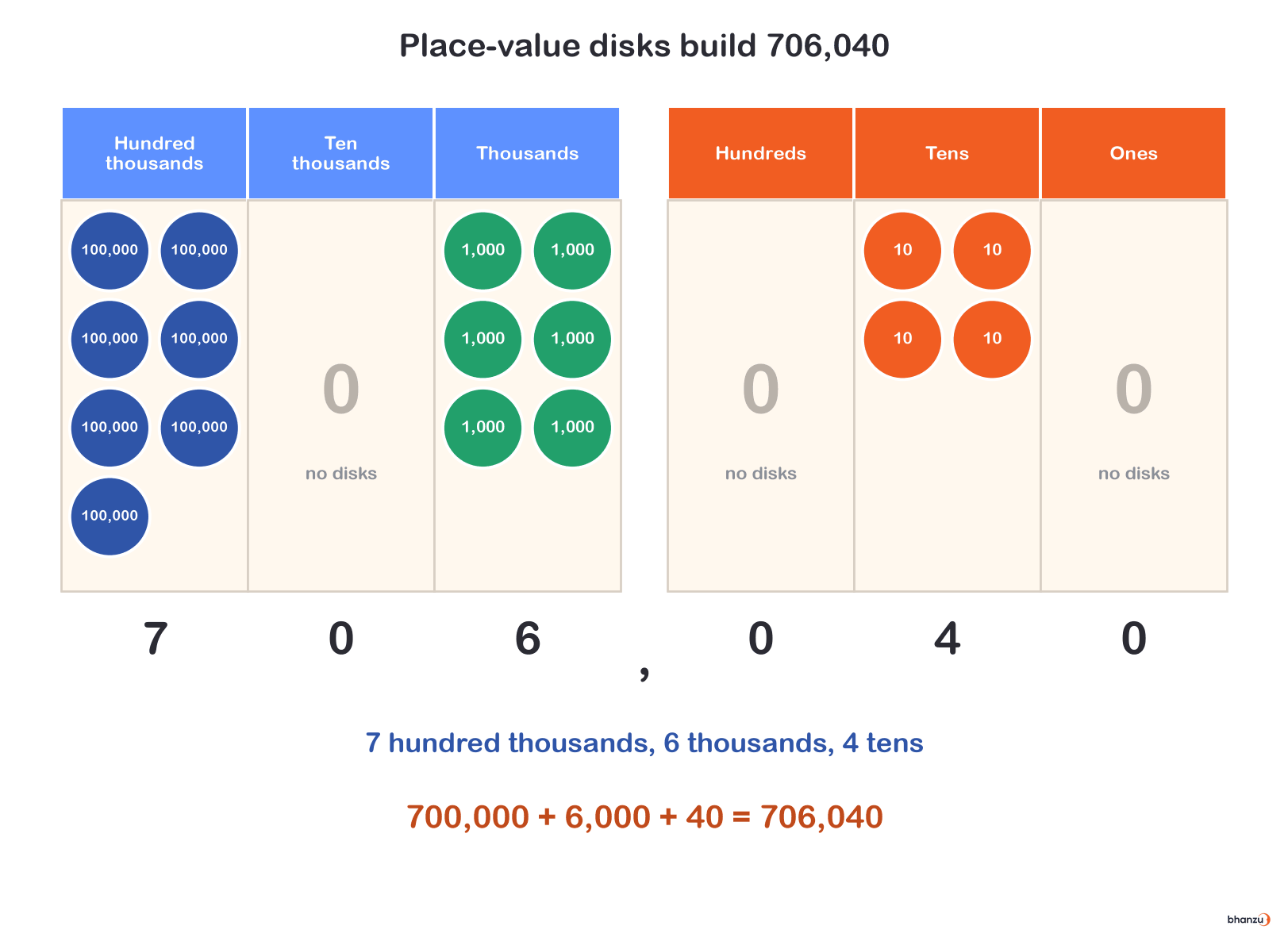
A place-value disk is a circle labeled with its value, such as 100,000. Each place is worth ten times the place to its right, the same pattern behind multiplying by 10, 100 and 1,000, so the 6 in 706,040 is worth 6,000, not 600.
What is the expanded form of 325,894? With no zeros, it has six parts.
Expanded notation, used in some classes, multiplies each digit by its place value.
Base-ten blocks work up to the thousands cube. A hundred-thousand block would need 100 of those cubes, so 4th grade switches to charts and disks (a disk for 1,000,000 is just one more circle).
Try It Yourself
Tap plus and minus to change the place-value disks in each column, and watch the standard, unit, expanded and word forms change together. The builder starts with 12 disks in the thousands column. Press Trade to swap 10 of them for 1 disk in the ten thousands column, and the number stays 312,040.
Turning number words back into digits
Turning words into digits works best with three blanks after the comma, so a silent zero still has somewhere to go.
- Write the number said before "thousand", then a comma.
- Draw three blanks after the comma.
- Write the number said after "thousand" in the blanks, lined up on the right.
- Put 0 in any blank still empty.
That 0 is a placeholder zero, a digit that holds an empty place. Four thousand six puts 4 before the comma and 6 in the last blank, giving 4,006 (not 46 or 406). A child who writes 4,006 sometimes erases it because the words never said "zero", and the blanks show why both zeros belong.
When unit form holds more than 9 of one unit, as in 5 ten thousands, 12 thousands and 3 ones, regroup first, the same move as regrouping whole numbers. Twelve thousands is 1 ten thousand and 2 thousands.
One million, 1,000,000, is a 1 and six zeros, the top of the 4th grade range, and 5th grade brings a shorter way to write it with powers of ten.
Examples of reading and writing large numbers
Example 1
Write North Dakota's July 1, 2025 estimate, 799,358 people, in expanded form.
The number holds 7 hundred thousands, 9 ten thousands, 9 thousands, 3 hundreds, 5 tens and 8 ones.
Example 2
Write six hundred eight thousand, forty-five in standard form.
The tempting move is to write 608, a comma, then 45, giving 608,45.
Only two digits follow that comma. With the comma three digits from the right, those digits read 60,845, sixty thousand, eight hundred forty-five, which is not the number in the words.
Draw three blanks after the comma instead. The 45 fills the last two, and 0 fills the hundreds blank.
Reading it back gives six hundred eight thousand, forty-five.
Example 3
Write Alaska's July 1, 2025 estimate, 737,270 people, in word form.
Read the thousands period, 737, say "thousand" at the comma, then read the ones period, 270.
The answer is seven hundred thirty-seven thousand, two hundred seventy.
Example 4
Write in standard form.
Put the values in order, biggest first.
The chart holds 3 hundred thousands, 0 ten thousands, 4 thousands, 0 hundreds, 6 tens and 2 ones.
The answer is 304,062.
Example 5
What number is 6 hundred thousands, 13 ten thousands and 5 hundreds?
Regroup the 13 ten thousands as 1 hundred thousand and 3 ten thousands.
That makes 7 hundred thousands, 3 ten thousands, 0 thousands, 5 hundreds, 0 tens and 0 ones.
Example 6
Mei reads that Vermont had six hundred forty-four thousand, six hundred sixty-three people in 2025. Write that number in standard and expanded form, and give the value of its ten thousands digit.
The periods are 644 and 663, so the standard form is 644,663.
The ten thousands digit is 4, and its value is 40,000.
Large numbers beyond the textbook
Place value lets just ten digits name any whole number, because every period repeats the same hundreds, tens and ones.
- It turns data into words. A figure like 799,358 only means something to a listener once you can say it aloud.
- It keeps written amounts safe. A bank check (a paper note telling a bank to pay someone) shows the amount in digits and in words, so anyone reading it can check that the two match.
- It sets up the next skills. Comparing 737,270 with 799,358 starts at the biggest place, and rounding multi-digit numbers starts by reading each digit's place.
- It reuses one small pattern. A six-digit number is just two numbers up to 999 joined by "thousand".
Expanded form comes back later in 4th grade, when you multiply larger numbers by breaking them into place values.
What most guides miss about large numbers
Unit form is the bridge most explanations skip. Saying "9 hundred thousands, 3 ten thousands, 5 thousands, 9 tens, 4 ones" turns the words for 935,094 into its expanded form one unit at a time. Unit form can also hold a name like 13 ten thousands, which standard form cannot show until you regroup.
The name "standard form" is genuinely confusing. In 4th grade it means digits with commas. In algebra the same two words name a way of writing equations, and some pages use standard form for numbers written with powers of ten. Fourth grade homework that says "standard form" means the digits-with-commas version.
Where do kids trip up on large numbers?
Mistake 1: Writing each part you hear
Where it slips in: Turning words into digits when "thousand" sits in the middle, as in Example 2.
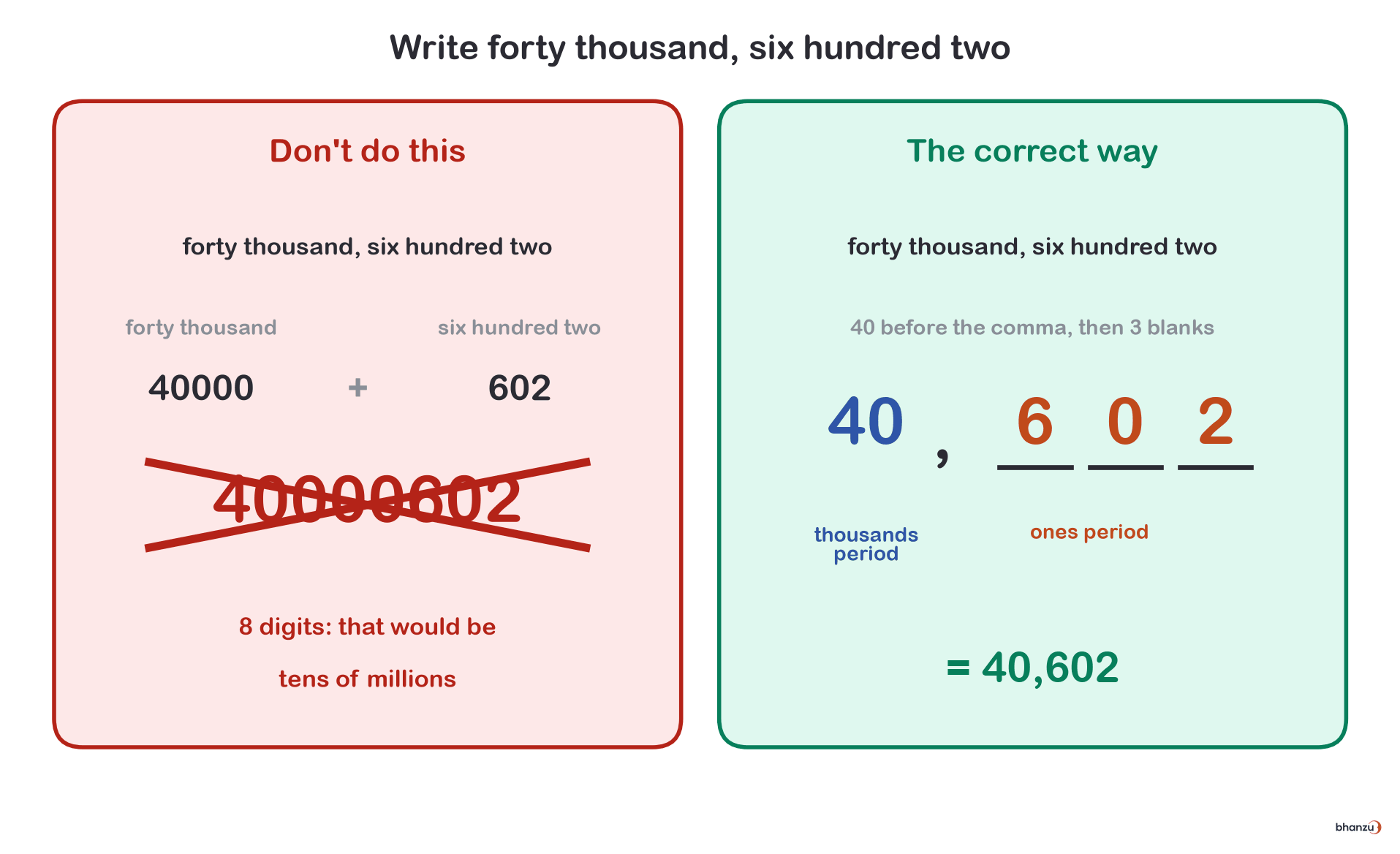
Don't do this: Writing forty thousand, six hundred two as 40000602.
The correct way: Put 40 before the comma and let six hundred two fill the three places after it, giving 40,602.
Children writing large numbers from words often write 40000602, because they put down each part the moment they hear it. A study of 172 children aged 4 to 6 found the same "expansions", such as 600402 for six hundred forty-two (Byrge, Smith and Mix, 2014). The same habit can come back when numbers reach the thousands.
Mistake 2: Dropping the placeholder zeros
Where it slips in: Writing standard form from expanded form when a place is missing, as in Example 4.
Don't do this: Writing as 3,520.
The correct way: Name every place from hundred thousands down to ones, 3, 0, 5, 0, 2, 0, to get 305,020.
Word form and expanded form never say "zero", so a child who rushes writes only the digits in sight. Counting places catches it, because a number with hundred thousands needs six digits.
Mistake 3: Saying "and" inside a whole number
Where it slips in: Reading a number aloud or writing word form, as in Examples 3 and 6.
Don't do this: Reading 205,300 as two hundred and five thousand, three hundred.
The correct way: Say two hundred five thousand, three hundred. In math, "and" marks a decimal point, so 15.68 is fifteen and sixty-eight hundredths.
Everyday speech often slips "and" into numbers, so the habit feels natural. Later in 4th grade, with tenths and hundredths, that little word will signal the decimal part.
Key Takeaways
- Read a big number one period at a time, and say "thousand" only where the comma sits.
- Draw three blanks after the comma before writing digits from words, so silent zeros get a seat.
- Expanded form lists only nonzero values, biggest first, and unit form bridges the words and that sum.
- Reading and writing large numbers in math leaves out the word "and", which belongs to decimals.
- For more practice with a teacher who catches the vanishing zero in 608,045, explore Bhanzu's 4th grade math tutor or math classes for kids.
Read More
- Comparing and Ordering Multi-Digit Numbers
- Multi-Digit Addition
- Decimals in Standard, Word and Expanded Form
- Scientific Notation
- Standard Notation
Research Behind This Article
- US Census Bureau, State Population Totals and Components of Change: 2020-2025 (2026). census.gov
- Common Core State Standards Initiative, Grade 4: Number and Operations in Base Ten (2010). thecorestandards.org
- OpenStax, Prealgebra 2e, 1.1 Introduction to Whole Numbers (2020). openstax.org
- Noa Handelsman and Dror Dotan, Reading numbers is hard, and the difficulty is a syntactic one (2025). pmc.ncbi.nlm.nih.gov
- Lisa Byrge, Linda B. Smith and Kelly S. Mix, Beginnings of Place Value: How Preschoolers Write Three-Digit Numbers (2014). eric.ed.gov
- OpenStax, Prealgebra 2e, 5.1 Decimals (2020). openstax.org
Quick Quiz: Check Yourself
Three levels, new numbers every time: expanded form to digits or a digit's value, number words to digits, then a number with more than 9 of one unit.
Was this article helpful?
Your feedback helps us write better content
Frequently Asked Questions
How do I teach expanded form to my child?
What is standard form in math in 4th grade?
Is expanded form the same as standard form?
How do you write 10 million in numbers?
What are the names of large numbers?