Key Points
- Multi-digit subtraction lines up two numbers by place value, subtracts the ones first and then moves left one place at a time.
- Regrouping trades 1 from the next place left for 10 in a column whose top digit is too small, and a zero passed on the way becomes 9.
- On a 2024 national question, , 67% of fourth graders chose the right answer, and the top wrong answer came from flipping digits.
- Common Core asks 4th graders to subtract fluently with the standard algorithm, using whole numbers up to 1,000,000.
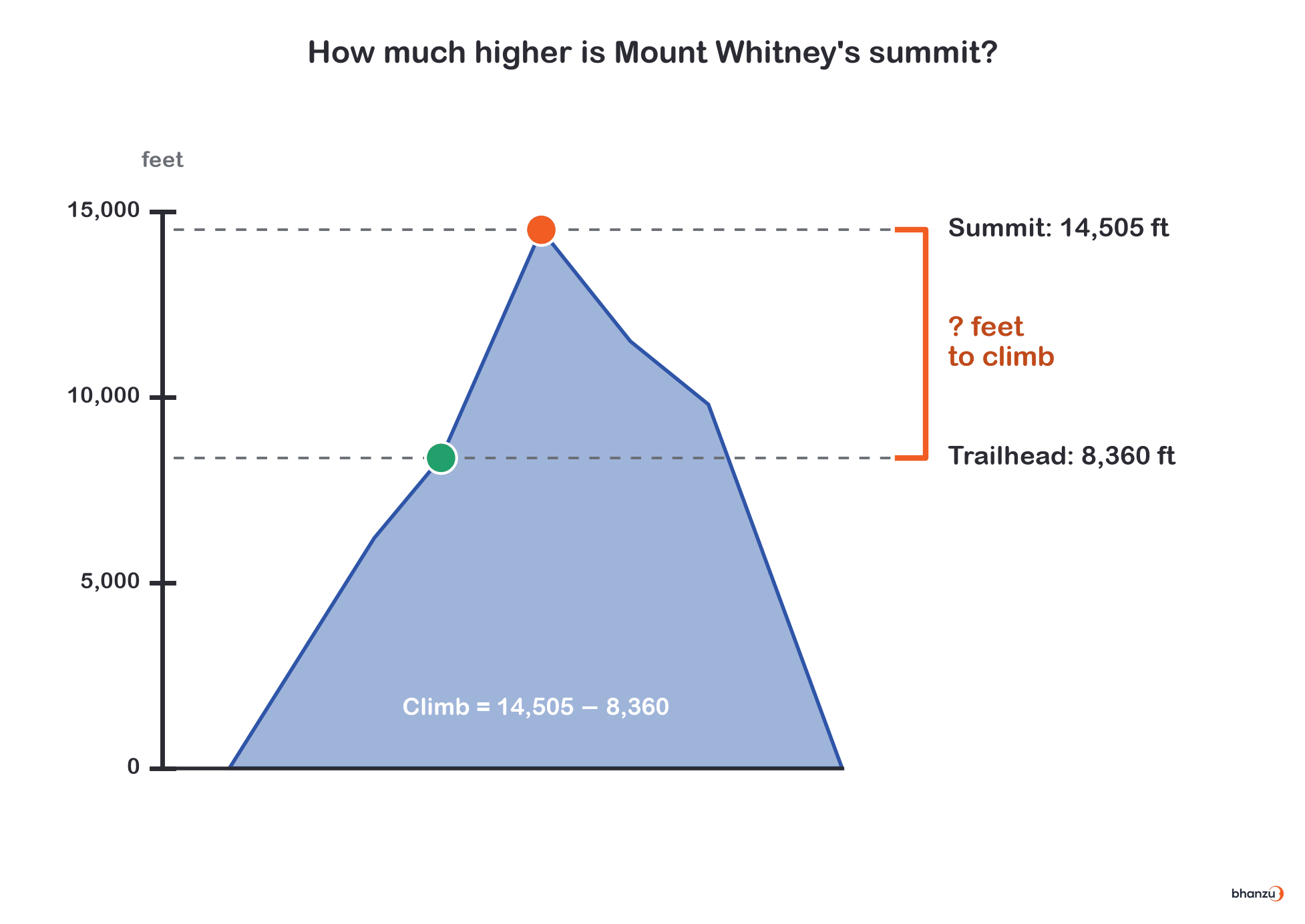
A mountain that starts at 8,360 feet
Hikers on Mount Whitney's main trail start out 8,360 feet above sea level. The National Park Service lists the summit at 14,505 feet (the tallest peak in the lower 48 states). So how much climbing is still ahead of them?
Finding out takes one multi-digit subtraction with five digits, a tricky zero and two trades. It looks like a lot of digits. You can work it out one column at a time, and next year in 5th grade the same right-to-left steps will subtract decimals, like dollars and cents.
What is multi-digit subtraction?
Multi-digit subtraction is finding the difference, or what is left over, between two numbers with many digits, working one place value at a time.
A place-value chart, a table with one column for each place, lines up the top number (the minuend) and the bottom number (the subtrahend).
| Thousands | Hundreds | Tens | Ones | |
|---|---|---|---|---|
| Top number | 6 | 2 | 3 | 4 |
| Bottom number | 2 | 7 | 5 | 8 |
When a column is short, trade with the column to its left. That trade is called regrouping, which means swapping 1 of a place for 10 of the place to its right without changing the number's value. In base-ten blocks, one thousand cube equals ten hundred flats.
This is Common Core standard 4.NBT.B.4, which asks 4th graders to "fluently add and subtract multi-digit whole numbers using the standard algorithm" with numbers up to 1,000,000. An algorithm is a fixed list of steps that always works. In 3rd grade your child subtracted within 1,000, so 4th grade brings longer numbers, more trades in a row and zeros stacked two or three deep.
How do you use the standard algorithm to subtract?
Line up the places, then subtract one column at a time from the ones to the left, trading before any column whose top digit is too small. Here is .
- Write the bigger number on top, ones under ones.
- In the ones, 4 is less than 8. Trade 1 ten, so 3 tens become 2, and .
- In the tens, 2 is less than 5. Trade 1 hundred, so 2 hundreds become 1, and .
- In the hundreds, 1 is less than 7. Trade 1 thousand, so 6 thousands become 5, and .
- In the thousands, , so the difference is 3,476.
- Check by adding, since , the top number.
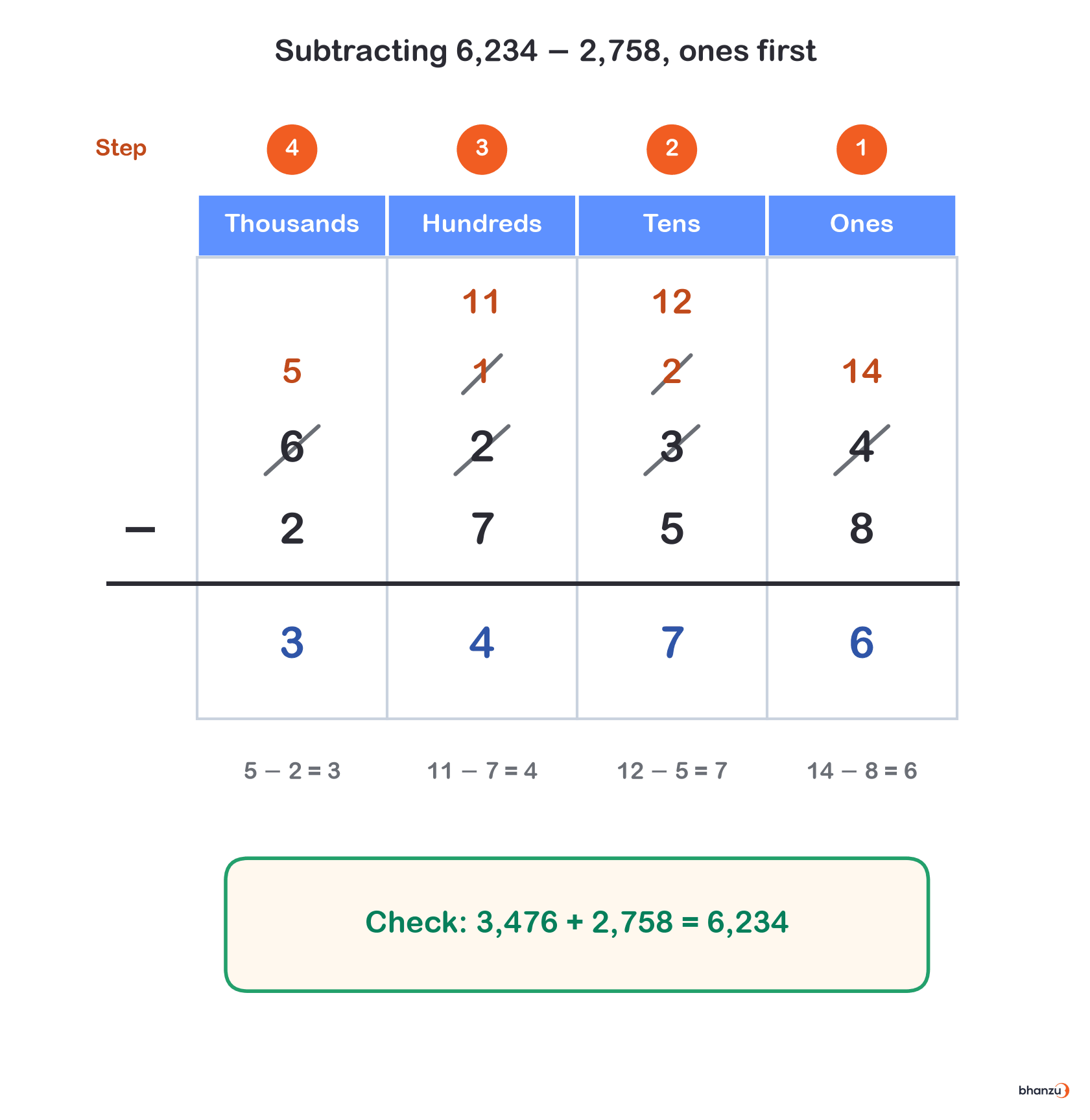
An estimate first shows the size to expect, since rounding to the nearest thousand gives , close to 3,476. Some books, including OpenStax Prealgebra 2e, call the trade borrowing.
Word problems can hide the order. In "subtract 2,638 from 8,005," the number said first is the one taken away.
| Words in the problem | Math it means |
|---|---|
| subtract 2,638 from 8,005 | |
| how many feet higher | summit minus trailhead |
| what number plus 4,795 makes 12,300 | |
| how many more to reach 1,000,000 | goal minus pages read |
How does subtracting across zeros work?
When the place you need to trade from holds 0, move left to the first digit that is not 0 and pass 1 back down. Every zero you pass through becomes 9, and the column that needed help gets 10 more.
In , the ones need help, so both zeros are passed through and become 9.
The columns give 3,647. In the ones are fine, but the tens column needs help, because 0 is less than 7. Its own column is asking, so that zero becomes 10.
The columns give 4,131. On the 2024 national math assessment, 67% of fourth graders chose 4,131, and 10% chose 4,121, which is what turning that tens zero into a 9 produces.
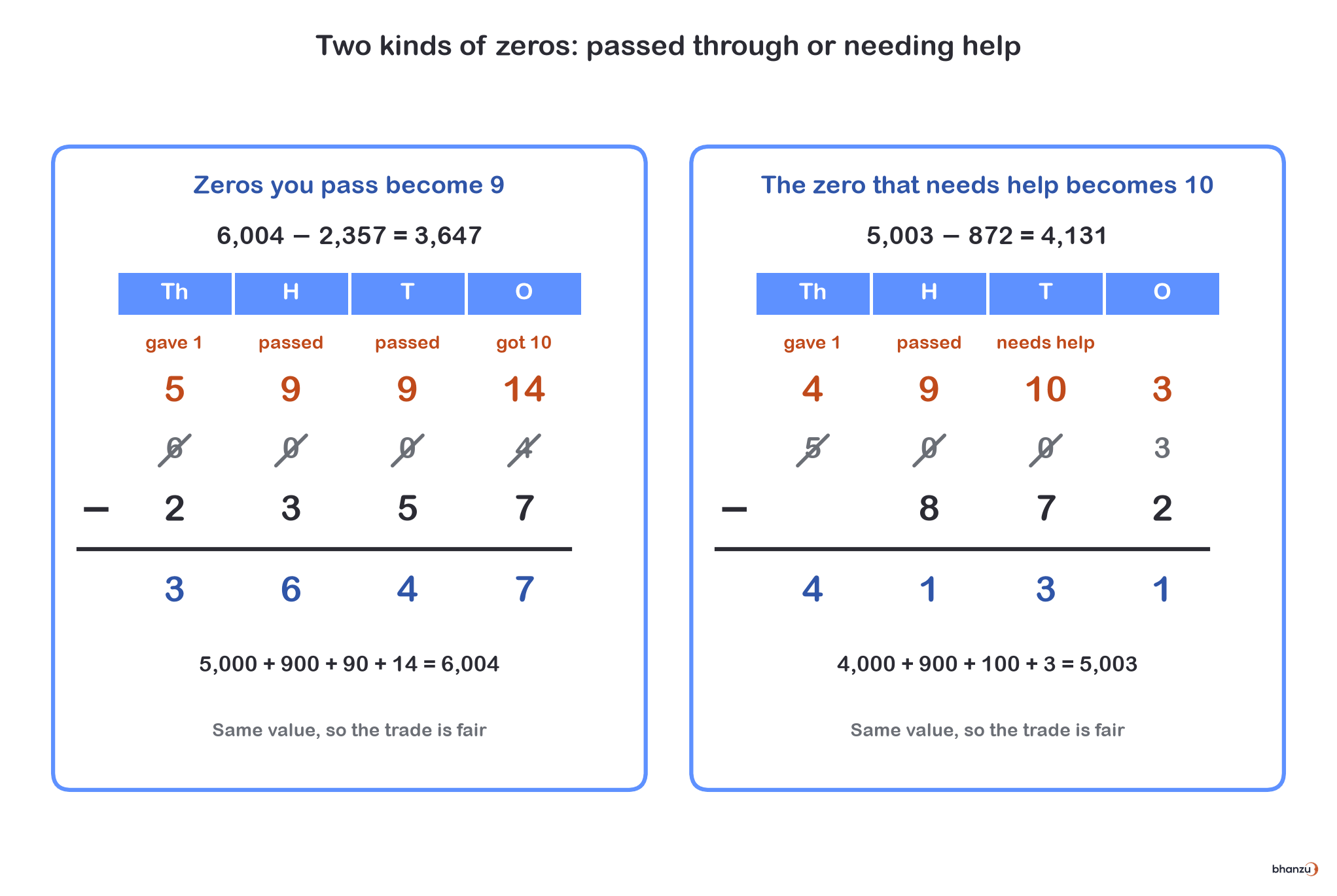
The 9-versus-10 difference confuses adults too, because both zeros sit in the middle and look alike. Ask whose column needs the help. Children who have just learned that zeros become 9 often turn every zero into 9, and some cross out a correct 10 because the rule they remember says 9.
Two shortcuts help when the column method gets slow.
- Count up. For , counting up goes 1 to 5,990 and 12 more to 6,002, so the difference is 13.
- Shift both numbers. has the same answer as , which needs no trades (both are 3,543).
Try It Yourself
Tap Trade above a column to turn 1 of that place into 10 in the place to its right, then press Subtract next column to work from the ones to the left. The line under the chart shows the top number keeping its value after every trade, and a number bond adds your answer back at the end.
Examples of multi-digit subtraction
Example 1
What is 7,482 minus 3,265?
Only the ones need a trade, so 8 tens become 7 and the ones become 12.
Adding back, .
Example 2
What is 8,005 minus 2,638?
Both middle places are 0. It is tempting to turn every zero into 10, so the top becomes 7 thousands, 10 hundreds, 10 tens and 15 ones, and the columns give 5,477.
Adding back exposes it, because . That rewrite grew the number by 110 before any subtracting began.
Zeros you pass through become 9, which keeps the value at 8,005.
Adding back, .
Example 3
Mount Whitney's trailhead is at 8,360 feet and its summit at 14,505 feet. How much higher is the summit?
The tens zero needs help, since 0 is less than 6, so it becomes 10 and the 5 hundreds become 4. The thousands need a trade from the ten thousands too.
The summit is 6,145 feet higher, and .
Example 4
What number plus 4,795 makes 12,300?
The box in stands for that number, and subtracting 4,795 from 12,300 undoes the adding. The tens zero is passed through and becomes 9, and two more trades handle the hundreds and the thousands.
The box holds 7,505, and .
Example 5
A reading club wants to read 1,000,000 pages. Its members read 286,450 pages in the fall and 397,875 in the winter. How many more pages do they need?
Add the parts first.
Then subtract from the goal. One trade from the millions passes through five zeros, each becoming 9, and the ones become 10.
They need 315,675 more pages, and .
Why does subtracting one column at a time work?
Column subtraction works because each column counts a different size of unit. A trade changes how a number is packed, never how much it is.
- It keeps units apart. Ones come off ones and thousands off thousands, so each column is a small subtraction you already know.
- It never changes the number. 7,050 packed as 6 thousands, 9 hundreds, 14 tens and 10 ones is still .
- It works for any size of number, even a year. The Declaration of Independence is dated July 4, 1776, and takes one trade across the zero in 2026.
The standard algorithm is place value written down quickly, which is why it keeps working in multi-step word problems and on numbers in the millions.
Common errors when working with multi-digit subtraction
Mistake 1: Taking the smaller digit from the bigger one
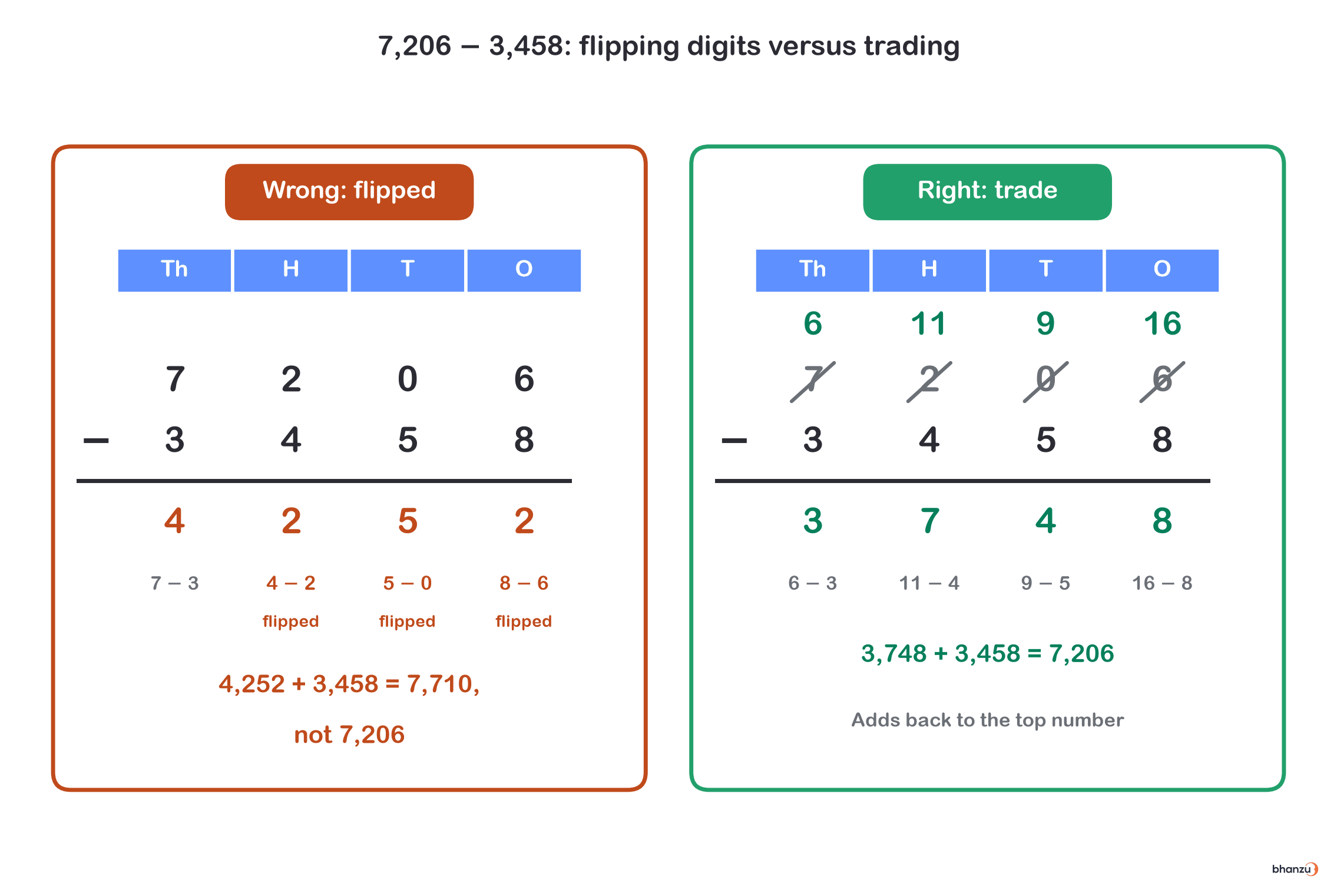
Where it slips in: Any column with a smaller top digit, such as every column but the thousands in . Addition lets you swap numbers, so children carry the swap over, but and are different problems.
Don't do this: Flipping each column to get 4,252, which adds back to 7,710.
The correct way: Trade across the zero, so the top reads 6 thousands, 11 hundreds, 9 tens and 16 ones. That gives 3,748, which adds back to 7,206.
In 2024, 16% of fourth graders chose the flipped-digit answer 5,871 for , and in 2011, 13% chose 2,853 for . A child making this mistake usually knows every subtraction fact, so the fix is reading each column as top minus bottom.
Mistake 2: Forgetting to lower the digit you traded from
Where it slips in: Right after a trade, as in . A child who works fast writes the 12 in the ones and skips crossing out the 5 tens.
Don't do this: Finding , then in the tens, which ends at 5,744.
The correct way: The 5 tens become 4 the moment you trade, so and the answer is 5,734.
Mistake 3: Lining up the numbers on the left
Where it slips in: A 4-digit number minus a 3-digit number, such as . You read from the left, so the shorter number slides left.
Don't do this: Putting the 3 under the 4, which subtracts 3,150 and gives 1,470.
The correct way: Line up the ones, with the 5 under the 0, so the answer is 4,305.
The part of multi-digit subtraction nobody explains
An estimate and an addition check catch different mistakes, so use both: one before you subtract and one after.
Which operation is used to check subtraction?
Addition does, because the bottom number and the answer are the two parts of a number bond whose whole is the top number. Textbooks call addition and subtraction inverse operations, since each undoes the other. In 2022, 51% of fourth graders on the national assessment picked to check , so this link is worth saying out loud.
Common Core standard 4.OA.A.3 also asks 4th graders to judge answers by estimating, including rounding. Rounding multi-digit numbers turns into about .
| Answer | Mistake | Estimate check | Add-back check |
|---|---|---|---|
| 5,871 | flipped digits | far from 4,100, caught | 6,743, caught |
| 4,121 | tens zero made 9 | 21 away, missed | 4,993, caught |
| 4,131 | none | close | 5,003, correct |
With whole numbers, an answer bigger than the top number is never right. A child who sees 4,121 close to 4,100 and stops has done half the job, because only the add-back finds the missing ten.
Key Takeaways
- Start in the ones column and trade only when a column's top digit is too small.
- In multi-digit subtraction, a passed zero ends as 9, while a zero whose own column needs help ends as 10.
- Estimate before you subtract and add back after, because each check catches a mistake the other misses.
- Line up the ones first when the numbers have different lengths.
- For practice with zero-heavy problems like 8,005 minus 2,638 and a teacher who spots a passed zero written as 10, explore Bhanzu's 4th grade math curriculum or elementary math tutor sessions.
Read More
- Multi-Digit Addition
- Multiplicative Comparison
- Subtracting Three-Digit Numbers
- Estimating Sums and Differences
- Estimating Decimal Sums and Differences
Research Behind This Article
- National Park Service, Seeing and Climbing Mt. Whitney (2025). nps.gov
- Common Core State Standards Initiative, Grade 4: Number and Operations in Base Ten (2010). thecorestandards.org
- OpenStax, Prealgebra 2e, 1.3 Subtract Whole Numbers (2020). openstax.org
- National Center for Education Statistics, NAEP Questions Tool: Grade 4 Mathematics, questions 2024-4M4 #2, 2022-4M1 #19 and 2011-4M9 #8 (2024). nationsreportcard.gov
- National Archives, Declaration of Independence: A Transcription (2026). archives.gov
- Common Core State Standards Initiative, Grade 4: Operations and Algebraic Thinking (2010). thecorestandards.org
Quick Quiz: Check Yourself
Three levels, new numbers every time: subtract 4-digit numbers, subtract across zeros or find a missing number, then solve two-step word problems up to 1,000,000.
Was this article helpful?
Your feedback helps us write better content
Frequently Asked Questions
Is regrouping and borrowing the same thing?
Do 4th graders have to use the standard algorithm for subtraction?
How do you teach subtraction across zeros at home?
Can you subtract a big number from a small one?
What goes on a multi-digit subtraction anchor chart?
How do you solve 4th grade subtraction word problems?