Key Points
- Adding and subtracting mixed numbers with like denominators, meaning matching bottom numbers, keeps the denominator fixed, because it names the piece size.
- Regrouping swaps 1 whole for a full set of pieces, so becomes before you subtract .
- A frequent regrouping mistake is adding 10 to the numerator, when 1 whole is only for thirds.
- Fourth graders learn this under Common Core standard 4.NF.B.3.c, and fifth grade adds different denominators.
Leftover pizza is already a mixed number
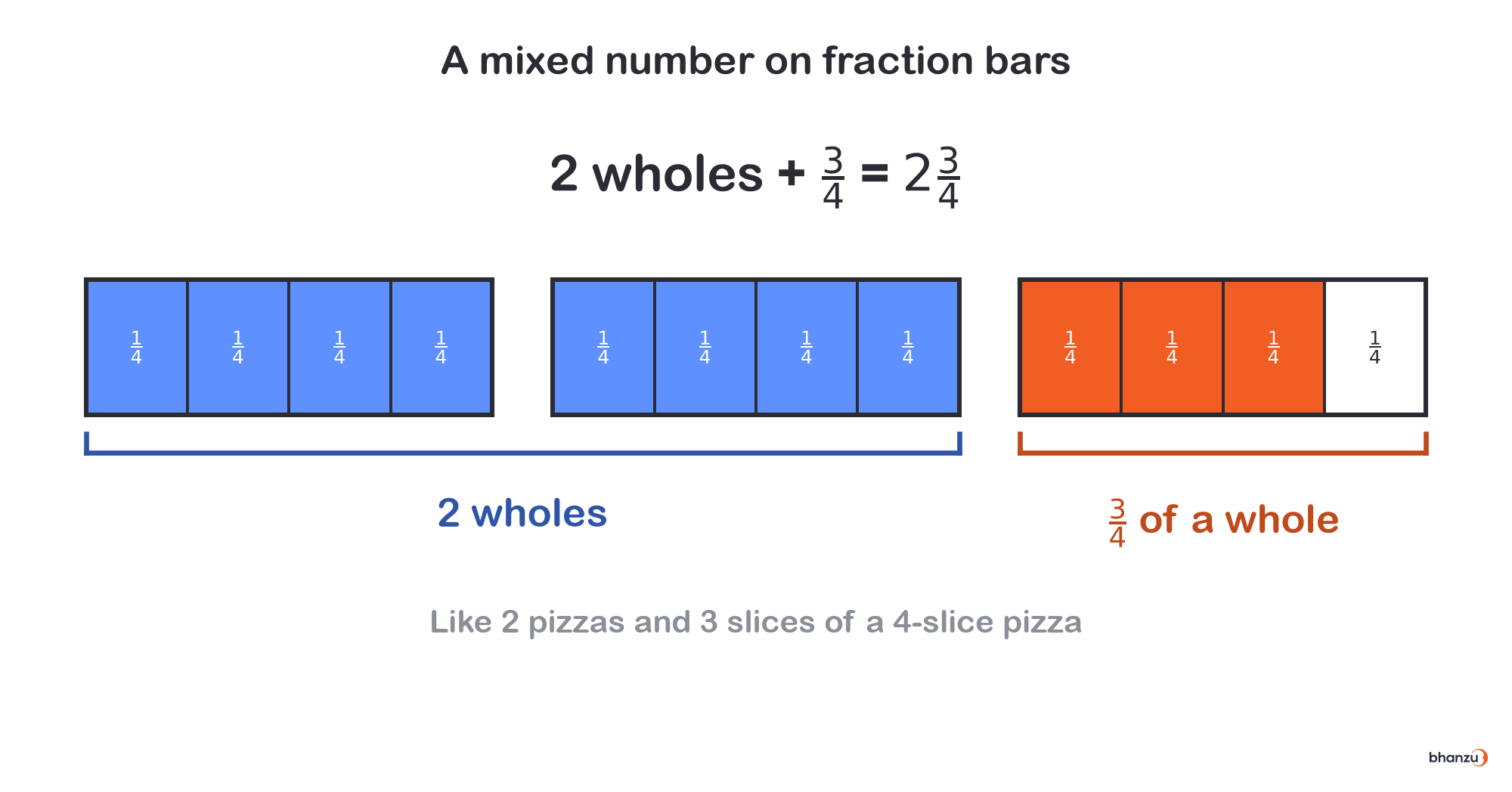
Two whole pizzas and three slices of a 4-slice pizza make a mixed number. The full pizzas are the whole number, 2. Each slice is one-fourth, so 3 slices make three-fourths, and together that's two and three-fourths pizzas.
Then a friend adds 3 more slices of the same size. Now you have 2 pizzas and 6 slices, and 4 of those slices make a third whole pizza with 2 left over. That trade, 4 slices for 1 whole, is the move behind adding and subtracting mixed numbers. In fifth grade, you'll use it again with pieces of different sizes.
How do you add and subtract mixed numbers?
Adding and subtracting mixed numbers works in two columns, one for whole numbers and one for fraction pieces, and the denominator tells you how many pieces make 1 whole. A mixed number is a whole number plus a fraction, like , which on fraction bars is 2 full bars and 3 of the 4 pieces in a third bar. The numerator (the top number) counts the pieces, and the denominator (the bottom number) names their size.
The fraction parts decide when you need a trade: check them before you subtract and after you add. The denominator stays the same throughout, because fourths plus fourths are still fourths. Your child meets this in Common Core standard 4.NF.B.3.c, which covers like denominators and allows keeping wholes and parts apart or rewriting each mixed number as one fraction.
Adding mixed numbers, step by step
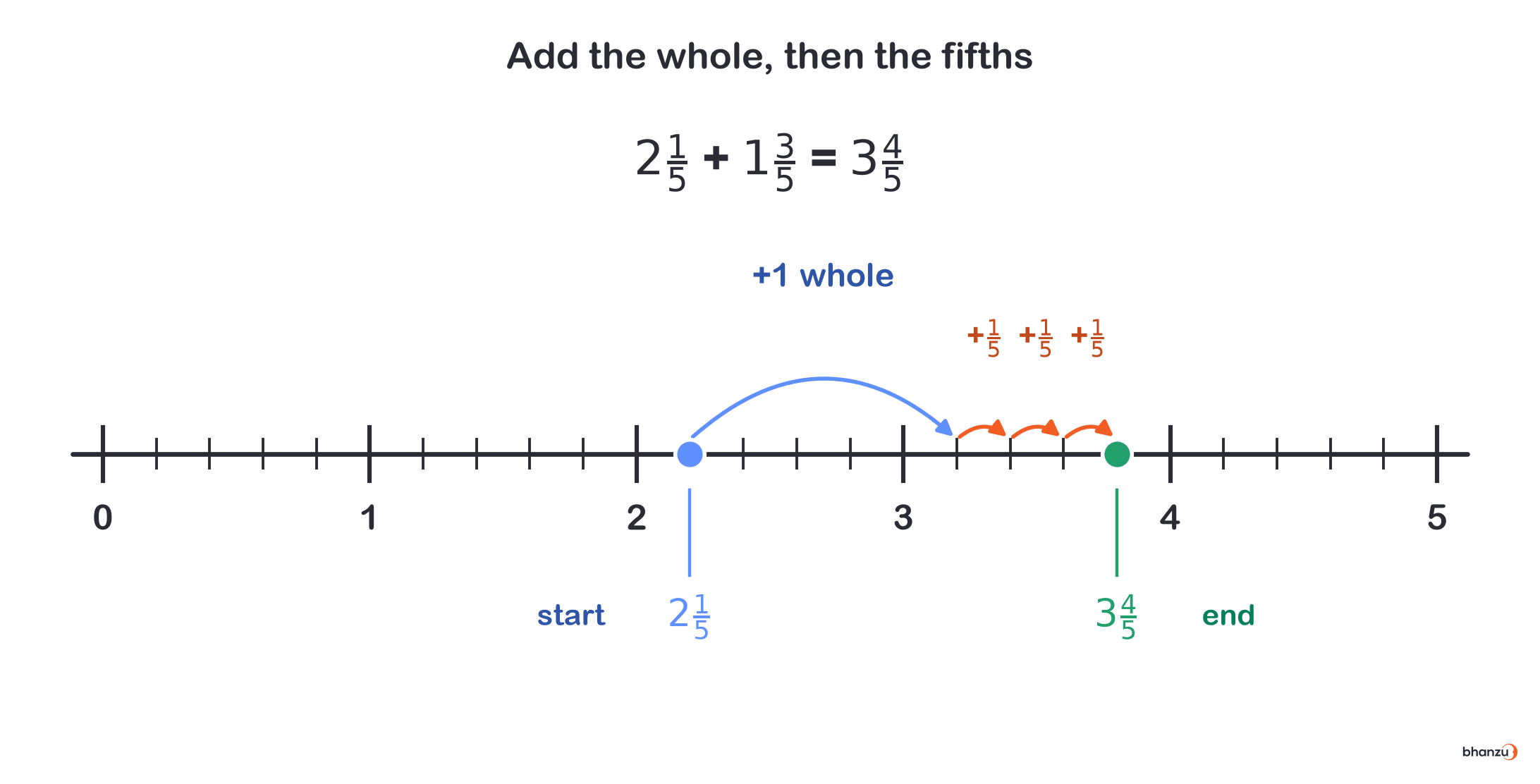
To add mixed numbers, add the fraction parts, add the whole numbers, then check whether the fraction part has grown into a whole or more. On a number line, is one hop of 1 whole and three hops of one-fifth. The fifths sit between the whole numbers, just as they did with fractions on a number line.
Adding mixed numbers with regrouping
In , the eighths add up to more than a whole.
Split eleven-eighths the way you did when decomposing fractions, into one whole and 3 more eighths.
A plain fraction works like a mixed number with 0 wholes, so plus three-eighths is .
Word problems under standard 4.NF.B.3.d hide the operation inside everyday phrases.
| Words in the problem | Math it means |
|---|---|
| "end to end, how long altogether" | Add the lengths |
| "on Saturday and on Sunday" | Add the two days |
| "how many more miles" to a goal | Subtract the total from the goal |
| "what number makes this true" | Subtract to find the missing part |
How do you subtract mixed numbers with regrouping?
To subtract mixed numbers with regrouping, trade 1 whole for equal pieces whenever the fraction you start with is smaller than the one you're taking away. The trade (also called borrowing or renaming) works like regrouping whole numbers, except 1 whole becomes as many pieces as the denominator says, not 10 ones.
On fraction bars, the trade cuts 1 whole bar into 6 sixths.
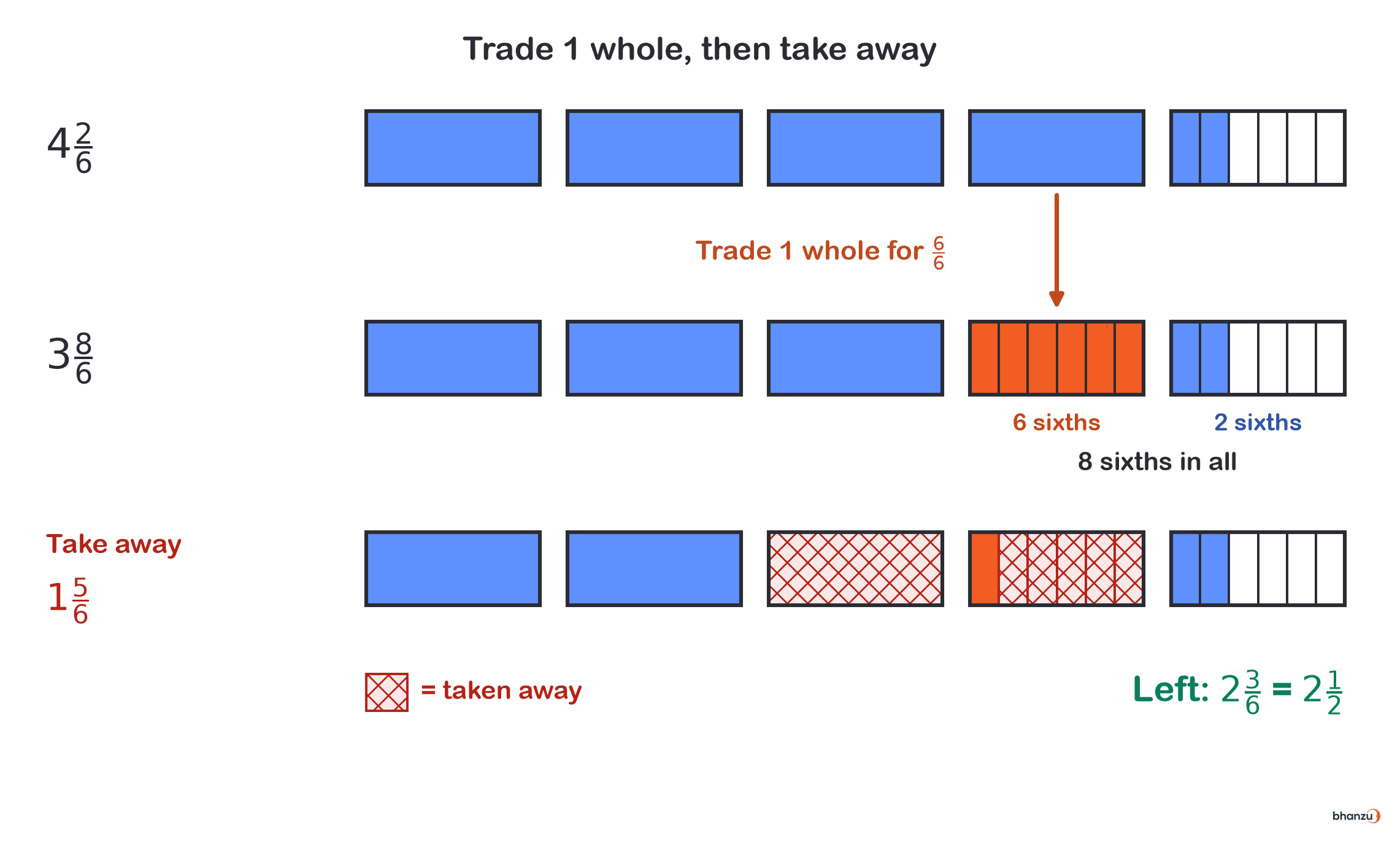
OpenStax's Prealgebra 2e textbook uses the same order of steps, shown here on .
- Compare the fraction parts. Two-sixths is less than five-sixths, so trade first.
- Trade 1 whole for six-sixths, so becomes .
- Subtract the fraction parts.
- Subtract the whole numbers.
- Simplify if you can.
A child who rushes past step 1 often subtracts the smaller fraction from the bigger one, whichever row it sits in, and gets an answer that is too big.
Subtracting a mixed number from a whole number
A whole number has no fraction part to take from, so write 5 as 4 wholes and eight-eighths first.
Try It Yourself
Pick Add or Take away, then use the whole and piece buttons to work the problem on the fraction bars. When you run out of pieces, trade 1 whole for pieces, and when pieces fill a bar, trade them back for 1 whole. The readout shows the mixed number after every move and the finished equation at the end.
When is the improper fraction method faster?
The improper fraction method is faster when the whole numbers are small, because rewriting each mixed number as one fraction skips the trade. An improper fraction has a numerator equal to or bigger than its denominator. Two wholes hold 8 fourths, so is 8 fourths plus 3 more, or .
| Mixed number | Traded form | Improper fraction |
|---|---|---|
The middle column trips people up, because a fraction part bigger than 1 whole looks wrong. It's fine partway through a problem, just not as a finished answer.
For , improper fractions take one line, while the parts method needs a trade first.
With big whole numbers the improper fraction method slows down, since becomes . Counting up on a number line is a third method, and it suits subtraction from a whole number. From , hop five-eighths to reach 3, then hop 2 more to reach 5.
Examples of adding and subtracting mixed numbers
Example 1
Add .
Add the whole numbers, then the sixths.
The answer is .
Example 2
Find .
The tempting move is to flip the fractions, since one-fourth looks too small, and take one-fourth from three-fourths instead. With 5 minus 2 for the wholes, that gives .
That answer can't be right. Taking away would leave exactly 3, and is more than that, so the real answer must be less than 3.
Trade 1 whole for four-fourths instead.
The answer is , or . Adding back checks it.
Example 3
Ava lays two boards end to end. One is feet long and the other is feet long. How long are they altogether?
Add the whole feet, then the eighths.
The boards measure feet altogether.
Example 4
What number makes true?
The box stands for the amount added to to reach 4. Subtract from 4 to find it, since subtraction undoes addition.
The missing number is .
Example 5
Maya runs miles on Saturday and miles on Sunday. Her goal for the weekend is 5 miles. How many more miles does she need to run?
Find how far she ran in all.
Subtract that total from the goal, trading 1 whole for four-fourths.
Maya needs to run mile more.
Why regrouping a whole works
Regrouping works because 1 whole and four-fourths are the same amount, so a trade changes how a number is written, never how big it is.
- It matches a trade you already know. Breaking 1 ten into 10 ones is the same idea as breaking 1 whole into 6 sixths, so taking one-sixth from 3 wholes leaves 2 wholes and five-sixths.
- It builds in a check. Adding back what you took away must land on the number you started with.
- It gives you footing that many children your age are still working on. In the NAEP 2025 Long-Term Trend results, 9-year-olds scored 4 points higher in math than in 2022 but still 4 points below 2020, with 7,600 students assessed in math.
In the 2024 NAEP results, 39% of fourth graders scored at or above NAEP Proficient in math, a bar NAEP says differs from grade-level proficiency. If fractions feel harder than whole numbers at home, the parent guide on why fractions are so hard explains that jump.
What most guides get wrong about adding and subtracting mixed numbers
Most guides jump straight to improper fractions and unlike denominators, yet the fourth-grade standard keeps denominators alike and accepts either method. For , keeping wholes and parts apart takes two tiny sums, 7 plus 2 and 3 eighths plus 1 eighth, for .
Improper fractions turn the same problem into bigger numbers.
Both answers equal , but only one needed 76 divided by 8. Sixth graders dividing mixed numbers start with improper fractions, so both methods earn a place.
A 2012 study of US and UK students, led by Robert Siegler, shows why this unit deserves time. It used data that followed children from elementary school into high school, and their fraction knowledge predicted algebra knowledge and overall math achievement 5 or 6 years later.
Why kids get adding and subtracting mixed numbers wrong (and the fix)
Mistake 1: Borrowing 10 instead of one whole
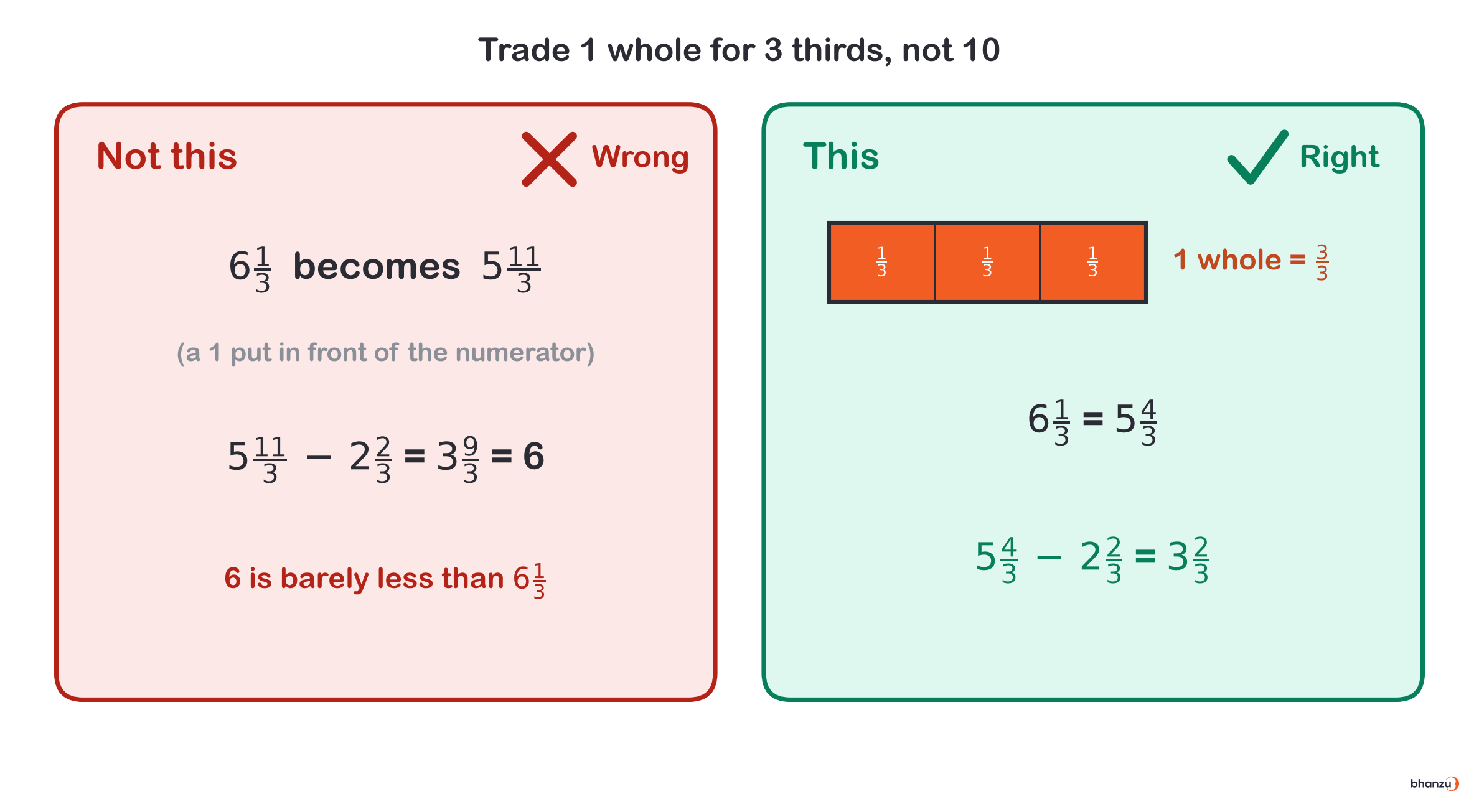
Where it slips in: Subtraction with a trade, such as . Children who regroup well with whole numbers often put a 1 in front of the numerator, as they would before a ones digit.
Don't do this: Turn into and get , which is 6, barely less than where you started.
The correct way: One whole is , so , and the answer is .
Mistake 2: Adding the denominators
Where it slips in: Addition, when a fraction looks like two stacked whole numbers, so a child adds the tops and the bottoms.
Don't do this: .
The correct way: Sixths plus sixths are still sixths, so the sum is .
A size check agrees, since two-sixths plus three-sixths is more than one-half and five-twelfths is less.
Mistake 3: Leaving an improper fraction in the answer
Where it slips in: Addition with regrouping, such as , when a child stops as soon as the adding is done.
Don't do this: Write as the final answer.
The correct way: Trade 6 sixths for 1 whole, so the answer is , or .
Mixed number answers keep the fraction part under 1 whole by convention, so the size is clear at a glance.
Key Takeaways
- Compare the fraction parts before any subtraction, since a starting fraction smaller than the one you take away signals a trade.
- One whole always equals the denominator over itself, so a trade adds 3 thirds or 8 eighths, and 10 pieces only when the pieces are tenths.
- Adding and subtracting mixed numbers is finished only when the fraction part is smaller than one whole.
- Adding back what you took away catches flipped fractions fast.
- To keep practicing the trade-one-whole step with a teacher who catches the borrow-10 mistake early, explore Bhanzu's 4th grade math tutor or its Common Core math curriculum.
Read More
- Fractions With Denominators of 10 and 100
- Multiplying Fractions by Whole Numbers
- Equivalent Fractions by Multiplying
- Fraction Addition and Subtraction Word Problems
- Multiplying Mixed Numbers
- Dividing Mixed Numbers
Research Behind This Article
- NGA Center and CCSSO, Common Core State Standards for Mathematics: Grade 4, Number and Operations, Fractions (2010). thecorestandards.org
- NGA Center and CCSSO, Common Core State Standards for Mathematics: Grade 5, Number and Operations, Fractions (2010). thecorestandards.org
- OpenStax, Prealgebra 2e, Section 4.6: Add and Subtract Mixed Numbers (2020). openstax.org
- National Center for Education Statistics, NAEP Long-Term Trend Assessment Results: Reading and Mathematics, 2025 (2026). nationsreportcard.gov
- National Center for Education Statistics, NAEP Mathematics 2024: National Trends and Student Skills, Grade 4 (2025). nationsreportcard.gov
- Robert S. Siegler and others, Early Predictors of High School Mathematics Achievement, Psychological Science (2012). pubmed.ncbi.nlm.nih.gov
Quick Quiz: Check Yourself
Three levels, new numbers every time: add or subtract mixed numbers with no regrouping, then regroup a whole or subtract from a whole number, then solve a two-step word problem.
Was this article helpful?
Your feedback helps us write better content
Frequently Asked Questions
Why is it important to have the same denominator when adding or subtracting mixed numbers?
How do you add mixed numbers with unlike denominators?
What are some real-life examples of adding and subtracting mixed numbers?
Is adding and subtracting mixed numbers taught in 4th grade?
How do you teach adding and subtracting mixed numbers at home?