Key Points
- Decomposing fractions turns one fraction into an addition equation whose parts share its denominator, like two eighths plus three eighths for five eighths.
- Only the numerator gets split, because the denominator names the size of each equal piece, which stays fixed.
- A numerator of 5 splits into two non-zero parts in exactly 4 ordered ways, and every numerator gives one fewer two-part split than its value.
- In a 2017 study of 201 fourth graders, children treated tops and bottoms as separate whole numbers on 120 of 1,809 same-denominator problems.
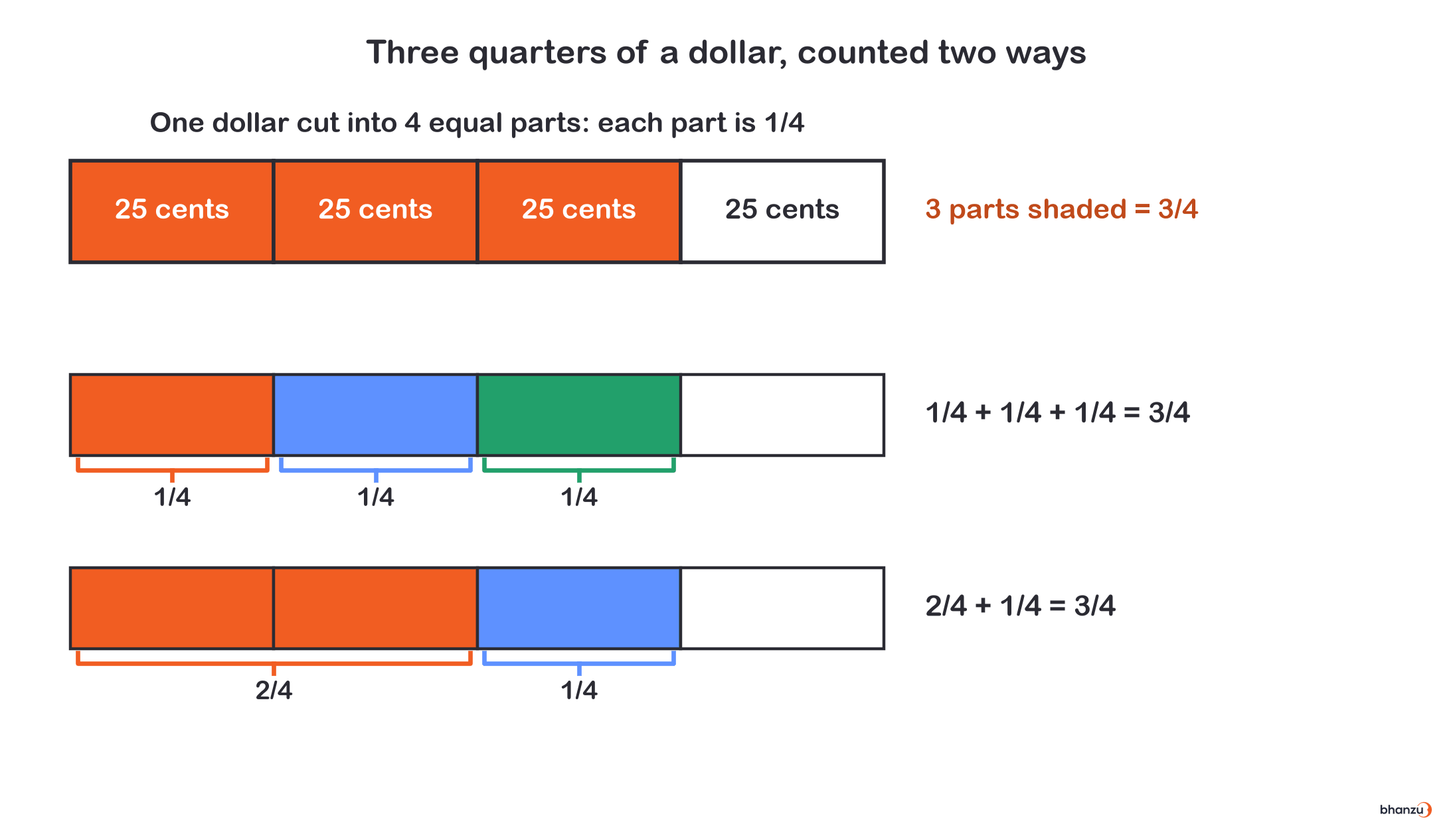
Three quarters, counted two ways
Three quarters in your pocket make 75 cents, however you count them. You can line them up one coin at a time, or push two together and leave one on its own. The money doesn't change.
Each quarter is one fourth of a dollar, so those two counts are two ways of splitting the same fraction. That move is called decomposing fractions. In a few weeks you'll use this exact split to add and subtract mixed numbers.
What does it mean to decompose a fraction?
Decomposing fractions is splitting a fraction into smaller fractions made of the same-size pieces, then writing them as an addition that totals the fraction you started with. To decompose a number in math is to break it into parts, the way 7 can be 4 + 3. The denominator (the bottom number) tells how many equal pieces make one whole, and the numerator (the top number) counts the pieces you have.
A fraction bar shows it before any symbols. Cut a strip into 8 equal pieces and shade 5. Group the shaded pieces as 2 and 3, and the strip reads . A unit fraction has 1 as its numerator, like , so it stands for exactly one piece.
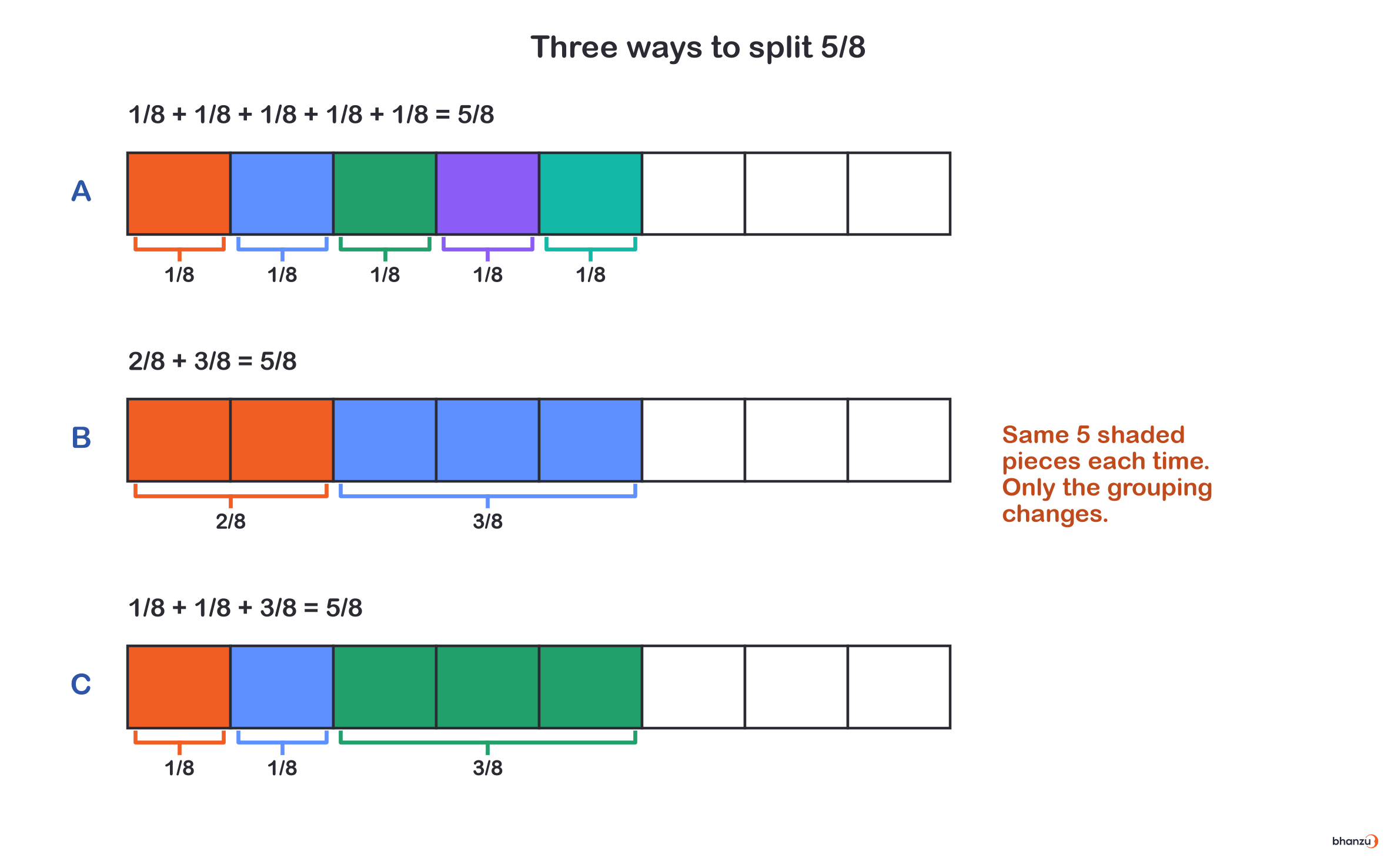
This is Common Core standard 4.NF.B.3.b, which asks for splits "in more than one way," each recorded as an equation. Your child is expected to justify each equation, for example with a fraction drawing, and in 4th grade the denominators stay among 2, 3, 4, 5, 6, 8, 10, 12 and 100.
How do you decompose fractions into unit fractions?
To decompose a fraction into unit fractions, write one unit fraction for every piece the numerator counts. Four sixths is 4 pieces of one sixth each.
Each one-sixth piece is one equal hop, the same hop you made with fractions on a number line in 3rd grade.
- Read the denominator and write the unit fraction with that bottom number.
- Write it as many times as the numerator says, with plus signs between.
- Add the numerators back and make sure you reach the top number you started with.
Why doesn't the bottom number change when you add the pieces back?
The denominator names the piece size, and adding same-size pieces never changes it. One sixth plus one sixth is two sixths, just as one apple plus one apple is two apples.
A 2010 Institute of Education Sciences fractions guide describes non-unit fractions as built from unit fractions, and adding the bottom numbers breaks that idea. In a 2017 study of 201 fourth graders, children treated the top and bottom numbers as two separate whole numbers on 120 of 1,809 same-denominator problems. That's about 7 in every 100, so step 3 earns its few extra seconds. With different denominators it happened on 965 of 2,211 problems, more than 4 in 10.
How many ways can you split the same fraction?
A numerator of 5 gives exactly 4 two-part splits when order counts and no part is zero, because the top number splits just like the whole number 5. Try to find all four before you read them here.
Any numerator follows the pattern of one fewer split than the top number, so 7 gives 6 two-part splits. Whether a split and its flipped order count as two ways or one is genuinely confusing (if order doesn't count, 5 has just 2 pairs).
The same pattern finds a missing part. If , the missing top number is . Splits can also have three parts.
A child who finds one split often stops right there, but the standard asks for more than one way. The method has one limit: every part must use the same piece size, so splitting three fourths into eighths means renaming it as six eighths with equivalent fractions first.
How do you decompose a mixed number?
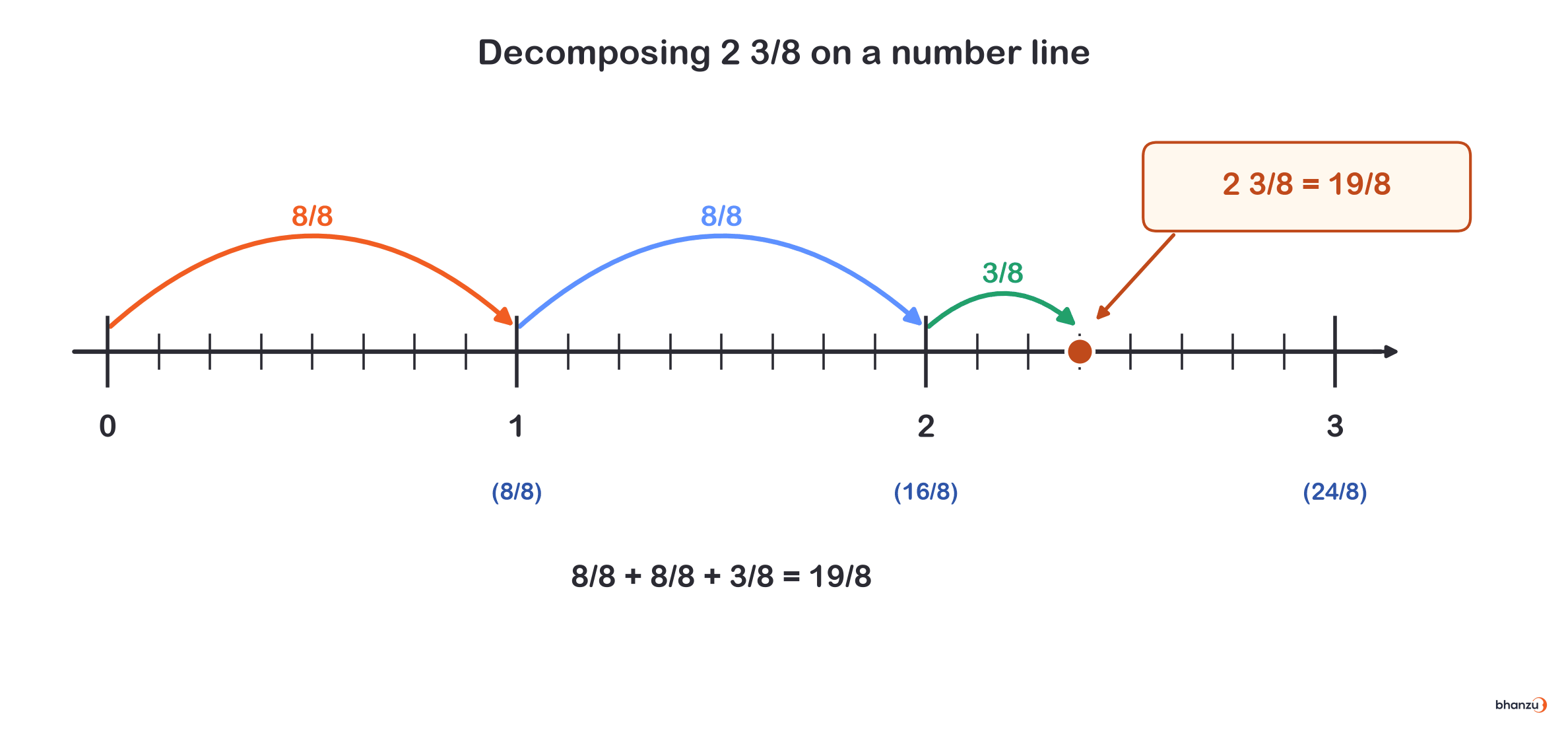
To decompose a mixed number, a whole number and a fraction written together, write each whole as a full set of pieces and then add the fraction part.
- Split off the wholes.
- Write each whole as eighths.
- Add the numerators, 8 + 8 + 3 = 19.
On a number line, that's a hop of 8 eighths to 1, another 8 eighths to 2, and 3 eighths more. You land on nineteen eighths, an improper fraction, which means its numerator is at least as big as its denominator.
| Mixed number | Wholes as pieces | One fraction |
|---|---|---|
Splitting off wholes is the first move in adding and subtracting mixed numbers.
Try It Yourself
Tap pieces of the fraction bar to color them, and press New part to start the next color. The equation grows as you shade. Check tells you whether your parts make the target fraction, and every new way you find joins a list.
Examples of decomposing fractions
Example 1
Write as a sum of unit fractions.
The unit fraction for fifths is one fifth, and the numerator asks for 3 of them.
Example 2
Write as a sum in two different ways.
Splitting both numbers looks fair. Break 5 into 2 + 3 and 8 into 4 + 4, and you get two fourths plus three fourths.
That's more than 1 whole, but five eighths is less than 1 whole (only 5 of 8 pieces). The split can't be right, because the pieces changed size from eighths to fourths.
Keep the eighths and split only the 5.
Check: 2 + 3 = 5 and 1 + 1 + 3 = 5.
Example 3
Find the missing number in .
The numerators must add to 7.
The missing fraction is .
Example 4
Decompose in two different ways.
One whole is six sixths, so two wholes are twelve sixths.
Both ways total thirteen sixths.
Example 5
Which sum is not equal to ?
Add the numerators of each choice.
Choice C is not equal, because it makes only eight twelfths.
Example 6
A pancake recipe needs cups of flour. Leo has only a quarter-cup scoop and has already poured in 3 scoops. How many more scoops does he need?
The unknown is the number of quarter-cup scoops Leo still has to pour. Write the whole cup as fourths first.
That's 7 scoops in all. Split seven fourths into the part poured and the part still missing.
The missing part is four fourths, which is 4 scoops. Leo needs 4 more scoops.
Check: 3 + 4 = 7 scoops, and seven fourths of a cup is cups.
The real reason decomposing fractions exists
A fraction is a count of equal pieces, and decomposing fractions lets you work with the pieces you actually have. That's why it turns up in kitchens, in money and in very old math records.
- It lets you measure with the scoop you own. A three-quarter-cup recipe works with a quarter-cup scoop used 3 times.
- It turns adding same-size pieces into counting. Two eighths plus three eighths is just 2 + 3 with the label eighths attached.
- It goes back thousands of years. To the ancient Egyptians, fractions were limited to unit fractions, apart from two thirds and, less often, three fourths. The Rhind papyrus, written around 1650 BC by the scribe Ahmes, has 87 problems, and 81 of them involve fractions.
Without decomposing, every fraction would be one solid block, and a quarter-cup scoop would be useless for that recipe.
Where do kids trip up on decomposing fractions?
Mistake 1: Adding the bottom numbers too
Where it slips in: Step 3 of the unit-fraction method, when the pieces go back together. Children treat the top and the bottom as two separate whole numbers, which is the habit the 2017 study measured.
Don't do this: .
The correct way: Four sixths make . The pieces stay sixths, and is only as big as one sixth.
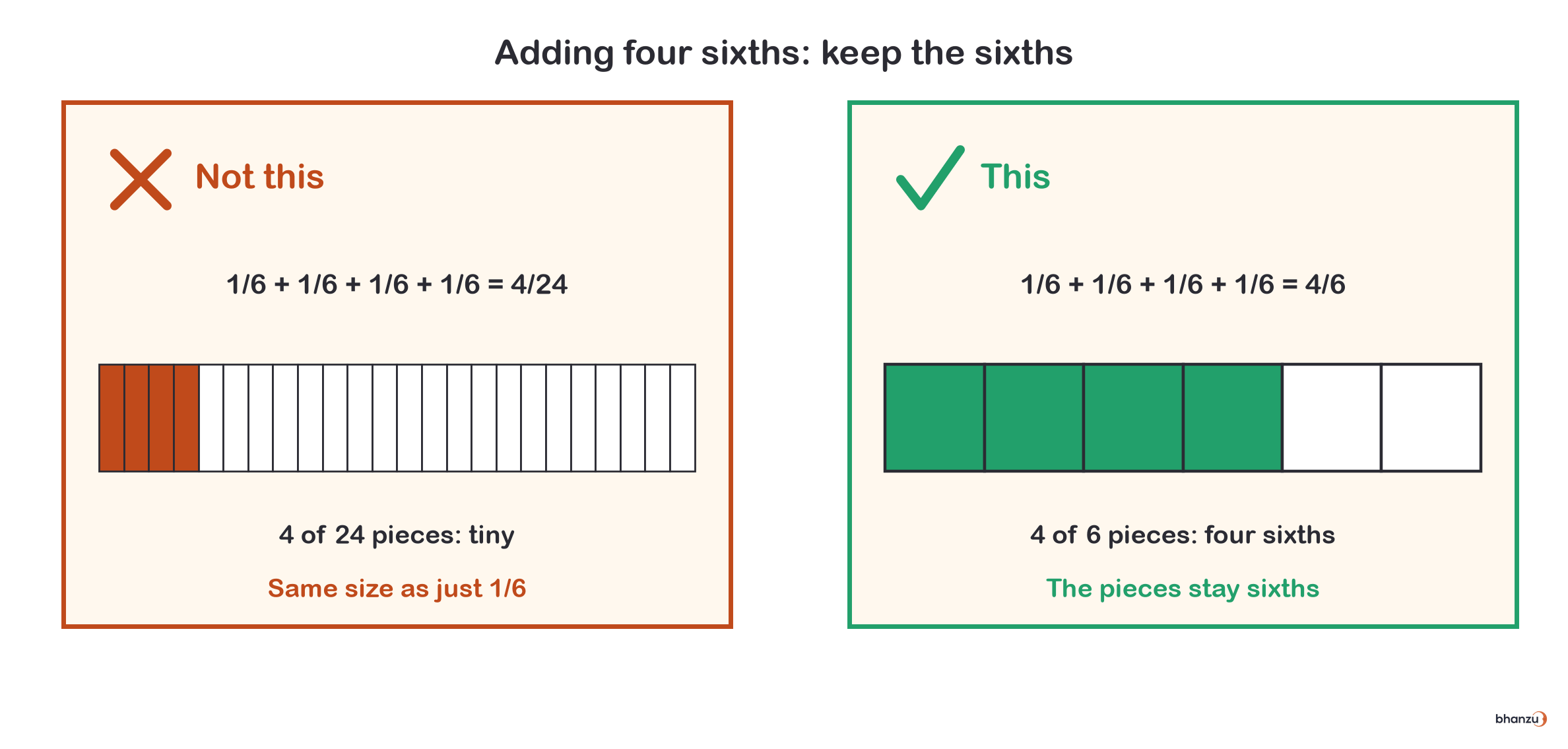
Reading the answer as "four over six" makes it sound like two numbers. Saying "four sixths" turns sixths into a name, like apples, and nobody adds the word apples to itself.
Mistake 2: Parts that don't add back to the fraction
Where it slips in: Long rows of unit fractions. A child copying the same fraction over and over loses count partway and stops one piece short.
Don't do this: Writing six times for , which only makes .
The correct way: Count the pieces before you stop, or group them, as in , where 4 + 3 = 7.
Mistake 3: Losing the whole in a mixed number
Where it slips in: Mixed numbers, as in Example 4. The 1 in sits right beside the fifths, so a child writes it as one fifth instead of one whole.
Don't do this: , which is only .
The correct way: One whole is , so .
A size check catches it: one and two fifths is more than 1, so a split that totals less than 1 has lost the whole.
What teachers watch for in decomposing fractions
The first thing teachers watch for is whether a child sees the numerator as a count of pieces. Once that clicks, splitting five eighths is the same job as splitting 5 with a number bond. Reading two stacked numbers as one amount is a big part of why fractions feel so hard at first, and a number bond gives your child a familiar handhold.
Can you decompose into fractions with different denominators?
Yes, is true, but in 4th grade every part keeps one denominator, and mixing halves with fourths is a 5th grade skill. Five copies of one fourth also lead to multiplying fractions by whole numbers, where .
Key Takeaways
- Say the piece name out loud, such as sixths, and keep it on every part of a split.
- Check any split by adding the numerators back to the top number you started with.
- Decomposing fractions with a whole in them gets easier once each whole becomes a full set of pieces.
- The 4th grade standard asks for more than one way, so hunt for a second split.
- For help splitting mixed numbers into wholes and pieces with a teacher who spots the 4/24 habit early, explore Bhanzu's 4th grade math tutor or Common Core math curriculum.
Read More
- Comparing Fractions of Different Wholes
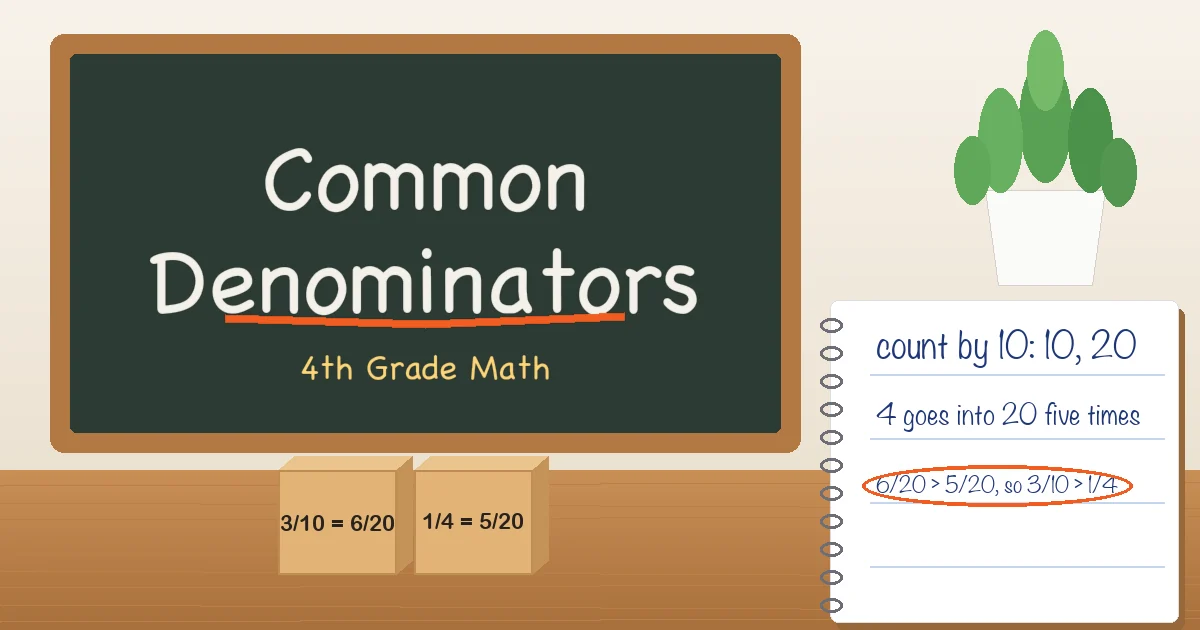
- Common Denominators
- Fractions With Denominators of 10 and 100
- Equivalent Fractions With Models
- Fraction Addition and Subtraction Word Problems
Research Behind This Article
- Common Core State Standards Initiative, Grade 4: Number and Operations, Fractions (2010). thecorestandards.org
- Robert Siegler and others, Institute of Education Sciences, Developing Effective Fractions Instruction for Kindergarten Through 8th Grade (2010). ies.ed.gov
- Robin F. Schumacher and Amelia S. Malone, Error Patterns with Fraction Calculations at Fourth Grade as a Function of Students' Mathematics Achievement Status (2017). eric.ed.gov
- J J O'Connor and E F Robertson, MacTutor, University of St Andrews, Egyptian numerals (2000). mathshistory.st-andrews.ac.uk
- J J O'Connor and E F Robertson, MacTutor, University of St Andrews, An overview of Egyptian mathematics (2000). mathshistory.st-andrews.ac.uk
Quick Quiz: Check Yourself
Three levels, new numbers every time: count or add unit fractions, find a missing part or pick a matching sum, then turn a mixed number into pieces or solve a scoop problem.
Was this article helpful?
Your feedback helps us write better content
Frequently Asked Questions
Can you decompose fractions to subtract?
What is the difference between composing and decomposing fractions?
Is decomposing fractions the same as partial fraction decomposition?
What grade do kids learn decomposing fractions?
How can I help my child understand decomposing fractions at home?