Key Points
- Fractions with denominators of 10 and 100 split one whole into 10 or 100 equal parts, so one tenth fills a column of 10 small squares on a hundred grid.
- Multiplying the numerator and denominator of a tenths fraction by 10 renames it in hundredths, so becomes with no change in size.
- Adding straight across turns into , which is smaller than alone and so cannot be the sum.
Three dimes, thirty pennies, same money
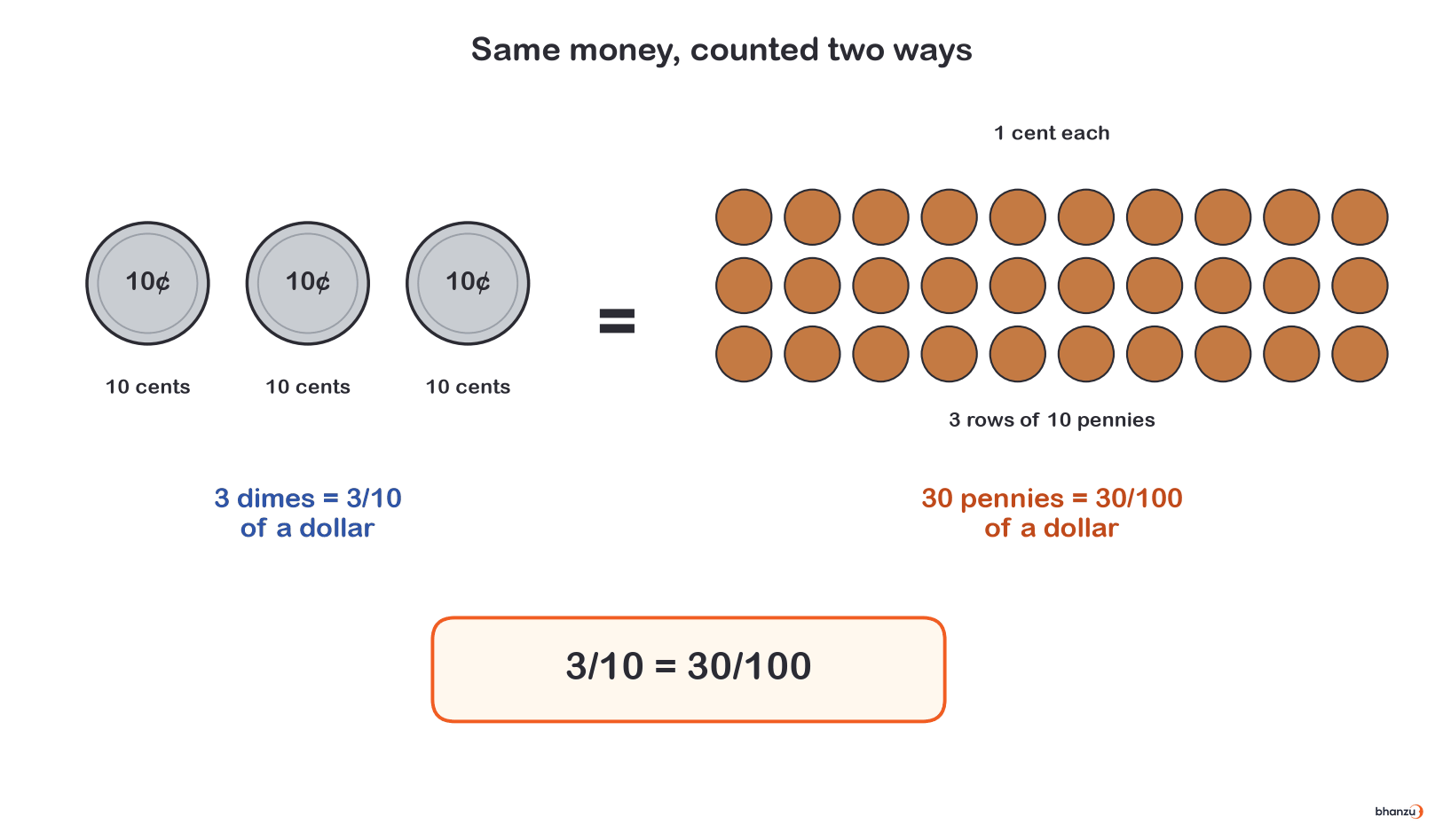
Three dimes and thirty pennies buy exactly the same pencil. The piles look nothing alike, yet both are worth 30 cents.
A dime is one of 10 equal parts of a dollar, and a penny is one of 100. Swap each dime for 10 pennies and nothing is lost.
That swap is the whole move behind adding tenths to hundredths. Soon you'll write these amounts as decimals like 0.3, and in 5th grade you'll add decimals by lining up tenths and hundredths the same way.
What are fractions with denominators of 10 and 100?
Fractions with denominators of 10 and 100 are fractions whose bottom number, the denominator, is 10 or 100. A denominator of 10 cuts one whole into 10 equal parts called tenths, and a denominator of 100 cuts it into 100 equal parts called hundredths.
A hundred grid, a square split into 10 rows and 10 columns, shows both sizes at once. One full column is 1 tenth, and one small square is 1 hundredth.
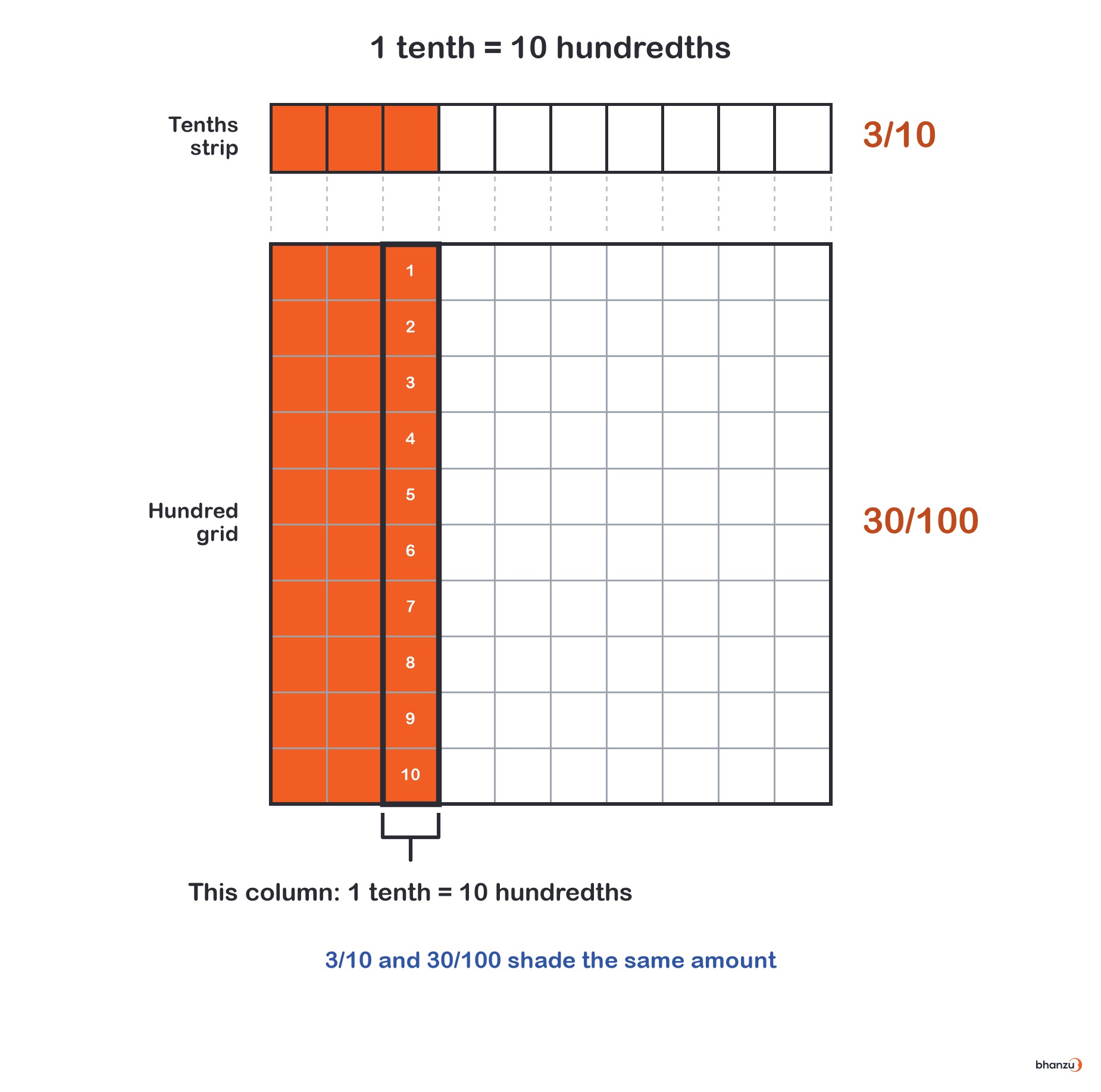
How many hundredths are in a tenth? Ten, because each column holds 10 small squares. So and cover the same area and land on the same point of a number line.
For parents, this is Common Core standard 4.NF.C.5. Its footnote says adding fractions with unlike (different) denominators in general isn't required in 4th grade, so tenths plus hundredths is the one unlike pair your child adds this year. As a national yardstick, the 2024 NAEP mathematics results put 39 percent of 4th graders at or above NAEP Proficient, 3 points up from 2022.
How do you convert tenths to hundredths?
To convert tenths to hundredths, multiply the numerator, or top number, and the denominator by 10. The old and new fractions are equivalent fractions, which name the same amount with different numbers.
- Multiply the numerator by 10, so .
- Multiply the denominator by 10, so .
- Write the new fraction.
Multiplying the bottom by 10 cuts every tenth into 10 thinner pieces. Each piece is one tenth as big, and multiplying the top by 10 counts the same shaded part in those smaller pieces, so the amount never changes. The top grows just as 3 becomes 30 when multiplying by 10 with whole numbers.
Renaming runs backward only when the hundredths fill whole columns. So , but has no tenths twin, because 3 squares are left over.
| Tenths | Hundredths | Decimal | Money |
|---|---|---|---|
| 0.1 | 10 cents | ||
| 0.3 | 30 cents | ||
| 1 | 1 dollar |
How the numbers sound matters too. In a 2017 study of 104 third and fourth graders, children taught formal labels such as "3 tenths and 4 hundredths" for 0.34 did better on problems about the role of zero. Informal labels like "point three four" helped less. At home, say "30 hundredths" rather than "thirty over a hundred" to your child.
How do you add tenths and hundredths?
Make both fractions count hundredths, then add the numerators and keep 100 as the denominator. Adding fractions with denominators 10 and 100 needs that renaming step, because numerators can only be added when the pieces are the same size.
- Rename the tenths, so .
- Add the numerators, .
- Keep the denominator, 100.
- Check with coins. Four dimes and 27 pennies make 67 cents.
The order doesn't matter, so is also . Renaming also finds a missing part, since means hundredths are missing. A shaded grid or a pile of coins gives the same answer, but renaming works on paper for every tenths-plus-hundredths sum.
Multiplying by 10 works here because 10 tens make 100. A sum such as has no shortcut like that, so it waits for 5th grade and a common denominator such as 12.
What happens when the sum passes one whole?
When the numerators add up to more than 100, the sum is bigger than 1 whole. You can leave it as an improper fraction (top at least as big as the bottom) or write it as a mixed number, a whole number and a fraction together.
- Rename the tenths, so .
- Add the numerators, , which makes .
- Split off one whole. 100 hundredths fill one grid, and 15 hundredths are left over.
Seven dimes and 45 pennies make 1 dollar and 15 cents. The mixed number is written as in adding and subtracting mixed numbers, whole number first.
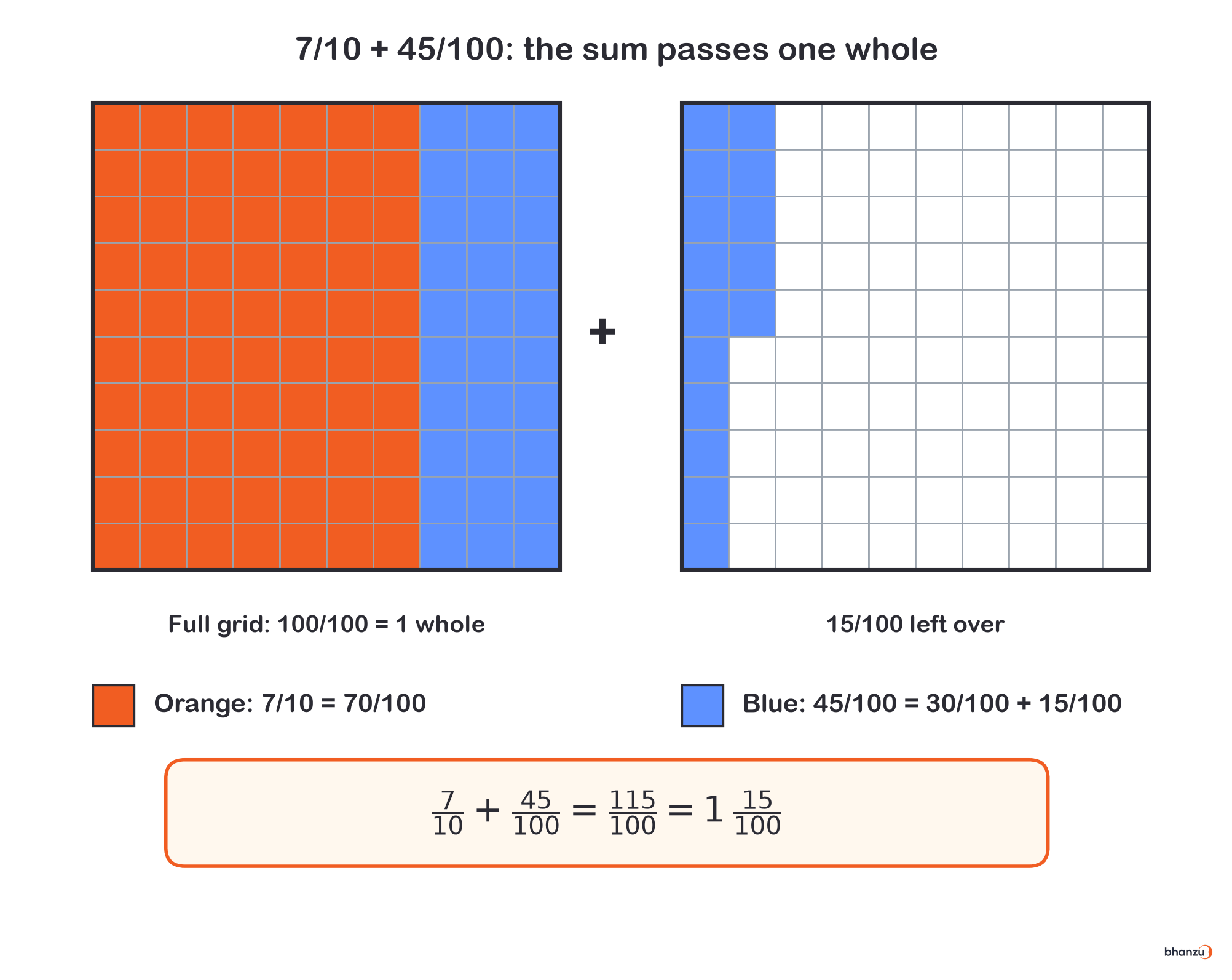
Some children see 115 on top and erase it, sure they've broken a rule. They haven't. is correct, and just makes its size easier to read.
Try It Yourself
Tap a part of the tenths strip to shade whole columns as tenths, or tap a square of the grid to shade one more hundredth, and the readout adds them in hundredths. Press New target for a sum to build, then press Check. Watch how each shaded column counts as 10 hundredths.
Why do fractions with denominators of 10 and 100 matter?
Tenths and hundredths are the sizes dollars and meters are cut into, so renaming lets you add a dime-sized piece to a penny-sized one. It is also your first sum with two different denominators.
- It runs every price. A cent is one hundredth of a dollar, so 3 dimes and 5 pennies make of a dollar, written $0.35 on a price tag.
- It measures in centimeters. The National Institute of Standards and Technology lists the prefix centi as one hundredth, so a ribbon meter long is meter, or 40 centimeters.
- It leads straight to decimals. In a 2023 study of 200 students in China, Yunqi Wang and Robert Siegler found that a sense of decimal size became accurate earlier than a sense of fraction size. Linking to 0.35 puts fractions, decimals and percentages in one family.
Every one of those uses rests on one trade, 1 tenth for 10 hundredths, the same swap as 1 dime for 10 pennies.
Examples of fractions with denominators of 10 and 100
Example 1
Rename as hundredths.
Multiply the top and the bottom by 10.
Example 2
Add .
The tempting move is to add straight across, on top and on the bottom, for .
That can't be right. The answer is less than one half (half of 110 is 55), but alone is more than one half, and adding should make it bigger.
Rename first instead.
Six dimes and 23 pennies make 83 cents, which matches.
Example 3
Find the missing number in .
Rename the tenths.
Then , so the missing number is 8.
Example 4
Add and write the sum as a mixed number.
Rename the tenths as 90 hundredths, then add.
100 hundredths make 1 whole, and 26 hundredths are left.
Nine dimes and 36 pennies make 1 dollar and 26 cents.
Example 5
Which is greater, or ?
Rename each tenths fraction, then add.
35 hundredths is more than 32 hundredths, so the second sum is greater, by 3 hundredths.
Example 6
Priya pours liter of orange juice and liter of mango juice into a 1-liter pitcher. How much juice is in it, and will liter more fit?
Rename the orange juice as 50 hundredths, then add.
Add the extra juice.
A full pitcher holds 100 hundredths, and 103 is more than 100. The pitcher holds liter, and the extra juice won't fit.
The part of tenths and hundredths nobody explains
Two ideas sit underneath this skill.
- "Add a zero" really means multiply by 10. A zero after both the 3 and the 10 in multiplies top and bottom by 10, while a zero on the bottom alone turns into , a tenth of the size.
- A sum is never smaller than its parts. When both fractions are bigger than 0, an answer smaller than either one is wrong on sight.
One honest snag trips up adults too. A zero added to the end of a decimal changes nothing, since 0.3 and 0.30 are the same amount. Calling the move "multiply the top and the bottom by 10" keeps it working when you start comparing decimals like 0.95 and 0.9.
Tenths and hundredths: where intuition breaks
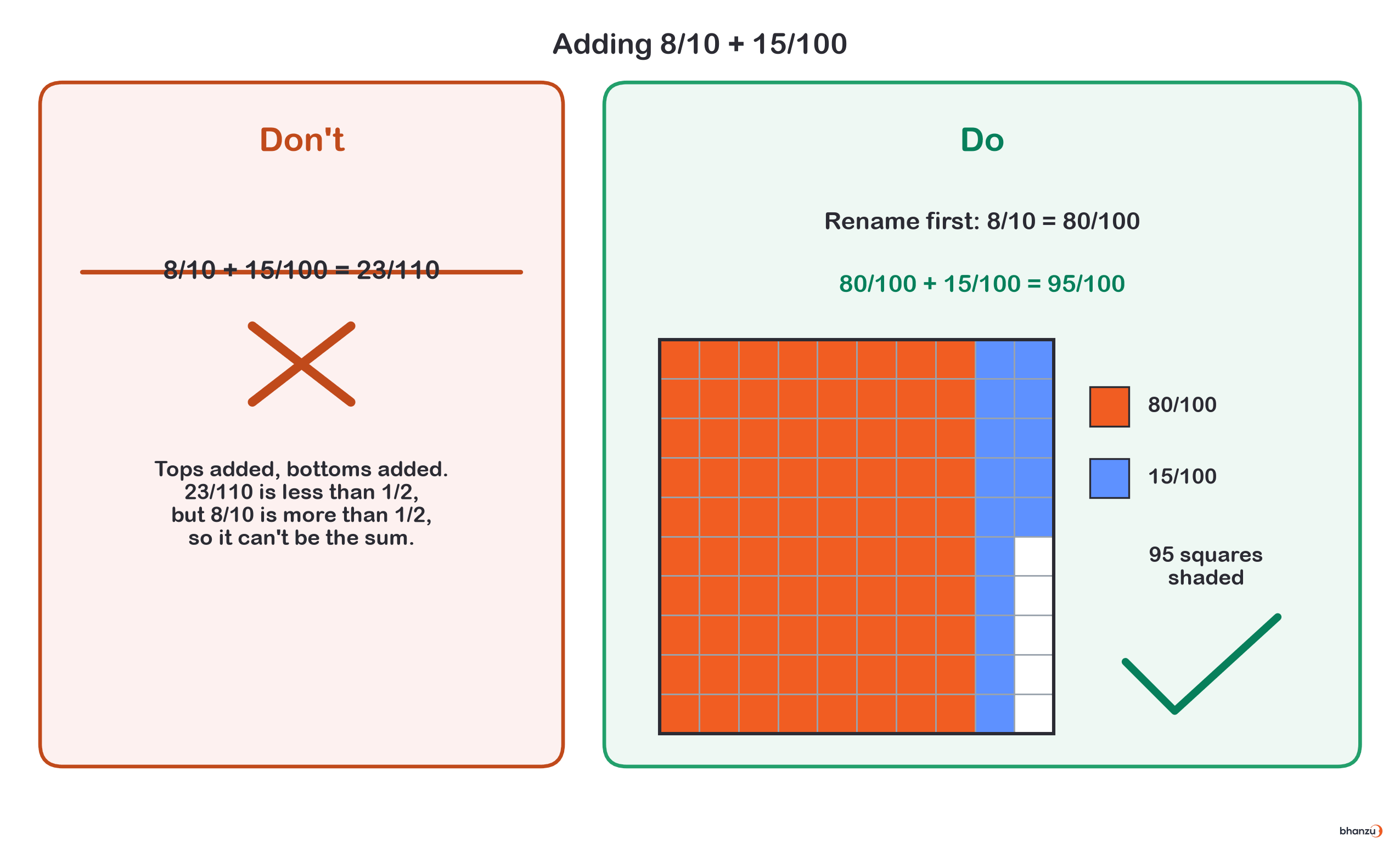
Mistake 1: Adding the tops and adding the bottoms
Where it slips in: Any tenths-plus-hundredths sum. Children treat the top and the bottom as two separate whole numbers and add each pair, the way they add columns of whole numbers.
Don't do this: .
The correct way: Rename first, so , then .
Mistake 2: Changing only the bottom number
Where it slips in: Renaming, when the "add a zero" shortcut is half-remembered. A child who rushes often puts one zero on the bottom and stops.
Don't do this: .
The correct way: (7 dimes are 70 cents, not 7 cents).
Mistake 3: Thinking hundredths are bigger because 100 is bigger
Where it slips in: Comparing tenths with hundredths. Children carry over the whole-number habit that a bigger number always means more.
Don't do this: Deciding that is more than because 9 is more than 1 and 100 is more than 10.
The correct way: Rename, so , which is more than , just as a dime is worth more than 9 pennies.
A bigger denominator means more, smaller pieces. Researchers call this habit whole-number bias, and Loehr and Rittle-Johnson's 2017 study suggests formal place-value labels may reduce it.
Key Takeaways
- Before adding, check both denominators, and if one fraction counts tenths, multiply its top and bottom by 10.
- On a hundred grid, 6 shaded columns and 60 shaded squares cover the same area, which is why 6 tenths equal 60 hundredths.
- An answer smaller than one of the fractions you added means it's time to go back and rename.
- Coins make a fast check for fractions with denominators of 10 and 100, since dimes are tenths of a dollar.
- When renaming tenths as hundredths needs a second pair of eyes, especially on answers like , explore Bhanzu's 4th grade math curriculum or math classes for kids.
Read More
- Decomposing Fractions
- Multiplying Fractions by Whole Numbers
- Equivalent Fractions With Models
- Regrouping Decimals
- Adding Decimals
- Mental Math With Fractions
Research Behind This Article
- Common Core State Standards Initiative, Grade 4: Number and Operations, Fractions (2010). thecorestandards.org
- National Center for Education Statistics, The Nation's Report Card: 2024 Mathematics, Grade 4 National Trends (2025). nationsreportcard.gov
- Loehr, A. M. and Rittle-Johnson, B., Putting the "th" in Tenths: Providing Place-Value Labels Helps Reveal the Structure of Our Base-10 Numeral System, Journal of Cognition and Development (2017). eric.ed.gov
- OpenStax, Prealgebra 2e, 5.1 Decimals (2020). openstax.org
- National Institute of Standards and Technology, Metric (SI) Prefixes (2025). nist.gov
- Wang, Y. and Siegler, R. S., Developmental Trajectories of Numerical Magnitude Representations of Fractions and Decimals, Developmental Psychology (2023). eric.ed.gov
Quick Quiz: Check Yourself
Three levels, new numbers every time: rename a tenths fraction as hundredths, add tenths to hundredths or find the missing part, then solve a word problem whose sum passes one whole.
Was this article helpful?
Your feedback helps us write better content
Frequently Asked Questions
What percent is 3/10?
How do I teach tenths and hundredths at home?
Do 4th graders learn thousandths too?
What is one and seventy-two hundredths?
How do I know if my child has got this down?