Key Points
- In multiplying fractions by whole numbers, the whole number counts copies of the fraction, so is 9 eighths.
- Every fraction is a count of unit fractions, as is five copies of , so multiplying counts more pieces of one size.
- A common error multiplies the bottom number too, turning into , which equals only one group.
- Common Core places this skill in 4th grade, including word problems and naming the two whole numbers an answer falls between.
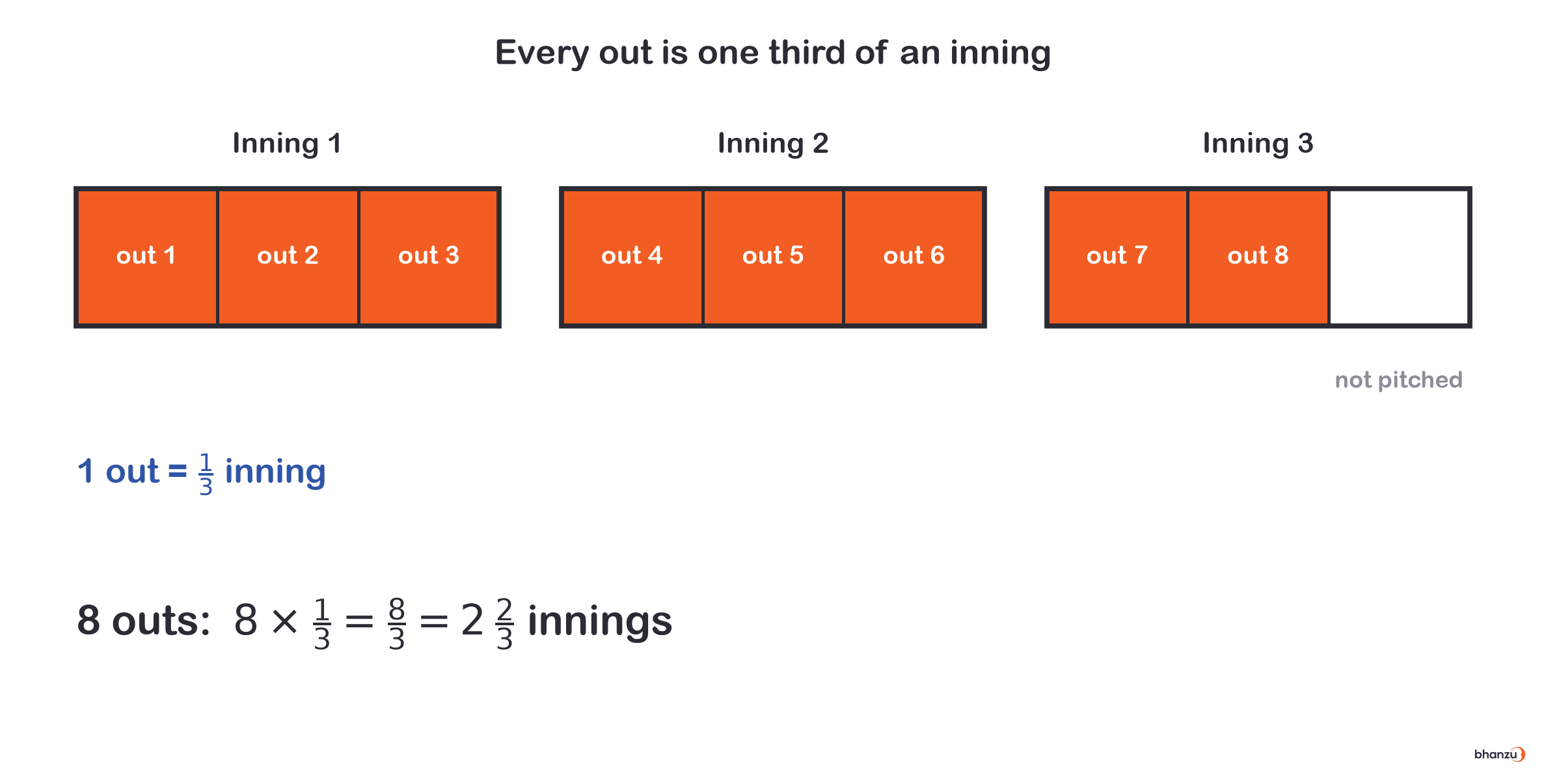
Every out is a third of an inning
Every out a baseball pitcher gets counts as one third of an inning. An inning ends after three outs, so Major League Baseball counts innings pitched in thirds.
A pitcher with 8 outs has pitched 8 thirds of an inning. That fills 2 whole innings, with 2 thirds left over.
That counting job multiplies a fraction by a whole number, and soon you'll use the same move to scale up a recipe.
How do you multiply a fraction by a whole number?
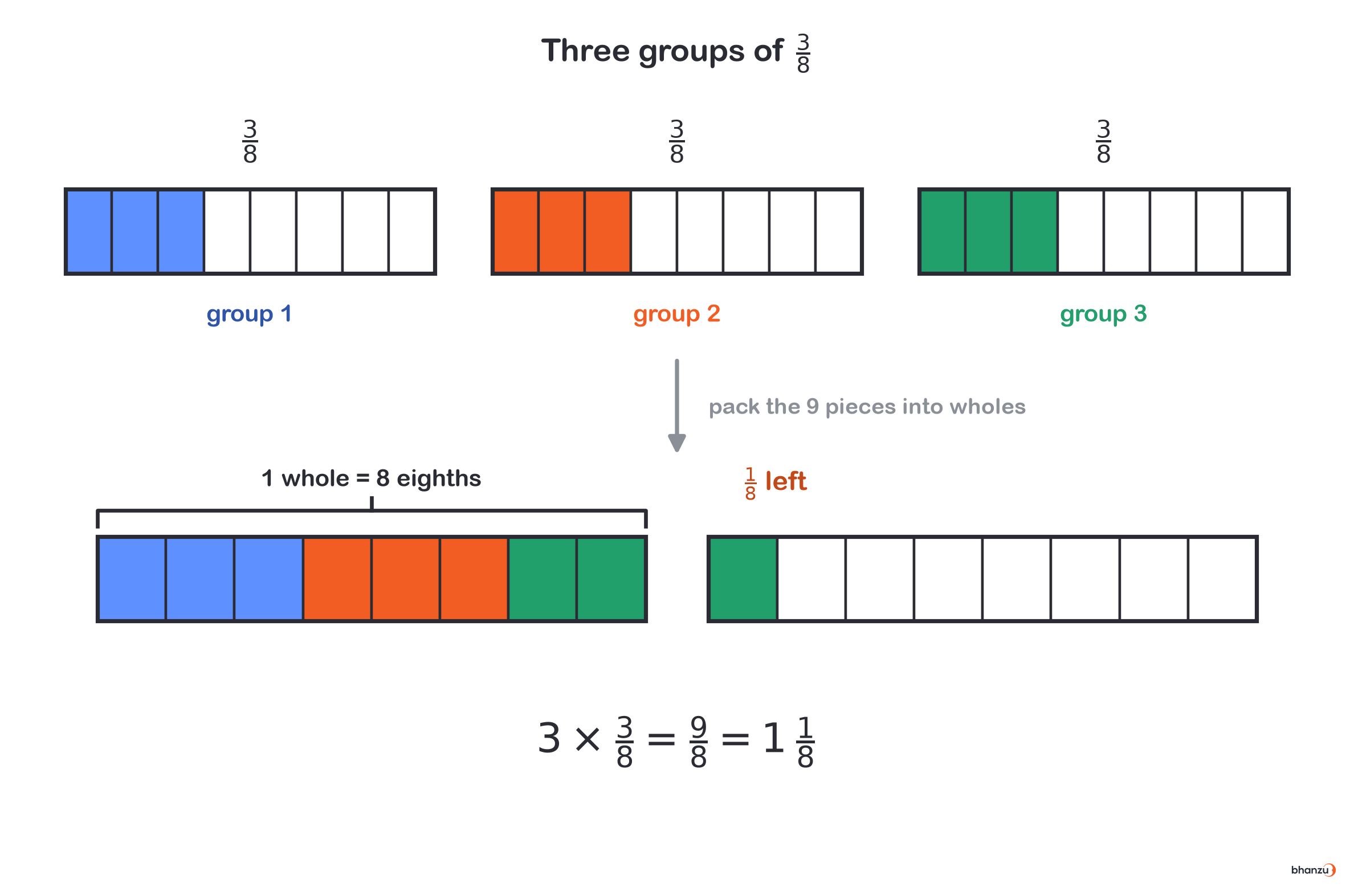
Multiplying fractions by whole numbers works by drawing as many copies of the fraction as the whole number says on a fraction bar (a strip cut into equal pieces), then counting the pieces. In , the numerator 3 (the top number) counts shaded pieces, and the denominator 8 (the bottom number) names their size.
So means 3 groups of 3 eighths, since "of" here means multiply. Together they hold 9 eighths, or .
Four methods give the same product:
- Equal groups. Draw the groups on fraction bars and count.
- Repeated addition. Add the fraction once per group.
- Number line hops. Hop once per group, starting at 0.
- The rule. Multiply the top number by the whole number and keep the bottom number.
In the rule, is the number of groups, the pieces in each group and the piece size.
It works because groups of pieces make pieces of the same size, and it beats drawing once groups pile up.
This is Common Core standard 4.NF.B.4, with 4th grade denominators of 2, 3, 4, 5, 6, 8, 10, 12 and 100. By the end of the year, your child should be able to draw a product like this, write its equation and say which two whole numbers the answer sits between.
Why is every fraction a group of unit fractions?
Every fraction counts copies of one small piece. A unit fraction is one equal piece of a whole, with 1 on top, such as . Five of them make , and splitting a fraction into unit pieces is decomposing fractions.
Multiplying unit fractions by whole numbers is the simplest case, since 7 groups of one tenth are 7 tenths. The bottom number stays put because it names the piece size, and more groups never change how big a piece is.
| Groups | Repeated addition | Unit fractions | Fraction |
|---|---|---|---|
A child who recites "multiply the top, keep the bottom" without knowing why often drops the rule when a problem looks new. Counting aloud, "one eighth, two eighths", keeps the reason attached.
Try It Yourself
Use the plus and minus buttons to set the groups and the fraction, and watch the pieces pack into whole bars as the equation changes. Press Challenge, tap pieces to shade your own answer, then press Check.
What happens when the answer is bigger than 1?
When the groups hold more pieces than one whole, pack the pieces into wholes. A whole holds as many pieces as the denominator says, so 6 sixths make 1 whole.
On a number line, is three equal hops of from 0, like the jumps for fractions on a number line in 3rd grade.
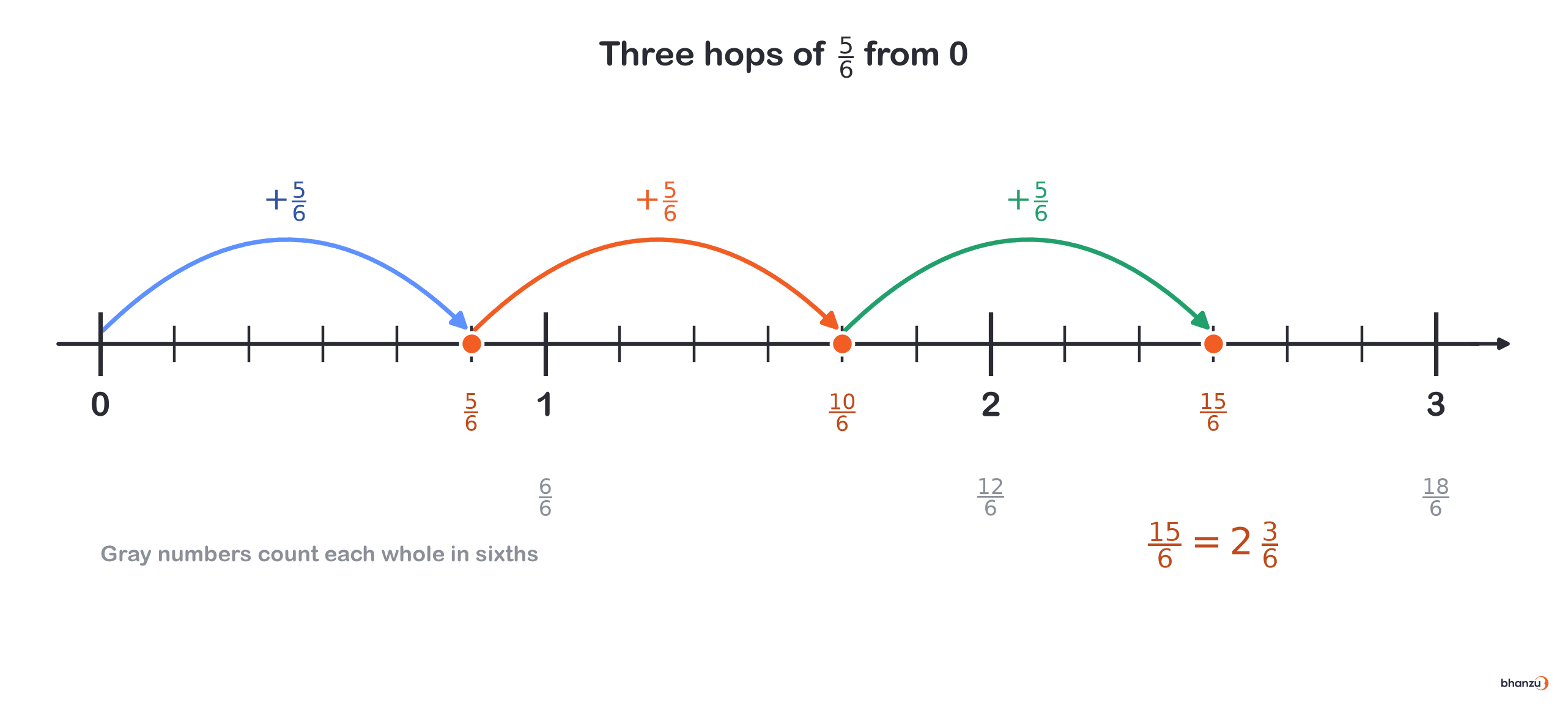
- Multiply the top number. Three times 5 is 15, so the product is 15 sixths.
- Count the wholes. Twelve sixths make 2 wholes.
- Write what is left. That leaves 3 sixths, so .
The fraction is an improper fraction, with a top number at least as big as its bottom number. As 2 wholes and 3 sixths, it becomes a mixed number, a whole number and a fraction together.
A common first instinct is to divide 15 by 5, the top number of one group, instead of by 6. A 2010 Institute of Education Sciences practice guide recommends number lines as a central tool for teaching fractions, and hops that sail past 1 show why.
How do you solve word problems with fractions and whole numbers?
Word problems hide the same multiplication inside a story.
- Find the size of one group, usually the fraction after "each".
- Find the number of groups, the whole number.
- Multiply, then pack into wholes if the answer passes 1.
Each lap of a path is mile, and Maya walks 7 laps. The unknown is Maya's total distance in miles. Seven groups of one quarter make 7 quarters, and 4 quarters fill 1 whole, so Maya walks miles, between 1 and 2.
| Words in the problem | Math it means |
|---|---|
| "each lap is 1/4 mile" | the size of one group |
| "7 laps" | the number of groups |
| "how far in all" | multiply, |
| "between which two whole numbers" | , so 1 and 2 |
Examples of multiplying fractions by whole numbers
Example 1
What is ?
Four groups of one sixth are 4 sixths.
Example 2
What is ?
The tempting move multiplies the top and the bottom by 4, giving .
Divide the top and bottom of by 4, though, and you're back at . They're equivalent fractions, so is only one group's worth, and 4 groups must be more than that.
Count tenths instead. Four groups of 3 tenths are 12 tenths.
The answer sits between 1 and 2.
Example 3
Which top number makes true?
The bottom number stays 12, so divide 15 by 5 to undo the times 5 and find the missing top number.
The missing number is 3.
Example 4
Multiply and write the answer as a mixed number.
Eight quarters make 2 wholes, with 1 quarter left.
Example 5
Without drawing, is more or less than 3? Then find it exactly.
Five groups of 2 thirds make 10 thirds. Exactly 3 wholes would be 9 thirds, so 10 thirds is more than 3.
Example 6
Diego, a pitcher, gets 2 outs in each of 4 games and 5 outs in a fifth. Each out is one third of an inning. How many innings did Diego pitch in all?
The unknown is Diego's total innings.
Both parts are thirds, so add the top numbers.
Diego pitched innings, between 4 and 5. Counting outs agrees, since 8 outs plus 5 more makes 13 outs, or 13 thirds.
Where multiplying fractions by whole numbers shows up in real life
This skill exists because life repeats the same part-sized amount, and multiplying beats adding one fraction over and over.
- It keeps score in baseball. Seven outs are 7 thirds of an inning, or innings.
- It scales a recipe. Five batches with cup of flour each take 15 quarters of a cup, or cups.
- It builds toward algebra. A 2012 study of 599 US children and 3,677 UK children found that fractions knowledge around age 10 predicted high school algebra and math achievement 5 or 6 years later. That held even after accounting for IQ and family income.
In the 2024 Nation's Report Card, 39 percent of US 4th graders scored at or above Proficient in math, up 3 points from 2022. The figure covers all of 4th grade math, fractions included.
What most guides miss about multiplying fractions by whole numbers
The denominator is a name, like "tens" or "apples", and names don't get multiplied. Four groups of 2 apples are 8 apples, and four groups of 2 fifths are 8 fifths, for the same reason.
Some pages teach writing the whole number over 1 and multiplying across. It works, since multiplying the bottom number by 1 changes nothing, but it hides the reason, and without the reason the error in Example 2 is hard to spot.
The standard's question about which two whole numbers an answer lies between doubles as a built-in check. For , the product must be bigger than and smaller than 4, so fails at once. Next year the order flips to finding a fraction of a whole number, such as three fifths of 10.
Multiplying fractions by whole numbers: where intuition breaks
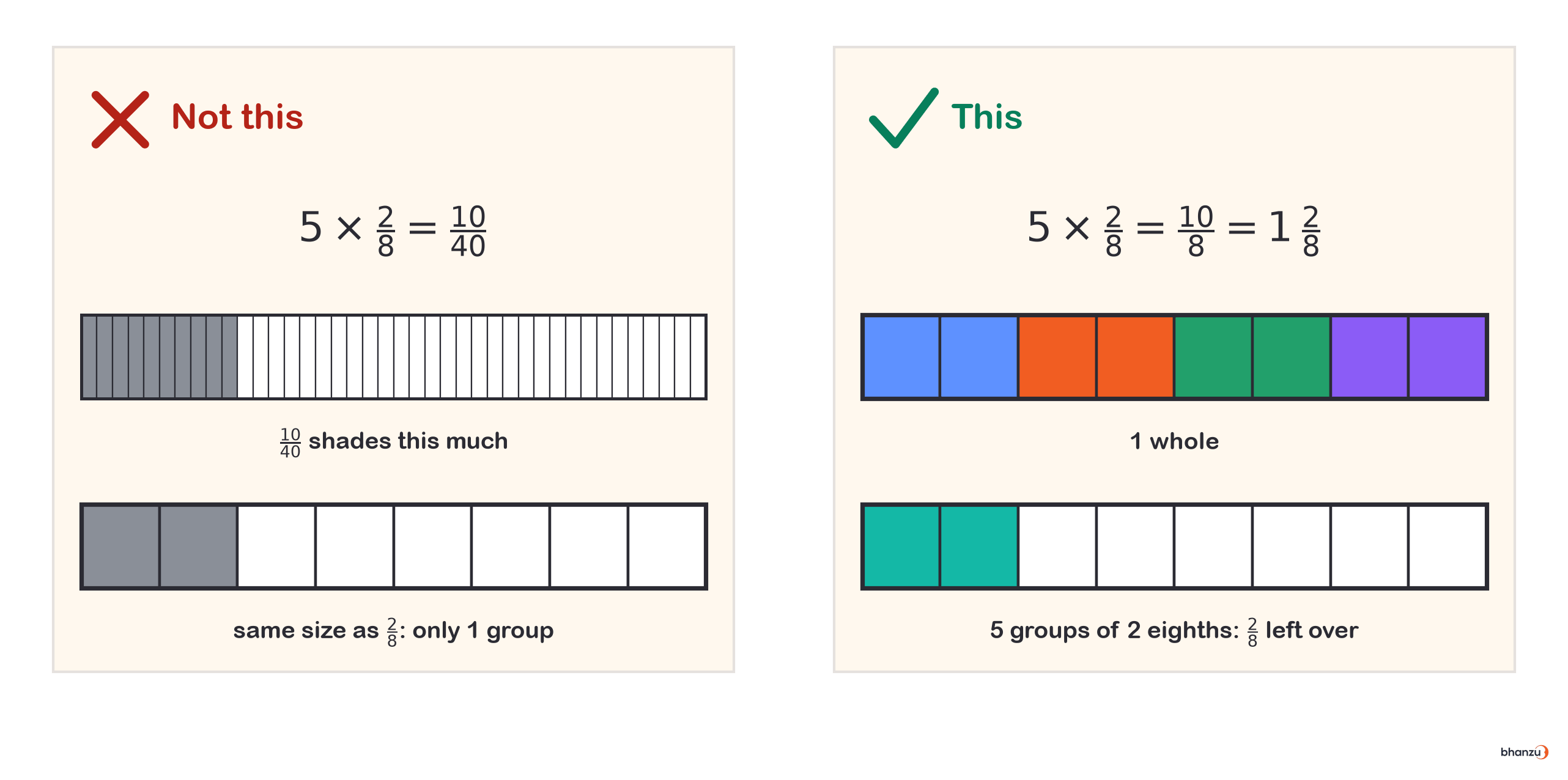
Mistake 1: Multiplying the bottom number too
Where it slips in: Right after times tables, when every number on the page looks like something to multiply.
Don't do this: .
The correct way: Five groups of 2 eighths are 10 eighths, so the product is .
The times-table habit is strong, but is the same amount as , only one group.
Mistake 2: Adding the whole number instead of multiplying
Where it slips in: Stories such as 6 jars that each hold 2/3 cup of beads, where the whole number and the fraction look like a ready-made mixed number.
Don't do this: cups.
The correct way: Six groups of 2 thirds make 12 thirds, and every 3 thirds fill 1 cup, so the jars hold 4 cups.
A child who gets bare problems right but writes in a story is stuck on the reading, so ask your child to name one group first.
Mistake 3: Thinking a big top number means a wrong answer
Where it slips in: Answers like in Example 4. First fraction lessons show parts of one whole, so more than a whole can feel impossible.
Don't do this: Turning into 7 because "can't be a fraction".
The correct way: Count halves past 1 on a number line. Seven halves are 3 wholes and 1 half, or .
A child who second-guesses a right answer often erases , which is part of why fractions feel so hard at first.
Key Takeaways
- When multiplying fractions by whole numbers, keep the denominator, since more groups never resize a piece.
- An answer past 1 is still a fraction, and packing it into wholes shows which two whole numbers it sits between.
- For more practice packing pieces into wholes with a teacher who catches the habit early, explore Bhanzu's 4th grade math tutor or elementary math programs.
Read More
- Adding and Subtracting Mixed Numbers
- Fractions With Denominators of 10 and 100
- Multiplicative Comparison
- Multiplying Fractions
- Multiplying Fractions Word Problems
- Mental Math With Fractions
Research Behind This Article
- Common Core State Standards Initiative, Grade 4: Number and Operations, Fractions (2010). thecorestandards.org
- Institute of Education Sciences, Developing Effective Fractions Instruction for Kindergarten Through 8th Grade (2010). ies.ed.gov
- Robert S. Siegler and others, Early Predictors of High School Mathematics Achievement (2012). eric.ed.gov
- National Center for Education Statistics, The Nation's Report Card: 2024 Mathematics Grade 4 National Trends (2025). nationsreportcard.gov
- National Mathematics Advisory Panel, Foundations for Success: The Final Report (2008). files.eric.ed.gov
Quick Quiz: Check Yourself
Three levels with fresh numbers: work with unit fractions, multiply by any fraction or find a missing top number, then solve a story problem or place an answer between two whole numbers.
Was this article helpful?
Your feedback helps us write better content
Frequently Asked Questions
How do you multiply a mixed fraction by a whole number?
Is the same as ?
Do you have to simplify the answer?
What grade do kids learn multiplying fractions by whole numbers?
How can I explain multiplying fractions by whole numbers at home?