Key Points
- Multiplying the numerator and denominator of by 4 makes , so finding equivalent fractions by multiplying gives a new name for the same amount.
- Multiplying a denominator by 4 cuts every part into 4 smaller parts, so the whole holds 4 times as many parts, each a quarter of its old size.
- Adding the same number, other than 0, to the top and bottom of a fraction less than 1 makes it bigger, since adding 2 turns two thirds into four fifths.
- Common Core's 4th grade standard 4.NF.A.1 extends 3rd grade equivalent fractions to denominators 2, 3, 4, 5, 6, 8, 10, 12 and 100, just before comparing fractions with different denominators.
More pieces, same amount of brownie
Cutting brownies into smaller pieces never makes more brownie.
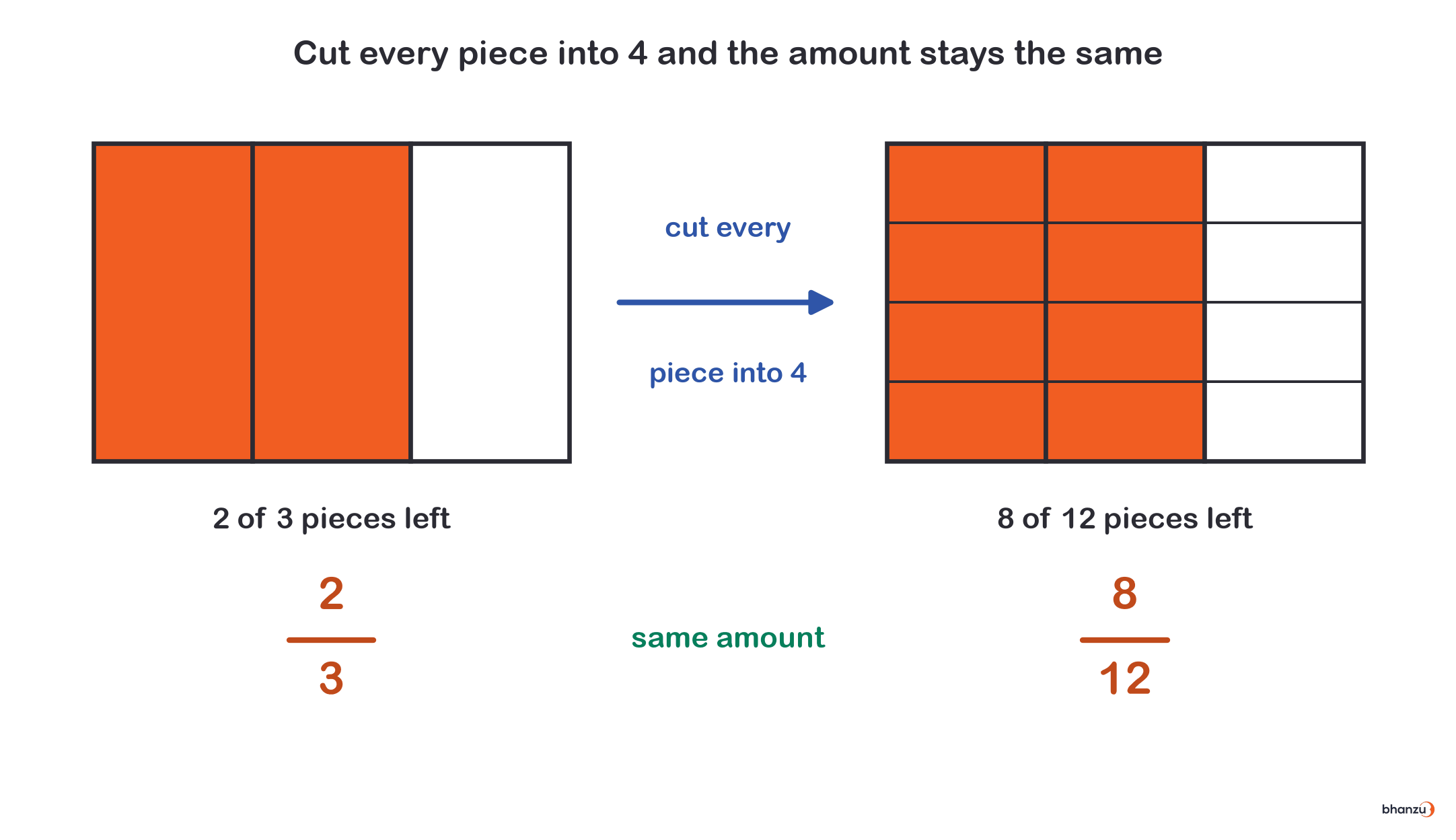
Say a pan holds 3 big pieces and 2 are still there. Cut every big piece into 4, and the pan has 12 small pieces, with 8 still there. The numbers jumped from 2 out of 3 to 8 out of 12, and nobody added a crumb.
Two fractions, one amount of brownie. In a few weeks you'll use that cutting move to tell which is bigger, two thirds or three fourths.
How do you find equivalent fractions by multiplying?
To find equivalent fractions by multiplying, multiply the numerator, or top number, and the denominator, or bottom number, by the same whole number, as long as it isn't 0. The denominator counts the equal parts in one whole, and the numerator counts the parts you have. Equivalent fractions are fractions that name the same amount, even when their numbers look different.
In the pan, cutting each of the 3 pieces into 4 multiplied both counts by 4.
That move is Common Core standard 4.NF.A.1, which asks 4th graders to explain with a fraction model why the fractions match and how the number and size of the parts change. This year's fractions use denominators 2, 3, 4, 5, 6, 8, 10, 12 and 100. In 3rd grade, your child matched equivalent fractions with models such as fraction strips, and now learns the rule behind those matches.
Why does multiplying the top and bottom work?
Cutting each part into 4 smaller pieces does two things at once. The whole now holds 4 times as many parts, and every part is a quarter of its old size. Multiplying the numerator by 4 recounts the same shaded space in smaller parts, so the amount can't change.
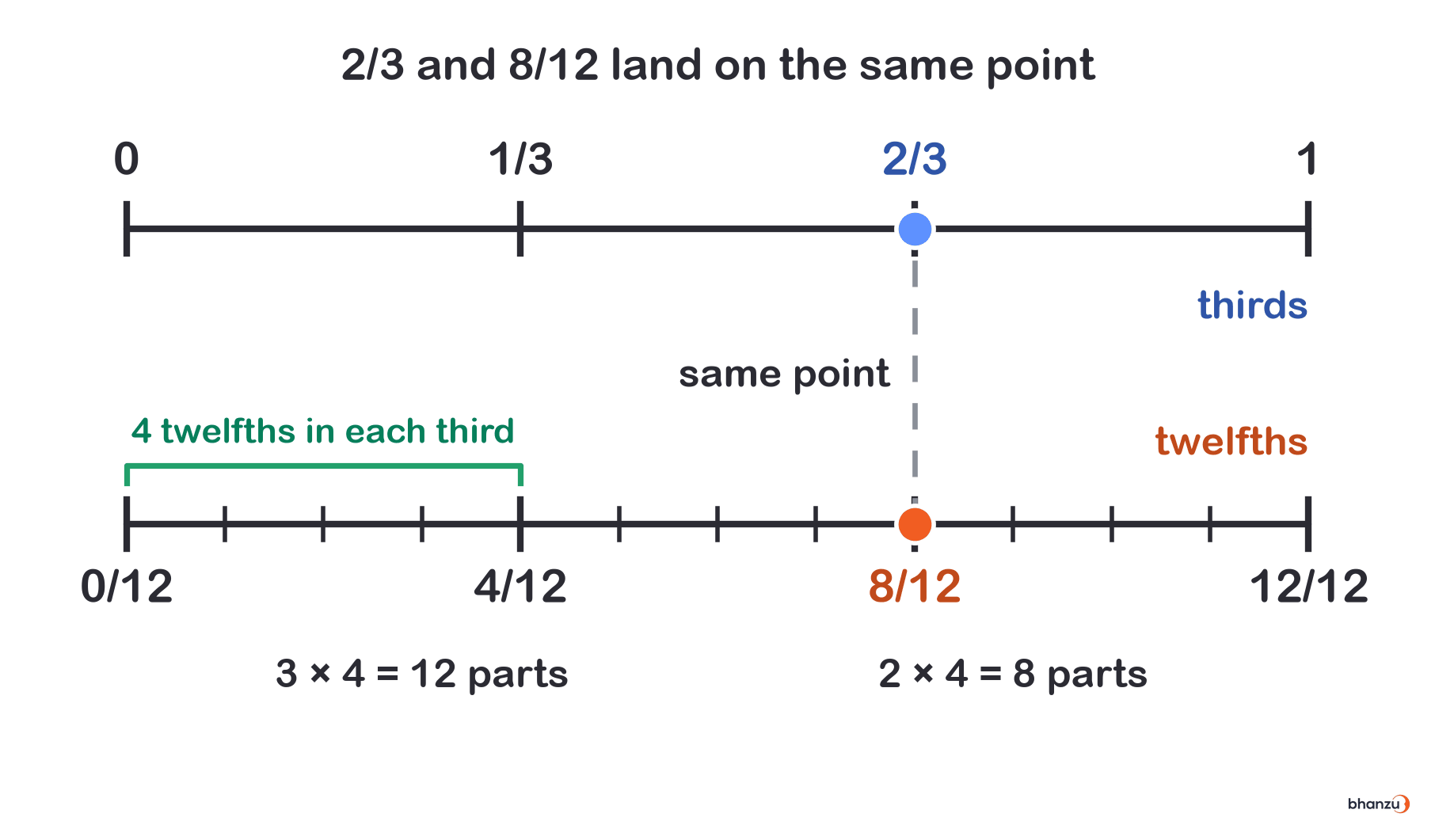
The What Works Clearinghouse fractions practice guide recommends number lines as a central tool for teaching fractions and notes that equivalent fractions share one point. The standard writes the rule with letters.
| Symbol | Meaning | Units |
|---|---|---|
| Numerator, the parts you have | parts | |
| Denominator, the equal parts in one whole | parts | |
| Pieces each part is cut into, a whole number other than 0 | count |
Cutting every part into pieces multiplies both counts by and leaves the shaded space alone (OpenStax's Prealgebra textbook calls this the Equivalent Fractions Property).
Multiplying the top and bottom by 4 is multiplying by , which is 1, an idea you'll lean on in 5th grade.
Try It Yourself
Pick how many pieces to cut each part into, then drag the orange edge of the bottom strip until it covers the same space as the top strip. The readout says when the two fractions match and shows the multiplying that proves it. Press New fraction to try another one.
How do you find a missing number in equivalent fractions?
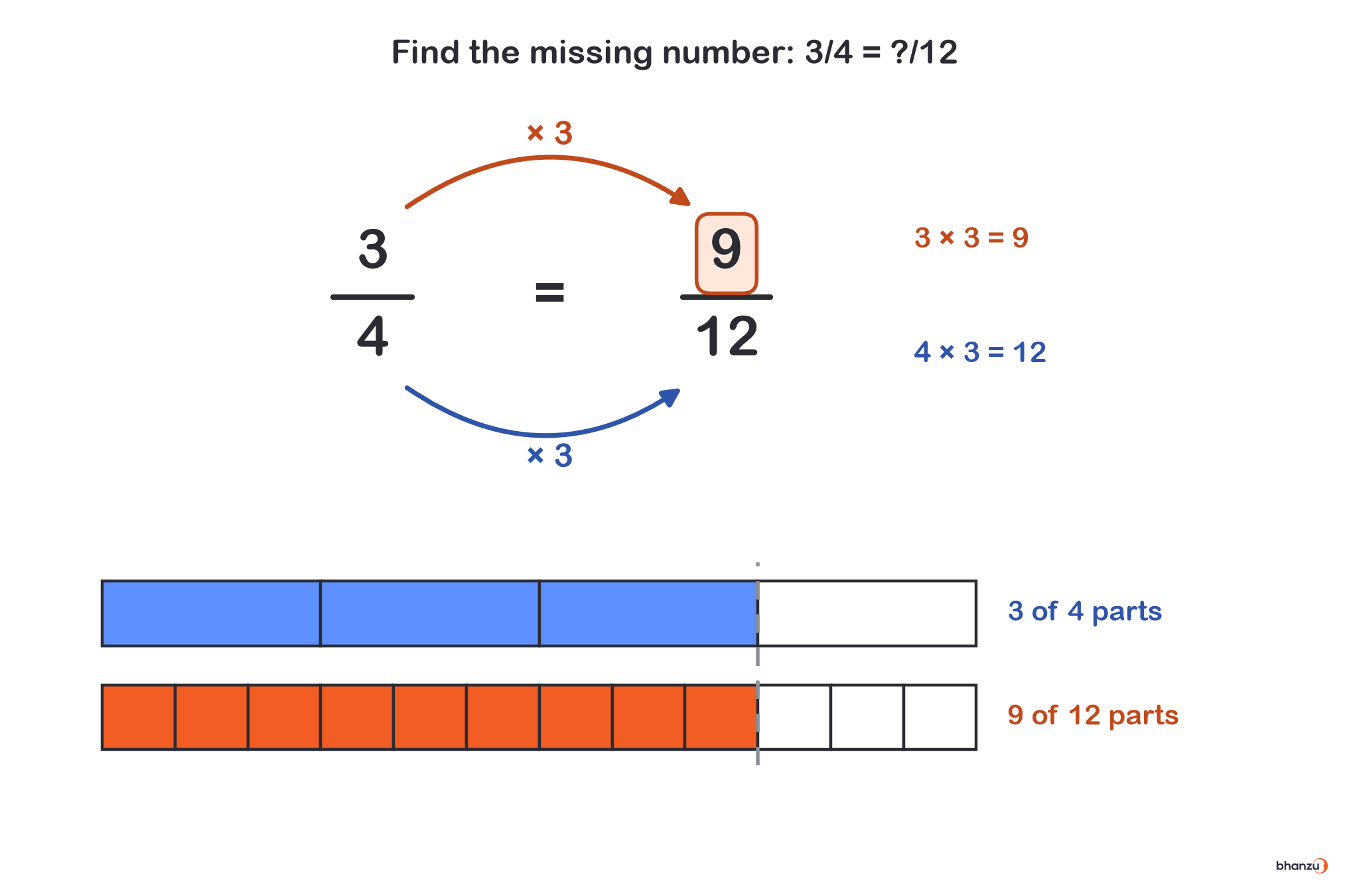
To find a missing number, ask what one denominator was multiplied by, then multiply the numerator by the same number (or swap the jobs when you know the numerators). Here's .
- Find the two numbers you know on the same level, here 4 and 12.
- Ask "times what?" Since , the multiplier is 3.
- Multiply the top by 3 too, so .
The missing number is 9.
Going the other way uses division. In , since , divide the top by 2 too, so the missing number is . Mixed numbers work the same way, as in , where the whole number stays put.
Multiplying stops working when the bigger denominator isn't a multiple of the smaller one, as in , because no whole number times 3 makes 8. Eighths can't show two thirds exactly, so pick a denominator that 3 goes into, such as 6 or 12.
Simplest form: the same move run backward
Dividing the numerator and denominator by a common factor greater than 1, a number that goes into both evenly, gives an equivalent fraction with smaller numbers. A fraction is in simplest form when the only common factor left is 1.
- The factors of 9 are 1, 3 and 9.
- The factors of 12 are 1, 2, 3, 4, 6 and 12.
- The common factors are 1 and 3, so divide the top and bottom by 3.
Children who learned "do the same to the top and bottom" sometimes try 2 first, find that 9 divided by 2 is 4 with 1 left over, and decide won't simplify. Only a number that goes into both evenly works, which is why the factor lists come first.
Any common factor greater than 1 works if you keep going. The brownie pan's reaches by dividing by 2 twice, or in one step by dividing by 4, the greatest common factor (6th grade makes that name official).
Simplest form sounds like a different answer. It isn't one, and eight twelfths is as correct as two thirds. The Common Core math standards never use the words "simplest form", though your child's teacher may still ask for it.
How do you know if two fractions are equivalent?
- Rename one or both so the denominators match, then compare the numerators.
- Simplify both, the way and both become .
Older students also learn cross multiplying, a shortcut for the same check.
Examples of equivalent fractions by multiplying
Example 1
Multiply the numerator and denominator of by 2. What equivalent fraction do you get?
The answer is , because each fifth splits into 2 tenths.
Example 2
Find the missing number in .
The tempting move is to see that 12 is 8 more than 4 and add 8 to the top too.
That gives , which can't be right. Nine of 12 small brownie pieces make three fourths of the pan, not one fourth.
Ask "times what?" instead. Since , multiply the top by 3.
The missing number is 3, because each fourth of the pan holds 3 small pieces.
Example 3
Find the missing denominator in .
The numerators are the known pair. Since , multiply the bottom by 2.
The missing denominator is 12.
Example 4
Is equivalent to ?
Since , the multiplier is 20.
The numerators match, so yes, .
Example 5
A recipe needs cup of milk and cup of water. Aisha's only scoop holds cup. How many scoops does she need in all?
Rename each amount in eighths. For the milk, .
For the water, .
That's 6 scoops of milk and 4 scoops of water, so Aisha needs scoops.
What makes equivalent fractions worth learning?
Equivalent fractions let you rename an amount without changing it, which matters any time two fractions use different-sized pieces.
- It lets you compare fairly. With a common denominator of 12, and become and , so three fourths is one twelfth more.
- It lets you measure with the tool you have. On a ruler marked in eighths of an inch, the half-inch mark is also the four-eighths mark.
- It explains money. A quarter is one fourth of a dollar, and is why it's worth 25 cents, the same step used for fractions with denominators of 10 and 100.
- It sets up adding fractions with different denominators in 5th grade, the move behind Aisha's scoops in Example 5.
The payoff lasts: a 2012 study in Psychological Science looked at 3,677 UK children assessed at age 10 and again at 16. Fraction knowledge at 10 was the strongest of five math measures for predicting their algebra at 16, and a US sample of 599 children showed a similar link.
The pattern hiding inside equivalent fractions
Count by 3s along the top and by 4s along the bottom, in step, and every pair names three fourths, even when you skip ahead to step 25.
| Step | Count by 3s | Count by 4s | Fraction |
|---|---|---|---|
| 1 | 3 | 4 | |
| 2 | 6 | 8 | |
| 3 | 9 | 12 | |
| 25 | 75 | 100 |
Those are the 3s and 4s rows of a multiplication table, so the missing number in is the 3s number lined up with 12.
The usual rule says never add or subtract to make equivalent fractions, and it holds for every fraction except one equal to 1. Adding the same number (other than 0) to the top and bottom of 2 halves gives 4 fourths, still one whole. Any fraction less than 1 grows instead, because adding pulls it closer to 1.
Equivalent fractions: spot the trap before you fall in
Mistake 1: Adding the same number to the top and bottom
Where it slips in: Missing-number problems. Adding feels natural, because adding the same amount to two whole numbers keeps the gap between them the same.
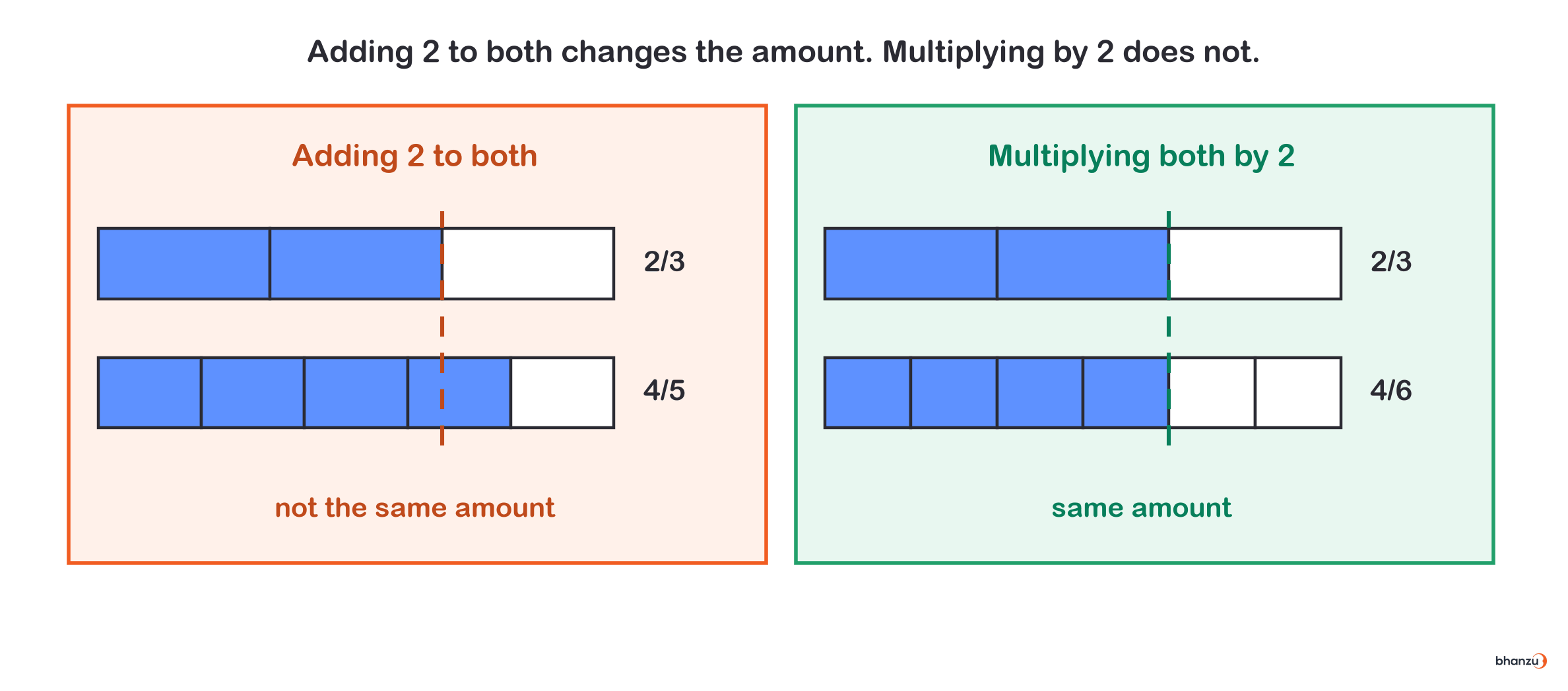
Don't do this: Add 2 to the top and bottom of to get .
The correct way: Multiply both by 2 to get . Four fifths leaves only one fifth uncovered and two thirds leaves one third, so the two aren't equivalent.
Mistake 2: Changing only the denominator
Where it slips in: Filling the box in , when a child who rushes copies the 3 already showing (it's right there on the page, after all).
Don't do this: Write .
The correct way: Since , multiply the top by 2 too and get . Smaller pieces mean you need more of them.
Mistake 3: Thinking simplifying makes the fraction smaller
Where it slips in: Simplest form problems, and the word "reduce", which means "make smaller" everywhere outside math class.
Don't do this: Decide that is more than because its numbers are bigger.
The correct way: Put both on a number line and they land on the same point, because twelfths are smaller parts.
A child who finds eight twelfths correctly will sometimes second-guess it, because 8 looks like more than 2. Saying "simplify" instead of "reduce" keeps the amount from sounding like it shrank.
Key Takeaways
- Before multiplying, ask "times what?" and use that single number on both the top and the bottom.
- Making equivalent fractions by multiplying keeps the amount fixed, because the pieces shrink by the same number of times that their count grows.
- If adding to both parts looks tempting, draw both fractions as bars, and for any fraction less than 1 the shaded lengths won't match.
- To practice equivalent fractions with a teacher who catches the add-to-both-numbers habit early, explore Bhanzu's 4th grade math tutor or math programs for elementary students.
Read More
- Divisibility Rules
- Comparing Fractions with Unlike Denominators
- Equivalent Ratios
- Why Are Fractions So Hard
- Mental Math with Fractions
Research Behind This Article
- Common Core State Standards Initiative, Grade 4: Number and Operations, Fractions (2010). thecorestandards.org
- What Works Clearinghouse, Institute of Education Sciences, Developing Effective Fractions Instruction for Kindergarten Through 8th Grade (2010). ies.ed.gov
- OpenStax, Prealgebra 2e, 4.1 Visualize Fractions (2020). openstax.org
- Common Core State Standards Initiative, Common Core State Standards for Mathematics (2010). thecorestandards.org
- Robert S. Siegler and others, Psychological Science, Early Predictors of High School Mathematics Achievement (2012). files.eric.ed.gov
- National Mathematics Advisory Panel, US Department of Education, Foundations for Success (2008). files.eric.ed.gov
Quick Quiz: Check Yourself
Three levels, new numbers every time: find a missing numerator, then find a missing denominator or work a fraction back down, then rename two amounts to count scoops or small cups.
Was this article helpful?
Your feedback helps us write better content
Frequently Asked Questions
What grade do you learn equivalent fractions?
What are equivalent fractions to 1/2?
Can you find equivalent fractions using division?
How do you explain equivalent fractions to kids?
How can I help my child with equivalent fractions in 4th grade?