Key Points
- Dividing mixed numbers starts by rewriting each mixed number as an improper fraction, so becomes and becomes .
- After rewriting, keep the first fraction, change division to multiplication and flip only the divisor, so comes out to .
- Dividing the whole numbers and the fraction parts separately fails, because for it gives 8, more than the starting amount, while the true quotient is 5.
Six shelves from one long board
A board seven and a half feet long is about to become shelves. Each shelf takes one and a quarter feet of wood. If you look only at the whole numbers, 7 divided by 1 says 7 shelves, but seven shelves would need eight and three quarter feet of wood. The board gives exactly 6.
The question of how many pieces of one size fit inside a bigger amount reaches far past 6th grade. Carpenters answer it when they cut trim into equal lengths, and bakers answer it whenever one large batch of dough becomes rolls of equal weight.
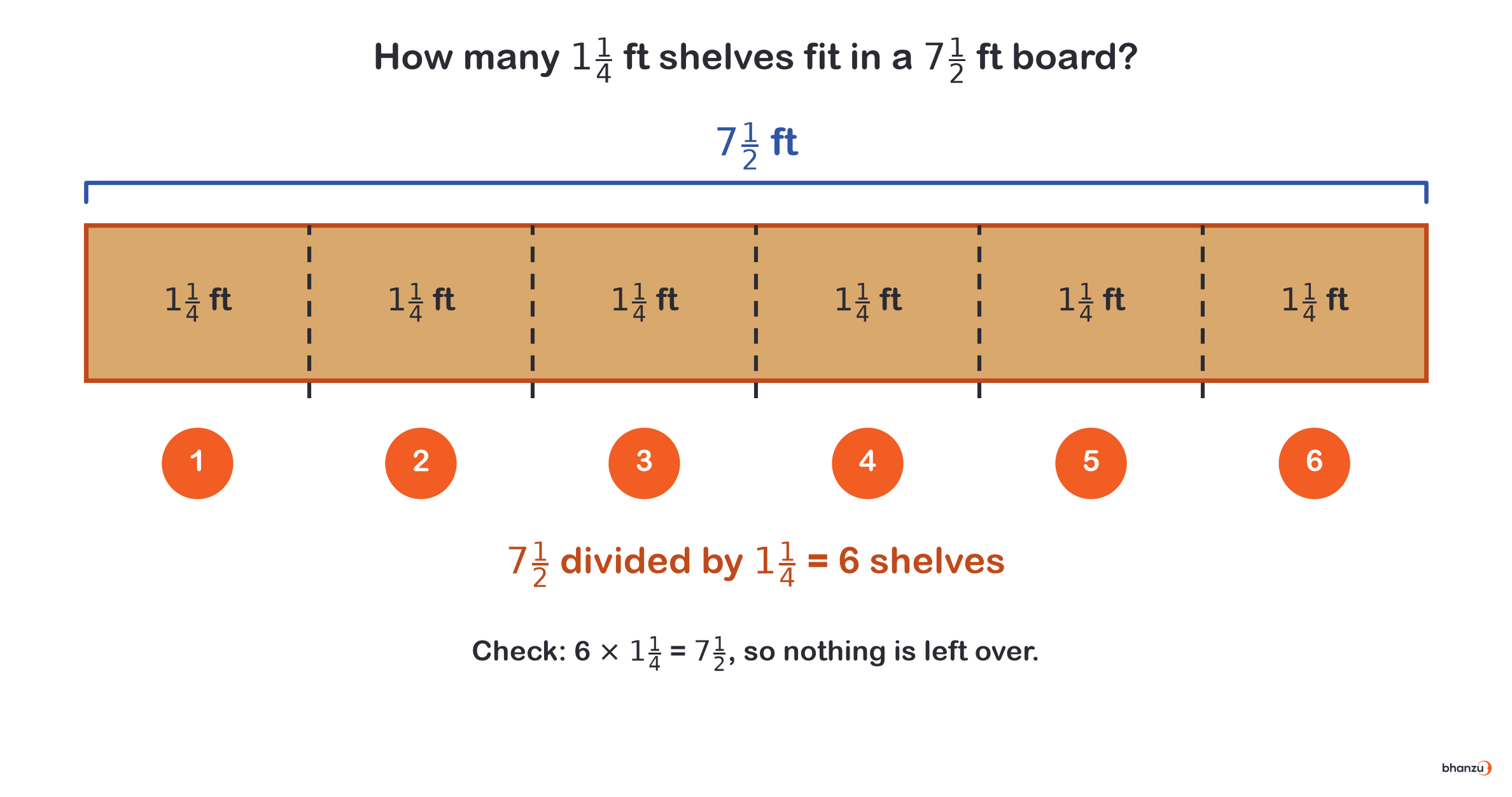
What does dividing mixed numbers mean?
Dividing mixed numbers means finding how many copies of the second number fit inside the first, and fraction bars drawn to the same scale let you see the answer. A mixed number is a whole number and a proper fraction (a fraction less than 1) written together, such as . In , the dividend, divisor and quotient are the amount being divided, the size of each piece and the number of pieces that fit.
Draw a bar units long, marked in halves, and lay bars units long under it, end to end. Exactly three fill it with nothing left over, so .
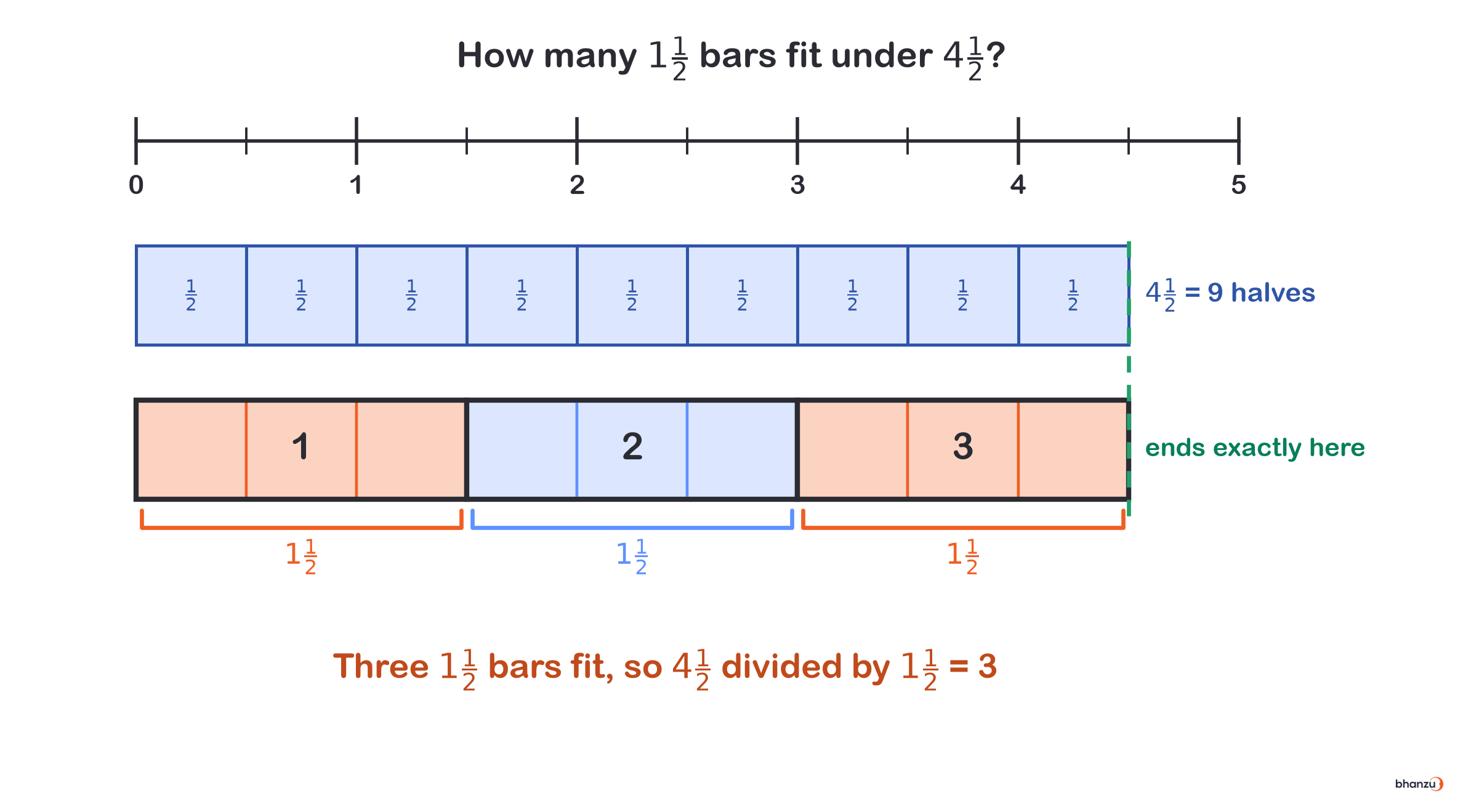
Bars work while the pieces line up neatly, but thirds against quarters turn the drawing into guesswork, and a written method takes over there.
Dividing mixed numbers falls under Common Core standard 6.NS.A.1, which covers dividing fractions by fractions with visual models and equations. In 6th grade, your child is expected to compute these quotients and also explain them with a fraction-bar drawing or an equation.
How do you divide mixed numbers step by step?
To divide mixed numbers, rewrite both as improper fractions, then multiply the first by the reciprocal of the second. The steps below run on .
- Estimate first. The problem is close to , so expect an answer near 3, and below because the divisor is more than 1.
- Rewrite each mixed number as an improper fraction, a fraction whose top number (the numerator) is at least as big as its bottom number (the denominator). Multiply the whole number by the denominator, then add the numerator, to get .
- Keep the first fraction, change to and flip only the divisor to its reciprocal, the fraction turned upside down. This move is nicknamed keep, change, flip, and it gives .
- Cancel before you multiply. The 10 and the 5 share a greatest common factor of 5, so the product becomes (the method only gets slow when numbers grow large, and cancelling keeps them small).
- Change back to a mixed number in simplest form, .
The answer is near 3 and below , as the estimate said. Multiplying it by the divisor gives back the dividend.
That check uses multiplying mixed numbers, the 5th grade skill, to run the division backward. A child who skips the estimate has nothing to compare the answer with, so an upside-down result can sail through.
Two other routes exist. A common denominator lets you divide the numerators alone, so 9 halves divided by 3 halves is , though unlike denominators must be renamed first. Decimals work when numbers end, as in , but thirds repeat forever, so the flip is the one route that needs neither a common denominator nor rounding.
| Mixed number | Improper fraction | Decimal |
|---|---|---|
| (repeats) |
Dividing mixed numbers by fractions or whole numbers
The steps stay the same when one number isn't mixed. A whole number gets a denominator of 1 first, and a plain fraction skips the rewrite.
| Problem | Multiply by the reciprocal | Quotient |
|---|---|---|
Why does flipping the divisor work?
Flipping works because dividing by is two moves in one, cutting the amount into quarters and then grouping the quarters in fives. Cutting into quarters multiplies by 4, grouping in fives divides by 5, and doing both is the same as multiplying by .
The shelf board shows it. Seven and a half feet is 30 quarter-feet, and each -foot shelf uses 5 of them, so the board makes shelves, the same answer the flip gives.
The same counting explains a quotient bigger than the dividend. is 10 quarters and a piece is 3 quarters, so 10 quarters make 3 full pieces with 1 quarter left over, one third of a piece. That makes , and turns the third back into the leftover quarter.
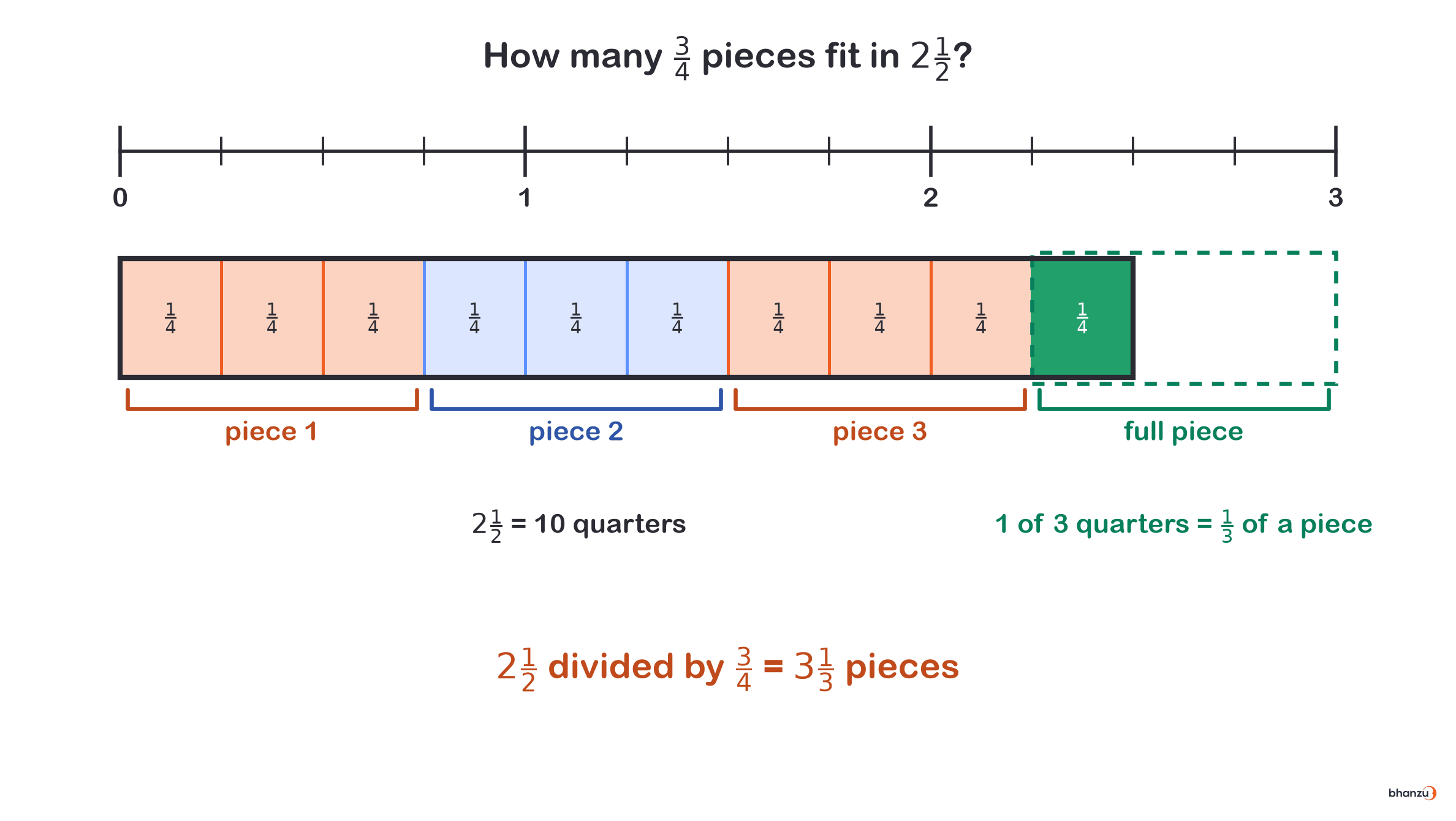
For positive numbers, this counting gives a size rule. Dividing by a number greater than 1 gives less than the dividend, and dividing by a number less than 1 gives more. The Institute of Education Sciences fractions practice guide reports that few students can explain why a quotient can come out larger than the number divided, and counting quarters shows the reason.
Try It Yourself
Set both mixed numbers with the plus and minus buttons, or tap a preset, then watch divisor-sized pieces line up under the dividend bar. The readout counts full pieces and writes out the steps. Watch the green leftover piece, because the share of one full piece it fills becomes the fraction part of the quotient.
Why does dividing mixed numbers matter?
Real measurements rarely come out whole, and dividing mixed numbers answers the two questions people ask about them most, how many fit and how much each one gets.
- It turns a measurement into a count. A 10-foot ribbon cut into -foot pieces makes 6 bows.
- It tells you how big each share is. Hiking miles over 3 days means miles a day, and the dividing fractions word problems lesson turns stories like this one into equations.
- It finds a rate. Walking miles in hours is 3 miles per hour, and in 8th grade the same division gives the slope of a line.
- It builds the fraction sense later math depends on. In the 2024 NAEP mathematics results, 28 percent of 8th graders reached NAEP Proficient and 39 percent scored below NAEP Basic, out of 115,200 eighth graders assessed. The IES fractions practice guide reports that on the 2004 NAEP, 50 percent of 8th graders could not order three fractions from least to greatest.
Sizing a quotient before computing it is one everyday way to build that fraction sense. In 7th grade, the same flip works on negative fractions too.
Examples of dividing mixed numbers
Example 1
Divide by .
The quotient is 3, and confirms it.
Example 2
Find .
The tempting shortcut divides the parts separately, and , for a total of 8.
That answer can't be right. The divisor is more than 1, so the quotient must be smaller than , and 8 is bigger. Rewrite both numbers instead and flip the divisor.
The quotient is 5.
Example 3
Share pounds of trail mix equally among 4 bags. How much goes in each bag?
Each bag gets of a pound.
Example 4
What number multiplied by gives ?
Division undoes multiplication, so the missing number is .
The missing number is .
Example 5
Without dividing, decide which is bigger, or . Then find both.
The first divisor is more than 1 and the second is less than 1, so the second quotient must be bigger.
So 7 beats 3, as predicted.
Example 6
A bag holds cups of flour, and one batch of pancakes uses cups. How many full batches can you make, and how much flour is left?
That is 4 full batches and of another. One sixth of a batch is cup, so cup of flour is left. The 4 batches use 6 cups, and 6 plus is the whole bag.
What most guides get wrong about dividing mixed numbers
Most guides stop once the answer is simplified, yet the fraction part of a quotient counts pieces of the divisor, not of the whole. Scoop cups of rice with a -cup scoop and you fill 3 scoops plus one third of another.
That third of a scoop holds cup, and this is the genuinely confusing part. Children who look at the leftover rice often write , because a quarter cup really is left, counted in cups instead of scoops. The What Works Clearinghouse fraction tips for educators suggest marking strips into equal parts, and a strip split into the three quarters of one scoop makes the third visible.
Guides also treat checking as optional, yet two quick checks catch different mistakes. An estimate catches most wrong or skipped flips. Multiplying back catches a bad conversion.
Where do kids trip up on dividing mixed numbers?
Mistake 1: Flipping the wrong fraction
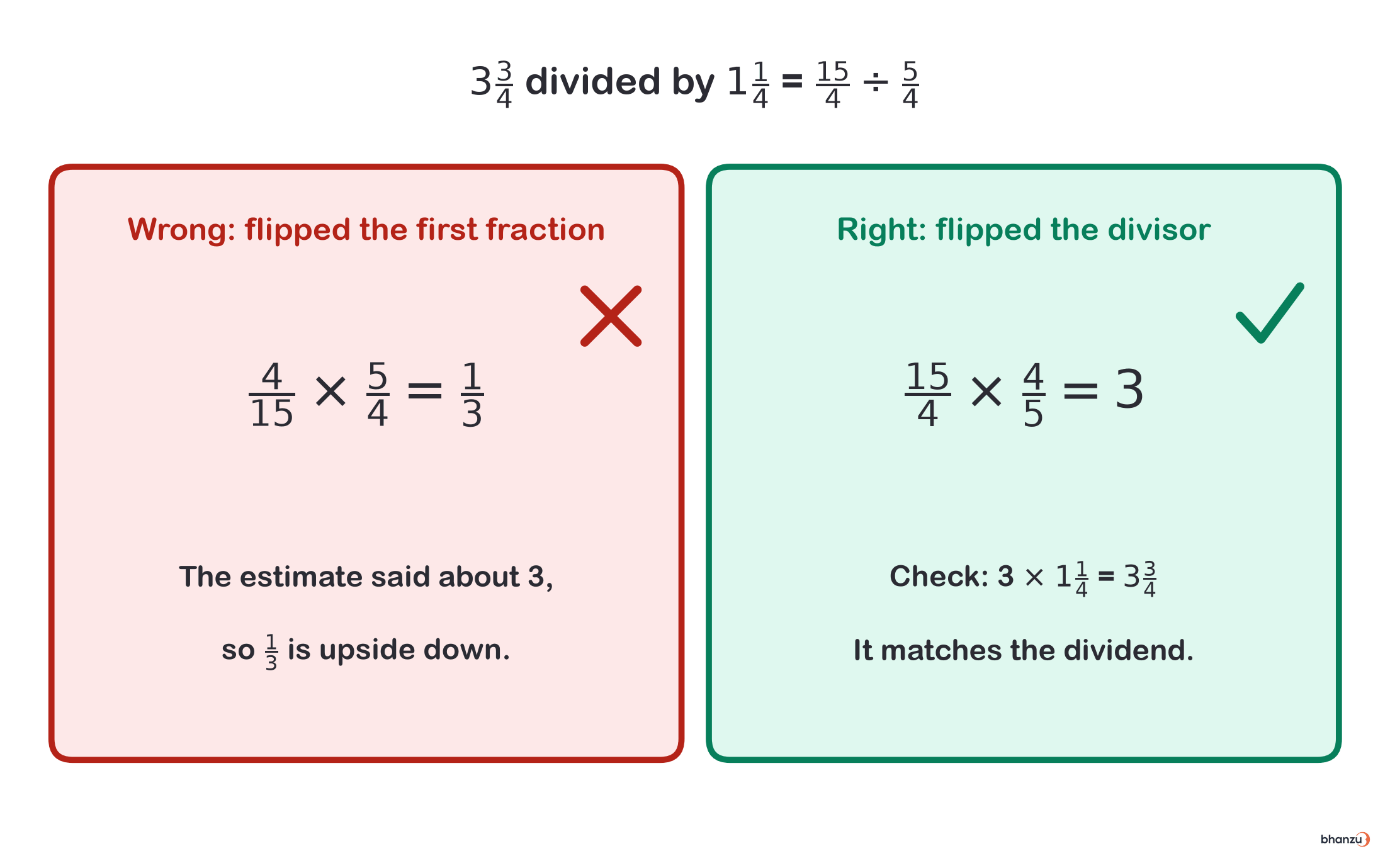
Where it slips in: Step 3, once both numbers are improper fractions and look alike. A child often flips the first fraction simply because it was written first.
Don't do this: For , writing .
The correct way: Flip only the divisor, , and checks it.
Flipping the first fraction and leaving the divisor alone always produces the reciprocal of the right answer. A result like next to an estimate of about 3 is the giveaway.
Mistake 2: Adding the whole number to the numerator
Where it slips in: Step 2, the rewrite. Children who remember that the whole number "goes into the top" add it instead of multiplying it by the denominator first.
Don't do this: Writing as , so becomes .
The correct way: Multiply, then add, , so . Fourteen sixths make again.
Mistake 3: Skipping the flip because the answer "should be smaller"
Where it slips in: Divisors less than 1. Years of whole-number division teach that dividing makes things smaller, so a child who gets a bigger answer second-guesses it and multiplies straight across instead.
Don't do this: Writing as , which is less than .
The correct way: Flip the divisor, . A divisor less than 1 must give a quotient bigger than the dividend, and it does.
Key Takeaways
- Estimate the quotient with whole numbers before dividing, so an upside-down or oversized answer stands out at once.
- When dividing mixed numbers, the dividend stays exactly as rewritten and only the divisor turns upside down.
- With positive numbers, a quotient larger than the dividend is expected whenever the divisor is less than 1.
- The fraction part of a quotient counts parts of one divisor-sized piece, so scoops means three full scoops and a third of another.
- For more practice spotting the flipped-fraction mistake and checking quotients against an estimate, explore Bhanzu's 6th grade math curriculum or math programs for kids.
Read More
- Dividing Decimals
- Fractions as Division
- Dividing Fractions and Whole Numbers Word Problems
- Multiplying and Dividing Negative Fractions
- Why Are Fractions So Hard
- Fractions, Decimals and Percentages
Research Behind This Article
- Common Core State Standards Initiative, Grade 6 The Number System (6.NS) (2010). thecorestandards.org
- OpenStax, Prealgebra 2e, 4.3 Multiply and Divide Mixed Numbers and Complex Fractions (2020). openstax.org
- Institute of Education Sciences, What Works Clearinghouse, Developing Effective Fractions Instruction for Kindergarten Through 8th Grade (2010). ies.ed.gov
- OpenStax, Prealgebra 2e, 4.2 Multiply and Divide Fractions (2020). openstax.org
- National Center for Education Statistics, NAEP Mathematics: 2024 Results for Grades 4 and 8 (2025). nationsreportcard.gov
- Institute of Education Sciences, What Works Clearinghouse, Developing Effective Fractions Instruction: Instructional Tips for Educators (2021). ies.ed.gov
Quick Quiz: Check Yourself
Three levels, new numbers every time: divide a mixed number by a fraction or a whole number, divide two mixed numbers or find a missing factor, then solve a how-many-servings word problem.
Was this article helpful?
Your feedback helps us write better content
Frequently Asked Questions
Can a mixed number be divided by another mixed number?
How do I divide fractions?
Do you flip fractions when multiplying?
How do you solve dividing mixed numbers word problems?
Is dividing mixed numbers a 6th grade skill?
How can I teach dividing mixed numbers at home?