Key Points
- The improper-fraction route for multiplying mixed numbers begins by rewriting each factor, so becomes before any multiplying happens.
- An area model splits times into four pieces: whole times whole, whole times fraction, fraction times whole and fraction times fraction.
- Pairing wholes with wholes and fractions with fractions skips the whole-times-fraction and fraction-times-whole pieces, so times gives , not .
- Common Core places multiplying fractions and mixed numbers in 5th grade, after 4th graders add mixed numbers and multiply a fraction by a whole number.
A 2-by-4 that is not 2 by 4
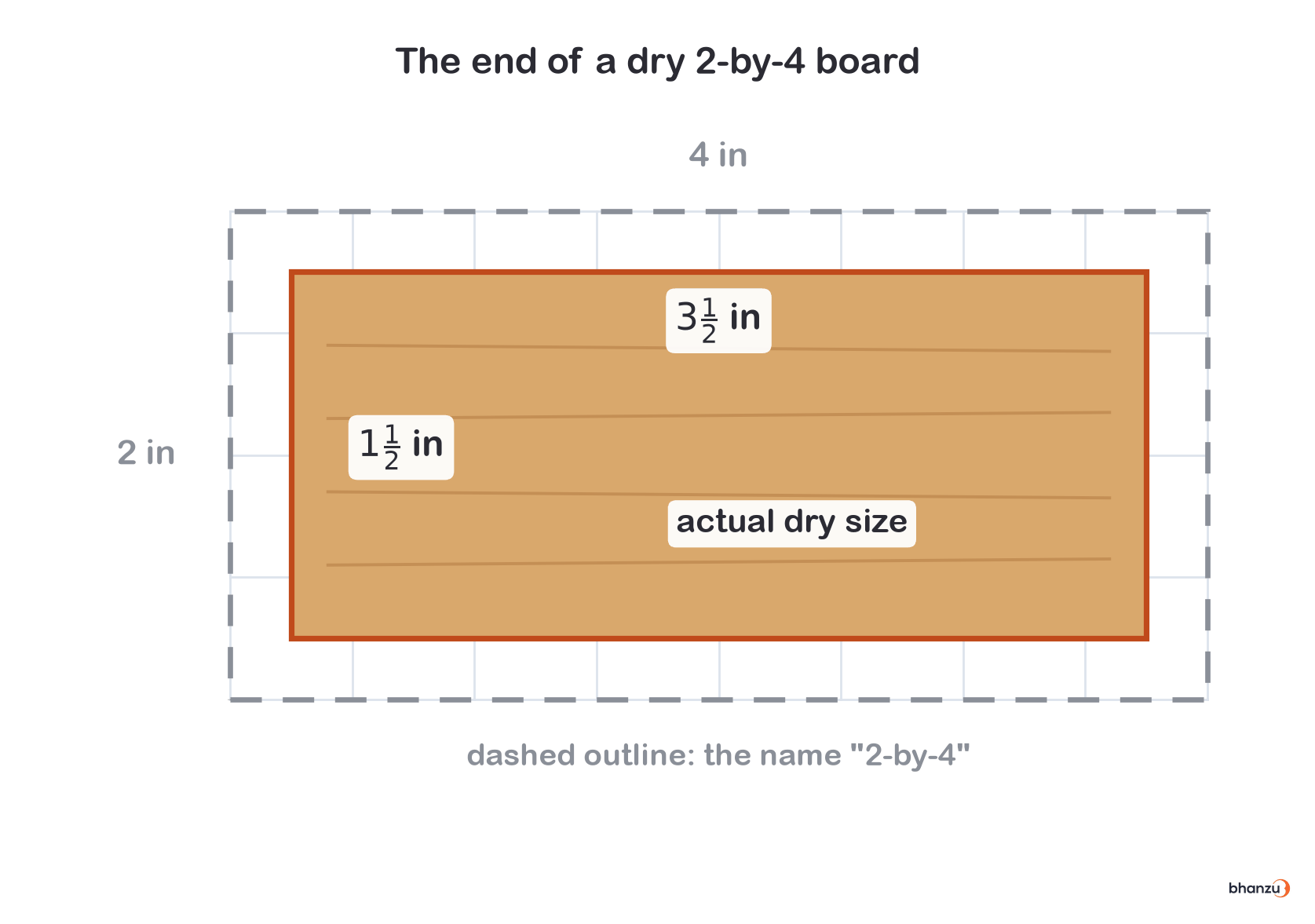
A 2-by-4 board from the hardware store is not 2 inches by 4 inches. Under the US lumber standard published in January 2025, a dry 2-by-4 (dried and planed smooth before it's sold) is one and a half inches by three and a half inches.
Stack these boards, and finding the height means multiplying a mixed number, a whole number plus a fraction. Leo's family is building a workbench, and nearly every size in the plan is a mixed number. Next year, in 6th grade, you'll divide mixed numbers too.
How do you multiply mixed numbers?
Multiplying mixed numbers works in three moves: turn each mixed number into a single fraction, multiply top times top and bottom times bottom, then simplify. That fraction is an improper fraction, with a top number (the numerator) at least as big as its bottom number (the denominator).
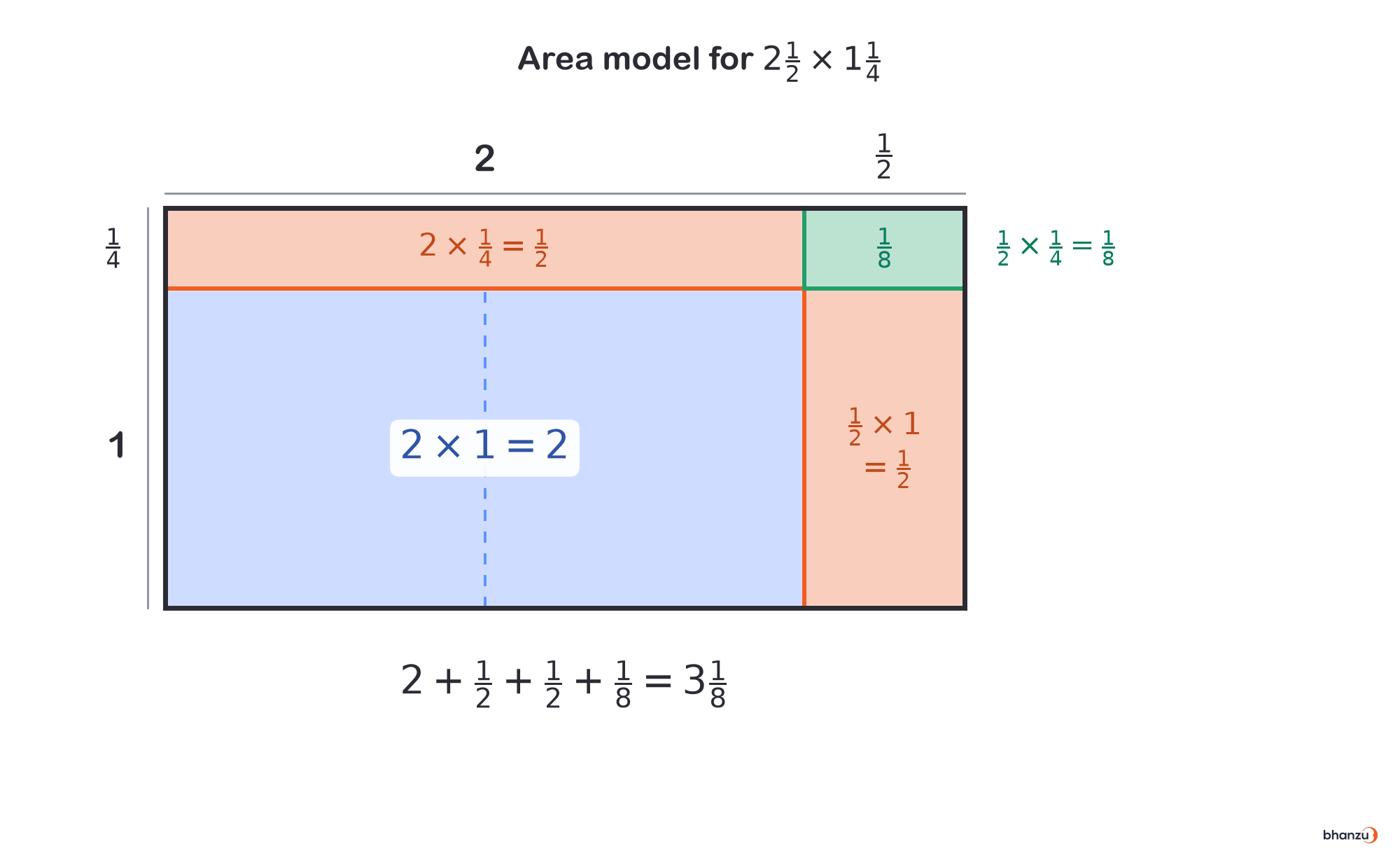
A mixed number is a whole number (not 0) beside a proper fraction, one whose top number is smaller than its bottom number. So a mixed number like means . A rectangle units wide and units tall shows the multiplication, and its area is the product.
- Rewrite each mixed number, so and .
- Multiply the tops, .
- Multiply the bottoms, .
- Simplify and turn it back into a mixed number, , the same total as the four pieces.
This is Common Core standard 5.NF.B.6, which asks 5th graders to solve real-world problems with products of fractions and mixed numbers, for example with visual fraction models or equations. In 4th grade your child learned adding and subtracting mixed numbers and multiplied a fraction by a whole number, so 5th grade is the first year that both factors can be mixed numbers.
How does multiplying mixed numbers with area models work?
An area model is a rectangle whose sides are the two numbers you're multiplying. Each side has a whole part and a fraction part, so the rectangle splits into four pieces.
| Piece | Multiply | Area |
|---|---|---|
| whole times whole | ||
| whole times fraction | ||
| fraction times whole | ||
| fraction times fraction |
Multiplying every part of one number by every part of the other is the distributive property, and the four answers are partial products. The whole-times-fraction and fraction-times-whole pieces are the cross pieces. Drawing gets slow with sevenths or ninths, and then improper fractions are faster.
A whole number has no fraction part, so makes only two pieces, the second one a 4th-grade product.
The rectangle also gives a size check. For two mixed numbers, the product is always more than the whole parts multiplied and less than the next whole numbers multiplied.
So lands between 2 and 6. Children who multiply the wholes and the fractions separately have counted only two of the four pieces, often because they raced ahead without drawing the two long strips.
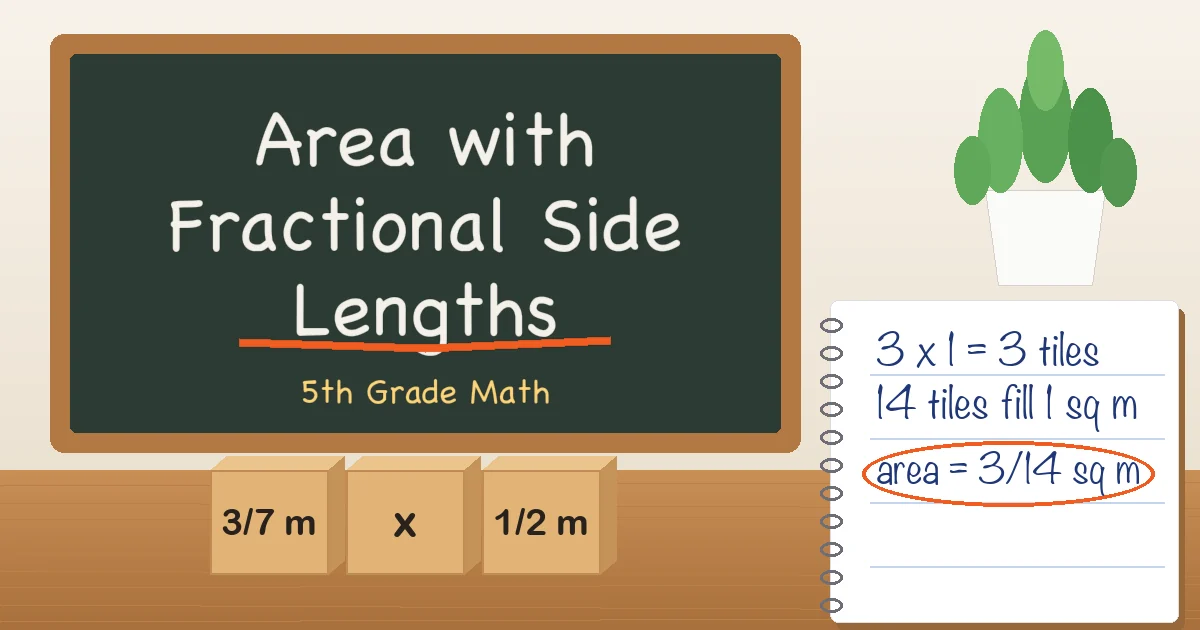
An area model also helps 5th graders find the area of rectangles with fractional side lengths. Understanding why the steps work pays off later. In a study published in July 2026 of 357 middle school students in Germany, understanding fraction ideas predicted later understanding of algebra, and skill with fraction steps predicted later skill in algebra.
How do you turn a mixed number into an improper fraction?
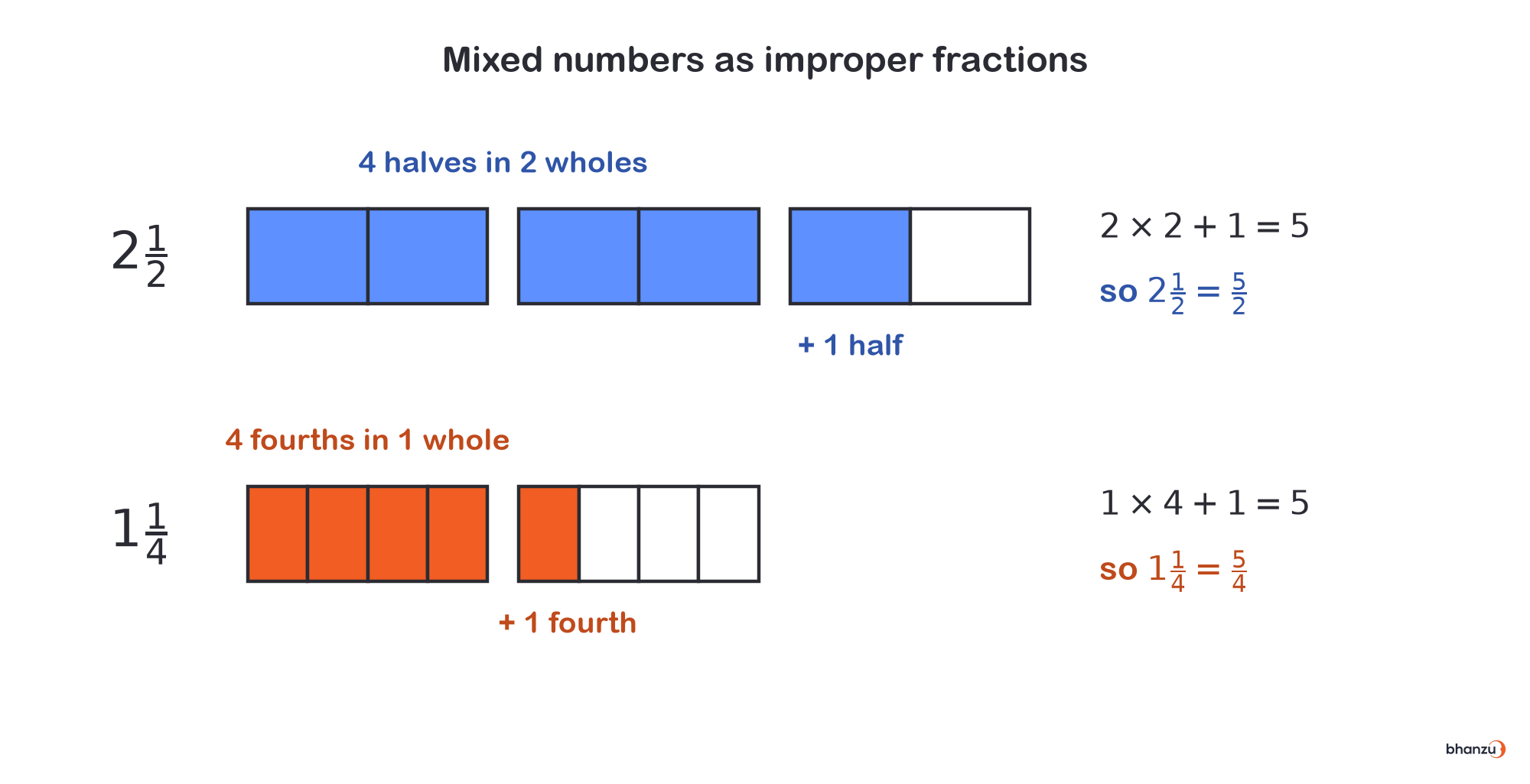
To write a mixed number as an improper fraction, multiply the whole number by the bottom number, add the top number, and keep the bottom number. Each whole holds as many pieces as the bottom number says, so is 4 halves plus 1 half, or .
| Mixed number | Improper fraction | Decimal |
|---|---|---|
Why change mixed numbers into improper fractions before multiplying?
A mixed number is a sum, so two of them make four products. One fraction per factor turns four products into one, and the rule for multiplying fractions does the rest.
- Convert each mixed number to an improper fraction.
- Write any whole number over 1, so .
- Multiply the tops, then multiply the bottoms.
- Divide the top and bottom by a common factor until none is left, then divide the top by the bottom to get a mixed number.
Simplifying before you multiply saves work. In , the mixed number becomes , and the two 5s divide out.
OpenStax's Prealgebra 2e teaches the same convert, multiply, simplify order.
Try It Yourself
Set two mixed numbers with the buttons, then tap each of the four rectangle pieces to see its area. Once all four are found, the total and its improper-fraction check appear. The Only two pieces button shows what multiplying just the wholes and just the fractions loses.
Examples of multiplying mixed numbers
Example 1
Leo stacks 5 dry 2-by-4 boards, each inches thick. How tall is the stack?
The stack is inches tall.
Example 2
Leo's workbench top is feet by feet. What is its area?
The tempting move multiplies the wholes and the fractions on their own.
That gives square feet, which can't be right. A top only 2 feet wide would already cover square feet, and this top is wider.
Converting gives the true area.
The two cross pieces, and , are the missing area.
The workbench top covers square feet.
Example 3
Mei needs of a -foot board for a shelf. How long is the shelf?
Two thirds of the board means . Change to , and the two 2s divide out.
The shelf is 3 feet long.
Example 4
Between which two whole-number products must land? Then find the exact product.
The product is , which lands between 8 and 15.
Example 5
A pancake recipe uses cups of milk. Priya makes batches and has a 4-cup carton. How much more milk does she need?
The milk needed must land between 2 and 6 cups.
Priya needs cup more milk.
Multiplying mixed numbers beyond the textbook
Mixed numbers describe amounts that come in wholes and parts, like the width of a board. Multiplying them turns one measurement into many, or one batch into two and a half.
- It sizes a building job. Under the same 2025 lumber standard, a dry 2-by-6 is inches wide, so seven boards side by side cover inches (not 42).
- It tells a carpenter how much wood to order. Carpenters use math to work out the material a job needs, says the US Bureau of Labor Statistics' Occupational Outlook Handbook, which counted 889,700 carpenter jobs in 2025.
- It scales a recipe. Two and a half batches means every amount gets multiplied by , as in Example 5.
In each case, multiplying tells you how much you need before you cut, buy or pour.
What are the most common mistakes with multiplying mixed numbers?
Mistake 1: Adding the whole number to the top
Where it slips in: Converting, as in . The 2 sits beside the 3, so adding them feels natural, but the 2 counts wholes and each whole is 4 fourths.
Don't do this: Writing as , so doubling gives , less than the number you started with.
The correct way: Work out , so and doubling gives .
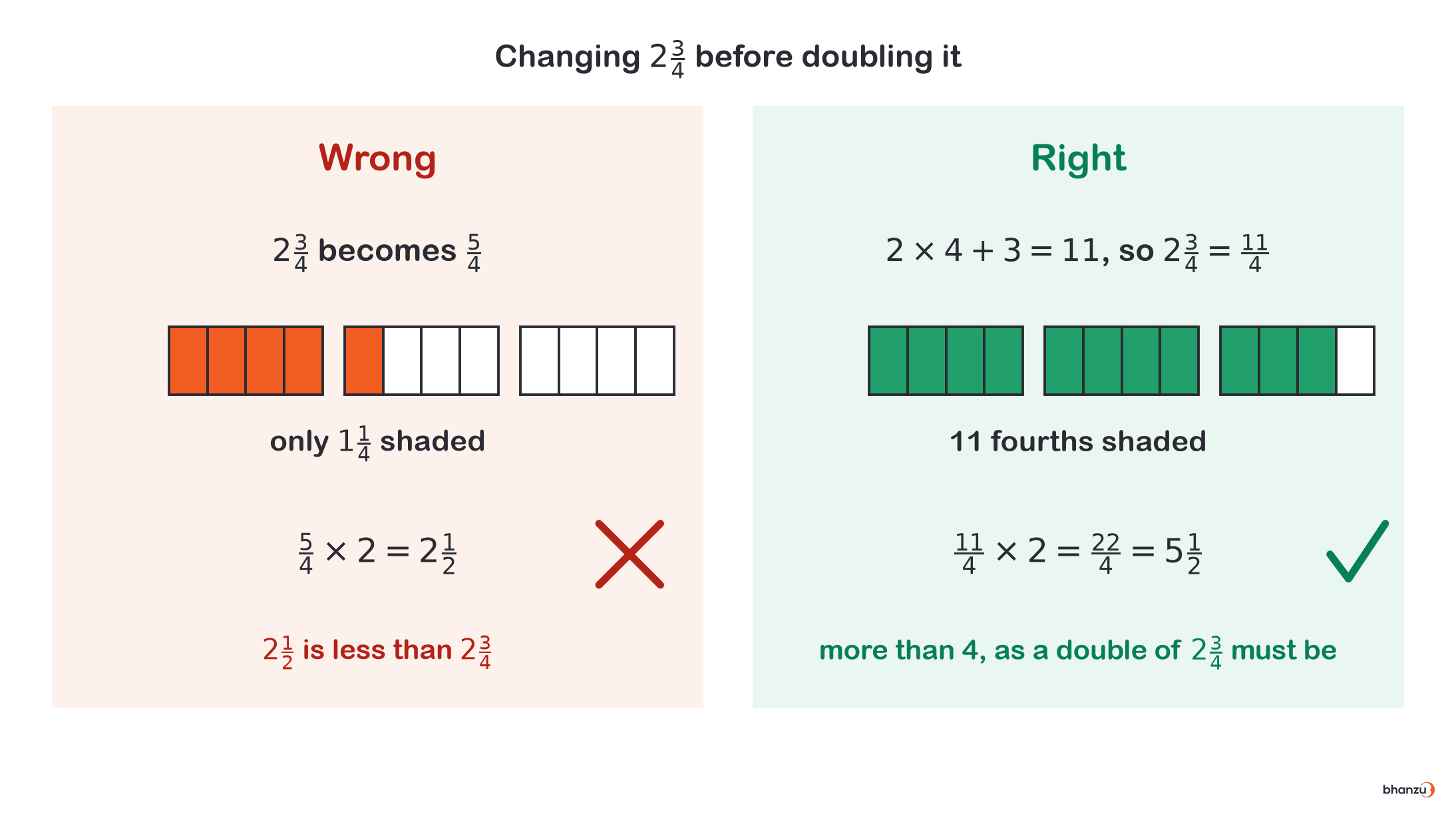
The Institute of Education Sciences' 2010 fractions practice guide names this exact misconception.
Mistake 2: Hunting for a common denominator
Where it slips in: Different bottom numbers, as in . Because adding needed a shared bottom number, a child may rewrite both in sixths before reading the sign, then copy the 6 into the answer.
Don't do this: Rewriting the factors as and , then multiplying only the tops to get .
The correct way: Skip it, since multiplying never needs a common denominator. , which lands between 2 and 6 as the size check says.
Mistake 3: Reading a mixed number as times
Where it slips in: A mixed number times a whole number, as in . Nothing is written between the 2 and the one third. That's genuinely confusing (adults trip on it too), because in algebra a number and a letter side by side, like , really do mean times.
Don't do this: Reading as , then .
The correct way: Read the hidden plus sign, so and .
The pattern hiding inside multiplying mixed numbers
Multiplying the parts separately always comes out too small, by exactly the two cross pieces. Take .
The cross pieces, and , add up to .
With the same fraction parts, the bigger the whole numbers, the more the shortcut loses.
The habit comes from adding. Adding mixed numbers can be done in parts, because adding only puts amounts together. Multiplying is different. It spreads every part of one number over every part of the other, so the adding habit quietly drops two pieces.
Key Takeaways
- For most problems, convert mixed numbers to improper fractions first and turn the answer back at the end.
- When multiplying mixed numbers, count four pieces, not two.
- Check that a product lands above the whole parts multiplied and below the next whole numbers multiplied.
- Keep the hidden plus sign in mind, since means 2 plus one third.
- To keep practicing multiplying mixed numbers and catch the add-the-whole-to-the-top slip early, explore Bhanzu's 5th grade math curriculum or math programs for kids.
Read More
- Multiplying Fractions by Whole Numbers
- Multiplying Fractions Word Problems
- Multiplication as Scaling
- Dividing Mixed Numbers
- Fractions, Decimals and Percentages
Research Behind This Article
- National Institute of Standards and Technology, Voluntary Product Standard PS 20-25: American Softwood Lumber Standard (2025). nist.gov
- NGA Center and CCSSO, Common Core State Standards for Mathematics: Grade 5, Number and Operations, Fractions (2010). thecorestandards.org
- D'Erchie, M., Forsmann, C. L., Schneider, M. and Obersteiner, A., From Fractions to Algebra: Cross-Domain Predictive Relationships between Conceptual and Procedural Knowledge and the Potential Mediating Role of Relational and Proportional Reasoning (2026). eric.ed.gov
- Marecek, L., Anthony-Smith, M. and Honeycutt Mathis, A., OpenStax, Prealgebra 2e, Section 4.3: Multiply and Divide Mixed Numbers and Complex Fractions (2020). openstax.org
- US Bureau of Labor Statistics, Occupational Outlook Handbook: Carpenters (2026). bls.gov
- Siegler, R. and others, What Works Clearinghouse, Developing Effective Fractions Instruction for Kindergarten Through 8th Grade (2010). ies.ed.gov
Quick Quiz: Check Yourself
Three levels, new numbers every time: a whole number times a mixed number, two mixed numbers or a fraction times a mixed number, then recipe, area and how-much-more problems.
Was this article helpful?
Your feedback helps us write better content
Frequently Asked Questions
Can you multiply mixed numbers without converting them to improper fractions?
Is the product of two mixed numbers always a mixed number?
Should the answer be an improper fraction or a mixed number?
How can I help my child practice multiplying mixed numbers at home?
Are worksheets enough practice for multiplying mixed numbers?