Key Points
- Fractions on a number line are points measured in equal parts of one whole, and one whole is the space from 0 to 1.
- To place , draw 3 tick marks to cut 0 to 1 into 4 equal spaces, then count 3 spaces from 0.
- Drawing 4 tick marks for fourths is the classic first mistake, because 4 marks make 5 spaces and the third mark becomes .
- Common Core standard 3.NF.A.2 covers this in 3rd grade with denominators 2, 3, 4, 6 and 8. The same counting reaches fractions greater than 1.
The numbers hiding between 0 and 1
There are numbers hiding between 0 and 1, and a ruler shows some of them. Each short line before the 1-inch mark names a fraction of an inch (the longest one marks half an inch). Fractions on a number line work the same way.
In 1st and 2nd grade, you practiced cutting shapes into halves, thirds and fourths. Now those equal parts move onto a line. Later this year they help you measure to the quarter inch, and 4th grade adds decimals like 0.5.
What are fractions on a number line?
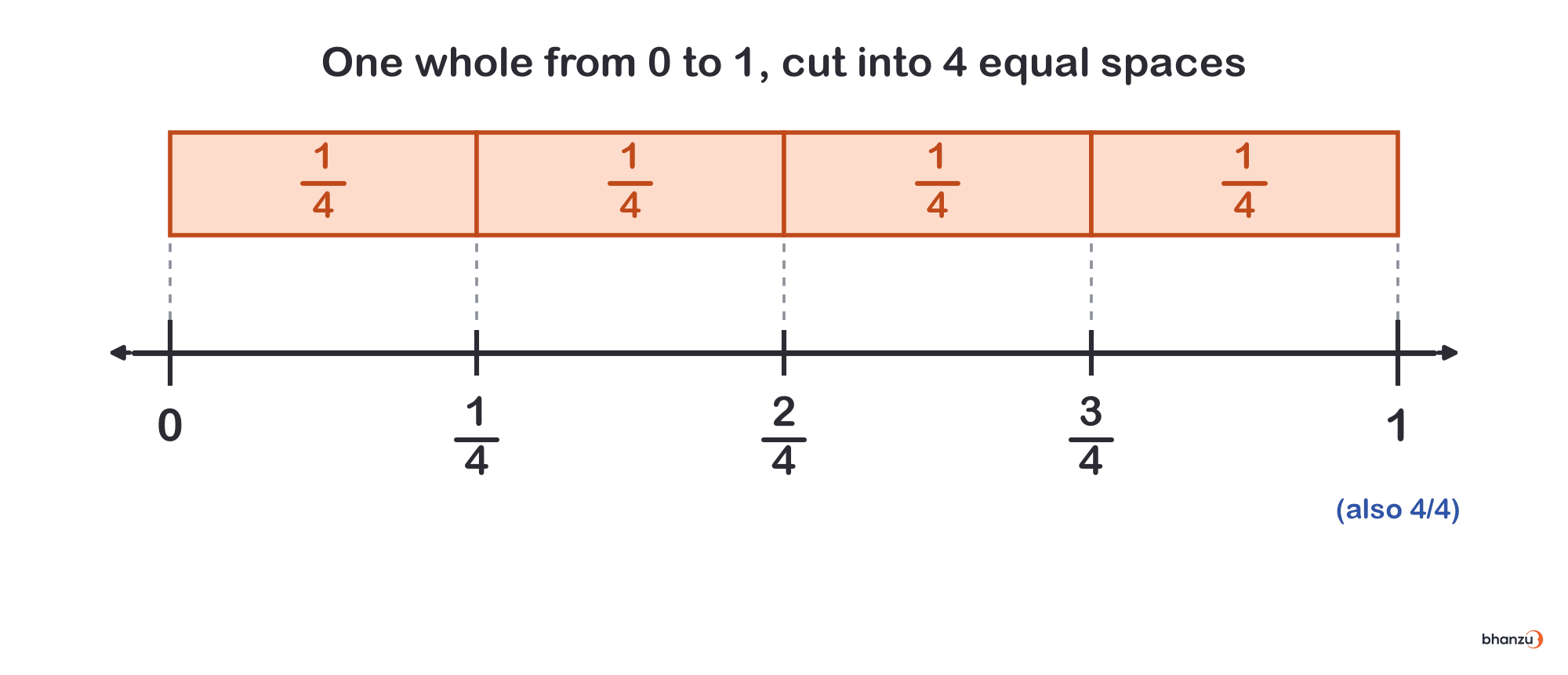
Fractions on a number line are exact spots on the line, measured in equal parts of the space from 0 to 1. That space is one whole, and short lines called tick marks show where each part ends.
The bottom number, the denominator, says how many equal spaces fill one whole. The top number, the numerator, says how many spaces to count from 0.
A unit fraction has 1 on top, like , and covers exactly one space (from 0 to the first tick mark). Children who shade pizza slices with ease often pause when that same becomes a point instead of a piece.
This is Common Core standard 3.NF.A.2, which asks 3rd graders to see a fraction as a number on the number line. For your child, that means halves, thirds, fourths, sixths and eighths this year, so a worksheet full of fifths or sevenths is reaching past what 3rd grade asks.
How do you put a fraction on a number line?
To put a fraction on a number line, let the bottom number cut the line and the top number count the spaces. For , that takes three steps.
- Mark 0 and 1 on a line. The space between them is one whole.
- Read the denominator, 3. Three equal spaces need only 2 tick marks.
- Count 2 spaces from 0, like hops on a number line with whole numbers. The first hop ends at , and the second lands on .
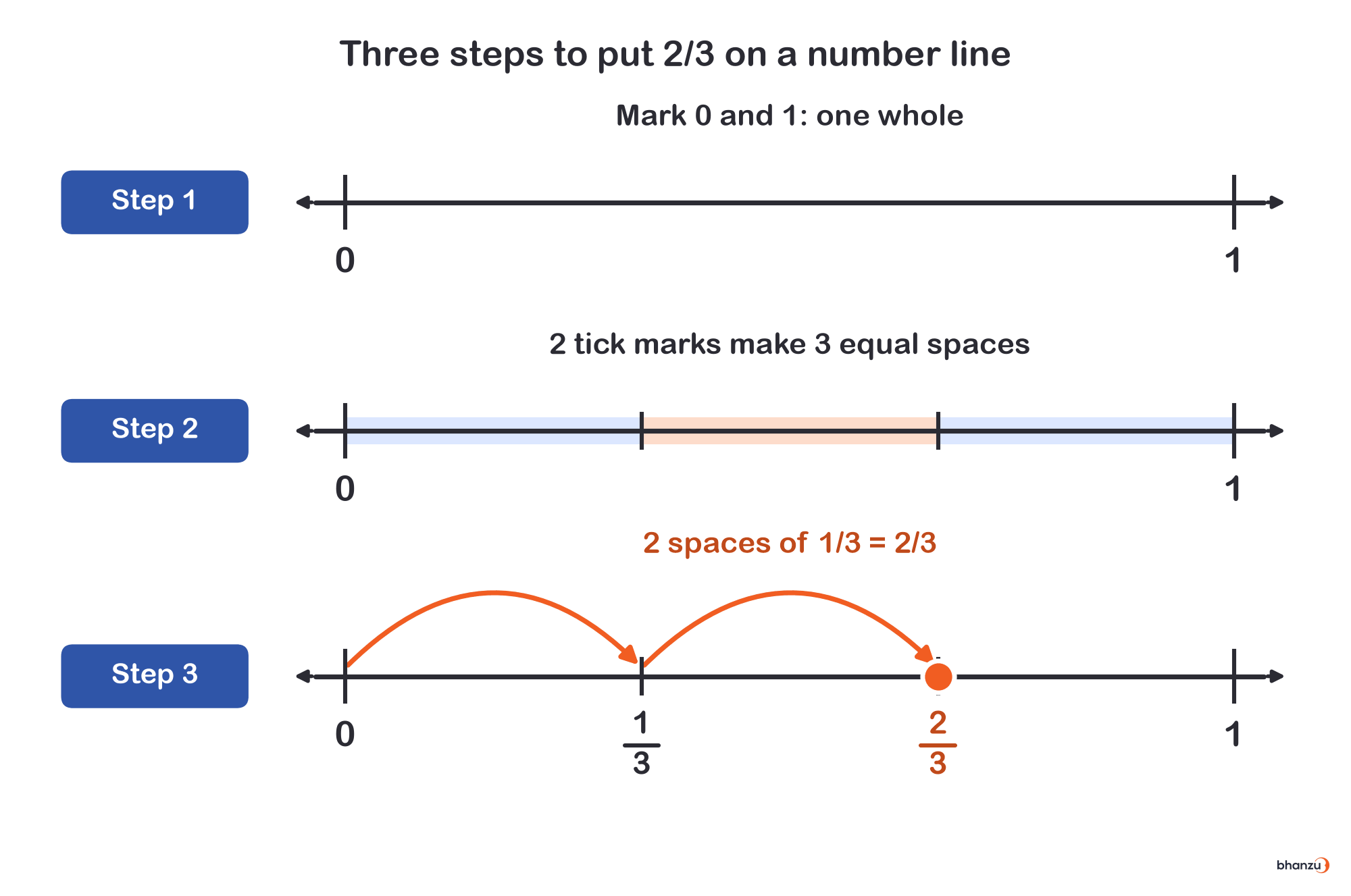
A child who counted right sometimes doubts the answer because the dot sits on a line, not inside a piece. The mark is correct, since the second space ends there.
By hand, equal spaces come from three moves:
- Measure with a ruler, marking the same distance each time.
- Fold a paper strip. Folding in half twice gives 4 equal pieces.
- Halve, then halve again, for fourths and then eighths.
Halving makes halves, fourths and eighths but never thirds, so thirds and sixths need a ruler or a strip folded in three.
What happens to fractions greater than 1 on a number line?
Fractions greater than 1 on a number line keep going past 1, with spaces the same size as before. Stretch the line to 2 and cut each whole into 4 equal spaces. Five spaces from 0 land on , one space past 1.
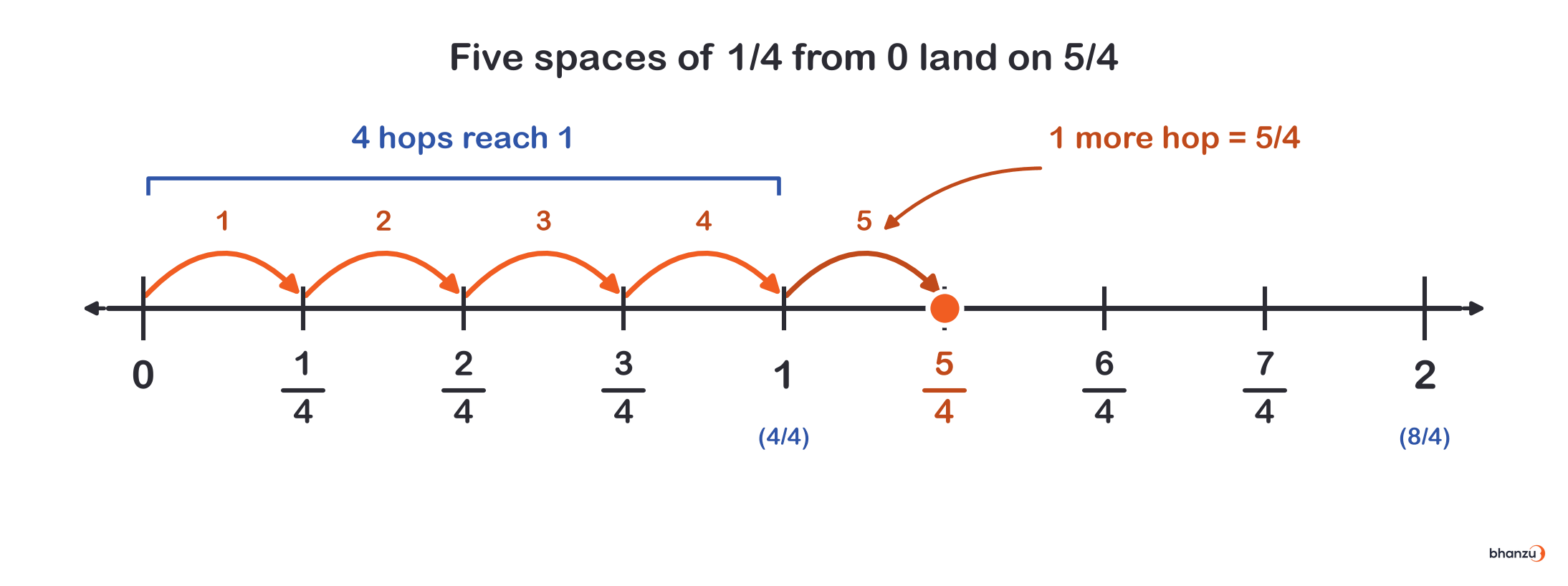
Four spaces reach 1 exactly, so and 1 share a point, the idea behind equivalent fractions. So 1 is a whole number and, written as , a fraction too.
When a line shows only 0 and , copy that first space 4 times (a paper strip makes a handy copier). The end of the fourth space is 1.
How do you name a point on a number line?
To name a point, read the line backwards. Count the spaces between 0 and 1 for the bottom number, then the spaces from 0 to the point for the top number.
| Spaces from 0 to 1 | Spaces from 0 to the point | Fraction |
|---|---|---|
| 3 | 2 | |
| 6 | 5 | |
| 8 | 3 | |
| 4 | 5 |
The last row goes past 1, but its bottom number still comes from one whole. Spaces left before 1 count the same way, so is one space of short of 1.
Try It Yourself
Pick how many equal spaces sit between 0 and 1, then drag the orange dot to the fraction on the card. Orange hops count the spaces from 0, and a message tells you at once if you landed on the right mark. Switch to the 0 to 2 line for fractions greater than 1.
Examples of fractions on a number line
Example 1
Show on a number line from 0 to 1.
The denominator is 3, so 0 to 1 needs 3 equal spaces, made by 2 tick marks.
The first space ends at the first tick mark, so that mark is .
Example 2
Where is on a number line from 0 to 1?
The tempting move is to draw 4 tick marks for fourths and put the dot on the third mark.
Those 4 marks make 5 spaces, so that dot is really at .
That can't be right. Two of 4 equal spaces cover half the whole, so must sit exactly halfway. This line's second mark, , falls short of halfway.
The correct line has 3 tick marks and 4 equal spaces. Count 3 spaces from 0.
is the third tick mark, one space before 1.
Example 3
A line from 0 to 1 has 6 equal spaces, and a dot sits on the 5th tick mark after 0. What fraction is the dot?
Six spaces fill one whole, so each space is .
The dot is 5 spaces from 0, so it is at .
Example 4
Show on a number line from 0 to 2 cut into thirds.
Three spaces of reach 1. Two more land on the point.
sits between 1 and 2, one space before 2.
Example 5
A line shows 0 and , but 1 is missing. The space from 0 to is 2 inches long. How far from 0 is 1?
One whole is 4 spaces of , so copy the 2-inch space 4 times.
The 1 sits 8 inches from 0.
Example 6
A fun-run path is 1 mile long, with a sign every of a mile. Leo stops for water at the 4th sign. How far has he run, and how much farther is the finish?
The signs cut the mile into 6 equal spaces. The 4th sign is 4 spaces from the start.
Leo has run of a mile.
He has of a mile still to go.
Why does a number line work so well for fractions?
A number line shows a fraction as a number with a size, the same way 3 and 7 have sizes. A 2023 study with 84 second and third graders backs this up. Number line lessons built a better sense of fraction size than a lesson with square area models.
- It keeps the whole the same size. On one line, is always the same distance from 0, while pizzas get drawn big or small.
- It has room past 1. One pizza can't show , but a number line can.
- It sets up comparing. The point farther right is bigger, the first step toward comparing fractions with the same denominator.
- It answers how far. A fun-run path is a number line, so of a mile is a real place on it.
The US Department of Education's 2010 fractions practice guide reached the same view years earlier. It calls number lines a central tool for teaching fractions.
Fractions on a number line: common confusions cleared up
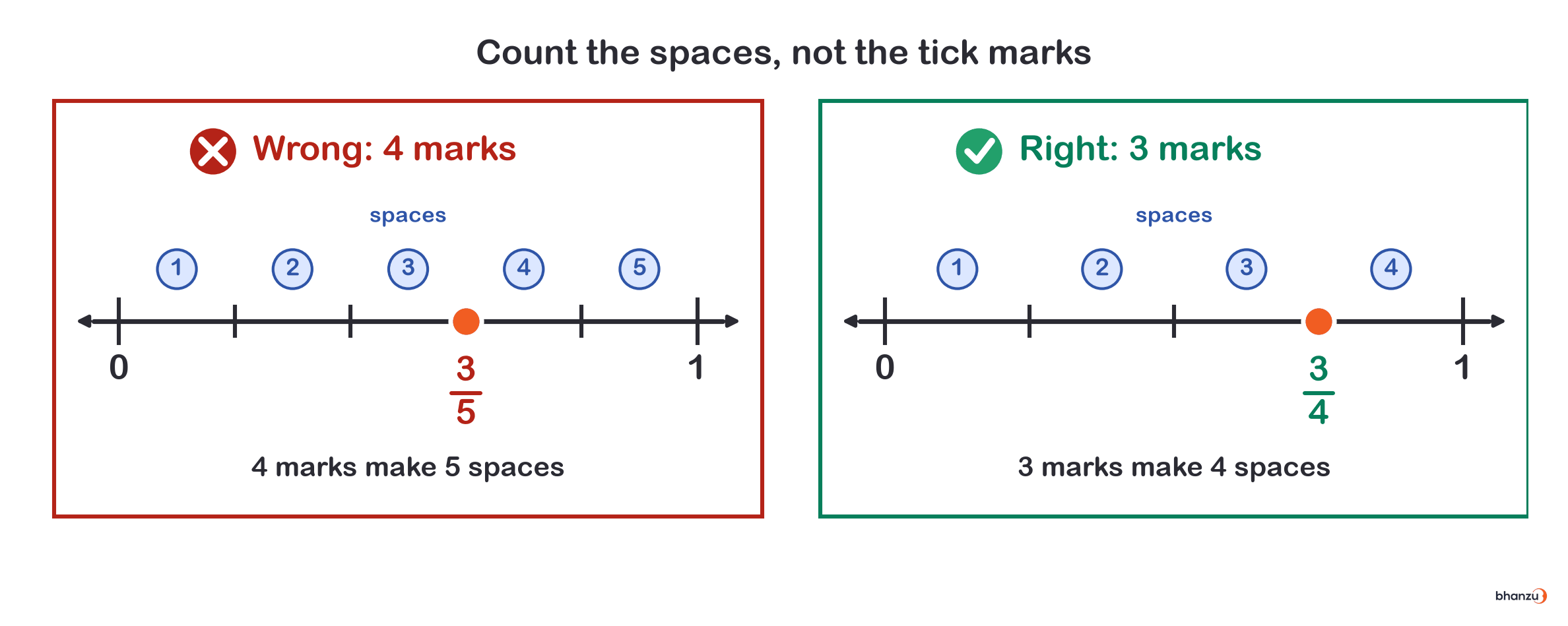
Mistake 1: Counting tick marks instead of spaces
Where it slips in: Step 2 of placing a fraction, whenever you draw the tick marks yourself, as in Example 2. A child who rushes hears "fourths," draws one mark per fourth, then counts the marks.
Don't do this: Draw 4 tick marks for fourths. That makes 5 spaces, so the third mark is .
The correct way: Draw 3 tick marks for 4 equal spaces, and the third mark is .
Counting marks feels natural because whole numbers trained you to count objects. The US Department of Education's 2010 fractions guide lists drawing four marks instead of three as a roadblock teachers should expect.
Mistake 2: Using the whole drawn line as one whole
Where it slips in: Lines that run past 1, as in Example 4. The drawn line looks like one thing, so it feels like one whole.
Don't do this: On a line from 0 to 2 cut into 8 equal spaces, name the point 3 spaces from 0 as .
The correct way: Count only the spaces from 0 to 1. There are 4, so the point is .
Mistake 3: Thinking a bigger bottom number means a bigger fraction
Where it slips in: Placing and on one line. Whole-number habits say 8 is more than 4, so feels bigger.
Don't do this: Put to the right of .
The correct way: Eighths are smaller spaces, so sits closer to 0. is 2 eighths from 0, so it sits farther right.
This habit can last. A 2023 study followed 189 fourth graders in Taiwan. Of those children, 41.3% showed a clear whole-number bias when they placed fractions on number lines, and by 5th grade half of that group still did.
The part of fractions on a number line nobody explains
A fraction names a tick mark, the end of the spaces you counted, not the space itself. Common Core's 3rd grade wording puts the fraction at that endpoint. A 2017 article from third-grade classrooms called building fractions on a number line a particularly complex task.
A second way in skips the cutting: find 3 on a line from 0 to 4, then shrink the line so 4 lands on 1.
| Line | Where the dot sits |
|---|---|
| 0 to 4 | 3, which is 3 of 4 equal steps |
| 0 to 1 | , which is 3 of 4 equal steps |
A 2023 study of 84 second and third graders tried this analogy lesson, and it worked at least as well as cutting and counting. Whole-number habits are part of why fractions feel so hard, and this move turns that whole-number knowledge into a help.
Key Takeaways
- Four equal spaces need only 3 tick marks, so count spaces and let the marks follow.
- The bottom number sets how many spaces fill one whole, and the top number sets how many to walk from 0.
- Fractions on a number line keep going past 1, so has a real spot one space before 2.
- A missing 1 comes back when you copy the unit-fraction space as many times as the bottom number says.
- To keep building fraction sense with a teacher who spots the four-marks-for-fourths habit early, explore Bhanzu's 3rd grade math curriculum or math classes for kids.
Read More
- Division Facts Within 100
- Fractions of Different Sized Wholes
- Decomposing Fractions
- Decimals on the Number Line
- Improper Fraction
Research Behind This Article
- Common Core State Standards Initiative, Grade 3 Number and Operations, Fractions (2010). thecorestandards.org
- Viegut, A. A. and Matthews, P. G., Building Fraction Magnitude Knowledge with Number Lines: Partitioning versus Analogy (2023). eric.ed.gov
- Siegler, R. et al., Institute of Education Sciences, Developing Effective Fractions Instruction for Kindergarten Through 8th Grade (2010). ies.ed.gov
- Yuan, Y. and Chen, K., Whole Number Bias of Students in Fraction Number Line Tasks (2023). eric.ed.gov
- Cramer, K., Ahrendt, S., Monson, D., Wyberg, T. and Colum, K., Fractions, Number Lines, Third Graders (2017). eric.ed.gov
Quick Quiz: Check Yourself
Three levels, new numbers every time. Easy asks about tick marks, Medium names a dot between 0 and 1, and Hard works past 1 or along a path.
Was this article helpful?
Your feedback helps us write better content
Frequently Asked Questions
What grade do kids learn fractions on a number line?
How do I start teaching fractions on a number line at home?
Is 0 a fraction?
Where is 1/2 on a number line?
How do you put mixed fractions on a number line?