Key Points
- Dividing fractions word problems put the total first, so 2/3 pound of birdseed in 1/6-pound scoops becomes 2/3 divided by 1/6, or 4 scoops.
- The reciprocal method multiplies the total by the flipped divisor, and multiplying the answer back by the divisor returns the story's total.
- Dividing a positive total by a fraction between 0 and 1 gives an answer bigger than the total, so a smaller answer signals a mistake.
Smaller cups, bigger answer
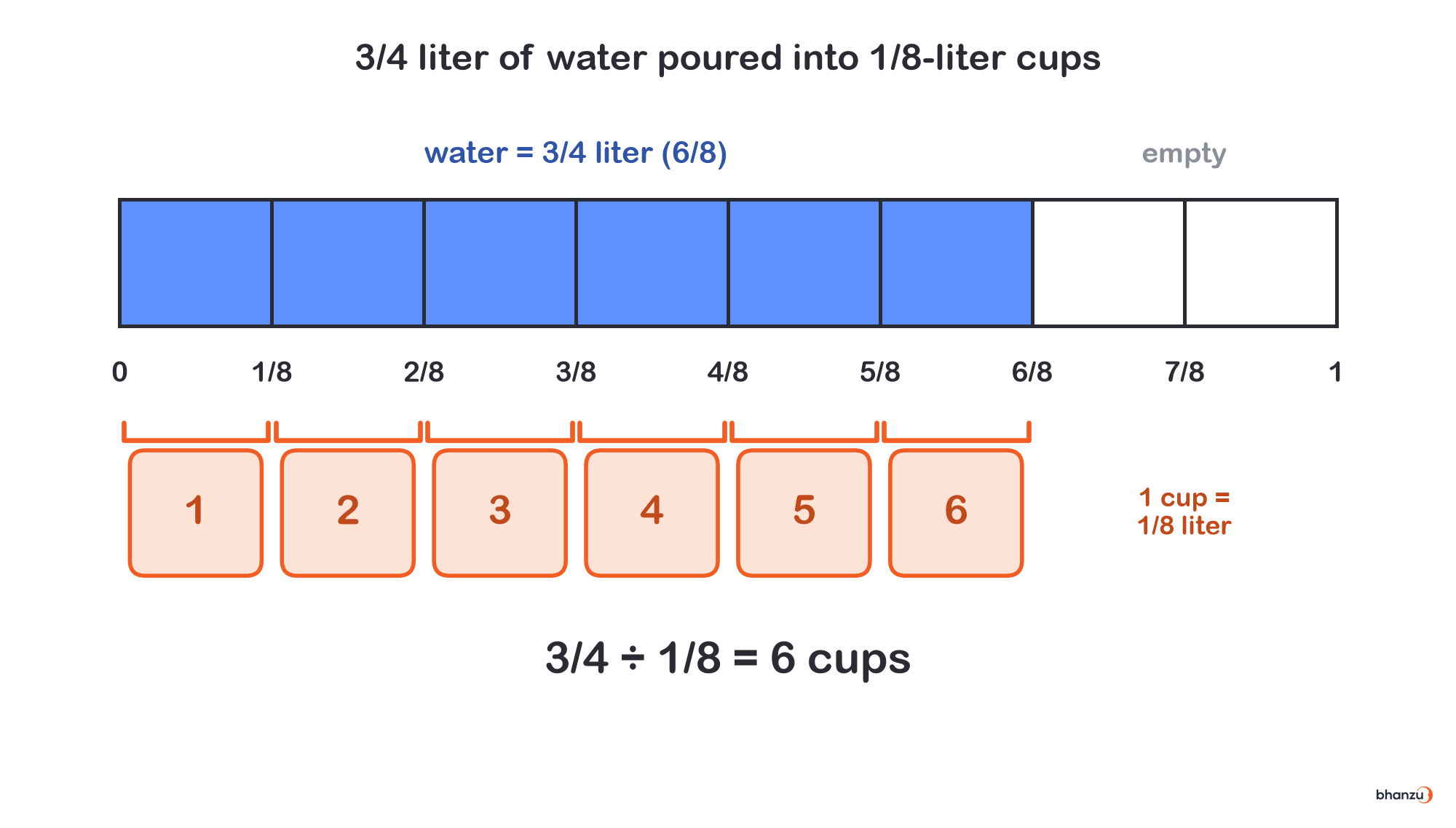
Divide three-quarters by one-eighth and the answer comes out bigger, not smaller. Pour three-quarters of a liter into cups that hold one-eighth of a liter each, and you fill 6 cups. The story asked one thing: how many cups fit.
Dividing fractions word problems hide one of two questions, how many groups fit in a total or how much fills one whole group. A nurse counting quarter-milliliter doses in a vial asks the first, and so does a quilter cutting fabric into strips. A baker with a recipe written for two-thirds of a batch asks the second, far from any classroom.
How do you solve dividing fractions word problems?
To solve dividing fractions word problems, divide the total by the other amount, which is either the size of one group or the part of one group that the total fills. In dividend, divisor and quotient terms, the total is the dividend, the number you divide by is the divisor, and the answer is the quotient.
On a fraction bar, three one-sixth pieces fit along a bar one-half long (the same picture OpenStax's Prealgebra builds with fraction tiles).
Your child meets this in 6th grade as Common Core standard 6.NS.A.1, which asks students to solve word problems that divide a fraction by a fraction. That is a step past 5th grade's dividing unit fractions word problems, where a unit fraction (1 on top) meets a whole number.
A child who divides bare fractions quickly often stalls on the same numbers in a story, because the story never says which number is the total. The first two steps fix that.
- Find the total. Rewrite 0.5 as and a mixed number such as as an improper fraction, top bigger than bottom, like .
- Decide whether the other number is one group's size or the part of a group the total fills.
- Write the total divided by that number, total first, with a whole number such as 2 written as .
- Multiply the total by the reciprocal of the divisor, the divisor flipped upside down, and simplify.
- Multiply the quotient by the divisor to get the total back, and check whether its size makes sense.
The flip works because dividing by counts sixths, and every whole holds 6 of them. Multiplying both numbers in a division by the same nonzero amount leaves the answer alone ( and both equal 4), so multiplying both by 6 turns the divisor into 1.
A second method, shown in Iain Pardoe's open textbook for teachers, uses common denominators: rewrite both fractions over one bottom number, the denominator, and divide the tops.
That method slows down with bottoms like 9 and 12, and the reciprocal method fails only for a divisor of 0, which has no reciprocal.
Which question is the story asking?
Every fraction division story asks one of two questions, and the same division answers both.
- How many groups fit. You know one group's size and count the groups, like half-cup scoops in three-quarters of a cup of rice.
- How much is in one group. You know what part of a group the total fills, like three-quarters of a pound of clay filling half a box, and you find the full box.
The two look almost identical, and telling them apart is the hardest part of this topic. Read the story's last sentence first, where the question lives.
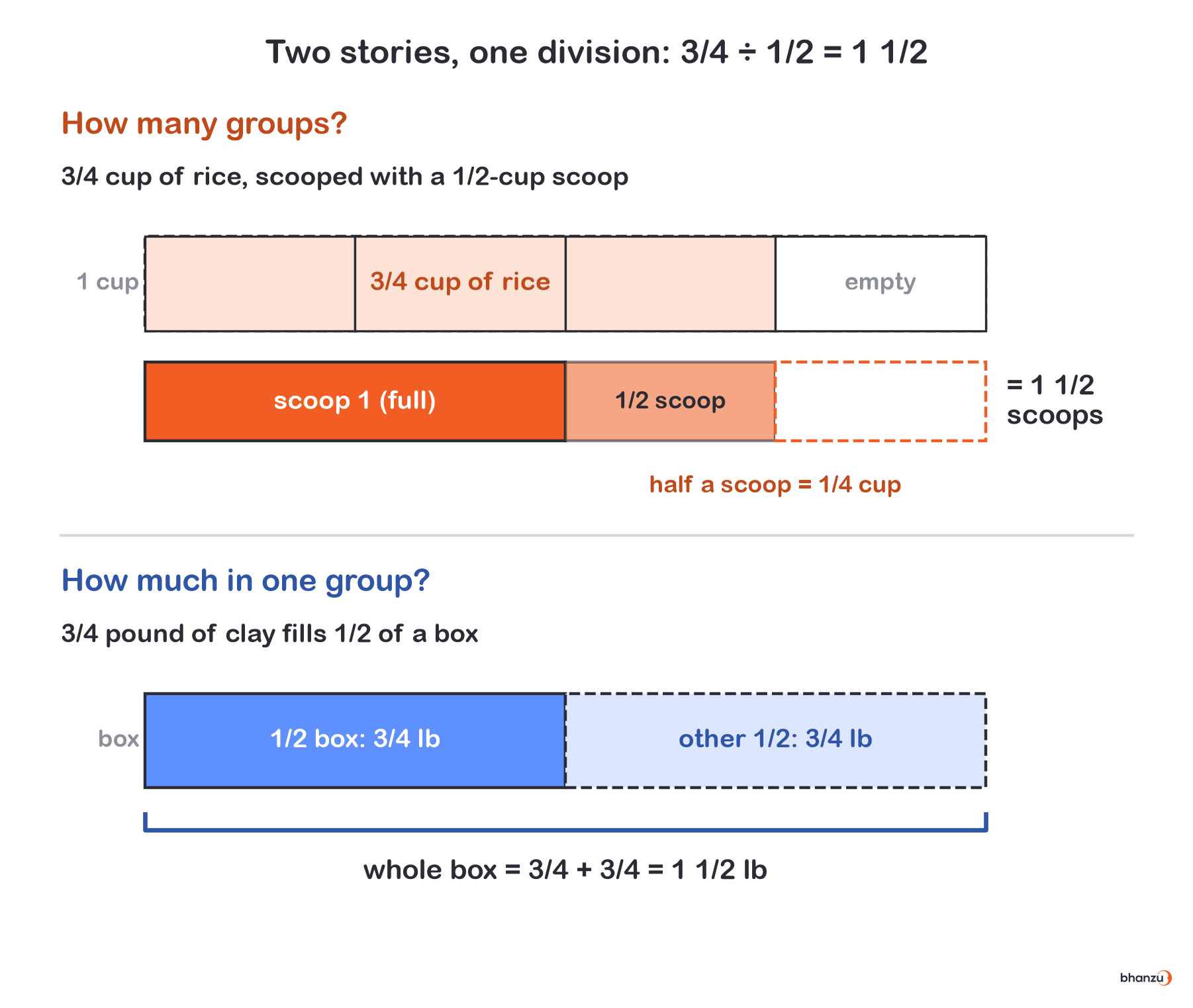
Both diagrams give , and the half means something different in each, half of a scoop ( cup) in one and half a pound in the other.
A rate such as mile in hour is a how-much-in-one-group story, with one whole hour as the group. A rectangle 3 units by 2 units holds 2 rows of 3 unit squares, so area is length times width in square units, and a missing width is area divided by length.
| Words in the problem | Math it means |
|---|---|
| -pound scoops in pound, how many? | |
| bag fills box, how much for a whole box? | |
| Area , length , how wide? | |
| Cut the recipe in half | |
| of cup |
The word "of" means multiply when the amount after it is known, as in multiplying fractions word problems like half of cup. When "of" names a whole you have not found yet, the story is a division, so lists that say "of means times" break down here.
How do you write your own fraction division word problems?
Write a whole-number division story first, then swap in the fractions and keep every other word, a move Michelle Manes of the University of Hawaii suggests in a LibreTexts lesson on fraction division stories.
- Pick a whole-number division, such as .
- Tell its story, such as "How many 3-mile laps make 12 miles?"
- Swap in fractions, giving "How many -mile laps make mile?"
- Write the multiplication sentence with a hole to check the story.
Every division story hides a multiplication sentence, groups times size of one group equals total, with one number missing. Here the box stands for the number of laps.
The box holds 2. Told as a how-much-in-one-group story, mile is of a trail, so the box becomes the whole trail's length, 2 miles.
Later this year the box becomes a letter such as .
Try It Yourself
Pick a total and a piece size, then add pieces under the bar until it is full and read how many fit and what part of a piece is left. Switch to Missing side and drag the width row by row until the shaded area matches the target.
Examples of dividing fractions word problems
Example 1
How many -pound scoops are in pound of birdseed?
One scoop is the group, so count how many fit.
The bag holds 4 scoops, and multiplying back confirms it.
Example 2
Ana uses of a bag of soil to fill of a planter box. How much of the bag fills the whole box?
The word "of" tempts a multiplication.
That says a whole box needs less soil than part of it. The story gives the soil for part of a box and asks for a whole box, so divide by .
Half a bag fills the whole box.
Example 3
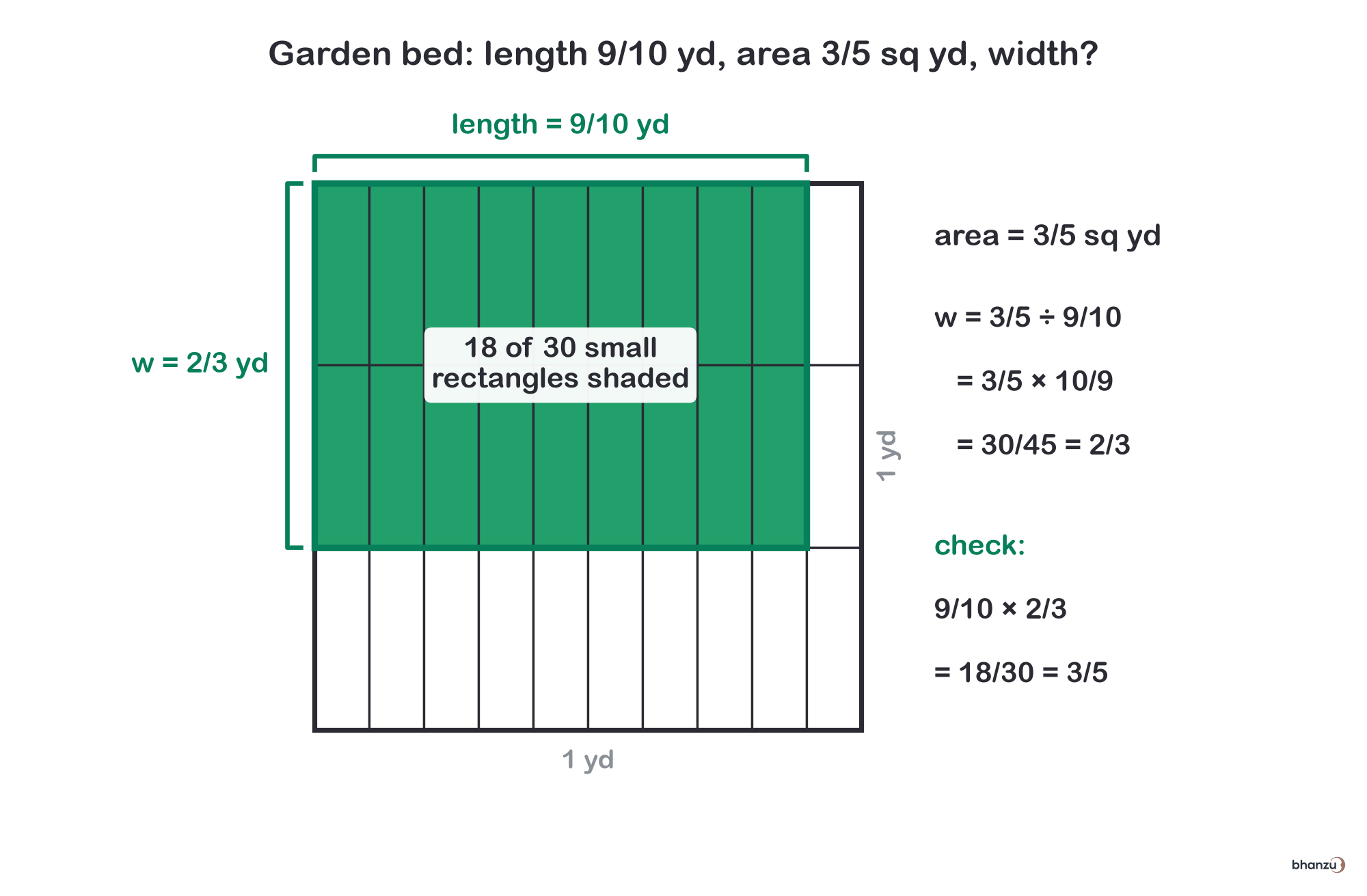
A rectangular garden bed has an area of square yard and a length of yard. How wide is it?
Let be the width in yards. Length times width gives the area.
Divide both sides by to undo the multiplication.
The bed is yard wide, and the area model shades 18 of 30 small rectangles, which is square yard.
Example 4
Write two stories for , then solve each one.
Story A counts groups. How many -gallon pitchers can gallon of lemonade fill?
That is 2 full pitchers and half of a third pitcher.
Story B finds one group. If gallon fills of a cooler, the full cooler holds gallons.
Example 5
Jay walks mile in hour. At that pace, how far does he walk in 1 hour?
One hour is the whole group.
Jay walks miles in 1 hour.
Example 6
A paper streamer is yards long. How many -yard pieces can you cut, and how much is left?
Write as .
You can cut 4 full pieces. The is part of a fifth piece, so find the leftover in yards.
The leftover is yard.
What makes dividing fractions word problems worth learning?
Division answers the question you ask when you know a total and need a count or the size of one whole. Fractions change only the numbers.
- It counts how many fit. The 6 small cups and the 4 streamer pieces both come from dividing a total by a piece size.
- It rebuilds a whole from a part. Knowing what three-quarters of a box takes tells you what a full box takes, the same move that scales up a recipe written for part of a batch.
- It turns a part into a rate. Miles walked in a third of an hour become miles per hour, the unit rate idea you will use in ratio work and in 7th grade.
For parents, national results put middle school math in context, though they do not report fraction division on its own. The 2024 NAEP mathematics results, from 115,200 8th graders, put 28 percent at or above Proficient and 39 percent below Basic, a share 8 percentage points higher than in 2019.
Why kids get dividing fractions word problems wrong (and the fix)
Mistake 1: Dividing in the order the numbers appear
Where it slips in: Stories that name the part first, such as Maya covering of a wall with of a can of paint. A child who rushes copies the numbers in reading order, because whole-number stories usually list the total first.
Don't do this: Writing cans for the whole wall. Then of the wall would take can, not the can Maya used.
The correct way: The paint is the total, so can, just over the can that covered most of the wall.
Mistake 2: Dividing by one-half to cut a recipe in half
Where it slips in: Halving a recipe. Children hear "half" and write , because one-half is the only fraction in the sentence.
Don't do this: Writing half of cups of milk as cups, more milk than the full recipe.
The correct way: Split the milk into 2 equal parts, so cup, the same as .
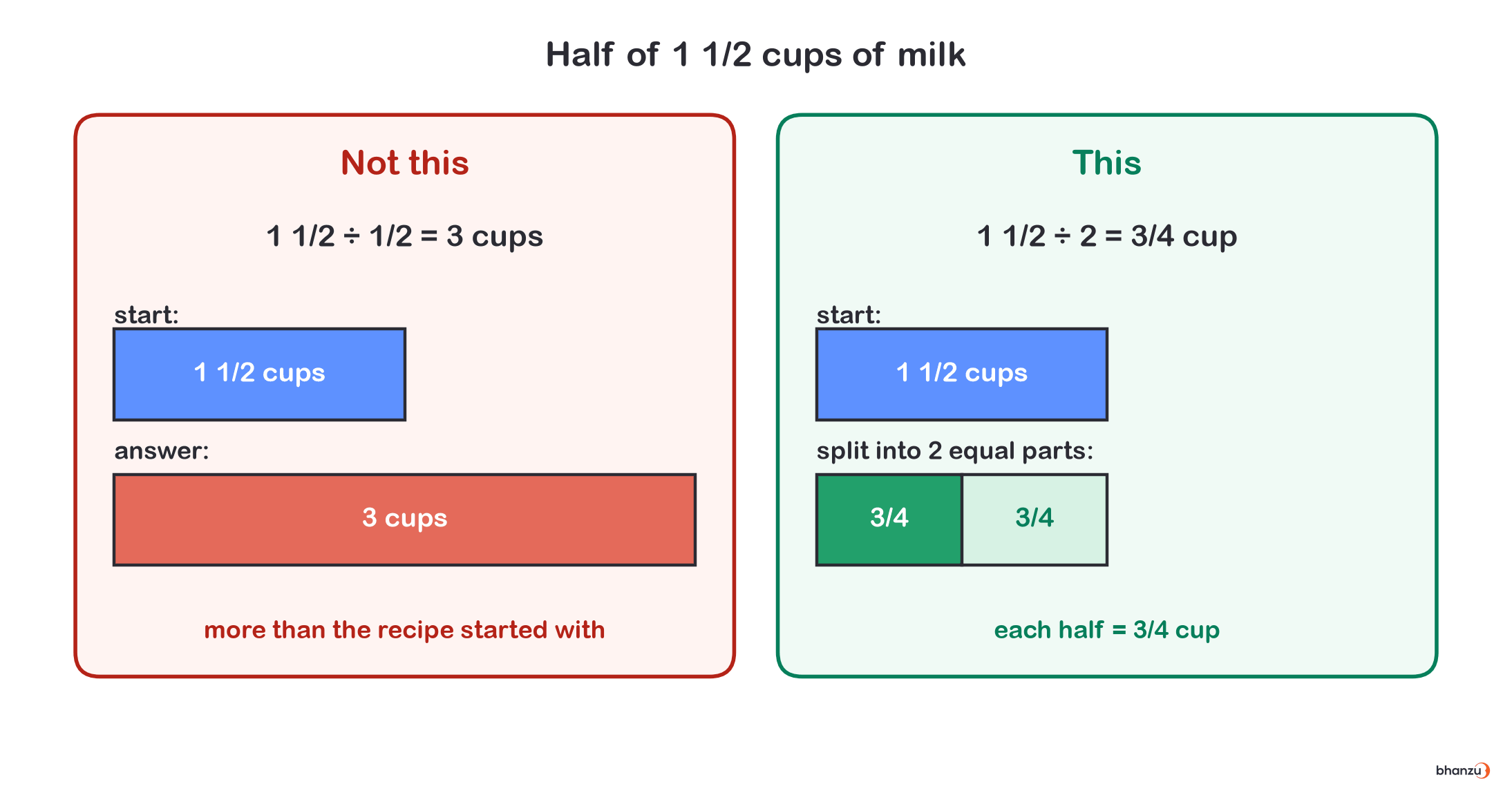
Dividing by one-half counts halves, so it doubles the amount.
Mistake 3: Reading the leftover in the wrong unit
Where it slips in: Cutting stories that call for dividing mixed numbers, like Example 6. The fraction part of the answer counts pieces, but children read it in yards because yards were the unit in the question.
Don't do this: Cutting yards of rope into -yard pieces, getting , then reporting yard left over.
The correct way: The is three-quarters of a piece, so yard is left.
The pattern hiding inside dividing fractions word problems
The size of the divisor tells you in advance whether the quotient beats the total. For any positive total and positive divisor, the pattern runs like this.
| Divisor | Quotient compared with the total | Example |
|---|---|---|
| Between 0 and 1 | Bigger | |
| Equal to 1 | The same | |
| Greater than 1 | Smaller |
A child who gets 4 scoops from pound sometimes erases it because 4 looks too big. The first row is the reason to keep it.
The What Works Clearinghouse fractions practice guide (2010) lists three misuses of invert and multiply, another name for multiplying by the reciprocal. Here they are on , whose answer is .
- Not inverting gives .
- Inverting the wrong fraction gives .
- Inverting both gives .
The size check catches only , while multiplying back by catches all three, since none of them returns .
For parents, two questions beat any keyword list. Before any pencil work, ask your child what the total is and what the other number measures, a habit that carries over to other math word problems.
Key Takeaways
- Read the question sentence first and decide whether it wants a count of groups or one whole group.
- Write the total first in the division, even when the story mentions it last.
- In a cutting story, multiply the leftover fraction by the piece length to turn it into the story's unit, such as yards.
- For guided practice spotting the total and the "in half" trap in dividing fractions word problems, explore Bhanzu's 6th grade math tutor or middle school math tutor.
Read More
- Finding the Percent of a Number
- Dividing Decimals
- Fractions as Division
- Multiplying and Dividing Negative Fractions
- Why Are Fractions So Hard
- Fractions, Decimals and Percentages
Research Behind This Article
- Common Core State Standards Initiative, Grade 6, The Number System (2010). thecorestandards.org
- OpenStax, Prealgebra 2e, 4.2 Multiply and Divide Fractions (2020). openstax.org
- Iain Pardoe, Thompson Rivers University, Mathematics for Elementary Teachers, Word Problems for Dividing Fractions (2023). pressbooks.tru.ca
- Michelle Manes, LibreTexts, Conceptual Mathematics in Society, 3.7 Dividing Fractions, Word Problems (2025). math.libretexts.org
- National Center for Education Statistics, NAEP Mathematics, 2024 Results for Grades 4 and 8 (2025). nationsreportcard.gov
- Institute of Education Sciences, What Works Clearinghouse, Developing Effective Fractions Instruction for Kindergarten Through 8th Grade (2010). ies.ed.gov
Quick Quiz: Check Yourself
Three levels, new numbers every time: count unit-fraction scoops in a total, find one whole group or a missing width, then cut a mixed-number length and give the full pieces or the leftover.
Was this article helpful?
Your feedback helps us write better content
Frequently Asked Questions
How do I teach dividing fractions word problems at home?
What grades are dividing fractions worksheets good for?
What does keep change flip mean?
Are fractions as division word problems the same as dividing fractions word problems?
How do I learn dividing fractions word problems?