Key Points
- Subtracting multiples of ten treats each ten as one thing you count, so 90 minus 60 is 9 tens take away 6 tens, or 30.
- Each subtraction of two multiples of 10 matches a small fact within 10, so gives .
- A common error is writing 5 for 90 minus 40, and adding back catches it, because 5 plus 40 makes 45, not 90.
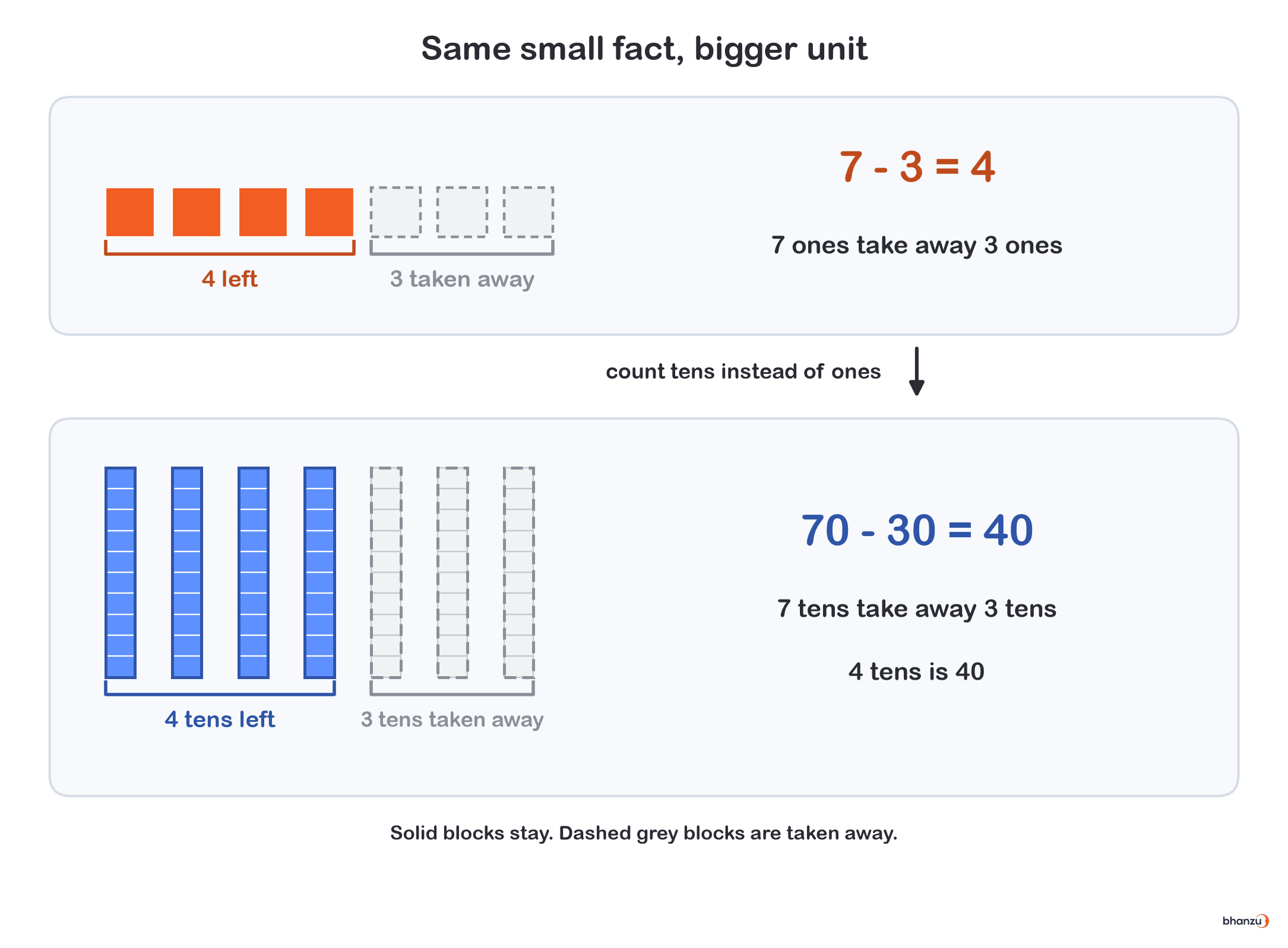
Seven take away three, but in tens
If you know 7 take away 3 is 4, you already know 70 take away 30. Aisha has 7 strings of beads, with 10 beads on each string. She uses 3 strings for a necklace.
Now 4 strings are left, which makes 40 beads, and she never counted a single bead. She counted strings (each one is a ten). In 2nd grade, the same move helps with 700 take away 300.
How do you subtract multiples of ten?
Subtracting multiples of ten works by counting tens instead of ones and reading the answer in tens. A multiple of 10 is a number you land on when you skip count by 10s, like 30 or 70, so it has 0 ones.
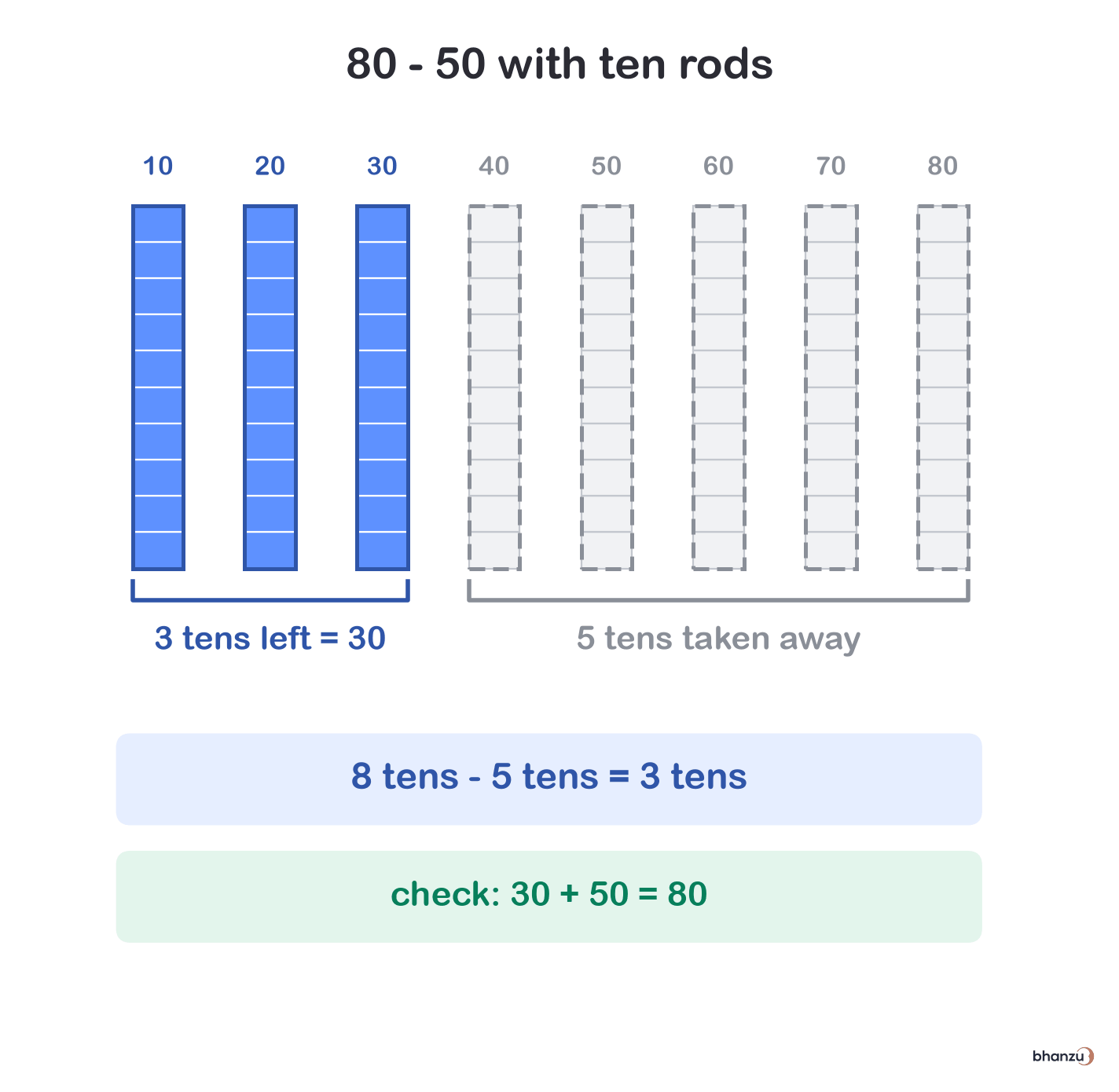
To subtract tens using models, build the first number with ten rods from base-ten blocks, each made of 10 cubes.
- Build 80 with 8 ten rods.
- Take 5 rods away, because 50 is 5 tens.
- Count the 3 rods left, which make 30.
Common Core lists this skill as standard 1.NBT.C.6, for multiples of 10 from 10 to 90. Your child usually meets it after subtracting within 10, so if your child can look at 70 and say "7 tens," the groundwork is already there.
An answer of 0 counts, since 5 tens take away 5 tens leaves no tens. Some children rub out that 0, yet is right. Taking 70 from 30 needs numbers below zero, which arrive in 6th grade.
Why does 7 minus 3 help with 70 minus 30?
A ten is a unit you can count, just like an apple. So 7 tens take away 3 tens leaves 4 tens, the way 7 apples take away 3 apples leaves 4 apples.
| Small fact | Same fact in tens | Answer |
|---|---|---|
| 7 tens take away 3 tens | 40 | |
| 8 tens take away 5 tens | 30 | |
| 5 tens take away 5 tens | 0 |
How do you check the answer? Add it back to the part you took away, using the same partners as from fact families.
Taking tens from tens always leaves a whole number of tens, so the ones digit is 0. One part really is confusing, though. The 4 in 40 is the digit you see, yet it means 4 tens.
Children who know in a blink often still count 70 down to 40 by ones. They may not have seen that both are the same fact. A dime works as a ten too (it's 10 cents), so if your child has started counting coins, 7 dimes take away 3 dimes is 40 cents.
How do you subtract tens on a number line?
Start at the bigger number and hop back 10 for each ten you take away. Count the hops you make, not the numbers you pass.
An open number line is one you draw yourself, with only the numbers you need. Here is on one.
- Mark 60 on the line.
- Hop back 10 four times, because 40 is 4 tens.
- Land on 50, 40, 30 and then 20, so .
There's a second way. Think addition, and ask what you add to 40 to make 60. Hop up to 50 and then 60, which is 2 hops, or 20.
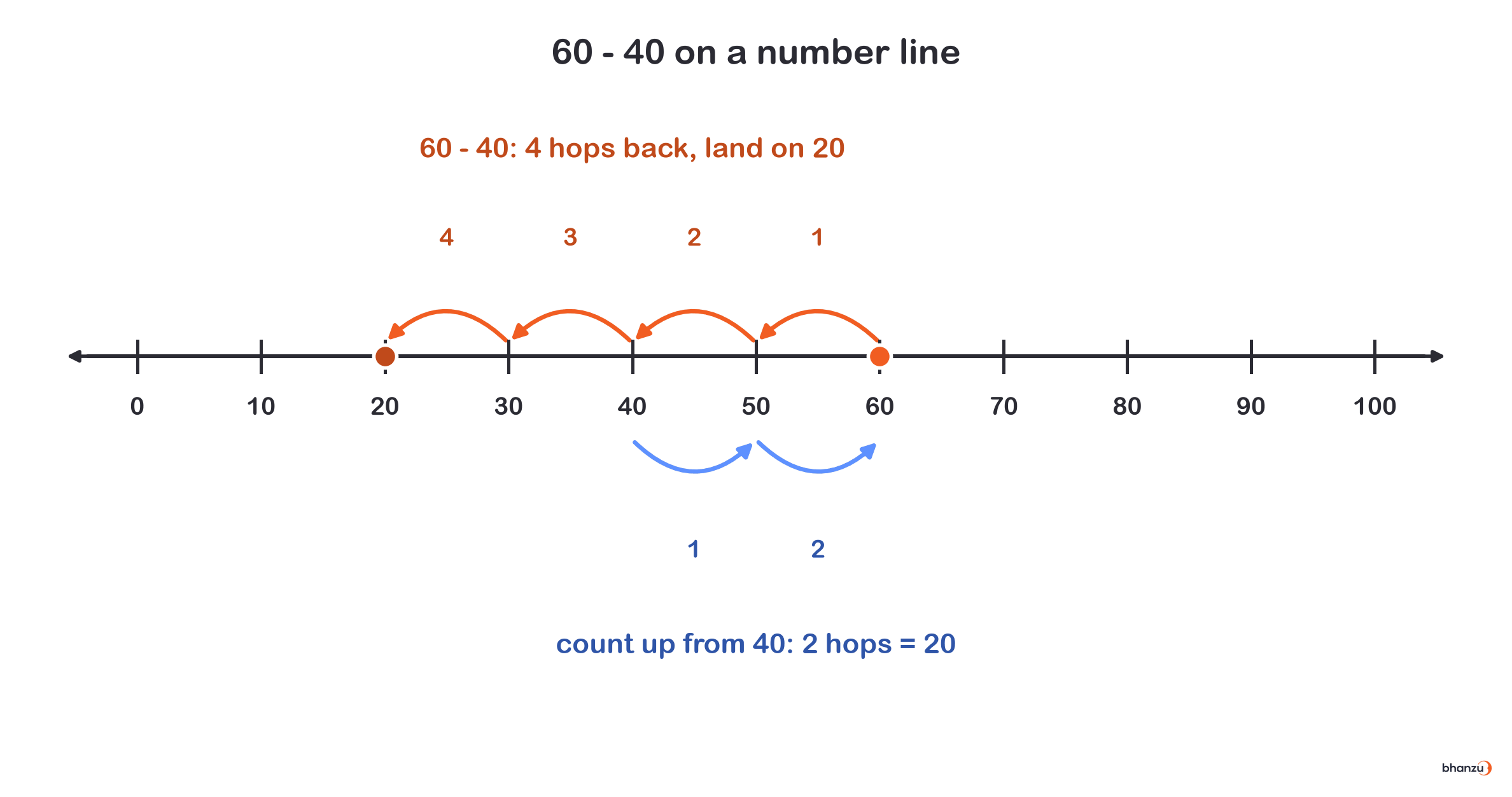
Common Core calls this understanding subtraction as an unknown-addend problem (standard 1.OA.B.4). Counting up wins when the numbers sit close, since takes 8 hops back but only 1 hop up.
Hopping back by tens is skip counting by 10s said backward. On a hundred chart, each row up is 10 less, just like 10 more and 10 less.
| Words in the problem | Math it means |
|---|---|
| spends 30 cents | take away |
| how many more | compare, or count up |
| uses 2 strings, then 3 | take away twice |
| what goes in the box | think addition |
The box in stands for the tens taken away.
Seeing numbers as parts pays off later. In a 2024 study of four Swedish first-grade classes, children spent eight months learning how numbers split into parts. A year later, they used that structure with bigger numbers, while comparison classes more often counted one by one.
Try It Yourself
Use the arrow buttons to build a number with ten rods, then tap or drag rods into the take-away tray. Each rod you move makes the number line hop back 10 and shows the matching small fact. Press Count up to see hops forward, or New problem for new numbers.
Why does subtracting multiples of ten matter?
Taking away whole tens lets a child subtract big numbers without counting every one.
- It turns a long count into one small fact. needs only .
- It makes money quicker. Take 2 dimes from 6 dimes and 40 cents are left.
- It's the move older kids reach for. In a 2023 study of 143 third graders on empty number lines, multiples of 10 were their most used strategy. The same move starts mental subtraction with bigger numbers.
- It grows into bigger subtraction. A 2023 study that followed 279 kindergartners found counting with tens and ones was the best single predictor of their 2nd grade calculation with bigger numbers.
In 3rd grade, tens thinking helps again with 4 groups of 60.
Examples of subtracting multiples of ten
Example 1
What is 80 minus 60?
80 is 8 tens and 60 is 6 tens, so 2 tens are left.
Example 2
What is 90 minus 40?
The tempting move is to use and write 5.
That can't be right, because , not 90.
The fact is about tens, so 9 tens take away 4 tens leaves 5 tens.
Check by adding, .
Example 3
What number goes in the box in ?
Think addition, so 20 plus the box makes 70. Counting up from 20 to 70 takes 5 hops of 10.
Example 4
Aisha has 90 beads and Priya has 70. How many more beads does Aisha have?
Count up from 70 to 80 and then 90, which is 2 tens.
Aisha has 20 more beads.
Example 5
Diego has 8 dimes, which is 80 cents. He spends 30 cents. How many cents are left?
30 cents is 3 dimes, and 8 dimes take away 3 dimes leaves 5 dimes.
Diego has 50 cents left.
Example 6
Aisha has 9 strings of 10 beads. She uses 2 strings for a bracelet and 3 for a necklace. How many beads are left?
9 strings of 10 is 90 beads.
Aisha has 40 beads left.
What do most guides miss about subtracting multiples of ten?
Most guides miss that three problems look alike, and only one is the 1st grade skill.
| Problem | What happens | Grade |
|---|---|---|
| tens from tens, ones stay 0 | 1st | |
| tens from tens, 4 ones stay | 2nd | |
| a ten breaks into 10 ones | 2nd |
The tens move still works on a number like 74, so 7 tens take away 3 tens leaves 4 tens, and with the 4 ones that's 44. Taking 4 from 70 needs a ten broken apart, which comes with subtracting two-digit numbers with regrouping.
A popular shortcut says to subtract the tens digits and put a zero on the end. On that shortcut gives 40, because the 4 ones get lost. Saying "tens" keeps every digit's meaning.
The mistakes kids make most often with subtracting multiples of ten
Mistake 1: Counting the starting number as a hop
Where it slips in: Counting back by tens, as in . Counting starts by saying a number, but that first number is where you stand.
Don't do this: Saying "80, 70, 60" for 3 tens and stopping at 60.
The correct way: Stand on 80 and hop 3 times, to 70, 60 and 50, so .
Mistake 2: Taking away ones instead of tens
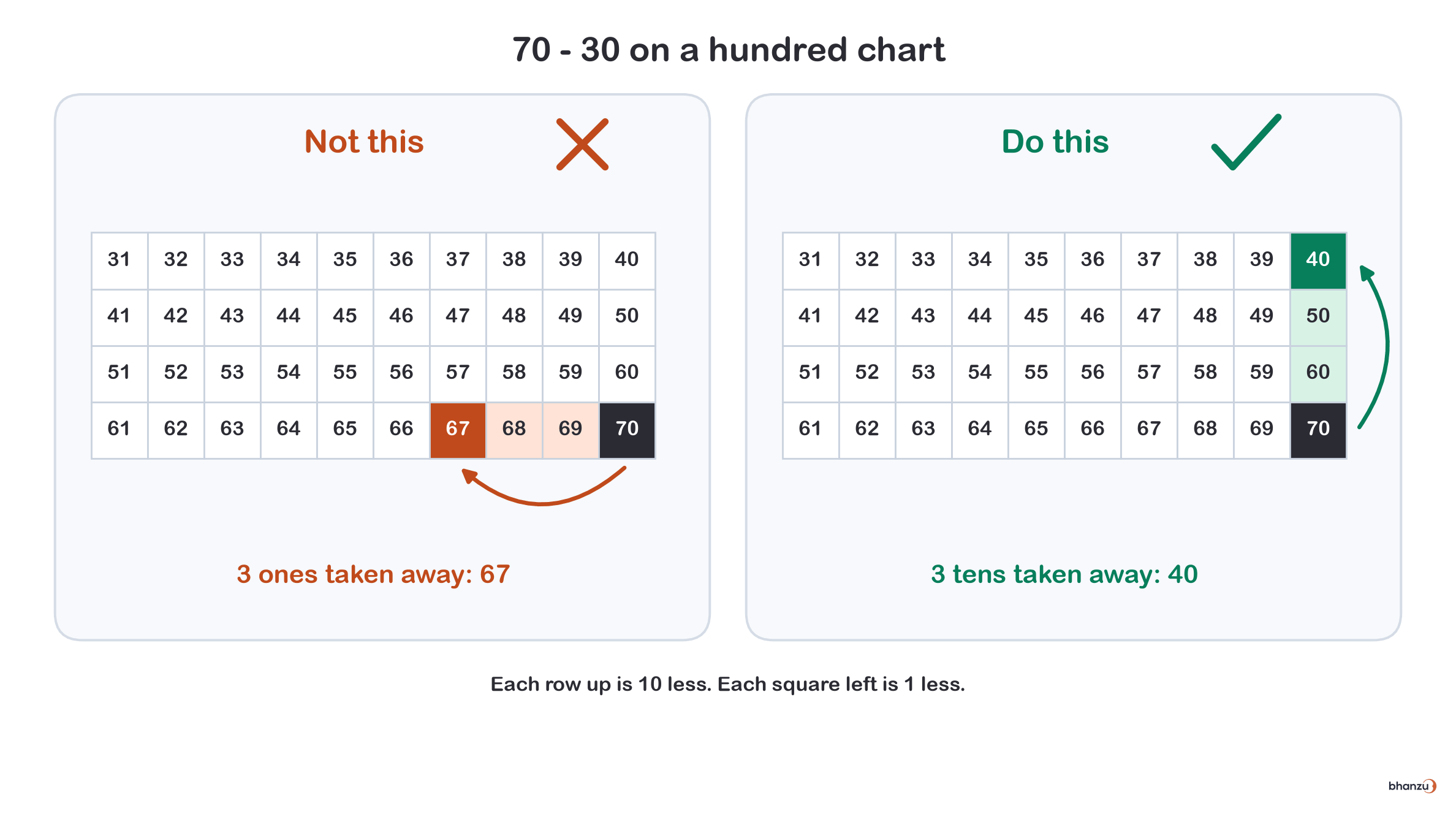
Where it slips in: A hundred chart or base-ten blocks, as in .
Don't do this: Sliding 3 squares left from 70 to 67.
The correct way: 30 is 3 tens, so move up 3 rows to 40, or take away 3 ten rods.
Children who just practiced 1 less on the chart often keep sliding sideways. Their hand remembers that move.
Mistake 3: Adding when the question says "how many more"
Where it slips in: Compare stories like Example 4. A child who grabs the word "more" before reading the whole question adds.
Don't do this: Noah has 70 stickers and Mei has 20, so Noah has more.
The correct way: "How many more" asks for the difference, so .
Key Takeaways
- Say "tens" out loud, so 80 minus 30 becomes 8 tens take away 3 tens.
- On a number line, count hops, never the number you start on.
- Pick the shorter path, so for 90 minus 80, one hop up beats eight hops back.
- Any answer in subtracting multiples of ten ends in 0, so 5 for 90 minus 40 needs another look.
- For practice turning 9 take away 4 into 90 take away 40 with a teacher who listens for "tens," explore Bhanzu's 1st grade math tutor or math programs for elementary.
Read More
- Adding Within 100 by Making a New Ten
- Adding Several Numbers With Tens and Ones
- Adding and Subtracting on a Number Line
- Mental Math for Kids
Research Behind This Article
- Common Core State Standards Initiative, Grade 1 Number and Operations in Base Ten (2010). thecorestandards.org
- Common Core State Standards Initiative, Grade 1 Operations and Algebraic Thinking (2010). thecorestandards.org
- Kullberg, Björklund, Runesson Kempe, Brkovic, Nord and Maunula, Improvements in Learning Addition and Subtraction When Using a Structural Approach in First Grade (2024). eric.ed.gov
- Halil Önal, Mental Processing Strategies in Primary School Students: The Empty Number Line (2023). eric.ed.gov
- Mix, Bower, Yuan, Hancock and Smith, Predictive Relations between Early Place Value Understanding and Multidigit Calculation: Approximate versus Syntactic Measures (2023). eric.ed.gov
Quick Quiz: Check Yourself
Three levels, new numbers every time: subtract tens, find a missing number or how many more, then solve dime and two-step bead stories.
Was this article helpful?
Your feedback helps us write better content
Frequently Asked Questions
Is 0 a multiple of 10?
How do you subtract a single-digit number from a multiple of 10?
How do you subtract multiples of 100?
How can I explain subtracting multiples of ten to my child?
What can my child use instead of counting on fingers to subtract?