Key Points
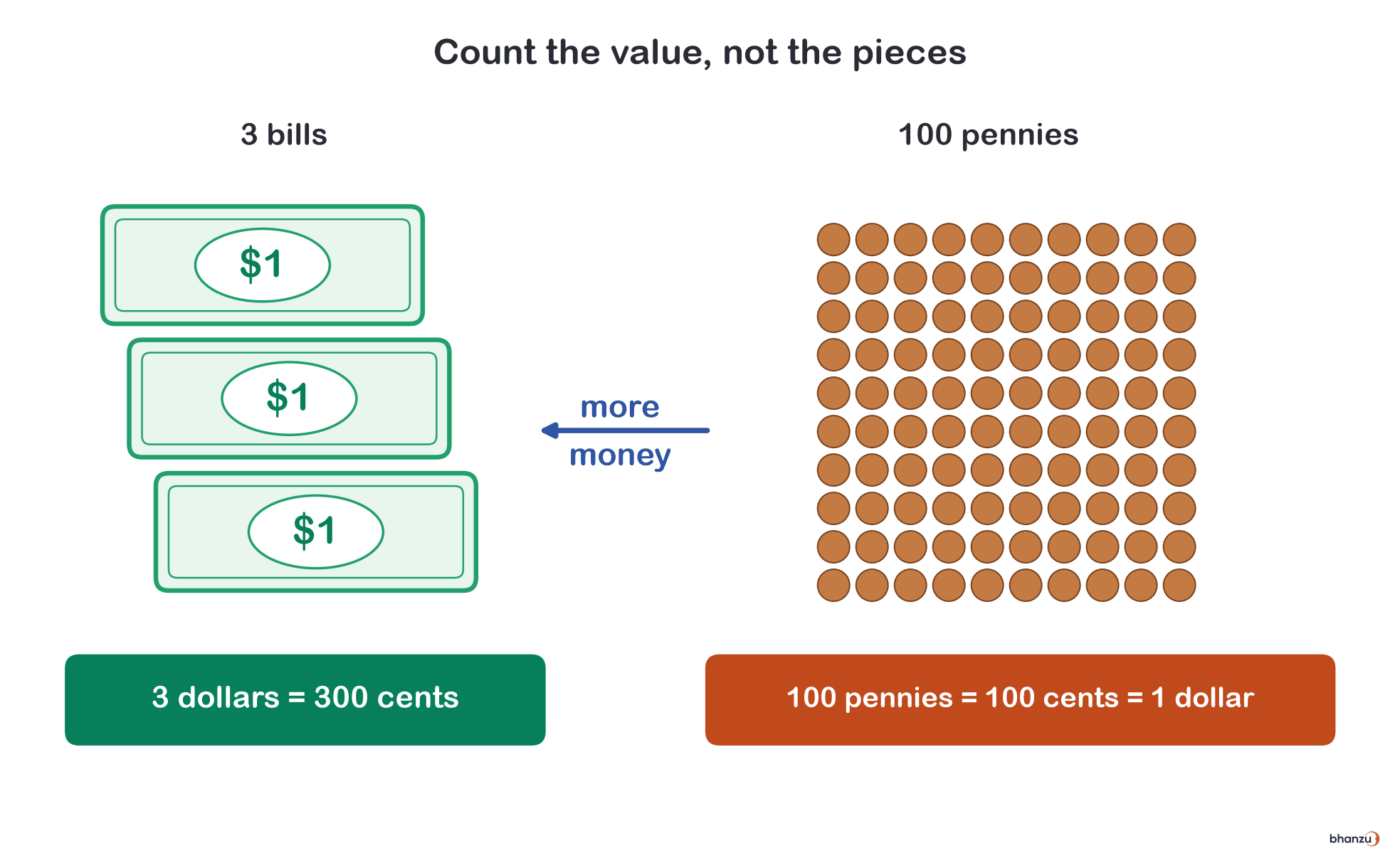
- Counting money finds the total value of a pile, so three $1 bills, worth 300 cents, beat a pile of 100 pennies.
- Count the bills first, then count on through the coins from the quarters down to the pennies.
- In 2nd grade the dollar sign goes in front ($7) and the cent sign goes after (48¢), with decimal points saved for 4th grade.
Three bills worth more than 100 pennies
Three paper bills can be worth more than a hundred shiny coins. Three $1 bills hold 300 cents. A pile of 100 pennies holds only 100 cents, even though it looks bigger (and feels much heavier).
At the end of a lemonade sale, Aisha's cash box holds a jumble of bills and coins. What she earned depends on what each piece is worth, not how many pieces there are. In 3rd grade, you'll use this counting for making change.
How do you count money?
Counting money works by adding the bills in dollars first, then adding the coins in cents, where 100 cents make 1 dollar. A bill is paper money worth whole dollars, and a cent is the value of one penny.
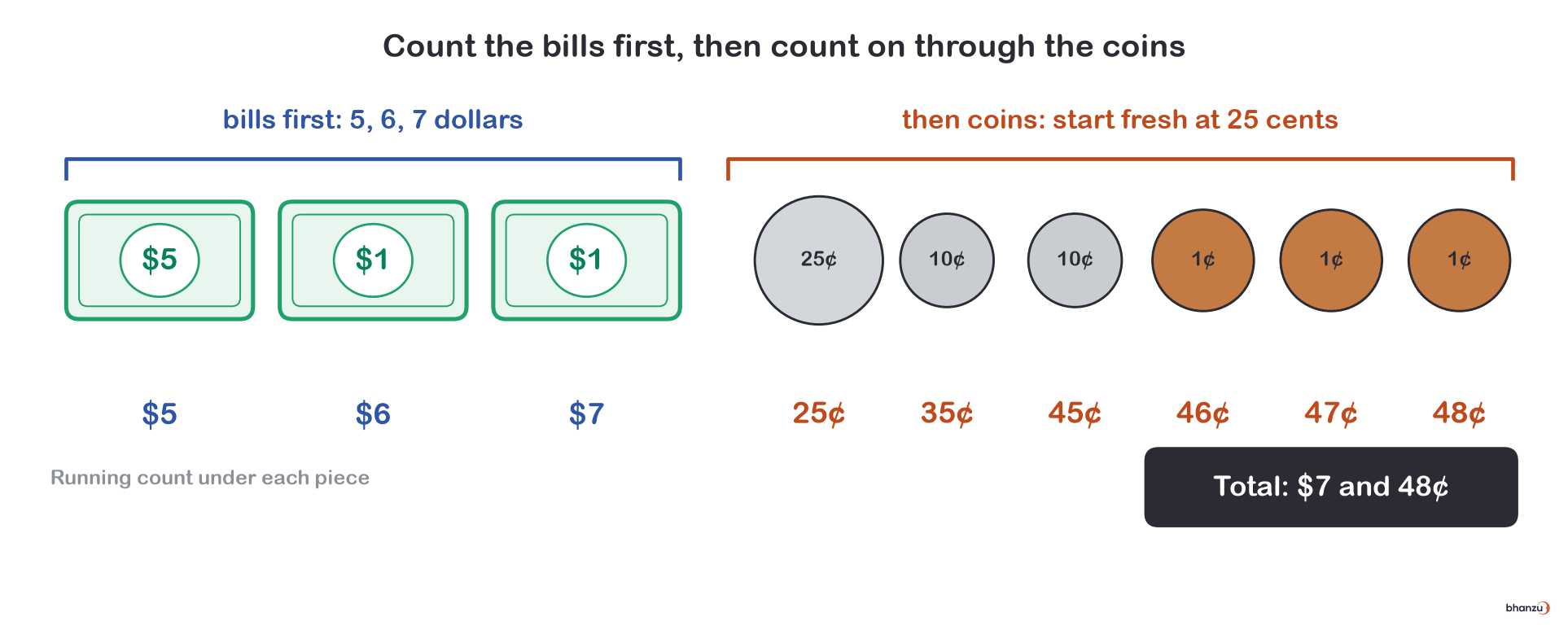
- Sort the money into bills and coins.
- Count the bills, biggest first.
- Start fresh for the coins and count on (add each coin to the total) from quarters down to pennies.
- Say the total as dollars and cents.
In the picture, the bills go $5, $6, $7. The coins go 25¢, 35¢, 45¢, 46¢, 47¢, 48¢, for a total of $7 and 48¢. A child who grabs the shiny coins first often counts the cents perfectly, then forgets the bills still on the table.
If your child has practiced counting coins, 2nd grade adds dollar bills and the $ sign. This is Common Core standard 2.MD.C.8, which asks your child to "solve word problems involving dollar bills, quarters, dimes, nickels, and pennies, using $ and ¢ symbols appropriately" by the end of the year.
What are bills and coins worth?
Each bill is worth the dollars printed on it, and each coin is worth a set number of cents. The last column shows how to skip count a pile of one kind.
| Money | Worth | Count by |
|---|---|---|
| $1 bill | 1 dollar | 1s |
| $5 bill | 5 dollars | 5s |
| $10 bill | 10 dollars | 10s |
| $20 bill | 20 dollars | 20s |
| Quarter | 25¢ | 25s |
| Dime | 10¢ | 10s |
| Nickel | 5¢ | 5s |
| Penny | 1¢ | 1s |
Bills also come as $2, $50 and $100. At the end of 2025, the Federal Reserve's count of bills in circulation showed more $100 bills (19.9 billion) than $1 bills (15.2 billion).
How many cents make a dollar? One hundred.
So 3 dollars are 300 cents, and 125 cents trade for 1 dollar and 25 cents.
How do you write dollars and cents?
Write the dollar sign, $, in front of a number of dollars, and the cent sign, ¢, after a number of cents. An amount with both gets two parts, as in $2 and 45¢.
Does the cent sign go before or after the number? After, as in 48¢. One number never gets both signs.
| Amount | Write it as |
|---|---|
| Forty-eight cents | 48¢ |
| Seven dollars | $7 |
| 125 cents | $1 and 25¢ |
| 245 cents | $2 and 45¢ |
Price tags use a third way: $7.48, with a dot called a decimal point. Common Core saves decimal money for 4th grade (standard 4.MD.A.2), so in 2nd grade you write $7 and 48¢.
How do you solve money word problems?
Count the money first, then choose to add or subtract.
- Read the story and say what it asks.
- Count each amount of money.
- Draw a bar model, or tape diagram, with one bar for the whole and smaller bars for the parts.
- Add to find the whole, or subtract to find a part.
- Write the answer with $ or ¢, then check it.
Like other math word problems, money stories fit the four kinds Common Core lists, adding to, taking from, putting together or taking apart, and comparing.
| Words in the problem | Math it means |
|---|---|
| How much in all? | Add |
| How much is left? | Subtract what was spent |
| How much more does she need? | Count on to the price |
| Who has more, and how much more? | Subtract the smaller total |
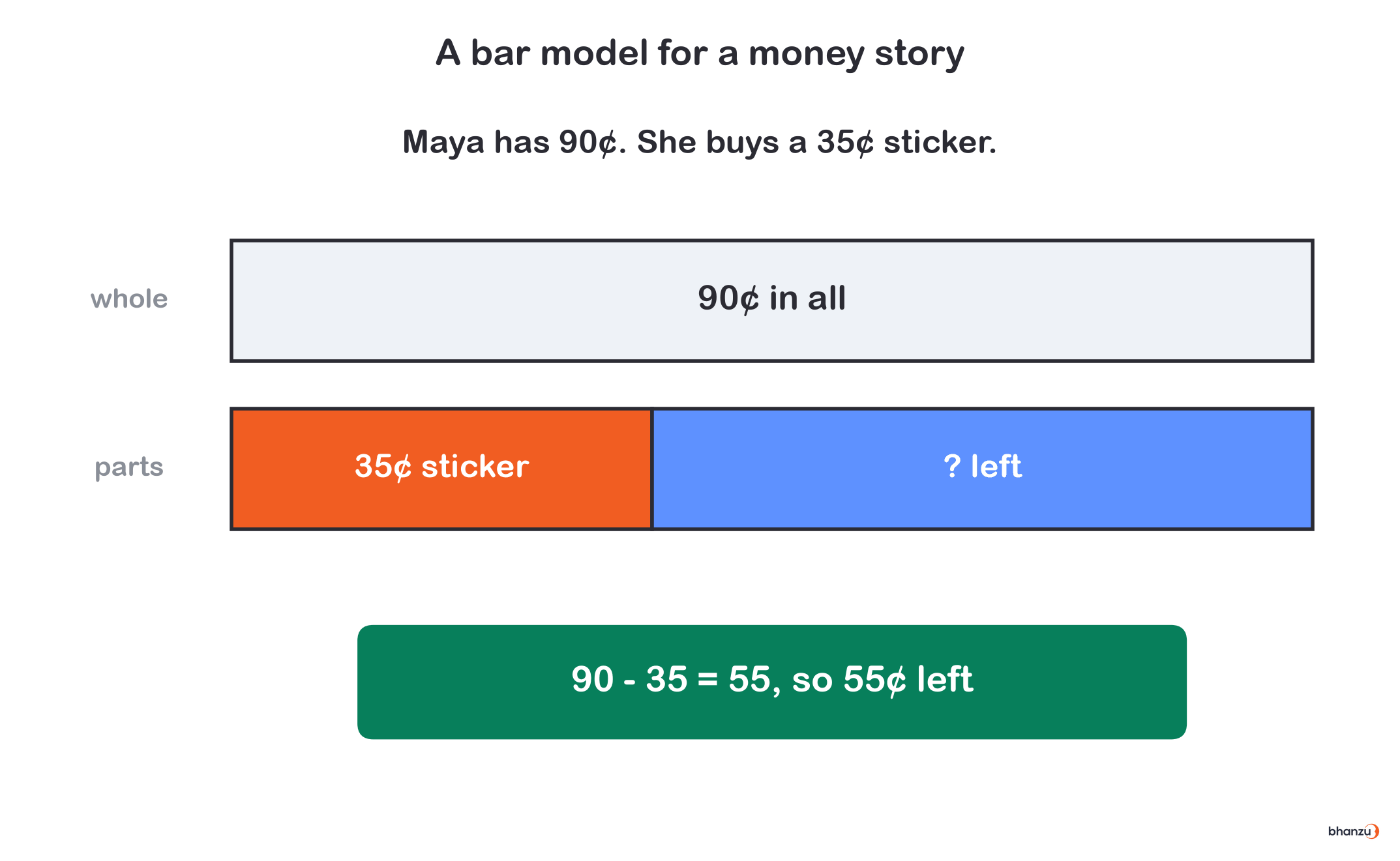
Maya has 90¢ and buys a 35¢ sticker, so the whole bar is 90¢ and one part is 35¢.
Maya has 55¢ left.
For how much more, count on from what you have to the price, as in finding the missing number. Counting on is quick from 45¢ to 60¢, but for 18¢ to 95¢, subtracting is faster, since . Some stories need both moves, like other two-step word problems.
Try It Yourself
Tap or drag bills and coins onto the mat to make the amount on the card. The mat sorts bills first, shows the running count and says how much more you need or how much extra you have. Tap money on the mat to take it back.
Why does counting money matter?
Counting money tells you whether you have enough before you pay.
- It fits real spending. In the Federal Reserve's 2026 Diary of Consumer Payment Choice, five out of six cash payments in 2025 were under $25.
- It turns a wallet into one number. In the same survey, 76% of adults carried cash, and the average amount was $69. That is three $20 bills, one $5 bill and four $1 bills.
- It tells you when you are short. Two $1 bills and 3 quarters make $2 and 75¢, which is 25¢ short of a $3 snack.
Counting turns a guess into a fact.
Examples of counting money
Example 1
Aisha's cash box holds one $10 bill, two $5 bills and three $1 bills. How much money is in it?
Count on from the biggest bill, 10, 15, 20, 21, 22, 23.
The box holds $23.
Example 2
Sam has one $5 bill and four $1 bills. Priya has seven $1 bills. Who has more money, and how much more?
The tempting move is to count bills, 7 for Priya and 5 for Sam, so Priya seems richer. That can't be right, because Sam's $5 bill trades for five $1 bills, which would give him nine bills to Priya's seven.
Count the value instead, $9 for Sam and $7 for Priya.
Sam has $2 more, even with fewer bills.
Example 3
Aisha's coin cup holds 2 quarters, 3 dimes, 1 nickel and 4 pennies. How much is in the cup?
Count on, 25, 50, 60, 70, 80, 85, 86, 87, 88, 89.
The cup holds 89¢.
Example 4
Leo has two $1 bills, 1 quarter, 2 dimes and 1 nickel. Write his money in dollars and cents, then in cents.
The bills make $2, and the coins make 25¢, 35¢, 45¢, 50¢, so Leo has $2 and 50¢.
Since 2 dollars are 200 cents, Leo also has 250¢.
Example 5
Mei has 45¢. A pencil costs 60¢. How much more money does Mei need?
The box stands for the cents Mei still needs.
Count on from 45, which is 5 more to 50 and 10 more to 60. Check by subtracting 45 from 60.
Mei needs 15¢ more, a dime and a nickel.
Example 6
Diego has two $5 bills and four $1 bills. He buys a $12 book. How much money is left?
Step 1. Count the money, 5, 10, 11, 12, 13, 14, so $14.
Step 2. Subtract the price.
Check by adding the price back, since . Diego has $2 left.
The pattern hiding inside money amounts
Dollar bills, dimes and pennies work just like hundreds, tens and ones.
- Three $1 bills, 4 dimes and 7 pennies make 347¢, just as 3 hundreds, 4 tens and 7 ones make 347.
- Trading 10 pennies for a dime, or 10 dimes for a dollar, is the same move as regrouping hundreds, tens and ones.
- Quarters and nickels fit no place at all.
That last part is genuinely confusing. A quarter (2 dimes and a nickel) has to be split before it fits, so counting on works better for mixed coins. In 4th grade the same digits come back as $3.47.
Counting money: common confusions cleared up
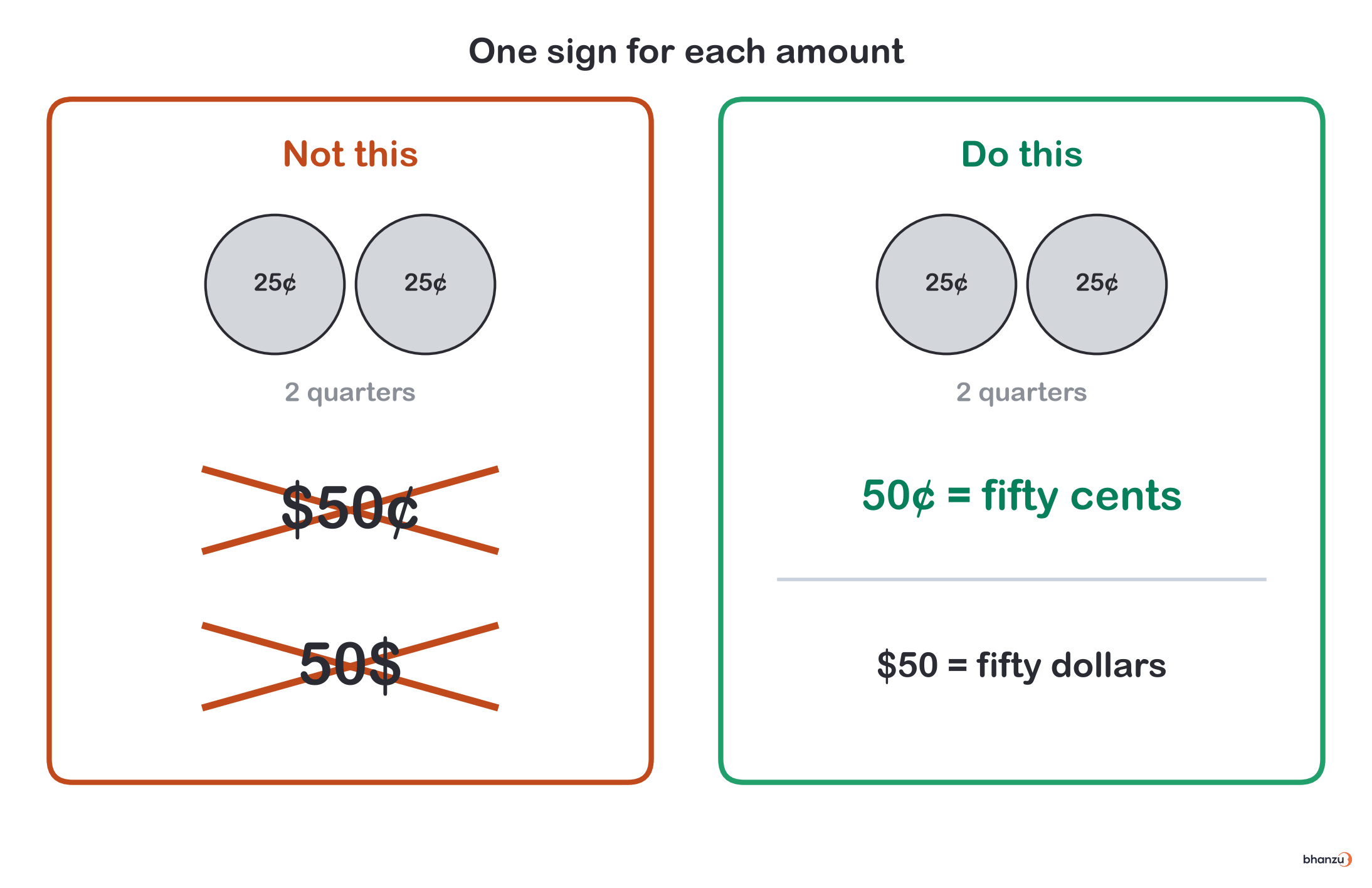
Mistake 1: Putting two signs on one amount
Where it slips in: Writing the answer after counting coins, such as 2 quarters.
Don't do this: Writing $50¢ or 50$.
The correct way: Write 50¢ for fifty cents, because $50 means fifty whole dollars.
Price tags show a dollar sign almost everywhere, so children often stick one on every money answer, like a label that says money.
Mistake 2: Adding the dollars to the cents
Where it slips in: Amounts with bills and coins together, like Example 4.
Don't do this: Writing two $1 bills and 45¢ as 47¢.
The correct way: Keep the parts apart, $2 and 45¢, which is 245¢.
A child who rushes sees a 2 and a 45 and adds them as plain numbers.
Mistake 3: Forgetting to trade 100 cents for a dollar
Where it slips in: Coins next to a bill, such as one $1 bill and 5 quarters.
Don't do this: Leaving the total as $1 and 125¢.
The correct way: Trade 100 cents for 1 dollar, so 125¢ becomes $1 and 25¢ and the total is $2 and 25¢.
Some children stop once the coins are counted, or doubt a coin total over 100¢ because coins seem too small to make a dollar.
Key Takeaways
- When counting money, judge a pile by value, since seven $1 bills still lose to one $5 bill and four $1 bills.
- Finish the bills before the coins, and swap every 100 cents for 1 dollar.
- Give each part of an amount one sign, $ in front or ¢ after.
- In a money story, first decide whether money is joining, leaving, still needed or being compared.
- For help keeping dollars and cents apart in money stories, explore Bhanzu's 2nd grade math curriculum or math programs for elementary students.
Read More
- Estimating and Rounding to the Nearest 10 and 100
- Reading a Calendar
- Measurement and Money Word Problems
- Math at Home
- Math Skills for Kids by Age
Research Behind This Article
- Common Core State Standards Initiative, Grade 2 Measurement and Data (2.MD) (2010). thecorestandards.org
- Board of Governors of the Federal Reserve System, Currency in Circulation: Volume (2026). federalreserve.gov
- Common Core State Standards Initiative, Grade 4 Measurement and Data (4.MD) (2010). thecorestandards.org
- Common Core State Standards Initiative, Mathematics Glossary, Table 1: Common Addition and Subtraction Situations (2010). thecorestandards.org
- Federal Reserve Financial Services, 2026 Findings from the Diary of Consumer Payment Choice (2026). frbservices.org
Quick Quiz: Check Yourself
Three levels, new money every time: count bills or coins, find a mixed total in cents, then solve a money story.
Was this article helpful?
Your feedback helps us write better content
Frequently Asked Questions
Is a 2 dollar bill rare?
How many quarters are in 10 dollars?
How do you count money fast?
What is an easy way to teach a child to count money?
How do you teach money word problems in 2nd grade?