Key Points
- Comparing two-digit numbers starts with the tens digit, so 52 is greater than 37 because 5 tens beat 3 tens.
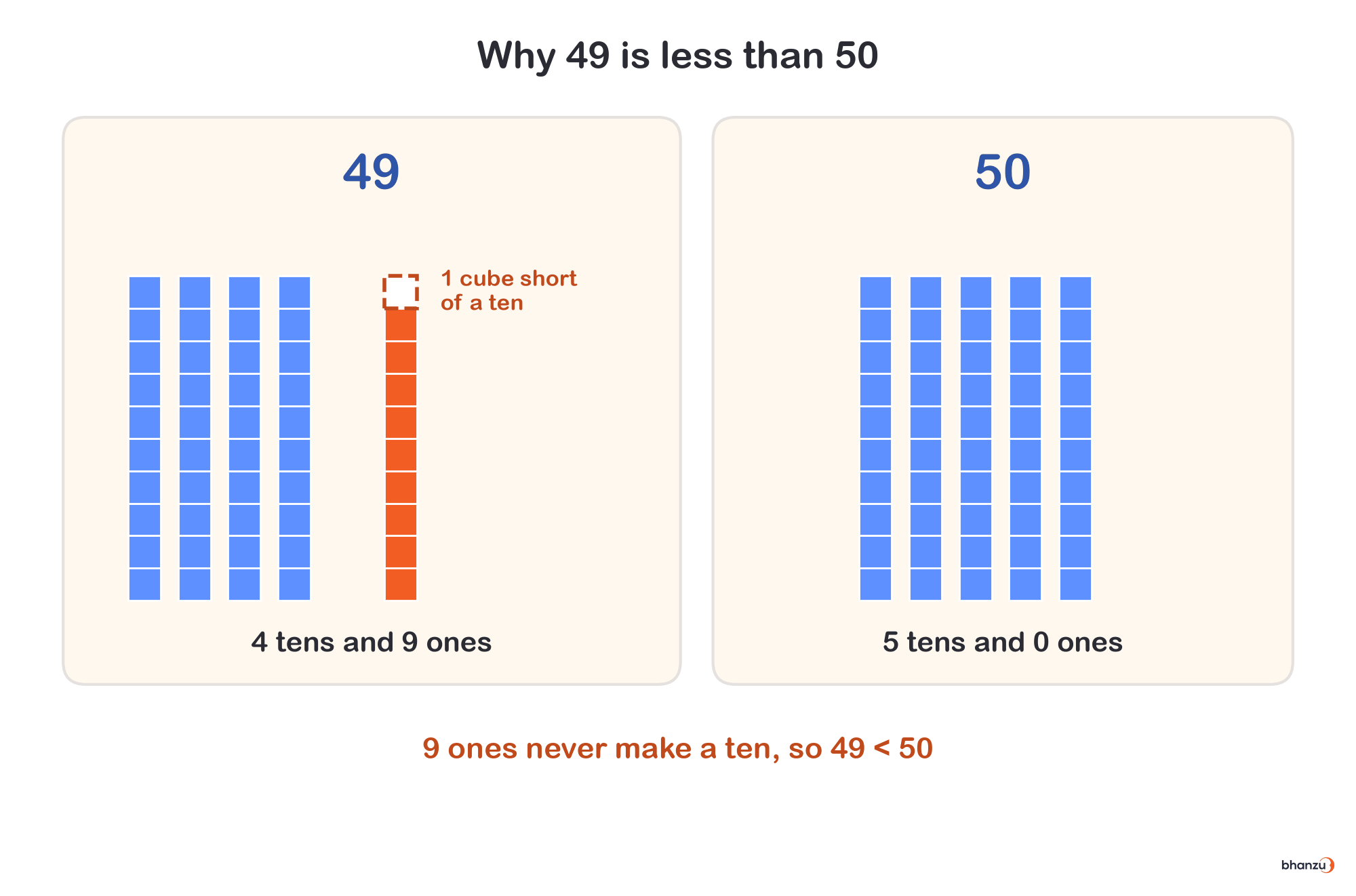
- The ones digit of a two-digit number is never more than 9, one cube short of a ten, so 49 is still less than 50.
- A common error lets the bigger ones digit win, as with 28 and 51, where 51 has more tens.
- The wide side of the greater than or less than sign faces the greater number, as in .
The bigger digit that still loses
Aisha's token sits on square 48, and Diego's sits on square 63. Their board game has 100 squares in rows of ten. Aisha points at her 8, the biggest digit on either square, and says she's winning.
Look at the rows, though. Diego has passed six full rows, and Aisha only four (her 8 counts squares in a row she hasn't finished).
In 2nd grade, you'll use this same move to compare three-digit numbers, hundreds first.
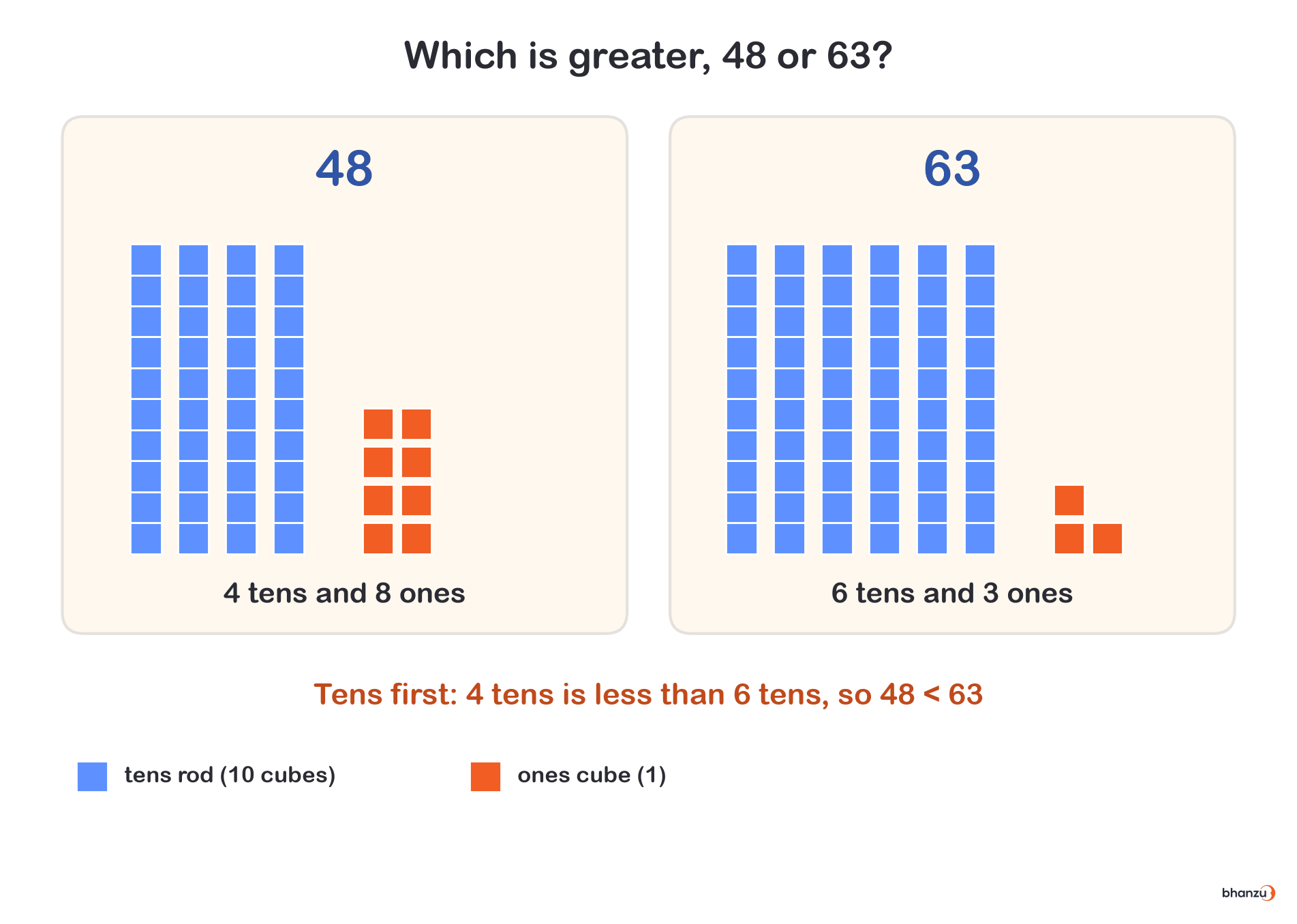
How do you compare two-digit numbers?
Comparing two-digit numbers works by counting the tens first and looking at the ones only if the tens are the same. A two-digit number is any whole number (no halves or other parts) from 10 to 99, written with two digits (the symbols 0 to 9). The left digit counts tens and the right digit counts ones.
On base-ten blocks, a tens rod is 10 cubes stuck together and a ones cube is a single cube. So 48 is 4 rods and 8 cubes. A digit's spot decides what it is worth, an idea called place value.
| Number | Tens and ones | Tens plus ones |
|---|---|---|
| 48 | 4 tens 8 ones | |
| 63 | 6 tens 3 ones | |
| 47 | 4 tens 7 ones |
This skill is Common Core standard 1.NBT.B.3. By the end of 1st grade, your child should compare two two-digit numbers by their tens and ones, then write the result with the greater than, less than or equal sign. For any two numbers, only one of those signs is true.
Why do the tens decide first?
The tens decide first because one ten is worth more than the biggest ones digit, 9.
- Compare the tens digits.
- If one number has more tens, it is greater. Stop there.
- If the tens match, compare the ones digits.
- If the ones match too, the numbers are equal.
The ones digit never goes past 9, and nine cubes are one cube short of a rod. So 49 is still less than 50. Counting rods by tens (10, 20, 30, 40) is skip counting by 10s.
A 1986 study of 60 children in grades 2 to 5 used six tasks asking what each digit of a two-digit number stands for. No second grader got all six right, and 28 of the 60 showed no clear grasp of the tens digit. That's why the blocks come before the rule.
A child who has just said 41 is greater than 39 may erase it, because the 9 looks so big. Pointing back at the rods settles it.
Try It Yourself
Build a number on each mat, then tap A or B for the greater one, or Same if they match. The readout checks the tens first and points to the ones only when the tens tie. Tap Break to turn a ten into 10 loose ones, then Trade them back and watch the number stay the same.
Which way does the greater than sign go?
Diego's 63 is greater than Aisha's 48. Math writes it like this.
The sign is the greater than sign, and its wide side faces the greater number. Flipped, it is the less than sign, so says the same thing from the smaller end. The equal sign means both sides have the same value.
| Say it | Write it |
|---|---|
| 63 is greater than 48 | |
| 48 is less than 63 | |
| 47 equals 40 plus 7 |
How do you remember the greater than and less than symbols?
- Say the comparison out loud, like "63 is greater than 48."
- Draw the sign so its wide side faces the number you called greater.
You'll meet these signs again with fractions in 3rd grade.
How do you order numbers from least to greatest?
To order numbers from least to greatest, put the smallest first, sorting by tens and using the ones only to break a tie.
- Write the number with the fewest tens first.
- When two numbers share their tens, the one with fewer ones goes first.
- Repeat until every number has a spot.
To order 41, 8 and 47, start with 8, because a one-digit number has 0 tens. Then 41 and 47 tie at 4 tens, so 41 comes before 47.
On a number line, numbers further right are greater, in the order you say them when counting to 120. Past 99, the hundreds decide first, which is the job of comparing and ordering three-digit numbers in 2nd grade.
Examples of comparing two-digit numbers
Example 1
Which sign goes between 52 and 37?
52 has 5 tens and 37 has 3 tens, so 52 is greater.
Example 2
Aisha is on square 39 and Diego is on square 41. Who is ahead?
The tempting move says 9 beats 1, so 39 is ahead.
That can't be right. Counting on from 39 goes 40, then 41, so 41 comes later on the board.
Compare the tens instead. 41 has 4 tens and 39 has only 3.
Diego is ahead.
Example 3
Mei's jump rope is 74 inches long and Sam's is 79 inches. Whose is longer? Write it two ways.
Both have 7 tens, so the ones decide, and 4 is less than 9.
Sam's 79-inch rope is longer.
Example 4
Which is greater, 4 tens and 7 ones or 52?
4 tens and 7 ones make 47, and 52 has 5 tens.
52 is greater.
Example 5
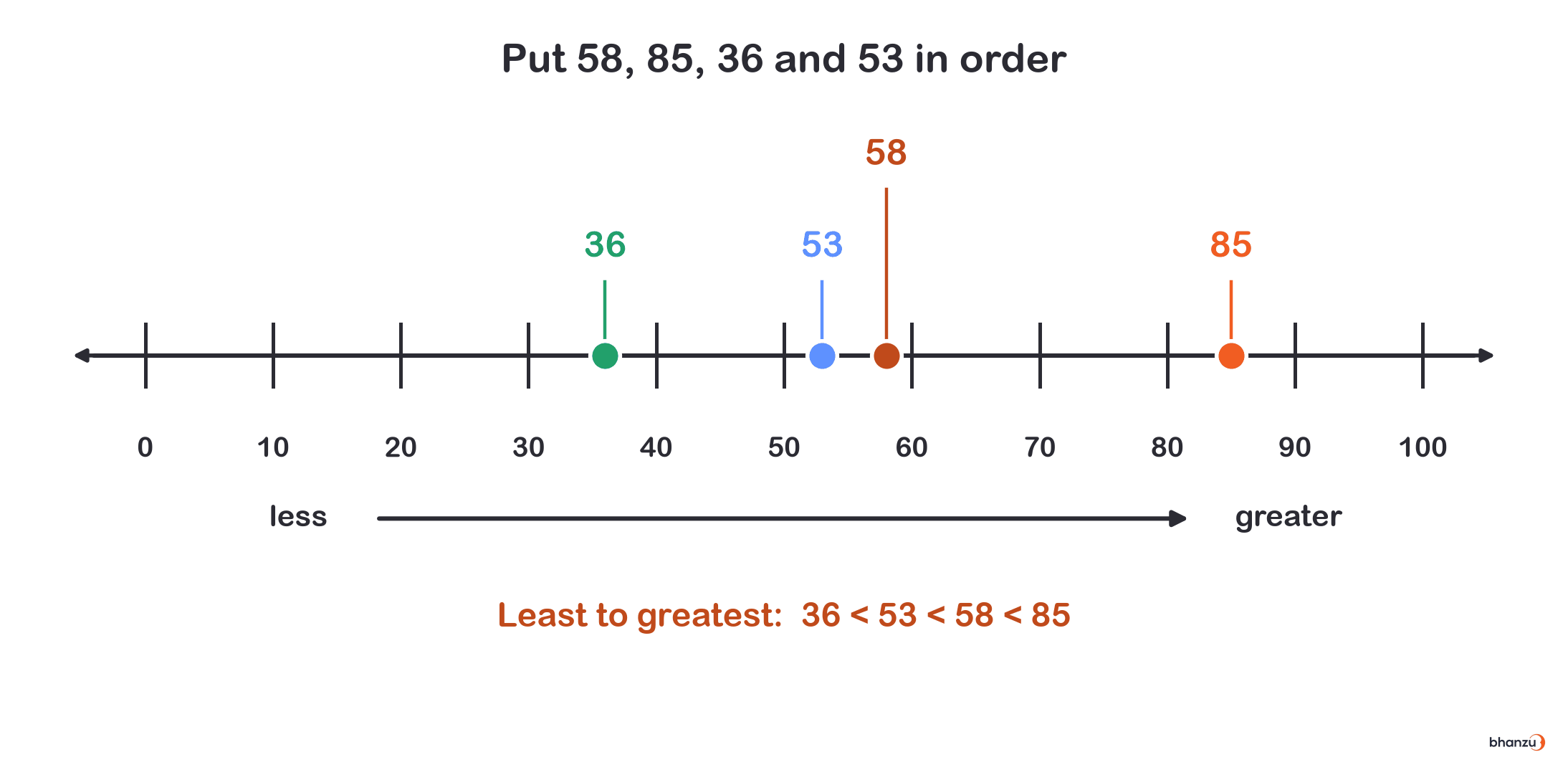
Put 58, 85, 36 and 53 in order from least to greatest.
36 has the fewest tens and goes first, and 85 has the most and goes last.
53 and 58 tie at 5 tens, and 3 ones come before 8 ones.
Example 6
In the 100-square game, Aisha is on 72, Priya is on 70 and Diego is on 27. Who leads, and who is last?
27 has only 2 tens, so Diego is last.
72 and 70 tie at 7 tens, and 2 ones beat 0 ones.
Aisha leads and Diego is last.
Comparing two-digit numbers beyond the textbook
Comparing two-digit numbers is how you tell which amount is more once counts pass 9.
- It settles who is ahead in a game. Square 41 beats square 39.
- It finds a page. Page 63 comes after page 48, so you flip forward.
- It catches counting mix-ups. 34 crayons and 43 crayons share digits, but 43 is more.
- It gives place value its first real job. The 6 in 63 must mean 6 tens.
In a 2017 study of 60 first graders tested in October and November, children picked the bigger of two numbers on 94% of tries. So comparing is within reach early in 1st grade, while their marks on a 0 to 100 number line were only moderately good.
The pattern hiding inside comparing two-digit numbers
Often you can answer before reading the ones digit, for a reason most guides skip.
- Every number in the 60s beats every number in the 40s. The smallest 60s number, 60, is 11 more than the biggest 40s number, 49.
- When the tens tie, they drop out. 74 against 79 shrinks to 4 against 9.
- The signs are a design choice: the wide side goes with the bigger amount. They appear in a 1631 math book of Thomas Harriot's work, printed ten years after he died. Math historians at the University of St Andrews credit them to its editor, since Harriot used other signs.
Comparing two-digit numbers: where intuition breaks
Mistake 1: Letting the bigger ones digit win
Where it slips in: Pairs where the smaller number has the bigger ones digit, as in Example 2.
Don't do this: Writing because 8 is more than 1.
The correct way: 28 has 2 tens and 51 has 5 tens, so .
Children who can already say "2 tens and 8 ones" still point to 28, because 8 is the biggest digit in sight.
Mistake 2: Writing the sign backward
Where it slips in: The writing step, when a child draws the sign first and fills in the numbers after.
Don't do this: Deciding 61 is greater than 46, then writing .
The correct way: Say "61 is greater than 46," then write with the wide side facing 61.
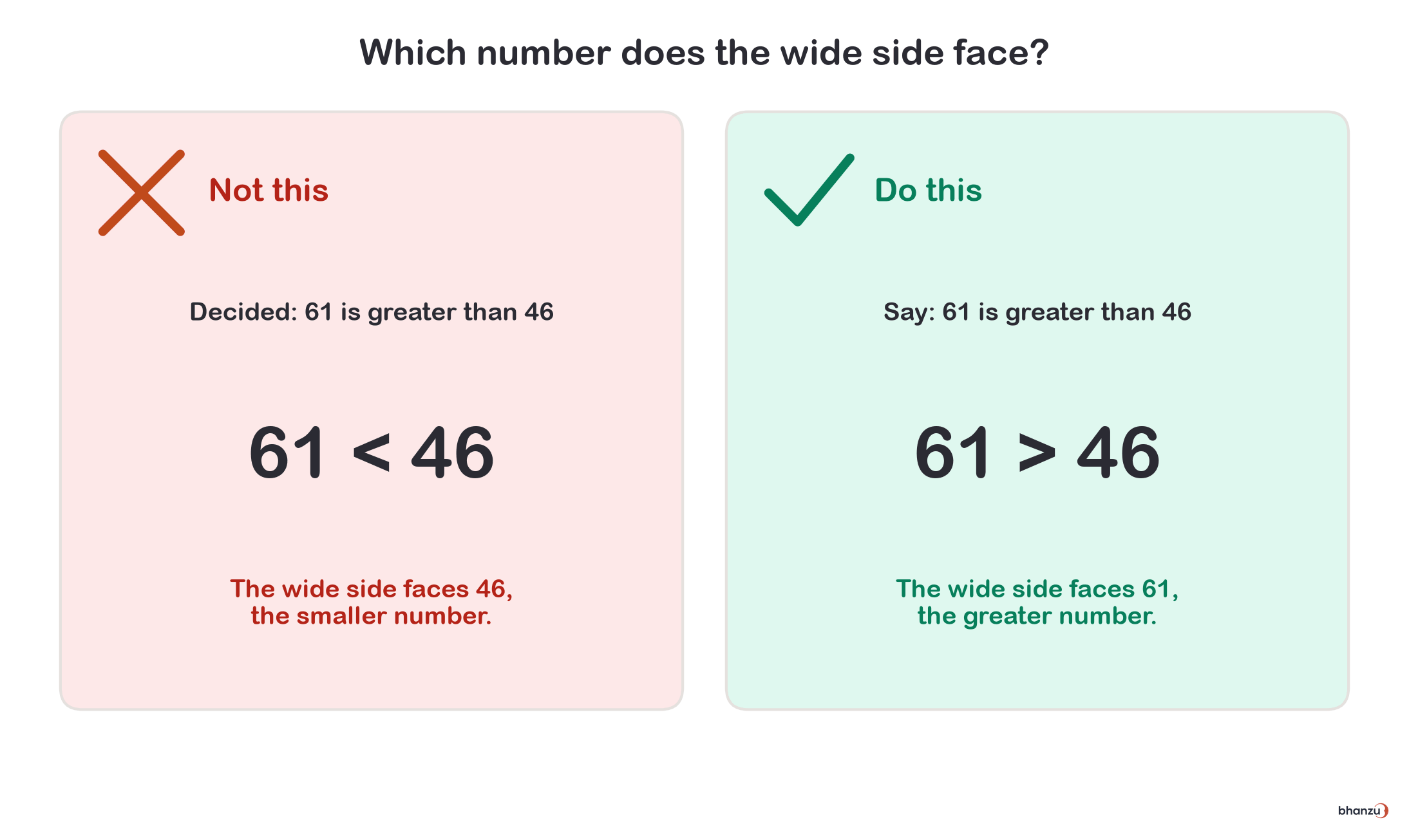
The sign comes from a remembered picture instead of the sentence, so it flips.
Mistake 3: Swapping the tens and the ones
Where it slips in: Two numbers with the same digits, like 47 and 74. The pair looks the same at a glance.
Don't do this: Reading 47 as 74 and 74 as 47, then writing .
The correct way: 47 is 4 tens 7 ones and 74 is 7 tens 4 ones, so .
Key Takeaways
- When comparing two-digit numbers, cover the ones digits and decide with the tens whenever they differ.
- Let the ones decide only when the tens tie, as with 74 and 79.
- Say the comparison out loud before drawing the sign, wide side toward the greater number.
- To keep building tens-first comparing with a teacher who catches the bigger-ones-digit trap, explore Bhanzu's 1st grade math curriculum or an elementary math tutor.
Read More
- Ordinal Numbers
- 10 More and 10 Less
- Comparing and Ordering Multi-Digit Numbers
- Early Math
- How to Teach Math to Kids
Research Behind This Article
- Common Core State Standards Initiative, Number and Operations in Base Ten: Standards by Domain (2010). thecorestandards.org
- Ross, Sharon Hill, The Development of Children's Place-Value Numeration Concepts in Grades Two through Five (1986). eric.ed.gov
- Thompson, Clarissa A., Morris, Bradley J. and Sidney, Pooja G., Are Books Like Number Lines? Children Spontaneously Encode Spatial-Numeric Relationships in a Novel Spatial Estimation Task (2017). eric.ed.gov
- O'Connor, J J and Robertson, E F, MacTutor History of Mathematics, Thomas Harriot (2000). mathshistory.st-andrews.ac.uk
- Laski, Elida V. and Siegler, Robert S., Learning from Number Board Games: You Learn What You Encode (2014). eric.ed.gov
Quick Quiz: Check Yourself
Three levels, new numbers every time: pick the sign, catch pairs built to fool the eye, then find the greatest or least in a set.
Was this article helpful?
Your feedback helps us write better content
Frequently Asked Questions
Does the alligator eat the bigger number?
What is the greatest 2 digit number?
How many 2 digit numbers are there?
What are some greater than less than games for kids?
How do you teach greater than less than in first grade?