Key Points
- A 1st grader counting to 120 learns to pick up a count at any number below 120, then read and write each numeral.
- When a number's ones digit is 9, the next number starts a new ten, so 109 becomes 110.
- A 2015 study tracked over 800 Australian children in their first school year. By mid-year, 109 was one of their three most common stopping points.
The square right after 109
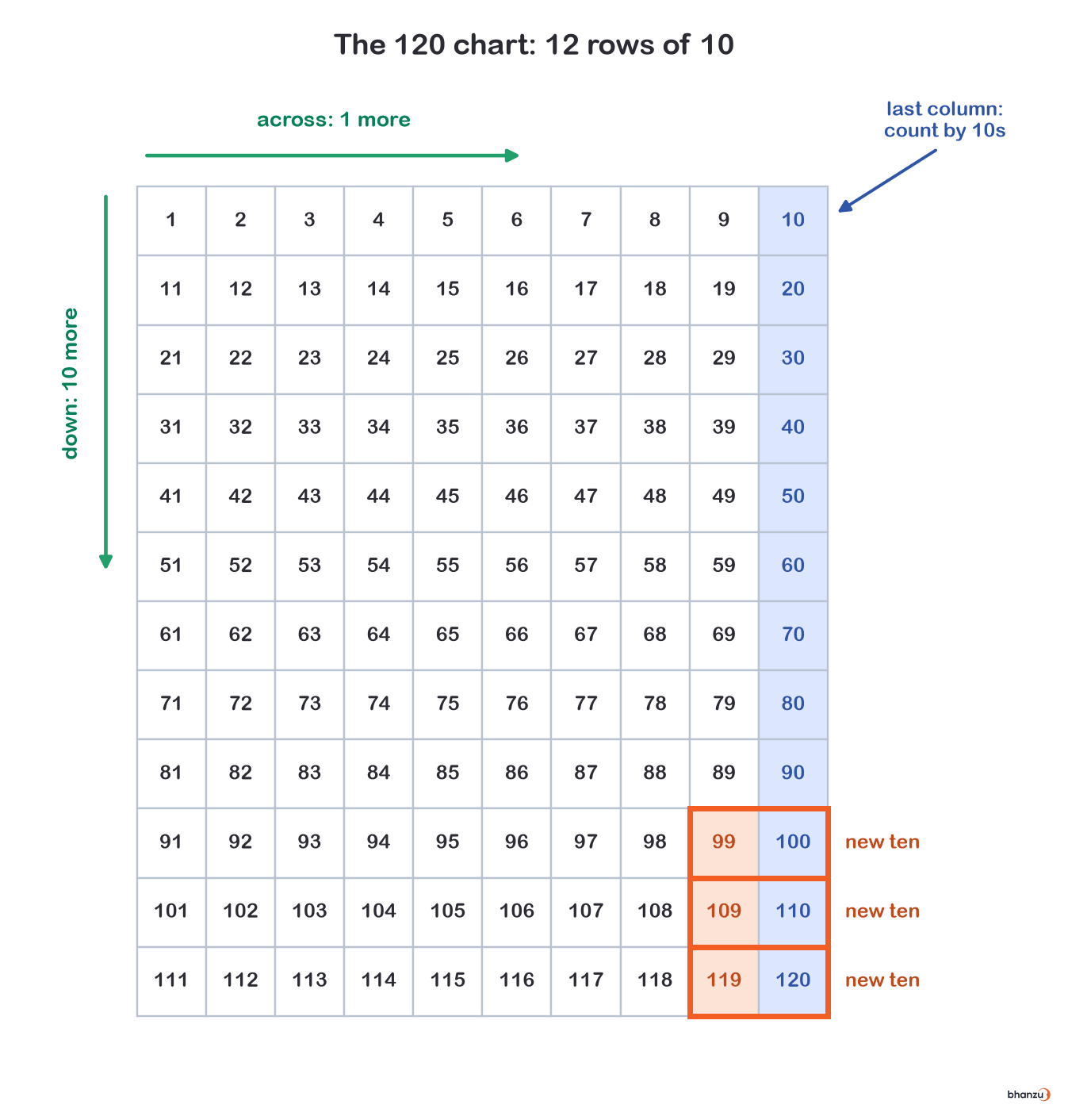
Count out loud from 105 and listen to the number after 109. Some 1st grade classes color one square of a 120 chart, a grid of 1 to 120, for every school day. Day 109 and day 110 sit side by side, and that tiny step is where plenty of counts wobble.
The reason hides in the last digit. Once you spot it, the same pattern carries your count past 120 to counting and skip counting within 1,000 in 2nd grade.
What does counting to 120 mean?
Counting to 120 is saying the next number, one more each time, until you land on 120. You can begin anywhere and follow along on a 120 chart or a number path, a row of numbered squares that starts at 1.
These counting numbers, which later grades call natural numbers, are written with the digits 0 to 9. A number written in digits is a numeral. Counting to 120 is Common Core standard 1.NBT.A.1, which also asks you to read and write numerals.
| Start at | Count up 3 | Count back 3 |
|---|---|---|
| 98 | 99, 100, 101 | 97, 96, 95 |
| 116 | 117, 118, 119 | 115, 114, 113 |
Counting back walks the same path the other way, as in counting on and counting back. By the end of 1st grade, Common Core expects your child to start a count at any number below 120, like 57 or 104.
How do you count past 100?
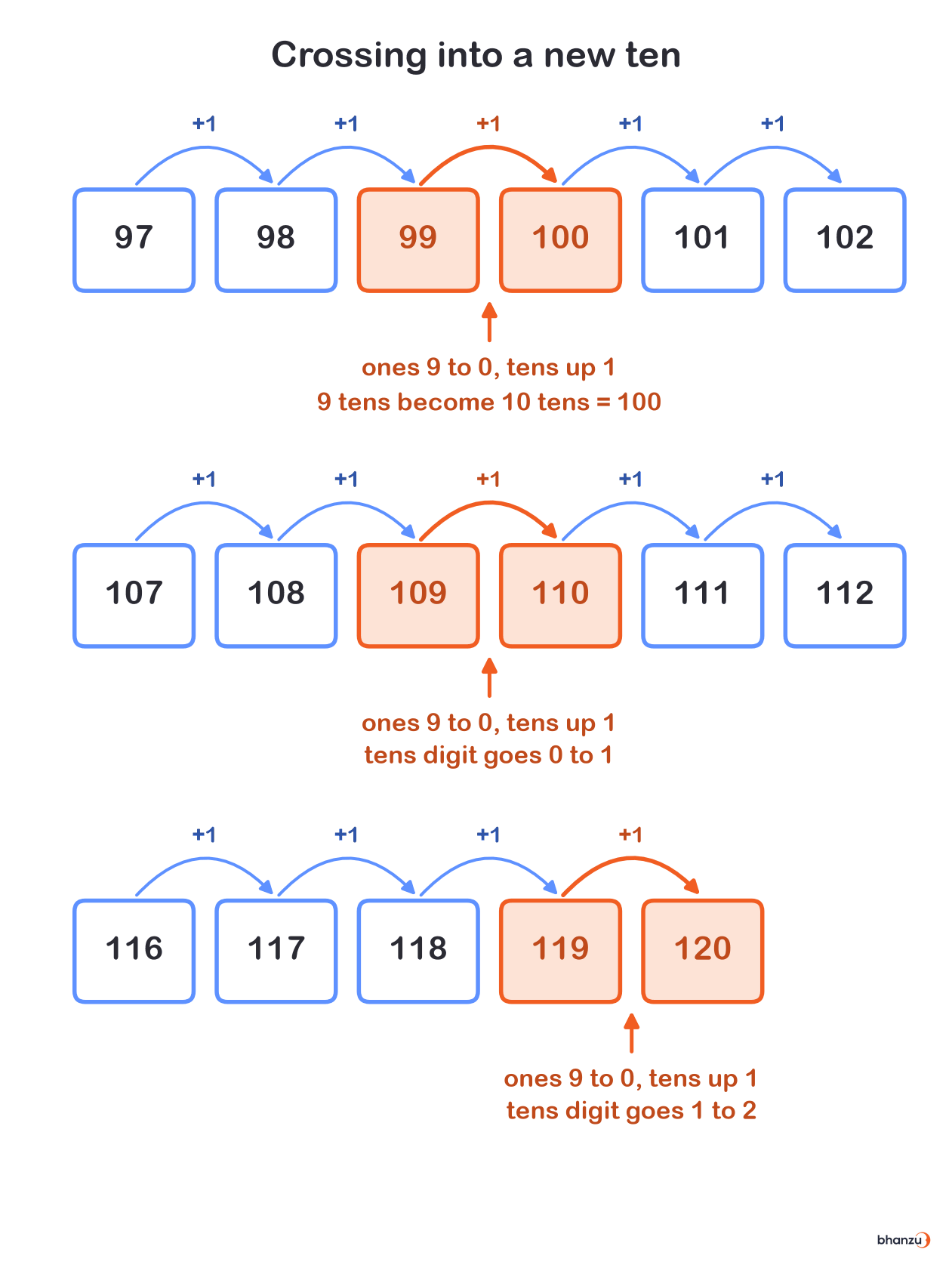
To count past 100, look at the ones digit (the last digit) before you say the next number. The digit to its left is the tens digit, which counts the tens.
- If the ones digit is 0 to 8, only it goes up by one, so 104 is followed by 105.
- If the ones digit is 9, it becomes 0 and the tens digit goes up by one, so 39 is followed by 40.
- At 99, the 9 tens become 10 tens, which make one hundred, written 100.
- Going back from a number that ends in 0, the next number ends in 9 with one fewer ten, so 110 goes back to 109.
What comes after 109? It is 110, said "one hundred ten".
In 2015, researcher Peter Gould tracked how far over 800 Australian children in their first school year could count from 1. Halfway through that year, more of them stopped at 109 than at any other number except 39 and 29. By the end of their third term, 109 was the middle score of the group.
A child who counts smoothly to 100 often stalls at 109, unsure what comes next. Counting by ones also gets slow, since 23 to 113 takes 90 counts. Hops of ten get there in 9 (33, 43 and on), a first step toward skip counting by 2s, 5s and 10s.
What is a 120 chart?
A 120 chart is a grid of the numbers 1 to 120 in 12 rows of 10, so each row holds one ten. One square to the right is 1 more. After a row ends, the count starts the next row, so 21 follows 20.
- Down is 10 more and up is 10 less. The square under 45 is 55, the idea behind 10 more and 10 less.
- Columns share an ending. The 5s column reads 5, 15, 25 and on down to 115.
- The last column counts by tens. It reads 10, 20, 30 and on to 120, twelve tens in all.
To find a missing square, check its neighbors. A blank with 87 on its left and 78 above it holds 88, since it is 1 more than 87 and 10 more than 78.
A child who runs a finger from 1 along every row to find 105 can jump straight down the 5s column instead. In 3rd grade, the same columns make rounding to the nearest ten quick.
Try It Yourself
Drag the slider to pick a start number. Press Count up or Count back to step one square, or Hop up 10 or Hop back 10 to jump a row. Watch the number name and the note at each new ten, like 109 to 110.
How do you write numbers past 100?
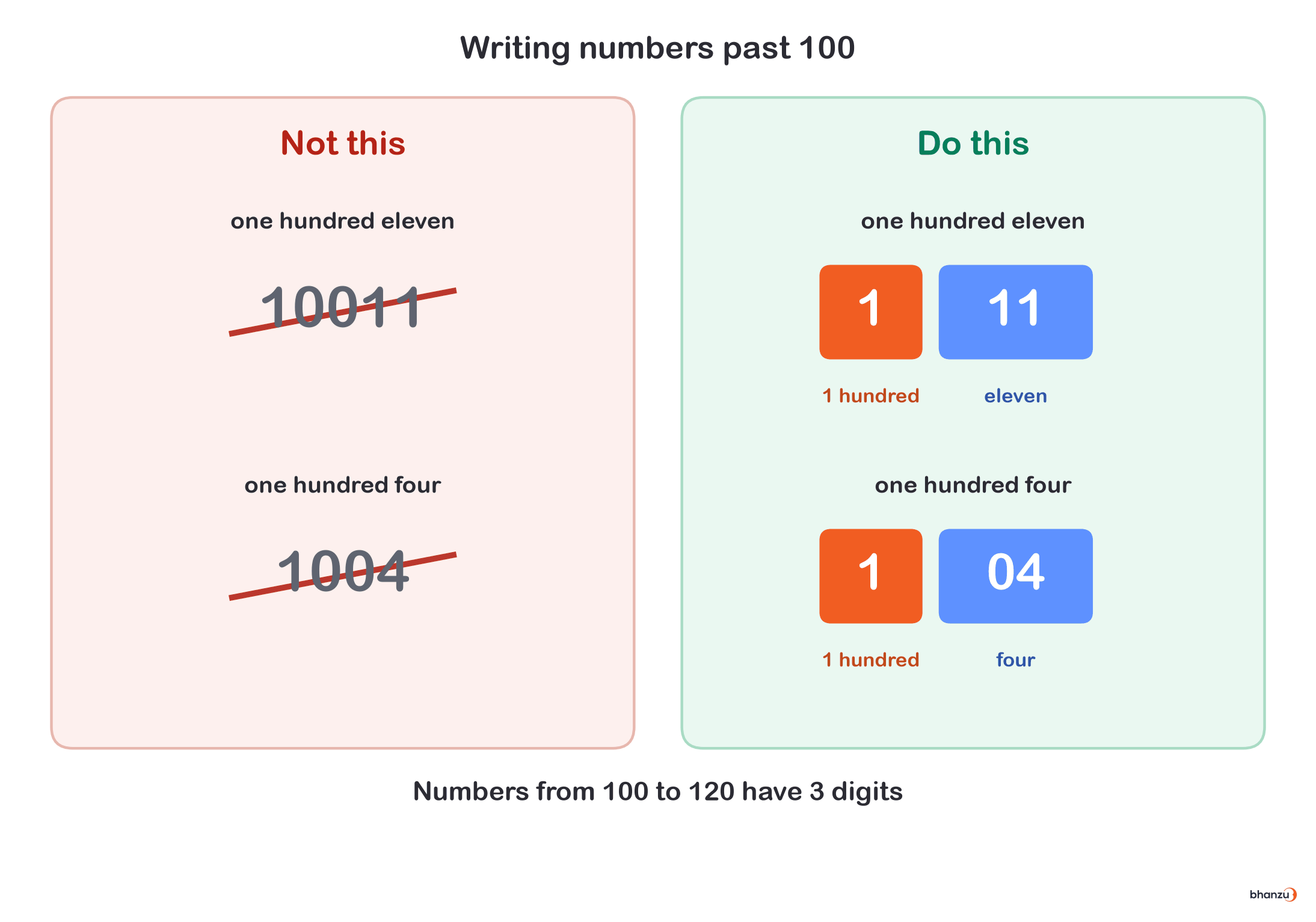
To write a number past 100, write a 1 for "one hundred", then the rest of the name as two digits. With no tens, the tens digit is 0.
| Numeral | Number name | Made of |
|---|---|---|
| 104 | one hundred four | |
| 111 | one hundred eleven | |
| 120 | one hundred twenty |
Every numeral from 100 to 120 has exactly three digits, so counting digits catches a written 10011 at once. Next year you'll write bigger numbers in standard, word and expanded form.
One spot confuses grown-ups too. Many people say "one hundred and eleven", but US math lessons usually drop the "and".
Examples of counting to 120
Example 1
What number comes right after 39?
The ones digit is 9, so it becomes 0 and the tens digit goes from 3 to 4.
The answer is 40.
Example 2
Mei's class colors one square of its 120 chart each school day. Today is day 109. Which square does it color on the next school day?
The tempting move is "after 9 comes 10", so you swap the 9 in 109 for 10 and get 1010.
That cannot be right. 1010 has four digits, but no square on a 120 chart has more than three.
Go back to the ones digit. The 9 ones become 0, and the tens digit goes from 0 to 1.
The class colors square 110 next.
Example 3
Count back from 103 to 98. Which three numbers fill the blanks in 103, 102, __, __, __, 98?
One less than 102 is 101, and one less than 101 is 100.
100 ends in 0, so the number before it ends in 9 with one fewer ten, which is 99.
The missing numbers are 101, 100 and 99.
Example 4
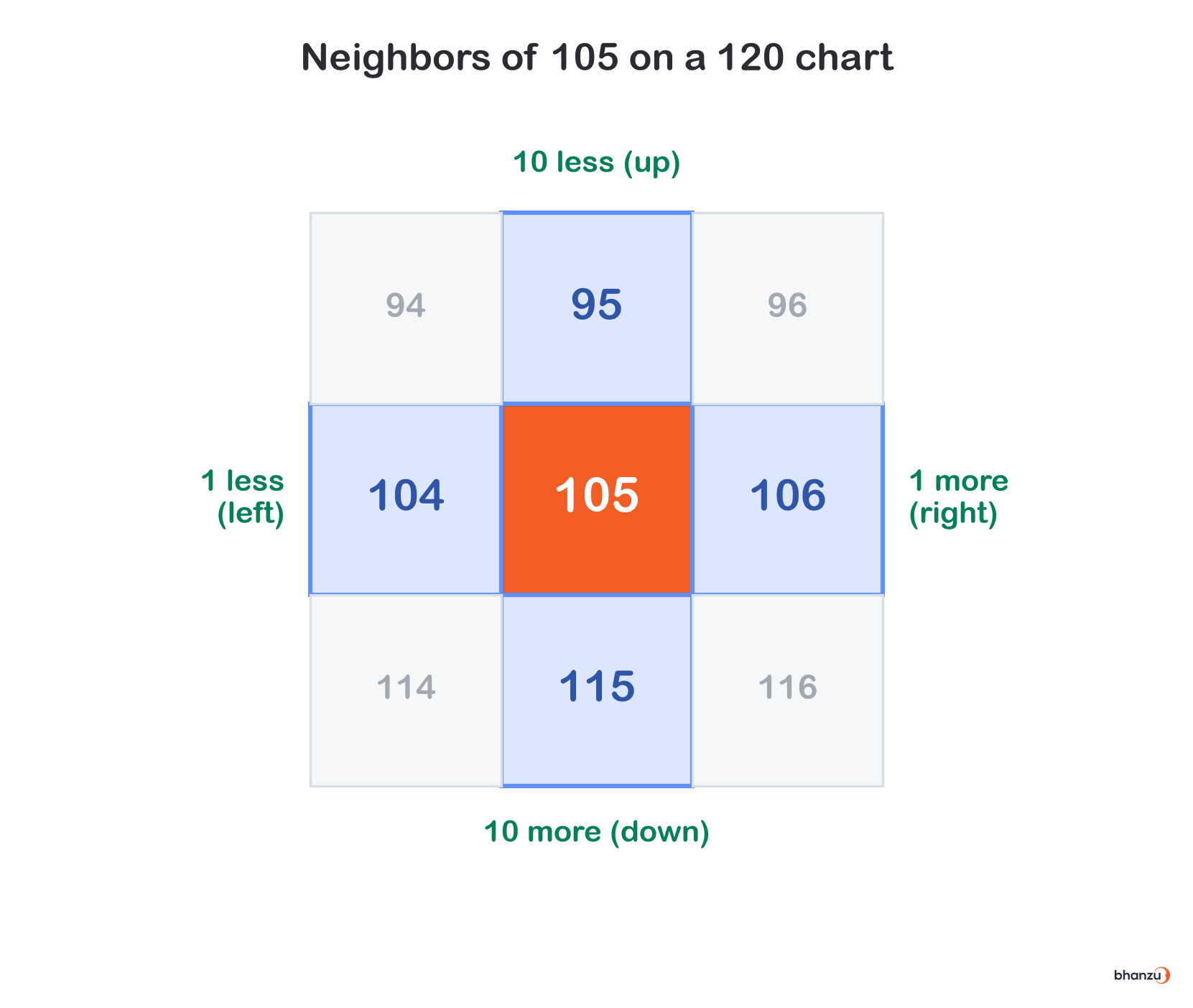
On a 120 chart, which numbers sit right above, below, left and right of 105?
Above is 10 less, so it is 95.
Below is 10 more, so it is 115.
Left is 1 less and right is 1 more, so they are 104 and 106.
Example 5
Leo's class has colored day 96 on its 120 chart. It colors one square a day for 8 more school days. What is the last square?
Counting on 8 times from 96 gives 97, 98, 99, 100, 101, 102, 103 and 104.
The last square is 104.
Counting to 120 beyond the textbook
Counting past 100 shows that the number pattern never runs out, because after 100 the ones and tens start over.
- It keeps track of long counts. A 2020 federal table lists 180 days as the most common minimum school year, set by 28 states and Washington, DC. A class on that calendar reaches square 120 with 60 school days to go.
- It tells how many. The last number you say when you count a pile is how many are in it.
- It finds your place. Page 112 comes right after page 111, so you can count on to find it.
Next year the same roll from 9 to 0 carries into the hundreds, when 199 turns into 200.
The pattern hiding inside counting to 120
After 100, the number names start over with words you already know.
- 101 to 109 reuse the names one to nine.
- 110 to 119 reuse ten to nineteen.
- 120 reuses twenty.
Going from 109 to 110 is the first time "ten" comes back since 10 itself, after children are told "thirty-ten" is wrong. Gould suggests that clash may be part of why so many counts stop at 109.
English also hides the tens inside the teens (eleven never says "ten and one"). A 2025 study by Karabekmez and colleagues, with 100 Turkish- and Dutch-speaking 4- and 5-year-olds, suggests other languages' number names affect some counting tasks too.
Counting to 120: spot the trap before you fall in
Mistake 1: Writing numbers the way they sound
Where it slips in: Writing down a number past 100 that someone says out loud.
Don't do this: Writing "one hundred eleven" as 10011, or "one hundred four" as 1004.
The correct way: Write a 1 for one hundred, then the rest as two digits, which gives 111 and 104.
A child who says one hundred eleven with no trouble can still write 10011, because each spoken part gets its own digits. In a 2014 study by Byrge, Smith and Mix, 61% of the 6-year-olds wrote a spoken three-digit number this way at least once. For 642, that looks like 600402.
Mistake 2: Saying "ten" after a nine
Where it slips in: Counting out loud across a new ten, such as 58, 59, 60.
Don't do this: Saying "fifty-eight, fifty-nine, fifty-ten".
The correct way: Say "fifty-nine, sixty", since a 9 in the ones place means a new ten starts.
Ten has followed nine since the start of the count (nine, ten), so the word feels right. Up to 120, "ten" correctly follows a nine only twice, at 9 to 10 and at 109 to 110.
Key Takeaways
- Before saying the next number when counting to 120, check the ones digit, because a 9 means a new ten starts next.
- After writing a number from 100 to 120, count its digits to make sure there are exactly three.
- Practice counting back across 110 and 100 out loud, where a 0 in the ones place turns into a 9.
- For more work on the 109 to 110 step and the 10011 habit, explore Bhanzu's 1st grade math curriculum or math classes for kids.
Read More
- Comparing Two-Digit Numbers
- Ordinal Numbers
- Comparing and Ordering Three-Digit Numbers
- Developing Math Skills in Early Childhood
Research Behind This Article
- Common Core State Standards Initiative, Grade 1 Number and Operations in Base Ten (1.NBT) (2010). thecorestandards.org
- Gould, Peter, Hurdles in Acquiring the Number Word Sequence (2016). eric.ed.gov
- National Center for Education Statistics, State Education Practices, Table 1.1 (2020). nces.ed.gov
- Karabekmez, S., Soysal, S. and Balci, A., The Effects of Number Naming Systems and Age Factor Variables on Counting Skills: Turkish and Dutch Children (2025). eric.ed.gov
- Byrge, L., Smith, L. B. and Mix, K. S., Beginnings of Place Value: How Preschoolers Write Three-Digit Numbers (2014). pmc.ncbi.nlm.nih.gov
Quick Quiz: Check Yourself
Three levels, new numbers every time: the number before or after, a gap in a count or chart, then a number name or counting story.
Was this article helpful?
Your feedback helps us write better content
Frequently Asked Questions
Is counting to 120 hard?
Why count to 120 in math?
How do you teach counting backwards?
How do you teach counting to 120?
What age can kids count to 100?