Key Points
- Estimating length gives an answer such as about 9 inches by checking an object against a benchmark, like a paper clip or a meter stick.
- To estimate, pick a unit that fits the object's size, count how many benchmarks would fit end to end, and measure afterward to check.
- In a 2020 study, 71 of 198 fifth graders estimated a string 51 to 100 centimeters long at least 25% too short.
A paper clip that measures books
A paper clip can tell you how long your library book is. It has no numbers on it, so you lean on one fact: a small paper clip is about 1 inch long.
Count clips along the book in your head, and you might say "about 9 inches" before anyone picks up a ruler. That is estimating. Next time someone asks if a bookshelf fits beside your bed, you can answer before the measuring tape comes out.
What does estimating length mean?
Estimating length is judging the size of an object without measuring, by comparing it with a benchmark, a length you know well. Every estimate carries "about" and a unit, so you say "about 9 inches" and never a bare "9". Length is the distance from one end of an object to the other.
This is Common Core standard 2.MD.A.3, "Estimate lengths using units of inches, feet, centimeters, and meters". It differs from rounding to the nearest 10 and 100, which starts from an exact number. By the end of 2nd grade, your child is expected to estimate in all four units and to measure with a ruler, a yardstick, a meter stick or a measuring tape.
How do you estimate length with a benchmark?
Lay copies of a benchmark end to end in your head, in five moves.
- Pick a unit that fits the size of the object.
- Choose the benchmark for that unit.
- Count how many benchmarks would fit end to end, like the 9 paper clips along the book below.
- Write the estimate with "about" and the unit.
- Measure to check, and find how far off you were.
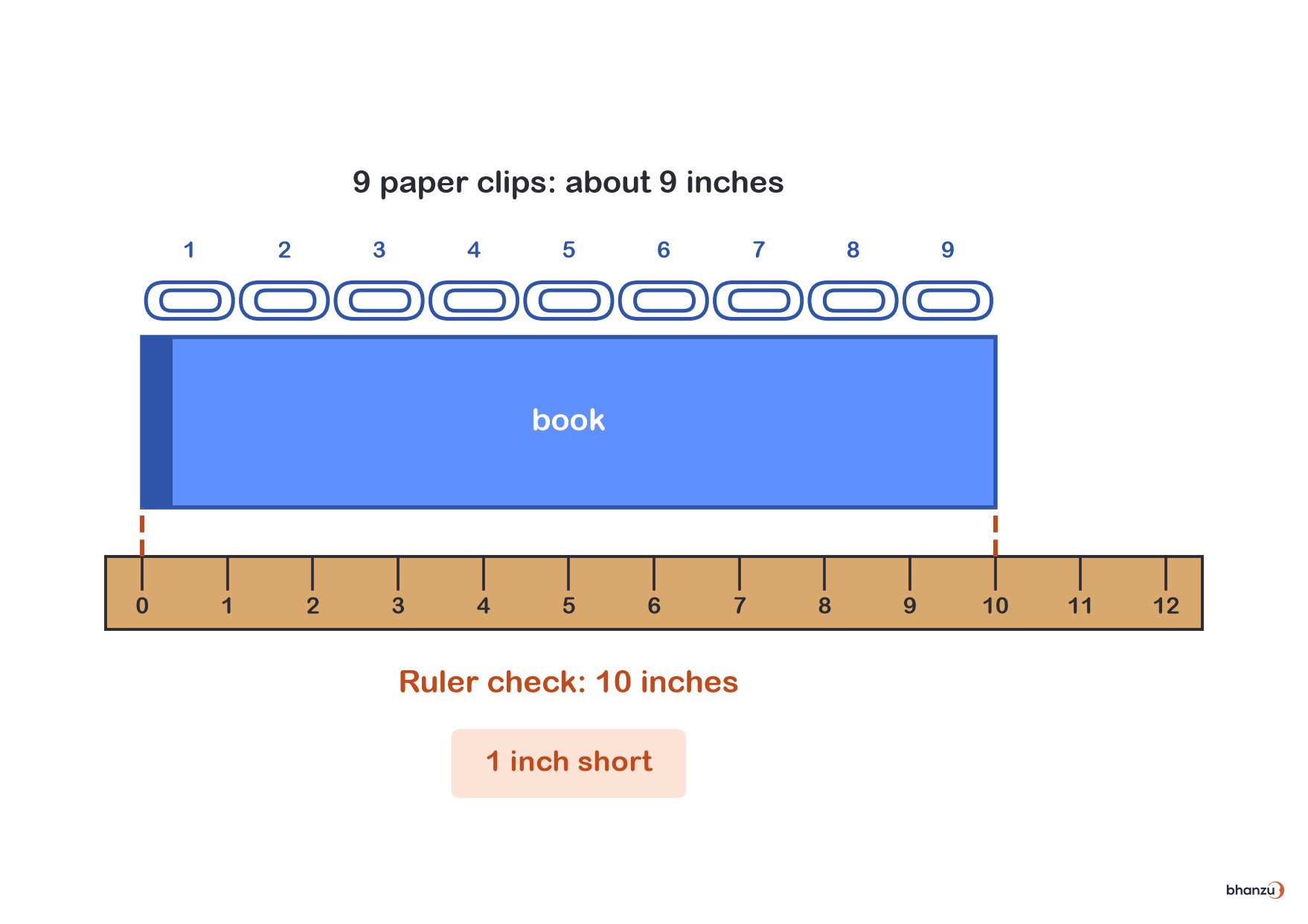
An estimate has no single right answer, so a close one is a good one. A child who measures first tends to copy the ruler's number into the estimate. Write the estimate before the ruler comes out.
In a small 2005 study of 44 third graders, children who used a benchmark estimated lengths more accurately than the others. On a long hallway, laying copies gets slow, so split it into chunks.
Which unit should you pick for estimating length?
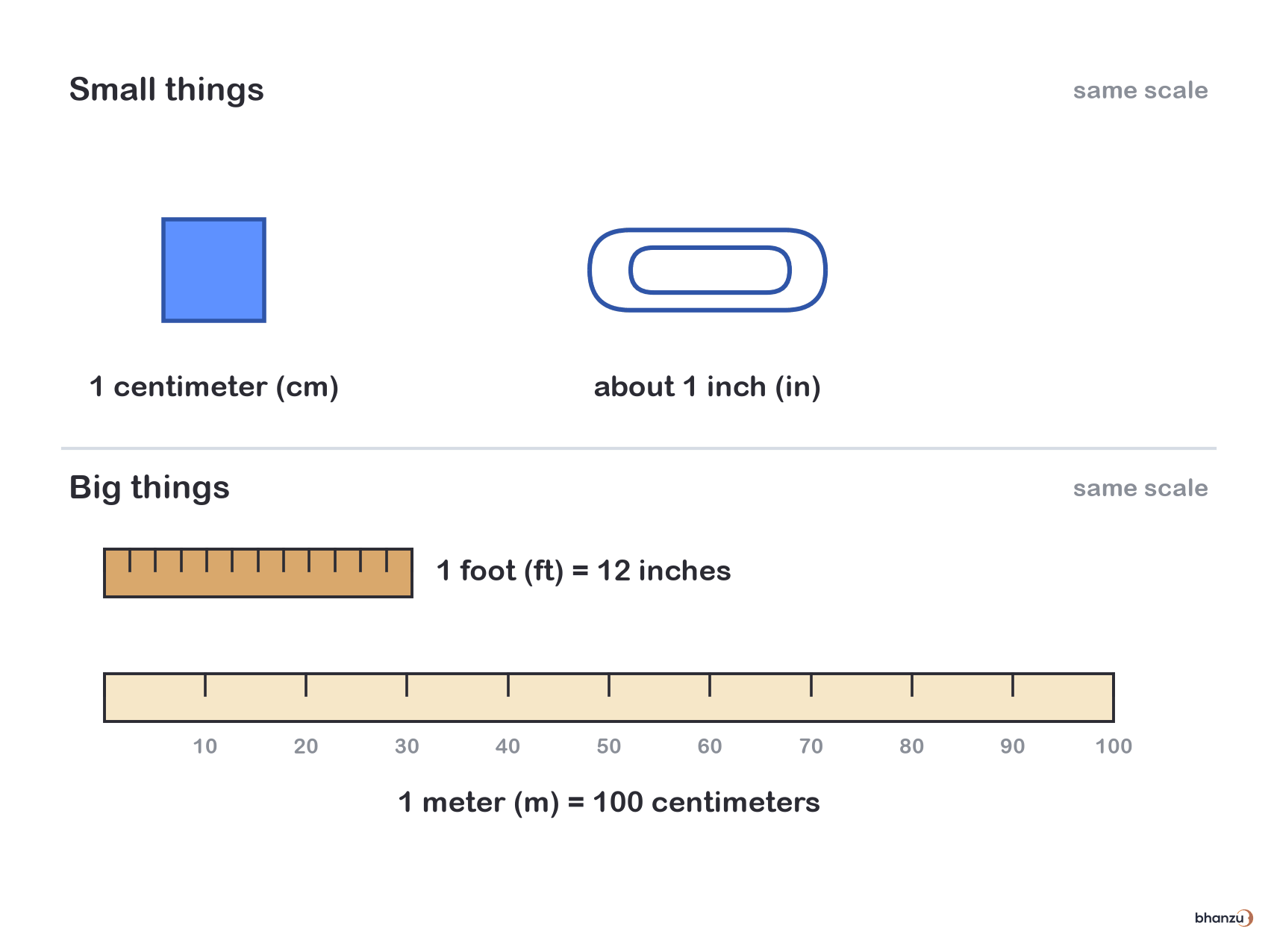
Small things get inches or centimeters, and big things get feet or meters. A unit is the same-size piece you count. Inches and feet are customary units, and centimeters and meters are metric units.
| Unit | Benchmark | Good for |
|---|---|---|
| centimeter (cm) | a base-ten cube, 1 centimeter wide | an eraser, a crayon |
| inch (in) | a small paper clip, about 1 inch | a pencil, a book |
| foot (ft) | a 12-inch ruler, exactly 1 foot | a desk, a bed |
| meter (m) | a meter stick, exactly 100 centimeters | a whiteboard, a hallway |
An inch is about 2 and a half centimeters, so a centimeter is less than half an inch. Half-inch marks on rulers wait until 3rd grade.
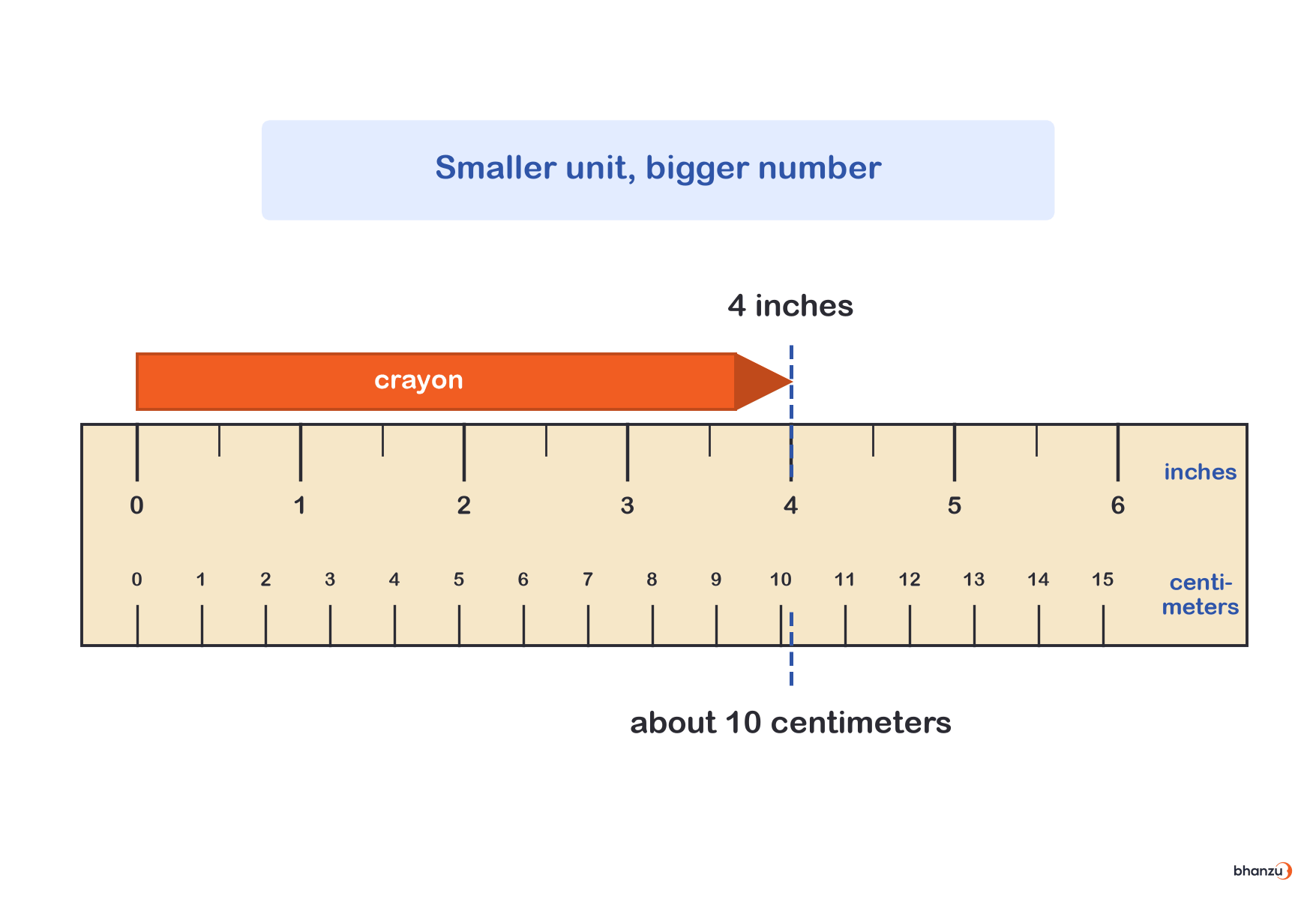
The National Institute of Standards and Technology lists the inch as exactly 2.54 centimeters (a decimal, a 4th grade idea), fixed in 1959. Because a smaller unit fits more times, a 4-inch crayon is about 10 centimeters long. Going back, 10 centimeters is about 4 inches.
Try It Yourself
Choose inches, centimeters, feet or meters, then slide to set your estimate. Tap Measure to bring in the ruler and see how many units short or long you were. The last line shows the same length in another unit, so you can compare.
How do you estimate length without a ruler?
Turn your body into a benchmark kit. Measure each part with a ruler, and again as you grow.
- Thumb width, for small things such as a crayon.
- Hand span (thumb tip to little-finger tip, hand stretched wide), for a book.
- One big step, for rugs and hallways. If your step is about 2 feet, skip count by 2s as you walk.
Counting beats one glance, because long things fool the eye. In a 2020 study in Taipei, 71 of 198 fifth graders estimated a string 51 to 100 centimeters long at least a quarter too short.
You will use the same benchmark idea for weights and liquids in 3rd grade.
Examples of estimating length
Example 1
Is a crayon about 4 inches long or about 4 feet long?
Four feet is four 12-inch rulers end to end, and a crayon is shorter than one ruler.
The crayon is about 4 inches long.
Example 2
Leo can lie on the classroom rug with room to spare. He has a paper clip and a meter stick, which fits along the rug about 3 times. About how long is the rug?
The tempting move is to grab the paper clip and call the rug about 9 inches.
That can't be right. Nine inches is less than one 12-inch ruler, and Leo is far longer than a ruler.
A big thing needs a big unit, so the meter stick wins. The rug is about 3 meters long.
Example 3
Mei lines up 6 small paper clips, each about 1 inch, along her pencil box. Her ruler shows 7 inches. How far off was her clip estimate?
Six clips make about 6 inches.
Mei's estimate of about 6 inches was 1 inch short.
Example 4
Aisha's crayon reaches the 4 on the inch side of her ruler. Is it closer to 4 centimeters or 10 centimeters long?
Centimeters are smaller than inches, so more of them fit. That rules out 4.
An inch is about 2 and a half centimeters, so 2 inches is about 5 centimeters and 4 inches is about 10.
The crayon is about 10 centimeters long.
Example 5
Priya's big step is about 2 feet. She crosses the hallway in 10 steps, and a measuring tape shows 21 feet. How far off was her step estimate?
Skip count by 2s, once for each step.
Her steps said about 20 feet.
Priya's estimate was 1 foot short.
What makes estimating length worth learning?
An estimate tells you what answer to expect before the ruler gives you one.
- It catches ruler mistakes. Expect about 6 inches for a pencil, read 15, and you are probably on the centimeter side.
- It reaches where a ruler can't. You can count meter sticks up to a ceiling in your head.
- It keeps growing with you. In a 2025 study of 335 junior high students, some still guessed or eyeballed lengths instead of using a benchmark.
An estimate only needs to be close enough to show when a measurement looks wrong.
The part of estimating length nobody explains
Length estimating is really three different skills. A 2023 study of 903 third and fourth graders in Germany and Taiwan found these three kinds.
- Small things you can hold, such as a crayon.
- Bigger things you can touch, such as a rug.
- Things out of reach, such as a ceiling.
Children in Taiwan, whose textbooks lean on body parts, did better on things they could touch. Children in Germany, who learn to keep pictures of 1 centimeter, 10 centimeters and 1 meter in mind, did better on things out of reach. So at home, practice all three kinds with your child.
Tripping points to avoid with estimating length
Mistake 1: Right number, wrong unit
Where it slips in: Picking the unit, as in Example 1.
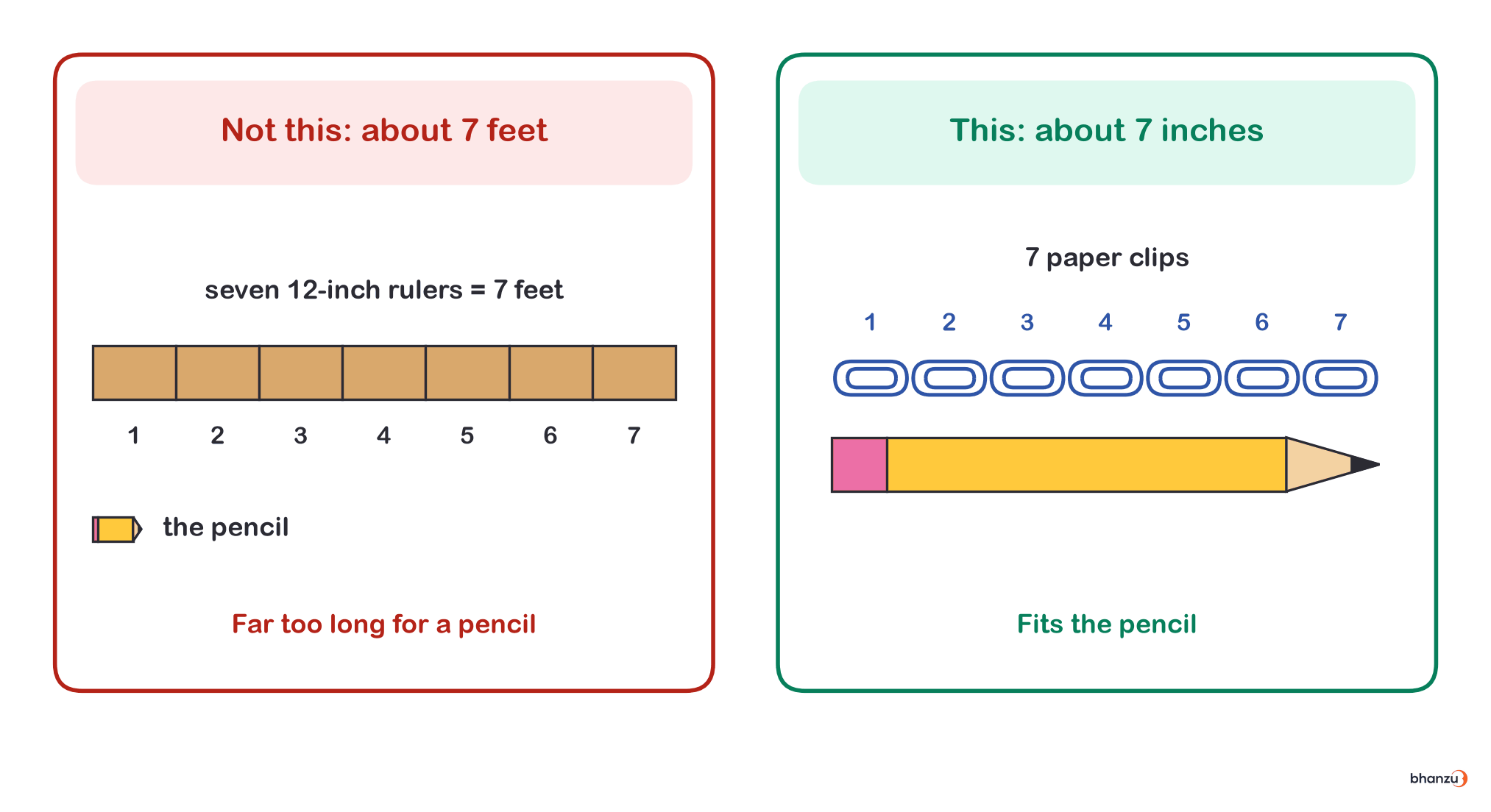
Don't do this: Calling a pencil "about 7 feet" long.
The correct way: Seven feet is seven 12-inch rulers end to end, far longer than a pencil, so the pencil is about 7 inches.
The word "foot" is genuinely confusing. It names a unit and a body part, and a child's own foot is shorter than a ruler, so "7 feet" sounds small.
Mistake 2: Guessing too short for long things
Where it slips in: Hallways and rugs, as in Examples 2 and 5.
Don't do this: Glancing down Priya's 21-foot hallway and calling it "about 8 feet" long.
The correct way: Count Priya's 10 big steps, about 2 feet each, to get about 20 feet.
Long things look shorter than they are, even to grown-ups. In the 2020 Taipei study, college students also guessed the long string at least a quarter too short (15 of 71). A child who gives a pencil and a hallway the same small number is guessing by eye.
Mistake 3: Keeping the number when the unit changes
Where it slips in: Switching from inches to centimeters, as in Example 4.
Don't do this: Saying a 4-inch crayon is also 4 centimeters.
The correct way: Centimeters are smaller, so more of them fit. The 4-inch crayon is about 10 centimeters.
Children make this one because the number feels like part of the crayon, when it belongs to the unit.
Key Takeaways
- Say "about" and a unit every time, since a bare number tells nobody anything.
- Let the object's size pick the benchmark.
- In estimating length, the estimate comes first and the ruler second.
- Count steps or meter sticks for long things, because the eye guesses them short.
- To keep practicing benchmark choices with a teacher who catches a "7 feet" pencil, explore Bhanzu's 2nd grade math tutor or elementary math tutor.
Read More
- Comparing Lengths: How Much Longer
- Length Word Problems
- Choosing Units of Measurement
- Estimating Sums and Differences
Research Behind This Article
- NGA Center and CCSSO, Common Core State Standards for Mathematics: Grade 2 Measurement and Data (2010). thecorestandards.org
- Joram, E., et al., Children's Use of the Reference Point Strategy for Measurement Estimation, Journal for Research in Mathematics Education (2005). eric.ed.gov
- National Institute of Standards and Technology, SI Units: Length (2025). nist.gov
- Huang, H.-M. E., Effects of Grade Level and Object Size on Students' Measurement Estimation Performance, EURASIA Journal of Mathematics, Science and Technology Education (2020). eric.ed.gov
- Huang, H.-M. E., et al., Junior High School Students' Length Estimation Skills and Use of Strategies for Making Estimations, International Journal of Science and Mathematics Education (2025). doi.org
- Hoth, J., et al., Elementary School Students' Length Estimation Skills: Analyzing a Multidimensional Construct in a Cross-Country Study, International Journal of Science and Mathematics Education (2023). doi.org
Quick Quiz: Check Yourself
Three levels, new questions every time: pick a unit, check a paper clip count against a ruler or switch inches to centimeters, then use big steps or find how far off a long estimate was.
Was this article helpful?
Your feedback helps us write better content
Frequently Asked Questions
Is a meter longer than a yard?
What measurements should a 2nd grader know?
How do you teach estimating and measuring length at home?
How can I help if my child finds it hard to estimate length?
Is there a game that makes estimating length for kids more fun?