Key Points
- Counting coins relies on fixed values, with a penny worth 1 cent, a nickel 5, a dime 10 and a quarter 25.
- With a mixed pile, start the count at the quarters, then let each dime add 10, each nickel 5 and each penny 1.
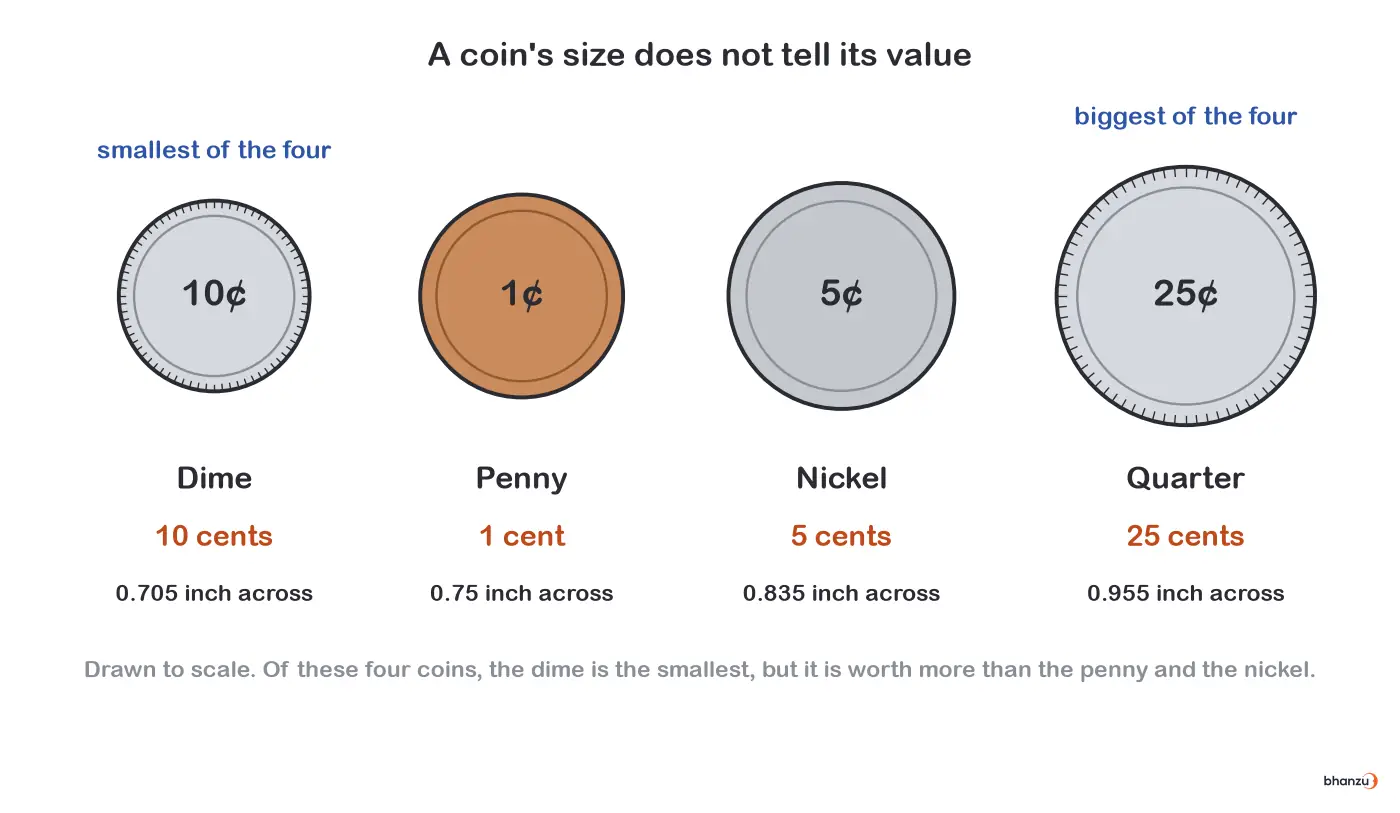
- The dime is the smallest of the four everyday coins at 0.705 inch across, yet it is worth twice as much as the nickel.
A tiny coin worth more than a big one
The dime is the tiniest of the four coins, yet it beats a penny and a nickel put together. One dime buys what 10 pennies buy. Those two bigger coins buy only what 6 pennies buy.
So size doesn't tell you value. Mei wants to know how much is in her coin jar. Soon you'll use the same counting to check you paid the right amount for a snack.
How do you count coins?
Counting coins works by adding up cents, small units of money where 100 cents make 1 dollar. A penny is 1 cent, a nickel 5, a dime 10 and a quarter 25. Count on from the coin worth the most.
The FDIC's Money Smart guide for families suggests showing your child coins, their values and trades such as 5 pennies for 1 nickel. Common Core does not list counting coins in 1st grade and places coin word problems in 2nd grade, as standard 2.MD.C.8.
| A fair goal in 1st grade | What 2nd grade adds |
|---|---|
| Name the four coins and their values | Dollar bills and the dollar sign |
| Count a handful up to 100 cents | Word problems with coins and bills |
For coins this year, your child leans mostly on skip counting by 5s and 10s. Next comes counting money and money word problems in 2nd grade.
What is each coin worth?
Each coin has one value set by law, whatever its size. The ¢ sign is short for cents, so 25¢ means 25 cents.
| Coin | Value | Edge | Size | Inches across (for grown-ups) |
|---|---|---|---|---|
| Penny | 1¢ | Smooth | Small | 0.75 |
| Nickel | 5¢ | Smooth | Bigger | 0.835 |
| Dime | 10¢ | Tiny ridges | Smallest of the four | 0.705 |
| Quarter | 25¢ | Tiny ridges | Biggest of the four | 0.955 |
Is a nickel bigger than a dime?
Yes. Today's coin law, 31 U.S. Code 5112, sets every size in the table, yet the dime is worth twice as much.
How many pennies make a dollar?
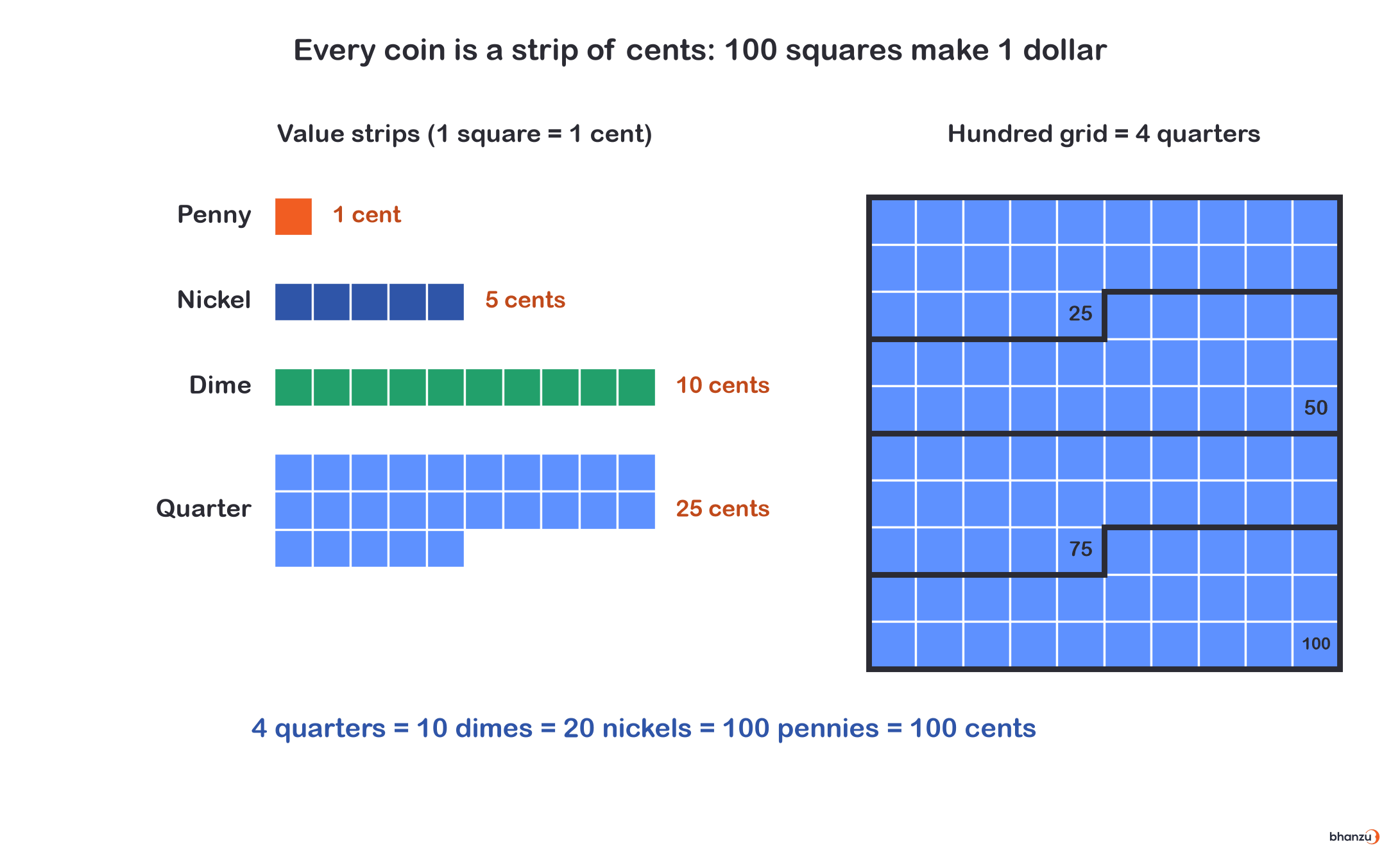
One hundred pennies make a dollar, because a dollar is 100 cents. Every other coin stands for a group of pennies, which value strips on a hundred grid make easy to see.
The law calls the quarter a "quarter dollar", and 4 quarters fill a dollar. Those are fourths, as in halves and fourths, and they return as fractions in 3rd grade.
| Coin | Cents | How many make 1 dollar |
|---|---|---|
| Penny | 1 | 100 |
| Nickel | 5 | 20 |
| Dime | 10 | 10 |
| Quarter | 25 | 4 |
Trades work both ways. Ten pennies trade up for 1 dime, and 1 quarter breaks down into 2 dimes and 1 nickel (10, 20, 25).
Dimes and pennies work like tens and ones on base-ten blocks. Three dimes and 4 pennies make 34 cents.
Counting a mixed handful, biggest value first
To count a mixed handful, sort the coins and start with the one worth the most.
- Sort the coins by kind.
- Count the quarters by 25s.
- Count on by 10s for dimes, 5s for nickels and 1s for pennies.
- Say the total in cents.
For 1 quarter, 2 dimes, 1 nickel and 2 pennies, say 25, 35, 45, 50, 51, 52, so 52 cents.
Starting with the quarters keeps the count on numbers ending in 0 or 5 until the pennies. A child who counts coins in the order they lie on the table keeps switching between 25s, 1s and 10s, and the count slips. The same quarters-first count handles two other jobs.
- Make an exact amount. Keep picking the coin worth the most that still fits, so 40 cents becomes a quarter, a dime and a nickel (25, 35, 40).
- Compare two piles. Count each pile, then compare the totals as in comparing two-digit numbers. Six dimes make 60 cents and 3 quarters make 75 cents, so the 3 quarters win by 15 cents with fewer coins.
A child who counts nickels easily, 5, 10, 15, often stops at a quarter, because one coin suddenly means 25. Counting it as five nickels shows where 25 comes from.
A big pile of pennies is slow, so group them into tens first. Making tens is also a method for adding mentally.
Try It Yourself
Tap or drag coins onto the mat until the total matches the target. The count-on line adds your coins starting with the one worth the most, and the hundred grid fills one square per cent. Tap a coin on the mat to take one off.
Examples of counting coins
Example 1
How many cents are 4 nickels?
Say 5, 10, 15, 20, one count per nickel.
Four nickels are worth 20 cents.
Example 2
Sam has 2 dimes and 3 nickels. How many cents does Sam have?
The tempting move counts by 10s for every coin, 10, 20, 30, 40, 50, for 50 cents.
That can't be right. The 3 nickels are each worth less than a dime, so the total must be less than 50.
Say 10, 20 for the dimes, then switch to 5s for the nickels and say 25, 30, 35.
Sam has 35 cents.
Example 3
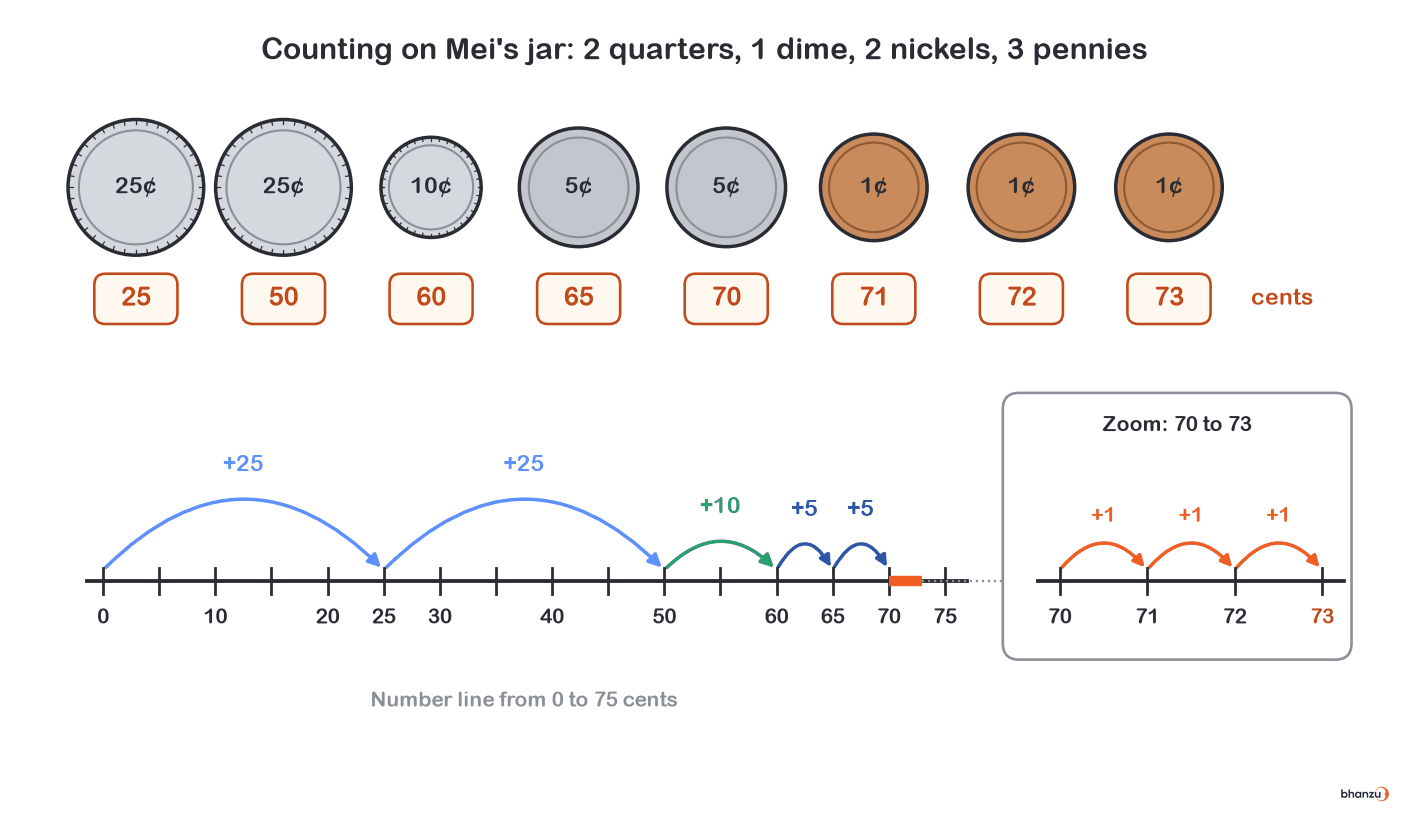
Mei's coin jar holds 2 quarters, 1 dime, 2 nickels and 3 pennies. How many cents are in the jar?
Sort the coins, then count on from the coin worth the most, saying 25, 50, 60, 65, 70, 71, 72, 73.
Mei's jar holds 73 cents.
Example 4
Leo has 1 quarter and 1 nickel. Which one coin does Leo need to make 40 cents?
Count Leo's coins, 25 and 30.
From 30 up to 40 is 10 more.
Leo needs 1 dime, the 10-cent coin.
Example 5
Priya has 7 nickels. Noah has 2 quarters. Who has more money, and how many cents more?
Priya's nickels go 5, 10, 15, 20, 25, 30, 35, so she has 35 cents.
Noah's quarters go 25, 50, so he has 50 cents.
Count on from 35 by 5s, saying 40, 45, 50.
Noah has 15 cents more, even with fewer coins.
Why does counting coins matter?
Counting coins lets you check, cent by cent, that a payment or a swap is fair.
- It lets you pay the right amount. A 45-cent sticker takes a quarter and 2 dimes, and 25, 35, 45 proves it.
- It shows whether a trade is fair. Ten pennies for 1 dime is fair, but 5 pennies for a quarter leaves someone 20 cents short.
- It helps when pennies run out. A December 2025 Treasury notice says the U.S. stopped making new pennies. Each one had come to cost 3.69 cents to make, up from 1.3 cents ten years earlier.
When a store runs out of pennies, it may round a cash total to the nearest 5 cents, so counting by 5s matters even more.
Tripping points to avoid with counting coins
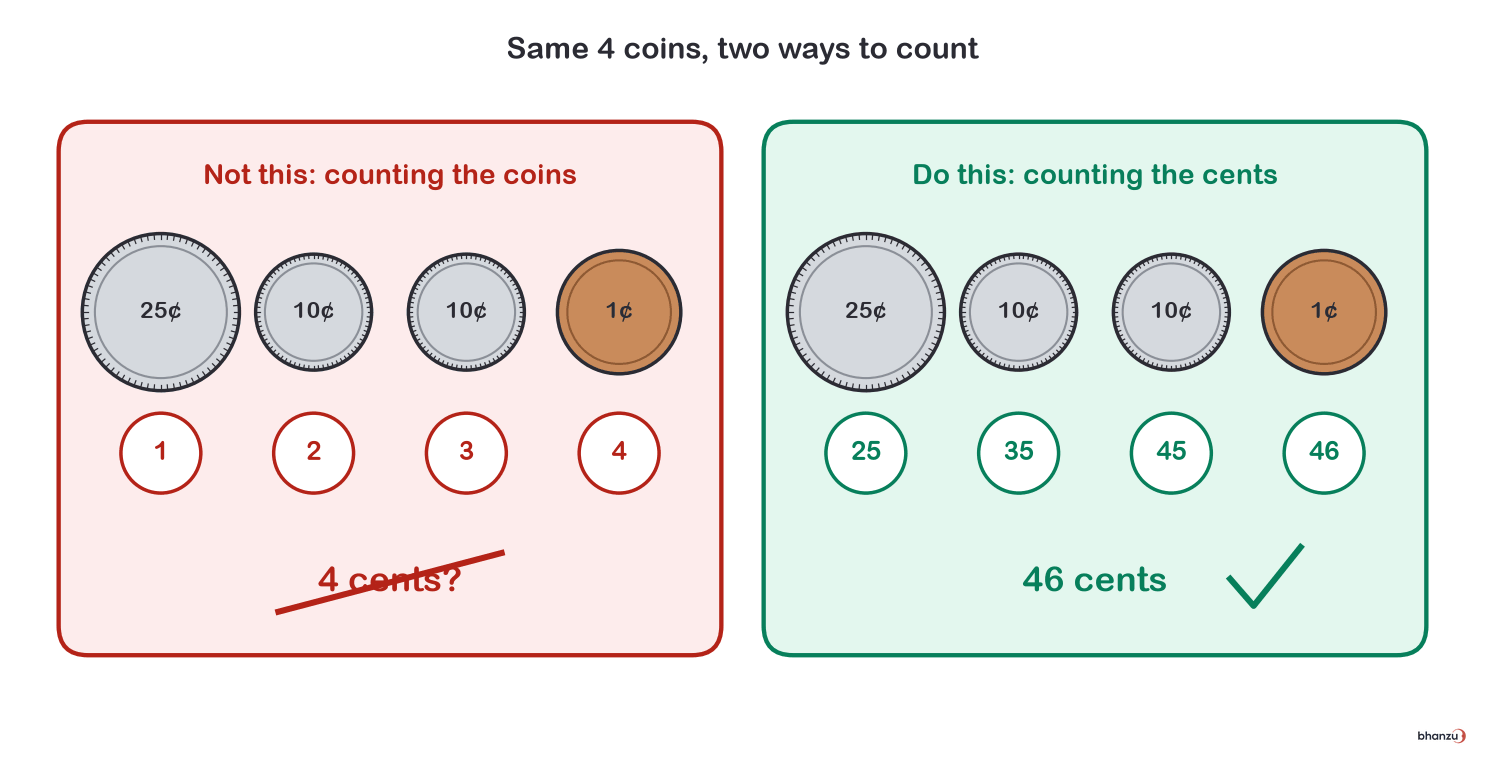
Mistake 1: Counting the coins instead of the cents
Where it slips in: The first mixed handful, when a child rushes to touch each coin and count it as one.
Don't do this: Counting 1 quarter, 2 dimes and 1 penny as 1, 2, 3, 4, so 4 cents.
The correct way: Count the values, saying 25, 35, 45, 46, for 46 cents.
Counting cubes and fingers were each worth 1. Coins break that habit. Saying the name and value together, such as "dime, 10," keeps the cents in view.
Mistake 2: Thinking the bigger coin is worth more
Where it slips in: Choosing between a nickel and a dime, since the bigger, heavier nickel looks like the better coin.
Don't do this: Picking the nickel (5 cents) over the dime (10 cents) because the nickel is bigger.
The correct way: Go by value. A dime is 10 cents and a nickel 5 cents, so 1 dime equals 2 nickels.
Watch for a child who says "dime" and then switches to the nickel because the dime looks too small to win.
Mistake 3: Starting the count over at each new coin
Where it slips in: Mixed piles where the pennies get counted first, so each new kind of coin feels like a fresh count.
Don't do this: Counting 3 pennies as 1, 2, 3, then restarting at 25, 50 for 2 quarters, so 50 cents.
The correct way: Keep going after the quarters, 25, 50, 51, 52, 53, for 53 cents.
The part of counting coins nobody explains
One coin can stand for many cents, and nothing about its size tells you how many. Almost everywhere else, a bigger thing holds more.
- Mixed coins are hard in 1st grade. In a 2000 study of first graders, only 7 of 35 children counted a set of mixed coins correctly. Just 35% knew that 100 pennies make a dollar.
- A coin's metal can change while its value stays put. Dimes were made mostly of silver until the Coinage Act of 1965 switched new dimes to copper and nickel, at 0.705 inch across. Every dime still counts as 10 cents.
The 2000 study's authors, Dyanne Tracy and Beverly Fanelli, advised first-grade teachers not to expect children to master money yet. If your child still mixes up which coin is worth more, that fits this one small study. Only 34% of its first graders put the coins in order of value.
Key Takeaways
- Read each coin by its value, not its size, so a dime always counts as 10.
- Sort the pile before counting coins, so the count switches from 25s to 10s, 5s and 1s only once each.
- Keep one running total and count on, instead of starting over when the coin changes.
- For practice with a teacher who catches the bigger-coin trap early, explore Bhanzu's 1st grade math tutor or math programs for kids.
Read More
- Days of the Week and Months
- Counting to 120
- Counting Money and Making Change
- Math Skills for Kids by Age
Research Behind This Article
- Federal Deposit Insurance Corporation, Money Smart for Young People, Grades Pre-K to 2, Parent/Caregiver Guide (2021). fdic.gov
- Common Core State Standards Initiative, Grade 2 Measurement and Data (2.MD) (2010). thecorestandards.org
- U.S. Government Publishing Office, United States Code, Title 31, Section 5112, 2024 Edition (2024). govinfo.gov
- Tracy, Dyanne M. and Fanelli, Beverly H., Teaching Money Concepts: Are We Shortchanging Our Kids? (2000). files.eric.ed.gov
- U.S. Government Publishing Office, Coinage Act of 1965, Public Law 89-81 (1965). govinfo.gov
Quick Quiz: Check Yourself
Three levels, new coins every time: count one kind of coin, count a mixed handful, then find a missing coin or compare two piles.
Was this article helpful?
Your feedback helps us write better content
Frequently Asked Questions
Is a nickel 10 cents?
How do I show my child how to count coins quickly?
How many pennies are in circulation?
What is an easy way to teach a child to count money?
How do you teach counting coins to first graders?