Key Points
- Ordinal numbers name a place in order, such as 1st, 2nd or 10th, while counting numbers such as 3 or 6 tell how many.
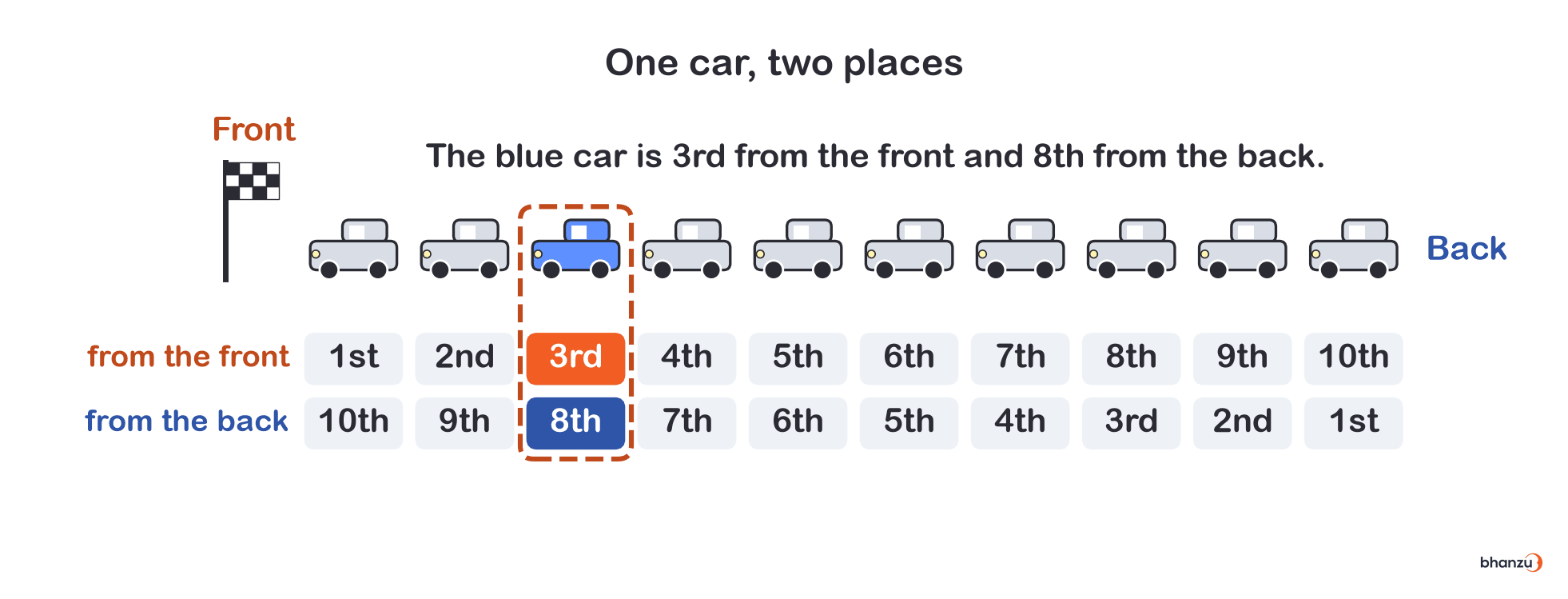
- Counting from the named end gives each place, so in 10 cars the 3rd from the front is the 8th from the back.
- A place number counts the item itself, so a child who is 7th in line has 6 children ahead, not 7.
Fifth in line, but only four ahead
If you're 5th in line for the slide, only 4 kids stand in front of you. The 5th spot is yours, and you can't stand in front of yourself.
Ten toy cars behind a checkered flag show the place words first to tenth (the flag marks the front). In 2nd grade, the same words help you read dates like the 21st and the 31st.
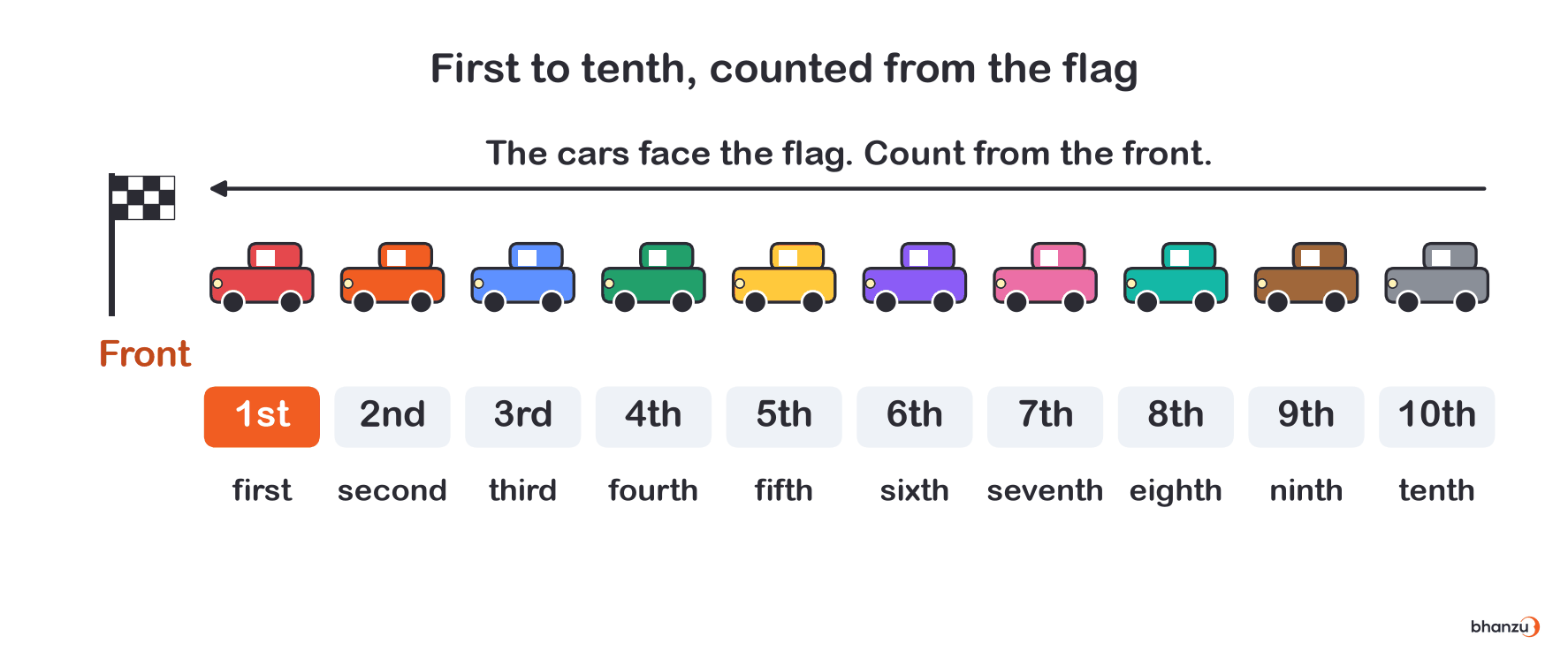
What are ordinal numbers?
Ordinal numbers are place words, such as first and second, and each one names a spot in a line or a list. An ordinal number tells which one, while a counting number such as 4 tells how many. Counting numbers are the natural numbers 1, 2, 3 and so on, the ones you say when counting to 120.
The best model is a number path: a row of spots with a place tag on each. At this stage, your child learns to name the place of a spot and find the spot for a place, up to tenth. A 2012 study of children aged 3 to 5 by Angels Colome and Marie-Pascale Noel found that naming came easier, so practice both with your child.
What is the difference between cardinal and ordinal numbers?
A cardinal number tells how many, and an ordinal number tells which one. "There are 6 blocks" uses a cardinal number, and "the star is on the 4th block" uses an ordinal number. Common Core's kindergarten standard K.CC.B.4 covers the how-many side, and the standards list no separate one for ordinal numbers.
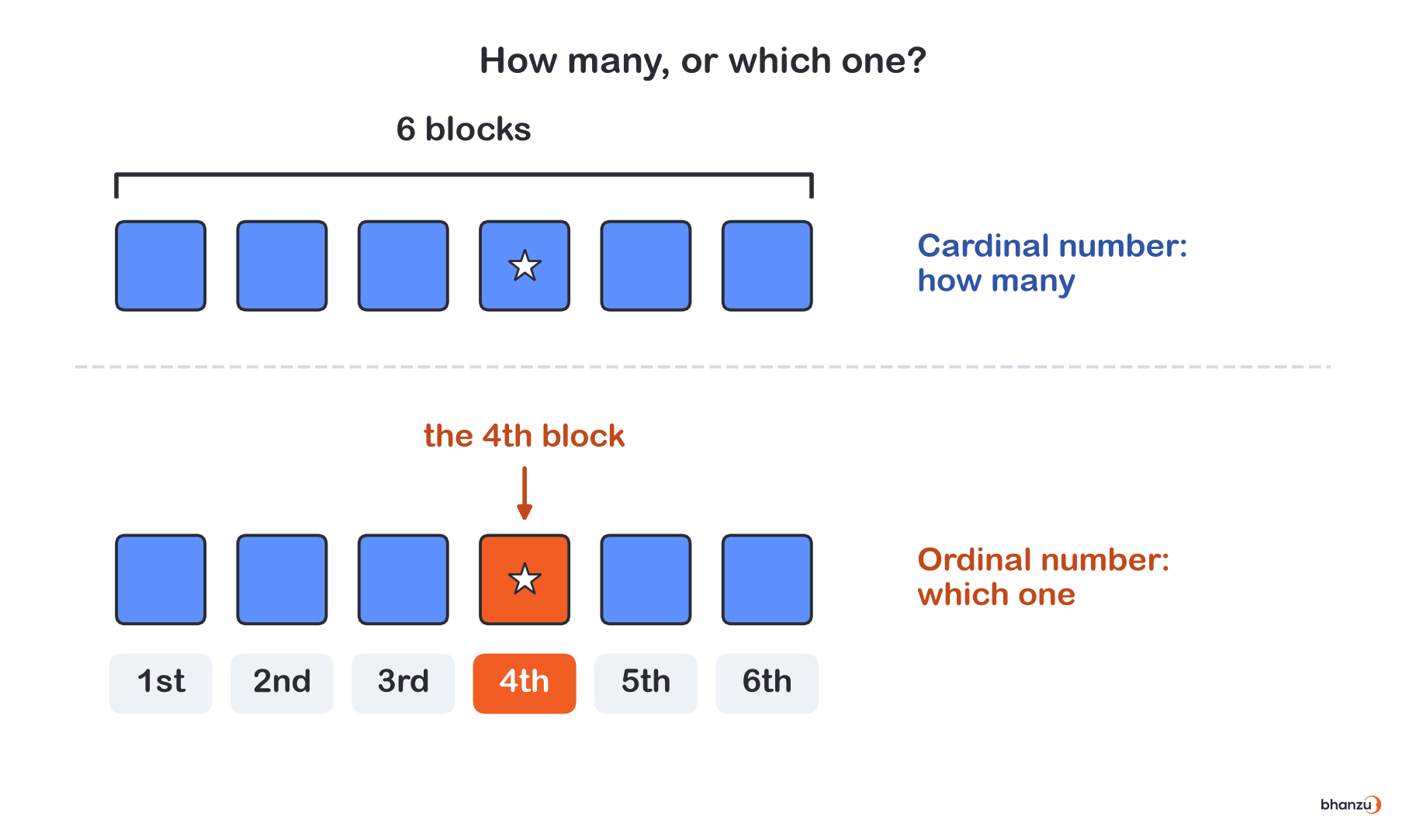
From the right, the star block is 3rd, but there are still 6 blocks. A number can also be just a name. The 7 on a soccer shirt is a nominal number, which tells neither how many nor which place.
Ask your child which block has the star, and the answer often comes back as "4" (the right place, said the how-many way). Say "the 4th block" back.
Which end of the line do you count from?
Find the starting end first. A flag or words like "from the right" show where 1st is.
- Find the starting end.
- Point to the item there and say "1st."
- Move one item at a time and say the next place word.
- Stop on the item you want. That word is its place.
With no end named, start at the left, the way English is read. In 10 cars, the blue car is 3rd from the front but 8th from the back. It has 2 cars ahead and 7 behind, so the line holds cars.
- Ahead means closer to the front, and behind means farther from it.
- Between means in the middle, without the two ends.
- Last means the very end, so in 10 cars the last car is 10th.
For the cars between the 2nd and the 6th, use counting on from the 2nd: 3rd, 4th, 5th. That makes 3 cars. Counting one by one gets slow in a line of 30, where subtraction is faster (you'll subtract numbers that big in 2nd grade).
Try It Yourself
Tap a car to see its place from each end and how many cars are ahead. Move the flag and watch the places change. In Find the car, count from the flag to the car the board asks for, then tap it.
How do you write ordinal numbers?
Write the number, then add the last two letters of its word. First ends in st, so 1 becomes 1st, and fourth ends in th, so 4 becomes 4th. First, second and third are the odd ones out, and fourth to tenth all end in th.
| Number | Word | Short form |
|---|---|---|
| 1 | first | 1st |
| 2 | second | 2nd |
| 3 | third | 3rd |
| 4 | fourth | 4th |
| 5 | fifth | 5th |
| 6 | sixth | 6th |
| 7 | seventh | 7th |
| 8 | eighth | 8th |
| 9 | ninth | 9th |
| 10 | tenth | 10th |
Writing a place is its own skill. A 2025 study followed 33 children aged 3 to 5 for a year. They wrote numerals for how many almost twice as often as for which place.
Examples of ordinal numbers
Example 1
A week on a calendar reads Sunday, Monday, Tuesday, Wednesday, Thursday, Friday, Saturday. Which place is Thursday in?
Count from Sunday: Sunday 1st, Monday 2nd, Tuesday 3rd, Wednesday 4th, Thursday 5th.
Thursday is 5th (fifth).
Example 2
Maya is 7th in line for the slide. How many children are ahead of her?
The tempting answer is 7, the number in her place.
That cannot be right. With 7 children ahead, Maya would be 8th, because her place number counts her too.
The children ahead hold the 1st to the 6th places.
Six children are ahead of Maya.
Example 3
Eight toy cars stand in a line. The green car is 3rd from the front. What place is it from the back?
Start at the back car and say 1st. Move toward the front, saying 2nd, 3rd, 4th and 5th.
The next car is the green car, so it is 6th from the back.
Example 4
In a race of 10 runners, Leo finished 3rd and Priya finished 8th. How many runners finished between them?
Count on from 3rd, saying 4th, 5th, 6th, 7th. The next place belongs to Priya.
Four runners finished between Leo and Priya.
Example 5
Aisha is 4th from the front of a line and 7th from the back. How many children are in the line?
From the front, 3 children are ahead of her. From the back, 6 children are behind her.
There are 10 children in the line.
Ordinal numbers beyond the textbook
Ordinal numbers let people agree on which one without pointing. They work only because everyone counts from the same end.
- They settle turns. The 1st child in the slide line goes first, and the 2nd waits one turn.
- They name winners. A race of 5 runners and a race of 50 both have a 1st, 2nd and 3rd place.
- They pin down the calendar. Federal law names Labor Day as the first Monday in September. A 1968 law moved Memorial Day from May 30 to the last Monday in May, starting in 1971.
On a route with 6 stops, the stop that is 3rd on the way to school is 4th on the way home. The front of the trip has changed.
The pattern hiding inside ordinal numbers
A place number counts the item itself, which gives two shortcuts for long lines.
Whoever is 9th has 8 ahead, because the 9th place counts that child too. For places between, take the smaller place from the bigger, then take away 1 more.
The jump from the 2nd car to the 6th takes 4 steps, and the last step lands on the 6th car. "Between" trips up grown-ups too, because the two ends are left out.
The second shortcut is the both-ends rule. Add a car's place from the front and its place from the back, and you get one more than the number of cars. That car got counted from both ends. The blue car, 3rd from the front in 10 cars, is 8th from the back.
NASA lists the eight planets in order from the Sun, with Earth 3rd. Counting in from Neptune, Earth is 6th. And 3 plus 6 is 9, one more than 8.
The mistakes kids make most often with ordinal numbers
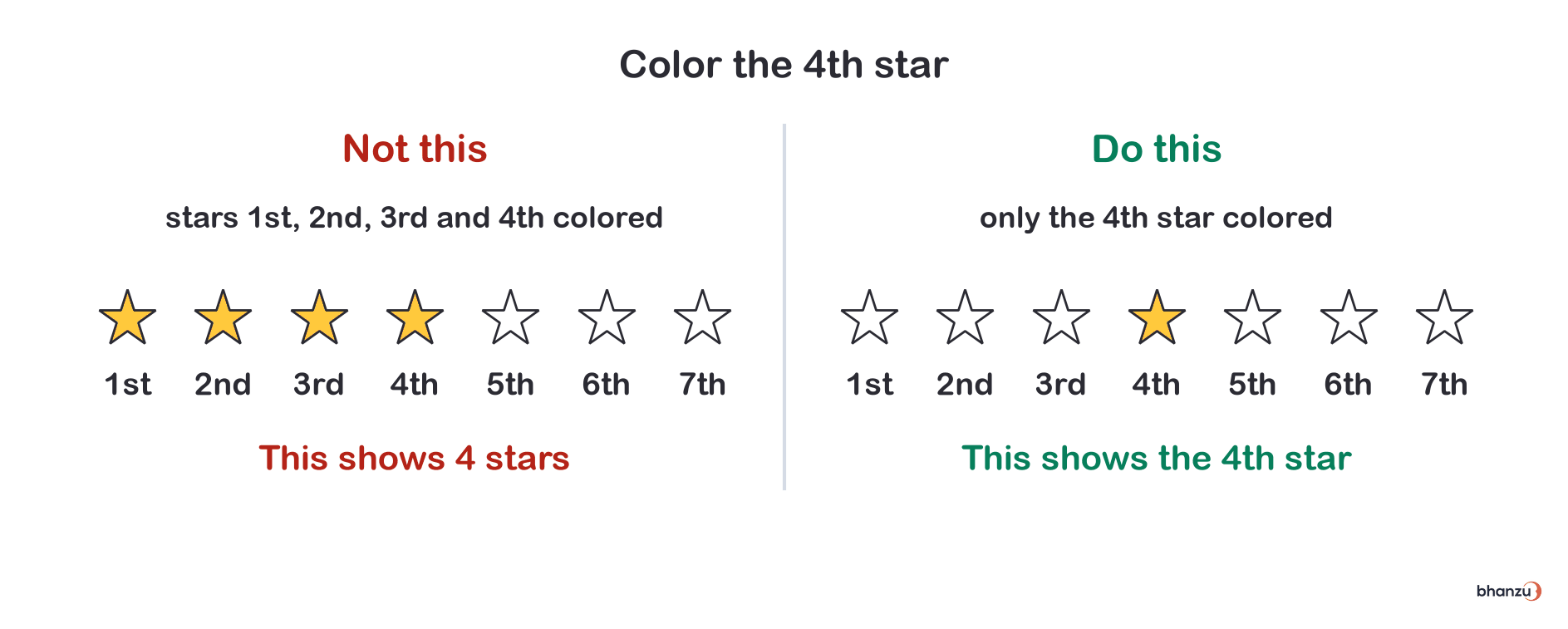
Mistake 1: Coloring four stars when asked for the 4th
Where it slips in: "Color the 4th star" tasks in a row of 7 stars.
Don't do this: Color stars 1, 2, 3 and 4.
The correct way: Count 1st, 2nd, 3rd, 4th and color only the 4th star. Four tells how many, and fourth tells which one.
When a child is asked for the 4th star, the first instinct is to color four, the habit that counting has built. A child who rushes to start coloring keeps going until the count runs out.
Mistake 2: Counting from the wrong end
Where it slips in: Rows that say "from the right."
Don't do this: In the row circle, star, square, heart, triangle, moon, call the square 3rd from the right.
The correct way: Start at the right end. The moon is 1st, the triangle 2nd, the heart 3rd and the square 4th from the right. The square is 3rd only from the left.
Reading pulls the eye to the left edge first. A child who second-guesses a right answer may freeze when one shape gets two places, so say both places are true.
Mistake 3: Writing 1th, 2th or 3th
Where it slips in: Writing places the short way, right after 4th to 10th.
Don't do this: Write 1th, 2th or 3th.
The correct way: Write 1st, 2nd and 3rd, the last two letters of first, second and third.
Seven of the ten short forms end in th. That makes th look like the rule for every place.
Key Takeaways
- To name a place in ordinal numbers, touch one item at a time and say the place words until you reach it.
- Pick the starting end first, because one car can hold two places.
- To find how many stand ahead, count one fewer than the place.
- Copy the last two letters of the word, so 2nd and 3rd, never 2th or 3th.
- For more practice with place words and the from-the-other-end trap, explore Bhanzu's 1st grade math curriculum or an elementary math tutor.
Read More
- Skip Counting by 2s, 5s and 10s
- Reading a Calendar
- Comparing and Ordering Three-Digit Numbers
- Comparing Two-Digit Numbers
- Days of the Week and Months
Research Behind This Article
- Colome, Angels and Noel, Marie-Pascale, One First? Acquisition of the Cardinal and Ordinal Uses of Numbers in Preschoolers (2012). eric.ed.gov
- Common Core State Standards Initiative, Kindergarten Counting and Cardinality (K.CC) (2010). thecorestandards.org
- Voutsina, Chronoula and Stott, Debbie, Young Children's Notations for Representing Ordinal Position and Quantity: A Longitudinal Study of Cross-Task and Within-Task Qualitative Variations (2025). eric.ed.gov
- Legal Information Institute, Cornell Law School, 5 U.S. Code 6103: Holidays (2021). law.cornell.edu
- NASA Science, Planets (2026). science.nasa.gov
Quick Quiz: Check Yourself
Three levels, new questions every time. Name a place, find how many are ahead or the place from the other end, then count those between or the whole line.
Was this article helpful?
Your feedback helps us write better content
Frequently Asked Questions
How do you write ordinal numbers for dates?
Is it 11th or 11st?
Is zero an ordinal number?
How do I teach ordinal numbers to my first grader?
When do children learn ordinal numbers?