Key Points
- Halves and fourths name equal parts of one whole, where 2 equal parts are halves and 4 equal parts are fourths, or quarters.
- To make fourths, cut a shape in half, then cut each half in half again.
- A fourth is smaller than a half of the same whole, because more equal parts means smaller parts.
- Common Core standard 1.G.A.3 teaches these shares in words, and writing them as numbers waits until about 3rd grade.
One sandwich, more friends, smaller bites
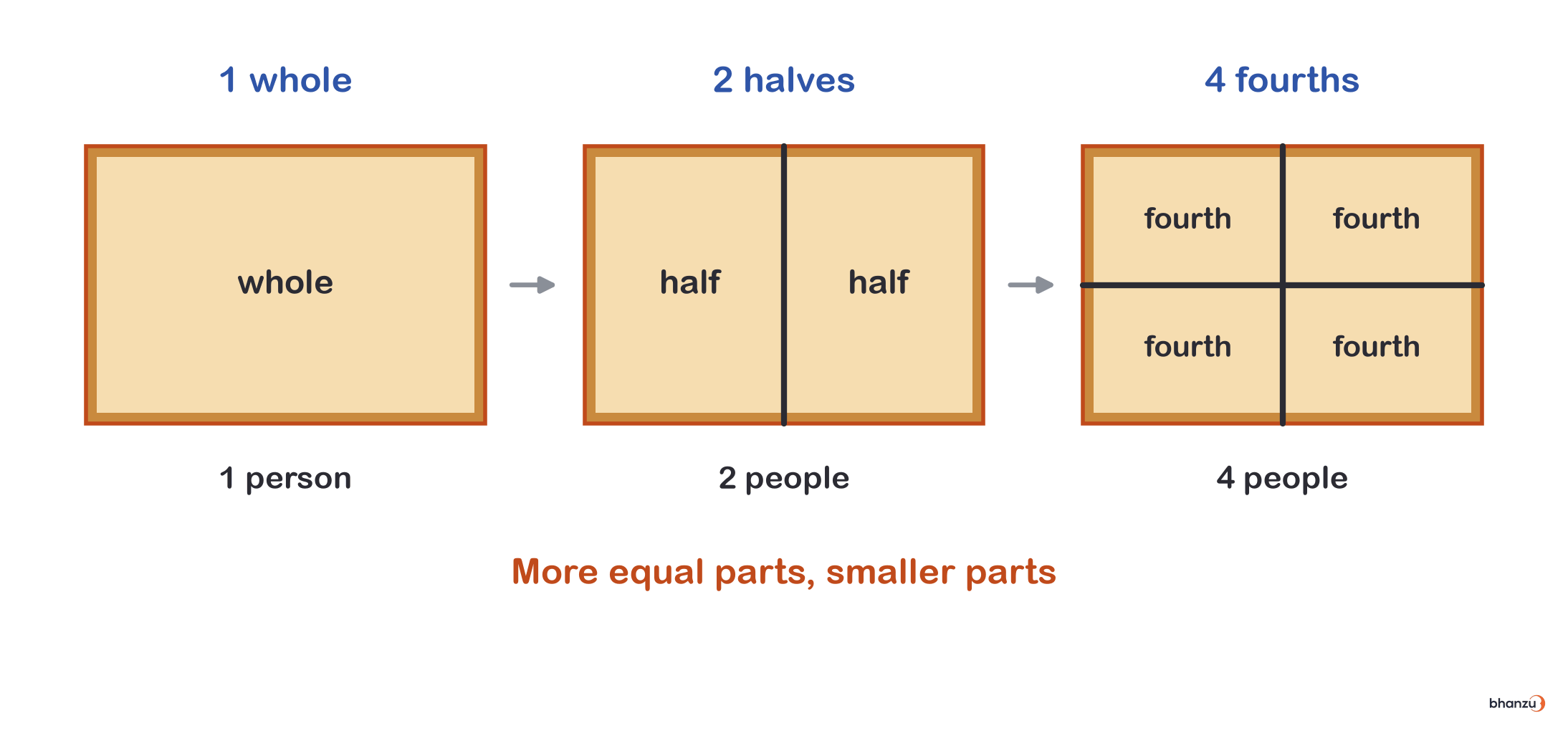
Share one sandwich with a friend, and you each get a big piece. Then 2 more friends join the picnic. The same sandwich now feeds 4, so every piece shrinks.
Nobody wants the tiny piece. Fair sharing means every piece is the same size, and those fair pieces have names, halves and fourths. Soon you'll spot them on clocks and coins too.
What are halves and fourths?
Halves and fourths are names for equal shares, the same-size parts of one whole shape (the whole is the shape before any cut). Two equal shares are halves. Four equal shares are fourths.
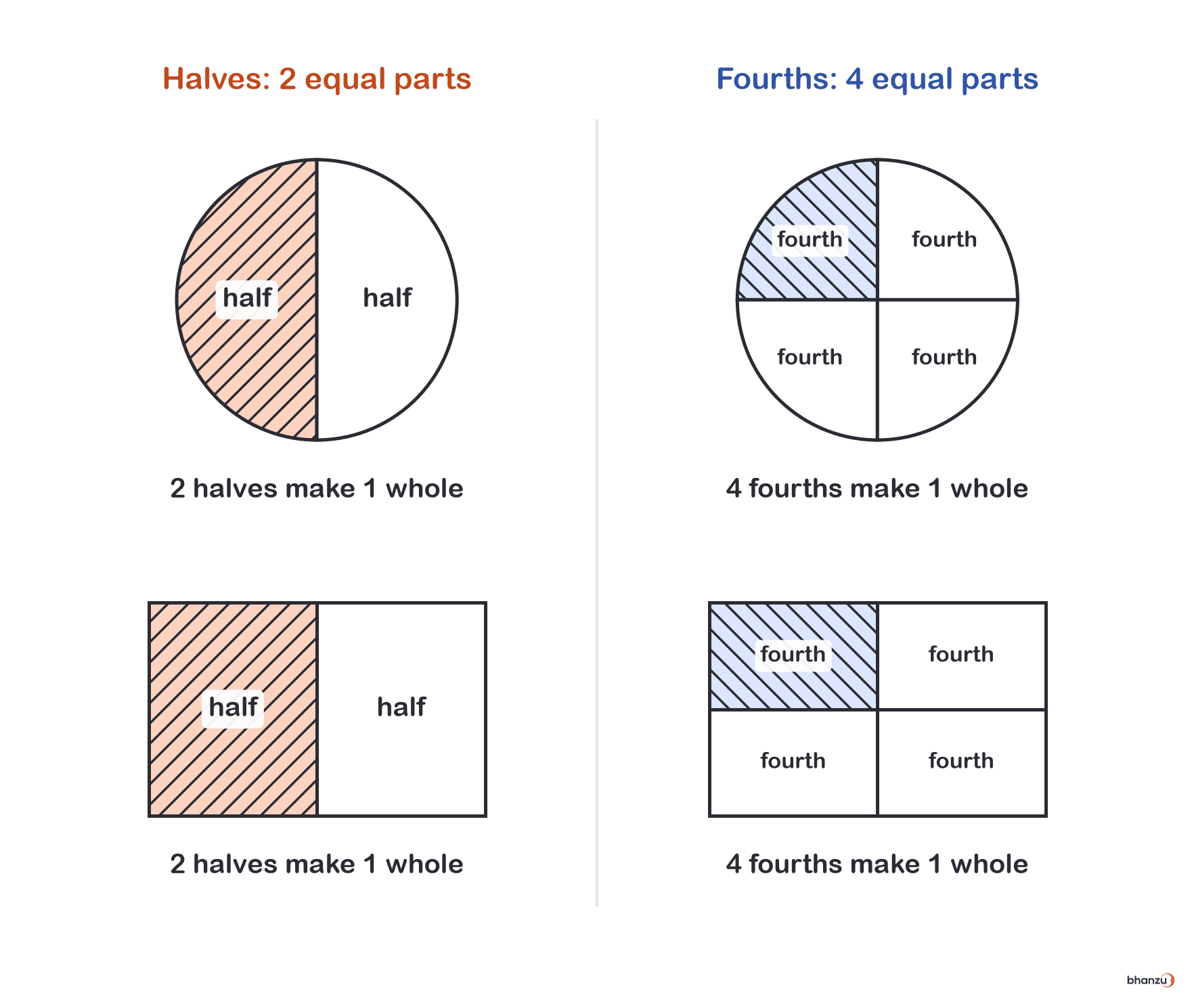
Circles and rectangles are flat shapes, so equal shares cover the same amount of flat space. Together, 2 halves make 1 whole and 4 fourths make 1 whole, so coloring 1 fourth leaves 3 fourths white.
| Equal parts | Each part is called | Parts in the whole |
|---|---|---|
| 2 | a half | 2 halves |
| 4 | a fourth, or a quarter | 4 fourths |
Is a fourth the same as a quarter? Yes. US law even names coins the half dollar and the quarter dollar, and counting coins shows that 4 quarters make 1 dollar.
This is Common Core standard 1.G.A.3, which uses the words half of, fourth of and quarter of. A 2023 study followed 103 first graders in the US through the school year and found most already showed some fraction sense in the fall, especially halving. Your child's job now is making the cuts equal.
How do you cut a shape into halves and fourths?
One straight cut through the middle makes halves, and cutting each half in half again makes fourths. The What Works Clearinghouse fractions guide (2010) suggests sharing among 2, 4 or 8 people first, because those shares come from halving.
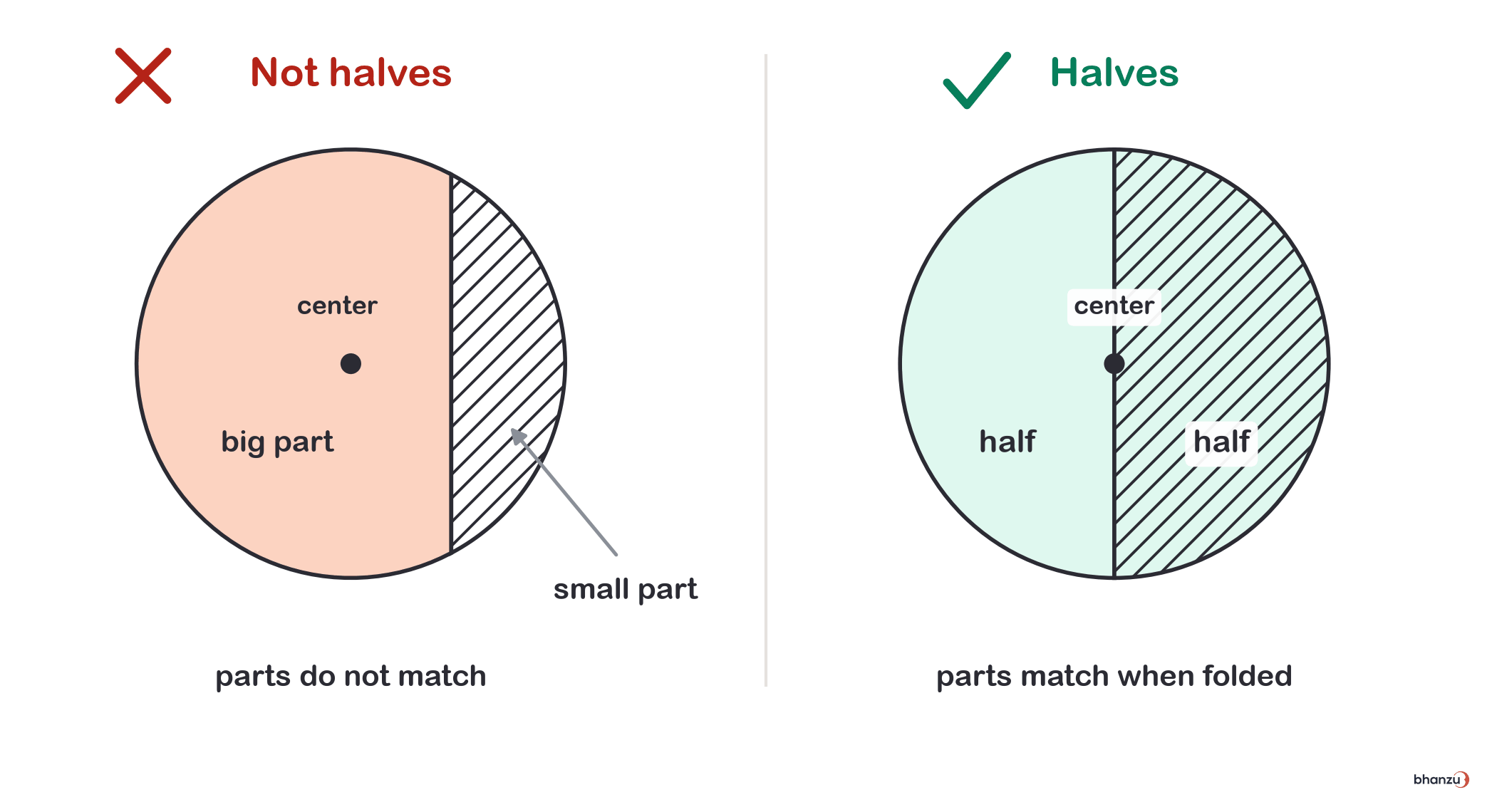
- For halves, cut straight through the middle, which on a circle is the center.
- For fourths, cut each half in half. On a circle, the two cuts cross at the center like a plus sign (all 4 corners square).
- Count the equal parts, and check that nothing is left over.
A rectangle can be halved down the middle, across the middle, or corner to corner. Fourths come from one cut down plus one across, or from 4 equal strips. Squares work too, since every square is a rectangle.
A shape cut into equal parts and colored is an area model. Halving again and again never makes 3 parts, so sharing fairly among 3 people needs a new plan, coming next with halves, thirds and fourths.
How do you check equal parts of shapes?
Fold the shape along the cut. If the edges line up, the parts are equal. Cut-out parts work too, since equal parts stacked together cover each other exactly.
One case is genuinely confusing, even for grown-ups. Cut a long rectangle from corner to corner, and folding along the cut leaves the points sticking out. Spin one triangle around (a half turn) and it fits exactly on the other, so they are halves.
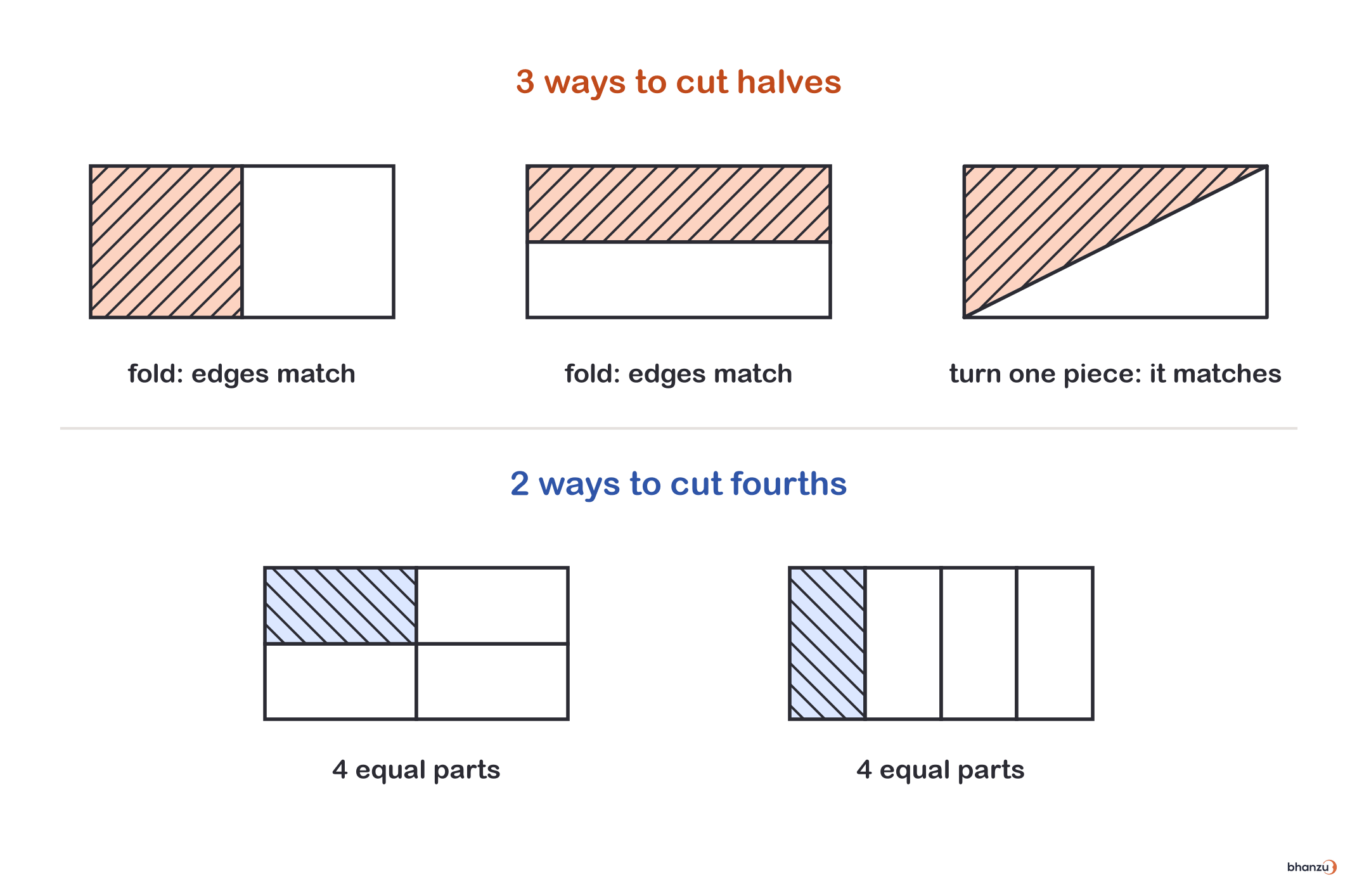
Children who fold that cut often decide the triangles are not halves. Folding matches parts only along the lines of symmetry in a rectangle, and a long one has just two, down and across the middle.
Why is a fourth smaller than a half?
A fourth is a half of a half. Cut each half of a sandwich in half again, and each new piece is a fourth, so 2 fourths fit inside 1 half.
| People sharing one sandwich | Each person gets |
|---|---|
| 1 | the whole sandwich |
| 2 | a half |
| 4 | a fourth |
More equal shares of the same whole make smaller shares. The same whole matters, because a fourth of a big pizza can be more food than half of a small cookie. Halve each fourth again and you get eighths, smaller still.
Try It Yourself
Pick a circle or a rectangle, cut it into 2 or 4 equal parts, and tap parts to shade the goal before you press Check. Switch a 2-part cut to Uneven and the readout says the parts are no longer halves.
The real reason halves and fourths exist
Halves and fourths exist so one thing can be shared fairly. Marbles can be counted out one by one, but a sandwich has to be cut. Without these names, you'd have to say one of the two same-size pieces every time.
- It names money. A quarter is one fourth of a dollar, so 4 friends sharing 1 dollar get 1 quarter each.
- It tells time. Half past 3 means the minute hand has gone halfway around the clock.
- It starts fractions. In a 2012 study of 3,677 UK and 599 US children, fraction knowledge at about age 10 predicted high school algebra and overall math.
All three uses need equal parts, so the check matters more than the name.
Examples of halves and fourths
Example 1
A rectangle-shaped sandwich is cut into 4 equal parts. What is each part called, and how many make the whole?
There are 4 equal parts, so each part is a fourth, and 4 fourths make the whole sandwich.
Example 2
Leo cuts a round cracker with one straight cut that misses the center. Did he make halves?
The 2 parts don't match, because the part holding the center is bigger.
No, he did not make halves. A cut through the center would.
Example 3
Diego marks 4 same-size pieces on a paper strip, starting at one end, and a piece is left over. Are his 4 pieces fourths?
Saying yes is tempting, since the 4 pieces match. But 4 fourths must fill the whole strip, and Diego's leave a gap, so each piece is too small.
- Fold the strip in half.
- Fold it in half again.
- Unfold it and count 4 equal parts with nothing left over.
No, his pieces are not fourths, but the 4 folded parts are.
Example 4
Mei gets one half of a granola bar. Sam gets one fourth of a same-size bar. Who gets more?
Cut Mei's half in half again and it makes 2 fourths, so her half holds 2 of Sam's pieces.
Mei gets more, because a half is bigger than a fourth of the same bar.
Example 5
Aisha folds a square napkin into 4 equal parts. She colors every part except 1. How many fourths did she color?
The napkin is 4 fourths, and 1 fourth stays white.
Aisha colored 3 fourths.
Example 6
Noah has 1 dollar, all in quarters. He spends 1 quarter on a sticker and 1 on a pencil. How many quarters are left?
A quarter is one fourth of a dollar, so 1 dollar is 4 quarters.
Noah has 2 quarters left.
The part of halves and fourths nobody explains
Naming the parts is the easy part.
- Cutting them equal is the hard part, even in 2nd grade. In a 2025 study of 1st and 2nd graders, most could cut the number of parts asked for. But most could not make the parts equal or use up the whole.
- Words come before numbers. The What Works Clearinghouse home tips (2021) leave writing fractions such as for grades 3 to 5.
If your child names a half but still cuts lopsided pieces, that is normal for 1st grade and is the exact thing to practice.
The mistakes kids make most often with halves and fourths
Mistake 1: Calling two unequal parts halves
Where it slips in: Cutting by eye, as in Example 2. A child counts 2 pieces and stops, because the count feels right.
Don't do this: Cut a cracker into 1 big part and 1 small part and call them 2 halves.
The correct way: Cut through the center so the 2 parts match when folded.
Mistake 2: Calling every piece a half
Where it slips in: Pizza slices and everyday talk, where "the bigger half" uses half to mean any piece.
Don't do this: Call one of 4 equal pizza slices a half.
The correct way: Count the equal parts first. Four equal slices are 4 fourths, so each slice is a fourth.
A piece is any part, but a half is 1 of 2 equal parts, so 2 true halves are always the same size.
Mistake 3: Thinking a fourth is bigger because 4 is bigger than 2
Where it slips in: Comparing shares, as in Example 4. A child answers "the fourth" at once, since 4 comes after 2 when counting.
Don't do this: Say a fourth of a pizza beats a half of it because 4 is more than 2.
The correct way: The 4 counts the equal parts sharing the pizza. More sharing means smaller pieces, so a fourth is smaller than a half of the same pizza.
Key Takeaways
- Count equal parts, not just pieces, before naming halves and fourths.
- Check by folding or stacking, and turn a piece when a corner-to-corner cut won't fold flat.
- When more friends share the same whole, each share gets smaller.
- For more practice cutting fair halves and fourths with a teacher, explore Bhanzu's 1st grade math curriculum or math classes for kids.
Read More
- Adding Several Numbers with Tens and Ones
- Equivalent Fractions with Models
- Fractions on a Number Line
- Why Are Fractions So Hard
Research Behind This Article
- Common Core State Standards Initiative, Grade 1 Geometry (1.G) (2010). thecorestandards.org
- Viegut, A. A. and others, Tracking Informal Fraction Knowledge and Its Correlates across First Grade (2023). doi.org
- What Works Clearinghouse, Developing Effective Fractions Instruction for Kindergarten Through 8th Grade (2010). ies.ed.gov
- Siegler, R. S. and others, Early Predictors of High School Mathematics Achievement (2012). files.eric.ed.gov
- Zolfaghari, M., Examining Fragmenting Knowledge in First and Second Grade Students: Insights into Fragmenting Developmental Trajectory (2025). doi.org
- What Works Clearinghouse, Learning About Fractions at Home: Evidence-Based Tips for Parents and Caregivers (2021). files.eric.ed.gov
Quick Quiz: Check Yourself
Three levels, new questions every time: name parts and count them in a whole, then judge cuts, compare shares or count fourths left, then solve quarter and pizza word problems.
Was this article helpful?
Your feedback helps us write better content
Frequently Asked Questions
What is a quarter of a circle called?
How many fourths are in two wholes?
Does fourth mean the same thing as a fourth of a shape?
What grade do kids learn fractions?
How can I help my child practice halves and fourths at home?