Key Points
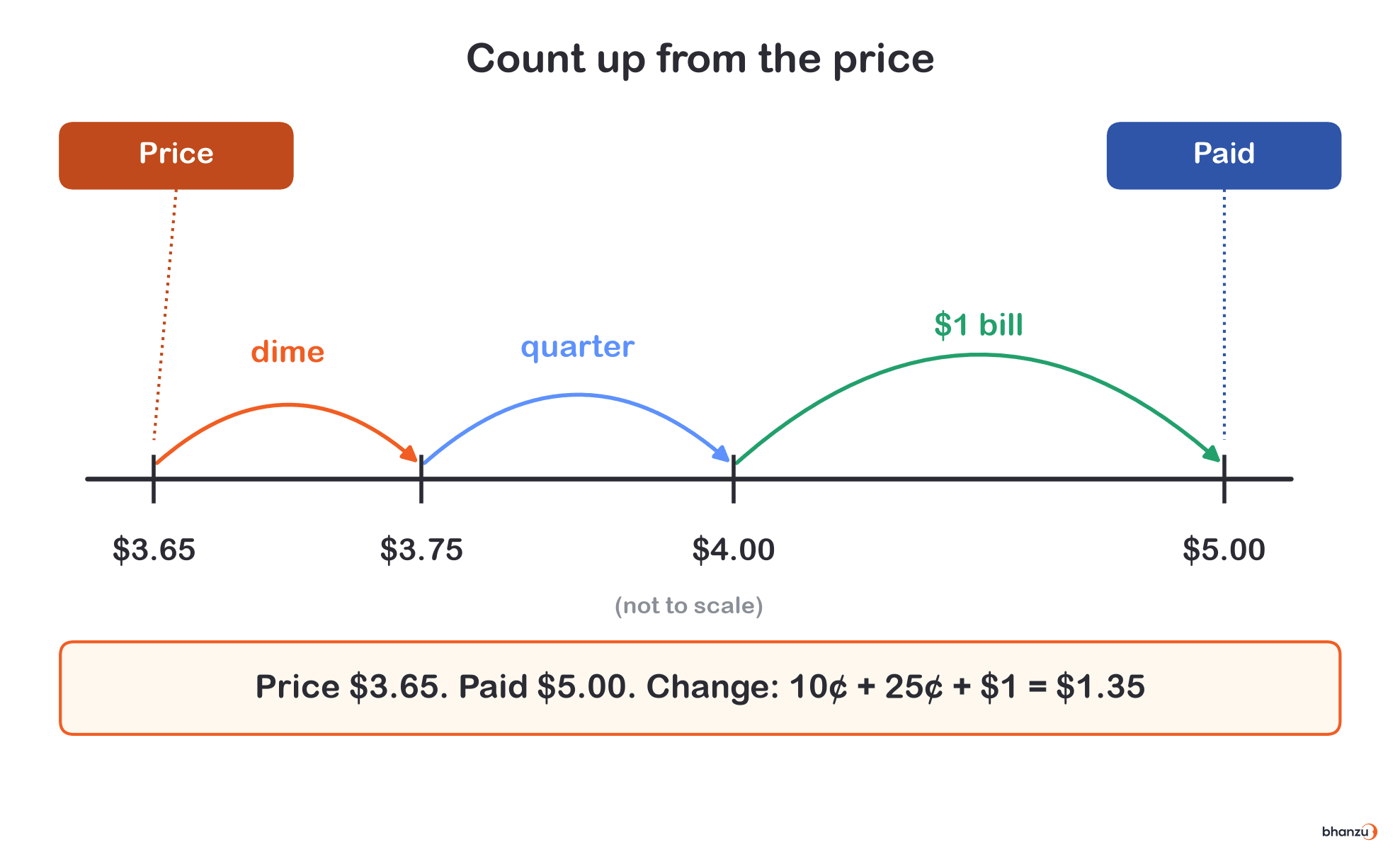
- A $3.65 poster paid for with a $5 bill brings back $1.35 in change, the gap between the price and the money handed over.
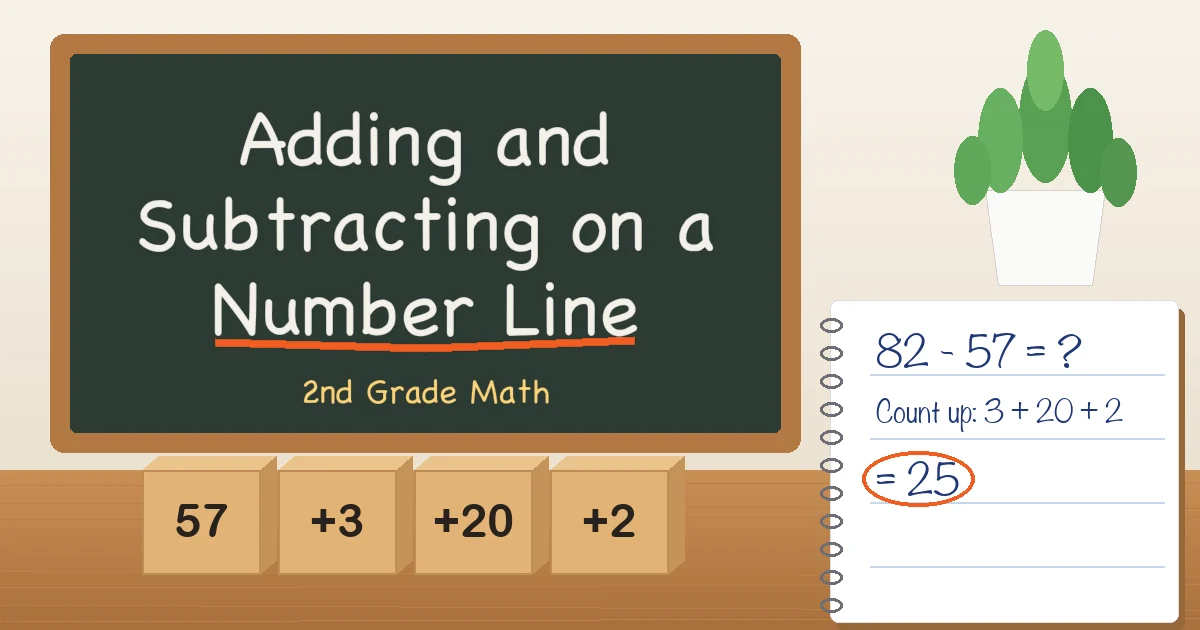
- The count-up method starts at the price and adds coins and bills to the amount paid, such as $3.75 with a dime, $4.00 with a quarter, then $5.00.
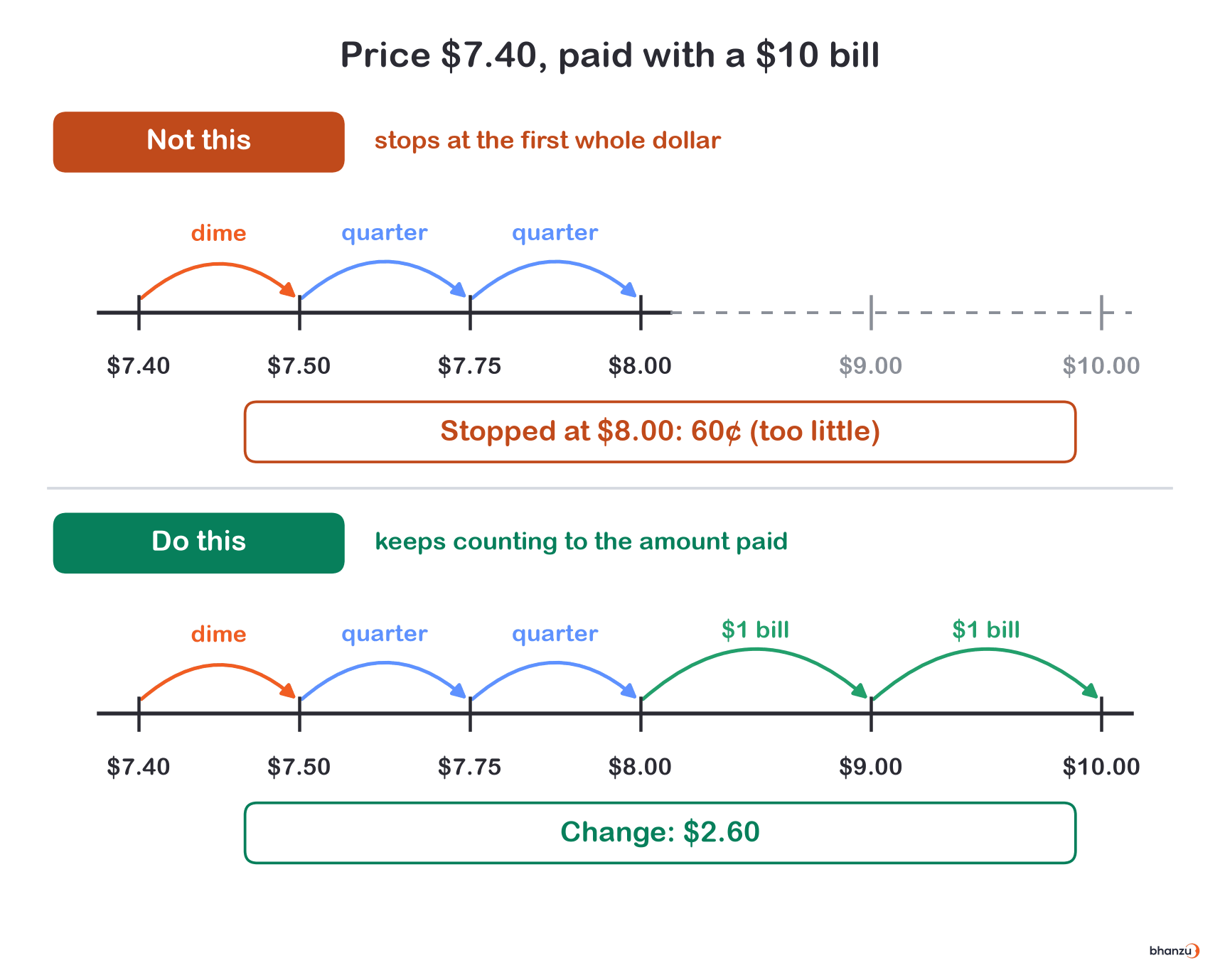
- A common mistake in making change is stopping at the first whole dollar, so a $7.40 book paid with a $10 bill gets 60 cents instead of $2.60.
Change you can count without subtracting
Store clerks can hand back the right change without writing one number down. They count up (no pencil needed). At a book fair, a poster costs $3.65 and you pay with a $5 bill.
The clerk hands you a dime and says the new total, three seventy-five. A quarter makes four dollars, and a $1 bill makes five. Nobody subtracted, yet the dime, quarter and bill in your hand are your change, $1.35.
How do you make change?
Making change is a number line walk from the price to the amount paid, with each hop a coin or bill you hand back. That walk is called counting up, which is counting on with money. Soon you'll check your own change at snack stands, and later this counting up helps you subtract big numbers in your head.
- Say the price out loud.
- Add pennies, nickels or dimes to reach 25, 50 or 75 cents or a whole dollar.
- Add quarters to reach the next whole dollar.
- Add $1 bills, or a $5 bill, to reach the amount paid.
- Add the change back to the price to check that you land on the amount paid.
For the $3.65 poster, the stops are $3.75, $4.00 and $5.00. Adding the $1.35 change back in cents checks it.
Say the new total at each stop, not the coin's value. Children who count up out loud often say "ten, twenty-five, one" for the pieces, then lose their place.
Common Core places coins and bills in 2nd grade (2.MD.C.8) and money problems with decimals in 4th grade (4.MD.A.2), with no separate money standard in 3rd grade. What your child adds this year rests on 3.NBT.A.2, fluently adding and subtracting within 1,000, where $10 is 1,000 cents.
How do you count a mix of bills and coins?
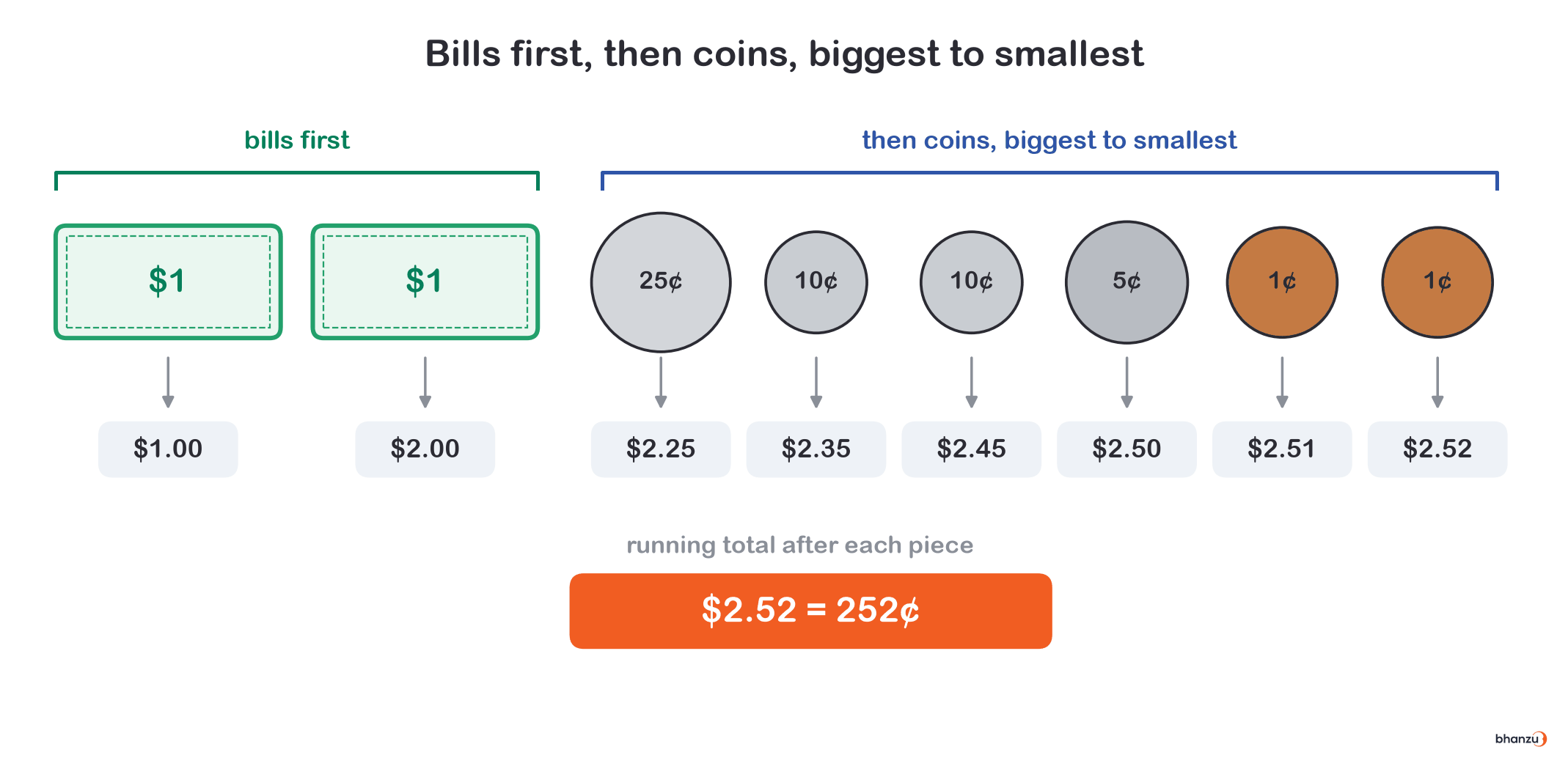
Count the bills first, biggest value down, then the coins from quarters to pennies. After each piece, say the running total, the amount counted so far. Every count rests on one trade.
So 3 dollars are 300 cents, and 252 cents make 2 dollars and 52 cents. If counting money with bills and coins is new, start with the 2nd grade lesson.
Two $1 bills, 1 quarter, 2 dimes, 1 nickel and 2 pennies count as $1.00, $2.00, $2.25, $2.35, $2.45, $2.50, $2.51 and $2.52. Counting quarters by 25s is skip counting.
In $2.52, the dot is a decimal point that separates dollars from cents. Cents always fill two places, so five cents is $0.05. In 4th grade, you will learn the names of those two places.
How much change makes a dollar? Four quarters, 10 dimes, 20 nickels or 100 pennies. For the fewest coins, start with the biggest coin that fits (so 30 cents is a quarter and a nickel, not three dimes).
| Money | Value in cents | Written in dollars |
|---|---|---|
| Penny | 1¢ | $0.01 |
| Nickel | 5¢ | $0.05 |
| Dime | 10¢ | $0.10 |
| Quarter | 25¢ | $0.25 |
| $1 bill | 100¢ | $1.00 |
| $5 bill | 500¢ | $5.00 |
In a 2009 study of 229 fourth and sixth graders, those given bills and coins solved fewer money word problems correctly than those without them. A second experiment found realistic-looking money caused the most errors, so plain paper circles marked 25 or 10 suit word problems at home.
Comparing money: which amount is worth more?
To compare two amounts, compare the dollars first, and if they match, compare the cents. Turning both amounts into cents works too.
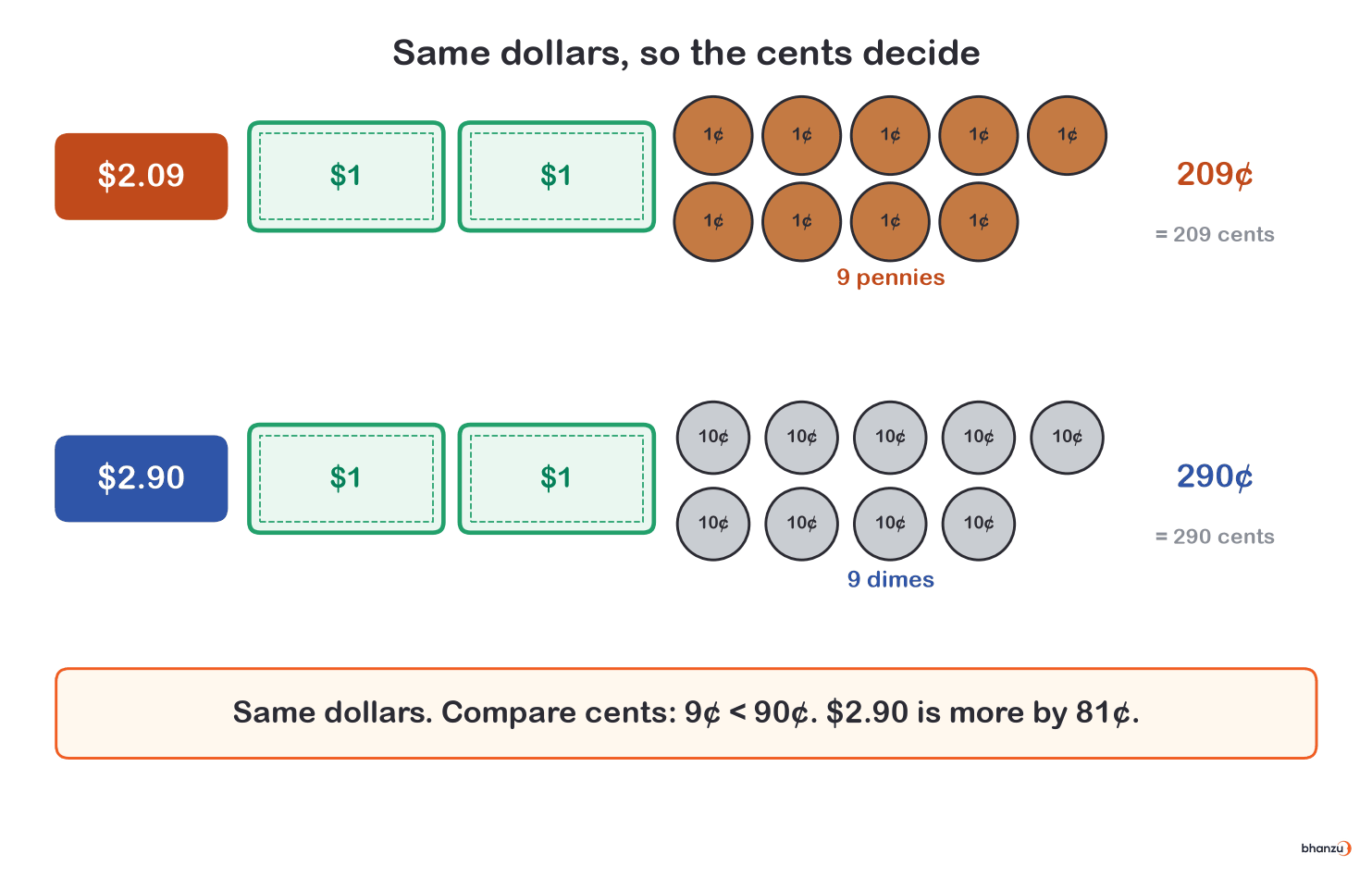
Both $2.09 and $2.90 have 2 dollars, so the cents decide. This pair is confusing at first glance, because the same digits, 2, 0 and 9, sit in both amounts. In cents, using for "is less than," it reads like this.
So $2.90 is more, by 81 cents. Coins alone follow the same rule, and 8 dimes (80 cents) are worth more than 3 quarters (75 cents). To find how much more, count up from the smaller amount to the larger.
Which way to find change is fastest?
Counting up is fastest with coins in your hand. On paper, subtracting in cents gives the same answer.
- Count up. Start at the price and add coins and bills until you reach the amount paid.
- Subtract in cents. Take the price away from the amount paid, the skill from subtracting within 1,000.
- Round up to the next dollar. It tells you what to pay, such as five $1 bills for $4.27, but not the change.
Counting up has one weak spot: you hold a running total in your head. Change from $10 for a 35-cent sticker takes nine pieces, so writing 1,000 minus 35 in cents is easier to track.
That is $9.65. For two items, add the prices first and trade every 100 cents for 1 dollar, so a 70-cent pen and a $1.45 notebook cost $2.15. Total first, then change, makes it one of the two-step word problems of 3rd grade.
| Words in the problem | Math it means |
|---|---|
| How much change? | Amount paid minus price, found by counting up |
| How much in all? Total? | Add the prices |
| Which is more? | Compare the dollars, then the cents |
| How much more? | Count up from the smaller amount to the larger |
Try It Yourself
Pick Make the amount or Make change, then tap or drag bills and coins onto the counter. In Make change, the counter starts at the price, counts up with each piece and warns you if you pass the amount paid. When you reach the amount paid, it shows your change and the fewest pieces that could make it.
Examples of making change
Example 1
At the book fair, Mei has one $1 bill, 2 quarters, 1 dime and 3 pennies. How much money does she have?
Count the bill first, $1.00, then the coins, $1.25, $1.50, $1.60, $1.61, $1.62 and $1.63.
Mei has $1.63, or 163 cents.
Example 2
A poster costs $2.35. Leo pays with a $5 bill. How much change should he get?
The tempting shortcut takes the smaller digit from the larger in each place (5 minus 2, 3 minus 0, 5 minus 0) and gets $3.35. Add that back to the price.
That is $5.70, more than the $5 Leo paid, so $3.35 cannot be right.
Count up instead. A nickel and a dime reach $2.40 and $2.50, two quarters reach $3.00, and two $1 bills reach $5.00. Leo should get $2.65.
Example 3
Which is more money, one $1 bill and 3 dimes or 5 quarters?
The $1 bill and 3 dimes make 130 cents. Five quarters count 25, 50, 75, 100 and 125 cents.
The $1 bill and 3 dimes are worth 5 cents more, even though 5 quarters is more coins.
Example 4
Noah pays for a 10-cent eraser with a $1 bill and gets his change in the fewest coins. Which coins does he get?
Counting up from 10 cents to $1.00 covers 90 cents. Biggest coins first, three quarters make 75 cents, a dime makes 85 and a nickel makes 90.
Noah gets 5 coins, 3 quarters, a dime and a nickel.
Example 5
A book costs $6.25. Maya pays with a $10 bill. How much change does she get, and in which coins and bills?
Count up. Three quarters reach $6.50, $6.75 and $7.00, then three $1 bills reach $8.00, $9.00 and $10.00. Maya gets $3.75, as 3 quarters and three $1 bills.
Example 6
Diego buys a bookmark for 85 cents and a poster for $2.35. He pays with a $5 bill. How much change does he get?
Add the prices in cents first.
From $3.20, a nickel reaches $3.25, three quarters reach $4.00 and a $1 bill reaches $5.00.
Diego gets $1.80, and 320 plus 180 makes the 500 cents he paid.
Why counting up works
Counting up works for one reason: change is a gap, and gaps add up. Crossing the gap from the price to the money paid, one coin at a time, gives the same answer as subtracting.
- It still happens at real counters. In the Federal Reserve's 2026 Diary of Consumer Payment Choice, a survey of 6,079 adults, 4 out of 5 paid with cash at least once in a 30-day stretch of 2025.
- It turns subtraction into adding. Counting up is a form of mental subtraction, and a 1988 study in the Journal for Research in Mathematics Education found it greatly improved 1st and 2nd graders' subtraction word problems.
- It skips the hardest regrouping. Subtracting 365 from 500 needs regrouping across two zeros, but counting up from $3.65 needs none.
- It lets you check a clerk. Count up from the price, and you should land exactly on what you paid.
Counting up turns a take-away problem into a how-far problem, and how far is something you can count one coin at a time.
Making change: spot the trap before you fall in
Mistake 1: Stopping at the first whole dollar
Where it slips in: Counting up to a $5 or $10 bill, as in Example 5. A round number like $8.00 feels like a finish line, so a child who rushes to the answer often stops there.
Don't do this: For a $7.40 book paid with a $10 bill, count a dime to $7.50 and two quarters to $8.00, then hand back 60 cents.
The correct way: Keep counting with $1 bills to $9.00 and $10.00, so the change is $2.60.
Mistake 2: Dropping the cents
Where it slips in: Finding change in your head from the dollars alone, because the dollars are the biggest number on the tag.
Don't do this: For a $4.30 snack paid with a $5 bill, think "5 minus 4 is 1" and hand back $1.
The correct way: Count up. Two dimes reach $4.50 and two quarters reach $5.00, so the change is 70 cents.
Mistake 3: Writing cents with one digit
Where it slips in: Writing an amount you hear. A child who hears "one dollar and five cents" often writes exactly the two numbers spoken, 1 and 5.
Don't do this: Write $1.5, which reads as one dollar and fifty cents.
The correct way: Write $1.05, because cents always fill two places after the dot.
What most guides miss about making change
Most guides assume every store has pennies, and that is changing now that the United States has stopped making new ones.
- Penny change still comes first. Treasury guidance from December 2025 says stores should keep giving penny change while pennies are around. Once penny change runs out, the guidance lets a store round cash totals to the closest 5 cents, while card payments keep every cent.
- The rule rounds to every 5 cents. A rounding rule from a state-legislatures report, quoted by the Treasury, rounds totals ending in 1, 2, 6 or 7 cents down and 3, 4, 8 or 9 cents up (states may differ). It works like rounding to the nearest 10 with landing spots every 5 cents.
- Change shifts with the total. A $3.67 cash total becomes $3.65, so change from $5 is $1.35, but $3.68 becomes $3.70 and the change is $1.30.
In 5th grade, you will round decimals with this same landing-spot idea.
Key Takeaways
- When making change, aim each coin at the next round stop, and the pieces you hand over are the answer.
- Read amounts dollars first, then cents, so $2.90 is more than $2.09 even with the same digits.
- Thinking in cents turns any change from $10 or less into subtraction within 1,000.
- For more practice counting all the way to the amount paid instead of quitting at a round dollar, explore Bhanzu's 3rd grade math curriculum or math programs for kids.
Read More
- Elapsed Time
- Measurement and Money Word Problems
- Counting Coins
- Comparing Decimals
- Mental Math for Kids
Research Behind This Article
- Common Core State Standards Initiative, Measurement and Data, Math Standards by Domain (2010). thecorestandards.org
- Common Core State Standards Initiative, Grade 3 Number and Operations in Base Ten (3.NBT) (2010). thecorestandards.org
- McNeil, Nicole M., Uttal, David H., Jarvin, Linda and Sternberg, Robert J., Should You Show Me the Money? Concrete Objects Both Hurt and Help Performance on Mathematics Problems (2009). eric.ed.gov
- Federal Reserve Financial Services, 2026 Findings from the Diary of Consumer Payment Choice (2026). frbservices.org
- Fuson, Karen C. and Willis, Gordon B., Subtracting by Counting Up: More Evidence (1988). eric.ed.gov
- U.S. Department of the Treasury, Penny Production Cessation FAQs (2025). home.treasury.gov
Quick Quiz: Check Yourself
Easy has you count bills and coins, and Medium has you compare two amounts or find the fewest coins. Hard has you make change from $5 or $10, sometimes after adding two prices, with new money each time.
Was this article helpful?
Your feedback helps us write better content
Frequently Asked Questions
What grade do kids learn to count money?
How can I help my child practice making change at home?
Is there a money chart for 3rd grade?
Do stores still accept pennies?
What does change mean in math?