Key Points
- The days of the week and months of the year form two loops of 7 days and 12 months. After Saturday comes Sunday, and after December comes January.
- Tomorrow is one step forward and yesterday is one step back. Two days after Sunday is Tuesday, because today never gets a number.
- Every date in one calendar column has the same day name, and the square right below a date is 7 days later.
A week that loops back to Sunday
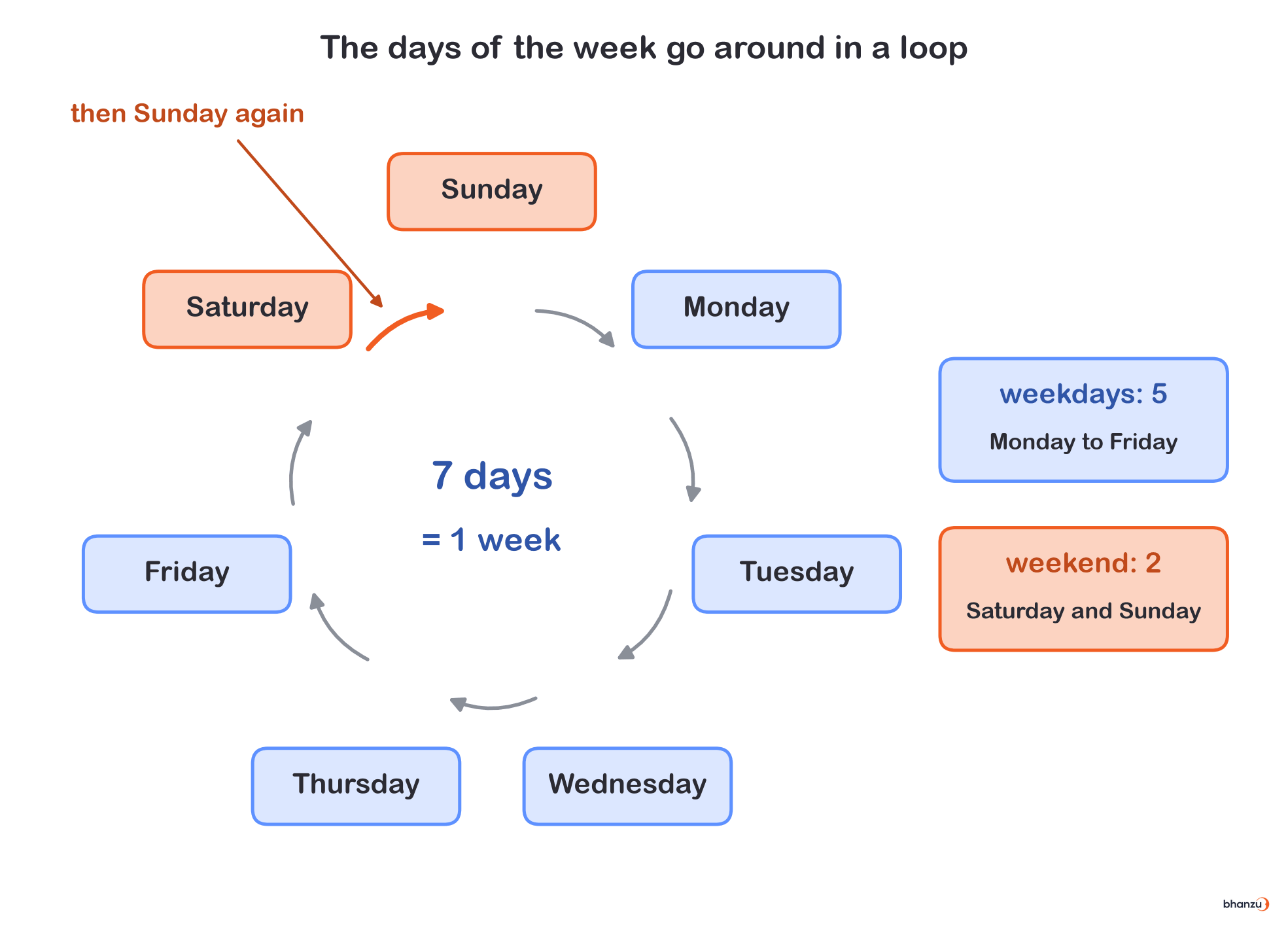
Saturday is the last square in a calendar row, but the days never stop there. Sunday comes right back, and a new week starts.
The 7 days go around like a circle, not a line, and the 12 months do the same. Next year, in 2nd grade, reading a calendar grows into counting the days until a birthday or a trip.
What are the days of the week and months of the year?
The days of the week and months of the year are two looping lists, 7 days in a week and 12 months in a year.
The days of the week in order are Sunday, Monday, Tuesday, Wednesday, Thursday, Friday and Saturday. Monday to Friday are weekdays, and Saturday and Sunday make the weekend. A date is the number of a day in its month, like March 10.
The months of the year in order are January, February, March, April, May, June, July, August, September, October, November and December.
| Unit | How long it is |
|---|---|
| 1 week | 7 days |
| 1 month | 28 to 31 days |
| 1 year | 12 months, or 365 days |
| 1 leap year, about every 4 years | 366 days |
Common Core has no calendar standard of its own in 1st grade. Its nearest one, 1.MD.B.3, covers telling time.
If your child still needs a running start to say all seven days, that's typical. In a 2025 study of 151 English-speaking children aged 3 to 7, 48% of 6-year-olds and 92% of 7-year-olds said the days in order on the first try.
How do yesterday, today and tomorrow work?
Tomorrow is one step forward from today in the list of days, and yesterday is one step back.
The days make a repeating pattern, so Sunday always comes right after Saturday. Yesterday and tomorrow are both one day from today in opposite directions, which is why the two words swap so easily.
| Words in the problem | Math it means |
|---|---|
| tomorrow | 1 day later |
| yesterday | 1 day earlier |
| in 3 days | 3 hops forward |
| one week later | same day name, date plus 7 |
To count days ahead:
- Put your finger on today.
- Hop to the next day and say 1.
- Keep hopping and counting until you reach the number.
- Read the day under your finger.
Each hop is counting on, and counting back finds a day a few days ago. In 3rd grade, the same hops will measure minutes on a clock.
A child who can sing all seven days may still restart from Sunday to find the day after Wednesday. The days were learned as one chant, so starting from today turns them into neighbors.
Which months go with each season?
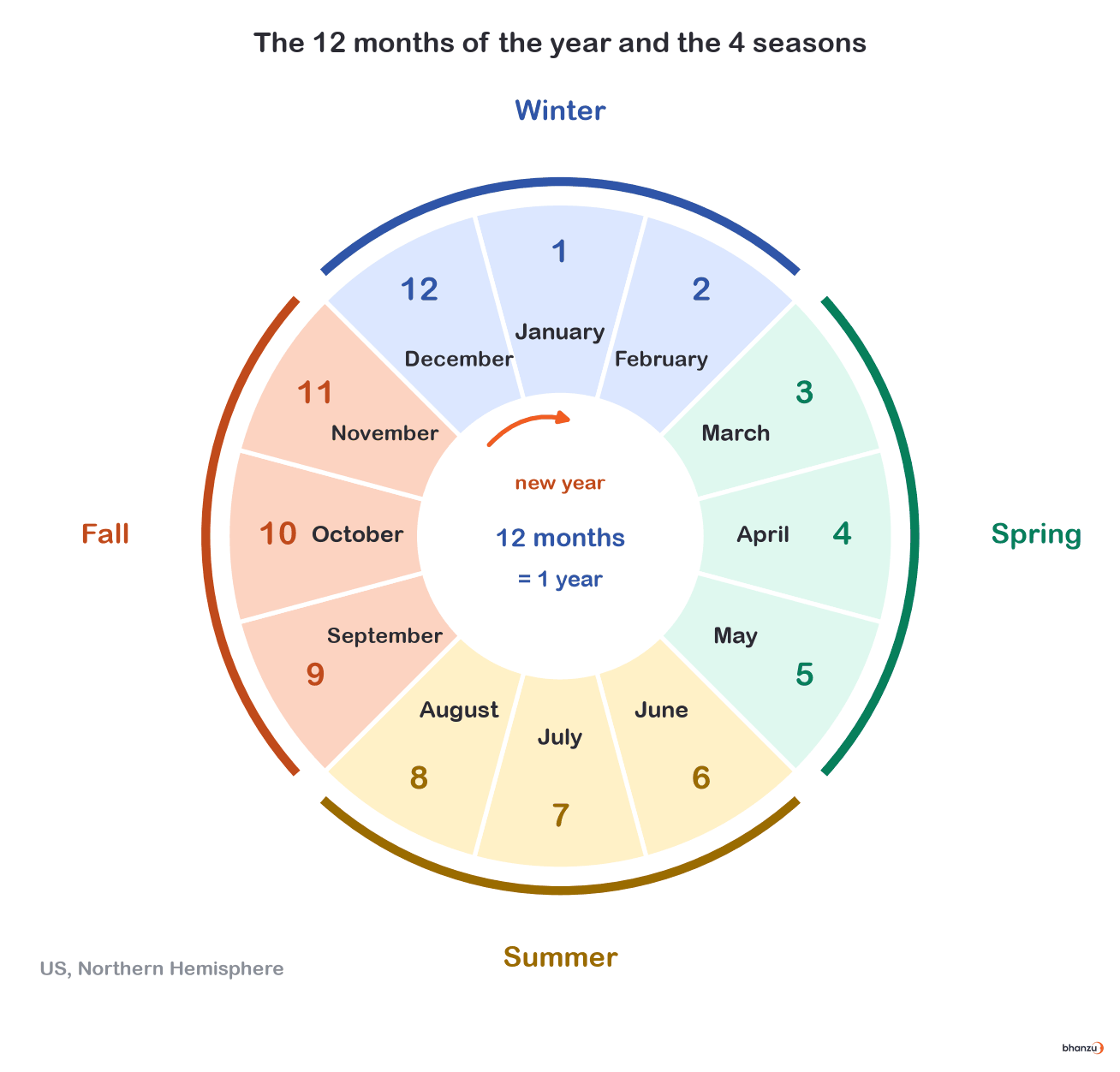
Each season gets 3 months in a row. In the US, winter takes December, January and February, so the 4 seasons in order from January are winter, spring, summer and fall.
These are the month groups weather scientists use, and some charts split the months differently.
| Season (US) | Months |
|---|---|
| Winter | December, January, February |
| Spring | March, April, May |
| Summer | June, July, August |
| Fall | September, October, November |
January is month 1 and December is month 12. After December, January starts a new year (and the season stays winter).
A month has 28, 29, 30 or 31 days, so check the last number on its calendar page.
How do you read a calendar?
To read a calendar, find the date's square, then look straight up its column to the day name.
A calendar page shows one month in rows of 7 days, and on this US calendar each row starts on Sunday. Dates are said with ordinal numbers, like "March tenth" for March 10.
- Read "March 2027" at the top.
- Find the square with 10.
- Look up its column to Wednesday.
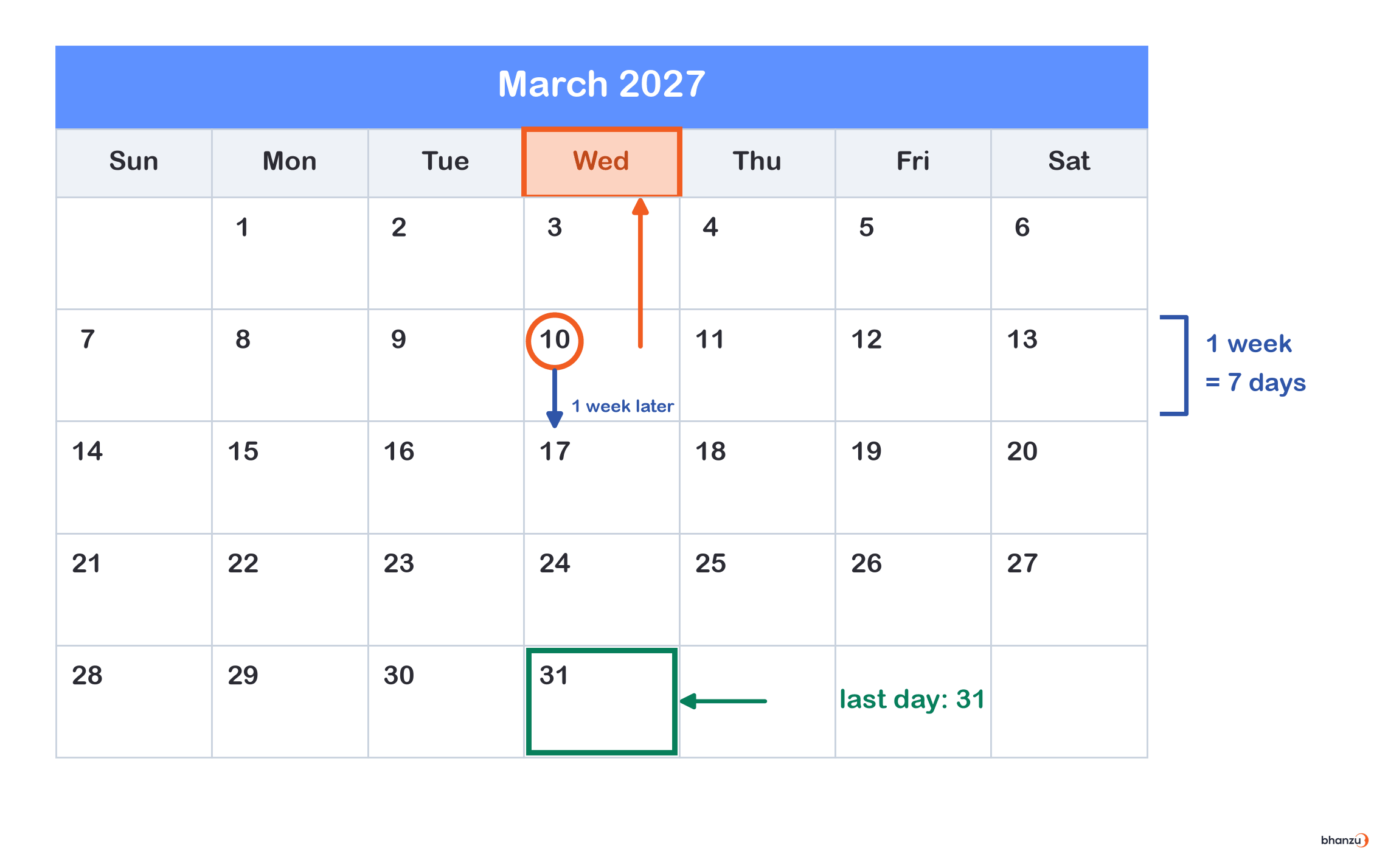
One square down is one week later, with the same day name and 7 more on the date.
So March 17 is a Wednesday too. The Sunday column reads 7, 14, 21 and 28, counting by 7s, which comes back in the 7 times table in 3rd grade.
Grids help with time words too. In that study, which also tested German speakers, 6-year-olds put time words like yesterday on the correct side of today 91% of the time on a calendar grid. On a plain line, it was 77%.
Try It Yourself
Tap any date on the March 2027 calendar to make it today, and the calendar labels yesterday and tomorrow. Use the arrow keys to move one day or one week. Watch which day name stays the same when you move down a row.
Examples of days of the week and months of the year
Example 1
What day comes right after Tuesday?
One step forward from Tuesday is Wednesday.
Example 2
Today is Sunday. What day will it be 2 days from now?
The tempting move is to count "Sunday, Monday" and answer Monday.
That can't be right. Monday is tomorrow, only 1 day away, and the count gave today a number.
Hop to Monday for 1 and Tuesday for 2, so the answer is Tuesday.
Example 3
Put October, March, July and January in order from the start of the year.
Their month numbers are 10, 3, 7 and 1.
From small to large, 1, 3, 7, 10 gives January, March, July, October.
Example 4
On the March 2027 calendar above, what day of the week is March 18?
Find 18 in the third row (14 to 20), then look straight up its column to Thursday.
March 11 sits right above it, and .
Example 5
Leo's birthday is July 9, and he lives in the US. Which season is that, and which comes next?
July is in summer, with June and August. The next group starts in September, so fall comes next.
Example 6
Today is Tuesday, March 2, 2027. Diego's seeds sprout one week later, and he measures them 3 days after that. On what day and date?
One week later keeps the day name and adds 7 to the date.
The seeds sprout on Tuesday, March 9. Then hop Wednesday for 1, Thursday for 2 and Friday for 3.
Diego measures on Friday, March 12.
Why did people invent calendars?
People made calendars so that "Friday, March 12" means the same day for everyone. The sky gave them the pieces.
- It follows the Moon. The Moon's cycle of shapes, from one dark new moon to the next, takes about 29.5 days, so a month is close to 30.
- It is very old. More than 4,000 years ago, people called the Babylonians used 12 months that took turns being 29 and 30 days long.
- It keeps summer in summer. Earth circles the Sun in about 365 days, one calendar year, so July is summer every year in the US.
Without a calendar, "see you next Friday" could mean a different day to each person.
Days of the week and months: common confusions cleared up
Mistake 1: Mixing up yesterday and tomorrow
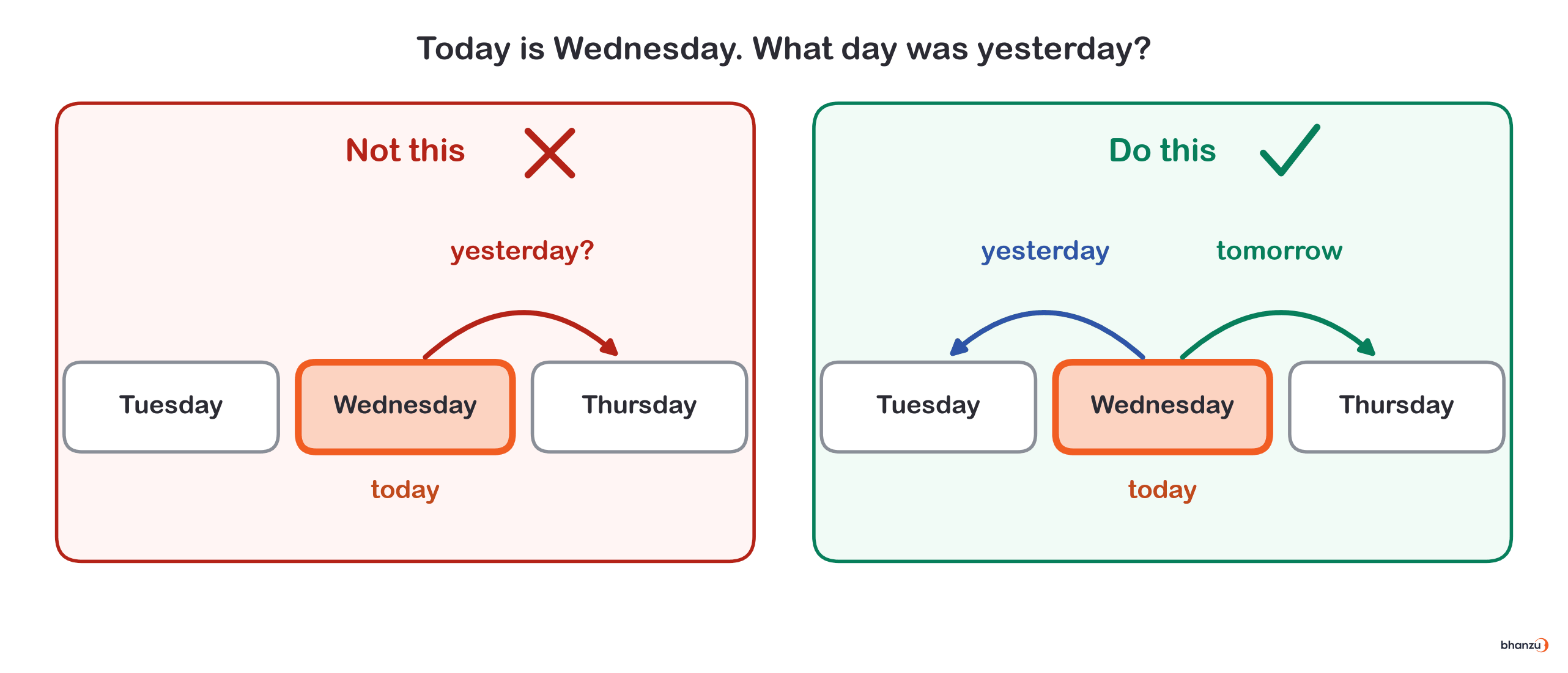
Where it slips in: A quick question from today, such as "Today is Wednesday. What day was yesterday?"
Don't do this: Answering Thursday.
The correct way: Yesterday is one step back, so it was Tuesday. Thursday is tomorrow.
Children learn which way each word points before they know it means exactly one day, which settles after age 7.
Mistake 2: Thinking every month ends on the 30th
Where it slips in: The last row of a calendar page.
Don't do this: Saying April 1 comes after March 30.
The correct way: March has 31 days, so March 31 comes next, then April 1.
Children hear "about 30 days" and stretch it to every month.
Mistake 3: Reading the row instead of the column
Where it slips in: Finding a date's day, as in Example 4.
Don't do this: For March 25, 2027, looking left to the row's first square (21) and saying Sunday.
The correct way: Look straight up from 25 to Thursday.
Children read left to right, so their eyes run to the row's first square, always a Sunday on this calendar. A child who rushes there names Sunday for every date in the row.
The part of the calendar nobody explains
Three calendar facts are less fixed than most charts make them look.
- Season dates depend on who counts them. Weather scientists start spring on March 1, but the Sun's spring starts on or around March 21.
- Seasons flip below the equator. In the Southern Hemisphere (Australia, for one), the seasons are reversed, so July is winter there.
- The week can start on Monday. Many calendars put Monday in the first column, so read the day names across the top first.
Key Takeaways
- Say the days of the week from today, then step forward for tomorrow or back for yesterday.
- When you count days ahead, say 1 on tomorrow, never on today.
- To name a date's day, look up its column instead of along its row.
- When the days of the week and months of the year run out, start again at Sunday or January.
- For calendar practice with a teacher who checks which way yesterday points, explore Bhanzu's 1st grade math curriculum or elementary math programs.
Read More
Research Behind This Article
- Common Core State Standards Initiative, Grade 1 Measurement and Data (2010). thecorestandards.org
- Steele, Bánki, Markova, Hoehl and Tillman, Today, Tomorrow, and Overmorrow: The Acquisition of Deictic Temporal Terms in English and German (2025). pmc.ncbi.nlm.nih.gov
- Frye and others, Institute of Education Sciences, Teaching Math to Young Children (2013). ies.ed.gov
- NOAA National Centers for Environmental Information, Meteorological Versus Astronomical Seasons (2023). ncei.noaa.gov
- NASA Science, Moon Phases (2026). science.nasa.gov
- National Institute of Standards and Technology, A Walk Through Time: Ancient Calendars (2026). nist.gov
Quick Quiz: Check Yourself
Three levels, new questions every time: put days and months in order, find yesterday, tomorrow, a later day or a season, then read a real calendar page.
Was this article helpful?
Your feedback helps us write better content
Frequently Asked Questions
How many days are in each month?
Why does February have 29 days every 4 years?
How many weeks are in a month?
Is it normal if my child has to start from Sunday to say what comes after Wednesday?
How do I teach my child the days of the week and months of the year?