Key Points
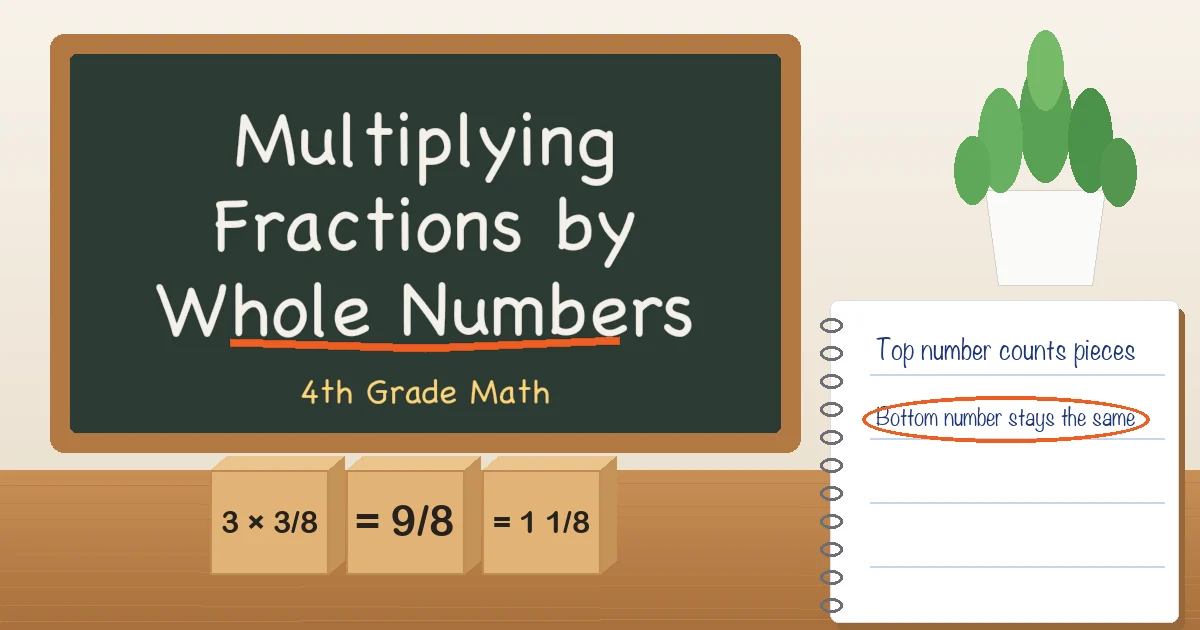
- Multiplying fractions word problems tie a fraction to an amount with the word "of", so three fourths of 24 seedlings means three fourths times 24, or 18 seedlings.
- A tape diagram cuts 45 minutes into 3 equal parts of 15, so two thirds of 45 minutes is 2 of those parts, or 30 minutes.
- When tomatoes fill three fourths of the planted four fifths of a garden bed, adding the two fractions gives more than one whole bed, while multiplying gives three fifths.
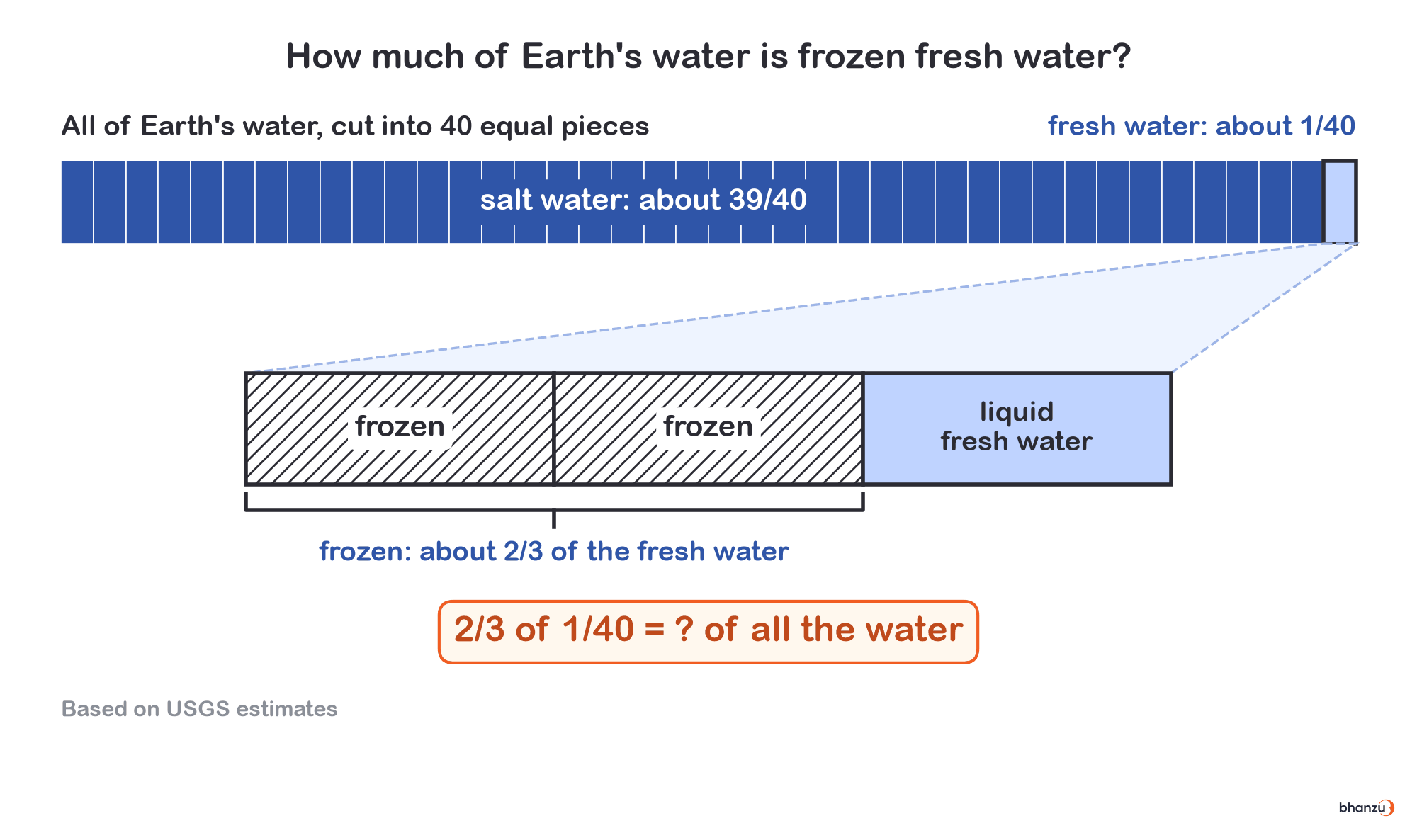
The frozen slice of Earth's water
Almost all of Earth's water is salty, and most of the rest is frozen. The US Geological Survey estimates that only about one fortieth of Earth's water is fresh. A bit more than two thirds of that fresh water is frozen in ice caps, glaciers and permanent snow.
So how much of all Earth's water is frozen fresh water? That question is a fraction of a fraction, and one multiplication answers it. In 6th grade, you'll write shares like these as percents, as the survey's table does.
How do you solve multiplying fractions word problems?
To solve multiplying fractions word problems, find the whole that each fraction is taken of, draw it, then write the story as that fraction times the amount.
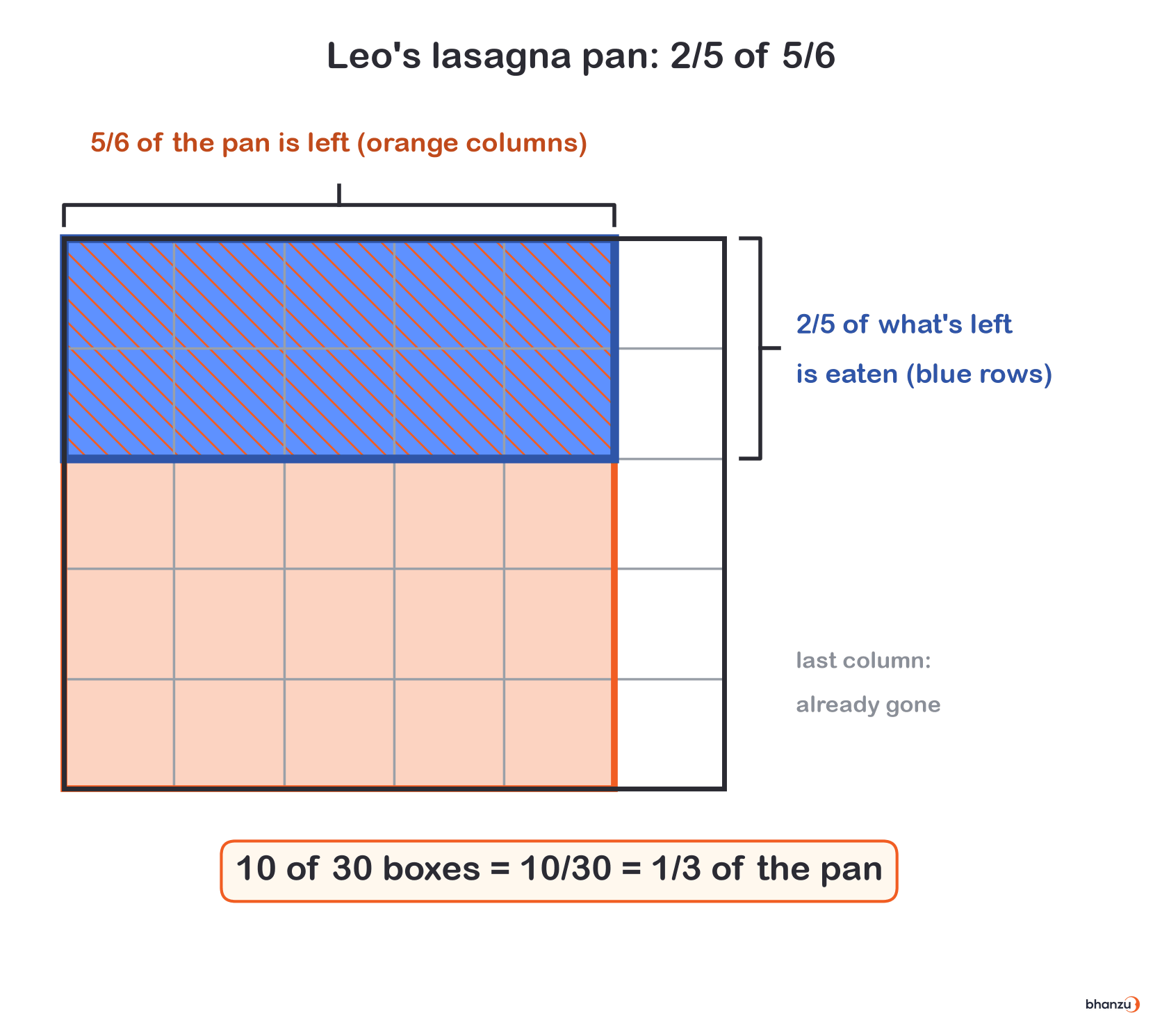
Leo's family has five sixths of a pan of lasagna left and eats two fifths of what's left. An area model, a rectangle cut into rows and columns, puts both fractions on one pan.
- Name the whole (the pan).
- Shade five sixths of it in columns, then two fifths of that part in rows.
- Write , since "of" means times.
- Multiply the numerators (top numbers) and the denominators (bottom numbers), then simplify.
- Check the size with multiplication as scaling. Since is less than 1, the answer is less than .
- Answer with the unit.
Leo's family eats one third of the pan. A child who expects multiplying to make things bigger sometimes erases that right answer, and step 5 says to keep it.
This is Common Core standard 5.NF.B.6, which asks 5th graders to solve real world problems that multiply fractions and mixed numbers. Your child met stories about multiplying fractions by whole numbers in 4th grade, so the new step this year is a fraction of a fraction, best seen in a drawing.
How can you tell a word problem needs multiplication?
A word problem needs multiplication when it takes a fraction of some amount, and the word "of" usually marks the spot. "Of" means times because 3 groups of 4 is , and three fourths of 24 works the same way. A child who multiplies the moment they see "of" often never asked what the fraction is of.
Two other kinds of stories multiply too. "Times as much" sounds like growing while "of" sounds like shrinking, which is genuinely confusing, yet both are one multiplication. So is the area of a bed, length times width, as in area of rectangles with fractional side lengths.
| Words in the problem | Math it means |
|---|---|
| three fourths of the 24 seedlings | |
| three fourths of the planted four fifths of the bed | |
| one and three fourths times as much as two thirds of a gallon | |
| three fourths of what is left after planting 12 of 36 seeds | , then |
| how many quarter-cup scoops of soil fill a 3-cup pot | , division |
Does "of" always mean multiply?
No. "How many quarter-cup scoops of soil fill a 3-cup pot?" has an "of", but it counts equal groups, so it needs division.
Drawing fraction multiplication word problems
Draw a tape diagram, one long bar cut into equal parts, for a fraction of a whole number. Draw an area model for a fraction of a fraction.
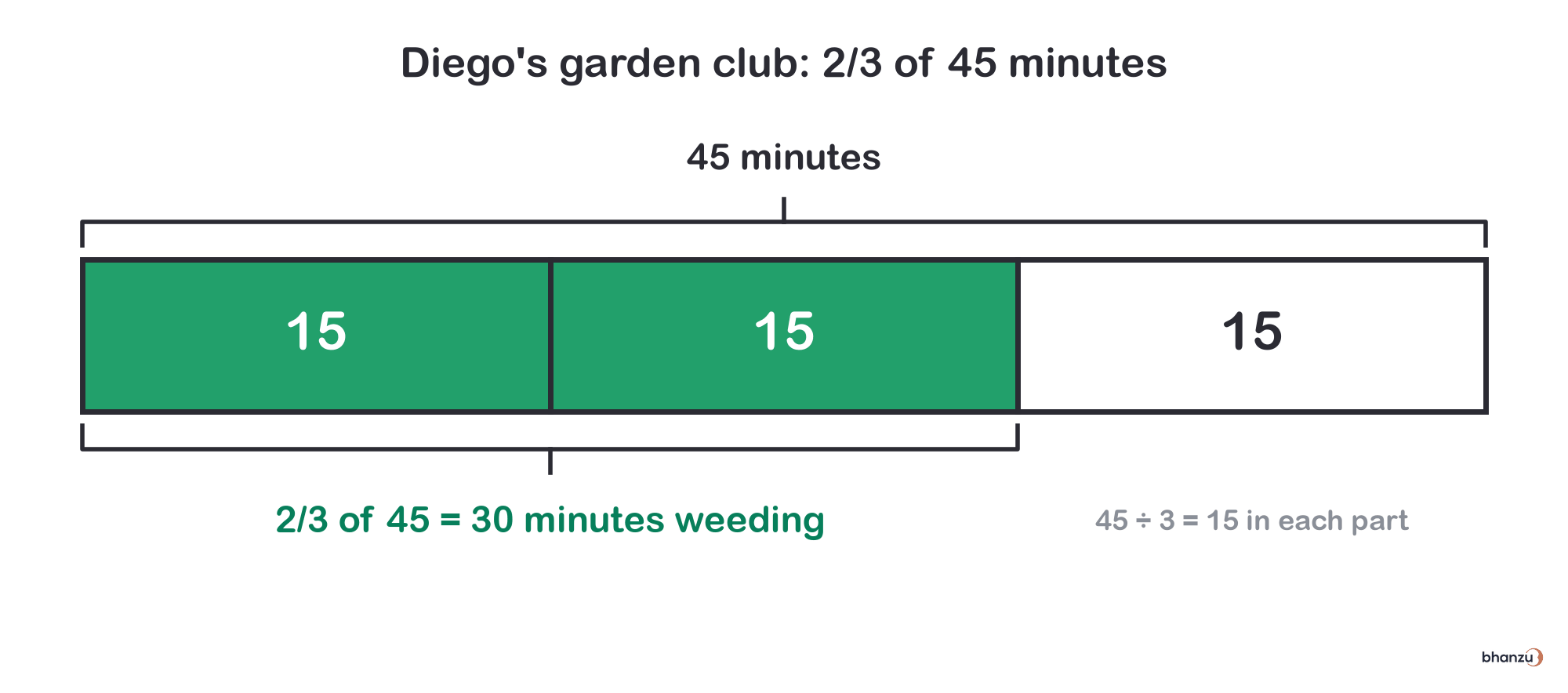
Diego's garden club meets for 45 minutes and spends two thirds of that time weeding. Cut the bar into 3 parts of 15 minutes and shade 2 of them, which is 30 minutes, the same answer as finding a fraction of a whole number by multiplying.
Why do you multiply the tops and the bottoms?
On Leo's grid, the bottoms multiply to the 30 boxes in the whole pan, and the tops multiply to the 10 boxes shaded twice. Children who can multiply on paper often draw each fraction on its own picture. Then they can't point to the answer, which only appears where two shadings overlap.
For multiplying mixed numbers word problems, split the mixed number (a whole number plus a fraction) into its parts. A seed tray takes of a bag holding cups of soil.
Multiplying each part and adding is the distributive property, so the tray takes 2 cups. Writing as the improper fraction , the route in multiplying mixed numbers, gives 2 as well.
Drawing gets slow as the bottom numbers grow (7 twelfths of 5 ninths needs 108 boxes), so switch to the rule in multiplying fractions. Unlike adding, multiplying never needs a common denominator.
A 2012 What Works Clearinghouse guide found strong evidence for teaching students to draw a problem before writing its equation. A review published in September 2025 pooled 52 studies with more than 6,900 elementary students who find word problems hard. Every mix of methods that worked paired objects and drawings with lessons on a problem's structure.
Try It Yourself
Pick Fraction of a number or Fraction of a fraction, then use the plus and minus buttons to cut and shade the model until it matches the story. Press Check my model to see the multiplication, or New story for fresh numbers.
What makes multiplying fractions word problems worth learning?
A fraction of a fraction describes a part of a part, and multiplying tells you how big that piece is compared with the whole.
- It finishes the water question. About of about is , or , so roughly 1 drop in 60 is frozen fresh water. The survey's table lists 1.74 in every 100, a bit more than one sixtieth, mostly because 68.7 percent tops two thirds.
- It shrinks a recipe. A half batch of granola with cup of oats needs cup.
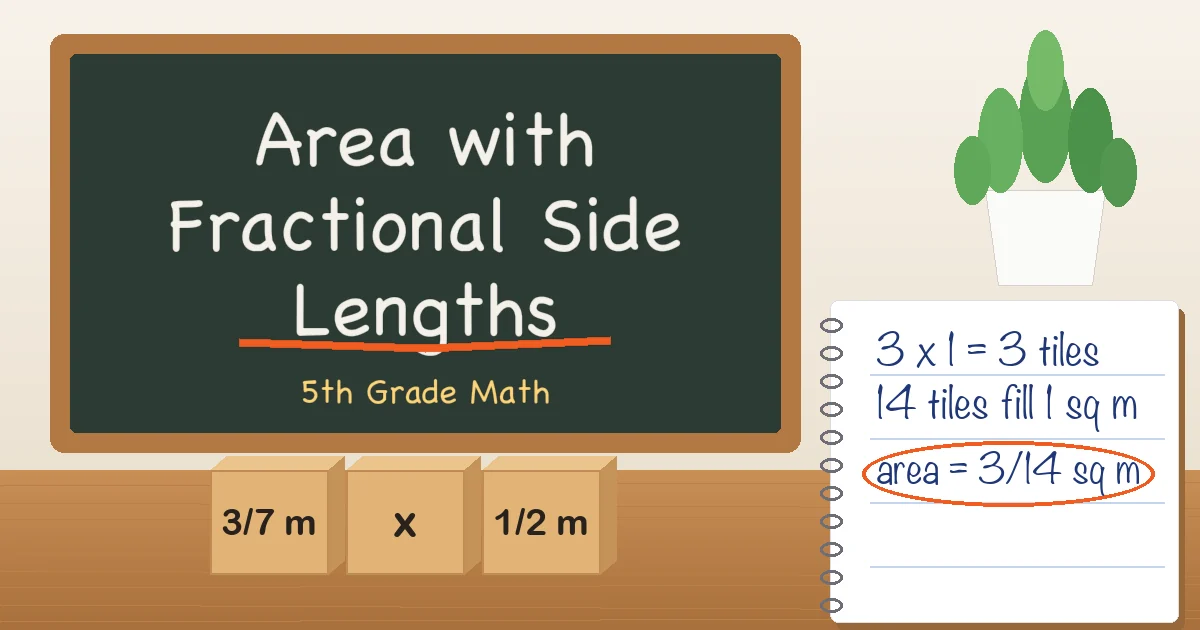
- It measures space. A bed yard wide and yard long covers square yard.
Each time, multiplying turns two fractions into one number you can act on, and 7th grade scale drawings run on the same move.
Examples of multiplying fractions word problems
Example 1
Diego's class grew 24 tomato seedlings and plants of them in the garden. How many seedlings go in the garden?
Cut 24 into 4 equal parts, then take 3 of them.
So 18 seedlings go in the garden.
Example 2
The class plants of a garden bed, and tomatoes fill of the planted part. What fraction of the whole bed is tomatoes?
The tempting move is adding.
That's more than one whole bed, which can't be right. The tomatoes fit inside the planted part, so they cover less than of the bed.
The tomatoes are of the , so multiply.
Tomatoes fill of the bed, which is 12 of the 20 boxes on an area model.
Example 3
The garden fence is yards long. Mei paints of it. How many yards does she paint?
Split into 4 and .
The improper fraction route agrees.
Mei paints yards.
Example 4
The class picks pounds of beans and gives of them to the school kitchen. Sam says multiplying makes the amount bigger. Is he right, and how much does the kitchen get?
Since is less than 1, the kitchen gets less than pounds, so Sam is not right.
The kitchen gets pounds.
Example 5
The bean bed gets gallon of water a day. The sunflower bed gets times as much. How much water does the sunflower bed get?
The sunflower bed gets gallons a day, more than the bean bed, since is more than 1.
Example 6
Aisha has a packet of 36 bean seeds. She plants of them in the first row and of the seeds that are left in the second row. How many seeds are still in the packet?
Six seeds are still in the packet.
What do teachers watch for in multiplying fractions word problems?
Teachers watch whether a child can say what each fraction is of before touching the numbers. In Leo's story, the two fifths is of what's left, and what's left is five sixths of the pan. Once that chain reaches one whole, multiplying is safe.
The chain can also break. If one fourth of a class of 24 has a dog and one third has a cat, both fractions are of the class. Multiplying them says nothing about who has both, since 6 dog owners and 8 cat owners could overlap in many ways.
Clue words fool readers the same way. In a study published in February 2026 of 112 3rd graders, most built correct equations when "more" meant adding, but fewer did when it didn't. The authors join earlier calls to stop teaching the keyword strategy.
Multiplying fractions word problems: where intuition breaks
Mistake 1: Multiplying a fraction that is already of the whole
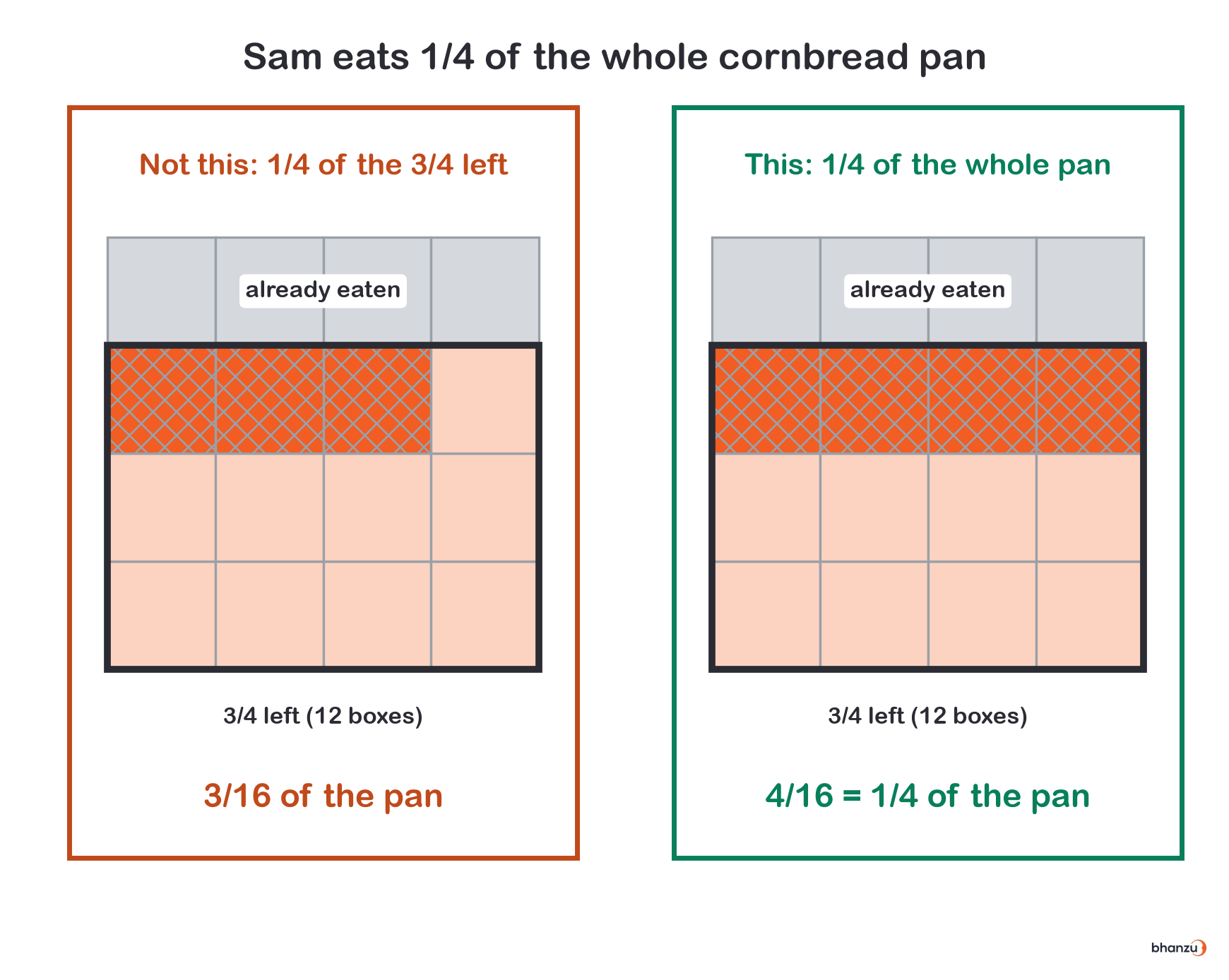
Where it slips in: Two-fraction stories, as when three fourths of a pan of cornbread is left and Sam eats one fourth of the whole pan. Children who just learned that "of" means times often multiply every pair of fractions they see.
Don't do this: of the pan.
The correct way: The one fourth is of the whole pan, so Sam eats , or , with no multiplying.
Mistake 2: Stopping at the fraction when the question asks how many
Where it slips in: Counting stories, such as how many of the 28 students in Noah's class water plants when three fourths have garden jobs and one third of those water. The fraction step feels like the hard part (and it often is), so a child who rushes stops there.
Don't do this: , then stop.
The correct way: Finish with students, because "how many" asks for a count.
Mistake 3: Multiplying when the story asks how many groups fit
Where it slips in: A unit fraction (1 on top) beside a whole number, as in how many quarter-cup scoops of soil fill a 3-cup pot. Multiplying looks natural, but the question counts groups.
Don't do this: scoop, which can't fill a 3-cup pot.
The correct way: Each cup holds 4 quarter-cup scoops, so 3 cups hold 12. That's , the kind of story in dividing unit fractions word problems, which come next in 5th grade.
Key Takeaways
- Ask "of what?" about every fraction in a story before you touch the numbers.
- Sketch before you calculate, with a bar for a fraction of a number and a grid for a fraction of a fraction.
- In multiplying fractions word problems about a part of a part, a sum bigger than the whole is the sign to multiply instead of add.
- For more practice turning "of" stories into multiplication with a teacher who catches the fraction-of-the-whole mistake, explore Bhanzu's 5th grade math tutor or elementary math tutor.
Read More
- Fraction Addition and Subtraction Word Problems
- Fractions as Division
- Dividing Fractions Word Problems
- Math Word Problems
- Fractions, Decimals and Percentages
Research Behind This Article
- US Geological Survey, Where is Earth's Water? (2018). usgs.gov
- NGA Center and CCSSO, Common Core State Standards: Grade 5, Number and Operations, Fractions (2010). thecorestandards.org
- Institute of Education Sciences, Improving Mathematical Problem Solving in Grades 4 Through 8 (2012). ies.ed.gov
- Peng Peng and others, Exploring the Effectiveness of Word-Problem Strategy and Strategy Combinations: A Systematic Review and Network Meta-Analysis (2025). eric.ed.gov
- Alison M. Hardy and others, How Keywords Impact Word-Problem Performance: When "More" Does Not Mean to Add (2026). eric.ed.gov
Quick Quiz: Check Yourself
Three levels, new numbers every time: find a fraction of a whole number, then a fraction of a fraction or a times-as-much amount, then a what-is-left or mixed-number story.
Was this article helpful?
Your feedback helps us write better content
Frequently Asked Questions
Is there a multiplying fractions word problems worksheet with answers?
What grade do kids learn to multiply fractions?
How do I explain multiplying fractions to my child?
Can you cross cancel in fraction of a fraction word problems?
What do word problems with multiplying fractions look like in 6th grade?